

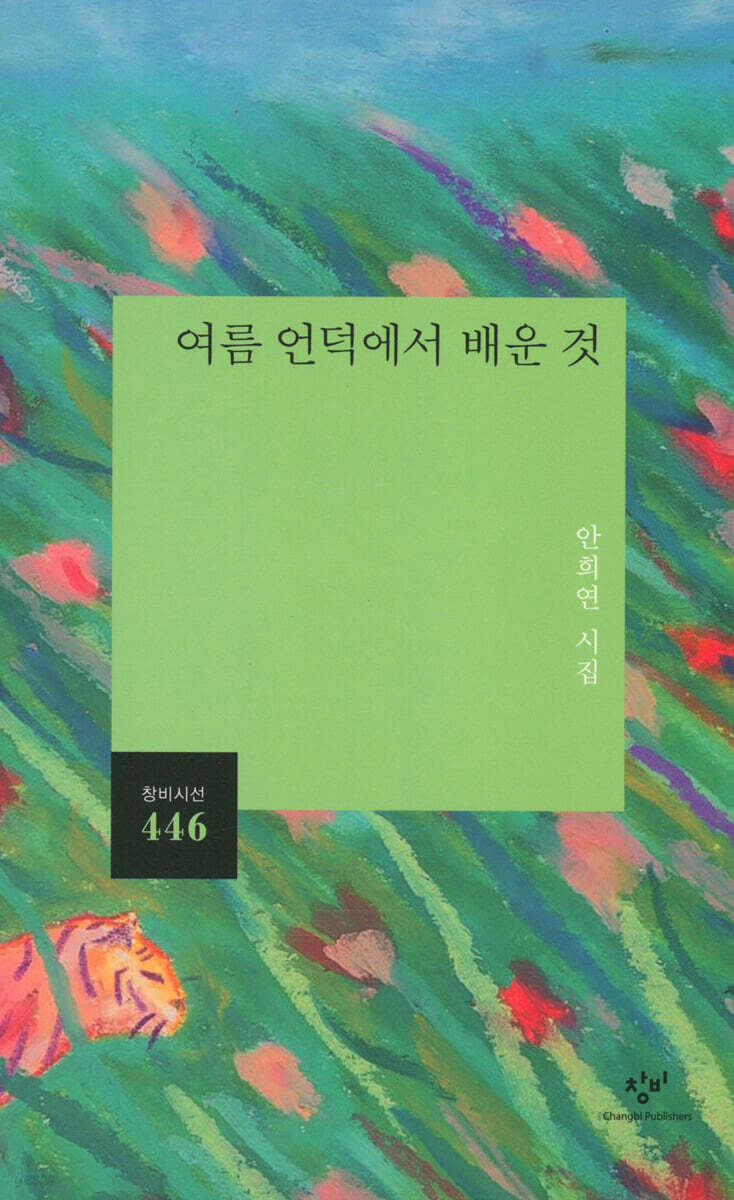
What I Learned from Summer Hill
 |
Description
Book Introduction
- A word from MD
-
At the end of the sorrow we face, hope is born.Poet Ahn Hee-yeon's third poetry collection.
As we stand on the road, sweat pouring down our faces and our breathing becoming rough, reading his poetry makes us believe that a welcome breeze is waiting for us behind us.
This book will be a friend willing to hold your hand on the arduous climb up the hill, a shade that will provide a rest for your heavy steps.
August 14, 2020. Novel/Poetry PD Park Hyung-wook
A new poetry collection by Shin Dong-yup Literary Award winner poet Ahn Hee-yeon
A warm hand that soothes the wounds of those who are alive and crying
Poet Ahn Hee-yeon, who has been actively producing since her debut with the Changbi New Poet Award in 2012, has published her third poetry collection, “What I Learned from Summer Hill,” through Changbi Poetry Selection.
The poet won the Shin Dong-yup Literary Award for his first poetry collection, “When Your Sorrow Intervenes” (Changbi, 2015), published three years after his debut. He also came in first place in the poetry category of the “Young Writers Who Will Be the Future of Korean Literature” poll conducted by Yes24 in 2018, and is currently attracting the most attention in the young poetry world.
In addition to his creative activities, he is also a popular poet who actively participates in social activities such as the '304 Reading' dedicated to the victims of the Sewol Ferry Disaster.
In this collection of poems, which follows the second collection of poems, 『Inside the Things Called Night』 (Hyundae Munhak, 2019), the poet presents a colorful world of lyricism and emotion that stands out with deeper poetic thought and delicate linguistic sense.
The passionate and earnest poems, “like fables of enlightenment” (Lee Je-ni, recommendation), which look at the bottom of life and consider all the sorrows of the world, evoke empathy and deeply touch the heart.
57 poems, including the winner of the '2020 Poem of the Day', 'Spare', are included in three parts.
A warm hand that soothes the wounds of those who are alive and crying
Poet Ahn Hee-yeon, who has been actively producing since her debut with the Changbi New Poet Award in 2012, has published her third poetry collection, “What I Learned from Summer Hill,” through Changbi Poetry Selection.
The poet won the Shin Dong-yup Literary Award for his first poetry collection, “When Your Sorrow Intervenes” (Changbi, 2015), published three years after his debut. He also came in first place in the poetry category of the “Young Writers Who Will Be the Future of Korean Literature” poll conducted by Yes24 in 2018, and is currently attracting the most attention in the young poetry world.
In addition to his creative activities, he is also a popular poet who actively participates in social activities such as the '304 Reading' dedicated to the victims of the Sewol Ferry Disaster.
In this collection of poems, which follows the second collection of poems, 『Inside the Things Called Night』 (Hyundae Munhak, 2019), the poet presents a colorful world of lyricism and emotion that stands out with deeper poetic thought and delicate linguistic sense.
The passionate and earnest poems, “like fables of enlightenment” (Lee Je-ni, recommendation), which look at the bottom of life and consider all the sorrows of the world, evoke empathy and deeply touch the heart.
57 poems, including the winner of the '2020 Poem of the Day', 'Spare', are included in three parts.
- You can preview some of the book's contents.
Preview
index
Part 1
There was a fire
disturbance
Chimney Mood
Uplifted
When I was a child of the moon
Ghost of the Perfect Wall
In the afternoon
cur
nap
tremor
Pick-up
involvement
Alameda
Forms of love
mystery drama
Part 2
Giant
What I Learned from Summer Hill
Mountain of Light
The world of backlight
When I was a child of the moon
When I was a child of the moon
No one lied
spark
target
Manager
Harmony
On a stormy night
Sometimes the Garden
Eft
I will never be able to sing anything else like this in my life.
city
Without a soul
The Balloon Seller's Song
The Fishmonger's Song
When I was a child of the moon
Reality
The morning passed by without stopping here.
Part 3
Companion bird
His little dog is so small
overpaint
A parrot speaks parrot language
meter reader
Sheep raising
Catchball
eye of the typhoon
survey
contemplation
spare
share
To Walnut
Meet at Alhon
My scale
My Struggle
rolling stone
Stollen
top
cracked fruit
Commentary | Yang Gyeong-eon
Poet's words
There was a fire
disturbance
Chimney Mood
Uplifted
When I was a child of the moon
Ghost of the Perfect Wall
In the afternoon
cur
nap
tremor
Pick-up
involvement
Alameda
Forms of love
mystery drama
Part 2
Giant
What I Learned from Summer Hill
Mountain of Light
The world of backlight
When I was a child of the moon
When I was a child of the moon
No one lied
spark
target
Manager
Harmony
On a stormy night
Sometimes the Garden
Eft
I will never be able to sing anything else like this in my life.
city
Without a soul
The Balloon Seller's Song
The Fishmonger's Song
When I was a child of the moon
Reality
The morning passed by without stopping here.
Part 3
Companion bird
His little dog is so small
overpaint
A parrot speaks parrot language
meter reader
Sheep raising
Catchball
eye of the typhoon
survey
contemplation
spare
share
To Walnut
Meet at Alhon
My scale
My Struggle
rolling stone
Stollen
top
cracked fruit
Commentary | Yang Gyeong-eon
Poet's words
Into the book
Imagine holding your child's hand and walking up a hill.
They say that when you climb a hill in summer, a cool breeze blows and your hair flutters.
There is not a single blade of grass or tree on this hill to lean our hearts on, but we can still be shaken.
As many words come and go, the world seems to have not changed at all and it seems as if eons of time have passed.
Even though I didn't cry, I felt like I had cried enough when I came down the hill.
I hope this collection of poems becomes that kind of hill for you too.
I will never be able to sing anything else like this in my life, and now I don't feel sad about it at all.
--- From "The Poet's Words"
Angel, soul, sincerity, secret… …
I pile up words I no longer believe in
I think, how to get out of this maze
(…)
I decided not to trust where the arrows were pointing anymore.
The labyrinth is a time open only to those who know how to wander.
The thing that keeps me on guard in moments when I think I know everything
A sheep that turns into a wolf day by day
Considering it a sign of bad luck
Too easy
--- From "Mystery Drama"
I walked to completely lose myself
If you write it as a hill and believe it,
An unexpected hill unfolded
I was walking up the hill that day too
(…)
I am among countless hills
I thought about why it had to be here.
Just the fact that you're going makes some time go by in half.
When you unfold it, it becomes a different landscape
--- From "What I Learned on Summer Hill"
I made a book out of discarded pages.
there
When you think that one person might be alive
I can't give up even one page
Every night I opened the bookshelf and went to the abandoned planet.
I have two times
At first, I only planned to sneak a peek.
One death per page
You are a really sad person
With the heart to climb the hill together
--- From "The World of Backlight"
I absentmindedly blurted out the sentence, "Ice is born to melt."
Born to melt
How could you say such a thing?
In front of melting ice
He said it was creepy, over and over again
Beeswax candles born to harden
Even about the silver foil that was born to be crumpled
No soul is born for that purpose.
I was trampled to death with that thought in mind
Sometimes a white rat pops out
--- From "Target"
New flesh does not grow in the cut area.
The potatoes remain in their original shape.
(…)
Cut me out and leave me alone
Living for today
Me still sitting inside me waiting for my turn
I am the rest of the rest
--- From "Spare"
From loving the dirty floor
Summer can be rewritten
Yeah, it's okay if it gets worse
My Orchard
Let's call the unit for counting sadness a gru
There are so many trees in front of me that I can almost count them to eternity.
They say that when you climb a hill in summer, a cool breeze blows and your hair flutters.
There is not a single blade of grass or tree on this hill to lean our hearts on, but we can still be shaken.
As many words come and go, the world seems to have not changed at all and it seems as if eons of time have passed.
Even though I didn't cry, I felt like I had cried enough when I came down the hill.
I hope this collection of poems becomes that kind of hill for you too.
I will never be able to sing anything else like this in my life, and now I don't feel sad about it at all.
--- From "The Poet's Words"
Angel, soul, sincerity, secret… …
I pile up words I no longer believe in
I think, how to get out of this maze
(…)
I decided not to trust where the arrows were pointing anymore.
The labyrinth is a time open only to those who know how to wander.
The thing that keeps me on guard in moments when I think I know everything
A sheep that turns into a wolf day by day
Considering it a sign of bad luck
Too easy
--- From "Mystery Drama"
I walked to completely lose myself
If you write it as a hill and believe it,
An unexpected hill unfolded
I was walking up the hill that day too
(…)
I am among countless hills
I thought about why it had to be here.
Just the fact that you're going makes some time go by in half.
When you unfold it, it becomes a different landscape
--- From "What I Learned on Summer Hill"
I made a book out of discarded pages.
there
When you think that one person might be alive
I can't give up even one page
Every night I opened the bookshelf and went to the abandoned planet.
I have two times
At first, I only planned to sneak a peek.
One death per page
You are a really sad person
With the heart to climb the hill together
--- From "The World of Backlight"
I absentmindedly blurted out the sentence, "Ice is born to melt."
Born to melt
How could you say such a thing?
In front of melting ice
He said it was creepy, over and over again
Beeswax candles born to harden
Even about the silver foil that was born to be crumpled
No soul is born for that purpose.
I was trampled to death with that thought in mind
Sometimes a white rat pops out
--- From "Target"
New flesh does not grow in the cut area.
The potatoes remain in their original shape.
(…)
Cut me out and leave me alone
Living for today
Me still sitting inside me waiting for my turn
I am the rest of the rest
--- From "Spare"
From loving the dirty floor
Summer can be rewritten
Yeah, it's okay if it gets worse
My Orchard
Let's call the unit for counting sadness a gru
There are so many trees in front of me that I can almost count them to eternity.
--- From "Rupture"
Publisher's Review
An Hee-yeon's poetry is born from a place of sadness where "tears like iron beads" ("Involvement") rise.
“A life with so many puddles” (“What I Learned from Summer Hill”).
The poet writes poetry with the intention of atonement for all the sins of the world.
Looking back, everyone embraces the sorrow of the poor beings, cries on their behalf, and tells the stories they have “earned by bumping into things with their whole body” (“Rolling Stone”) through their own voices.
In a world of darkness where “the whole universe is trying to ruin my happiness” (Meditation), being alive itself can be suffering.
But “all creation exists to endure,” so “whatever it is or isn’t,” “there is no other way but to keep going” (“The Rolling Stone”).
Thus, the poet begins again “from loving the soiled floor” (“Ripped Fruit”), and tries to live a life in the “here and now” by loving “me as the rest of the rest” (“Spare”) left behind after failure and despair.
The poet says that “while so many words have risen and fallen over the years, the world seems to have not changed at all” (the poet’s words).
However, knowing that “the labyrinth is a time that opens only to the mind that knows how to wander” (“Detective”), he does not give up the belief that there is a “stairway to another world” (“Spare”) beyond it.
So, to “view our souls that are too big to be buried in despair and sorrow,” we decide to “go further and further back” (“Giant”).
The poet laments, “I will never be able to sing anything but songs like this in my life,” but he does not feel sad at all.
You're sad.
Even if it is a story that “will disappear like a bubble” (“I will only be able to sing songs like this for the rest of my life”), the song of a poet who endures life with a heart that “pretends to live as best as possible” (“Uplifted”) while willingly embracing the greater despair that comes after despair, may rather be the “quiet fierceness” (Yang Kyung-eon, commentary) and hope of life.
A Brief Interview with Poet Ahn Hee-yeon
- Including the poetry collection that was released as part of the 'Pin Series', this is your third poetry collection.
I'd like to hear your thoughts on the publication.
I don't think publishing a poetry collection is something you get used to just by repeating it over and over again.
I'm still shaking, anxious, and dizzy.
I remember crying a lot when I was putting together my first poetry collection, and I thought I would never cry like that again.
But as soon as I wrote the last sentence of 'The Poet's Note', tears started to flow out, and I was very surprised.
I don't know in what direction, at what speed, at what temperature, or with what kind of people this poetry collection, which has just begun to walk, will meet.
I can only thank everyone who reads this.
- 〔Literature 3〕 I understand that you are usually very busy as a planning committee member and a member of the 304 Reading Club.
I'm curious about your daily life, where you write poetry while also maintaining your external activities.
Due to COVID-19, external activities have been greatly reduced since this spring.
I usually spend my day eating a hearty meal at home or taking a walk around the neighborhood.
Writing poetry is a solitary task that requires considerable isolation, so there are many times when I feel lonely.
At times like that, I think I actively look for things that I can enjoy and participate in them.
I try to strike a good balance between the inside and the outside, but I always find it difficult to maintain that balance.
- The sentence from ‘The Poet’s Words’ that was impressive was “I will never be able to sing anything but songs like this in my life, and now I am not sad about it at all.”
In this regard, what were the most important aspects or characteristics you considered while compiling this poetry collection?
As the title of the poetry collection suggests, I wanted to invite readers to ‘Summer Hill.’
The last poem in my first collection of poems is “The Guitar is a Gun, Songs are Bullets,” and there is a line like this:
“If you say it’s a cliff, it’s trapped/If you say it’s a hill, it’s flowing.”
It was important to me that it was a flowing hill rather than an isolated cliff.
If the foundation of our lives is that every moment of each repetitive day is on the edge of a cliff, then it's just too hard.
When you're haunted by memories of death, when you think the world couldn't get any worse, when meaninglessness, boredom, and sadness rage against you like their own home, think to yourself, "I'm not standing on a cliff; I'm climbing a hill."
Climbing a hill in the summer might leave you breathless, sweat dripping down your forehead, and you'll be battling the heat, thirst, and all sorts of other negative emotions, but once you're on the hill, a cool breeze will blow and your hair will fly.
When you look out at the world from the top of a hill, the heaviness of things can become a little lighter, and it can be time to gather your strength and go down the hill again.
I sincerely hope that this poetry collection will be a good companion to you on your journey up the hill.
I hope that after closing the book, something will definitely change.
Even if it is a very small, invisible, and unlikely change.
- If there is a piece in this collection that you are particularly attached to, please introduce it and tell us why.
I would like to pick out the poem “Heat” included at the very end of the poetry collection.
Perhaps this collection of poems was a journey to reach the first line of “Yeolgwa,” “Now I can talk about summer.”
Within the collection of poems, there is a man who walks the hill with a seething heart, who cannot forgive anything, who feels infinitely empty, but by the time I reached the last page of the collection, I hoped he would have felt a little lighter.
I hope that the readers who read this will also feel lighter.
- I am curious about your future plans and life direction.
Anything more than a pledge to continue to be in the position of a writer would seem superfluous.
A hand that can give cool water to those who are struggling to climb a hill.
The wind that shakes my hair.
I will try to write poems like Chair or Tree Shade.
I would like to express my deepest gratitude in advance to those who have come to see my in-laws.
“A life with so many puddles” (“What I Learned from Summer Hill”).
The poet writes poetry with the intention of atonement for all the sins of the world.
Looking back, everyone embraces the sorrow of the poor beings, cries on their behalf, and tells the stories they have “earned by bumping into things with their whole body” (“Rolling Stone”) through their own voices.
In a world of darkness where “the whole universe is trying to ruin my happiness” (Meditation), being alive itself can be suffering.
But “all creation exists to endure,” so “whatever it is or isn’t,” “there is no other way but to keep going” (“The Rolling Stone”).
Thus, the poet begins again “from loving the soiled floor” (“Ripped Fruit”), and tries to live a life in the “here and now” by loving “me as the rest of the rest” (“Spare”) left behind after failure and despair.
The poet says that “while so many words have risen and fallen over the years, the world seems to have not changed at all” (the poet’s words).
However, knowing that “the labyrinth is a time that opens only to the mind that knows how to wander” (“Detective”), he does not give up the belief that there is a “stairway to another world” (“Spare”) beyond it.
So, to “view our souls that are too big to be buried in despair and sorrow,” we decide to “go further and further back” (“Giant”).
The poet laments, “I will never be able to sing anything but songs like this in my life,” but he does not feel sad at all.
You're sad.
Even if it is a story that “will disappear like a bubble” (“I will only be able to sing songs like this for the rest of my life”), the song of a poet who endures life with a heart that “pretends to live as best as possible” (“Uplifted”) while willingly embracing the greater despair that comes after despair, may rather be the “quiet fierceness” (Yang Kyung-eon, commentary) and hope of life.
A Brief Interview with Poet Ahn Hee-yeon
- Including the poetry collection that was released as part of the 'Pin Series', this is your third poetry collection.
I'd like to hear your thoughts on the publication.
I don't think publishing a poetry collection is something you get used to just by repeating it over and over again.
I'm still shaking, anxious, and dizzy.
I remember crying a lot when I was putting together my first poetry collection, and I thought I would never cry like that again.
But as soon as I wrote the last sentence of 'The Poet's Note', tears started to flow out, and I was very surprised.
I don't know in what direction, at what speed, at what temperature, or with what kind of people this poetry collection, which has just begun to walk, will meet.
I can only thank everyone who reads this.
- 〔Literature 3〕 I understand that you are usually very busy as a planning committee member and a member of the 304 Reading Club.
I'm curious about your daily life, where you write poetry while also maintaining your external activities.
Due to COVID-19, external activities have been greatly reduced since this spring.
I usually spend my day eating a hearty meal at home or taking a walk around the neighborhood.
Writing poetry is a solitary task that requires considerable isolation, so there are many times when I feel lonely.
At times like that, I think I actively look for things that I can enjoy and participate in them.
I try to strike a good balance between the inside and the outside, but I always find it difficult to maintain that balance.
- The sentence from ‘The Poet’s Words’ that was impressive was “I will never be able to sing anything but songs like this in my life, and now I am not sad about it at all.”
In this regard, what were the most important aspects or characteristics you considered while compiling this poetry collection?
As the title of the poetry collection suggests, I wanted to invite readers to ‘Summer Hill.’
The last poem in my first collection of poems is “The Guitar is a Gun, Songs are Bullets,” and there is a line like this:
“If you say it’s a cliff, it’s trapped/If you say it’s a hill, it’s flowing.”
It was important to me that it was a flowing hill rather than an isolated cliff.
If the foundation of our lives is that every moment of each repetitive day is on the edge of a cliff, then it's just too hard.
When you're haunted by memories of death, when you think the world couldn't get any worse, when meaninglessness, boredom, and sadness rage against you like their own home, think to yourself, "I'm not standing on a cliff; I'm climbing a hill."
Climbing a hill in the summer might leave you breathless, sweat dripping down your forehead, and you'll be battling the heat, thirst, and all sorts of other negative emotions, but once you're on the hill, a cool breeze will blow and your hair will fly.
When you look out at the world from the top of a hill, the heaviness of things can become a little lighter, and it can be time to gather your strength and go down the hill again.
I sincerely hope that this poetry collection will be a good companion to you on your journey up the hill.
I hope that after closing the book, something will definitely change.
Even if it is a very small, invisible, and unlikely change.
- If there is a piece in this collection that you are particularly attached to, please introduce it and tell us why.
I would like to pick out the poem “Heat” included at the very end of the poetry collection.
Perhaps this collection of poems was a journey to reach the first line of “Yeolgwa,” “Now I can talk about summer.”
Within the collection of poems, there is a man who walks the hill with a seething heart, who cannot forgive anything, who feels infinitely empty, but by the time I reached the last page of the collection, I hoped he would have felt a little lighter.
I hope that the readers who read this will also feel lighter.
- I am curious about your future plans and life direction.
Anything more than a pledge to continue to be in the position of a writer would seem superfluous.
A hand that can give cool water to those who are struggling to climb a hill.
The wind that shakes my hair.
I will try to write poems like Chair or Tree Shade.
I would like to express my deepest gratitude in advance to those who have come to see my in-laws.
GOODS SPECIFICS
- Date of publication: July 24, 2020
- Page count, weight, size: 152 pages | 184g | 124*200*8mm
- ISBN13: 9788936424466
- ISBN10: 8936424467
You may also like
카테고리
korean


korean

![GQ KOREA Mark (Monthly): December [2025]](http://librairie.coreenne.fr/cdn/shop/files/8ef265dbbfbf186523ed75ba7319009d.jpg?v=1765340328&width=3840)


