

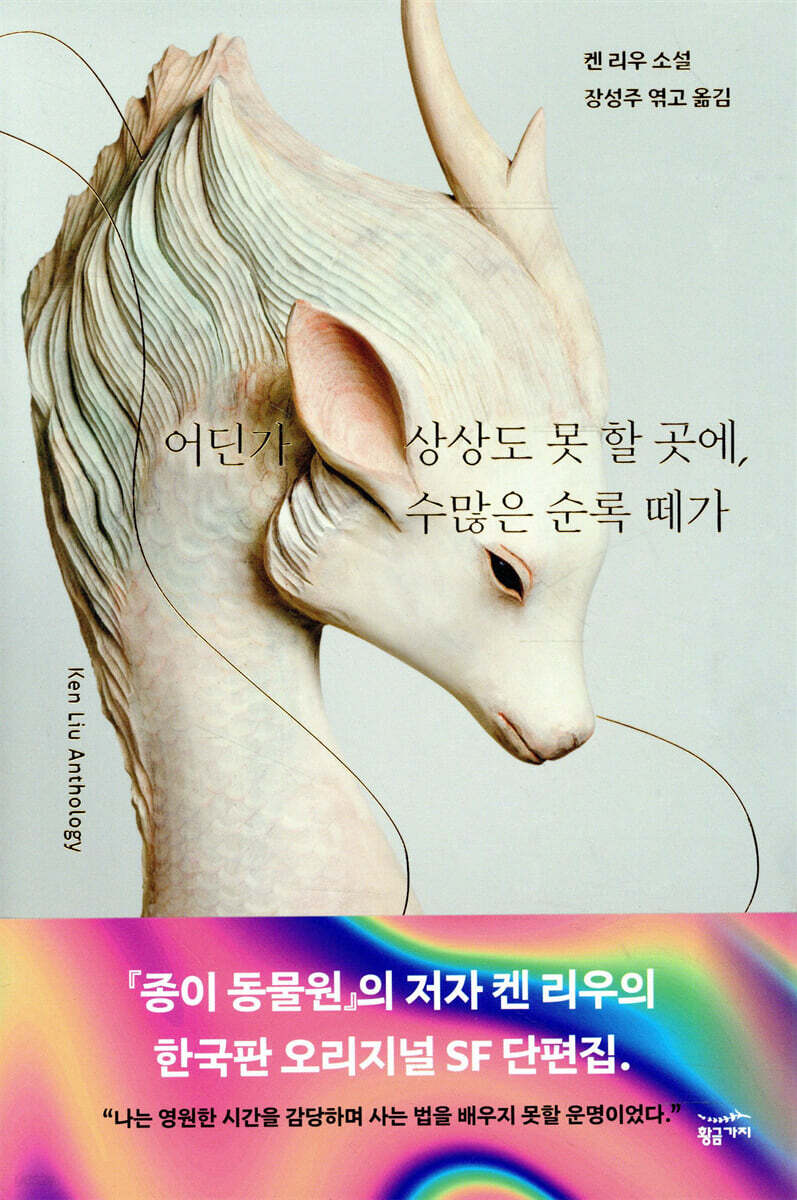
Somewhere in an unimaginable place, a herd of countless reindeer
 |
Description
Book Introduction
- A word from MD
-
A collection of short stories by Hugo Award-winning author Ken Liu『Paper Menagerie』 A carefully selected collection of 12 short stories by Ken Liu.
A story of family transcending time, space, and dimensions, dealing with death and eternal life, and the clash of races and cultures, this book illuminates the issues and concerns we face today through the lens of science fiction.
An original Korean edition of short story collection with a preface from the author to Korean readers.
July 17, 2020. Novel/Poetry PD Park Hyung-wook
A Korean edition of original science fiction short stories by Ken Liu, author of "Paper Menagerie."
A selection of 12 short stories, including debut works, that have never been compiled together before.
The second collection of short stories by Ken Liu, one of the most notable contemporary science fiction and fantasy writers, has been published by Golden Bough.
This is a Korean edition of a collection of carefully selected unpublished short stories by Ken Liu, who has secured a large readership in Korea with his masterpiece "Paper Menagerie," which won the prestigious Hugo Award, Nebula Award, and World Fantasy Award for the first time in 40 years.
Edited by Jang Seong-ju, winner of the 13th Yuyoung Translation Award for “Paper Zoo,” the book includes a separate preface from author Ken Liu addressed to Korean readers.
It consists of a total of 12 works, including Ken Liu's debut work, "The Rose of Carthage," "The Algorithm of Love," which won the prestigious Spanish Ignotus Award, "Tying the Knot," which was inspired by the Korean language, and the "Singularity Trilogy," a series that the author cherishes.
All of these works share a common theme: they depict diverse families transcending time, space, and dimensions. Each piece intriguingly explores various concerns of contemporary people, including death and eternal life, and the clash of races and cultures.
A selection of 12 short stories, including debut works, that have never been compiled together before.
The second collection of short stories by Ken Liu, one of the most notable contemporary science fiction and fantasy writers, has been published by Golden Bough.
This is a Korean edition of a collection of carefully selected unpublished short stories by Ken Liu, who has secured a large readership in Korea with his masterpiece "Paper Menagerie," which won the prestigious Hugo Award, Nebula Award, and World Fantasy Award for the first time in 40 years.
Edited by Jang Seong-ju, winner of the 13th Yuyoung Translation Award for “Paper Zoo,” the book includes a separate preface from author Ken Liu addressed to Korean readers.
It consists of a total of 12 works, including Ken Liu's debut work, "The Rose of Carthage," "The Algorithm of Love," which won the prestigious Spanish Ignotus Award, "Tying the Knot," which was inspired by the Korean language, and the "Singularity Trilogy," a series that the author cherishes.
All of these works share a common theme: they depict diverse families transcending time, space, and dimensions. Each piece intriguingly explores various concerns of contemporary people, including death and eternal life, and the clash of races and cultures.
- You can preview some of the book's contents.
Preview
index
Author's Preface 7
Arc 13
The Five Elements of Mind and Body 65
Knot Tying 107
Love Algorithm 137
The Rose of Carthage (Singularity Trilogy) 167
High tide 195
Those Left Behind (Singularity Trilogy) 203
Side 231
Somewhere in the most unimaginable, a herd of reindeer (Singularity Trilogy) 243
Towards the Moon 267
All the flavors in one bowl.
The American Settlement of the Warlord Guan Yu, Part 291
Memories of My Mother 407
Translator's Note 415
Arc 13
The Five Elements of Mind and Body 65
Knot Tying 107
Love Algorithm 137
The Rose of Carthage (Singularity Trilogy) 167
High tide 195
Those Left Behind (Singularity Trilogy) 203
Side 231
Somewhere in the most unimaginable, a herd of reindeer (Singularity Trilogy) 243
Towards the Moon 267
All the flavors in one bowl.
The American Settlement of the Warlord Guan Yu, Part 291
Memories of My Mother 407
Translator's Note 415
Detailed image

Publisher's Review
A Korean edition of original science fiction short stories by Ken Liu, author of "Paper Menagerie."
A selection of 12 short stories, including debut works, that have never been compiled together before.
The second collection of short stories by Ken Liu, one of the most notable contemporary science fiction and fantasy writers, has been published by Golden Bough.
This is a Korean edition of a collection of carefully selected unpublished short stories by Ken Liu, who has secured a large readership in Korea with his masterpiece, "The Paper Menagerie," which won the prestigious Hugo Award, Nebula Award, and World Fantasy Award for the first time in 40 years.
Edited by Jang Seong-ju, winner of the 13th Yuyoung Translation Award for “Paper Zoo,” the book includes a separate preface from author Ken Liu addressed to Korean readers.
It consists of a total of 12 works, including Ken Liu's debut work, 'The Rose of Carthage', 'The Algorithm of Love', winner of the prestigious Spanish Ignotus Award, 'Tying the Knot', inspired by the Korean language, and the 'Singularity Trilogy', a series that the author cherishes.
All of these works share a common theme of depicting diverse families that transcend time, space, and dimensions, and each interestingly captures various concerns of contemporary people, such as death and eternal life, and the clash of races and cultures.
Two more Korean short story collections by Ken Liu are in preparation, with Gods Will Not Be Killed and The Story of Silver Nang scheduled for publication next year.
"Thank you to all the Korean readers who opened the book I wrote.
I feel that we become most human when writers and readers engage in conversations that transcend time, space, language, and culture.
"Because we are a species that tells stories." - From the author's preface
What does it mean to be human in an age when the wisdom of the past has lost its persuasive power?
The 'Singularity Trilogy', which includes the title work, depicts the transformation of humanity, which has sent its mind into the data world and abandoned its physical body, with the author's rich imagination.
In this world realized through 'singularity,' digital humans not only achieve eternal life, but also form lifestyles and family relationships that are unimaginable in physical life, thereby unfolding a new future world for readers.
The first work, 『Ho』, which depicts the human life from birth to death as a parabola, also depicts the process by which the protagonist, who becomes an unwed mother at the age of sixteen, is able to choose eternal youth and eternal life.
In his foreword, author Ken Liu poses the question, "What does it mean to be human in an age when the wisdom of the past seems to have lost its persuasive power?"
Ken Liu projects the image of individuals who have faced various choices at every moment of revolutionary change that changed the world, such as electricity, the internet, and smartphones, and at the same time, gives readers interesting food for thought by asking how the values of tradition, identity, culture, family, and love that we have maintained so far have changed and how they will change with each new moment of change in the future.
"Lena Ozen was sixteen years old when her first son was born.
A hundred years later, Ozen's youngest daughter was born." - From the text
"If we were to categorize the stories among the included works, those that could be categorized as science fiction show the human form that transcends not only the physical form of existence but also time and space.
The author seems to be saying that it is the nature of the human species to cherish things even after achieving transcendence." - From the translator's note
A profound look at family, parents and children, that is embedded in each work.
While "Paper Zoo" conveyed a touching story about immigrant parents and their children, this collection of short stories truly delves into the diverse perspectives and concerns surrounding the relationship between parents and children.
『Ho』, where parents who abandoned their child at the age of sixteen for their own freedom meet their child who has grown old while maintaining his youth; 『My Mother's Memory』, where a story of observing the entire growth process of a daughter in a seven-year cycle in order to make the most of the two years left to them; 『Somewhere in an Unimaginable Place, a Herd of Reindeer』, which shows a family in the digital world where a child is born and grows through the distribution of the mind rather than physical birth; 『By the Side』, where a caregiver uses a care robot instead of a caregiver to care for a mother and watch her die through a screen; 『Those Left Behind』, which is impressive for the growth and independence of a child and the image of the parents left behind, are stories of families that Ken Liu unfolds, each containing its own individuality that transcends time and dimension.
In particular, due to the similar cultural characteristics, Ken Liu's works are evaluated as containing more emotional resonance elements for Korean readers than any other science fiction writer.
"You go to visit your mother every night.
As robot piloting skills improve, hospitals are granting them more control.
To move faster and more freely.
You learn how to change diapers, how to wipe yourself, how to sit by the bedside for hours, watching your mother's face, hoping to see if any facial muscles move.
This robot was created to relieve guilt.
For those who live too far away and have too many excuses.
Even though you know that you are essentially an illusion with your mother, and that you are lying to yourself with the help of technology, you feel a sense of relief."
Capturing the pain of racial discrimination, cultural conflict, and the immigrant generation.
"All the Flavors in One Bowl" was originally included in Ken Liu's first short story collection, "Paper Menagerie," but was included in this collection in the Korean edition.
This work depicts Chinese gold panners and the contemptuous gaze of Westerners during the gold rush in the late 19th century in the United States. It is set against the backdrop of the anti-Chinese sentiment that swept the West at the time and the Chinese Exclusion Act passed in 1882.
The author clarifies his writing intentions by detailing this background in the epilogue.
"To the Moon" also weaves together the realistic story of a Chinese immigrant who sets foot on American soil dreaming of the American dream with the unrealistic figure of Son Oh-gong.
In particular, because it contains critical content about the reality in China, it was not translated and published in China like 『People Who Put an End to History』, a work included in 『Paper Zoo』.
"Tying the Knot" is set in an isolated, innocent village in the East and details the economic devastation caused by the sudden arrival of Westerners, while "The Five Elements of the Mind and Body" takes the form of a space opera but deals with the cultural clash between those who continue to follow old customs and those who benefit from advanced medical care.
All four works are based on subjects that evoke emotional resonance among the Korean people, who have experienced foreign invasion and generations of immigrants, and these works are made even more special by Ken Liu's own identity as a Chinese-American.
“You are not the first person to climb that conversation tree.
It won't be the last either.
You're not the first person to tell your story to others, and of course you won't be the last either.
Well, welcome to the moon.
This is the land of swindlers, charlatans, con artists, dreamers, and liars.
“It’s thanks to people like you that the moon becomes such a wonderful place.”
A selection of 12 short stories, including debut works, that have never been compiled together before.
The second collection of short stories by Ken Liu, one of the most notable contemporary science fiction and fantasy writers, has been published by Golden Bough.
This is a Korean edition of a collection of carefully selected unpublished short stories by Ken Liu, who has secured a large readership in Korea with his masterpiece, "The Paper Menagerie," which won the prestigious Hugo Award, Nebula Award, and World Fantasy Award for the first time in 40 years.
Edited by Jang Seong-ju, winner of the 13th Yuyoung Translation Award for “Paper Zoo,” the book includes a separate preface from author Ken Liu addressed to Korean readers.
It consists of a total of 12 works, including Ken Liu's debut work, 'The Rose of Carthage', 'The Algorithm of Love', winner of the prestigious Spanish Ignotus Award, 'Tying the Knot', inspired by the Korean language, and the 'Singularity Trilogy', a series that the author cherishes.
All of these works share a common theme of depicting diverse families that transcend time, space, and dimensions, and each interestingly captures various concerns of contemporary people, such as death and eternal life, and the clash of races and cultures.
Two more Korean short story collections by Ken Liu are in preparation, with Gods Will Not Be Killed and The Story of Silver Nang scheduled for publication next year.
"Thank you to all the Korean readers who opened the book I wrote.
I feel that we become most human when writers and readers engage in conversations that transcend time, space, language, and culture.
"Because we are a species that tells stories." - From the author's preface
What does it mean to be human in an age when the wisdom of the past has lost its persuasive power?
The 'Singularity Trilogy', which includes the title work, depicts the transformation of humanity, which has sent its mind into the data world and abandoned its physical body, with the author's rich imagination.
In this world realized through 'singularity,' digital humans not only achieve eternal life, but also form lifestyles and family relationships that are unimaginable in physical life, thereby unfolding a new future world for readers.
The first work, 『Ho』, which depicts the human life from birth to death as a parabola, also depicts the process by which the protagonist, who becomes an unwed mother at the age of sixteen, is able to choose eternal youth and eternal life.
In his foreword, author Ken Liu poses the question, "What does it mean to be human in an age when the wisdom of the past seems to have lost its persuasive power?"
Ken Liu projects the image of individuals who have faced various choices at every moment of revolutionary change that changed the world, such as electricity, the internet, and smartphones, and at the same time, gives readers interesting food for thought by asking how the values of tradition, identity, culture, family, and love that we have maintained so far have changed and how they will change with each new moment of change in the future.
"Lena Ozen was sixteen years old when her first son was born.
A hundred years later, Ozen's youngest daughter was born." - From the text
"If we were to categorize the stories among the included works, those that could be categorized as science fiction show the human form that transcends not only the physical form of existence but also time and space.
The author seems to be saying that it is the nature of the human species to cherish things even after achieving transcendence." - From the translator's note
A profound look at family, parents and children, that is embedded in each work.
While "Paper Zoo" conveyed a touching story about immigrant parents and their children, this collection of short stories truly delves into the diverse perspectives and concerns surrounding the relationship between parents and children.
『Ho』, where parents who abandoned their child at the age of sixteen for their own freedom meet their child who has grown old while maintaining his youth; 『My Mother's Memory』, where a story of observing the entire growth process of a daughter in a seven-year cycle in order to make the most of the two years left to them; 『Somewhere in an Unimaginable Place, a Herd of Reindeer』, which shows a family in the digital world where a child is born and grows through the distribution of the mind rather than physical birth; 『By the Side』, where a caregiver uses a care robot instead of a caregiver to care for a mother and watch her die through a screen; 『Those Left Behind』, which is impressive for the growth and independence of a child and the image of the parents left behind, are stories of families that Ken Liu unfolds, each containing its own individuality that transcends time and dimension.
In particular, due to the similar cultural characteristics, Ken Liu's works are evaluated as containing more emotional resonance elements for Korean readers than any other science fiction writer.
"You go to visit your mother every night.
As robot piloting skills improve, hospitals are granting them more control.
To move faster and more freely.
You learn how to change diapers, how to wipe yourself, how to sit by the bedside for hours, watching your mother's face, hoping to see if any facial muscles move.
This robot was created to relieve guilt.
For those who live too far away and have too many excuses.
Even though you know that you are essentially an illusion with your mother, and that you are lying to yourself with the help of technology, you feel a sense of relief."
Capturing the pain of racial discrimination, cultural conflict, and the immigrant generation.
"All the Flavors in One Bowl" was originally included in Ken Liu's first short story collection, "Paper Menagerie," but was included in this collection in the Korean edition.
This work depicts Chinese gold panners and the contemptuous gaze of Westerners during the gold rush in the late 19th century in the United States. It is set against the backdrop of the anti-Chinese sentiment that swept the West at the time and the Chinese Exclusion Act passed in 1882.
The author clarifies his writing intentions by detailing this background in the epilogue.
"To the Moon" also weaves together the realistic story of a Chinese immigrant who sets foot on American soil dreaming of the American dream with the unrealistic figure of Son Oh-gong.
In particular, because it contains critical content about the reality in China, it was not translated and published in China like 『People Who Put an End to History』, a work included in 『Paper Zoo』.
"Tying the Knot" is set in an isolated, innocent village in the East and details the economic devastation caused by the sudden arrival of Westerners, while "The Five Elements of the Mind and Body" takes the form of a space opera but deals with the cultural clash between those who continue to follow old customs and those who benefit from advanced medical care.
All four works are based on subjects that evoke emotional resonance among the Korean people, who have experienced foreign invasion and generations of immigrants, and these works are made even more special by Ken Liu's own identity as a Chinese-American.
“You are not the first person to climb that conversation tree.
It won't be the last either.
You're not the first person to tell your story to others, and of course you won't be the last either.
Well, welcome to the moon.
This is the land of swindlers, charlatans, con artists, dreamers, and liars.
“It’s thanks to people like you that the moon becomes such a wonderful place.”
GOODS SPECIFICS
- Date of issue: July 2, 2020
- Page count, weight, size: 420 pages | 552g | 140*210*30mm
- ISBN13: 9791158887162
- ISBN10: 1158887167
You may also like
카테고리
korean


korean

![GQ KOREA Mark (Monthly): December [2025]](http://librairie.coreenne.fr/cdn/shop/files/8ef265dbbfbf186523ed75ba7319009d.jpg?v=1765340328&width=3840)


