

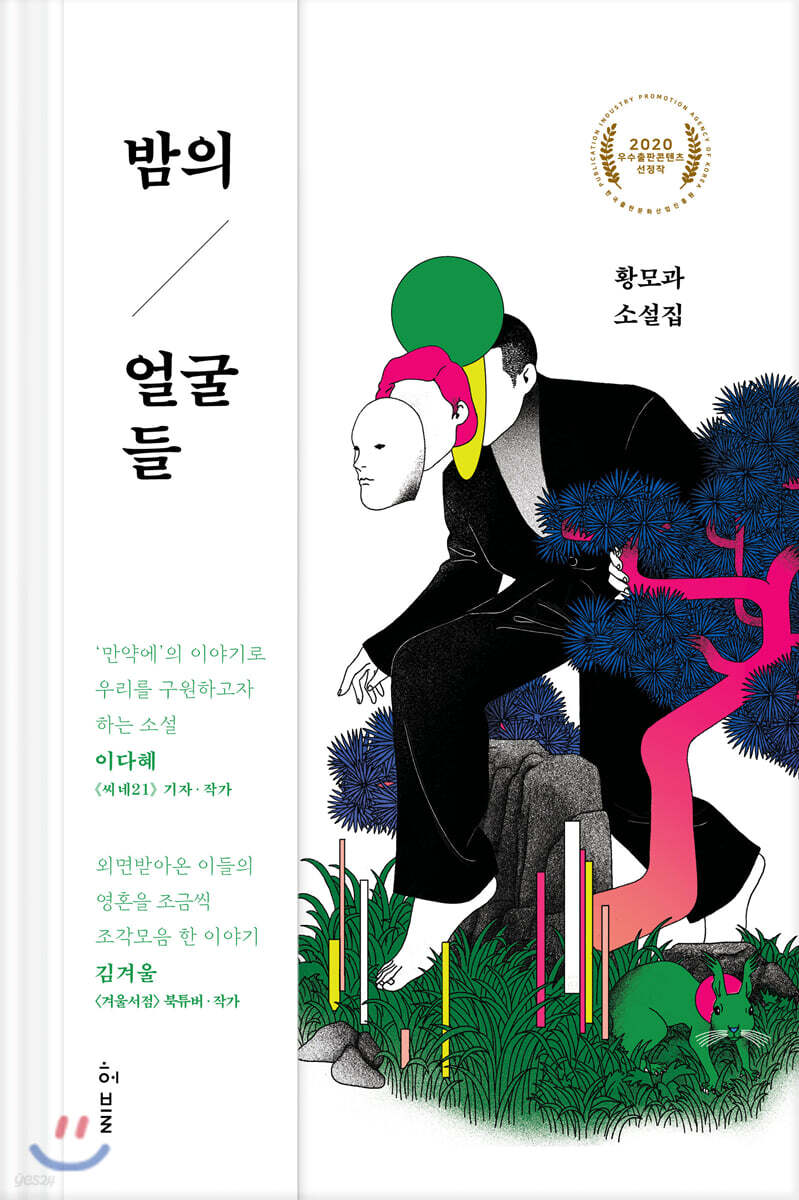
Faces of the Night
 |
Description
Book Introduction
The new face of science fiction discovered by the 'Korea Science Literature Award': Hwangmogwa
Every time the wind of memory blows, the faces of the night turn one page at a time.
Fifteen years ago, Hwang Mo-gwa, who moved to Japan to become a cartoonist, eventually returned to Korea and became a novelist.
Hwang Mo-gwa, a new cartoonist with a lighthearted sensibility and bold imagination, and a borderline identity as a Korean citizen and permanent resident of Japan, has broken down the boundaries between life and death, present and history, generations, and nations.
His first collection of short stories, Faces of the Night, was published.
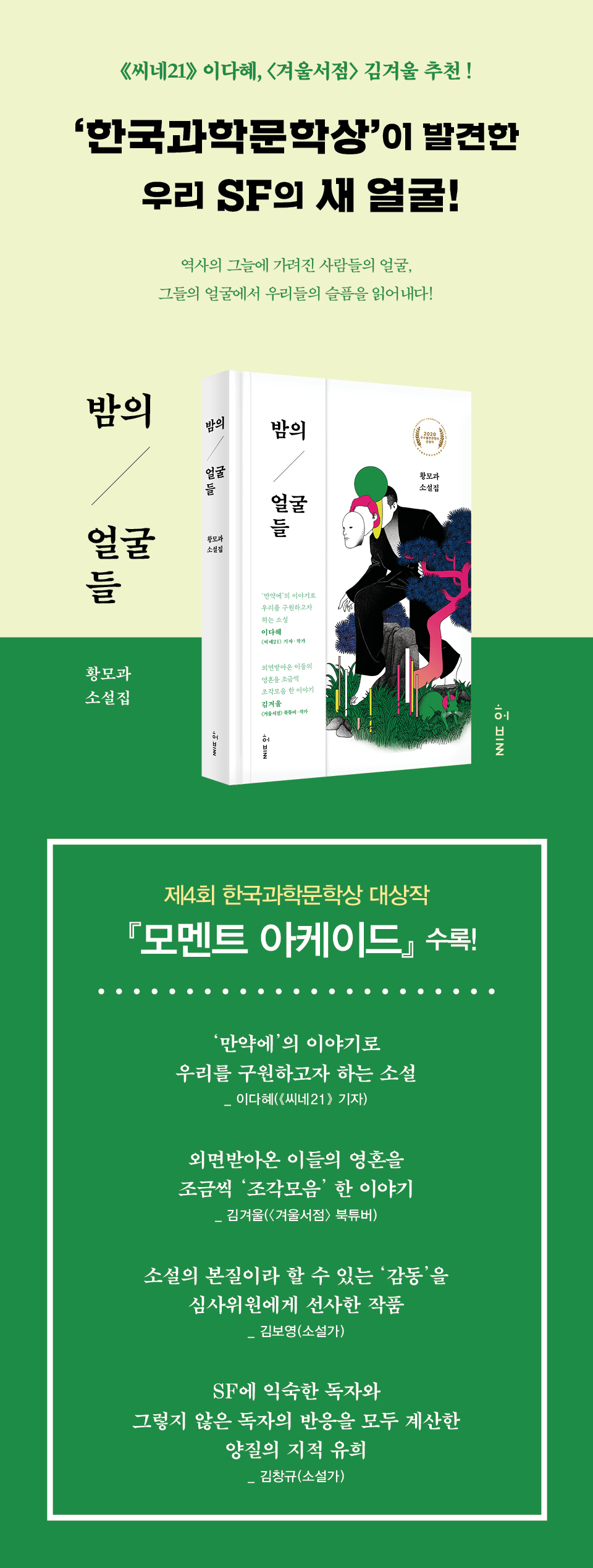
In 2019, immediately after winning the grand prize in the short story category of the 'Korea Science Literature Award' for the included work "Moment Arcade," he received an award at the 'Safe House Story Contest', and the winning work garnered much attention when it was decided to be produced as a joint drama between MBC and waave.
Although Hwangmo's novels use a lighthearted style like Japanese manga, the story itself is not lighthearted.
It is not a clean face with a smile that seems to know no misfortune, but a face that has lost not only its name but also its eyes, nose, and mouth in the shadow of history.
It deals with stories about death that we can never laugh off, and these stories are not limited to the present, but go back to over 100 years ago.
As reporter Da-Hye Lee said in her recommendation, Hwang Mo-Gwa's novel strives to remember a death that remains a mystery.
In particular, "Let's meet again, even if it's late" and "Nishiwaseda Station B Floor" make an effort to remember the victims of the Japanese colonial period.
Set in the spatial background of 'Japan,' the two novels freely move between the present and the past of over 100 years ago, blurring the boundaries between the present and the past.
As a result, the violence and oppression experienced by people in the past lead to our present sorrow.
Every time the wind of memory blows, the faces of the night turn one page at a time.
Fifteen years ago, Hwang Mo-gwa, who moved to Japan to become a cartoonist, eventually returned to Korea and became a novelist.
Hwang Mo-gwa, a new cartoonist with a lighthearted sensibility and bold imagination, and a borderline identity as a Korean citizen and permanent resident of Japan, has broken down the boundaries between life and death, present and history, generations, and nations.
His first collection of short stories, Faces of the Night, was published.
In 2019, immediately after winning the grand prize in the short story category of the 'Korea Science Literature Award' for the included work "Moment Arcade," he received an award at the 'Safe House Story Contest', and the winning work garnered much attention when it was decided to be produced as a joint drama between MBC and waave.
Although Hwangmo's novels use a lighthearted style like Japanese manga, the story itself is not lighthearted.
It is not a clean face with a smile that seems to know no misfortune, but a face that has lost not only its name but also its eyes, nose, and mouth in the shadow of history.
It deals with stories about death that we can never laugh off, and these stories are not limited to the present, but go back to over 100 years ago.
As reporter Da-Hye Lee said in her recommendation, Hwang Mo-Gwa's novel strives to remember a death that remains a mystery.
In particular, "Let's meet again, even if it's late" and "Nishiwaseda Station B Floor" make an effort to remember the victims of the Japanese colonial period.
Set in the spatial background of 'Japan,' the two novels freely move between the present and the past of over 100 years ago, blurring the boundaries between the present and the past.
As a result, the violence and oppression experienced by people in the past lead to our present sorrow.
- You can preview some of the book's contents.
Preview
index
Bye, let's meet up even if it's late
Your memories are ghosts
Tank Man
Nishi-Waseda Station B floor
transparent runner
Moment Arcade
Author's Note
Your memories are ghosts
Tank Man
Nishi-Waseda Station B floor
transparent runner
Moment Arcade
Author's Note
Detailed image
Into the book
The grave is the foundation of my life.
Tonight too, I take a leisurely stroll around the graveyard as if I were strolling through the front yard.
--- From "Let's meet up, even if it's late"
I gripped the spear with both hands and slowly shifted my weight over the body that lay with its back turned.
At that moment, a tremor was felt through the tip of the spear.
The body that was not yet dead flinched and struggled for the last time.
I cut off the last lifeline of the one who was still breathing with my own hands.
My hands were shaking.
Would it be okay if I wandered around my hometown and had the face of the person who sent me to Tokyo?
I wanted to check the face.
If the corpse's face looked similar to that person, my guilt would probably be alleviated a little.
I slowly turned the body over to check the face.
He was a person I didn't know at all.
He was a young boy.
I was about fifteen. My whole body was shaking nonstop.
I heard Japanese.
--- From "Let's meet up, even if it's late"
I felt a strong shock.
A dull sound pierced through my skin.
The pain reached my bones.
The pain contained in her memories was being replayed within me as I watched the video.
It was also linked to me through synesthesia data linkage.
Lisle was embarrassed that her pain had been transferred and apologized.
--- From "Your Memory is a Ghost"
The body and memories of a dead person will eventually disappear.
The soul will go to heaven.
The memories of the dead will have their own voice somewhere among certain data.
When we can touch someone's story from a single, insignificant photograph, from a single, insignificant sip of scent, those who remain will be able to remember those who have disappeared.
--- From "Your Memory is a Ghost"
Listen quietly to the noise around you.
A subtle but diverse sound flows loudly.
Coughing, groaning, kicking walls, snoring, swearing, muttering, singing, and laughing hysterically.
Everyone is trapped.
There are so many people I can't stand without going crazy.
--- From "Tank Man"
I stood in front of the line of tanks, holding a black bag in one hand and a plastic bag in the other.
The moment I had longed for and waited for.
The surroundings are so bright that it feels like they're on fire.
My heart pounded all over my body.
--- From "Tank Man"
There are stories that you can enjoy, and there are stories that you simply cannot enjoy.
I was embarrassed that I couldn't remember the face of the man I met today.
If we meet again, will I recognize him?
--- From "Nishiwaseda Station B Floor"
I couldn't help but feel suffocated as I pictured a young woman with a small child in her arms running frantically through a Toyama park, desperately begging for help.
I think of your face.
The face was one I knew well, then another I couldn't remember who it was, then another I knew so well, then another clear face.
Then, it turns into the face of someone who has nothing to do with my life and moves away.
Her faces flash through my mind.
It will linger in my heart forever, crying sadly.
--- From "Nishiwaseda Station B Floor"
“I’m so shocked that Japanese people don’t know about Wangnuni! It’s the story of Romeo and Juliet.
“It is a masterpiece that deals with class conflict.”
“Hmm, Koreans really like stories about class struggle.”
--- From "The Transparent Runner"
“After you finish playing, you must shout out ‘Gaisan’.
Then the transparent runner will also rest.
“Treat us equally.”
--- From "The Transparent Runner"
Slowly, I walk towards your memory.
Your senses and emotions come into me through remote real.
I can feel your breathing and even your heartbeat.
Through your moments, I experience a thrill I have never felt in the past 12 years.
I breathe with yours, and gently layer the movement of my heart with your leisurely yet rapid heartbeat.
Tonight too, I take a leisurely stroll around the graveyard as if I were strolling through the front yard.
--- From "Let's meet up, even if it's late"
I gripped the spear with both hands and slowly shifted my weight over the body that lay with its back turned.
At that moment, a tremor was felt through the tip of the spear.
The body that was not yet dead flinched and struggled for the last time.
I cut off the last lifeline of the one who was still breathing with my own hands.
My hands were shaking.
Would it be okay if I wandered around my hometown and had the face of the person who sent me to Tokyo?
I wanted to check the face.
If the corpse's face looked similar to that person, my guilt would probably be alleviated a little.
I slowly turned the body over to check the face.
He was a person I didn't know at all.
He was a young boy.
I was about fifteen. My whole body was shaking nonstop.
I heard Japanese.
--- From "Let's meet up, even if it's late"
I felt a strong shock.
A dull sound pierced through my skin.
The pain reached my bones.
The pain contained in her memories was being replayed within me as I watched the video.
It was also linked to me through synesthesia data linkage.
Lisle was embarrassed that her pain had been transferred and apologized.
--- From "Your Memory is a Ghost"
The body and memories of a dead person will eventually disappear.
The soul will go to heaven.
The memories of the dead will have their own voice somewhere among certain data.
When we can touch someone's story from a single, insignificant photograph, from a single, insignificant sip of scent, those who remain will be able to remember those who have disappeared.
--- From "Your Memory is a Ghost"
Listen quietly to the noise around you.
A subtle but diverse sound flows loudly.
Coughing, groaning, kicking walls, snoring, swearing, muttering, singing, and laughing hysterically.
Everyone is trapped.
There are so many people I can't stand without going crazy.
--- From "Tank Man"
I stood in front of the line of tanks, holding a black bag in one hand and a plastic bag in the other.
The moment I had longed for and waited for.
The surroundings are so bright that it feels like they're on fire.
My heart pounded all over my body.
--- From "Tank Man"
There are stories that you can enjoy, and there are stories that you simply cannot enjoy.
I was embarrassed that I couldn't remember the face of the man I met today.
If we meet again, will I recognize him?
--- From "Nishiwaseda Station B Floor"
I couldn't help but feel suffocated as I pictured a young woman with a small child in her arms running frantically through a Toyama park, desperately begging for help.
I think of your face.
The face was one I knew well, then another I couldn't remember who it was, then another I knew so well, then another clear face.
Then, it turns into the face of someone who has nothing to do with my life and moves away.
Her faces flash through my mind.
It will linger in my heart forever, crying sadly.
--- From "Nishiwaseda Station B Floor"
“I’m so shocked that Japanese people don’t know about Wangnuni! It’s the story of Romeo and Juliet.
“It is a masterpiece that deals with class conflict.”
“Hmm, Koreans really like stories about class struggle.”
--- From "The Transparent Runner"
“After you finish playing, you must shout out ‘Gaisan’.
Then the transparent runner will also rest.
“Treat us equally.”
--- From "The Transparent Runner"
Slowly, I walk towards your memory.
Your senses and emotions come into me through remote real.
I can feel your breathing and even your heartbeat.
Through your moments, I experience a thrill I have never felt in the past 12 years.
I breathe with yours, and gently layer the movement of my heart with your leisurely yet rapid heartbeat.
--- From "Moment Arcade"
Publisher's Review
The new face of science fiction discovered by the 'Korea Science Literature Award': Hwangmogwa
Fifteen years ago, Hwang Mo-gwa, who moved to Japan to become a cartoonist, eventually returned to Korea and became a novelist.
Hwang Mo-gwa, a new cartoonist with a lighthearted sensibility and bold imagination, and a borderline identity as a Korean citizen and permanent resident of Japan, has broken down the boundaries between life and death, present and history, generations, and nations.
His first collection of short stories, Faces of the Night, was published.
In 2019, immediately after winning the grand prize in the short story category of the 'Korea Science Literature Award' for the included work "Moment Arcade," he received an award at the 'Safe House Story Contest', and the winning work garnered much attention when it was decided to be produced as a joint drama between MBC and waave.
For “Moment Arcade,” which won the grand prize at the Korea Science Literature Award, the judges at the time, Kim Bo-young and Kim Chang-gyu, praised it as “a work that presented the judges with ‘emotion,’ which can be said to be the essence of a novel,” and “a high-quality intellectual play that calculated the reactions of both readers familiar with SF and those who are not.” For “Faces of the Night,” the book received wonderful recommendations from two authors who are currently loved by numerous readers for their trendiest sensibilities: reporter Da-hye Lee of [Cine21] and booktuber Gyul-wool Kim of [Winter Bookstore].
Every time the wind of memory blows, the faces of the night turn one page at a time.
Although Hwangmo's novels use a lighthearted style like Japanese manga, the story itself is not lighthearted.
It is not a clean face with a smile that seems to know no misfortune, but a face that has lost not only its name but also its eyes, nose, and mouth in the shadow of history.
It deals with stories about death that we can never laugh off, and these stories are not limited to the present, but go back to over 100 years ago.
Life has no subjunctive, but Hwangmogwa seeks to save us with stories of "what ifs." For mortals, perhaps it is the ultimate pleasure. Even in the world of tomorrow, death leaves behind unsolved mysteries, and memories forever follow those who remain. Until no one is left alone. - Da-hye Lee (Reporter and Writer, Cine21)
As reporter Da-Hye Lee said in her recommendation, Hwang Mo-Gwa's novel strives to remember a death that remains a mystery.
In particular, "Let's meet again, even if it's late" and "Nishiwaseda Station B Floor" make an effort to remember the victims of the Japanese colonial period.
Set in the spatial background of 'Japan,' the two novels freely move between the present and the past of over 100 years ago, blurring the boundaries between the present and the past.
As a result, the violence and oppression experienced by people in the past lead to our present sorrow.
"Let's meet up, even if it's late."
In a world where technology has been developed to extract DNA from remains to confirm identity, the narrator is a homeless person living in a cemetery in a Japanese city center.
'I' meets a Korean woman, and with her help, I find out whose hair the 'hair amulet' that I have been keeping so preciously without knowing why belongs to.
As I recall my lost memories of the past, the scars of history that Koreans had to endure during the Japanese colonial period are also revealed.
Nishi-Waseda Station B floor
Just like "Let's Meet Again, Even If It's Late," the story begins with a world where technology has been developed to extract DNA from remains to confirm identity, and a Korean exchange student, "I," and a local Japanese student, "Ezra," leave for "Nishi-Waseda Station" to find out the truth about a ghost story.
The two people who arrived on the B floor by chance meet a homeless person that 'I' had met before, and through that homeless person, they learn that the B floor was a place where biological experiments were conducted on Koreans.
The story told by Hwangmogwa deals with violence and death that occurred so far back in time that it could almost be said to have disappeared into the back alleys of history.
Because everything is powerless before the power of time, the violence and death that were once vivid sound like stories that have nothing to do with us.
However, Hwang Mo-gwa's novel does not give in to this, and uses all the imagination of science fiction to remember and name those who have been deprived of their eyes, nose, mouth, and name.
As a result, we feel that this story of old times is our story now.
Hwang Mo-gwa's novels have the power to read our sorrows in the faces of others, and ultimately to make their faces resemble our own.
Other People's Memories and Senses: Stories We Must Read to Become "Ourselves"
‘Memory’ and ‘Sense’, ‘Faces of the Night’ carefully examines these two elements that make up human beings.
In this book, the dead come back to life and the names of the forgotten are called out.
Other people's experiences enter my body and my senses flow into others.
After reading these six novels, you realize that each one has been, little by little, 'piecing together' the souls of those who have been wounded and neglected in that way.
And the book asks us:
Shouldn't we try the impossible, like feeling the hearts of others as if they were our own, or bringing back those who have disappeared?
No matter how hopeless it is, no matter how shitty everything is.
- Kim Gyul-wool ([Winter Bookstore] Booktuber/author)
There is something we must possess in order to be 'us'.
It is the power of empathy that allows everyone to be included in 'us'.
If you want to empathize with others, you must at least be able to think from their perspective, and if possible, it would be best to experience and feel their memories and sensations as if they were your own.
To achieve this impossible feat, to mourn the hearts of those who have been neglected until now, Hwang Mo-gwa uses the imagination of science fiction.
"Your Memory is a Ghost" and "Moment Arcade" imagine the science and technology of "synesthetic data embedding" ("Your Memory is a Ghost"), which allows you to feel the sensations felt by others through specific sensory information, and "Moment" ("Moment Arcade"), which allows you to experience the memories of others, in order to transfuse the "memories" and "sensations" of others into your body like blood.
It is never easy to give space in your body to allow the memories and sensations of another person to enter.
Moreover, if the memories and sensations of others entering your body are the result of violence and oppression, they will return as pain beyond discomfort.
Your Memories Are Ghosts
In a world where 'data embedding' has been developed, which can extract other people's senses as data and add them to specific sensory information, an incident occurs when 'I', who is caring for my grandfather who is nearing the end of his life, links my grandfather's sensory data to a video of his will.
The consciousness of a foreign immigrant woman named 'Rizle' infiltrates the augmented memory in my grandfather's brain, and because the sensory data is linked, I also feel the pain she felt when she was subjected to domestic violence.
Moment Arcade
In a world where 'Moments' are developed that allow you to directly experience other people's memories, 'I', who has not been able to find meaning in life and only experiences other people's Moments randomly, one day accidentally experiences an unpopular Moment.
'I', who felt a thrill of life that I had never experienced before, began to experience 'Sister's' moments in order to find that thrill in my past life.
Then, 'I' realizes that I have been misunderstanding 'sister' and recalls past events that I had forgotten.
In this way, Hwang Mo-gwa's novel brings to light, in an interesting way, a story that we have been putting off day after day because we thought it was not immediately necessary.
Reading his story, you can see the expression on the face of science fiction when it comforts us.
A willingness to cross boundaries to hear voices beyond them
Hwang Mo-gwa had to live as a foreigner in Japan for 15 years, and as the period of his stay was long, his situation in Korea was not much different.
But it seems that such alienation does not disappear just by moving from outside to inside the border.
The realization that one can only be a stranger in one's own life, that one's identity can no longer be anything other than a 'borderline', is fully contained in the other two films: "The Transparent Runner," which deals with the friendship between a Korean-Japanese exchange student and a Japanese NEET, and "Tank Man," which is the story of a patient confined to a psychiatric ward who struggles to remember the sins he cannot remember.
The reason we are focusing on the identity of the yellow crocus as a 'borderer' is because it is trying to break down the boundaries that divide our society with the power of that identity.
Are these boundaries truly valid? Like intergenerational and inter-national conflicts, we are trying to carve out what isn't, and as a result, we are marginalizing those who have been left behind.
Throughout history, the division between the older generation and the newer generation, between locals and foreigners, seems to have been quite effective.
However, when we look at the future society depicted in Hwang Mo-gwa's novel, where people of different generations or nationalities communicate and harmonize, we can feel that the time when we can truly be 'us' is approaching.
To fully appreciate all the charm of this novel, which delves deeply into practical issues like historical issues, intergenerational conflict, and conflict between nations, as well as philosophical questions like life and death, a science fiction reading alone would be insufficient.
I sincerely hope that Hwangmogwa's novel will go beyond our science fiction and become the face of our literature.
A new face of science fiction that will comfort us is just beginning to emerge.
Fifteen years ago, Hwang Mo-gwa, who moved to Japan to become a cartoonist, eventually returned to Korea and became a novelist.
Hwang Mo-gwa, a new cartoonist with a lighthearted sensibility and bold imagination, and a borderline identity as a Korean citizen and permanent resident of Japan, has broken down the boundaries between life and death, present and history, generations, and nations.
His first collection of short stories, Faces of the Night, was published.
In 2019, immediately after winning the grand prize in the short story category of the 'Korea Science Literature Award' for the included work "Moment Arcade," he received an award at the 'Safe House Story Contest', and the winning work garnered much attention when it was decided to be produced as a joint drama between MBC and waave.
For “Moment Arcade,” which won the grand prize at the Korea Science Literature Award, the judges at the time, Kim Bo-young and Kim Chang-gyu, praised it as “a work that presented the judges with ‘emotion,’ which can be said to be the essence of a novel,” and “a high-quality intellectual play that calculated the reactions of both readers familiar with SF and those who are not.” For “Faces of the Night,” the book received wonderful recommendations from two authors who are currently loved by numerous readers for their trendiest sensibilities: reporter Da-hye Lee of [Cine21] and booktuber Gyul-wool Kim of [Winter Bookstore].
Every time the wind of memory blows, the faces of the night turn one page at a time.
Although Hwangmo's novels use a lighthearted style like Japanese manga, the story itself is not lighthearted.
It is not a clean face with a smile that seems to know no misfortune, but a face that has lost not only its name but also its eyes, nose, and mouth in the shadow of history.
It deals with stories about death that we can never laugh off, and these stories are not limited to the present, but go back to over 100 years ago.
Life has no subjunctive, but Hwangmogwa seeks to save us with stories of "what ifs." For mortals, perhaps it is the ultimate pleasure. Even in the world of tomorrow, death leaves behind unsolved mysteries, and memories forever follow those who remain. Until no one is left alone. - Da-hye Lee (Reporter and Writer, Cine21)
As reporter Da-Hye Lee said in her recommendation, Hwang Mo-Gwa's novel strives to remember a death that remains a mystery.
In particular, "Let's meet again, even if it's late" and "Nishiwaseda Station B Floor" make an effort to remember the victims of the Japanese colonial period.
Set in the spatial background of 'Japan,' the two novels freely move between the present and the past of over 100 years ago, blurring the boundaries between the present and the past.
As a result, the violence and oppression experienced by people in the past lead to our present sorrow.
"Let's meet up, even if it's late."
In a world where technology has been developed to extract DNA from remains to confirm identity, the narrator is a homeless person living in a cemetery in a Japanese city center.
'I' meets a Korean woman, and with her help, I find out whose hair the 'hair amulet' that I have been keeping so preciously without knowing why belongs to.
As I recall my lost memories of the past, the scars of history that Koreans had to endure during the Japanese colonial period are also revealed.
Nishi-Waseda Station B floor
Just like "Let's Meet Again, Even If It's Late," the story begins with a world where technology has been developed to extract DNA from remains to confirm identity, and a Korean exchange student, "I," and a local Japanese student, "Ezra," leave for "Nishi-Waseda Station" to find out the truth about a ghost story.
The two people who arrived on the B floor by chance meet a homeless person that 'I' had met before, and through that homeless person, they learn that the B floor was a place where biological experiments were conducted on Koreans.
The story told by Hwangmogwa deals with violence and death that occurred so far back in time that it could almost be said to have disappeared into the back alleys of history.
Because everything is powerless before the power of time, the violence and death that were once vivid sound like stories that have nothing to do with us.
However, Hwang Mo-gwa's novel does not give in to this, and uses all the imagination of science fiction to remember and name those who have been deprived of their eyes, nose, mouth, and name.
As a result, we feel that this story of old times is our story now.
Hwang Mo-gwa's novels have the power to read our sorrows in the faces of others, and ultimately to make their faces resemble our own.
Other People's Memories and Senses: Stories We Must Read to Become "Ourselves"
‘Memory’ and ‘Sense’, ‘Faces of the Night’ carefully examines these two elements that make up human beings.
In this book, the dead come back to life and the names of the forgotten are called out.
Other people's experiences enter my body and my senses flow into others.
After reading these six novels, you realize that each one has been, little by little, 'piecing together' the souls of those who have been wounded and neglected in that way.
And the book asks us:
Shouldn't we try the impossible, like feeling the hearts of others as if they were our own, or bringing back those who have disappeared?
No matter how hopeless it is, no matter how shitty everything is.
- Kim Gyul-wool ([Winter Bookstore] Booktuber/author)
There is something we must possess in order to be 'us'.
It is the power of empathy that allows everyone to be included in 'us'.
If you want to empathize with others, you must at least be able to think from their perspective, and if possible, it would be best to experience and feel their memories and sensations as if they were your own.
To achieve this impossible feat, to mourn the hearts of those who have been neglected until now, Hwang Mo-gwa uses the imagination of science fiction.
"Your Memory is a Ghost" and "Moment Arcade" imagine the science and technology of "synesthetic data embedding" ("Your Memory is a Ghost"), which allows you to feel the sensations felt by others through specific sensory information, and "Moment" ("Moment Arcade"), which allows you to experience the memories of others, in order to transfuse the "memories" and "sensations" of others into your body like blood.
It is never easy to give space in your body to allow the memories and sensations of another person to enter.
Moreover, if the memories and sensations of others entering your body are the result of violence and oppression, they will return as pain beyond discomfort.
Your Memories Are Ghosts
In a world where 'data embedding' has been developed, which can extract other people's senses as data and add them to specific sensory information, an incident occurs when 'I', who is caring for my grandfather who is nearing the end of his life, links my grandfather's sensory data to a video of his will.
The consciousness of a foreign immigrant woman named 'Rizle' infiltrates the augmented memory in my grandfather's brain, and because the sensory data is linked, I also feel the pain she felt when she was subjected to domestic violence.
Moment Arcade
In a world where 'Moments' are developed that allow you to directly experience other people's memories, 'I', who has not been able to find meaning in life and only experiences other people's Moments randomly, one day accidentally experiences an unpopular Moment.
'I', who felt a thrill of life that I had never experienced before, began to experience 'Sister's' moments in order to find that thrill in my past life.
Then, 'I' realizes that I have been misunderstanding 'sister' and recalls past events that I had forgotten.
In this way, Hwang Mo-gwa's novel brings to light, in an interesting way, a story that we have been putting off day after day because we thought it was not immediately necessary.
Reading his story, you can see the expression on the face of science fiction when it comforts us.
A willingness to cross boundaries to hear voices beyond them
Hwang Mo-gwa had to live as a foreigner in Japan for 15 years, and as the period of his stay was long, his situation in Korea was not much different.
But it seems that such alienation does not disappear just by moving from outside to inside the border.
The realization that one can only be a stranger in one's own life, that one's identity can no longer be anything other than a 'borderline', is fully contained in the other two films: "The Transparent Runner," which deals with the friendship between a Korean-Japanese exchange student and a Japanese NEET, and "Tank Man," which is the story of a patient confined to a psychiatric ward who struggles to remember the sins he cannot remember.
The reason we are focusing on the identity of the yellow crocus as a 'borderer' is because it is trying to break down the boundaries that divide our society with the power of that identity.
Are these boundaries truly valid? Like intergenerational and inter-national conflicts, we are trying to carve out what isn't, and as a result, we are marginalizing those who have been left behind.
Throughout history, the division between the older generation and the newer generation, between locals and foreigners, seems to have been quite effective.
However, when we look at the future society depicted in Hwang Mo-gwa's novel, where people of different generations or nationalities communicate and harmonize, we can feel that the time when we can truly be 'us' is approaching.
To fully appreciate all the charm of this novel, which delves deeply into practical issues like historical issues, intergenerational conflict, and conflict between nations, as well as philosophical questions like life and death, a science fiction reading alone would be insufficient.
I sincerely hope that Hwangmogwa's novel will go beyond our science fiction and become the face of our literature.
A new face of science fiction that will comfort us is just beginning to emerge.
GOODS SPECIFICS
- Date of issue: June 10, 2020
- Format: Hardcover book binding method guide
- Page count, weight, size: 212 pages | 348g | 138*206*20mm
- ISBN13: 9791190090131
- ISBN10: 1190090139
You may also like
카테고리
korean


korean

![GQ KOREA Mark (Monthly): December [2025]](http://librairie.coreenne.fr/cdn/shop/files/8ef265dbbfbf186523ed75ba7319009d.jpg?v=1765340328&width=3840)


