

The greatest blessing of my life
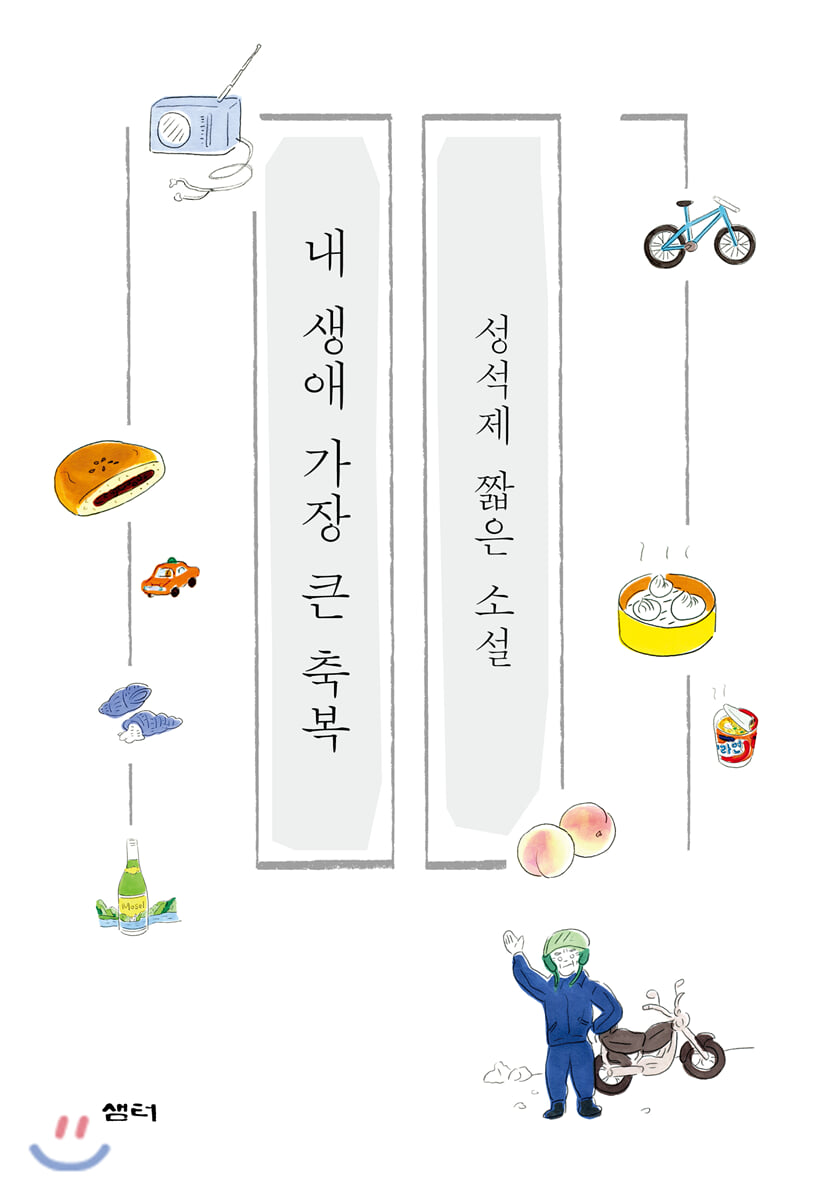 |
Description
Book Introduction
- A word from MD
-
Novelist Seong Seok-je, a short story with a long aftertasteA collection of short stories by novelist Seong Seok-je on the theme of 'encounter'.
Our daily lives, which flow by without incident but sometimes encounter small variables and take unexpected turns, the author captures certain moments hidden in such ordinary and trivial scenes and delicately depicts them with his signature wit and satire.
A book that leaves a long aftertaste with a short story.
June 19, 2020. Novel/Poetry PD Park Hyung-wook
The diverse group of people encountered at the crossroads of everyday life
The aesthetics of short stories drawn with satire and humor!
An Ordinary and Fun World Through the Eyes of Novelist Seong Seok-je
Read the novels that capture the emotions of life, nurtured from ordinary and trivial daily life!
A collection of short stories by novelist Seong Seok-je was published by Samteo.
The new work, "The Greatest Blessing of My Life," is a collection of short stories, re-edited from 40 manuscripts that were serialized on the topic of "encounter" in the monthly cultural magazine Samteo from 2015 to 2019.
The term "leaf novel," commonly referred to as a "leaf novel," refers to a novel format that is shorter than a short story, meaning that it contains a complete story about the width of a leaf.
It is also called a long story or minifiction, meaning a novel the size of the palm of one's hand, and is sometimes translated as a conte.
"The Greatest Blessing of My Life" is characterized by breaking away from the conventional short story grammar by using light and everyday stories as its subject matter, and each story ends with an unexpected ending.
Through short stories with less formal restrictions, the author reveals the colorful aspects of life, delicately depicting the diverse human figures encountered in everyday life with his characteristic wit and satire.
Sometimes, just through a single, humorous or even ambiguous action of a character or a short line of dialogue, you can feel the unique humor, wit, satire, and exaggeration of author Seong Seok-je, who is called the "alchemist of language," come to life.
The aesthetics of short stories drawn with satire and humor!
An Ordinary and Fun World Through the Eyes of Novelist Seong Seok-je
Read the novels that capture the emotions of life, nurtured from ordinary and trivial daily life!
A collection of short stories by novelist Seong Seok-je was published by Samteo.
The new work, "The Greatest Blessing of My Life," is a collection of short stories, re-edited from 40 manuscripts that were serialized on the topic of "encounter" in the monthly cultural magazine Samteo from 2015 to 2019.
The term "leaf novel," commonly referred to as a "leaf novel," refers to a novel format that is shorter than a short story, meaning that it contains a complete story about the width of a leaf.
It is also called a long story or minifiction, meaning a novel the size of the palm of one's hand, and is sometimes translated as a conte.
"The Greatest Blessing of My Life" is characterized by breaking away from the conventional short story grammar by using light and everyday stories as its subject matter, and each story ends with an unexpected ending.
Through short stories with less formal restrictions, the author reveals the colorful aspects of life, delicately depicting the diverse human figures encountered in everyday life with his characteristic wit and satire.
Sometimes, just through a single, humorous or even ambiguous action of a character or a short line of dialogue, you can feel the unique humor, wit, satire, and exaggeration of author Seong Seok-je, who is called the "alchemist of language," come to life.
- You can preview some of the book's contents.
Preview
index
Part 1 - If it works, I'll do it
Oh, of all places! / The legend of Pele / If I can do it, I can do it / The price of a bicycle / The poet said / Two jobs / My pretty older sister, my classmate / Where is my mind / Lucky person / I really didn't know
Part 2_ The Origin of Thoughts
Today's You Only Had Yesterday / The Last of the Tick / I'll Run If You Want / The Pigeon Is a Bird / Bach's Gift / The Calculation of the Prologue / Comrade's Thoughts 1 / Comrade's Thoughts 2 / Ramen Boiled by Magma / The Origin of Thoughts / Abu Dhabi's Treasure Castle
Part 3: A place with clear water and beautiful scenery
Rescue the Radio Private / A Rainy Evening Concert / The Best Speaker / A Spring Where Everyone Eats Well and Lives Well / A Place with Clear Water and Beautiful Scenery / Chickens or Geese / Next Time, the Rest of the Peninsula / Native Species Are Preferred / Expert Advice
Part 4_ The Secret of Sukkutteok
The Art of 'Opening a Bottle' / Living as a Korean / Bread and Me 1 / Bread and Me 2 / Is it a business or a business? / Yeomjangmyeon, and Naengmyeon / The Secret of Sukkutteok / A Letter Written on a Napkin / The Birth of Patriotism / Blessings
Oh, of all places! / The legend of Pele / If I can do it, I can do it / The price of a bicycle / The poet said / Two jobs / My pretty older sister, my classmate / Where is my mind / Lucky person / I really didn't know
Part 2_ The Origin of Thoughts
Today's You Only Had Yesterday / The Last of the Tick / I'll Run If You Want / The Pigeon Is a Bird / Bach's Gift / The Calculation of the Prologue / Comrade's Thoughts 1 / Comrade's Thoughts 2 / Ramen Boiled by Magma / The Origin of Thoughts / Abu Dhabi's Treasure Castle
Part 3: A place with clear water and beautiful scenery
Rescue the Radio Private / A Rainy Evening Concert / The Best Speaker / A Spring Where Everyone Eats Well and Lives Well / A Place with Clear Water and Beautiful Scenery / Chickens or Geese / Next Time, the Rest of the Peninsula / Native Species Are Preferred / Expert Advice
Part 4_ The Secret of Sukkutteok
The Art of 'Opening a Bottle' / Living as a Korean / Bread and Me 1 / Bread and Me 2 / Is it a business or a business? / Yeomjangmyeon, and Naengmyeon / The Secret of Sukkutteok / A Letter Written on a Napkin / The Birth of Patriotism / Blessings
Into the book
The doors of the car in front opened wide and two men with short hair and strong builds got out.
C's fingers were trembling as he held the steering wheel.
“Ah, don’t be silly, don’t be silly!”
O was shouting loudly, but he himself was very embarrassed.
As he was about to put one foot on the ground and the other foot on the ground with the car door open, he saw a large hammer - commonly called a "hammer" on construction sites, a heavy, blunt metal block with a long handle at the end, capable of exerting more force than a regular hammer and used to break concrete formwork and the like - standing on the ground.
Exquisitely placed in the gap between the car and the roadside field, with a birch handle and a metal body covered in red rust.
“No, why is this here?”
As he spoke, O picked it up without realizing it.
It seemed a little heavy to lift with one hand, so I tried lifting it with both hands and then switching to my right hand to gauge the weight.
Looking back at C, he passed the hammer back and forth, thinking, “Why is this on the street?”
C, still unable to take his hand off the phone, said, “I guess so.
“It’s not that bad,” he replied.
As O looked ahead, the two short-haired men who had gotten out of the car earlier were standing about five or six meters ahead, unable to move forward or backward, with expressions on their faces.
"Why, Arthur! Do you have something to say? Do you have something to say?"
O swung the hammer over his head and aimed at the opponent's flashing car.
As if he could break it if he wanted to.
Then one of the two men said urgently, “No.
“We were just passing by and I noticed that you drive so safely, so I decided to learn from you,” he said, blinking at his colleague.
His companions simply stood there with their fists clasped together, as if they had no words to offer.
--- pp.12-13
After a week without seeing anything for sale, I couldn't stand it any longer and ended up buying a bottle of sesame oil from my grandmother.
There was no marking on the bottle.
Since my grandmother grew the oil herself and sold it at the town oil shop, I thought it was natural that there would be no labels, unlike factory-made oils that had the country of origin, manufacturer, and supplier indicated.
While I was at it, I bought a bag each of Seoraksan specialties: wild chives, chamnamul, and dried mushrooms.
At that time, poet O came to me from somewhere and parked his car in the parking lot.
“I got caught.
“Novelists brag about knowing the economy and everything else, as if they know everything about the world.”
“What did you get caught up in?
“That’s made in China.
A mixture of Chinese sesame oil, Chinese perilla oil, and Chinese cooking oil.
A little cheaper than the real thing, but a lot more expensive than the fake.
The profits are that big.
That's what 'Grandma Jang' is
Don't say 'sa'.
Every morning, clever merchants would drive their vans to rural villages, pick up old ladies, and drop them off at major locations, where they would rip off any naive, unscrupulous customers.
They say that's the only item that's doing business these days.
That old lady told me everything.
My grandmother was sitting far away, smiling, showing her gums where two of her front teeth were missing.
I asked in disbelief.
“So this is all fake?”
“It’s not fake.
It'll be edible.
“You’ll probably have a stomachache for a long time, since I paid a lot for it.”
--- pp.33-44
P's creed is to farm by relying on the power of people and nature, avoiding fossil fuel-powered machines as much as possible, but the vastness of the grasslands and the grass growing as strong as trees make it impossible.
After taking the mower out into the grass and running it a few times as a test drive, he realized that he needed to solve a few problems first.
When cutting grass, you should also consider the risk of scratching your skin with blades or thorns, or disturbing snakes or bee nests.
It would be nice to wear protective clothing that covers you from head to toe, like a semiconductor company researcher, but that's unlikely to be available in rural areas.
Anyway, he put on his boots, his raincoat, his face covered with netting, and with tape tightly sealed the gaps between the netting and the raincoat, he put on sunglasses and a straw hat (he said he looked quite like an astronaut from Andromeda), and he went out to cut grass very early in the morning or just before sunset, when the heat was a little mild.
When we went out into the field, there were unexpected variables.
There were so many mosquitoes that it blurred my vision.
And the target was not a domestic mosquito, but a female forest mosquito.
Female mosquitoes in the forest about to lay eggs would have been waiting for the opportunity, which is given only once or twice in their lifetime, to carry out the absolute task of genetic reproduction, which is the nature of living things.
To cut a single blade of grass in a field, you had to be prepared to have your blood sucked by dozens or hundreds of mosquitoes.
So he ordered an ultrasonic mosquito repellent, or 'chomotoe' for short.
--- pp.132-133
“There is no such thing as a perfect speaker.
It's a person.
“For the human ear, the sound of a human being is the best speaker.”
C couldn't just give up decades of theory, and with the drunkenness involved, a heated debate broke out out of nowhere.
After a heated debate over which side was superior, with audio-science-machines on one side and music-people-concerts on the other, C proposed to immediately test the perfection of the 'human speaker'.
P asked if he would take responsibility if the police came, saying that he would prove it with his voice, that is, with his song.
“Haha, if you just get the police to come, I’ll take full responsibility for today’s drinking expenses.
“You can call me all night until the police arrive.”
When C spoke provocatively, P's face hardened.
S just sat there, wringing out tissues, wondering what was going on.
I, a local, stepped forward.
“No one lives in this neighborhood who would call the police for singing a song.
The people in our neighborhood are so high-level.
“Let’s go listen to some live music from a real singer for free today.”
P jumped up from his seat and stood in the middle of the alley with his arms spread out.
The person looked different.
I guess I felt like I had the aura of a hero on the battlefield.
He started singing.
It was a familiar aria, 'The Stars Shine' from Puccini's [Tosca].
The song started out as a soft chant, but as it progressed, it gained momentum and by the end, it felt like a storm was brewing.
The sound of the window opening and closing continued.
“E non ho amato mai tanto la vita! Tanto la vita.”
When the final chorus ended, a thunderous applause erupted.
People passing by, looking at the life with worried faces
Even the owner of the pub applauded as if throwing flowers.
Naturally, “Encore” came out.
The faces of the townspeople appeared like flower pots in every window.
--- pp.119-180
The man was wearing a thick jumper, but underneath was a loose, thin shirt, and the wind was poking through the collar, making it clear that he was feeling the chill.
But he was waiting for Mr. Kim to lower the price a little more.
An invisible, fierce war of nerves ensued between the two.
Mr. Kim held out until the trucks that had finished their business started up and left.
I got so hungry that I almost died.
Finally, the man approached Manager Kim.
“Look, it’s you, old man.
“That T-shirt is in one piece?”
“I will never sell one.
“Two for ten thousand won, ten thousand won.”
Mr. Kim's speech automatically changed to a dialect appropriate for the region.
“Hey, don’t be so picky, just buy one. A person has only one body, so why would they wear two at once?”
“That’s not true.
Gramma, the only one left, T-shirt, is lonely and cannot live alone.
Take two together, color depending on the day and mood
“It would be good if you wore a bakagami.”
Their tense debate did not end easily.
There was no one right or wrong.
In the end, in business, the one who has time on his back is the one who has to win.
Finally, Mr. Kim, gritting his teeth, put a T-shirt in a plastic bag and handed it to the man.
The man handed Manager Kim a five-thousand-won note that looked like it would wear out any minute, and then tried to leave the store with a shaky step.
Mr. Kim said to his back, “Those clothes, if you bring them to the market, half, half, half…” but he couldn’t remember the words that followed.
Instead of saying 'no returns', words like 'half', 'half', 'opposite', 'reflection', and 'firefly' flew at him like flies. Then, Mr. Kim shook his head and finally made a decision.
“I made some money on market day and bought the rest of the rice cakes, okay?”
The man stood there with his body half turned, nodded in bewilderment, and then held up a black plastic bag.
“Then let’s go again!”
C's fingers were trembling as he held the steering wheel.
“Ah, don’t be silly, don’t be silly!”
O was shouting loudly, but he himself was very embarrassed.
As he was about to put one foot on the ground and the other foot on the ground with the car door open, he saw a large hammer - commonly called a "hammer" on construction sites, a heavy, blunt metal block with a long handle at the end, capable of exerting more force than a regular hammer and used to break concrete formwork and the like - standing on the ground.
Exquisitely placed in the gap between the car and the roadside field, with a birch handle and a metal body covered in red rust.
“No, why is this here?”
As he spoke, O picked it up without realizing it.
It seemed a little heavy to lift with one hand, so I tried lifting it with both hands and then switching to my right hand to gauge the weight.
Looking back at C, he passed the hammer back and forth, thinking, “Why is this on the street?”
C, still unable to take his hand off the phone, said, “I guess so.
“It’s not that bad,” he replied.
As O looked ahead, the two short-haired men who had gotten out of the car earlier were standing about five or six meters ahead, unable to move forward or backward, with expressions on their faces.
"Why, Arthur! Do you have something to say? Do you have something to say?"
O swung the hammer over his head and aimed at the opponent's flashing car.
As if he could break it if he wanted to.
Then one of the two men said urgently, “No.
“We were just passing by and I noticed that you drive so safely, so I decided to learn from you,” he said, blinking at his colleague.
His companions simply stood there with their fists clasped together, as if they had no words to offer.
--- pp.12-13
After a week without seeing anything for sale, I couldn't stand it any longer and ended up buying a bottle of sesame oil from my grandmother.
There was no marking on the bottle.
Since my grandmother grew the oil herself and sold it at the town oil shop, I thought it was natural that there would be no labels, unlike factory-made oils that had the country of origin, manufacturer, and supplier indicated.
While I was at it, I bought a bag each of Seoraksan specialties: wild chives, chamnamul, and dried mushrooms.
At that time, poet O came to me from somewhere and parked his car in the parking lot.
“I got caught.
“Novelists brag about knowing the economy and everything else, as if they know everything about the world.”
“What did you get caught up in?
“That’s made in China.
A mixture of Chinese sesame oil, Chinese perilla oil, and Chinese cooking oil.
A little cheaper than the real thing, but a lot more expensive than the fake.
The profits are that big.
That's what 'Grandma Jang' is
Don't say 'sa'.
Every morning, clever merchants would drive their vans to rural villages, pick up old ladies, and drop them off at major locations, where they would rip off any naive, unscrupulous customers.
They say that's the only item that's doing business these days.
That old lady told me everything.
My grandmother was sitting far away, smiling, showing her gums where two of her front teeth were missing.
I asked in disbelief.
“So this is all fake?”
“It’s not fake.
It'll be edible.
“You’ll probably have a stomachache for a long time, since I paid a lot for it.”
--- pp.33-44
P's creed is to farm by relying on the power of people and nature, avoiding fossil fuel-powered machines as much as possible, but the vastness of the grasslands and the grass growing as strong as trees make it impossible.
After taking the mower out into the grass and running it a few times as a test drive, he realized that he needed to solve a few problems first.
When cutting grass, you should also consider the risk of scratching your skin with blades or thorns, or disturbing snakes or bee nests.
It would be nice to wear protective clothing that covers you from head to toe, like a semiconductor company researcher, but that's unlikely to be available in rural areas.
Anyway, he put on his boots, his raincoat, his face covered with netting, and with tape tightly sealed the gaps between the netting and the raincoat, he put on sunglasses and a straw hat (he said he looked quite like an astronaut from Andromeda), and he went out to cut grass very early in the morning or just before sunset, when the heat was a little mild.
When we went out into the field, there were unexpected variables.
There were so many mosquitoes that it blurred my vision.
And the target was not a domestic mosquito, but a female forest mosquito.
Female mosquitoes in the forest about to lay eggs would have been waiting for the opportunity, which is given only once or twice in their lifetime, to carry out the absolute task of genetic reproduction, which is the nature of living things.
To cut a single blade of grass in a field, you had to be prepared to have your blood sucked by dozens or hundreds of mosquitoes.
So he ordered an ultrasonic mosquito repellent, or 'chomotoe' for short.
--- pp.132-133
“There is no such thing as a perfect speaker.
It's a person.
“For the human ear, the sound of a human being is the best speaker.”
C couldn't just give up decades of theory, and with the drunkenness involved, a heated debate broke out out of nowhere.
After a heated debate over which side was superior, with audio-science-machines on one side and music-people-concerts on the other, C proposed to immediately test the perfection of the 'human speaker'.
P asked if he would take responsibility if the police came, saying that he would prove it with his voice, that is, with his song.
“Haha, if you just get the police to come, I’ll take full responsibility for today’s drinking expenses.
“You can call me all night until the police arrive.”
When C spoke provocatively, P's face hardened.
S just sat there, wringing out tissues, wondering what was going on.
I, a local, stepped forward.
“No one lives in this neighborhood who would call the police for singing a song.
The people in our neighborhood are so high-level.
“Let’s go listen to some live music from a real singer for free today.”
P jumped up from his seat and stood in the middle of the alley with his arms spread out.
The person looked different.
I guess I felt like I had the aura of a hero on the battlefield.
He started singing.
It was a familiar aria, 'The Stars Shine' from Puccini's [Tosca].
The song started out as a soft chant, but as it progressed, it gained momentum and by the end, it felt like a storm was brewing.
The sound of the window opening and closing continued.
“E non ho amato mai tanto la vita! Tanto la vita.”
When the final chorus ended, a thunderous applause erupted.
People passing by, looking at the life with worried faces
Even the owner of the pub applauded as if throwing flowers.
Naturally, “Encore” came out.
The faces of the townspeople appeared like flower pots in every window.
--- pp.119-180
The man was wearing a thick jumper, but underneath was a loose, thin shirt, and the wind was poking through the collar, making it clear that he was feeling the chill.
But he was waiting for Mr. Kim to lower the price a little more.
An invisible, fierce war of nerves ensued between the two.
Mr. Kim held out until the trucks that had finished their business started up and left.
I got so hungry that I almost died.
Finally, the man approached Manager Kim.
“Look, it’s you, old man.
“That T-shirt is in one piece?”
“I will never sell one.
“Two for ten thousand won, ten thousand won.”
Mr. Kim's speech automatically changed to a dialect appropriate for the region.
“Hey, don’t be so picky, just buy one. A person has only one body, so why would they wear two at once?”
“That’s not true.
Gramma, the only one left, T-shirt, is lonely and cannot live alone.
Take two together, color depending on the day and mood
“It would be good if you wore a bakagami.”
Their tense debate did not end easily.
There was no one right or wrong.
In the end, in business, the one who has time on his back is the one who has to win.
Finally, Mr. Kim, gritting his teeth, put a T-shirt in a plastic bag and handed it to the man.
The man handed Manager Kim a five-thousand-won note that looked like it would wear out any minute, and then tried to leave the store with a shaky step.
Mr. Kim said to his back, “Those clothes, if you bring them to the market, half, half, half…” but he couldn’t remember the words that followed.
Instead of saying 'no returns', words like 'half', 'half', 'opposite', 'reflection', and 'firefly' flew at him like flies. Then, Mr. Kim shook his head and finally made a decision.
“I made some money on market day and bought the rest of the rice cakes, okay?”
The man stood there with his body half turned, nodded in bewilderment, and then held up a black plastic bag.
“Then let’s go again!”
--- pp.207-208
Publisher's Review
At that time, the class president was secretly chewing gum that had lost its sweetness and flavor.
At the sudden call, the squad leader, like a secret royal inspector at the appearance of a royal inspector, answered “Niei!” and ran forward, so he didn’t have time to spit out his gum.
As the class president came forward and stood, Pele put down his club, took off his suit, and threw it on the podium.
He shouted at the class president, interrupting each word as he unbuttoned his shirt sleeves.
"You're the class president? You're the class president of Class 1, Grade 2, right? What on earth are you in this class for? What are you in this class?"
It was clear that a dance featuring fists, feet, and clubs would follow.
When Pele rolled up his sleeves and asked his final question in a rattlesnake-like voice, “Ni, ee, ba, eh, mor, nyah, go, oh!”, the captain quickly answered.
“It’s gum.”
Chairs fell over and desks were overturned.
Books and notebooks flew into the air.
Some children even climbed onto the windows facing the hallway as if they had suddenly become primates.
It is said that this was the beginning of the legend that later became known as 'Juban, Gum, and Pele'.
*** From the included work “The Legend of Pele”
A collection of short stories by novelist Seong Seok-je was published by Samteo.
The new work, "The Greatest Blessing of My Life," is a collection of short stories, re-edited from 40 manuscripts that were serialized on the topic of "encounter" in the monthly cultural magazine Samteo from 2015 to 2019.
The term "leaf novel," commonly referred to as a "leaf novel," refers to a novel format that is shorter than a short story, meaning that it contains a complete story about the width of a leaf.
It is also called a long story or minifiction, meaning a novel the size of the palm of one's hand, and is sometimes translated as a conte.
"The Greatest Blessing of My Life" is characterized by breaking away from the conventional short story grammar by using light and everyday stories as its subject matter, and each story ends with an unexpected ending.
Through short stories with less formal restrictions, the author reveals the colorful aspects of life, delicately depicting the diverse human figures encountered in everyday life with his characteristic wit and satire.
Sometimes, just through a single, humorous or even ambiguous action of a character or a short line of dialogue, you can feel the unique humor, wit, satire, and exaggeration of author Seong Seok-je, who is called the "alchemist of language," come to life.
Slices of life captured through satire, humor, wit, and exaggeration.
As the saying goes, life is a tragedy when seen up close, but a comedy when seen from afar. As such, author Seong Seok-je has used our ordinary daily lives, a mixture of tragedy and comedy, as his basic ingredients, and has meticulously mixed in his unique wit and satire to ensure readers a flavor and nutrition that exceeds their expectations.
The new book, "The Best Blessing of My Life," which consists of a total of 40 short stories (ultra-short stories, postcards), is also full of the author's unique "flavor of words" that flows out like a rich bone, providing both the pleasure of reading and a sense of intellectual satisfaction.
The characters appearing in the work may or may not be the author himself.
The emotions and meanings of everyday life that ordinary people, with no particularly good or evil intentions, encounter every day are vividly brought to life through the author's mature prose.
At the sudden call, the squad leader, like a secret royal inspector at the appearance of a royal inspector, answered “Niei!” and ran forward, so he didn’t have time to spit out his gum.
As the class president came forward and stood, Pele put down his club, took off his suit, and threw it on the podium.
He shouted at the class president, interrupting each word as he unbuttoned his shirt sleeves.
"You're the class president? You're the class president of Class 1, Grade 2, right? What on earth are you in this class for? What are you in this class?"
It was clear that a dance featuring fists, feet, and clubs would follow.
When Pele rolled up his sleeves and asked his final question in a rattlesnake-like voice, “Ni, ee, ba, eh, mor, nyah, go, oh!”, the captain quickly answered.
“It’s gum.”
Chairs fell over and desks were overturned.
Books and notebooks flew into the air.
Some children even climbed onto the windows facing the hallway as if they had suddenly become primates.
It is said that this was the beginning of the legend that later became known as 'Juban, Gum, and Pele'.
*** From the included work “The Legend of Pele”
A collection of short stories by novelist Seong Seok-je was published by Samteo.
The new work, "The Greatest Blessing of My Life," is a collection of short stories, re-edited from 40 manuscripts that were serialized on the topic of "encounter" in the monthly cultural magazine Samteo from 2015 to 2019.
The term "leaf novel," commonly referred to as a "leaf novel," refers to a novel format that is shorter than a short story, meaning that it contains a complete story about the width of a leaf.
It is also called a long story or minifiction, meaning a novel the size of the palm of one's hand, and is sometimes translated as a conte.
"The Greatest Blessing of My Life" is characterized by breaking away from the conventional short story grammar by using light and everyday stories as its subject matter, and each story ends with an unexpected ending.
Through short stories with less formal restrictions, the author reveals the colorful aspects of life, delicately depicting the diverse human figures encountered in everyday life with his characteristic wit and satire.
Sometimes, just through a single, humorous or even ambiguous action of a character or a short line of dialogue, you can feel the unique humor, wit, satire, and exaggeration of author Seong Seok-je, who is called the "alchemist of language," come to life.
Slices of life captured through satire, humor, wit, and exaggeration.
As the saying goes, life is a tragedy when seen up close, but a comedy when seen from afar. As such, author Seong Seok-je has used our ordinary daily lives, a mixture of tragedy and comedy, as his basic ingredients, and has meticulously mixed in his unique wit and satire to ensure readers a flavor and nutrition that exceeds their expectations.
The new book, "The Best Blessing of My Life," which consists of a total of 40 short stories (ultra-short stories, postcards), is also full of the author's unique "flavor of words" that flows out like a rich bone, providing both the pleasure of reading and a sense of intellectual satisfaction.
The characters appearing in the work may or may not be the author himself.
The emotions and meanings of everyday life that ordinary people, with no particularly good or evil intentions, encounter every day are vividly brought to life through the author's mature prose.
GOODS SPECIFICS
- Date of issue: May 29, 2020
- Page count, weight, size: 284 pages | 384g | 145*210*15mm
- ISBN13: 9788946473317
- ISBN10: 8946473312
You may also like
카테고리
korean


korean

![GQ KOREA Mark (Monthly): December [2025]](http://librairie.coreenne.fr/cdn/shop/files/8ef265dbbfbf186523ed75ba7319009d.jpg?v=1765340328&width=3840)


