

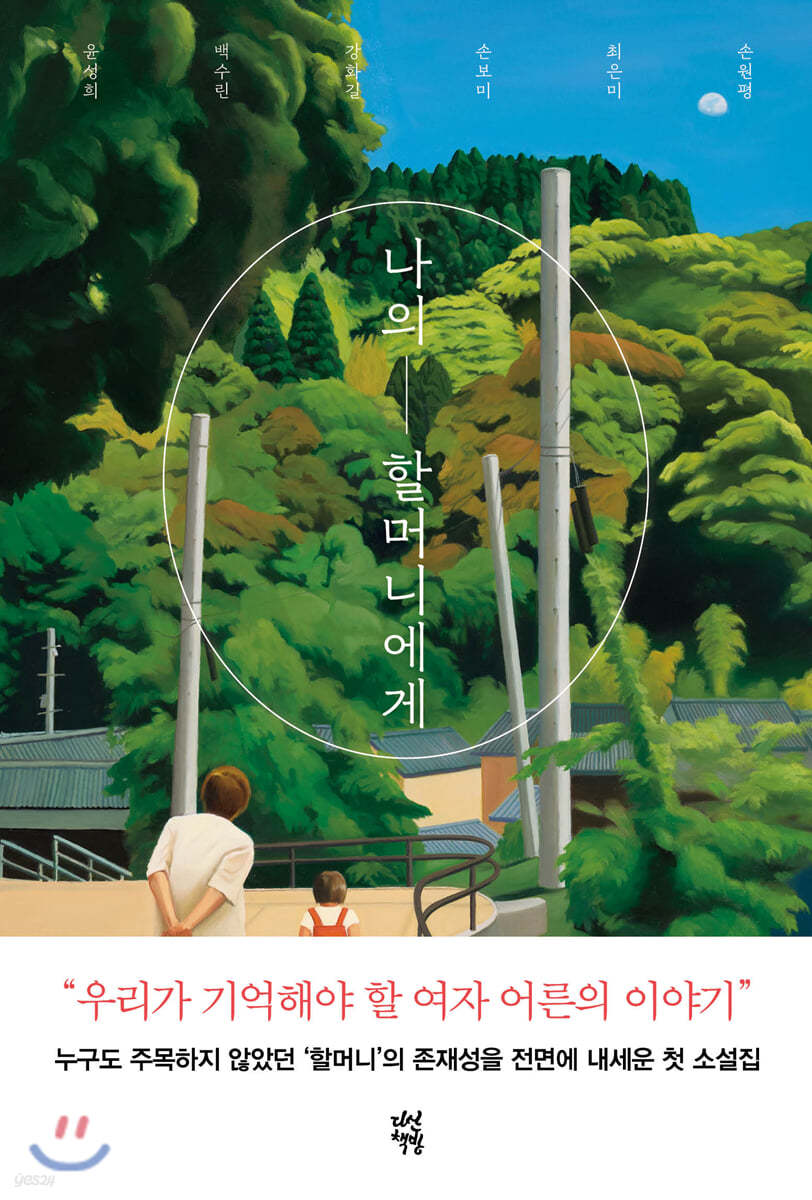
To my grandmother
 |
Description
Book Introduction
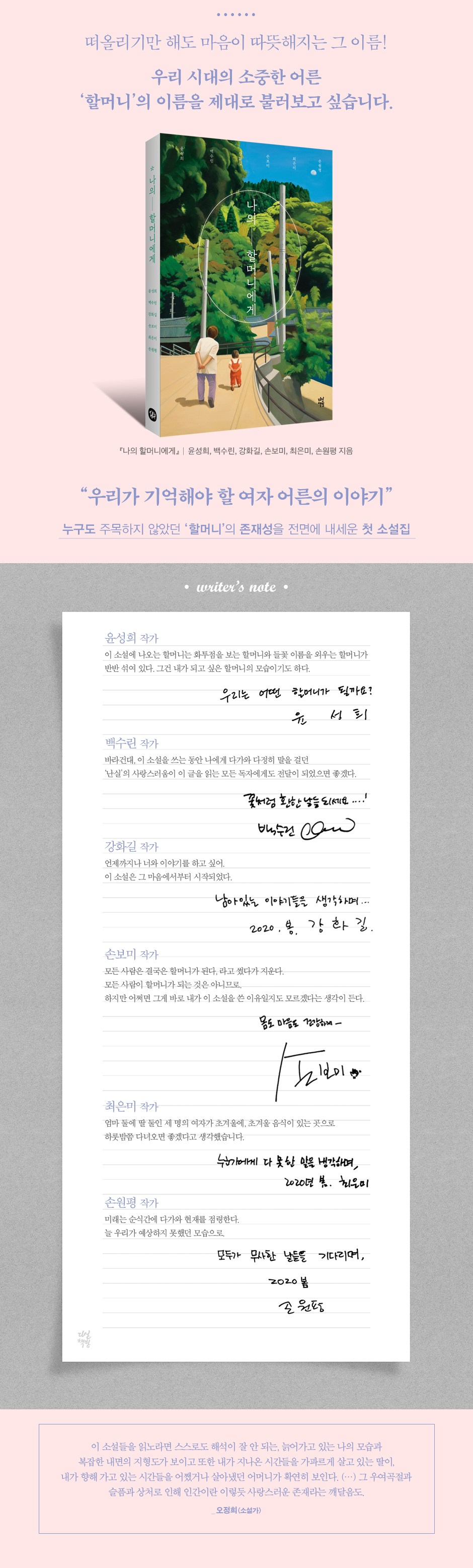
Women who have undoubtedly been by our side, but have never been looked at with any degree of certainty. "To My Grandmother" began with the desire to properly call out the names of "grandmothers," precious adults of our time who faithfully lived through difficult times, even though they are still marginalized and unnoticed in many parts of society. Six of the most active female writers in the Korean literary world today (Yoon Seong-hee, Baek Su-rin, Kang Hwa-gil, Son Bo-mi, Choi Eun-mi, and Son Won-pyeong) each portrayed the incredible life drama of those who overcame harmful times with harmless love, each with their own unique sensibilities and individuality. Even in an age when the meaning of family is fading, there are those who raised and cherished us in place of our parents. A witness to history who endured an era, erasing her own name for the sake of her family and the unfair world that oppressed women. A word that always warms my heart when I think of it. This book contains six novels about grandmothers, “women who have undoubtedly been by our side but have never been looked at with any certainty” (Hwang Ye-in, Preface). |
- You can preview some of the book's contents.
Preview
index
Yoon Seong-hee · The dream I had yesterday
Baeksurin and brown sugar candy
Gangwha-gil · Sunbed
Son Bo-mi · Great Legacy
Eunmi Choi · November
Son Won-pyeong and Ariadne Garden
Preface_Hwang Ye-in · Not yet, but at the same time, already a grandmother
Baeksurin and brown sugar candy
Gangwha-gil · Sunbed
Son Bo-mi · Great Legacy
Eunmi Choi · November
Son Won-pyeong and Ariadne Garden
Preface_Hwang Ye-in · Not yet, but at the same time, already a grandmother
Detailed image
Into the book
Ji-hoo told me to recite the spell, so I grabbed the stick and tried it.
But the words wouldn't come out of my mouth.
I shook the stick and recited a spell in my head.
Please make the little ghost that follows my son disappear.
Please let my daughter call me once a week.
As I handed the stick to Ji-hoo, I said that I had recited a spell in my head.
“Can you tell me what the order is?” Ji-hoo asked, so I whispered in his ear.
“I wished to become a grandmother.
“When my grandchild is born, I will tell him a story.”
--- Yoon Seong-hee, from "The Dream I Had Yesterday"
As time passed, the loneliness inside my grandmother piled up silently like snow.
At first, it was a thin film that seemed like it would melt soon.
But soon it would have formed a thick and hard layer that would reach up to the waist.
However, I was so desperately trying not to look like the typical Asian girl with an overly serious and humorless sense of humor in the eyes of my barely-made friends that I didn't realize that my grandmother went to the supermarket to buy sanitary pads for me when I just started my period, but ended up standing blankly in front of a display case full of tampons, not knowing what they were, and that when I got bored after a long day, I would deliberately go to a Japanese grocery store to chat with someone, but felt a mixture of pride and shame whenever I managed to communicate fluently with the Japanese owner.
--- Baek Su-rin, from "Black Sugar Candy"
I never asked my grandmother what she thought of Myeongju.
There was no need for that.
My grandmother loved Myeongju and praised her many times.
I couldn't help but know that it was true.
She was always worried about me, and always thought about me being left alone after she passed away.
I could tell without even asking.
But there was more I didn't know.
--- Kang Hwa-gil, from "Sunbed"
If you think about it, her very existence was wrong at that time.
At the time, her grandmother was torn between wanting to publicly expose the scandal surrounding her daughter-in-law and to rip up all the time and space connected to her daughter-in-law, put it in a coffin, and solder the opening.
Chopping and soldering, both of course, were my grandmother's ways.
She knew that her grandmother would eventually choose the latter.
Because my grandmother must have been convinced that this choice was the only way to show that her mother's scandal had not affected her in any way.
--- Son Bo-mi, from "The Great Legacy"
Gyu-ok had red spots appearing here and there on her skin.
Even after going to the hospital, the cause was not found, and even after taking herbal medicine and getting acupuncture, there was no improvement.
That was something Gyu-ok had never experienced in the past 60 years of his life.
Recently, things that were happening to Gyu-ok's body for the first time in her life were happening more dramatically than ever before.
On the waist, on the shoulders, on the wrists, on the blood vessels, like a sign, like a result, like a beginning.
It seemed like something that was bound to show up on the surface of the skin.
--- Choi Eun-mi, from "November Journey"
If I had gotten married sooner, if I had taken on a huge debt and bought a house in the city center early, would everything have been different?
Minah had been plagued by doubts and regrets for half her life, wondering if the life she had never lived was the right answer.
The good thing about meeting Jiyoon is that I learned that there are no right answers in life.
I felt sorry for Jiyoon, but it was actually quite a relief.
Jiyoon, who lived a life that everyone envied, ended up in Unit D.
But the words wouldn't come out of my mouth.
I shook the stick and recited a spell in my head.
Please make the little ghost that follows my son disappear.
Please let my daughter call me once a week.
As I handed the stick to Ji-hoo, I said that I had recited a spell in my head.
“Can you tell me what the order is?” Ji-hoo asked, so I whispered in his ear.
“I wished to become a grandmother.
“When my grandchild is born, I will tell him a story.”
--- Yoon Seong-hee, from "The Dream I Had Yesterday"
As time passed, the loneliness inside my grandmother piled up silently like snow.
At first, it was a thin film that seemed like it would melt soon.
But soon it would have formed a thick and hard layer that would reach up to the waist.
However, I was so desperately trying not to look like the typical Asian girl with an overly serious and humorless sense of humor in the eyes of my barely-made friends that I didn't realize that my grandmother went to the supermarket to buy sanitary pads for me when I just started my period, but ended up standing blankly in front of a display case full of tampons, not knowing what they were, and that when I got bored after a long day, I would deliberately go to a Japanese grocery store to chat with someone, but felt a mixture of pride and shame whenever I managed to communicate fluently with the Japanese owner.
--- Baek Su-rin, from "Black Sugar Candy"
I never asked my grandmother what she thought of Myeongju.
There was no need for that.
My grandmother loved Myeongju and praised her many times.
I couldn't help but know that it was true.
She was always worried about me, and always thought about me being left alone after she passed away.
I could tell without even asking.
But there was more I didn't know.
--- Kang Hwa-gil, from "Sunbed"
If you think about it, her very existence was wrong at that time.
At the time, her grandmother was torn between wanting to publicly expose the scandal surrounding her daughter-in-law and to rip up all the time and space connected to her daughter-in-law, put it in a coffin, and solder the opening.
Chopping and soldering, both of course, were my grandmother's ways.
She knew that her grandmother would eventually choose the latter.
Because my grandmother must have been convinced that this choice was the only way to show that her mother's scandal had not affected her in any way.
--- Son Bo-mi, from "The Great Legacy"
Gyu-ok had red spots appearing here and there on her skin.
Even after going to the hospital, the cause was not found, and even after taking herbal medicine and getting acupuncture, there was no improvement.
That was something Gyu-ok had never experienced in the past 60 years of his life.
Recently, things that were happening to Gyu-ok's body for the first time in her life were happening more dramatically than ever before.
On the waist, on the shoulders, on the wrists, on the blood vessels, like a sign, like a result, like a beginning.
It seemed like something that was bound to show up on the surface of the skin.
--- Choi Eun-mi, from "November Journey"
If I had gotten married sooner, if I had taken on a huge debt and bought a house in the city center early, would everything have been different?
Minah had been plagued by doubts and regrets for half her life, wondering if the life she had never lived was the right answer.
The good thing about meeting Jiyoon is that I learned that there are no right answers in life.
I felt sorry for Jiyoon, but it was actually quite a relief.
Jiyoon, who lived a life that everyone envied, ended up in Unit D.
--- Son Won-pyeong, from “Ariadne’s Garden”
Publisher's Review
“Reading these novels, I see myself aging and the complex topography of my inner self, which I find difficult to interpret myself. I also see my daughter, who is living the steep times I have passed, and my mother, who has somehow managed to survive the times I am heading toward.”
_ Oh Jeong-hee (novelist)
Women who have undoubtedly been by our side, but have never been looked at with any degree of certainty.
The late Kim Bok-dong, a victim of Japanese military sexual slavery, worked to improve women's rights for nearly 30 years after reporting the abuse, and passed away last year, leaving behind the words, "I live with hope, so follow me."
However, in the 'here and now' where crimes and violence against women are openly committed, as in the 'Telegram Nth Room' case, it is still difficult for women to live with peace of mind and hope.
Moreover, even in feminist discourse, ‘grandmothers’ remain on the periphery and, even in reality, they become the target of baseless anger and resentment directed at the weak.
Just like Grandma Kim Bok-dong, who left behind 'hope' as her will, a grandmother who whispers hope with her life rather than giving advice or counsel right in front of her is invaluable.
This is because a grandmother like this would likely say, “Nevertheless, I cannot stop hoping; this is what it means to be alive” (Kang Hwa-gil, “Sunbed”), and “It is because of the twists and turns, the sadness, and the wounds that humans are such lovable beings” (Oh Jeong-hee, Recommendation).
"To My Grandmother" began with the desire to properly call out the names of "grandmothers," precious adults of our time who faithfully lived through difficult times, even though they are still marginalized and unnoticed in many parts of society.
Six of the most active female writers in the Korean literary world today (Yoon Seong-hee, Baek Su-rin, Kang Hwa-gil, Son Bo-mi, Choi Eun-mi, and Son Won-pyeong) each portrayed the incredible life drama of those who overcame harmful times with harmless love, each with their own unique sensibilities and individuality.
Even in an age when the meaning of family is fading, there are those who raised and cherished us in place of our parents.
A witness to history who endured an era, erasing her own name for the sake of her family and the unfair world that oppressed women.
A word that always warms my heart when I think of it.
This book contains six novels about grandmothers, “women who have undoubtedly been by our side but have never been looked at with any certainty” (Hwang Ye-in, Preface).
The first novel collection to highlight the existence of "grandmother," a character no one had previously noticed.
As a 'female adult', my grandmother still lives in the same era as us.
In a reality where about half of the children in dual-income families are raised by their grandmothers, our grandmothers silently endure the "second childcare" that is close to hard labor, while suffering from arthritis and depression and not receiving proper child support.
Why are our grandmothers, who (perhaps) were not granted equal authority at home by their husbands and (most likely) were not guaranteed equal opportunities socially, still not treated as adults who lived their lives to the fullest?
This book is the first collection of short stories to bring to the forefront the existence of 'grandmothers', a topic that no one had previously paid attention to.
Yun Seong-hee's "The Dream I Had Yesterday," winner of the 2019 Kim Seung-ok Literary Award, vividly expresses the speaker's wish to become a good grandmother who "tells storybooks when her grandchildren are born," while also feeling sad that her children do not contact her even on the anniversary of her husband's death.
Baek Su-rin's "Black Sugar Candy," winner of the 2020 Contemporary Literature Award, depicts a grandmother who dreamed of becoming a pianist in her youth and "believed she had a duty to make life a special narrative," but who ultimately felt like she had "stretched out on a strange island alone," transforming her loneliness and isolation into a beautiful and loving life.
The latest work by Kang Hwa-gil, winner of the 2020 Young Writer's Award, "Sunbed," tells the story of a granddaughter and her friend Myeong-ju, who visit their grandmother who is hospitalized in a nursing home. The story is about the grandmother's harmless love, which worries about her granddaughter "who will be left alone after she passes away," but who eventually develops dementia and "completely forgets her granddaughter." The story is quickly portrayed with restrained scenes and composition.
Son Bo-mi's "The Great Legacy," the most-received Young Writer's Award winner, traces the events that unfold as "I" returns to the "huge house" I inherited from my grandmother after 10 years to dispose of it and encounters the woman who worked as a housekeeper in this house when I was young, using delicate psychological descriptions and a tense development.
Choi Eun-mi's "November Journey," winner of the 2018 Daesan Literary Award, tells the story of women who go on a temple stay at Sudeoksa Temple on a weekend in November. Through the speaker who "leaves something (...) left behind forever", the novel asks, in dense sentences, what it means to lose time.
"Ariadne's Garden" by Won-pyeong Son, the author of "Almond," a bestseller that sold 250,000 copies and was the first Asian novel to win the Japan Booksellers' Award, sharply depicts the problems of the elderly, generational conflict, and immigrant issues in the near future through the protagonist who must live in "Unit D" as an "old woman" despite the elegant name "Ariadne's Garden".
The story of a female adult we must remember
Literary critic Hwang Ye-in says, “Reading the stories of these grandmothers is a way to connect with the past and also a process of recognizing our future.”
Then, young women who grow up through ups and downs, and mature women who realize the power of solidarity and become courageous.
Could we place older women here? Clearly, the presence of grandmothers, now more prominent than before, would open up the possibility of mutual understanding and communication.
Novelist Oh Jeong-hee also stated in her recommendation that these works “break down common notions and prejudices about old age, rejecting hasty solutions such as acceptance, resignation, and reconciliation, and instead conveying to us the incomprehensibility of life, the mystery of human existence, and the lingering fragrance of all that has been experienced and endured as we pass through this world.”
When you feel a lump in your throat while enduring the harsh reality alone, when you want to hold onto those rough, dry, yet warm hands, when you feel immature even though you are already an adult, and when you are hesitantly crossing from one side of life to the other, this book will be a shining milestone and a wonderful comfort that warms your heart just by thinking about it.
_ Oh Jeong-hee (novelist)
Women who have undoubtedly been by our side, but have never been looked at with any degree of certainty.
The late Kim Bok-dong, a victim of Japanese military sexual slavery, worked to improve women's rights for nearly 30 years after reporting the abuse, and passed away last year, leaving behind the words, "I live with hope, so follow me."
However, in the 'here and now' where crimes and violence against women are openly committed, as in the 'Telegram Nth Room' case, it is still difficult for women to live with peace of mind and hope.
Moreover, even in feminist discourse, ‘grandmothers’ remain on the periphery and, even in reality, they become the target of baseless anger and resentment directed at the weak.
Just like Grandma Kim Bok-dong, who left behind 'hope' as her will, a grandmother who whispers hope with her life rather than giving advice or counsel right in front of her is invaluable.
This is because a grandmother like this would likely say, “Nevertheless, I cannot stop hoping; this is what it means to be alive” (Kang Hwa-gil, “Sunbed”), and “It is because of the twists and turns, the sadness, and the wounds that humans are such lovable beings” (Oh Jeong-hee, Recommendation).
"To My Grandmother" began with the desire to properly call out the names of "grandmothers," precious adults of our time who faithfully lived through difficult times, even though they are still marginalized and unnoticed in many parts of society.
Six of the most active female writers in the Korean literary world today (Yoon Seong-hee, Baek Su-rin, Kang Hwa-gil, Son Bo-mi, Choi Eun-mi, and Son Won-pyeong) each portrayed the incredible life drama of those who overcame harmful times with harmless love, each with their own unique sensibilities and individuality.
Even in an age when the meaning of family is fading, there are those who raised and cherished us in place of our parents.
A witness to history who endured an era, erasing her own name for the sake of her family and the unfair world that oppressed women.
A word that always warms my heart when I think of it.
This book contains six novels about grandmothers, “women who have undoubtedly been by our side but have never been looked at with any certainty” (Hwang Ye-in, Preface).
The first novel collection to highlight the existence of "grandmother," a character no one had previously noticed.
As a 'female adult', my grandmother still lives in the same era as us.
In a reality where about half of the children in dual-income families are raised by their grandmothers, our grandmothers silently endure the "second childcare" that is close to hard labor, while suffering from arthritis and depression and not receiving proper child support.
Why are our grandmothers, who (perhaps) were not granted equal authority at home by their husbands and (most likely) were not guaranteed equal opportunities socially, still not treated as adults who lived their lives to the fullest?
This book is the first collection of short stories to bring to the forefront the existence of 'grandmothers', a topic that no one had previously paid attention to.
Yun Seong-hee's "The Dream I Had Yesterday," winner of the 2019 Kim Seung-ok Literary Award, vividly expresses the speaker's wish to become a good grandmother who "tells storybooks when her grandchildren are born," while also feeling sad that her children do not contact her even on the anniversary of her husband's death.
Baek Su-rin's "Black Sugar Candy," winner of the 2020 Contemporary Literature Award, depicts a grandmother who dreamed of becoming a pianist in her youth and "believed she had a duty to make life a special narrative," but who ultimately felt like she had "stretched out on a strange island alone," transforming her loneliness and isolation into a beautiful and loving life.
The latest work by Kang Hwa-gil, winner of the 2020 Young Writer's Award, "Sunbed," tells the story of a granddaughter and her friend Myeong-ju, who visit their grandmother who is hospitalized in a nursing home. The story is about the grandmother's harmless love, which worries about her granddaughter "who will be left alone after she passes away," but who eventually develops dementia and "completely forgets her granddaughter." The story is quickly portrayed with restrained scenes and composition.
Son Bo-mi's "The Great Legacy," the most-received Young Writer's Award winner, traces the events that unfold as "I" returns to the "huge house" I inherited from my grandmother after 10 years to dispose of it and encounters the woman who worked as a housekeeper in this house when I was young, using delicate psychological descriptions and a tense development.
Choi Eun-mi's "November Journey," winner of the 2018 Daesan Literary Award, tells the story of women who go on a temple stay at Sudeoksa Temple on a weekend in November. Through the speaker who "leaves something (...) left behind forever", the novel asks, in dense sentences, what it means to lose time.
"Ariadne's Garden" by Won-pyeong Son, the author of "Almond," a bestseller that sold 250,000 copies and was the first Asian novel to win the Japan Booksellers' Award, sharply depicts the problems of the elderly, generational conflict, and immigrant issues in the near future through the protagonist who must live in "Unit D" as an "old woman" despite the elegant name "Ariadne's Garden".
The story of a female adult we must remember
Literary critic Hwang Ye-in says, “Reading the stories of these grandmothers is a way to connect with the past and also a process of recognizing our future.”
Then, young women who grow up through ups and downs, and mature women who realize the power of solidarity and become courageous.
Could we place older women here? Clearly, the presence of grandmothers, now more prominent than before, would open up the possibility of mutual understanding and communication.
Novelist Oh Jeong-hee also stated in her recommendation that these works “break down common notions and prejudices about old age, rejecting hasty solutions such as acceptance, resignation, and reconciliation, and instead conveying to us the incomprehensibility of life, the mystery of human existence, and the lingering fragrance of all that has been experienced and endured as we pass through this world.”
When you feel a lump in your throat while enduring the harsh reality alone, when you want to hold onto those rough, dry, yet warm hands, when you feel immature even though you are already an adult, and when you are hesitantly crossing from one side of life to the other, this book will be a shining milestone and a wonderful comfort that warms your heart just by thinking about it.
GOODS SPECIFICS
- Date of issue: May 8, 2020
- Page count, weight, size: 239 pages | 378g | 134*194*18mm
- ISBN13: 9791130629612
- ISBN10: 1130629619
You may also like
카테고리
korean


korean

![GQ KOREA Mark (Monthly): December [2025]](http://librairie.coreenne.fr/cdn/shop/files/8ef265dbbfbf186523ed75ba7319009d.jpg?v=1765340328&width=3840)


