

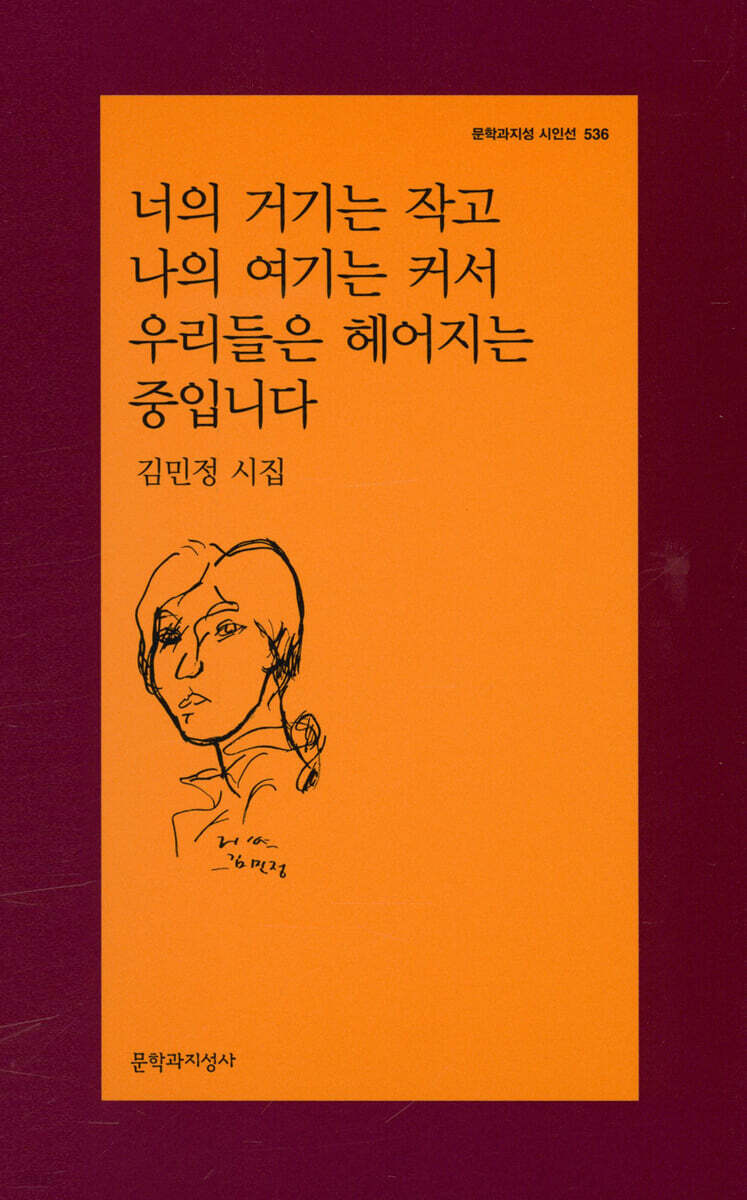
Your place is small and mine is big, so we are breaking up.
 |
Description
Book Introduction
- A word from MD
-
"Beautiful and Useless," a new work by poet Kim Min-jeongThis is the fourth poetry collection by poet Kim Min-jeong, who has been writing poetry and publishing books for over 20 years, but whose “love for literature is still very much alive and in full swing.”
He says that there is nothing he loves the most, but there will be a lot of love, and in the stories and songs that he tells in the language of love, he says, "We too are excited" (Park Jun).
December 20, 2019. Novel/Poetry PD Kim Do-hoon
In the language of directness, honesty, and frankness
A long love that embraces a weak and painful life
Writer: Kim Min-jeong
A beloved poet and successful editor.
Since winning the Munye Joongang New Writer's Award in the poetry category in 1999 with "Black Nana's Dream" and nine other poems, she has published works such as "The Flying Hedgehog Lady," "She Began to Feel for the First Time," and "I Wish She Was Beautiful and Useless," and this year marks her 20th anniversary since her literary debut.
He also started working at a magazine in 1998, published over 40 poetry collections at Munye Joongang in 2005, and took on a second term at Munhakdongne in 2009, launching a poetry selection.
Although more than 20 years have passed since she began writing poetry and publishing books, her love for literature is still strong and vibrant.
Poet Kim Min-jeong, who published her fourth poetry collection, “Your place is small, my place is big, so we are parting ways,” containing forty-four poems in the winter of her forty-fourth year.
As expected from a master of poetry, the title itself is unique.
The poet explained the unconventional title in a recent interview:
Compared to my passion and desire for literature, the hole in the essence of literature has always been too small, so it feels like I'm taking a long detour and constantly breaking away.
But the reason I expressed it as ‘in the process of breaking up’ rather than ‘we broke up’ is because I felt that the ‘in-between’ itself was like the ‘existence of poetry.’
(Paper, Fall 2019 issue)
The poet's desire to write was intense, and poetry kept her alive.
The expression ‘crossing the boundaries of poetry’ has been with the poet for a long time.
Poetry and language, which the poet has persistently questioned since his debut work.
In this collection of poems by Kim Min-jeong, who flexibly stretches the rigid walls of convention and gives language to a world we have turned away from, we glimpse the will and calling as a poet that still burns brightly within her.
There is no greatest love, but there will be much love, and in the end, I am the one who holds the greatest love of all, so I am leaving to embrace you, who cannot leave or stay, who cannot live or die, who cannot sleep today as well.
It's been a long time since we left.
A long love that embraces a weak and painful life
Writer: Kim Min-jeong
A beloved poet and successful editor.
Since winning the Munye Joongang New Writer's Award in the poetry category in 1999 with "Black Nana's Dream" and nine other poems, she has published works such as "The Flying Hedgehog Lady," "She Began to Feel for the First Time," and "I Wish She Was Beautiful and Useless," and this year marks her 20th anniversary since her literary debut.
He also started working at a magazine in 1998, published over 40 poetry collections at Munye Joongang in 2005, and took on a second term at Munhakdongne in 2009, launching a poetry selection.
Although more than 20 years have passed since she began writing poetry and publishing books, her love for literature is still strong and vibrant.
Poet Kim Min-jeong, who published her fourth poetry collection, “Your place is small, my place is big, so we are parting ways,” containing forty-four poems in the winter of her forty-fourth year.
As expected from a master of poetry, the title itself is unique.
The poet explained the unconventional title in a recent interview:
Compared to my passion and desire for literature, the hole in the essence of literature has always been too small, so it feels like I'm taking a long detour and constantly breaking away.
But the reason I expressed it as ‘in the process of breaking up’ rather than ‘we broke up’ is because I felt that the ‘in-between’ itself was like the ‘existence of poetry.’
(Paper, Fall 2019 issue)
The poet's desire to write was intense, and poetry kept her alive.
The expression ‘crossing the boundaries of poetry’ has been with the poet for a long time.
Poetry and language, which the poet has persistently questioned since his debut work.
In this collection of poems by Kim Min-jeong, who flexibly stretches the rigid walls of convention and gives language to a world we have turned away from, we glimpse the will and calling as a poet that still burns brightly within her.
There is no greatest love, but there will be much love, and in the end, I am the one who holds the greatest love of all, so I am leaving to embrace you, who cannot leave or stay, who cannot live or die, who cannot sleep today as well.
It's been a long time since we left.
- You can preview some of the book's contents.
Preview
index
Sunday, January 1st/The bowl has risen/Poets who only write numbers and not poetry/I wrote and erased and then it disappeared/In my dream, I was a Sri Lankan woman/I have a really bad aftertaste/That's why summer doesn't call me/Cologne Cathedral/Clue/Now you become a person/I'm clumsy because I'm in a hurry It's not that I'm clumsy because I'm in a hurry/I guess it's thanks to my blunder/Is that your shovel? It's my shovel! / One day that place becomes you, and one day you become there / Why do miracles not ring miracles and confuse people? / Have you ever heard of it? / Anyway, it seems like a player, the end / I feel it so much that my heart is moved / One story about someone else that makes me useless / Two stories about someone else that makes me useless / It must have been about ten and a day ago / Soo-kyung's dot dot dot / I don't know, but / You do all the fun things / Cheol-gyu's potatoes / Jun-i's onions / That bucket / There's something else strange / Beidao / Jake who buys sweet potatoes / Jake's text / When I reach a woman who knows how to sleep but doesn't know how to do it / We can do that / Evening / It's a night sitting on a seesaw / The end and honey water / Break, break / Ears fall / Three stories about someone else that makes me useless / If conversation doesn't work, at least digest / It's me / Three times / Stories about someone else that makes me useless Net/I couldn't finish it without putting a period because it was lacking.
epilogue
We also have Poljak and Park Jun
epilogue
We also have Poljak and Park Jun
Into the book
It's a night where my butt is numb and I'm sitting on a seesaw.
It's a night where I'm sitting on a seesaw in a short-sleeved T-shirt and panties.
There's a jungle gym, a swing, a horizontal bar, a slide, and it's a night where you sit on a seesaw.
There is no one on the other side, so it is a night where I sit on a seesaw, year after year.
It's a night when I'm sitting on the seesaw, staring at the other side to see if there's really anyone there.
Who called me out? I came out alone. It's a night where I sit on a seesaw.
It's a night where I sit on the seesaw and dig my feet deeper into the sand because I don't want to bother shaking the sand off my feet.
I said I would never have a night like that again because it happened one night, but I forgot again and am sitting on the seesaw again.
--- From "It's a Night Sitting on a Seesaw"
As long as this is difficult to do, I'll keep unraveling the scroll between my resentment and my conscience until it becomes easier to do something about it.
Right, but have you seen that? In 1977, at the [Teen Singer Festival], when Hye-eun was singing "I Only Love You," Gil Ok-yoon was playing the saxophone next to her. She was smiling brightly and prettily, and her cheeks were puffed out as she blew it.
I know Hye-eun's voice, but I don't know Gil Ok-yoon's voice.
Why did Gil Ok-yoon play the saxophone so passionately back then, when she wasn't even showing off her voice?
They used to blow like that, but now where are they and what are they blowing?
I don't know.
I didn't know, so I wrote and erased it, and then it disappeared.
--- From "I wrote it, erased it, and then it disappeared"
It's not over just because you can't eat one bite of the meal.
You can't even pull out one of those fancy peppers
There are only useless girls hanging around in that world
What can I do about all these women who are going to eat my food?
You're saying it's a waste to even click your tongue right now, so tsk tsk
That old man with the bear head isn't even my grandfather
He came wearing a black hat and a jade-colored robe.
After taking off the black hat and jade-colored overcoat,
You're eating it right now, slurping it down
I'm talking nonsense, but I'm talking nonsense, so put it in your mouth
Fish stew, fish meat, and meat pancake
Marinate the short ribs in crab sauce and fry the shrimp
Mom is crazy, mom is crazy
Yeah, I'm crazy, I'm crazy, so I'll live with your dad.
Just bring the little one into this house while peeling the persimmon.
I'm going to poke your eyes out with this
It's a night where I'm sitting on a seesaw in a short-sleeved T-shirt and panties.
There's a jungle gym, a swing, a horizontal bar, a slide, and it's a night where you sit on a seesaw.
There is no one on the other side, so it is a night where I sit on a seesaw, year after year.
It's a night when I'm sitting on the seesaw, staring at the other side to see if there's really anyone there.
Who called me out? I came out alone. It's a night where I sit on a seesaw.
It's a night where I sit on the seesaw and dig my feet deeper into the sand because I don't want to bother shaking the sand off my feet.
I said I would never have a night like that again because it happened one night, but I forgot again and am sitting on the seesaw again.
--- From "It's a Night Sitting on a Seesaw"
As long as this is difficult to do, I'll keep unraveling the scroll between my resentment and my conscience until it becomes easier to do something about it.
Right, but have you seen that? In 1977, at the [Teen Singer Festival], when Hye-eun was singing "I Only Love You," Gil Ok-yoon was playing the saxophone next to her. She was smiling brightly and prettily, and her cheeks were puffed out as she blew it.
I know Hye-eun's voice, but I don't know Gil Ok-yoon's voice.
Why did Gil Ok-yoon play the saxophone so passionately back then, when she wasn't even showing off her voice?
They used to blow like that, but now where are they and what are they blowing?
I don't know.
I didn't know, so I wrote and erased it, and then it disappeared.
--- From "I wrote it, erased it, and then it disappeared"
It's not over just because you can't eat one bite of the meal.
You can't even pull out one of those fancy peppers
There are only useless girls hanging around in that world
What can I do about all these women who are going to eat my food?
You're saying it's a waste to even click your tongue right now, so tsk tsk
That old man with the bear head isn't even my grandfather
He came wearing a black hat and a jade-colored robe.
After taking off the black hat and jade-colored overcoat,
You're eating it right now, slurping it down
I'm talking nonsense, but I'm talking nonsense, so put it in your mouth
Fish stew, fish meat, and meat pancake
Marinate the short ribs in crab sauce and fry the shrimp
Mom is crazy, mom is crazy
Yeah, I'm crazy, I'm crazy, so I'll live with your dad.
Just bring the little one into this house while peeling the persimmon.
I'm going to poke your eyes out with this
--- From "A Woman Who Knows How to Do Well, But Doesn't Know How to Do It"
Publisher's Review
Days of eating, drinking, and pouring
Kim Min-jeong's poetry has always been a straight ball without a curve.
The early poems, overflowing with direct and shocking images, were often criticized as “somewhat uncomfortable poetry” and “rough, extreme, improvisational, and violent” (Lee Jang-wook), and led to the discovery of “a ‘black play’ that castrated and blocked such laughter, rather than a play that induces comical laughter” (Kang Gye-sook).
It showed an “intense attack power” that no one could match, but through this, it “captured the scenery of this era, which is shabby but not without a pleasant side” (Kim In-hwan), and added depth and weight to it.
Poet Lee Won wrote in the preface to her previous poetry collection, “The way of the decisive moment.
Since I don't even dream of beating around the bush, I sometimes say that I "arrest life on the spot" rather than "capture life on the spot."
In this collection of poems, Kim Min-jeong does not embellish life, but looks at the world with a free-spirited yet not frivolous gaze.
I try to resolve that I won’t “write a damn poem/write a slur on my eyes” (“Sunday, January 1st”), but I think, “I’m so sick of it, I’m just going to come home and make kimchi and some gochujang rice cakes and pour some soju.”
“Why do we all have to suffer this much when we are born?” (“Poets Who Write Numbers, Not Poetry”).
“There are hallucinations and no expectations/There are illusions and no expectations/There are expectations and no hugs/There are hugs and no you.”
In this time of absence and loss, there is “me who is kicking ass while picking dog poop off the soles of my shoes” (“I Have a Great Aftertaste”).
A heart that is visible is a heart that must be used.
A written heart is a heart that must be read.
A read heart is a discovered heart.
A caught mind is a spreading mind.
The poem should spread like wildfire and not be kept secret.
[… … ] My heart is still living in a time when today becomes yesterday.
This heart.
That is my heart, which can read tomorrow the poem I wrote today and tear up tomorrow what I read today.
This heart.
My heart is such that no one can say anything even if I say that it is more comfortable to have a side dish than to have a side dish.
This heart.
My honesty that there is something and nothing is not true makes sense.
("Is that your shovel? It's mine!" part)
The poet's unique keen sense is an eye that sees the other side of the world.
Ten years ago, she first began to feel that there was someone inside her who was turning his back on her.
A poem that is like a long ritual or a novel, written by eating, listening, being possessed, and pouring out everything.
Whether it's dog shit, hemorrhoids, or shit, everything in her poetry can be beautiful because of the eyes that shine in the honesty that pours out life.
Sincerity toward the presence of nothingness
The theme that runs through this collection of poems is 'Gokdu', or the illusion of something that is not right in front of one's eyes.
While many of the poet's previous poems have addressed women's issues and contained vivid narratives based on the participants' own experiences, this collection shares the same critical awareness while broadening its horizons to include the lives of our neighbors, foreign workers in Korea, and women overseas, whom we have rarely, if ever, looked upon with envy.
It's been four months since I came back to Korea.
I went in and came out again.
I went in and came out again.
Because I like Korea.
It's been over 10 years since I came and went.
I learned massage when I was twenty.
I'm strong, so customers like me.
I am thirty-three years old.
My husband lives in Tianjin.
I haven't seen you in a long time.
I miss you.
Mongolia is nice, but it's boring when you go there.
There are only stars.
But I haven't seen anything like the Mongolian Star in Korea.
Shall I show you a picture of Mongolian stars? (Part 3 of "Three Stories of Other People That Make Me Unusable")
All of them, existing independently, have specific names.
[… … ] Every name signifies her dignity.
This is a phrase that gave me a deep realization when I was working on the assembly line.
My name is Zheng Xiaochong.
Please don't call me a Chinese female worker.
(Excerpt from "Four Stories of Other People That Make Me Unusable")
The poet sees.
People who clearly live together but people don't envy them, so they are invisible even though they are there and then disappear before you know it.
The world is so narrow and frustrating for her, where real events are so shocking that they are easily believed to be fiction and covered up, while embellished stories are believed to be true.
Therefore, this collection of poems contains a deep love that seeks to directly look at, understand, and approach the pain and sorrow of our erased neighbors and to show solidarity through language.
As the poet says in his prose on the back cover, “The topic is a topic of conversation. / But love gave me language.”
The stories of these poets will be a great source of motivation and inspiration for poets.
In “The Poet’s Words,” the poet says, “I am my appendix,” and that he is always the last person to himself, but we know.
There is no last one.
There is just a lot of love.
Kim Min-jeong's poetry has always been a straight ball without a curve.
The early poems, overflowing with direct and shocking images, were often criticized as “somewhat uncomfortable poetry” and “rough, extreme, improvisational, and violent” (Lee Jang-wook), and led to the discovery of “a ‘black play’ that castrated and blocked such laughter, rather than a play that induces comical laughter” (Kang Gye-sook).
It showed an “intense attack power” that no one could match, but through this, it “captured the scenery of this era, which is shabby but not without a pleasant side” (Kim In-hwan), and added depth and weight to it.
Poet Lee Won wrote in the preface to her previous poetry collection, “The way of the decisive moment.
Since I don't even dream of beating around the bush, I sometimes say that I "arrest life on the spot" rather than "capture life on the spot."
In this collection of poems, Kim Min-jeong does not embellish life, but looks at the world with a free-spirited yet not frivolous gaze.
I try to resolve that I won’t “write a damn poem/write a slur on my eyes” (“Sunday, January 1st”), but I think, “I’m so sick of it, I’m just going to come home and make kimchi and some gochujang rice cakes and pour some soju.”
“Why do we all have to suffer this much when we are born?” (“Poets Who Write Numbers, Not Poetry”).
“There are hallucinations and no expectations/There are illusions and no expectations/There are expectations and no hugs/There are hugs and no you.”
In this time of absence and loss, there is “me who is kicking ass while picking dog poop off the soles of my shoes” (“I Have a Great Aftertaste”).
A heart that is visible is a heart that must be used.
A written heart is a heart that must be read.
A read heart is a discovered heart.
A caught mind is a spreading mind.
The poem should spread like wildfire and not be kept secret.
[… … ] My heart is still living in a time when today becomes yesterday.
This heart.
That is my heart, which can read tomorrow the poem I wrote today and tear up tomorrow what I read today.
This heart.
My heart is such that no one can say anything even if I say that it is more comfortable to have a side dish than to have a side dish.
This heart.
My honesty that there is something and nothing is not true makes sense.
("Is that your shovel? It's mine!" part)
The poet's unique keen sense is an eye that sees the other side of the world.
Ten years ago, she first began to feel that there was someone inside her who was turning his back on her.
A poem that is like a long ritual or a novel, written by eating, listening, being possessed, and pouring out everything.
Whether it's dog shit, hemorrhoids, or shit, everything in her poetry can be beautiful because of the eyes that shine in the honesty that pours out life.
Sincerity toward the presence of nothingness
The theme that runs through this collection of poems is 'Gokdu', or the illusion of something that is not right in front of one's eyes.
While many of the poet's previous poems have addressed women's issues and contained vivid narratives based on the participants' own experiences, this collection shares the same critical awareness while broadening its horizons to include the lives of our neighbors, foreign workers in Korea, and women overseas, whom we have rarely, if ever, looked upon with envy.
It's been four months since I came back to Korea.
I went in and came out again.
I went in and came out again.
Because I like Korea.
It's been over 10 years since I came and went.
I learned massage when I was twenty.
I'm strong, so customers like me.
I am thirty-three years old.
My husband lives in Tianjin.
I haven't seen you in a long time.
I miss you.
Mongolia is nice, but it's boring when you go there.
There are only stars.
But I haven't seen anything like the Mongolian Star in Korea.
Shall I show you a picture of Mongolian stars? (Part 3 of "Three Stories of Other People That Make Me Unusable")
All of them, existing independently, have specific names.
[… … ] Every name signifies her dignity.
This is a phrase that gave me a deep realization when I was working on the assembly line.
My name is Zheng Xiaochong.
Please don't call me a Chinese female worker.
(Excerpt from "Four Stories of Other People That Make Me Unusable")
The poet sees.
People who clearly live together but people don't envy them, so they are invisible even though they are there and then disappear before you know it.
The world is so narrow and frustrating for her, where real events are so shocking that they are easily believed to be fiction and covered up, while embellished stories are believed to be true.
Therefore, this collection of poems contains a deep love that seeks to directly look at, understand, and approach the pain and sorrow of our erased neighbors and to show solidarity through language.
As the poet says in his prose on the back cover, “The topic is a topic of conversation. / But love gave me language.”
The stories of these poets will be a great source of motivation and inspiration for poets.
In “The Poet’s Words,” the poet says, “I am my appendix,” and that he is always the last person to himself, but we know.
There is no last one.
There is just a lot of love.
GOODS SPECIFICS
- Publication date: December 10, 2019
- Page count, weight, size: 131 pages | 190g | 128*205*9mm
- ISBN13: 9788932035963
- ISBN10: 8932035962
You may also like
카테고리
korean


korean

![GQ KOREA Mark (Monthly): December [2025]](http://librairie.coreenne.fr/cdn/shop/files/8ef265dbbfbf186523ed75ba7319009d.jpg?v=1765340328&width=3840)


