

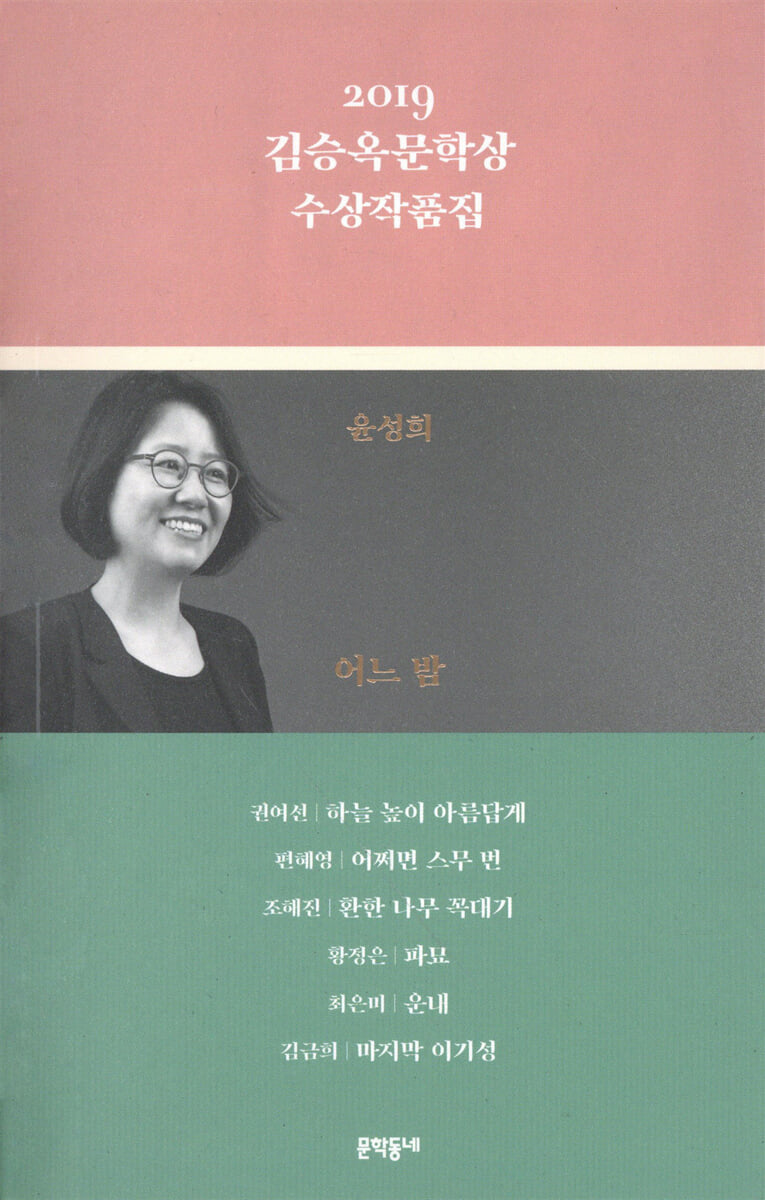
2019 Kim Seung-ok Literary Award Winners' Collection
 |
Description
Book Introduction
- A word from MD
-
Seven Shining Stars of Korean LiteratureA collection of seven novels published over the past year, selected from authors who have been writing for over 10 years.
You can see the power of good sentences and stories, as well as familiar names that can be called "pillars of contemporary literature."
Novels that will allow you to discover and enjoy the depth and uniqueness of Korean literature, something newer than anything else.
October 8, 2019. Novel/Poetry PD Kim Do-hoon
All-Star Stage of Korean Literature
Seven Stars of Contemporary Literature: Newer than New
『2019 Kim Seung-ok Literary Award Winners Collection』
The Kim Seung-ok Literary Award has been hosted by Munhakdongne since 2019.
Among the short stories published over the past year by authors with over 10 years of experience, the seven best works are selected through a blind review process with the author information removed, and among them, one grand prize winner and six excellence award winners are selected to be presented to readers.
In the spring, with the green and energetic Young Writer Award winners' collection, and in the fall, with the mature and solid Kim Seung-ok Literary Award winners' collection, Munhakdongne plans to broaden the scope of Korean literature and share its beauty and joy with readers more frequently.
This year's winners of the Kim Seung-ok Literary Award are Yun Seong-hee, Kwon Yeo-seon, Pyeon Hye-young, Jo Hae-jin, Hwang Jeong-eun, Choi Eun-mi, and Kim Geum-hee.
All of the winners are authors who have established their own unique literary worlds and are at the center and pillars of Korean literature.
In this shining list, “all writers did as well as I did, but Yoon Seong-hee did better than me” (Shin Hyeong-cheol), so the grand prize was awarded to Yoon Seong-hee, and writers Pyeon Hye-young, Jo Hae-jin, Hwang Jeong-eun, Choi Eun-mi, and Kim Geum-hee moved their names from Young Writer’s Award recipients to the Kim Seung-ok Literary Award, proving that they themselves are the future of Korean literature.
Seven works by seven writers worthy of a new beginning for the Kim Seung-ok Literary Award.
It is time to encounter and enjoy the depth and uniqueness of Korean literature, which is newer than anything new.
Seven Stars of Contemporary Literature: Newer than New
『2019 Kim Seung-ok Literary Award Winners Collection』
The Kim Seung-ok Literary Award has been hosted by Munhakdongne since 2019.
Among the short stories published over the past year by authors with over 10 years of experience, the seven best works are selected through a blind review process with the author information removed, and among them, one grand prize winner and six excellence award winners are selected to be presented to readers.
In the spring, with the green and energetic Young Writer Award winners' collection, and in the fall, with the mature and solid Kim Seung-ok Literary Award winners' collection, Munhakdongne plans to broaden the scope of Korean literature and share its beauty and joy with readers more frequently.
This year's winners of the Kim Seung-ok Literary Award are Yun Seong-hee, Kwon Yeo-seon, Pyeon Hye-young, Jo Hae-jin, Hwang Jeong-eun, Choi Eun-mi, and Kim Geum-hee.
All of the winners are authors who have established their own unique literary worlds and are at the center and pillars of Korean literature.
In this shining list, “all writers did as well as I did, but Yoon Seong-hee did better than me” (Shin Hyeong-cheol), so the grand prize was awarded to Yoon Seong-hee, and writers Pyeon Hye-young, Jo Hae-jin, Hwang Jeong-eun, Choi Eun-mi, and Kim Geum-hee moved their names from Young Writer’s Award recipients to the Kim Seung-ok Literary Award, proving that they themselves are the future of Korean literature.
Seven works by seven writers worthy of a new beginning for the Kim Seung-ok Literary Award.
It is time to encounter and enjoy the depth and uniqueness of Korean literature, which is newer than anything new.
- You can preview some of the book's contents.
Preview
index
Target
Yoon Seong-hee · One Night
Author's Note | Until the Grandmother Falls While Riding a Kickboard
Review | The Magic of a Moment, Memories of That Moment _Shin Soo-jung
Excellence Award
Kwon Yeo-seon · Beautifully high in the sky
Author's Note | Blue Target
Review | The Noble and the Unnoble _ Jeong Hong-su
Hye-young Pyeon · Maybe Twenty Times
Author's Note | How Much More Will I Remember?
Review | Even If Everything Seems Infinite _Jeong I-hyeon
Cho Hae-jin · Bright treetops
Note | Ultimately, I want to become brighter.
Review | Light Beyond Solitude, Bright Treetops _ Eun Hee-kyung
Hwang Jeong-eun and Pa Myo
Author's Note | …
Review | Seven Perspectives on the Identity of Collective Memory _ Kim Hwa-young
Choi Eun-mi and Unnae
Author's Note | Words That Are
Review | In the End, Unnae _Kim Kyung-wook
Kim Geum-hee and Lee Ki-seong
Author's Note | So the last one to be updated
Review | Horticulture in Aesthetic Solidarity _ Shin Hyeong-cheol
2019 Kim Seung-ok Literary Award
Purpose of the Kim Seung-ok Literary Award
Evaluation process and evaluation comments
Yoon Seong-hee · One Night
Author's Note | Until the Grandmother Falls While Riding a Kickboard
Review | The Magic of a Moment, Memories of That Moment _Shin Soo-jung
Excellence Award
Kwon Yeo-seon · Beautifully high in the sky
Author's Note | Blue Target
Review | The Noble and the Unnoble _ Jeong Hong-su
Hye-young Pyeon · Maybe Twenty Times
Author's Note | How Much More Will I Remember?
Review | Even If Everything Seems Infinite _Jeong I-hyeon
Cho Hae-jin · Bright treetops
Note | Ultimately, I want to become brighter.
Review | Light Beyond Solitude, Bright Treetops _ Eun Hee-kyung
Hwang Jeong-eun and Pa Myo
Author's Note | …
Review | Seven Perspectives on the Identity of Collective Memory _ Kim Hwa-young
Choi Eun-mi and Unnae
Author's Note | Words That Are
Review | In the End, Unnae _Kim Kyung-wook
Kim Geum-hee and Lee Ki-seong
Author's Note | So the last one to be updated
Review | Horticulture in Aesthetic Solidarity _ Shin Hyeong-cheol
2019 Kim Seung-ok Literary Award
Purpose of the Kim Seung-ok Literary Award
Evaluation process and evaluation comments
Publisher's Review
★
The award-winning work, "One Night" by Yoon Seong-hee, is a story about an elderly woman who has an accident in the middle of the night, collapses in an unfamiliar place, and is rescued one night. It is a work like a galaxy where "countless agendas of women's narratives shine here and there within a short story" (Shin Hyeong-cheol), melting her life story into a single night.
It was selected as the grand prize winner, receiving praise for revealing the magic of a 'moment' by retrieving "the secret of life, like a goldfly shining in the midst of a chaotic daily life" (Shin Su-jeong).
Kwon Yeo-seon's "Beautifully High in the Sky" is a work that reminisces about the death of Maria, who was dispatched to Germany as a nurse, but lost her husband and child in succession and was forcibly repatriated. Several "not noble" characters change their perspectives as if dancing to recall her.
Pyeon Hye-young's "Maybe Twenty Times" is a novel that presents the strange tension that arises when a couple moves into a country house in the suburbs and encounters security guards who only increase their anxiety, using Pyeon Hye-young's signature eerie skill.
Jo Hae-jin's "Bright Treetop" beautifully and delicately describes the new life that Kang-hee, who experienced becoming a monk and returning to secular life in his early twenties, begins after the death of his friend Hye-won, in a summer landscape.
Hwang Jeong-eun's "Digging the Grave" is the story of Lee Soon-il, who digs up the grave of her grandfather who raised her, and the family surrounding her. The exquisite sentences, in which not a single sentence is wasted, lead the act of digging up a grave to a sociological as well as an ontological perspective.
Eunmi Choi's "Unnae" is a story about two girls who spent a period of time at Unnae's training center, which provides pseudo-medical treatment. It is a novel full of pathos, with a tenacious determination that seems to have been drawn from blood and even a ghostly aura.
Kim Geum-hee's "The Last Lee Gi-seong" is a novel where the love and solidarity between Lee Gi-seong, an international student, and Yukiko, a Korean resident in Japan, intersect. The wonderful characters and plot, which can be said to be Kim Geum-hee's signature, invite us into the midst of "gardening the struggle."
★
There are two changes that have occurred since Munhakdongne began hosting the Kim Seung-ok Literary Award.
The judging criteria has changed from single volumes to short stories, and among the works of authors who have been in the literary world for over 10 years, 7 works will be selected, and among them, 1 will be selected as the grand prize winner and 6 will be selected as the excellence prize winner.
The tendency to always pay more attention to the fresh sensibilities of young talents is a natural phenomenon not only in literature but also in the art world as a whole. However, the process by which mid-career writers create something new within their world and expand the boundaries of established practices is an unsung struggle, and it deserves its due recognition.
From July 2018 to June 2019, literary critics Shin Su-jeong, Shin Hyeong-cheol, and Jeong Hong-su, and novelists Kim Gyeong-uk, Eun Hee-kyung, and Jeong I-hyeon took turns in the preliminary screening of short stories that met the criteria, and each recommended 3 to 5 stories, resulting in a total of 23 stories being selected for the final screening.
The final selection of seven pieces was a difficult task, with the participation of the judges, including Professor Kim Hwa-young.
It was difficult to find fault with the works of writers with their own worlds, and comparing the works on the same level felt more meaningless than in any other judging process.
The list of seven writers who were ultimately selected was not surprising.
These were familiar names that could be called pillars of contemporary literature.
_In 'Review Process and Review Comments'
★
Yoon Seong-hee, "One Night"
A recreation of that very night that made 'today, no different from yesterday' into the decisive 'that night'.
By presenting the passage of time between mother and daughter, and then from daughter to daughter, as a single moment, the decisive moment of "One Night," Yoon Seong-hee succeeds in retrieving the secret of life, like a goldfinch shining in the midst of the chaotic daily life.
_Shin Su-jeong (literary critic)
The young man who found me said he was on his way home after finishing his studies in the reading room.
I was originally planning to stay up all night, but then I heard the sound of rain, and as I listened to it, I thought of my ex-girlfriend.
During the five years we dated, we never fought once, so our friends used to tease us and call us an unrealistic couple.
But you can break up without fighting.
The young man said to me.
Okay, okay.
There are many people who live their whole lives without loving.
I said so. (『Munhakdongne』 Winter 2018 issue)
■ Debuted in 1999 when his short story “A House Made of Legos” was selected for the Dong-A Ilbo New Year’s Literary Contest.
Winner of the Contemporary Literature Award, Lee Su Literature Award, Hwang Sun-won Literature Award, Lee Hyo-seok Literature Award, and Hankook Ilbo Literature Award.
Kwon Yeo-seon, "Beautifully High in the Sky"
When we reach a point where the surface of the novel is tarnished by the characters' thoughts in language that seems to have just been taken out of it, even if we read it with the author's name hidden, some people might feel uneasy and think of the author's name, 'Kwon Yeo-seon.'
(…) It’s really quite a novel.
Jeong Hong-su (literary critic)
“It was a life that never existed in the first place, but it’s okay that I was born and lived like this, and there were good times in my life, so it’s okay,” said Maria.
“That’s all I can thank God for, Madam.
“I no longer seek God’s grace.”
Oh my, where will Mary, who has been so stubborn and unbelieving, go now? Susanna couldn't even imagine.
About the path of a soul cursed by disbelief. (Littor, October/November 2018)
■ Debuted in 1996, winning the Imagination Literature Award for his novel, “Blue Crack.”
Won the Oh Young-su Literary Award, Yi Sang Literary Award, Hankook Ilbo Literary Award, Dong-ri Literary Award, Dong-in Literary Award, and Lee Hyo-seok Literary Award.
Pyeon Hye-young, "Maybe Twenty Times"
Pyeon Hye-young's novel resembles a key in the shape of a question mark.
A key crafted with exquisite detail.
Only after reaching the very end of a narrative composed of essential short sentences does the reader blink and then sigh.
(…) Reading Pyeon Hye-young is like moving forward through a dense forest of ‘secrets, darkness, and codes.’
With the question mark key tightly in hand.
_Jeong I-hyeon (novelist)
Once you get it right, it's easy the next time.
The more evil you use, the more peaceful and quiet the world becomes, so there is no way to tolerate it.
I knew that feeling right before you scream.
It feels like a long string is tied to my chest.
It feels like if I just wiggle it a little, I can pull the string out.
Once the sound started, it was okay.
Because the string is coming off.
When that happens repeatedly, screaming becomes as easy as tying and untying your shoelaces. (『Ssang』, Volume 2, 2018)
■ Debuted in 2000 when “Dewdrop” was selected for the Seoul Shinmun New Year’s Literary Contest.
Winner of the Hankook Ilbo Literary Award, Lee Hyo-seok Literary Award, Dong-in Literary Award, Yi Sang Literary Award, Contemporary Literary Award, and Shirley Jackson Award.
Jo Hae-jin, "Bright Treetops"
It's amazing that you can look so deeply into a person's heart.
Who is this writer, who, trapped in a stubborn loneliness, ultimately looks toward the light, comparing the miserable emptiness that has accumulated at the bottom, through passion and pain, to the bright top of a tree?
Eun Hee-kyung (novelist)
She couldn't take her eyes off the summer night streaming outside the window.
With each gust of wind, it seemed as if a page of the night had been turned, birds and insects sang anew, and the leaves rustled with a different note than before.
I felt protected as I imagined myself surrounded by layers of night, pages upon pages, each page leading to another.
It was a decent sense of stability.
No, it was the stability I'd been searching for my entire life. (Literature and Society, Fall 2018)
■ Debuted in 2004 when “Asking a Woman for Directions” won the Munye Joongang New Writer’s Award.
Won the Shin Dong-yup Literary Award, Lee Hyo-seok Literary Award, Kim Yong-ik Novel Literary Award, Baek Shin-ae Literary Award, and Hyeongpyeong Literary Award.
Hwang Jeong-eun, "The Excavation of Graves"
The short story "The Died Grave" is an outstanding work with a classical style and structure rarely seen in recent times.
(…) While many of our short stories today display a free and open structure that makes it difficult to simply summarize the subject, “The Grave” is rather novel in that it presents a closed structure that describes a consistent action within a generally limited time and space.
Kim Hwa-young (French literature scholar and literary critic)
Is what you do a living?
If not for living.
What kind of life is that if you live without getting married?
Living in my own home is my life. (Creation and Criticism, Spring 2019)
■ Debuted in 2005 when his short story “Mother” was selected for the Kyunghyang Shinmun New Year’s Literary Contest.
He has won numerous awards, including the Hankook Ilbo Literary Award, Shin Dong-yup Literary Award, Lee Hyo-seok Literary Award, Daesan Literary Award, Kim Yu-jeong Literary Award, Young Writer Award in 2012 and 2013, Grand Prize in the Young Writer Award in 2014, and Manhae Literary Award.
Choi Eun-mi, "Unnae"
What adjectives could be applied to this immense precision? Gaia's clockwork? Awesome, unbelievable ...
(…) For me, the summer of 2019 may be remembered as the time I read “Unnae.”
I don't want to unfold it again.
I don't think I have enough blood to read it three times.
_Kim Kyung-wook (novelist)
Seungmi just looked into the sky and said this.
“Oh, I’m bored.” He said he could have just asked if I was bored.
“What?” “I said it was okay.” “……” “I said something was okay.” Some days, I said it was okay.
Seungmi did three-three more often than when she was a pig. She did three-three when she had a headache, when she couldn't sleep, and when the sun went down.
At that time, Seungmi was three-three. (『Littor』 June/July 2019 issue)
■ Debuted in 2008 when his short story “I Cry and Go” was selected for the New Writer Recommendation in 『Modern Literature』.
Won the Young Writer Award and the Daesan Literary Award in 2014, 2015, and 2017.
Kim Geum-hee, "The Last Lee Ki-seong"
A story about meeting a strange person, being drawn to them because they are strange, and even though it may not necessarily lead to love, it ends up changing me because of them.
A plot that is like Kim Geum-hee's signature begins to work.
(…) This novel knows that ‘sameness’ can only lead to a deeper and broader ‘similarity’ when we recognize the ‘difference’ within ourselves.
Kim Geum-hee is a writer who stands most deeply at the intersection of 'love' and 'solidarity'.
Shin Hyeong-cheol (literary critic)
And then I realized that in the space where I had done more than necessary by turning over and changing the soil every three days, something nameless was growing again.
Flying here, flying here without a destination or purpose.
So, the words "I love you" that day were as natural and obvious as the movement of living things. (Munjang Webzine, February 2019)
■ Debuted in 2009 when his short story “Your Document” was selected for the Hankook Ilbo New Year’s Literary Contest.
Won the Young Writer's Award in 2015 and 2017, the Grand Prize at the Young Writer's Award in 2016, the Shin Dong-yup Literary Award, and the Contemporary Literature Award.
The award-winning work, "One Night" by Yoon Seong-hee, is a story about an elderly woman who has an accident in the middle of the night, collapses in an unfamiliar place, and is rescued one night. It is a work like a galaxy where "countless agendas of women's narratives shine here and there within a short story" (Shin Hyeong-cheol), melting her life story into a single night.
It was selected as the grand prize winner, receiving praise for revealing the magic of a 'moment' by retrieving "the secret of life, like a goldfly shining in the midst of a chaotic daily life" (Shin Su-jeong).
Kwon Yeo-seon's "Beautifully High in the Sky" is a work that reminisces about the death of Maria, who was dispatched to Germany as a nurse, but lost her husband and child in succession and was forcibly repatriated. Several "not noble" characters change their perspectives as if dancing to recall her.
Pyeon Hye-young's "Maybe Twenty Times" is a novel that presents the strange tension that arises when a couple moves into a country house in the suburbs and encounters security guards who only increase their anxiety, using Pyeon Hye-young's signature eerie skill.
Jo Hae-jin's "Bright Treetop" beautifully and delicately describes the new life that Kang-hee, who experienced becoming a monk and returning to secular life in his early twenties, begins after the death of his friend Hye-won, in a summer landscape.
Hwang Jeong-eun's "Digging the Grave" is the story of Lee Soon-il, who digs up the grave of her grandfather who raised her, and the family surrounding her. The exquisite sentences, in which not a single sentence is wasted, lead the act of digging up a grave to a sociological as well as an ontological perspective.
Eunmi Choi's "Unnae" is a story about two girls who spent a period of time at Unnae's training center, which provides pseudo-medical treatment. It is a novel full of pathos, with a tenacious determination that seems to have been drawn from blood and even a ghostly aura.
Kim Geum-hee's "The Last Lee Gi-seong" is a novel where the love and solidarity between Lee Gi-seong, an international student, and Yukiko, a Korean resident in Japan, intersect. The wonderful characters and plot, which can be said to be Kim Geum-hee's signature, invite us into the midst of "gardening the struggle."
★
There are two changes that have occurred since Munhakdongne began hosting the Kim Seung-ok Literary Award.
The judging criteria has changed from single volumes to short stories, and among the works of authors who have been in the literary world for over 10 years, 7 works will be selected, and among them, 1 will be selected as the grand prize winner and 6 will be selected as the excellence prize winner.
The tendency to always pay more attention to the fresh sensibilities of young talents is a natural phenomenon not only in literature but also in the art world as a whole. However, the process by which mid-career writers create something new within their world and expand the boundaries of established practices is an unsung struggle, and it deserves its due recognition.
From July 2018 to June 2019, literary critics Shin Su-jeong, Shin Hyeong-cheol, and Jeong Hong-su, and novelists Kim Gyeong-uk, Eun Hee-kyung, and Jeong I-hyeon took turns in the preliminary screening of short stories that met the criteria, and each recommended 3 to 5 stories, resulting in a total of 23 stories being selected for the final screening.
The final selection of seven pieces was a difficult task, with the participation of the judges, including Professor Kim Hwa-young.
It was difficult to find fault with the works of writers with their own worlds, and comparing the works on the same level felt more meaningless than in any other judging process.
The list of seven writers who were ultimately selected was not surprising.
These were familiar names that could be called pillars of contemporary literature.
_In 'Review Process and Review Comments'
★
Yoon Seong-hee, "One Night"
A recreation of that very night that made 'today, no different from yesterday' into the decisive 'that night'.
By presenting the passage of time between mother and daughter, and then from daughter to daughter, as a single moment, the decisive moment of "One Night," Yoon Seong-hee succeeds in retrieving the secret of life, like a goldfinch shining in the midst of the chaotic daily life.
_Shin Su-jeong (literary critic)
The young man who found me said he was on his way home after finishing his studies in the reading room.
I was originally planning to stay up all night, but then I heard the sound of rain, and as I listened to it, I thought of my ex-girlfriend.
During the five years we dated, we never fought once, so our friends used to tease us and call us an unrealistic couple.
But you can break up without fighting.
The young man said to me.
Okay, okay.
There are many people who live their whole lives without loving.
I said so. (『Munhakdongne』 Winter 2018 issue)
■ Debuted in 1999 when his short story “A House Made of Legos” was selected for the Dong-A Ilbo New Year’s Literary Contest.
Winner of the Contemporary Literature Award, Lee Su Literature Award, Hwang Sun-won Literature Award, Lee Hyo-seok Literature Award, and Hankook Ilbo Literature Award.
Kwon Yeo-seon, "Beautifully High in the Sky"
When we reach a point where the surface of the novel is tarnished by the characters' thoughts in language that seems to have just been taken out of it, even if we read it with the author's name hidden, some people might feel uneasy and think of the author's name, 'Kwon Yeo-seon.'
(…) It’s really quite a novel.
Jeong Hong-su (literary critic)
“It was a life that never existed in the first place, but it’s okay that I was born and lived like this, and there were good times in my life, so it’s okay,” said Maria.
“That’s all I can thank God for, Madam.
“I no longer seek God’s grace.”
Oh my, where will Mary, who has been so stubborn and unbelieving, go now? Susanna couldn't even imagine.
About the path of a soul cursed by disbelief. (Littor, October/November 2018)
■ Debuted in 1996, winning the Imagination Literature Award for his novel, “Blue Crack.”
Won the Oh Young-su Literary Award, Yi Sang Literary Award, Hankook Ilbo Literary Award, Dong-ri Literary Award, Dong-in Literary Award, and Lee Hyo-seok Literary Award.
Pyeon Hye-young, "Maybe Twenty Times"
Pyeon Hye-young's novel resembles a key in the shape of a question mark.
A key crafted with exquisite detail.
Only after reaching the very end of a narrative composed of essential short sentences does the reader blink and then sigh.
(…) Reading Pyeon Hye-young is like moving forward through a dense forest of ‘secrets, darkness, and codes.’
With the question mark key tightly in hand.
_Jeong I-hyeon (novelist)
Once you get it right, it's easy the next time.
The more evil you use, the more peaceful and quiet the world becomes, so there is no way to tolerate it.
I knew that feeling right before you scream.
It feels like a long string is tied to my chest.
It feels like if I just wiggle it a little, I can pull the string out.
Once the sound started, it was okay.
Because the string is coming off.
When that happens repeatedly, screaming becomes as easy as tying and untying your shoelaces. (『Ssang』, Volume 2, 2018)
■ Debuted in 2000 when “Dewdrop” was selected for the Seoul Shinmun New Year’s Literary Contest.
Winner of the Hankook Ilbo Literary Award, Lee Hyo-seok Literary Award, Dong-in Literary Award, Yi Sang Literary Award, Contemporary Literary Award, and Shirley Jackson Award.
Jo Hae-jin, "Bright Treetops"
It's amazing that you can look so deeply into a person's heart.
Who is this writer, who, trapped in a stubborn loneliness, ultimately looks toward the light, comparing the miserable emptiness that has accumulated at the bottom, through passion and pain, to the bright top of a tree?
Eun Hee-kyung (novelist)
She couldn't take her eyes off the summer night streaming outside the window.
With each gust of wind, it seemed as if a page of the night had been turned, birds and insects sang anew, and the leaves rustled with a different note than before.
I felt protected as I imagined myself surrounded by layers of night, pages upon pages, each page leading to another.
It was a decent sense of stability.
No, it was the stability I'd been searching for my entire life. (Literature and Society, Fall 2018)
■ Debuted in 2004 when “Asking a Woman for Directions” won the Munye Joongang New Writer’s Award.
Won the Shin Dong-yup Literary Award, Lee Hyo-seok Literary Award, Kim Yong-ik Novel Literary Award, Baek Shin-ae Literary Award, and Hyeongpyeong Literary Award.
Hwang Jeong-eun, "The Excavation of Graves"
The short story "The Died Grave" is an outstanding work with a classical style and structure rarely seen in recent times.
(…) While many of our short stories today display a free and open structure that makes it difficult to simply summarize the subject, “The Grave” is rather novel in that it presents a closed structure that describes a consistent action within a generally limited time and space.
Kim Hwa-young (French literature scholar and literary critic)
Is what you do a living?
If not for living.
What kind of life is that if you live without getting married?
Living in my own home is my life. (Creation and Criticism, Spring 2019)
■ Debuted in 2005 when his short story “Mother” was selected for the Kyunghyang Shinmun New Year’s Literary Contest.
He has won numerous awards, including the Hankook Ilbo Literary Award, Shin Dong-yup Literary Award, Lee Hyo-seok Literary Award, Daesan Literary Award, Kim Yu-jeong Literary Award, Young Writer Award in 2012 and 2013, Grand Prize in the Young Writer Award in 2014, and Manhae Literary Award.
Choi Eun-mi, "Unnae"
What adjectives could be applied to this immense precision? Gaia's clockwork? Awesome, unbelievable ...
(…) For me, the summer of 2019 may be remembered as the time I read “Unnae.”
I don't want to unfold it again.
I don't think I have enough blood to read it three times.
_Kim Kyung-wook (novelist)
Seungmi just looked into the sky and said this.
“Oh, I’m bored.” He said he could have just asked if I was bored.
“What?” “I said it was okay.” “……” “I said something was okay.” Some days, I said it was okay.
Seungmi did three-three more often than when she was a pig. She did three-three when she had a headache, when she couldn't sleep, and when the sun went down.
At that time, Seungmi was three-three. (『Littor』 June/July 2019 issue)
■ Debuted in 2008 when his short story “I Cry and Go” was selected for the New Writer Recommendation in 『Modern Literature』.
Won the Young Writer Award and the Daesan Literary Award in 2014, 2015, and 2017.
Kim Geum-hee, "The Last Lee Ki-seong"
A story about meeting a strange person, being drawn to them because they are strange, and even though it may not necessarily lead to love, it ends up changing me because of them.
A plot that is like Kim Geum-hee's signature begins to work.
(…) This novel knows that ‘sameness’ can only lead to a deeper and broader ‘similarity’ when we recognize the ‘difference’ within ourselves.
Kim Geum-hee is a writer who stands most deeply at the intersection of 'love' and 'solidarity'.
Shin Hyeong-cheol (literary critic)
And then I realized that in the space where I had done more than necessary by turning over and changing the soil every three days, something nameless was growing again.
Flying here, flying here without a destination or purpose.
So, the words "I love you" that day were as natural and obvious as the movement of living things. (Munjang Webzine, February 2019)
■ Debuted in 2009 when his short story “Your Document” was selected for the Hankook Ilbo New Year’s Literary Contest.
Won the Young Writer's Award in 2015 and 2017, the Grand Prize at the Young Writer's Award in 2016, the Shin Dong-yup Literary Award, and the Contemporary Literature Award.
GOODS SPECIFICS
- Date of publication: September 27, 2019
- Page count, weight, size: 284 pages | 332g | 130*205*15mm
- ISBN13: 9788954657952
- ISBN10: 8954657958
You may also like
카테고리
korean


korean

![GQ KOREA Mark (Monthly): December [2025]](http://librairie.coreenne.fr/cdn/shop/files/8ef265dbbfbf186523ed75ba7319009d.jpg?v=1765340328&width=3840)


