

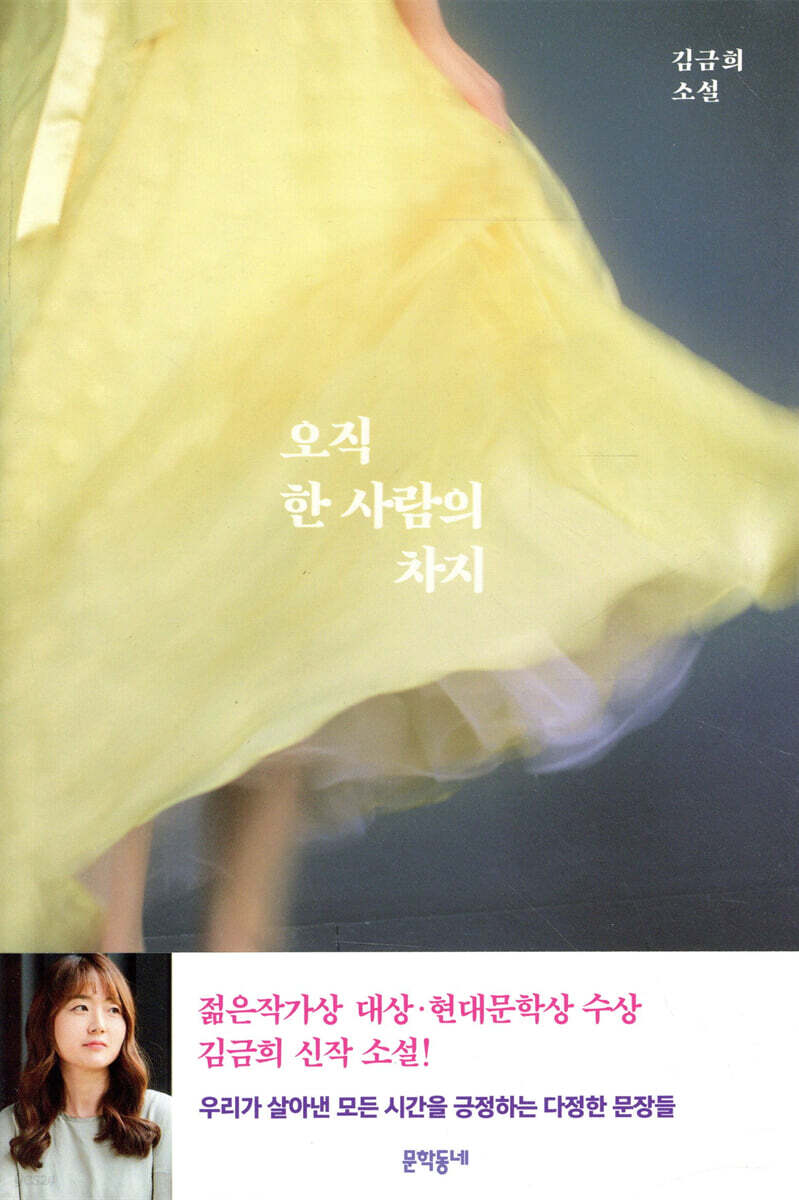
Only one person's place
 |
Description
Book Introduction
- A word from MD
-
Kim Geum-hee's new novel, ranked first among readers' top young writersListening to Kim Dong-ryul's "The End of Summer," I recall the author's words.
"I think that holding on to myself, no one else, is the only thing we can do in life when our hearts are broken." In his new work, he finds meaning in all the time we have lived with his characteristically affectionate gaze.
I love a summer night where I can drift off to sleep with a novel that I want to cherish for a long time, one that I won't forget even when the morning comes again.
August 30, 2019. Novel/Poetry PD Kim Do-hoon
“Holding onto myself, not anyone else,
What we do in life when our hearts are hurt is
I think that's all there is to it."
After the heat of the heart subsides, a refreshing air envelops us.
A rich emotional surround that fills the dullness of everyday life.
Kim Geum-hee's third collection of short stories, "Only One Person's Occupation," has been published. She keenly observes interesting scenes encountered in everyday life and unfamiliar faces we occasionally encounter in people both near and far, creating a world of works that are deeply intimate yet relatable to everyone.
Kim Geum-hee, who is loved by many for her short story collection “Love in Broad Daylight” and her novel “Heart of Respect,” and who was selected as “a young writer who will become the future of Korean literature in 2019, chosen by readers,” shines with new achievements in each of her nine novels.
The author delicately caresses the complex emotions of the unique characters, using this very place where we live as a stage.
In her previous work, "Love in Broad Daylight," Kim Geum-hee, who described in detail the inexplicable emotions that suddenly took over her life and explored the origins of those emotions, now focuses on moments from the past that violently shake her once peaceful inner self.
The author gazes intently at the wounds of the past that we had to bury in order to live, and revives the ugly side of us that sometimes had to be cruel and cowardly, and the painful and burdensome emotions that come with life as a byproduct.
Kim Geum-hee's latest work, richly blending the vibrant emotions that surge to the surface of life with the bitter and bitter sentiments that permeate the depths of life, fills the reader's inner self with a "surround of emotions" that is more three-dimensional and sensuous than ever before.
What we do in life when our hearts are hurt is
I think that's all there is to it."
After the heat of the heart subsides, a refreshing air envelops us.
A rich emotional surround that fills the dullness of everyday life.
Kim Geum-hee's third collection of short stories, "Only One Person's Occupation," has been published. She keenly observes interesting scenes encountered in everyday life and unfamiliar faces we occasionally encounter in people both near and far, creating a world of works that are deeply intimate yet relatable to everyone.
Kim Geum-hee, who is loved by many for her short story collection “Love in Broad Daylight” and her novel “Heart of Respect,” and who was selected as “a young writer who will become the future of Korean literature in 2019, chosen by readers,” shines with new achievements in each of her nine novels.
The author delicately caresses the complex emotions of the unique characters, using this very place where we live as a stage.
In her previous work, "Love in Broad Daylight," Kim Geum-hee, who described in detail the inexplicable emotions that suddenly took over her life and explored the origins of those emotions, now focuses on moments from the past that violently shake her once peaceful inner self.
The author gazes intently at the wounds of the past that we had to bury in order to live, and revives the ugly side of us that sometimes had to be cruel and cowardly, and the painful and burdensome emotions that come with life as a byproduct.
Kim Geum-hee's latest work, richly blending the vibrant emotions that surge to the surface of life with the bitter and bitter sentiments that permeate the depths of life, fills the reader's inner self with a "surround of emotions" that is more three-dimensional and sensuous than ever before.
- You can preview some of the book's contents.
Preview
index
All About Chess _007
The boss comes wearing a hat _039
Only One Person's Occupation _061
Lady _095
Condolences _131
Going to see the birds _161
Mori and Mura _193
Who's Friend's Ryu _223
Shopper, Mystery, Fiction _251
Commentary | Baek Ji-yeon (literary critic)
The Sympathizer, Contemplating the Irony of Life _275
Author's Note _292
The boss comes wearing a hat _039
Only One Person's Occupation _061
Lady _095
Condolences _131
Going to see the birds _161
Mori and Mura _193
Who's Friend's Ryu _223
Shopper, Mystery, Fiction _251
Commentary | Baek Ji-yeon (literary critic)
The Sympathizer, Contemplating the Irony of Life _275
Author's Note _292
Detailed image
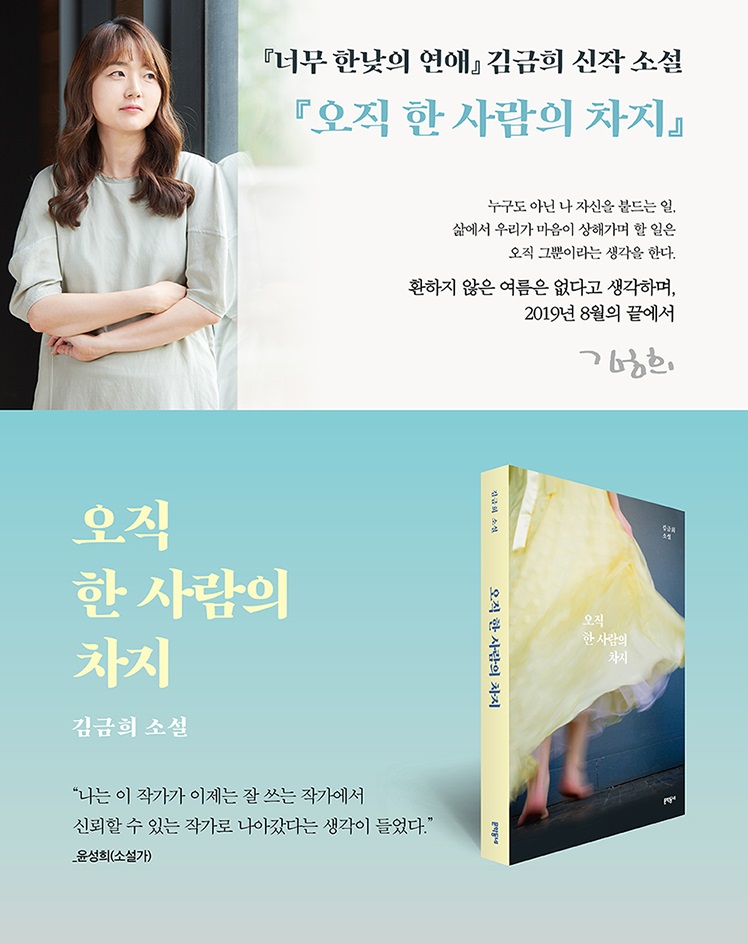
Into the book
For a very long time, I was afraid of getting my feelings hurt.
If I could avoid it, I wanted to avoid it, and if I could not admit it, I wanted to not admit it, but looking back, it was as natural as the fruit falling off the table.
I don't intend to romanticize the process of heartbreak by saying that the more you hurt, the stronger and sweeter the scent becomes, but it is also true that as you look into the wound, you discover unexpected truths, enlightenment, beauty, and sad joy.
This is a collection of short stories from 2015 to 2018.
The good news is that I tried not to back down as much as possible and recorded every condition.
If there is beauty, I wrote that it is beautiful.
If there is love, there is love, and if there is loss or tragedy, there is sadness.
If you were foolish, you would be so foolish that it would be painfully unforgivable, and you would write that you would not be able to forgive in those moments when it seemed unforgivable.
If you feel completely alone, then yes, but that doesn't mean forced isolation.
We can make those choices ourselves and prepare for the time after the injury.
--- From the author's note
The three of us can't play chess, and besides, I don't know how to play chess, so I switched places with Gukhwa.
But the moment I lifted my butt and moved, I felt that just moving to the next seat would cause me to feel extremely alienated.
--- From "All About Chess"
But how romantic is it that your breath reaches all the way to your toes?
If our high and spacious mouths touch the feet far below, which bear the entire weight of our bodies, if someone else's thing touches someone else's thing in that way, what else would it be but a miracle?
--- From "The boss comes wearing a hat"
What the heck, look at those cars, they all have their fog lights on, they look like stars.
"At this rate, it'll probably take two hours to get home," Ki said, adding that he had no idea how this stunt might end.
Like a bear in spring who has forgotten the days when hibernation was the only way to survive, or like the common children of the world who have learned early on that the only thing we can truly possess is loss.
--- From "Only One Person's Occupation"
I've been thinking for a long time about how some people are left behind and others move on based on the way they speak, and how perhaps many things in the world are just based on such trivial distinctions.
--- From "Lady"
It was a spring night with cherry blossoms falling in the sky, and the comedian stretched out his legs on the floor and said, "I used to be a bad guy, I was bad, you know that."
He asked so earnestly and earnestly that even a passing Songra would agree, saying, "Yes, you were bad, very bad."
--- From "Condolences"
Hyun-kyung, who was taken in like that, said she couldn't even go out for a month.
When he couldn't contact me, he would come to the front of the apartment and look up at the window until dawn before leaving.
Then one day, Hyun-kyung came to Yoon and asked him to deliver a note to someone waiting outside.
(…)
I asked again what was written there.
Yoon said, his face bathed in the liquid crystal light, as if he was not very interested, “I think today, when I lose you, will be the happiest day of my remaining days.”
--- From "Whose Friend's Ryu"
K thought about the woman growing old, that the woman had survived without dying and had finally grown old.
At least the woman didn't refuse, she would live.
To live my life to the fullest.
If a woman could do it, he could do it too.
I felt like I could live a lie here in this city, bearing the weight of something.
If so, then he had accomplished everything he set out to accomplish.
If I could avoid it, I wanted to avoid it, and if I could not admit it, I wanted to not admit it, but looking back, it was as natural as the fruit falling off the table.
I don't intend to romanticize the process of heartbreak by saying that the more you hurt, the stronger and sweeter the scent becomes, but it is also true that as you look into the wound, you discover unexpected truths, enlightenment, beauty, and sad joy.
This is a collection of short stories from 2015 to 2018.
The good news is that I tried not to back down as much as possible and recorded every condition.
If there is beauty, I wrote that it is beautiful.
If there is love, there is love, and if there is loss or tragedy, there is sadness.
If you were foolish, you would be so foolish that it would be painfully unforgivable, and you would write that you would not be able to forgive in those moments when it seemed unforgivable.
If you feel completely alone, then yes, but that doesn't mean forced isolation.
We can make those choices ourselves and prepare for the time after the injury.
--- From the author's note
The three of us can't play chess, and besides, I don't know how to play chess, so I switched places with Gukhwa.
But the moment I lifted my butt and moved, I felt that just moving to the next seat would cause me to feel extremely alienated.
--- From "All About Chess"
But how romantic is it that your breath reaches all the way to your toes?
If our high and spacious mouths touch the feet far below, which bear the entire weight of our bodies, if someone else's thing touches someone else's thing in that way, what else would it be but a miracle?
--- From "The boss comes wearing a hat"
What the heck, look at those cars, they all have their fog lights on, they look like stars.
"At this rate, it'll probably take two hours to get home," Ki said, adding that he had no idea how this stunt might end.
Like a bear in spring who has forgotten the days when hibernation was the only way to survive, or like the common children of the world who have learned early on that the only thing we can truly possess is loss.
--- From "Only One Person's Occupation"
I've been thinking for a long time about how some people are left behind and others move on based on the way they speak, and how perhaps many things in the world are just based on such trivial distinctions.
--- From "Lady"
It was a spring night with cherry blossoms falling in the sky, and the comedian stretched out his legs on the floor and said, "I used to be a bad guy, I was bad, you know that."
He asked so earnestly and earnestly that even a passing Songra would agree, saying, "Yes, you were bad, very bad."
--- From "Condolences"
Hyun-kyung, who was taken in like that, said she couldn't even go out for a month.
When he couldn't contact me, he would come to the front of the apartment and look up at the window until dawn before leaving.
Then one day, Hyun-kyung came to Yoon and asked him to deliver a note to someone waiting outside.
(…)
I asked again what was written there.
Yoon said, his face bathed in the liquid crystal light, as if he was not very interested, “I think today, when I lose you, will be the happiest day of my remaining days.”
--- From "Whose Friend's Ryu"
K thought about the woman growing old, that the woman had survived without dying and had finally grown old.
At least the woman didn't refuse, she would live.
To live my life to the fullest.
If a woman could do it, he could do it too.
I felt like I could live a lie here in this city, bearing the weight of something.
If so, then he had accomplished everything he set out to accomplish.
--- From "Shopper, Mystery, Fiction"
Publisher's Review
The title piece, "Only One Person's Occupation," depicts the humiliation and loss felt by 'me' who had to close down the business after struggling to run a one-man publishing company while keeping an eye on the opinions of my wife and father-in-law.
After receiving a belated complaint about the book from a reader using the ID 'Naenae', 'Na' gets to know Naenae, who has a secret charm, and gains a strange vitality.
He felt resentful towards his wife and father-in-law who pursued worldly values and wanted to settle down in society, but he felt a sense of guilt at having no choice but to receive their help. Then, he felt a strange sense of kinship with Nannae, a mixture of fulfillment and loneliness in his own world, and a sense of inexplicable defeat.
But as the identity of Nannae becomes clearer, the illusions and romanticism in my heart are also peeled away, one by one.
In this way, Kim Geum-hee's novels give the protagonists' place to pitiful characters who, unable to calm the memories and emotions that suddenly surge up, end up tripping over their own feet.
The 2017 Contemporary Literature Award winner, "All About Chess," depicts the college interactions between "Senior Noah," who obsessively relives the humiliation once he experiences something embarrassing and indulges in self-mockery and self-deprecation, and "Gukhwa," who tries to overcome humiliation with a strong attitude disguised as indifference.
The way they confront each other to play chess according to their own stubbornness passes through the author's thoughts and expands into a will not to be shaken by one's own beliefs.
The work "Condolences," which won the Young Writer's Award in the same year, captures a scene where guilt stemming from the death of a close person is violently expressed.
'Song', who still bears the scars from the violence, gradually heals his own trauma on the road to comfort others.
"The Boss Wears a Hat" follows the process of the deepening bond between the boss, who has a sensitive temperament but surprisingly has a soft heart and a crush on someone, and the part-time worker, "I," who catches wind of the boss's secret.
The scene where 'I', who was in the position of a sympathizer, takes over and completes the remaining emotions after the love ends leaves a deep lingering impression.
The 'uncle' in 'Mori and Mura' lived a neat and orderly life, unlike the other family members, but somehow, it seems like there might be a hidden side to him, which makes me suspicious.
The novel reveals the guilt that the uncle carried in solitude, and asks whether, if his cruel life ultimately freed him from suffering, it might be another form of mercy.
"Lady" exquisitely overlaps the pure hearts of two girls who tried their best to love each other with the "miraculous misfortune" of a relationship that was as easily broken as it was pure at the time, on a single canvas.
The anguish experienced by Kim Geum-hee's characters is very similar to the intimate pain and suffering that we all have to endure alone as long as we live.
Yet, what makes the inner turmoil depicted in the novel feel even more special is the charm radiated by the characters, each with a unique personality that can truly be called "Kim Geum-hee's style," and because these characters gradually come to understand the complex inner selves of humans through their own vivid voices.
In this way, the novel faithfully fulfills its role as a sympathizer, untangling the tangled web of emotions and enabling communication between the reader and the characters in the novel.
So, as we read Kim Geum-hee's novels, we can look into our own hearts and the hearts of others with greater clarity.
Memories of wounds and current feelings that transcend them
Affectionate sentences that affirm all the times we have lived.
If you read the autobiographical novel 『Shopper, Mystery, Fiction』, published in the fall of 2016, you can see what the author has been trying to achieve through his novel writing so far.
The protagonist of this short story, 'K', a novelist, has lived an isolated life without sharing the wounds of his childhood with anyone.
A time of liberation and healing comes to him, who burned with passion, digging through his scars, hoping to one day write about those wounds as a novel.
K, who is confronted with the trigger of his sorrow at the closing night market, senses “the fate of fiction, which cannot help but infiltrate life beyond the memories of perfection and pain” (literary critic Baek Ji-yeon, commentary).
Now, for him, novels are created within the life he is living, and they somehow influence the present.
So, instead of embellishing the wounds of the past, Kim Geum-hee looks straight into the gaping chasm, and with her characteristically affectionate gaze, she discovers the meaning contained in all the time we have lived.
The author tells us not to be afraid of facing the past we wanted to forget, that there was a reason why the path we had drawn was drawn that way, and that only then could we survive.
Even though we live a life where we are becoming more and more accustomed to losing, isn't this feeling of fullness that we feel every moment ours?
In this way, what Kim Geum-hee consistently seeks to convey are messages of discovering and affirming the meaning of life.
Through Kim Geum-hee's loving words, even our unlovable aspects become expressions of the will to live, not simply judged as good or bad.
The author steadfastly carries out the task of conveying the true comfort we longed to hear through novels and making us empathize with them.
That is probably why Kim Geum-hee has become the most valuable writer to contemporary readers.
After receiving a belated complaint about the book from a reader using the ID 'Naenae', 'Na' gets to know Naenae, who has a secret charm, and gains a strange vitality.
He felt resentful towards his wife and father-in-law who pursued worldly values and wanted to settle down in society, but he felt a sense of guilt at having no choice but to receive their help. Then, he felt a strange sense of kinship with Nannae, a mixture of fulfillment and loneliness in his own world, and a sense of inexplicable defeat.
But as the identity of Nannae becomes clearer, the illusions and romanticism in my heart are also peeled away, one by one.
In this way, Kim Geum-hee's novels give the protagonists' place to pitiful characters who, unable to calm the memories and emotions that suddenly surge up, end up tripping over their own feet.
The 2017 Contemporary Literature Award winner, "All About Chess," depicts the college interactions between "Senior Noah," who obsessively relives the humiliation once he experiences something embarrassing and indulges in self-mockery and self-deprecation, and "Gukhwa," who tries to overcome humiliation with a strong attitude disguised as indifference.
The way they confront each other to play chess according to their own stubbornness passes through the author's thoughts and expands into a will not to be shaken by one's own beliefs.
The work "Condolences," which won the Young Writer's Award in the same year, captures a scene where guilt stemming from the death of a close person is violently expressed.
'Song', who still bears the scars from the violence, gradually heals his own trauma on the road to comfort others.
"The Boss Wears a Hat" follows the process of the deepening bond between the boss, who has a sensitive temperament but surprisingly has a soft heart and a crush on someone, and the part-time worker, "I," who catches wind of the boss's secret.
The scene where 'I', who was in the position of a sympathizer, takes over and completes the remaining emotions after the love ends leaves a deep lingering impression.
The 'uncle' in 'Mori and Mura' lived a neat and orderly life, unlike the other family members, but somehow, it seems like there might be a hidden side to him, which makes me suspicious.
The novel reveals the guilt that the uncle carried in solitude, and asks whether, if his cruel life ultimately freed him from suffering, it might be another form of mercy.
"Lady" exquisitely overlaps the pure hearts of two girls who tried their best to love each other with the "miraculous misfortune" of a relationship that was as easily broken as it was pure at the time, on a single canvas.
The anguish experienced by Kim Geum-hee's characters is very similar to the intimate pain and suffering that we all have to endure alone as long as we live.
Yet, what makes the inner turmoil depicted in the novel feel even more special is the charm radiated by the characters, each with a unique personality that can truly be called "Kim Geum-hee's style," and because these characters gradually come to understand the complex inner selves of humans through their own vivid voices.
In this way, the novel faithfully fulfills its role as a sympathizer, untangling the tangled web of emotions and enabling communication between the reader and the characters in the novel.
So, as we read Kim Geum-hee's novels, we can look into our own hearts and the hearts of others with greater clarity.
Memories of wounds and current feelings that transcend them
Affectionate sentences that affirm all the times we have lived.
If you read the autobiographical novel 『Shopper, Mystery, Fiction』, published in the fall of 2016, you can see what the author has been trying to achieve through his novel writing so far.
The protagonist of this short story, 'K', a novelist, has lived an isolated life without sharing the wounds of his childhood with anyone.
A time of liberation and healing comes to him, who burned with passion, digging through his scars, hoping to one day write about those wounds as a novel.
K, who is confronted with the trigger of his sorrow at the closing night market, senses “the fate of fiction, which cannot help but infiltrate life beyond the memories of perfection and pain” (literary critic Baek Ji-yeon, commentary).
Now, for him, novels are created within the life he is living, and they somehow influence the present.
So, instead of embellishing the wounds of the past, Kim Geum-hee looks straight into the gaping chasm, and with her characteristically affectionate gaze, she discovers the meaning contained in all the time we have lived.
The author tells us not to be afraid of facing the past we wanted to forget, that there was a reason why the path we had drawn was drawn that way, and that only then could we survive.
Even though we live a life where we are becoming more and more accustomed to losing, isn't this feeling of fullness that we feel every moment ours?
In this way, what Kim Geum-hee consistently seeks to convey are messages of discovering and affirming the meaning of life.
Through Kim Geum-hee's loving words, even our unlovable aspects become expressions of the will to live, not simply judged as good or bad.
The author steadfastly carries out the task of conveying the true comfort we longed to hear through novels and making us empathize with them.
That is probably why Kim Geum-hee has become the most valuable writer to contemporary readers.
GOODS SPECIFICS
- Date of issue: August 30, 2019
- Page count, weight, size: 296 pages | 370g | 133*200*19mm
- ISBN13: 9788954657273
- ISBN10: 8954657273
You may also like
카테고리
korean


korean

![GQ KOREA Mark (Monthly): December [2025]](http://librairie.coreenne.fr/cdn/shop/files/8ef265dbbfbf186523ed75ba7319009d.jpg?v=1765340328&width=3840)


