

Direct message 1
 |
Description
Book Introduction
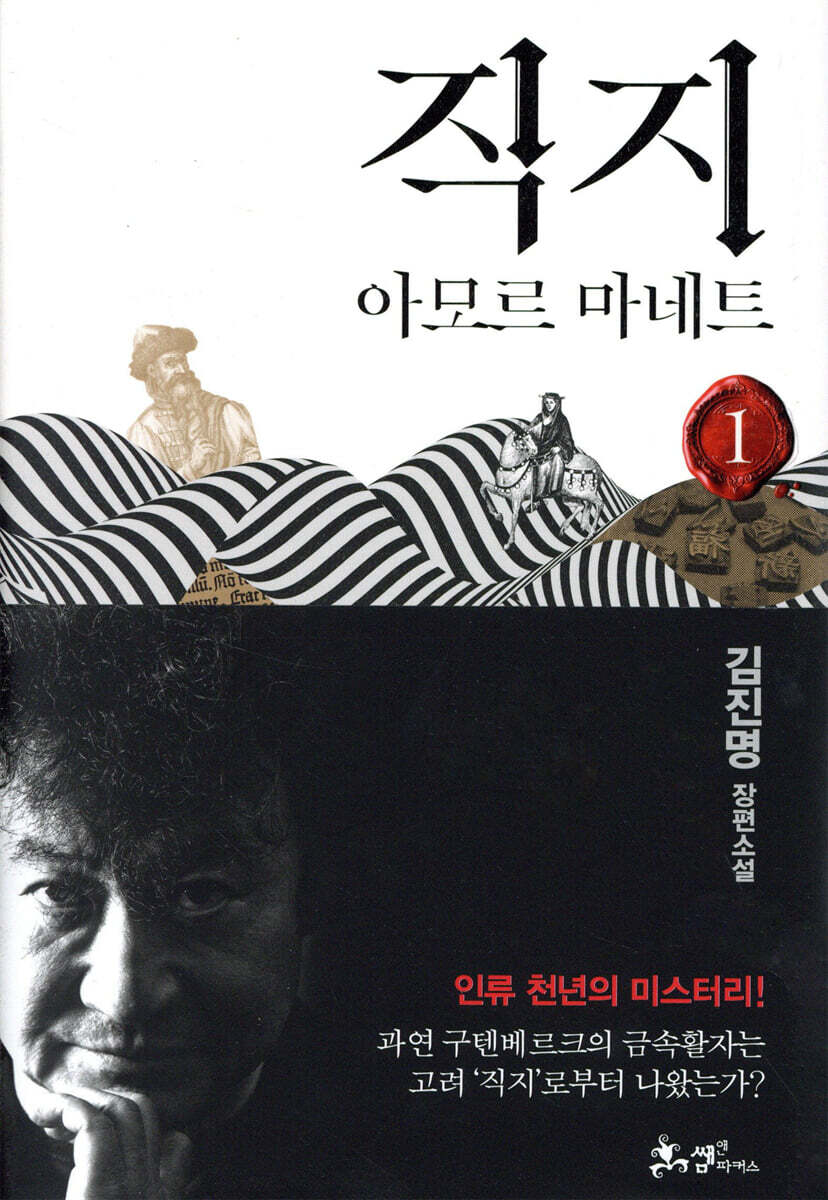
Kim Jin-myeong's new work traces the millennium-old mystery of humanity. “Did Gutenberg’s metal type really come from Goryeo’s ‘Jikji’?” What invention has been considered the greatest, most groundbreaking, transformational change in human life over the past millennium? Gutenberg's metal type. But what if this metal type, which has had a profound impact on human history, actually originated from our "Jikji"? Author Kim Jin-myeong, who has garnered explosive readership with each new release, has returned with the two-volume novel "Jikji," which stems from this very question. From "The Rose of Sharon Has Blossomed" to "The Sino-American War," he has built a unique world of works that breathe with the times. As expected from a million-selling author, he demonstrates his skills as an excellent storyteller in his new work and delivers a weighty message. |
- You can preview some of the book's contents.
Preview
index
Author's Note
Strange Murder
Latin professor
Letter from the Pope
symbolic murder
Jikji Festival
Portrait of Gutenberg
Interpretation of the letter
Two names
Professor Fisher
The Legend of the Abbey of Senanque
Records from 1444
symposium
Lorelai's Thoughts
An unexpected helper
Karena
Legend and Truth
Strange Murder
Latin professor
Letter from the Pope
symbolic murder
Jikji Festival
Portrait of Gutenberg
Interpretation of the letter
Two names
Professor Fisher
The Legend of the Abbey of Senanque
Records from 1444
symposium
Lorelai's Thoughts
An unexpected helper
Karena
Legend and Truth
Into the book
“Surprisingly, the world’s response to the directive is lukewarm.
Yes, I admit, the direct mail is the oldest.
So what's the big deal?"
“They are only recognized as the oldest, but they are not treated as the protagonists of the great knowledge revolution that changed world history.”
"is it so.
How dare you compare Jikji to Gutenberg's great printing revolution? It's true that Jikji is the oldest, but it's incredibly crude and was just tucked away in a temple somewhere. What did it actually do? If Jikji were truly useful, shouldn't you Koreans have achieved a great intellectual revolution? Even all the techniques you Koreans use to print books and produce newspapers today weren't derived from Jikji. Isn't that all imported from Gutenberg's printing technology?
--- p.54
“There is a story that has been passed down in Europe since ancient times.
A group of monks who returned from a trip to a country in the East presented the Pope with a drawing of the metal type they had seen, and soon after that, metal type spread rapidly throughout Europe.”
“Ah! Then which country in the East is that……”
--- p.56
Kiyeon pondered the meaning of the fact that he had sucked blood with his steel teeth and that he had stabbed people to death with a spear.
In fact, for a professional of that level, a small knife would have been enough, and considering the former professor's small stature and his advanced age as a retired person, strangling him with his bare hands would have been enough.
Nevertheless, if he had killed people by sucking their blood and using a spear, there would have been a meaning beyond the mere fact of killing them.
--- p.76~77
“If it’s not a letter from the Pope, then what is it?”
"It's unthinkable that a former professor, who is reluctant to move for something as simple as interpreting a letter, would fly all the way to France. There must be some other, bigger secret."
“Well, what secret did he try to uncover and get killed?”
“The fact that he was trying to fly to France means that there is a secret clue there.
Perhaps those two are the stepping stones to the secret.”
--- p.142~143
His death may have had nothing to do with the directive.
But that can't be the case.
If we separate his death from the direct message, the murder scene becomes even more incomprehensible.
What other reason did he have for clashing with foreigners?
It is most reasonable to assume that his death was caused by his involvement in the papal letter and, in the process, by access to some secret that no one knew about.
What secret did he touch on?
Having run all the way from Strasbourg to Avignon, I am no worse than the former professor.
But he can't even guess what the secret he's approaching is, let alone see it.
What am I missing?
By what route did he approach the secret, and I cannot even guess?
What does he have that I don't?
Yes, I admit, the direct mail is the oldest.
So what's the big deal?"
“They are only recognized as the oldest, but they are not treated as the protagonists of the great knowledge revolution that changed world history.”
"is it so.
How dare you compare Jikji to Gutenberg's great printing revolution? It's true that Jikji is the oldest, but it's incredibly crude and was just tucked away in a temple somewhere. What did it actually do? If Jikji were truly useful, shouldn't you Koreans have achieved a great intellectual revolution? Even all the techniques you Koreans use to print books and produce newspapers today weren't derived from Jikji. Isn't that all imported from Gutenberg's printing technology?
--- p.54
“There is a story that has been passed down in Europe since ancient times.
A group of monks who returned from a trip to a country in the East presented the Pope with a drawing of the metal type they had seen, and soon after that, metal type spread rapidly throughout Europe.”
“Ah! Then which country in the East is that……”
--- p.56
Kiyeon pondered the meaning of the fact that he had sucked blood with his steel teeth and that he had stabbed people to death with a spear.
In fact, for a professional of that level, a small knife would have been enough, and considering the former professor's small stature and his advanced age as a retired person, strangling him with his bare hands would have been enough.
Nevertheless, if he had killed people by sucking their blood and using a spear, there would have been a meaning beyond the mere fact of killing them.
--- p.76~77
“If it’s not a letter from the Pope, then what is it?”
"It's unthinkable that a former professor, who is reluctant to move for something as simple as interpreting a letter, would fly all the way to France. There must be some other, bigger secret."
“Well, what secret did he try to uncover and get killed?”
“The fact that he was trying to fly to France means that there is a secret clue there.
Perhaps those two are the stepping stones to the secret.”
--- p.142~143
His death may have had nothing to do with the directive.
But that can't be the case.
If we separate his death from the direct message, the murder scene becomes even more incomprehensible.
What other reason did he have for clashing with foreigners?
It is most reasonable to assume that his death was caused by his involvement in the papal letter and, in the process, by access to some secret that no one knew about.
What secret did he touch on?
Having run all the way from Strasbourg to Avignon, I am no worse than the former professor.
But he can't even guess what the secret he's approaching is, let alone see it.
What am I missing?
By what route did he approach the secret, and I cannot even guess?
What does he have that I don't?
--- p.180
Publisher's Review
Who is hiding the truth of 'Jikji'?
Metal movable type, considered to be the greatest invention of mankind in the past millennium
A masterpiece that traces its origins from us
Jikji: The world's oldest extant metal type book, published at Heungdeoksa Temple in Cheongju in 1377.
The official name is 'Baekunhwasangchorok Buljojisimcheyojeol', and it is printed in two volumes, upper and lower.
Currently, only the lower volume is held by the National Library of France.
It predates Gutenberg's '42-line Bible', the oldest metal type book in the West, by 78 years.
"Jikji" is a full-length novel that traces the medieval mystery surrounding Jikji, recognized as the world's oldest metal type book, and Gutenberg's metal type.
Author Kim Jin-myeong combines meticulous research, local reporting in France and elsewhere, and the achievements of modern science with historical imagination to approach the substantive truth about the spread of metal movable type.
The novel begins in the present, but expands its time and space to the reign of King Sejong of Joseon and 15th-century Europe, quickly drawing readers in with its sophisticated story and fast-paced development.
Amidst the clash between those who seek to share knowledge and those who seek to monopolize it, the greatest legacy created by human intelligence unfolds, and the breathtaking fates of the characters caught in the midst of this conflict unfold.
Author Kim Jin-myeong traces the process by which Jikji and Hangeul became the seeds of a knowledge revolution, illuminating the identity of the Korean people and suggesting the path we must take through the spirit contained within.
“I often think about how we are always ahead in the means of knowledge transmission, from the oldest woodblock print of the Darani Sutra, to the oldest metal type Jikji, to Hangeul, considered by world linguists to be the best language, to the best memory semiconductor.
And I feel proud of the invisible history of Korean culture consistently contributing to the knowledge revolution of mankind.” _[Author’s Note]
Korea has become a digital powerhouse
It was no accident!
Former U.S. Vice President Al Gore drew attention in 1995 when he said, “Korea has given great gifts to humanity through the invention of metal type and digital technology.”
Through his new work, Jikji, author Jinmyeong Kim sheds new light on the great value of Jikji, a world documentary heritage that we are familiar with but do not know much about.
Furthermore, it reminds us that the spirit contained in ‘Jikji’ and Hangeul, created by King Sejong, is not fundamentally different.
To liberate knowledge and information from the monopoly of the ruling class and enable all of humanity to move forward together.
This is the spirit contained in Jikji and Hangeul, and it sends a message that it is the tool that led the knowledge revolution and is the driving force behind South Korea becoming a digital powerhouse and the world's leading semiconductor country.
The novel features key clues from the Pope's letters discovered in the Vatican vaults and the modern scientific achievement of comparative analysis of the best metal type from the East and the West using an electron microscope.
Based on these facts, the author reveals the possibility that the metal movable type casting technique was passed on to Gutenberg, and fills in the gaps in the historical record with advanced imagination.
What exactly transpired in medieval Europe between the birth of Jikji and the publication of Gutenberg's "42-Line Bible"? The author traces the story of Jikji, a journalist whose perspective begins with a mysterious murder, and traces the mystery of the book's origins.
Hidden behind the bizarre symbolic murder
The mystery of 'Jikji' is finally revealed!
Kim Ki-yeon, a daily newspaper social affairs reporter, covers a bizarre murder scene that shocked even veteran detectives.
The brutally murdered body had its ears cut off and a spear pierced through its heart.
What's surprising is that there are clear fang marks on his neck, as if he had been attacked by Dracula, and blood was sucked out of him.
The victim was Professor Jeon Hyeong-woo, who taught Latin at Korea University.
As scientific investigation fails to find a suspect, Kiyeon becomes increasingly drawn into this strange case.
Then, they find out that the recent destination of the murdered professor's car navigation system is 'Seowon University' in Cheongju, and they find a person named 'Professor Kim Jeong-jin of Seowon University' on his cell phone.
Professor Kim Jeong-jin, a figure who is promoting the 'Jikji' movement, is convinced that the root of Gutenberg's metal type is 'Jikji' and is digging up evidence to support his belief.
Meanwhile, an old parchment letter is discovered in the Vatican's secret vault.
It is a letter believed to have been sent by Pope John XXII to King Chungsuk of Goryeo. Researchers of Jikji believed that this would prove the spread of Jikji to Europe and requested Professor Jeon Hyeong-woo to interpret the letter.
But the former professor presented an interpretation that denies that possibility, and researchers are angry at him.
Kiyeon realizes for the first time that a motive has emerged and places the Jikji researchers under suspicion.
However, Ki-yeon, who was struggling with the contradictory situation where the motive for the crime and the murder scene did not match at all, discovers a crucial clue in Professor Jeon's study.
It is a travel guidebook for the South of France and the names of two people written in the book: Professor Fischer of the University of Strasbourg and Carena of Avignon.
Kiyeon follows the route planned by the former professor and flies to France to meet the two people.
There, a shocking truth and a twist that Giyeon could never have imagined awaits him… .
The dense plot and thrilling twists that keep you glued to the book until the very last word are the reasons why tens of millions of readers read Kim Jin-myeong.
GOODS SPECIFICS
- Date of issue: August 1, 2019
- Format: Hardcover book binding method guide
- Page count, weight, size: 280 pages | 448g | 130*195*22mm
- ISBN13: 9788965708322
- ISBN10: 896570832X
You may also like
카테고리
korean


korean

![GQ KOREA Mark (Monthly): December [2025]](http://librairie.coreenne.fr/cdn/shop/files/8ef265dbbfbf186523ed75ba7319009d.jpg?v=1765340328&width=3840)


