

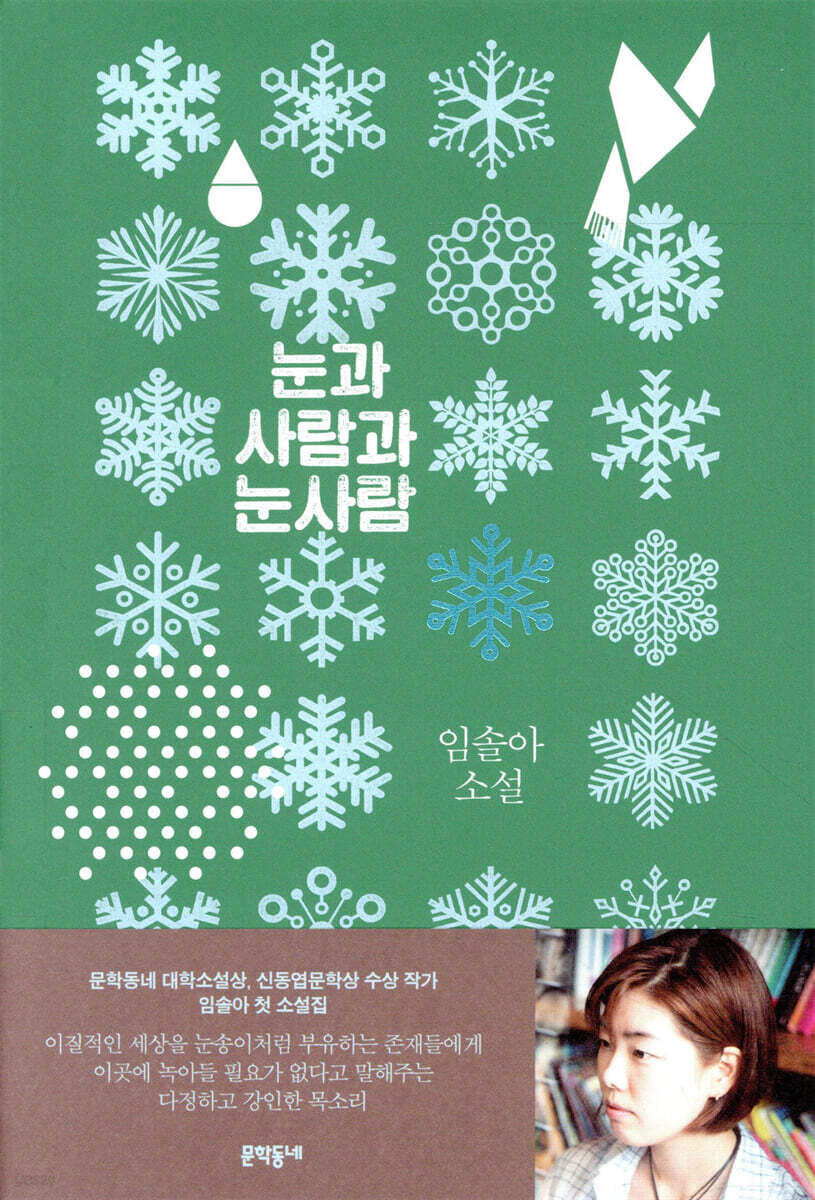
Snow, people and snowmen
 |
Description
Book Introduction
- A word from MD
-
The voices of those who should never be ignoredThe first novel collection by author Im Sol-a, who faces life head-on and experiences it with her whole body.
It contains a voice that clearly says, "This is not right," while revealing the rudeness and injustice we encounter in our daily lives, from snowflakes that could not melt into the world to gathering together to build a snowman in order to maintain their form.
June 7, 2019. Novel/Poetry PD Kim Do-hoon
Winner of the Munhakdongne University Novel Award and the Shin Dong-yup Literary Award
Im Sol-a's first novel collection
From eighteen to twenty-five years old
A story that is very close to you, starting from your own experience.
The first novel collection, 『Snow, People, and Snowman』, by author Im Sol-a, who faces life head-on and experiences it with her whole body, has been published.
He began his literary career in 2013 when his poetry was selected for the Joongang New Writer's Award. He proved his talent as a novelist by winning the Munhakdongne University Novel Award in 2015 with his first full-length novel, "The Best Life." He also won the Shin Dong-yup Literary Award in 2017 with his first poetry collection, "Strange Weather and Good People." He is a young writer who has shown remarkable achievements in both poetry and novels.
This is the first opportunity to savor the world of Im Sol-a's works, which add depth to Korean literature by encapsulating profound thoughts within poetic sentences, through a collection of short stories.
The words that Im Sol-a has carefully selected and arranged carry the same weight as poetry, quietly filling the spaces between sentences with unspoken meanings and emitting their own unique resonance.
The eight stories in the collection are arranged in order of the characters' ages.
As the story progresses to the next work, the changes shown in the characters of Im Sol-ah as she ages are impressive.
The beings who were scattered like grains of sand, rebelling against a world that makes them feel abnormal, come together at the end of the novel and turn into snowflakes filled with moisture.
As Im Sol-ah stated in her “Author’s Note,” “These characters are comrades who have gone through the same things I have gone through so far,” the changes that the characters in the novel undergo as they continue their lives seem to be related to the changes that the author Im Sol-ah has gone through.
Im Sol-ah immerses herself in the blind spots of society that are very close by but cannot be noticed unless you pay attention.
Thus, the author places details of life as a weak and minority that cannot be written about without experiencing it himself into the novel.
Because it is written this way, while reading Im Sol-ah's novel, we vividly remember some of the rudeness and injustice that we have encountered at least once in our daily lives.
Im Sol-a's first novel collection
From eighteen to twenty-five years old
A story that is very close to you, starting from your own experience.
The first novel collection, 『Snow, People, and Snowman』, by author Im Sol-a, who faces life head-on and experiences it with her whole body, has been published.
He began his literary career in 2013 when his poetry was selected for the Joongang New Writer's Award. He proved his talent as a novelist by winning the Munhakdongne University Novel Award in 2015 with his first full-length novel, "The Best Life." He also won the Shin Dong-yup Literary Award in 2017 with his first poetry collection, "Strange Weather and Good People." He is a young writer who has shown remarkable achievements in both poetry and novels.
This is the first opportunity to savor the world of Im Sol-a's works, which add depth to Korean literature by encapsulating profound thoughts within poetic sentences, through a collection of short stories.
The words that Im Sol-a has carefully selected and arranged carry the same weight as poetry, quietly filling the spaces between sentences with unspoken meanings and emitting their own unique resonance.
The eight stories in the collection are arranged in order of the characters' ages.
As the story progresses to the next work, the changes shown in the characters of Im Sol-ah as she ages are impressive.
The beings who were scattered like grains of sand, rebelling against a world that makes them feel abnormal, come together at the end of the novel and turn into snowflakes filled with moisture.
As Im Sol-ah stated in her “Author’s Note,” “These characters are comrades who have gone through the same things I have gone through so far,” the changes that the characters in the novel undergo as they continue their lives seem to be related to the changes that the author Im Sol-ah has gone through.
Im Sol-ah immerses herself in the blind spots of society that are very close by but cannot be noticed unless you pay attention.
Thus, the author places details of life as a weak and minority that cannot be written about without experiencing it himself into the novel.
Because it is written this way, while reading Im Sol-ah's novel, we vividly remember some of the rudeness and injustice that we have encountered at least once in our daily lives.
- You can preview some of the book's contents.
Preview
index
I have something to give you _007
Hospital _039
Let's do it again _057
Admiration _083
A very ordinary way of speaking in a plain world _099
Body Excavations _121
Sunshine Chalet _145
Snow, People, and Snowmen _171
Preface | Yoon I-hyeong (novelist)
Snowman Made of Sand _201
Author's Note _221
Hospital _039
Let's do it again _057
Admiration _083
A very ordinary way of speaking in a plain world _099
Body Excavations _121
Sunshine Chalet _145
Snow, People, and Snowmen _171
Preface | Yoon I-hyeong (novelist)
Snowman Made of Sand _201
Author's Note _221
Into the book
“It’s not your fault.
“You have to get rid of that idea first.”
I blinked.
The meaning of the word 'wrong' seemed to slip away and fall to the bottom like a squishy fish.
Father said he would help, and that he would swear, and asked Young-hoo if he would swear too.
Since my father kept nodding, I nodded absentmindedly too.
Only when my father let go of my body and closed the open window did the meanings that had been slipping away begin to flutter on the floor.
It was only then that I realized that I had never thought of myself as having done anything wrong.
--- From "I Have Something to Give You"
When I had the key, the author who arrived home first had to stand in front of the door and wait for me.
When the author had the key, the author arrived first, opened the door, went in, and locked the room.
I made a promise to myself that I would make a copy of the key every time the author wouldn't open the door.
If you copy the key, you won't have to wait for each other even if you fight.
Each person could enter the room at any time they wanted and leave the room at any time they wanted.
That's exactly why we didn't copy the key.
--- From "Let's Do It Again"
Since the incident with Instructor B, Jeongwon has developed a habit of mulling over the term 'poetic license'.
Until the day before, it was a word that Jeongwon liked.
Because poetry allowed me to remember all the memories that broke my heart.
But now the term 'poetic license' felt violent.
Those words seemed to cover up some injustice with poetic privilege.
Those who enjoyed this privilege often described it as 'Dionysian', but their Dionysian side had a characteristic of erupting strongly only in front of others, especially the weak.
--- From "Admiration"
My sister was the only one who didn't reject me even though she thought I was abnormal.
I know you need me to keep up the illusion that you're normal.
I also know that the aspects of me that don't seem normal fulfill my sister's desire to be normal.
Of course, I know that my sister's affection is well-intentioned.
But I'm not grateful.
Because we've been disguising ourselves for so long that it's become normal to not even know what we're disguising, and we're all festering together equally.
Why am I saying this to my sister?
I wonder if my sister will understand that I am saying this out of good intentions.
--- From "The Very Ordinary Speech of an Obvious World"
How much should we price a body that is unusable?
We estimated the price of a second toe with one joint amputated and the price of a toe with a healthy joint attached.
If my sister's toe had been in the bottle, would she have gone to retrieve it?
He probably just left it behind.
If the heart of the galaxy was in the bottle, would my sister have gone to get it back?
That would probably be the case.
If my sister's heart was in the bottle, would Eunha have gone to get it back?
Four million won was a huge sum of money that Eunha could earn by working part-time for eight hours a day for three months.
It was an amount of money that Eunha had never held in her hands before.
Still, Eunha would not have given up on her sister's heart.
What would Eunha have done if her sister's toe had been in the glass bottle?
The answer didn't come right away.
How are the heart and the toes different?
--- From "Body Excavations"
I remembered the self-introductions that were filled with lies.
If you say that nothing is nothing, it cannot become nothing.
My struggle back then was that being nothing was considered worthless, but I couldn't write about that struggle in any self-introduction.
They created false suffering, false enlightenment, and false passion.
It was no different when meeting people.
People liked my fake pain.
But to some people, my lie was seen through.
Every time I had to meet them again, I looked around.
Every time I opened my mouth, they looked at me with a strange look.
Those eyes were telling me I was fake.
No one was happy to hear that I had never actually been that sick.
I was falsely sick, but I wanted to escape from that pain.
--- From "Sunshine Chalet"
The people who will probably be most pleased when we write this story in its most explicit form and put it out into the world are the perpetrators.
The perpetrators will use our writing to trample on the courage of the victims who have come forward against them.
Few people would tolerate the fact that victims can sometimes emotionally blame others.
Very few people understood that we could not try to explain ourselves.
We decided not to make any explanation.
He was additionally accused of being silent.
“You have to get rid of that idea first.”
I blinked.
The meaning of the word 'wrong' seemed to slip away and fall to the bottom like a squishy fish.
Father said he would help, and that he would swear, and asked Young-hoo if he would swear too.
Since my father kept nodding, I nodded absentmindedly too.
Only when my father let go of my body and closed the open window did the meanings that had been slipping away begin to flutter on the floor.
It was only then that I realized that I had never thought of myself as having done anything wrong.
--- From "I Have Something to Give You"
When I had the key, the author who arrived home first had to stand in front of the door and wait for me.
When the author had the key, the author arrived first, opened the door, went in, and locked the room.
I made a promise to myself that I would make a copy of the key every time the author wouldn't open the door.
If you copy the key, you won't have to wait for each other even if you fight.
Each person could enter the room at any time they wanted and leave the room at any time they wanted.
That's exactly why we didn't copy the key.
--- From "Let's Do It Again"
Since the incident with Instructor B, Jeongwon has developed a habit of mulling over the term 'poetic license'.
Until the day before, it was a word that Jeongwon liked.
Because poetry allowed me to remember all the memories that broke my heart.
But now the term 'poetic license' felt violent.
Those words seemed to cover up some injustice with poetic privilege.
Those who enjoyed this privilege often described it as 'Dionysian', but their Dionysian side had a characteristic of erupting strongly only in front of others, especially the weak.
--- From "Admiration"
My sister was the only one who didn't reject me even though she thought I was abnormal.
I know you need me to keep up the illusion that you're normal.
I also know that the aspects of me that don't seem normal fulfill my sister's desire to be normal.
Of course, I know that my sister's affection is well-intentioned.
But I'm not grateful.
Because we've been disguising ourselves for so long that it's become normal to not even know what we're disguising, and we're all festering together equally.
Why am I saying this to my sister?
I wonder if my sister will understand that I am saying this out of good intentions.
--- From "The Very Ordinary Speech of an Obvious World"
How much should we price a body that is unusable?
We estimated the price of a second toe with one joint amputated and the price of a toe with a healthy joint attached.
If my sister's toe had been in the bottle, would she have gone to retrieve it?
He probably just left it behind.
If the heart of the galaxy was in the bottle, would my sister have gone to get it back?
That would probably be the case.
If my sister's heart was in the bottle, would Eunha have gone to get it back?
Four million won was a huge sum of money that Eunha could earn by working part-time for eight hours a day for three months.
It was an amount of money that Eunha had never held in her hands before.
Still, Eunha would not have given up on her sister's heart.
What would Eunha have done if her sister's toe had been in the glass bottle?
The answer didn't come right away.
How are the heart and the toes different?
--- From "Body Excavations"
I remembered the self-introductions that were filled with lies.
If you say that nothing is nothing, it cannot become nothing.
My struggle back then was that being nothing was considered worthless, but I couldn't write about that struggle in any self-introduction.
They created false suffering, false enlightenment, and false passion.
It was no different when meeting people.
People liked my fake pain.
But to some people, my lie was seen through.
Every time I had to meet them again, I looked around.
Every time I opened my mouth, they looked at me with a strange look.
Those eyes were telling me I was fake.
No one was happy to hear that I had never actually been that sick.
I was falsely sick, but I wanted to escape from that pain.
--- From "Sunshine Chalet"
The people who will probably be most pleased when we write this story in its most explicit form and put it out into the world are the perpetrators.
The perpetrators will use our writing to trample on the courage of the victims who have come forward against them.
Few people would tolerate the fact that victims can sometimes emotionally blame others.
Very few people understood that we could not try to explain ourselves.
We decided not to make any explanation.
He was additionally accused of being silent.
--- From "Snow, People, and Snowmen"
Publisher's Review
Refusing to be subordinated to the power of normalcy
A strong voice that turns the normal into the abnormal
Even if they are classified as abnormal by the powers that be, Im Sol-ah's characters are beings who cannot live any other way.
“I was sick not because I was abnormal, but because I tried to be normal even while rejecting myself” (from “A Very Ordinary World’s Ordinary Speech”), they confess.
Instead of being integrated into the world, they decide to live as outsiders, viewing the world from their own perspective.
And I am increasingly realizing that this world cannot be said to be normal, and that the world is not divided into normal and abnormal.
Now they are beginning to point out the wrongs in the world, from all the "ethical lies" and "good violence" that are often tolerated to be considered normal, to the sexual violence scandal within the literary world, and to clearly say, "This is not right."
Can 'Sister', who maintains the illusion that she is living a normal life by looking down on those weaker than her with her "very ordinary speech in a typical world" and 'Eun-ji', who is a "body removal object" and can rationally leave her younger brother's toe, which was amputated in an unexpected accident while traveling, abroad and return to Korea, be considered normal from the perspectives of 'Ki-jeong', who is cared for by her older sister, and 'Eun-ha', who has lost part of her body forever?
Im Sol-a's novels blur the line between normal and abnormal by turning what was considered normal into abnormal, and they destroy the power that holds the name of normal.
This subversion is most intense in "Admiration."
"Admiration" is a work written by Im Sol-ah with courage as a victim of sexual violence within the literary world.
The novel testifies that among “countless professors and poets with a reputation for being upright or respectable,” there are certainly perpetrators who have used their power to harass and assault students who respected them.
There is no wavering in Im Sol-ah's strong voice, which hopes to end the blind pursuit of rationalizing "all violence wrapped in poetic freedom and romanticism" and move on to the next world.
Beings that floated like snowflakes in a heterogeneous world
They gathered together to make a snowman so as not to lose their shape.
When the characters in Im Sol-ah's novels break free from the illusion of normalcy and accept themselves as they are, they find peace.
The main character of "Sunshine Chalet", Minju, is like that.
Minju is an employee of the Hidden Rome Villa, a secret retreat where beings who do not need to be named freely stay and leave.
In this place where travelers say there is 'nothing', Minju lives with things that are nothing but clearly exist.
As long as Minju forgets the identity that was forcibly imposed on her from the outside, she can live a life assimilated into the world as nothing.
And in the last work, “Snow, People, and Snowmen,” Im Sol-ah’s characters extend a helping hand to others in order to maintain their true selves.
Just as snowflakes gather together to form a large snowman without melting into the world.
The characters in this short story come together to stand in solidarity with victims of sexual violence, but are met with an unexpected misunderstanding and are criticized by other supporters.
They prepare an explanation, but after a long and drawn-out meeting, they conclude that their confession will be a useful weapon for the perpetrators of sexual violence to attack the victims and undermine the solidarity group.
The solidarity of these individuals, who chose to isolate themselves in order to build a greater solidarity, may never be conveyed to others, but the more it remains and solidifies, the stronger it becomes.
After carefully reading this collection of short stories from the first to the last, you can feel the trajectory of Im Sol-ah's changing perspective on others.
She may not be as warm as others, and she may not stand out as much, but Im Sol-ah is reaching out to others in her own way.
At your own temperature, building a transparent bridge like snowflakes between you and me.
A strong voice that turns the normal into the abnormal
Even if they are classified as abnormal by the powers that be, Im Sol-ah's characters are beings who cannot live any other way.
“I was sick not because I was abnormal, but because I tried to be normal even while rejecting myself” (from “A Very Ordinary World’s Ordinary Speech”), they confess.
Instead of being integrated into the world, they decide to live as outsiders, viewing the world from their own perspective.
And I am increasingly realizing that this world cannot be said to be normal, and that the world is not divided into normal and abnormal.
Now they are beginning to point out the wrongs in the world, from all the "ethical lies" and "good violence" that are often tolerated to be considered normal, to the sexual violence scandal within the literary world, and to clearly say, "This is not right."
Can 'Sister', who maintains the illusion that she is living a normal life by looking down on those weaker than her with her "very ordinary speech in a typical world" and 'Eun-ji', who is a "body removal object" and can rationally leave her younger brother's toe, which was amputated in an unexpected accident while traveling, abroad and return to Korea, be considered normal from the perspectives of 'Ki-jeong', who is cared for by her older sister, and 'Eun-ha', who has lost part of her body forever?
Im Sol-a's novels blur the line between normal and abnormal by turning what was considered normal into abnormal, and they destroy the power that holds the name of normal.
This subversion is most intense in "Admiration."
"Admiration" is a work written by Im Sol-ah with courage as a victim of sexual violence within the literary world.
The novel testifies that among “countless professors and poets with a reputation for being upright or respectable,” there are certainly perpetrators who have used their power to harass and assault students who respected them.
There is no wavering in Im Sol-ah's strong voice, which hopes to end the blind pursuit of rationalizing "all violence wrapped in poetic freedom and romanticism" and move on to the next world.
Beings that floated like snowflakes in a heterogeneous world
They gathered together to make a snowman so as not to lose their shape.
When the characters in Im Sol-ah's novels break free from the illusion of normalcy and accept themselves as they are, they find peace.
The main character of "Sunshine Chalet", Minju, is like that.
Minju is an employee of the Hidden Rome Villa, a secret retreat where beings who do not need to be named freely stay and leave.
In this place where travelers say there is 'nothing', Minju lives with things that are nothing but clearly exist.
As long as Minju forgets the identity that was forcibly imposed on her from the outside, she can live a life assimilated into the world as nothing.
And in the last work, “Snow, People, and Snowmen,” Im Sol-ah’s characters extend a helping hand to others in order to maintain their true selves.
Just as snowflakes gather together to form a large snowman without melting into the world.
The characters in this short story come together to stand in solidarity with victims of sexual violence, but are met with an unexpected misunderstanding and are criticized by other supporters.
They prepare an explanation, but after a long and drawn-out meeting, they conclude that their confession will be a useful weapon for the perpetrators of sexual violence to attack the victims and undermine the solidarity group.
The solidarity of these individuals, who chose to isolate themselves in order to build a greater solidarity, may never be conveyed to others, but the more it remains and solidifies, the stronger it becomes.
After carefully reading this collection of short stories from the first to the last, you can feel the trajectory of Im Sol-ah's changing perspective on others.
She may not be as warm as others, and she may not stand out as much, but Im Sol-ah is reaching out to others in her own way.
At your own temperature, building a transparent bridge like snowflakes between you and me.
GOODS SPECIFICS
- Date of issue: June 7, 2019
- Page count, weight, size: 224 pages | 276g | 133*200*20mm
- ISBN13: 9788954656429
- ISBN10: 8954656420
You may also like
카테고리
korean


korean

![GQ KOREA Mark (Monthly): December [2025]](http://librairie.coreenne.fr/cdn/shop/files/8ef265dbbfbf186523ed75ba7319009d.jpg?v=1765340328&width=3840)


