

If we can't go at the speed of light
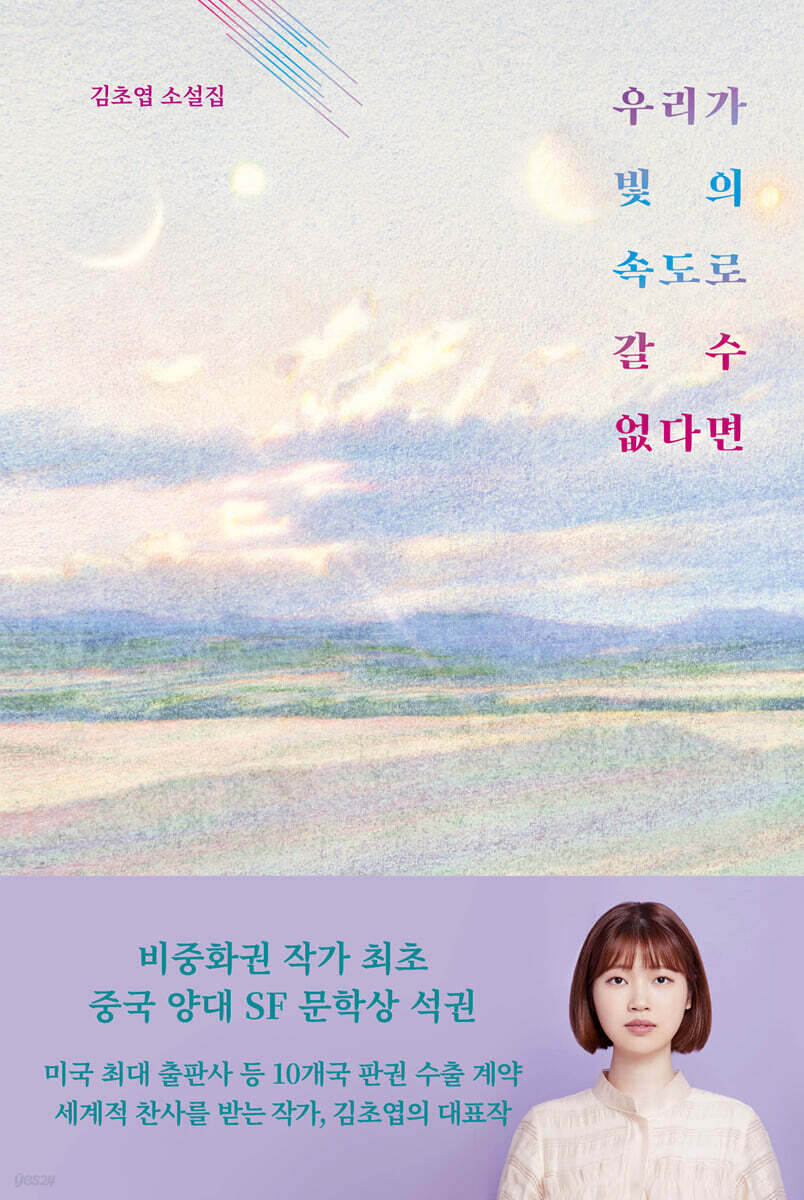 |
Description
Book Introduction
- A word from MD
-
Kim Cho-yeop, the future of Korean science fiction, presents his first novel collection.The 43rd Today's Writer Award winner.
This is the first novel collection by Kim Cho-yeop, who announced the emergence of a new generation of science fiction writers by winning both the grand prize and honorable mention at the Korea Science Literature Award. This is truly the hottest writer and book of the year.
Anyone who has read it will nod in agreement with the comment, "Everything is impressive, from the gaze to the questions."
We look forward to seeing the future of this author, who will be the present and future of Korean science fiction.
June 28, 2019. Novel/Poetry PD Kim Do-hoon
“In this story, which flows so smoothly that it is hard to believe it is the debut work of a young novelist, I discovered the eyes and mouth of the novelist I envision.
“Everything is impressive, from the gaze to the questions.”
-Kim Yeon-su (novelist)
“I’m thrilled to have found a new author I can entrust my heart to.”
-Jeong Se-rang (novelist)
“Our first SF” loved by readers around the world today
Kim Cho-yeop, a former scientist, began his career as a writer in 2017 when he won the grand prize in the short story category at the 2nd Korea Science Literature Award for “Loss in the Office” and an honorable mention for “If We Can’t Travel at the Speed of Light.”
The first short story collection, "If We Can't Go at the Speed of Light," which includes these two works, has received attention from readers and critics since its publication, winning the 43rd Today's Writer Award in 2019, being selected as the Book of the Year by the Chosun Ilbo, Dong-A Ilbo, Munhwa Ilbo, Hankyoreh, Kyunghyang Shinmun, and Sisa IN, being selected as the Book of the Year by Kyobo Bookstore, Aladdin, and Yes24, being selected as the Youth Culture Book of the Year by the Korean Publishers Association, and being selected as the Literature Sharing Book by the Arts Council Korea (ARKO). In 2020, it was selected as the Book of the Year by Pohang City, Gumi City, and Gimhae City, and it received rave reviews from many artists, including novelists Jeong Se-rang and Kim Yeon-su, musician Jang Ki-ha, and film director Kim Bo-ra, receiving enthusiastic attention from all fields.
In 2023, he received high praise internationally as the first non-Chinese writer to simultaneously win the Gold Prize in the Translated Works category of the China Nebula Award, China's leading science fiction literary award, and the Galaxy Award for Most Popular Foreign Writer.
"If We Can't Go at the Speed of Light" has sold 400,000 copies to date, and its rights have been exported to over 10 countries, including Simon & Schuster (Saga Press) in the United States.
It has been published in Japan, Taiwan, China, Spain, and France and is loved by overseas fans.
“Everything is impressive, from the gaze to the questions.”
-Kim Yeon-su (novelist)
“I’m thrilled to have found a new author I can entrust my heart to.”
-Jeong Se-rang (novelist)
“Our first SF” loved by readers around the world today
Kim Cho-yeop, a former scientist, began his career as a writer in 2017 when he won the grand prize in the short story category at the 2nd Korea Science Literature Award for “Loss in the Office” and an honorable mention for “If We Can’t Travel at the Speed of Light.”
The first short story collection, "If We Can't Go at the Speed of Light," which includes these two works, has received attention from readers and critics since its publication, winning the 43rd Today's Writer Award in 2019, being selected as the Book of the Year by the Chosun Ilbo, Dong-A Ilbo, Munhwa Ilbo, Hankyoreh, Kyunghyang Shinmun, and Sisa IN, being selected as the Book of the Year by Kyobo Bookstore, Aladdin, and Yes24, being selected as the Youth Culture Book of the Year by the Korean Publishers Association, and being selected as the Literature Sharing Book by the Arts Council Korea (ARKO). In 2020, it was selected as the Book of the Year by Pohang City, Gumi City, and Gimhae City, and it received rave reviews from many artists, including novelists Jeong Se-rang and Kim Yeon-su, musician Jang Ki-ha, and film director Kim Bo-ra, receiving enthusiastic attention from all fields.
In 2023, he received high praise internationally as the first non-Chinese writer to simultaneously win the Gold Prize in the Translated Works category of the China Nebula Award, China's leading science fiction literary award, and the Galaxy Award for Most Popular Foreign Writer.
"If We Can't Go at the Speed of Light" has sold 400,000 copies to date, and its rights have been exported to over 10 countries, including Simon & Schuster (Saga Press) in the United States.
It has been published in Japan, Taiwan, China, Spain, and France and is loved by overseas fans.
- You can preview some of the book's contents.
Preview
index
Why Don't Pilgrims Return? - 007
Spectrum - 057
Symbiosis Hypothesis - 097
If we can't travel at the speed of light - 145
The Physical Properties of Emotions - 189
Lost and Found - 219
About My Space Hero - 273
Commentary | Inayoung (literary critic)
Finding the Place of Beautiful Beings - 321
Author's Note - 337
Spectrum - 057
Symbiosis Hypothesis - 097
If we can't travel at the speed of light - 145
The Physical Properties of Emotions - 189
Lost and Found - 219
About My Space Hero - 273
Commentary | Inayoung (literary critic)
Finding the Place of Beautiful Beings - 321
Author's Note - 337
Into the book
Sophie, where should I begin?
By the time this letter reaches you, rumors of my departure will have already spread.
I wonder if the adults were very angry.
Because no one has ever run away from the village before becoming an adult like me.
If you don't mind, could you tell them the story instead? I still love them very much, but I don't regret my decision.
You might be wondering why I made this choice.
Believe it or not, I'm going to the 'origin' right now.
---From "Why Don't Pilgrims Return"
When he answered that he was leaving, he had the best smile I've ever seen on his many unhappy faces.
That's when I knew.
We'll be miserable there.
But you'll be happier than that.
---From "Why Don't Pilgrims Return"
Five satellites rose every night, shining brightly as if to prove that this was not Earth.
Only the recording device told Heejin the flow of time on Earth, which was familiar to her.
When she finally met them, Heejin thought she was hallucinating.
There was a person.
People with limbs who walk on two legs.
Has someone finally come to save Heejin?
no.
There was no way that could happen.
This is a strange planet.
---From "Spectrum"
The third Louis, like the previous Louises, drew pictures and treated Heejin kindly and affectionately.
The third Louis was smaller than the others and had only two arms.
And he lived a shorter life than the previous Louises.
---From "Spectrum"
A planet without a name.
The fact that I couldn't put its name into words only added a dreamy fantasy to that mysterious world.
People called it Lyudmila's Planet.
There was a world agreed upon by that name, regardless of the planet's existence.
A clear world that Lyudmila remembers, that Lyudmila has visited, that Lyudmila has created, and that Lyudmila consistently portrays.
---From "Symbiosis Hypothesis"
People who knew my story have been coming to me for decades to offer words of comfort.
But you are still in the same universe.
Take comfort in that fact.
But if we can't even travel at the speed of light, what's the point of the concept of a shared universe?
---From "If We Can't Go at the Speed of Light"
“I want to stroke my depression and put it on my hand.
“I wish it was something I could taste and touch.”
Bohyun held the depression body in his hand and placed it on the table.
The object was a small, round object with a soft texture, firm, blue, and a strange scent.
---From "The Properties of Emotions"
Sometimes it seems that some people just need tears for their own sake, not tears with meaning.
---From "The Properties of Emotions"
My dead mother was recorded in this library.
According to the dozens of mind manuals Jimin received in the mail after hearing of his mother's death, that was it.
But Jimin never went to the library.
I never thought about meeting my dead mother, nor did I ever think about what I would say if I did.
If I had known Mom would disappear so suddenly, I would have come here before it was too late.
---From "Lost in the Office"
Jae-kyung must have changed the lives of countless girls.
Even if Jae-kyung made a different choice in the end, the countless life paths she changed would not be undone.
Gayoon was one of those pieces of evidence.
Gayoon was once a girl who dreamed of space while looking at Jaekyung, and now she was the one who came after Jaekyung.
By the time this letter reaches you, rumors of my departure will have already spread.
I wonder if the adults were very angry.
Because no one has ever run away from the village before becoming an adult like me.
If you don't mind, could you tell them the story instead? I still love them very much, but I don't regret my decision.
You might be wondering why I made this choice.
Believe it or not, I'm going to the 'origin' right now.
---From "Why Don't Pilgrims Return"
When he answered that he was leaving, he had the best smile I've ever seen on his many unhappy faces.
That's when I knew.
We'll be miserable there.
But you'll be happier than that.
---From "Why Don't Pilgrims Return"
Five satellites rose every night, shining brightly as if to prove that this was not Earth.
Only the recording device told Heejin the flow of time on Earth, which was familiar to her.
When she finally met them, Heejin thought she was hallucinating.
There was a person.
People with limbs who walk on two legs.
Has someone finally come to save Heejin?
no.
There was no way that could happen.
This is a strange planet.
---From "Spectrum"
The third Louis, like the previous Louises, drew pictures and treated Heejin kindly and affectionately.
The third Louis was smaller than the others and had only two arms.
And he lived a shorter life than the previous Louises.
---From "Spectrum"
A planet without a name.
The fact that I couldn't put its name into words only added a dreamy fantasy to that mysterious world.
People called it Lyudmila's Planet.
There was a world agreed upon by that name, regardless of the planet's existence.
A clear world that Lyudmila remembers, that Lyudmila has visited, that Lyudmila has created, and that Lyudmila consistently portrays.
---From "Symbiosis Hypothesis"
People who knew my story have been coming to me for decades to offer words of comfort.
But you are still in the same universe.
Take comfort in that fact.
But if we can't even travel at the speed of light, what's the point of the concept of a shared universe?
---From "If We Can't Go at the Speed of Light"
“I want to stroke my depression and put it on my hand.
“I wish it was something I could taste and touch.”
Bohyun held the depression body in his hand and placed it on the table.
The object was a small, round object with a soft texture, firm, blue, and a strange scent.
---From "The Properties of Emotions"
Sometimes it seems that some people just need tears for their own sake, not tears with meaning.
---From "The Properties of Emotions"
My dead mother was recorded in this library.
According to the dozens of mind manuals Jimin received in the mail after hearing of his mother's death, that was it.
But Jimin never went to the library.
I never thought about meeting my dead mother, nor did I ever think about what I would say if I did.
If I had known Mom would disappear so suddenly, I would have come here before it was too late.
---From "Lost in the Office"
Jae-kyung must have changed the lives of countless girls.
Even if Jae-kyung made a different choice in the end, the countless life paths she changed would not be undone.
Gayoon was one of those pieces of evidence.
Gayoon was once a girl who dreamed of space while looking at Jaekyung, and now she was the one who came after Jaekyung.
---From "About My Space Hero"
Publisher's Review
From the gaze to the question, everything is impressive.
When a novelist simply observes the joys and sorrows of the world around him as they are, without making hasty judgments, his eyes become remarkably clear and transparent.
Only from this perspective, which is clear and expansive, and which can see this world directly, can the question arise: "What is a human being, and what should humanity be?"
It's hard to believe that this is a young novelist's first collection, but in the story that flows so smoothly, I discovered the eyes and mouth of the novelist I envision.
From the gaze to the questions, everything is impressive.
- Kim Yeon-su (novelist)
Kim Cho-yeop's novels depict an imaginary world, but as novelist Kim Yeon-su said in her recommendation, they transparently portray the real world without making hasty judgments.
The world is beautiful, but not innocent, and it seems to be nowhere, but somewhere.
"Why Don't the Pilgrims Return" is set in the near future, where the selection of "perfect" genes has become possible thanks to the brilliant scientist Lily Doudna.
But those who do not fall into the category of perfection are pushed out of bounds.
Meanwhile, the novel also depicts a planet called 'The Village', where there is no disability, discrimination, hatred, or love.
This beautiful and peaceful 'village' brings to mind a kind of 'utopia'.
Except for the question of whether some of those who go on pilgrimage when they come of age never return.
"If the village is a utopia, why don't the pilgrims return? This question, rather than simply reversing disability into non-disability, dystopia into utopia, or imperfection into perfection, forces us to contemplate the relationship between these dichotomies," says literary critic Inayoung (from her commentary on the work).
What makes us struggle to live in a world filled with hatred, discrimination, and contradictions?
This novel asks questions through its story.
Girls' heroes don't have to be gold medalists.
In Kim Cho-yeop's novels, there is a gaze toward and a questioning of boundaries such as normal and abnormal, success and failure, mainstream and non-mainstream.
"My Space Hero" features a failed female astronaut.
Aunt Jae-kyung, who is selected to be an astronaut to travel 'beyond space', is criticized for not having the 'specs' to be expected and being an old woman, but despite this, she is neither frustrated nor discouraged by the criticism.
I have no intention of living up to someone else's expectations or of racing toward success based on someone else's standards.
The novel reminds me of a young historian writing a lost history.
It also seems similar to the question posed by a young historian writing ‘Women’s History.’
Why are some records not recorded, why is history always a male narrative, and why are role models for success mostly also men?
It seems to be saying that for minorities, their history is meaningful in itself, and not their history of success (by anyone's standards).
Even if he is an astronaut who is criticized for failing his mission, his very existence can be a source of encouragement to some girls.
What is success and what is failure.
If you fail in your space mission, but succeed in cheering the girl on, can you really call that life a failure?
Girls' heroes don't have to be gold medalists.
This novel also depicts an alternative family made up of women, suggesting that our family system is not necessarily a given, and that the family has the potential to be a community of friendship and solidarity.
The author's concerns and questions are told in a "brightly shining" story.
Even where five satellites rise, the heart that does not give up
The protagonist of "If We Can't Travel at the Speed of Light" is a charming "grandmother scientist."
It depicts a life of separation from family and struggles to reunite in a distant universe.
In "Spectrum," a "grandmother scientist" also appears as the main character.
Why have novels so far primarily featured male or, at best, young women as protagonists? Literary critic Seo Young-in observes that "grandmothers" emerge as narrative protagonists in Kim Cho-yeop's novels.
In doing so, we focus on the ‘language’ discussed in this novel, ‘Spectrum.’
“What I remember most is the language of the aliens.
Their language records records in colors instead of letters, and in pictures instead of documents or books.
So the scenery would become words, and light and darkness would determine the meaning of the words.” (Grandma Astronaut Grandma Poet, Hankyoreh)
Suddenly, I burst into laughter.
My mind became loose.
The Louis in front of me felt like the same Louis I had been with just a few days ago.
Louis was looking at Heejin.
And I was looking at the sunset behind Heejin.
“Okay, Louis.
To you… … .”
Heejin saw the red glow of the sunset reflected in Louis' eyes.
“It looks like that scenery is talking to me.”
Heejin will never be able to see the scenery the way Louis does.
But Heejin was able to imagine a little bit of the world Louis saw, and felt joy.
- From "Spectrum"
Literary critic Ina Young cites the scene in Spectrum where the alien life form 'Louis' and the main character 'Heejin' first communicate.
“Have you ever seen such a beautiful scene of incomprehension?
To Heejin, Louis will always be “a complete other who dies too soon to be loved with all one’s heart, who cannot be fully felt or understood by human senses.”
However, in front of them, Heejin cannot give up her desire to understand them, and tries to believe in them even though she knows it is impossible, and tries to accept their existence.
If Heejin, who returned to Earth, had collected glass throughout her life, "is a tool that allows us to see things we cannot see with our normal senses," then the science fiction novels that depict alien life and other planets that make this beautiful scene possible are another form of glass that allows us to see the world here and now with new sensibilities. (Modern Literature, September 2018)
Kim Cho-yeop's novels go beyond the imagination of depicting a wonderful world, and ask questions that make us reflect.
Isn't wanting to know someone else another way of saying that you love them?
To someone who desperately asks if there is no way to fully understand someone who is completely incomprehensible.
The story told in Kim Cho-yeop's novel can be summarized in the words of literary critic In A-young.
“Embracing the Impossible” Through characters who embrace the impossible and struggle, Kim Cho-yeop’s novel struggles to find an impossible answer for which there is no right answer.
Even when you are left alone on a planet with five moons and encounter aliens (“Spectrum”), and even when you can live in a painless utopia without asking questions and pretending not to know (“Why Don’t the Pilgrims Return”).
Nevertheless, Kim Cho-yeop's novels contain the courage to know my world, our world, the unwavering spirit of speaking of our love and friendship, and the attitude of struggle.
When a novelist simply observes the joys and sorrows of the world around him as they are, without making hasty judgments, his eyes become remarkably clear and transparent.
Only from this perspective, which is clear and expansive, and which can see this world directly, can the question arise: "What is a human being, and what should humanity be?"
It's hard to believe that this is a young novelist's first collection, but in the story that flows so smoothly, I discovered the eyes and mouth of the novelist I envision.
From the gaze to the questions, everything is impressive.
- Kim Yeon-su (novelist)
Kim Cho-yeop's novels depict an imaginary world, but as novelist Kim Yeon-su said in her recommendation, they transparently portray the real world without making hasty judgments.
The world is beautiful, but not innocent, and it seems to be nowhere, but somewhere.
"Why Don't the Pilgrims Return" is set in the near future, where the selection of "perfect" genes has become possible thanks to the brilliant scientist Lily Doudna.
But those who do not fall into the category of perfection are pushed out of bounds.
Meanwhile, the novel also depicts a planet called 'The Village', where there is no disability, discrimination, hatred, or love.
This beautiful and peaceful 'village' brings to mind a kind of 'utopia'.
Except for the question of whether some of those who go on pilgrimage when they come of age never return.
"If the village is a utopia, why don't the pilgrims return? This question, rather than simply reversing disability into non-disability, dystopia into utopia, or imperfection into perfection, forces us to contemplate the relationship between these dichotomies," says literary critic Inayoung (from her commentary on the work).
What makes us struggle to live in a world filled with hatred, discrimination, and contradictions?
This novel asks questions through its story.
Girls' heroes don't have to be gold medalists.
In Kim Cho-yeop's novels, there is a gaze toward and a questioning of boundaries such as normal and abnormal, success and failure, mainstream and non-mainstream.
"My Space Hero" features a failed female astronaut.
Aunt Jae-kyung, who is selected to be an astronaut to travel 'beyond space', is criticized for not having the 'specs' to be expected and being an old woman, but despite this, she is neither frustrated nor discouraged by the criticism.
I have no intention of living up to someone else's expectations or of racing toward success based on someone else's standards.
The novel reminds me of a young historian writing a lost history.
It also seems similar to the question posed by a young historian writing ‘Women’s History.’
Why are some records not recorded, why is history always a male narrative, and why are role models for success mostly also men?
It seems to be saying that for minorities, their history is meaningful in itself, and not their history of success (by anyone's standards).
Even if he is an astronaut who is criticized for failing his mission, his very existence can be a source of encouragement to some girls.
What is success and what is failure.
If you fail in your space mission, but succeed in cheering the girl on, can you really call that life a failure?
Girls' heroes don't have to be gold medalists.
This novel also depicts an alternative family made up of women, suggesting that our family system is not necessarily a given, and that the family has the potential to be a community of friendship and solidarity.
The author's concerns and questions are told in a "brightly shining" story.
Even where five satellites rise, the heart that does not give up
The protagonist of "If We Can't Travel at the Speed of Light" is a charming "grandmother scientist."
It depicts a life of separation from family and struggles to reunite in a distant universe.
In "Spectrum," a "grandmother scientist" also appears as the main character.
Why have novels so far primarily featured male or, at best, young women as protagonists? Literary critic Seo Young-in observes that "grandmothers" emerge as narrative protagonists in Kim Cho-yeop's novels.
In doing so, we focus on the ‘language’ discussed in this novel, ‘Spectrum.’
“What I remember most is the language of the aliens.
Their language records records in colors instead of letters, and in pictures instead of documents or books.
So the scenery would become words, and light and darkness would determine the meaning of the words.” (Grandma Astronaut Grandma Poet, Hankyoreh)
Suddenly, I burst into laughter.
My mind became loose.
The Louis in front of me felt like the same Louis I had been with just a few days ago.
Louis was looking at Heejin.
And I was looking at the sunset behind Heejin.
“Okay, Louis.
To you… … .”
Heejin saw the red glow of the sunset reflected in Louis' eyes.
“It looks like that scenery is talking to me.”
Heejin will never be able to see the scenery the way Louis does.
But Heejin was able to imagine a little bit of the world Louis saw, and felt joy.
- From "Spectrum"
Literary critic Ina Young cites the scene in Spectrum where the alien life form 'Louis' and the main character 'Heejin' first communicate.
“Have you ever seen such a beautiful scene of incomprehension?
To Heejin, Louis will always be “a complete other who dies too soon to be loved with all one’s heart, who cannot be fully felt or understood by human senses.”
However, in front of them, Heejin cannot give up her desire to understand them, and tries to believe in them even though she knows it is impossible, and tries to accept their existence.
If Heejin, who returned to Earth, had collected glass throughout her life, "is a tool that allows us to see things we cannot see with our normal senses," then the science fiction novels that depict alien life and other planets that make this beautiful scene possible are another form of glass that allows us to see the world here and now with new sensibilities. (Modern Literature, September 2018)
Kim Cho-yeop's novels go beyond the imagination of depicting a wonderful world, and ask questions that make us reflect.
Isn't wanting to know someone else another way of saying that you love them?
To someone who desperately asks if there is no way to fully understand someone who is completely incomprehensible.
The story told in Kim Cho-yeop's novel can be summarized in the words of literary critic In A-young.
“Embracing the Impossible” Through characters who embrace the impossible and struggle, Kim Cho-yeop’s novel struggles to find an impossible answer for which there is no right answer.
Even when you are left alone on a planet with five moons and encounter aliens (“Spectrum”), and even when you can live in a painless utopia without asking questions and pretending not to know (“Why Don’t the Pilgrims Return”).
Nevertheless, Kim Cho-yeop's novels contain the courage to know my world, our world, the unwavering spirit of speaking of our love and friendship, and the attitude of struggle.
GOODS SPECIFICS
- Date of publication: June 24, 2019
- Page count, weight, size: 344 pages | 496g | 130*198*30mm
- ISBN13: 9791190090018
- ISBN10: 1190090015
You may also like
카테고리
korean


korean

![GQ KOREA Mark (Monthly): December [2025]](http://librairie.coreenne.fr/cdn/shop/files/8ef265dbbfbf186523ed75ba7319009d.jpg?v=1765340328&width=3840)


