

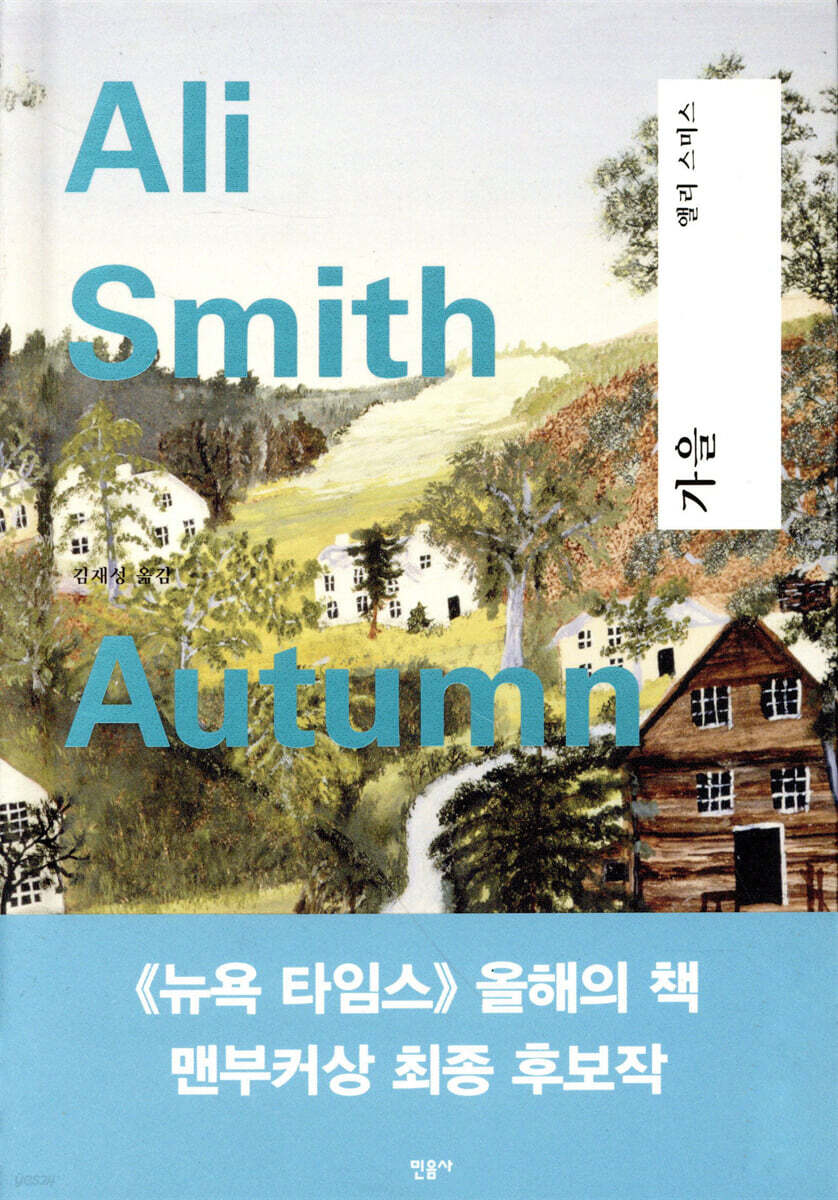
autumn
 |
Description
Book Introduction
- A word from MD
- A masterpiece that demonstrates the role of literature in an age of hatred.[A novel to read when you're tired of 'apathy'] In an age where there are so many reasons to tire us out and where we define something as "wrong" simply because it's "different" from us, the novel "Autumn" clearly shows the role of literature.
How the value of embracing others can brighten not only individual lives but also society.
April 9, 2019. Novel/Poetry PD Kim Do-hoon
The first short story in the four-part series "The Four Seasons" by Ali Smith, a unique female character in British literature.
Ali Smith is a British writer who is considered a unique female writer in Britain for her unique writing style, intellectual themes that freely move between mythology and painting, and her active sense of social engagement.
The fact that he has been shortlisted for the Man Booker Prize four times proves this.
And as a Scottish native, one of the ways the world views her is with the expectation and assessment that if Scotland ever produces a Nobel Prize winner in Literature, it will be her.
In Korea, after the publication of two works under the name of 'Ali Smith', 'Girl Meets Boy' (Munhakdongne, 2008) and 'Hotel World' (Open Books, 2011), there was no opportunity to introduce other works, but Ali Smith continued to expand her horizons by steadily working on her works.
The new work that Minumsa is introducing to Korea this time is her latest work from 2017, 『Autumn』, the first published in a series planned as a ‘four-part series on the four seasons.’
As soon as it was published, it became a hot topic in the global book market, was shortlisted for the Man Booker Prize, and was selected as a 'Book of the Year' by the New York Times, receiving great attention from the media, literary circles, and readers.
Why has this story, which interweaves the story of Elizabeth, a teenage girl who shares a special friendship with her eighty-something neighbor, Daniel, with the daily life of Elizabeth, who has now become a thirty-two-year-old art history lecturer, been called “the first post-Brexit novel” ([New York])?
This novel is a truly insightful work that depicts the current state of British society, which is in turmoil due to various socio-political issues, while also being a novel with a contemporary quality that could be applied to Korean society at this very moment.
The cold daily lives of Daniel, who is over 100 years old and awaits death alone in a nursing home, and Elizabeth, who has become a working adult, expand the scope of thought beyond 'elderly people living alone' and 'single women' to include 'bureaucracy' and 'refugees'.
How can communication with neighbors illuminate society with a strong light in each individual's life? Allie Smith sketches society with the sharp intuition of a novelist right in the heart of society.
Discovering her unique wordplay, which can only be described as lively and clever, is also a must-read for literature lovers.
Ali Smith is a British writer who is considered a unique female writer in Britain for her unique writing style, intellectual themes that freely move between mythology and painting, and her active sense of social engagement.
The fact that he has been shortlisted for the Man Booker Prize four times proves this.
And as a Scottish native, one of the ways the world views her is with the expectation and assessment that if Scotland ever produces a Nobel Prize winner in Literature, it will be her.
In Korea, after the publication of two works under the name of 'Ali Smith', 'Girl Meets Boy' (Munhakdongne, 2008) and 'Hotel World' (Open Books, 2011), there was no opportunity to introduce other works, but Ali Smith continued to expand her horizons by steadily working on her works.
The new work that Minumsa is introducing to Korea this time is her latest work from 2017, 『Autumn』, the first published in a series planned as a ‘four-part series on the four seasons.’
As soon as it was published, it became a hot topic in the global book market, was shortlisted for the Man Booker Prize, and was selected as a 'Book of the Year' by the New York Times, receiving great attention from the media, literary circles, and readers.
Why has this story, which interweaves the story of Elizabeth, a teenage girl who shares a special friendship with her eighty-something neighbor, Daniel, with the daily life of Elizabeth, who has now become a thirty-two-year-old art history lecturer, been called “the first post-Brexit novel” ([New York])?
This novel is a truly insightful work that depicts the current state of British society, which is in turmoil due to various socio-political issues, while also being a novel with a contemporary quality that could be applied to Korean society at this very moment.
The cold daily lives of Daniel, who is over 100 years old and awaits death alone in a nursing home, and Elizabeth, who has become a working adult, expand the scope of thought beyond 'elderly people living alone' and 'single women' to include 'bureaucracy' and 'refugees'.
How can communication with neighbors illuminate society with a strong light in each individual's life? Allie Smith sketches society with the sharp intuition of a novelist right in the heart of society.
Discovering her unique wordplay, which can only be described as lively and clever, is also a must-read for literature lovers.
- You can preview some of the book's contents.
Preview
index
1.
9
2.
115
3.
233
Acknowledgments 332
9
2.
115
3.
233
Acknowledgments 332
Into the book
It was the worst of times, the worst of times.
again.
That's how the world is.
Everything falls apart.
It has always been that way and it will always be that way.
That's the way of nature.
--- p.13
She knows it will take a while (she's been here twenty minutes and the same two customers are still being served), as the two employees manning the twelve windows are probably serving customers 154 and 155. She leaves the post office, waits for the green light, crosses the street, and goes to the used bookstore on Bernard Street.
When I returned ten minutes later, the two employees were still providing service, and the guidance screen announced the numbers 284, 285, and 286 in that order.
--- p.28
A coin commemorating the anniversary of Shakespeare's birth or death can be seen from where she sits.
Judging by the skull on one side, it appears to be the death side.
Elizabeth returns to her book.
A quote from Shakespeare appears on the page I was reading.
(...) It was truly a remarkable experience to look up from the book and see the commemorative coin, the moment when the novel truly met Shakespeare.
As she moves her body, she accidentally rattles the seat.
The woman next to me is slightly floating in the air, but she doesn't react, either because she doesn't notice or doesn't care.
It's funny to be sitting in such a non-communal communal waiting room.
But Elizabeth has no one to share that with, much less anyone to discuss her thoughts about books and commemorative coins.
--- p.30
He compares the photo in his existing passport with the photo Elizabeth took with her instant camera.
I can tell.
He says.
Barely. (Shoulders shrug.) But that's the difference between twenty-two and thirty-two.
I'll see you again in ten years when you come to get your new passport. (Shoulders shrug.) --- p.36
He takes out a tape measure, pulls it out a few centimeters, and places it over Elizabeth's photo.
That's right.
He says.
Yes? Elizabeth says.
I knew it.
He says.
It's 24 millimeters.
As expected.
That's good.
Elizabeth says.
It's not going well.
The man speaks.
It's a shame, but it's not good at all.
The face size is wrong.
How could my face size be wrong? says Elizabeth.
You did not follow the instructions for the specification.
If the instant camera you used had instructions regarding passport photos.
The man speaks.
Of course, the instant camera you used may not have come with instructions for passport photos.
But it doesn't help anyway.
What size should my face be? says Elizabeth.
The correct face size for the submitted photo is between 29 millimeters and 34 millimeters.
The man speaks.
The guest photo is 5 millimeters short.
Why does my face have to be a certain size? says Elizabeth.
That's the rule.
The man speaks.
--- p.39
Old faggot.
Elizabeth's mother spoke in a low voice.
"Why him of all people?" she asked in a more normal voice.
Because he is our neighbor.
Elizabeth said.
--- p.59
It's been a little over a week since the voting ended.
(..) The atmosphere of the village is also gloomy.
Elizabeth passes a small house near the bus stop.
From the door to the upper window, the words “Go back to your country” are painted in black paint across the front.
--- p.72
People either look away, avert their gaze, or stare at her, making her look away.
As she buys fruit, painkillers, and newspapers for her mother, people in the store speak to her indifferently, unlike before.
On the way from the bus stop to her mother's house, people passing by treat her, and she treats them, with a different kind of arrogance than before.
--- p.73
It's like making a big deal out of something trivial and treating something truly terrible as if it were nothing.
I'm tired of anger, I'm tired of vulgarity, I'm tired of selfishness.
I'm tired of no effort to stop it, and I'm tired of it being encouraged.
I'm tired of the violence we have now, and I'm tired of the violence that's coming, but hasn't happened yet.
I'm tired of liars.
I'm tired of the liars who pretend it doesn't happen, and the people who cause this.
I'm tired of wondering if they're stupid or if they do it on purpose.
I'm tired of governments that lie.
I'm tired of people who don't care whether I lie to them or not.
I'm tired of being afraid like this.
I'm tired of the hostility.
--- p.76~77
There was suffering and joy throughout the country.
The event shook the entire country as the storm tore down power lines from towers and tore the air above trees, roofs, and vehicles.
People all over the country felt that it was wrong.
People all over the country felt it was a good thing.
All over the country people felt they had truly been defeated.
All over the country people felt they had truly won.
All over the country, people felt that they had done the right thing and others had done the wrong thing.
People all over the country were searching on Google for “what is the European Union”.
People across the country were searching Google for “migrate to Scotland.”
People from all over the country were searching Google for “Irish passport application.”
All over the country, people were calling each other sluts.
People all over the country felt unsafe.
--- p.78~79
Throughout the country, the haves and have-nots remained the same.
Across the country, as usual, a tiny minority of people made money by exploiting a huge number of people.
The whole country was overflowing with money, money, money, money.
All over the country, money, money, money, money has dried up.
--- p.80
He is eighty-five years old.
Her mother said.
How can an eighty-five-year-old be your friend? Why can't you have normal friends like any normal thirteen-year-old?
It depends on how your mom defines normal.
Elizabeth said.
That definition may be different from how I define normal.
We all live in relativity, and my definition of normal right now is different from my mother's, and probably never will be.
--- p.102~103
It's unnatural.
It's unhealthy.
That won't happen.
I can't allow it.
No more.
--- p.111
Can I register now and receive treatment? Elizabeth says.
My body feels unwell.
I really want to talk to someone.
The receptionist asks if you have any identification.
Elizabeth shows her university library card to the receptionist.
At least until you lose your job.
Elizabeth says.
Universities are said to be cutting 16 percent of their budgets.
The receptionist smiles patiently (especially for patients).
I need your current address and, if possible, a photo.
She says.
Elizabeth shows her her passport.
My passport has expired.
The receptionist says.
that's right.
Elizabeth says.
It's being updated.
Sorry, we cannot accept expired IDs.
The receptionist says.
--- p.136~137
“It’s incredibly easy to design and print invoices.
It's the same with pretending to be someone else.
Elizabeth says.
"And what about those who commit fraud? How can having your name stamped on a piece of paper prove who you are?" --- p.138
“We have not only been advising against integration, both rhetorically and practically, on immigrants in this country.
It has been advised, both investigatively and practically, not to integrate even into ourselves.
Ever since Thatcher taught us to be selfish, to believe in the non-existence of society, we've been making this a matter of self-censorship."
“Well, that’s what it is.
Give up, grow up.
Your era is over.
democracy.
You are the one who lost.” --- p.146
A group of thugs chanted "Rule, Britain" on the street near the apartment building.
Britain rules the waves.
First we'll catch the Poles.
Next we'll catch the Muslims and the day laborers, and then we'll catch the homosexuals.
“No matter how hard you run, we will chase you and catch you.”
again.
That's how the world is.
Everything falls apart.
It has always been that way and it will always be that way.
That's the way of nature.
--- p.13
She knows it will take a while (she's been here twenty minutes and the same two customers are still being served), as the two employees manning the twelve windows are probably serving customers 154 and 155. She leaves the post office, waits for the green light, crosses the street, and goes to the used bookstore on Bernard Street.
When I returned ten minutes later, the two employees were still providing service, and the guidance screen announced the numbers 284, 285, and 286 in that order.
--- p.28
A coin commemorating the anniversary of Shakespeare's birth or death can be seen from where she sits.
Judging by the skull on one side, it appears to be the death side.
Elizabeth returns to her book.
A quote from Shakespeare appears on the page I was reading.
(...) It was truly a remarkable experience to look up from the book and see the commemorative coin, the moment when the novel truly met Shakespeare.
As she moves her body, she accidentally rattles the seat.
The woman next to me is slightly floating in the air, but she doesn't react, either because she doesn't notice or doesn't care.
It's funny to be sitting in such a non-communal communal waiting room.
But Elizabeth has no one to share that with, much less anyone to discuss her thoughts about books and commemorative coins.
--- p.30
He compares the photo in his existing passport with the photo Elizabeth took with her instant camera.
I can tell.
He says.
Barely. (Shoulders shrug.) But that's the difference between twenty-two and thirty-two.
I'll see you again in ten years when you come to get your new passport. (Shoulders shrug.) --- p.36
He takes out a tape measure, pulls it out a few centimeters, and places it over Elizabeth's photo.
That's right.
He says.
Yes? Elizabeth says.
I knew it.
He says.
It's 24 millimeters.
As expected.
That's good.
Elizabeth says.
It's not going well.
The man speaks.
It's a shame, but it's not good at all.
The face size is wrong.
How could my face size be wrong? says Elizabeth.
You did not follow the instructions for the specification.
If the instant camera you used had instructions regarding passport photos.
The man speaks.
Of course, the instant camera you used may not have come with instructions for passport photos.
But it doesn't help anyway.
What size should my face be? says Elizabeth.
The correct face size for the submitted photo is between 29 millimeters and 34 millimeters.
The man speaks.
The guest photo is 5 millimeters short.
Why does my face have to be a certain size? says Elizabeth.
That's the rule.
The man speaks.
--- p.39
Old faggot.
Elizabeth's mother spoke in a low voice.
"Why him of all people?" she asked in a more normal voice.
Because he is our neighbor.
Elizabeth said.
--- p.59
It's been a little over a week since the voting ended.
(..) The atmosphere of the village is also gloomy.
Elizabeth passes a small house near the bus stop.
From the door to the upper window, the words “Go back to your country” are painted in black paint across the front.
--- p.72
People either look away, avert their gaze, or stare at her, making her look away.
As she buys fruit, painkillers, and newspapers for her mother, people in the store speak to her indifferently, unlike before.
On the way from the bus stop to her mother's house, people passing by treat her, and she treats them, with a different kind of arrogance than before.
--- p.73
It's like making a big deal out of something trivial and treating something truly terrible as if it were nothing.
I'm tired of anger, I'm tired of vulgarity, I'm tired of selfishness.
I'm tired of no effort to stop it, and I'm tired of it being encouraged.
I'm tired of the violence we have now, and I'm tired of the violence that's coming, but hasn't happened yet.
I'm tired of liars.
I'm tired of the liars who pretend it doesn't happen, and the people who cause this.
I'm tired of wondering if they're stupid or if they do it on purpose.
I'm tired of governments that lie.
I'm tired of people who don't care whether I lie to them or not.
I'm tired of being afraid like this.
I'm tired of the hostility.
--- p.76~77
There was suffering and joy throughout the country.
The event shook the entire country as the storm tore down power lines from towers and tore the air above trees, roofs, and vehicles.
People all over the country felt that it was wrong.
People all over the country felt it was a good thing.
All over the country people felt they had truly been defeated.
All over the country people felt they had truly won.
All over the country, people felt that they had done the right thing and others had done the wrong thing.
People all over the country were searching on Google for “what is the European Union”.
People across the country were searching Google for “migrate to Scotland.”
People from all over the country were searching Google for “Irish passport application.”
All over the country, people were calling each other sluts.
People all over the country felt unsafe.
--- p.78~79
Throughout the country, the haves and have-nots remained the same.
Across the country, as usual, a tiny minority of people made money by exploiting a huge number of people.
The whole country was overflowing with money, money, money, money.
All over the country, money, money, money, money has dried up.
--- p.80
He is eighty-five years old.
Her mother said.
How can an eighty-five-year-old be your friend? Why can't you have normal friends like any normal thirteen-year-old?
It depends on how your mom defines normal.
Elizabeth said.
That definition may be different from how I define normal.
We all live in relativity, and my definition of normal right now is different from my mother's, and probably never will be.
--- p.102~103
It's unnatural.
It's unhealthy.
That won't happen.
I can't allow it.
No more.
--- p.111
Can I register now and receive treatment? Elizabeth says.
My body feels unwell.
I really want to talk to someone.
The receptionist asks if you have any identification.
Elizabeth shows her university library card to the receptionist.
At least until you lose your job.
Elizabeth says.
Universities are said to be cutting 16 percent of their budgets.
The receptionist smiles patiently (especially for patients).
I need your current address and, if possible, a photo.
She says.
Elizabeth shows her her passport.
My passport has expired.
The receptionist says.
that's right.
Elizabeth says.
It's being updated.
Sorry, we cannot accept expired IDs.
The receptionist says.
--- p.136~137
“It’s incredibly easy to design and print invoices.
It's the same with pretending to be someone else.
Elizabeth says.
"And what about those who commit fraud? How can having your name stamped on a piece of paper prove who you are?" --- p.138
“We have not only been advising against integration, both rhetorically and practically, on immigrants in this country.
It has been advised, both investigatively and practically, not to integrate even into ourselves.
Ever since Thatcher taught us to be selfish, to believe in the non-existence of society, we've been making this a matter of self-censorship."
“Well, that’s what it is.
Give up, grow up.
Your era is over.
democracy.
You are the one who lost.” --- p.146
A group of thugs chanted "Rule, Britain" on the street near the apartment building.
Britain rules the waves.
First we'll catch the Poles.
Next we'll catch the Muslims and the day laborers, and then we'll catch the homosexuals.
“No matter how hard you run, we will chase you and catch you.”
--- p.256
Publisher's Review
A post-Brexit novel that examines current British society.
Every morning she wakes up feeling like she's been tricked somehow.
This leads me to wonder how many people across the country would wake up feeling cheated, regardless of which side they voted for. (Page 256)
The setting of "Autumn" is around the time of the 2016 Brexit (Britain's withdrawal from the European Union) referendum.
British society was left in turmoil, with public opinion narrowly divided, with 51.9% in favor of leaving and 48.1% opposed.
The ongoing Brexit debate is fully reflected in this novel.
Daniel's comparison of the mid-20th century, under the cultural blessings of the time, with the present day in the 2010s is faithful to the novel's role as a reflection of the times, but it is not a grand historical novel.
The neighborhood scenes that Elizabeth, in her thirties, passes by, and the images of residents waiting at government offices surround the characters like a background, vividly conveying the current atmosphere of Britain.
In particular, the scene where Elizabeth waits endlessly in line at the post office to apply for a new passport, or talks to a postal worker and gets rejected because her head size doesn't meet the standard, is a famous scene that accurately points out the bureaucratic nature of this society.
It's incredibly easy to customize and print your invoice.
It's the same with pretending to be someone else.
Elizabeth says.
What about those who commit fraud? How can having your name on a printed piece of paper be considered proof of your identity? (Page 138)
In particular, discussions about Elizabeth's 'identification' appear throughout the novel. The scene where she goes to the hospital for urgent treatment but has only a university faculty/staff ID card with little time left for proof of identity brings to mind the issue of the Higher Education Act, which is currently experiencing severe pain in Korea.
The treatment of part-time lecturers, who may lose their jobs at any time due to university restructuring, and the tyranny of the system that operates regardless of this are worth noting.
Meanwhile, Elizabeth's mother, Wendy, appears throughout the work as a character who causes conflict with her daughter, Elizabeth.
Wendy doesn't understand her daughter's friendship with an older gay man, and she is indifferent to her daughter's art studies, which causes constant friction between them.
In short, he is a person who conforms to the existing society and does not feel any problems about the present.
However, in the latter half of the film, Wendy becomes a regular guest on a British TV program similar to Korea's "TV Show Real Luxury," and is transformed into someone with extensive knowledge of lost and forgotten British antiques.
Embracing Elizabeth's unfamiliar past and the newfound homosexual relationship with Joey that the show has forged, Wendy is cast in a new light as a human being who holds onto traditional values while also being capable of change.
Through concise scene descriptions and dialogues, Ali Smith has created a single, unadorned work that depicts the various characters of a country that is incredibly chaotic, embracing political, social, and cultural diversity, slowly circulating along with the seasonal keyword of "autumn."
The value of a neighbor who embraces others
When Elizabeth was a child, she tried to visit the house of her neighbor, Daniel Gluck, to do her homework of 'interviewing a neighbor', but her mother forbade her from approaching him, saying that Daniel was rumored to be an old homo.
But eventually, Elizabeth becomes friends with Daniel, and Daniel helps her grow into a humanistically literate person by awakening the most important values in her teenage life.
But everyday life outside the story is not so easy.
People constantly draw lines between the British, the Scottish, the European, and the non-European, trying to distinguish between 'me' and 'others'.
European society is already suffering greatly from the refugee problem.
The discovery of the body of a three-year-old child on a Turkish beach has become a global issue.
The author inserted a scene that brings that scene to mind from the beginning of the work, which is a symbolic act that tells the readers what story he wants to tell next.
He looks at the bodies that are scattered on the shore, washed up by the tide.
There are also very small children's things.
He squats down next to the bloated corpse of a man.
Inside the man's zippered shirt, a child, or rather a baby, is leaking seawater with its mouth open.
He is dead, his head on the man's swollen chest. (Page 25)
Type hatred is not something that started yesterday or today. It is a problem that has been entrenched in a changing world, but now it is bursting out of the water.
The issue of refugee inclusion is not only a problem in Europe; as seen in the Yemeni refugee crisis in Jeju, Korea is also at a stage where it needs to begin a full-scale social discussion.
At this time, Ali Smith points out the current state of society with an elegant and sharp attitude about what literature can convey.
All over the country, people felt that they had done the right thing and others had done the wrong thing.
People all over the country were searching on Google for “what is the European Union”.
People across the country were searching Google for “migrate to Scotland.”
People from all over the country were searching Google for “Irish passport application.”
All over the country, people were calling each other sluts.
People all over the country felt unsafe (pp. 78-79)
The question of whether we can accept older homosexuals as neighbors expands to the question of whether one nation can accept another nation as neighbors.
In the novel, Elizabeth grows into a profound person who ponders right and wrong thanks to Daniel, and Daniel, too, rather than facing a miserable old age as a social minority, is able to maintain his human dignity and live out his life alongside people who recognize the value of his achievements thanks to the help of someone close to him, Elizabeth.
In this novel, Allie Smith argues that the experience of being a neighbor is special, that it is a service to the world, and that time will repeat its eternal cycle even if humans hate each other and build fences.
When her mother asked, “Why him of all people?” young Elizabeth replied, “Because he’s our neighbor.” This line is probably the most famous line in the entire novel.
The importance of unchanging creation
Daniel helps teenage Elizabeth discover a variety of humanistic sensibilities through questions and answers.
Daniel was a composer and a man who interacted with various artists and intellectuals in a time when “the world was more exciting than it is now.”
The only woman he ever loved in the world was the real-life British pop artist Pauline Boty, and the author skillfully blends the artist's real story with the fictional story of Daniel.
Pauline Boty, who led a dazzling career at a time when women were not recognized, but died young, and Elizabeth, who discovered a catalog of her work in a used bookstore and chose it as the topic of her doctoral dissertation despite the opposition of her disparaging professor, suddenly realize that even in an indifferent world, there are people with sparkling creativity and those who recognize them.
Daniel's answer to young Elizabeth's question about the meaning of creating a fictional world can be said to be the author's firm belief in the value of the act of a novelist creating a story.
Creating the world is meaningless.
Elizabeth said.
Because the real world already exists.
There is just a world, and there is a truth about the world.
So what you're saying is that there is truth and there is a fake version of it, and we live by the fake version.
Daniel said.
No, the world is real.
Stories are made.
Elizabeth said.
But that doesn't make it any less true.
Daniel said.
That's absolute bullshit.
Elizabeth said.
And it is said that those who create stories are the ones who create the world.
Daniel said.
So always try to welcome people into the house of your story.
That's my suggestion. (Pages 157-158)
Every morning she wakes up feeling like she's been tricked somehow.
This leads me to wonder how many people across the country would wake up feeling cheated, regardless of which side they voted for. (Page 256)
The setting of "Autumn" is around the time of the 2016 Brexit (Britain's withdrawal from the European Union) referendum.
British society was left in turmoil, with public opinion narrowly divided, with 51.9% in favor of leaving and 48.1% opposed.
The ongoing Brexit debate is fully reflected in this novel.
Daniel's comparison of the mid-20th century, under the cultural blessings of the time, with the present day in the 2010s is faithful to the novel's role as a reflection of the times, but it is not a grand historical novel.
The neighborhood scenes that Elizabeth, in her thirties, passes by, and the images of residents waiting at government offices surround the characters like a background, vividly conveying the current atmosphere of Britain.
In particular, the scene where Elizabeth waits endlessly in line at the post office to apply for a new passport, or talks to a postal worker and gets rejected because her head size doesn't meet the standard, is a famous scene that accurately points out the bureaucratic nature of this society.
It's incredibly easy to customize and print your invoice.
It's the same with pretending to be someone else.
Elizabeth says.
What about those who commit fraud? How can having your name on a printed piece of paper be considered proof of your identity? (Page 138)
In particular, discussions about Elizabeth's 'identification' appear throughout the novel. The scene where she goes to the hospital for urgent treatment but has only a university faculty/staff ID card with little time left for proof of identity brings to mind the issue of the Higher Education Act, which is currently experiencing severe pain in Korea.
The treatment of part-time lecturers, who may lose their jobs at any time due to university restructuring, and the tyranny of the system that operates regardless of this are worth noting.
Meanwhile, Elizabeth's mother, Wendy, appears throughout the work as a character who causes conflict with her daughter, Elizabeth.
Wendy doesn't understand her daughter's friendship with an older gay man, and she is indifferent to her daughter's art studies, which causes constant friction between them.
In short, he is a person who conforms to the existing society and does not feel any problems about the present.
However, in the latter half of the film, Wendy becomes a regular guest on a British TV program similar to Korea's "TV Show Real Luxury," and is transformed into someone with extensive knowledge of lost and forgotten British antiques.
Embracing Elizabeth's unfamiliar past and the newfound homosexual relationship with Joey that the show has forged, Wendy is cast in a new light as a human being who holds onto traditional values while also being capable of change.
Through concise scene descriptions and dialogues, Ali Smith has created a single, unadorned work that depicts the various characters of a country that is incredibly chaotic, embracing political, social, and cultural diversity, slowly circulating along with the seasonal keyword of "autumn."
The value of a neighbor who embraces others
When Elizabeth was a child, she tried to visit the house of her neighbor, Daniel Gluck, to do her homework of 'interviewing a neighbor', but her mother forbade her from approaching him, saying that Daniel was rumored to be an old homo.
But eventually, Elizabeth becomes friends with Daniel, and Daniel helps her grow into a humanistically literate person by awakening the most important values in her teenage life.
But everyday life outside the story is not so easy.
People constantly draw lines between the British, the Scottish, the European, and the non-European, trying to distinguish between 'me' and 'others'.
European society is already suffering greatly from the refugee problem.
The discovery of the body of a three-year-old child on a Turkish beach has become a global issue.
The author inserted a scene that brings that scene to mind from the beginning of the work, which is a symbolic act that tells the readers what story he wants to tell next.
He looks at the bodies that are scattered on the shore, washed up by the tide.
There are also very small children's things.
He squats down next to the bloated corpse of a man.
Inside the man's zippered shirt, a child, or rather a baby, is leaking seawater with its mouth open.
He is dead, his head on the man's swollen chest. (Page 25)
Type hatred is not something that started yesterday or today. It is a problem that has been entrenched in a changing world, but now it is bursting out of the water.
The issue of refugee inclusion is not only a problem in Europe; as seen in the Yemeni refugee crisis in Jeju, Korea is also at a stage where it needs to begin a full-scale social discussion.
At this time, Ali Smith points out the current state of society with an elegant and sharp attitude about what literature can convey.
All over the country, people felt that they had done the right thing and others had done the wrong thing.
People all over the country were searching on Google for “what is the European Union”.
People across the country were searching Google for “migrate to Scotland.”
People from all over the country were searching Google for “Irish passport application.”
All over the country, people were calling each other sluts.
People all over the country felt unsafe (pp. 78-79)
The question of whether we can accept older homosexuals as neighbors expands to the question of whether one nation can accept another nation as neighbors.
In the novel, Elizabeth grows into a profound person who ponders right and wrong thanks to Daniel, and Daniel, too, rather than facing a miserable old age as a social minority, is able to maintain his human dignity and live out his life alongside people who recognize the value of his achievements thanks to the help of someone close to him, Elizabeth.
In this novel, Allie Smith argues that the experience of being a neighbor is special, that it is a service to the world, and that time will repeat its eternal cycle even if humans hate each other and build fences.
When her mother asked, “Why him of all people?” young Elizabeth replied, “Because he’s our neighbor.” This line is probably the most famous line in the entire novel.
The importance of unchanging creation
Daniel helps teenage Elizabeth discover a variety of humanistic sensibilities through questions and answers.
Daniel was a composer and a man who interacted with various artists and intellectuals in a time when “the world was more exciting than it is now.”
The only woman he ever loved in the world was the real-life British pop artist Pauline Boty, and the author skillfully blends the artist's real story with the fictional story of Daniel.
Pauline Boty, who led a dazzling career at a time when women were not recognized, but died young, and Elizabeth, who discovered a catalog of her work in a used bookstore and chose it as the topic of her doctoral dissertation despite the opposition of her disparaging professor, suddenly realize that even in an indifferent world, there are people with sparkling creativity and those who recognize them.
Daniel's answer to young Elizabeth's question about the meaning of creating a fictional world can be said to be the author's firm belief in the value of the act of a novelist creating a story.
Creating the world is meaningless.
Elizabeth said.
Because the real world already exists.
There is just a world, and there is a truth about the world.
So what you're saying is that there is truth and there is a fake version of it, and we live by the fake version.
Daniel said.
No, the world is real.
Stories are made.
Elizabeth said.
But that doesn't make it any less true.
Daniel said.
That's absolute bullshit.
Elizabeth said.
And it is said that those who create stories are the ones who create the world.
Daniel said.
So always try to welcome people into the house of your story.
That's my suggestion. (Pages 157-158)
GOODS SPECIFICS
- Date of publication: March 22, 2019
- Format: Hardcover book binding method guide
- Page count, weight, size: 336 pages | 384g | 127*188*30mm
- ISBN13: 9788937439780
- ISBN10: 8937439786
You may also like
카테고리
korean


korean

![GQ KOREA Mark (Monthly): December [2025]](http://librairie.coreenne.fr/cdn/shop/files/8ef265dbbfbf186523ed75ba7319009d.jpg?v=1765340328&width=3840)


