

Where I am
 |
Description
Book Introduction
- A word from MD
-
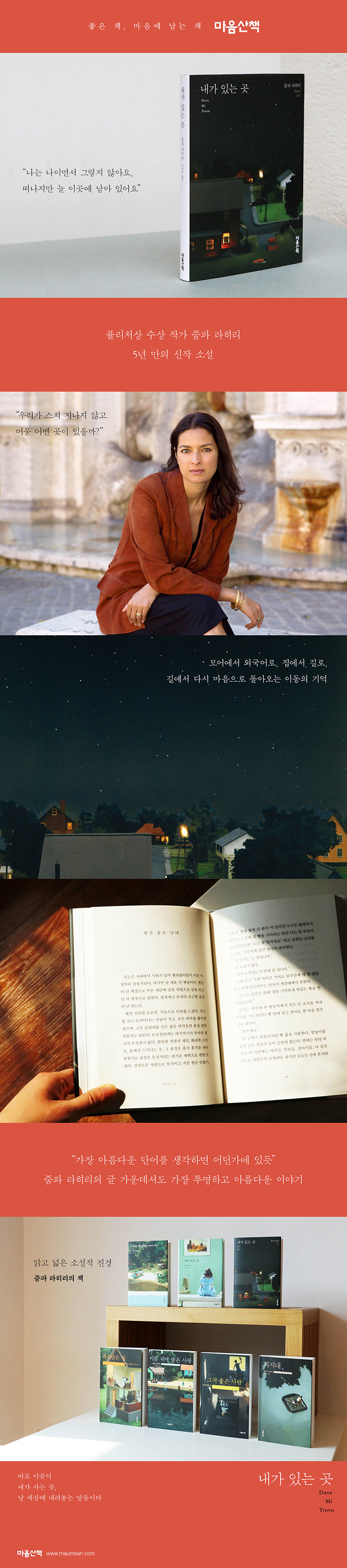
This is where I live, the words that put me down in the worldPulitzer Prize-winning author Jhumpa Lahiri's first new novel in five years.
This is the author's first novel written in Italian, not her native language, and it presents the unstable identity and the memories of a moving being in a uniquely delicate and beautiful style.
As author Eunyoung Choi introduces it, "The most transparent and beautiful story among Jhumpa Lahiri's writings."
March 19, 2019. Novel/Poetry PD Kim Do-hoon
“I’m not like that when I get older, I leave, but I always stay here.”
Pulitzer Prize-winning author Jhumpa Lahiri's new novel, her first in five years
“A writer who has been deprived of his own language is as good as dead, so how can he do such a thing voluntarily?” (Novelist Kim Yeon-su) would answer this question like this.
“Change creates the framework of our existence” (This Little Book is Always Bigger Than Me).
Jhumpa Lahiri, a novelist who took on an adventure as a writer through her first collection of prose, "This Little Book is Always Bigger Than Me," written in Italian, a foreign language rather than her native English.
As expected, he published his second collection of prose, 『The Clothes Books Wear』, in Italian, and finally published his first novel in Italian.
"Where I Am" is the author's latest work and fifth novel, published five years after the full-length novel "The Lowlands" published in the United States in 2013.
Jhumpa Lahiri is an Indian-American writer who won the Pulitzer Prize at the age of thirty-three for her first collection of short stories, not a novel, and for her work that addresses the question of identity as a "person living in America" rather than an "American."
Through 『Blessed Home』 『Love Behind the Name』 『Just a Good Man』 『The Lowcountry』, he swept many prestigious awards including the Pulitzer Prize, O. Henry Award, PEN/Hemingway Award, and Frank O'Connor International Short Story Award, and recorded national bestsellers, establishing himself as a representative American writer who is trusted and loved by both critics and readers.
In 2015, he received the National Humanities Medal from former U.S. President Obama.
In "This Little Book is Always Bigger Than Me," she honestly reveals the process of choosing and learning Italian as a new means of expression that would fill the void within her and realize her self, connecting it to her life. In "The Clothes Books Wear," she also tells a thrilling story with unique and classical reflections on book covers.
And through 『Where I Am』, he once again presents the unstable identity and the memories of a moving being in his uniquely delicate and beautiful writing style.
It is a great joy to witness her steady steps as she transcends boundaries, discovers her own language, and through it, pioneers a completely new world.
Pulitzer Prize-winning author Jhumpa Lahiri's new novel, her first in five years
“A writer who has been deprived of his own language is as good as dead, so how can he do such a thing voluntarily?” (Novelist Kim Yeon-su) would answer this question like this.
“Change creates the framework of our existence” (This Little Book is Always Bigger Than Me).
Jhumpa Lahiri, a novelist who took on an adventure as a writer through her first collection of prose, "This Little Book is Always Bigger Than Me," written in Italian, a foreign language rather than her native English.
As expected, he published his second collection of prose, 『The Clothes Books Wear』, in Italian, and finally published his first novel in Italian.
"Where I Am" is the author's latest work and fifth novel, published five years after the full-length novel "The Lowlands" published in the United States in 2013.
Jhumpa Lahiri is an Indian-American writer who won the Pulitzer Prize at the age of thirty-three for her first collection of short stories, not a novel, and for her work that addresses the question of identity as a "person living in America" rather than an "American."
Through 『Blessed Home』 『Love Behind the Name』 『Just a Good Man』 『The Lowcountry』, he swept many prestigious awards including the Pulitzer Prize, O. Henry Award, PEN/Hemingway Award, and Frank O'Connor International Short Story Award, and recorded national bestsellers, establishing himself as a representative American writer who is trusted and loved by both critics and readers.
In 2015, he received the National Humanities Medal from former U.S. President Obama.
In "This Little Book is Always Bigger Than Me," she honestly reveals the process of choosing and learning Italian as a new means of expression that would fill the void within her and realize her self, connecting it to her life. In "The Clothes Books Wear," she also tells a thrilling story with unique and classical reflections on book covers.
And through 『Where I Am』, he once again presents the unstable identity and the memories of a moving being in his uniquely delicate and beautiful writing style.
It is a great joy to witness her steady steps as she transcends boundaries, discovers her own language, and through it, pioneers a completely new world.
- You can preview some of the book's contents.
Preview
index
On the news
On the road
At the office
At the restaurant
In spring
In the square
In the waiting room
At the bookstore
In my heart
At the museum
At the psychologist's house
On the balcony
At the swimming pool
On the road
At the beauty shop
At the hotel
At the ticket booth
On a sunny day
At my house
In August
At the checkout counter
In my heart
At dinner
On vacation
At the supermarket
In the sea
At the cafe
At the villa
In the countryside
In bed
In a phone call
In the shade
In winter
At the stationery store
At dawn
In my heart
At his house
At the cafe
Wake up from sleep
At mom's house
At the station
In the mirror
At the graveyard
On the walking path
Anywhere
On the train
Translator's Note
On the road
At the office
At the restaurant
In spring
In the square
In the waiting room
At the bookstore
In my heart
At the museum
At the psychologist's house
On the balcony
At the swimming pool
On the road
At the beauty shop
At the hotel
At the ticket booth
On a sunny day
At my house
In August
At the checkout counter
In my heart
At dinner
On vacation
At the supermarket
In the sea
At the cafe
At the villa
In the countryside
In bed
In a phone call
In the shade
In winter
At the stationery store
At dawn
In my heart
At his house
At the cafe
Wake up from sleep
At mom's house
At the station
In the mirror
At the graveyard
On the walking path
Anywhere
On the train
Translator's Note
Detailed image
Into the book
Even though I don't share my life with anyone, just a warm hug is enough.
Just give each other a light kiss on the cheek, go for a walk, and walk together for a while.
We know without saying a word that if we want to, we can go down any wrong and useless path.
--- p.18
The two of us also become shadows projected on the wall.
An everyday scene that is difficult to capture.
--- p.20
This is a place to stay for a while.
I can't settle down in here.
--- p.22
He died two years ago.
He didn't die here, but something about him remains, so I think this room is a tomb.
--- p.23
This woman has no companion.
No caregiver, no friend, no husband.
I'm afraid that twenty years from now, when I find myself in a hospital waiting room like this woman, I'll notice that no one is there with me.
--- p.37
Enjoying loneliness has become my specialty.
It's a matter of training.
I try to fully embrace loneliness, but it still hurts, and even though I've gotten used to it, it still leaves me confused at times.
--- p.44
Despite my mother's obsession with me, she doesn't care how I see things.
It was this gap that taught me true loneliness.
--- p.45
I am far from life in the water.
Thoughts melt away and flow smoothly without any obstacles.
Water protects me
Because nothing touches it, the body, the mind, and the entire universe seem to become tolerable.
Observe the play of light flowing like smoke beneath your body, projecting uneasy light and shade onto the bottom of the pool.
I am surrounded by elements that regenerate me.
My mother wouldn't be able to survive in the water.
--- p.60
We speak of misery in this damp, rusty environment, where our women show each other their naked, wet bodies, the wounds on their breasts and bellies, the bruises on their thighs, and the moles on their backs.
Complain about your husband, children, and aging parents.
Express forbidden thoughts without guilt.
As I feel that loss and unhappiness, I think that the water in the pool is not so clear anymore.
This water knows pain and suffering, and is polluted.
Even the water that flows back in is invaded by an unknown anxiety.
All that pain, like water that sometimes enters the ears, never flows out again.
No, it is stored in the mind and spreads to every corner of the body. --- p.62~63
Even though we are now connected as one, I try to look only at her, knowing that we are separate beings.
For twenty minutes, this woman stands between me and the mirror, protecting me from my image, from my sorrow.
In the end, at least for this moment, I feel beautiful.
--- p.71
Every morning and every evening, we wait for each other even though we didn't plan to.
For three days, this silent relationship brought me, however faintly, into reconciliation with the world.
--- p.76~77
If you think of the most beautiful word, it's probably somewhere, somewhere in a jewel box.
--- p.105~106
It's true.
I don't need anything else.
The affection he keeps for me in a corner of his heart is enough.
--- p.117
I look at the frowning sky that covers the sea and melts into the horizon, at the peace beyond this chaos.
No one but me realizes the brilliance of the sea.
--- p.119~120
There is a loud noise outside.
The roar of the wind and the sound of the sea, the sound of explosions that seemed to consume everything.
Why is it shaking
I wonder if sound can soothe our hearts like this.
--- p.121
The image of two people connected by a string moves me.
Only then can we understand the commitment and connected life between them.
I think of the substance that flows within us, that must be circulated and regularly eliminated.
Hidden, ugly, but important tasks.
--- p.127
Then, I wake up in the middle of the night at the same time every time.
Because of the silence, as if a mouse had died.
At that moment, there were no cars running on the street and no people heading anywhere.
Sleep gradually fades away and leaves me.
Anyone, anyone, I'm waiting for someone to appear.
The thoughts that come into that dark hour are always the darkest and most vivid.
The first rays of morning light scatter my dark thoughts, and the silence, along with the dark sky, holds me until I hear the sound of my life partner passing beneath the house again.
--- p.136
The shade available to anyone was more of a defeat than a rescue.
If you think about it, the sea is always a wild element that must be endured or overcome, an element that is desired or hated.
Even though I don't have any smart brothers or beautiful sisters to compare myself to, I'm careful not to be in the shadows.
You cannot escape the harsh shadow of this season or the shadow of your own family.
At the same time, I don't have anyone's kind shadow.
--- p.142
As I think about that, all the bags suddenly feel like giant books.
Large, untitled, meaningless books in a library for monsters, giants, and fools.
--- p.151
Step by step, it takes me away from danger until my misguided love is broken and I no longer miss our flawed love story.
--- p.160~161
But there was something that pushed me through the armor of my life, just as the dog dragged me along the villa path.
I gave in to the impulse.
I already know the atmosphere and humor of this place too well to pass up.
But today I'm lazy, caught up in that feeling deep inside that refuses to go away.
--- p.167
I'm not like that when I get older, I leave but I always stay here.
These two sentences momentarily disturb my gloomy mind, like a gust of wind shaking tree branches and rustling leaves.
--- p.187
Ultimately, the environment – physical space, light, walls – has nothing to do with it.
It doesn't matter whether it's under a clear sky, in the rain, or in clear water on a summer day.
Whether it's inside a train, a car, or an airplane flying through clouds of various shapes scattered here and there like a swarm of jellyfish.
Rather than staying, I am always moving, waiting to arrive, to re-enter, or to leave.
A small suitcase at your feet, piled up and then unpacked, a cheap handbag containing a book.
Is there a place where we can stay without passing by?
--- p.189
Lost, lost, bewildered, disoriented, adrift, confused, dizzy, floundering, uprooted, floundering.
I found myself in this relationship with words again.
This is where I live, these are the words that put me down in the world.
Just give each other a light kiss on the cheek, go for a walk, and walk together for a while.
We know without saying a word that if we want to, we can go down any wrong and useless path.
--- p.18
The two of us also become shadows projected on the wall.
An everyday scene that is difficult to capture.
--- p.20
This is a place to stay for a while.
I can't settle down in here.
--- p.22
He died two years ago.
He didn't die here, but something about him remains, so I think this room is a tomb.
--- p.23
This woman has no companion.
No caregiver, no friend, no husband.
I'm afraid that twenty years from now, when I find myself in a hospital waiting room like this woman, I'll notice that no one is there with me.
--- p.37
Enjoying loneliness has become my specialty.
It's a matter of training.
I try to fully embrace loneliness, but it still hurts, and even though I've gotten used to it, it still leaves me confused at times.
--- p.44
Despite my mother's obsession with me, she doesn't care how I see things.
It was this gap that taught me true loneliness.
--- p.45
I am far from life in the water.
Thoughts melt away and flow smoothly without any obstacles.
Water protects me
Because nothing touches it, the body, the mind, and the entire universe seem to become tolerable.
Observe the play of light flowing like smoke beneath your body, projecting uneasy light and shade onto the bottom of the pool.
I am surrounded by elements that regenerate me.
My mother wouldn't be able to survive in the water.
--- p.60
We speak of misery in this damp, rusty environment, where our women show each other their naked, wet bodies, the wounds on their breasts and bellies, the bruises on their thighs, and the moles on their backs.
Complain about your husband, children, and aging parents.
Express forbidden thoughts without guilt.
As I feel that loss and unhappiness, I think that the water in the pool is not so clear anymore.
This water knows pain and suffering, and is polluted.
Even the water that flows back in is invaded by an unknown anxiety.
All that pain, like water that sometimes enters the ears, never flows out again.
No, it is stored in the mind and spreads to every corner of the body. --- p.62~63
Even though we are now connected as one, I try to look only at her, knowing that we are separate beings.
For twenty minutes, this woman stands between me and the mirror, protecting me from my image, from my sorrow.
In the end, at least for this moment, I feel beautiful.
--- p.71
Every morning and every evening, we wait for each other even though we didn't plan to.
For three days, this silent relationship brought me, however faintly, into reconciliation with the world.
--- p.76~77
If you think of the most beautiful word, it's probably somewhere, somewhere in a jewel box.
--- p.105~106
It's true.
I don't need anything else.
The affection he keeps for me in a corner of his heart is enough.
--- p.117
I look at the frowning sky that covers the sea and melts into the horizon, at the peace beyond this chaos.
No one but me realizes the brilliance of the sea.
--- p.119~120
There is a loud noise outside.
The roar of the wind and the sound of the sea, the sound of explosions that seemed to consume everything.
Why is it shaking
I wonder if sound can soothe our hearts like this.
--- p.121
The image of two people connected by a string moves me.
Only then can we understand the commitment and connected life between them.
I think of the substance that flows within us, that must be circulated and regularly eliminated.
Hidden, ugly, but important tasks.
--- p.127
Then, I wake up in the middle of the night at the same time every time.
Because of the silence, as if a mouse had died.
At that moment, there were no cars running on the street and no people heading anywhere.
Sleep gradually fades away and leaves me.
Anyone, anyone, I'm waiting for someone to appear.
The thoughts that come into that dark hour are always the darkest and most vivid.
The first rays of morning light scatter my dark thoughts, and the silence, along with the dark sky, holds me until I hear the sound of my life partner passing beneath the house again.
--- p.136
The shade available to anyone was more of a defeat than a rescue.
If you think about it, the sea is always a wild element that must be endured or overcome, an element that is desired or hated.
Even though I don't have any smart brothers or beautiful sisters to compare myself to, I'm careful not to be in the shadows.
You cannot escape the harsh shadow of this season or the shadow of your own family.
At the same time, I don't have anyone's kind shadow.
--- p.142
As I think about that, all the bags suddenly feel like giant books.
Large, untitled, meaningless books in a library for monsters, giants, and fools.
--- p.151
Step by step, it takes me away from danger until my misguided love is broken and I no longer miss our flawed love story.
--- p.160~161
But there was something that pushed me through the armor of my life, just as the dog dragged me along the villa path.
I gave in to the impulse.
I already know the atmosphere and humor of this place too well to pass up.
But today I'm lazy, caught up in that feeling deep inside that refuses to go away.
--- p.167
I'm not like that when I get older, I leave but I always stay here.
These two sentences momentarily disturb my gloomy mind, like a gust of wind shaking tree branches and rustling leaves.
--- p.187
Ultimately, the environment – physical space, light, walls – has nothing to do with it.
It doesn't matter whether it's under a clear sky, in the rain, or in clear water on a summer day.
Whether it's inside a train, a car, or an airplane flying through clouds of various shapes scattered here and there like a swarm of jellyfish.
Rather than staying, I am always moving, waiting to arrive, to re-enter, or to leave.
A small suitcase at your feet, piled up and then unpacked, a cheap handbag containing a book.
Is there a place where we can stay without passing by?
--- p.189
Lost, lost, bewildered, disoriented, adrift, confused, dizzy, floundering, uprooted, floundering.
I found myself in this relationship with words again.
This is where I live, these are the words that put me down in the world.
--- p.189~190
Publisher's Review
“Is there a place where we can stay without passing by?”
Memories of movement: from mother tongue to foreign language, from home to the road, and from the road back to the heart
Jhumpa Lahiri's themes of bewilderment of existence, rootedness and heterogeneity reach their zenith in this novel.
The protagonist of the novel is estimated to be in his early 40s and living in a quiet seaside town.
She is a lonely, single woman who is a professor and has difficulty forming relationships with others.
She wavers between stillness and movement, seeking to identify with a place while refusing to create lasting relationships.
The city where she currently lives and which fascinates her is a living backdrop and an important interlocutor that creates her daily life.
These include sidewalks around her house, parks, bridges, plazas, bookstores, streets, shops, cafes, swimming pools, restaurants, hospital waiting rooms, balconies, supermarkets, museums, ticket booths, stations, and the train that occasionally takes her far away to visit her mother, who lives in loneliness without a cure after her husband's premature death.
The same goes for her coworkers, her many friends, and the shadow of love that comforts and confuses her.
And then comes the moment when you have to leave the place you have been living in.
The novel depicts the changing seasons of the year, but it also vividly depicts her waking up on a day when the sea and sun shine, and her blood instantly heats up with the passion of life.
Ultimately, the environment – physical space, light, walls – has nothing to do with it.
It doesn't matter whether it's under a clear sky, in the rain, or in clear water on a summer day.
Whether it's inside a train, a car, or an airplane flying through clouds of various shapes scattered here and there like a swarm of jellyfish.
Rather than staying, I am always moving, waiting to arrive, to re-enter, or to leave.
A small suitcase at your feet, piled up and then unpacked, a cheap handbag containing a book.
Is there a place where we can stay without passing by?
Page 143
“This is where I live, these are the words that bring me into the world.”
The most transparent and beautiful story among Jhumpa Lahiri's writings.
The title of the book, 'Where I Am', refers not only to a geographical physical space, but also to an inner space.
The locations of the 46 stories are physical space and mental space.
In this space, the protagonist constantly thinks and asks where he is now.
The name of the protagonist and the city where he lives are not specifically mentioned in this novel.
Since names have the property of creating limitations and calling out names has the property of making things concrete, the author wanted to free the story from the weight by eliminating names and make it into an open world.
In this way, the story of the protagonist in the novel becomes the story of us all.
In the novel, she has a strong trauma from her parents when she was young.
A father who refused to interact with the outside world, locked himself in his own cocoon, and forced his stingy lifestyle on his family. A mother who was obsessed with her daughter and fought with her father, who had incompatible personalities, every day.
Because of this, the deprivation and anxiety she felt from her family as a child spread to her relationships with friends and the opposite sex, and still shakes her life.
There are wounds in love too.
A lover who had two lives, a brief encounter with a married man, the pain of loving a friend's husband but having to watch him, a future love that I briefly met at an academic conference and still hold dear in my heart.
Just as she finds it difficult to settle down in one place, but also harbors a vague anxiety about leaving home, she still harbors both anxiety and anticipation about love, having not yet settled down after getting married.
However, through her figure, we become aware of the coexistence of a desire to remain in the present position while also going beyond that limitation and moving forward into a new world.
In her, who acknowledges the universality of being lost, adrift, and uprooted, and who seeks to move and change again, we see the real “place where I live.”
To feel and want to change something that “pushed me through the armor of my life, like a dog dragging me along the villa path.”
“This story makes us rediscover and feel the little moments we let slip away.
Most of the time I'm lonely, but sometimes I feel warmth and sometimes I have memories of moments that I can enjoy completely as mine.
This is why I agree with novelist Choi Eun-young's words: "This novel is the most transparent and beautiful story among Jhumpa Lahiri's works that I have read."
Lost, lost, bewildered, disoriented, adrift, confused, dizzy, floundering, uprooted, floundering.
I found myself in this relationship with words again.
This is where I live, these are the words that put me down in the world.
Pages 189-190
Memories of movement: from mother tongue to foreign language, from home to the road, and from the road back to the heart
Jhumpa Lahiri's themes of bewilderment of existence, rootedness and heterogeneity reach their zenith in this novel.
The protagonist of the novel is estimated to be in his early 40s and living in a quiet seaside town.
She is a lonely, single woman who is a professor and has difficulty forming relationships with others.
She wavers between stillness and movement, seeking to identify with a place while refusing to create lasting relationships.
The city where she currently lives and which fascinates her is a living backdrop and an important interlocutor that creates her daily life.
These include sidewalks around her house, parks, bridges, plazas, bookstores, streets, shops, cafes, swimming pools, restaurants, hospital waiting rooms, balconies, supermarkets, museums, ticket booths, stations, and the train that occasionally takes her far away to visit her mother, who lives in loneliness without a cure after her husband's premature death.
The same goes for her coworkers, her many friends, and the shadow of love that comforts and confuses her.
And then comes the moment when you have to leave the place you have been living in.
The novel depicts the changing seasons of the year, but it also vividly depicts her waking up on a day when the sea and sun shine, and her blood instantly heats up with the passion of life.
Ultimately, the environment – physical space, light, walls – has nothing to do with it.
It doesn't matter whether it's under a clear sky, in the rain, or in clear water on a summer day.
Whether it's inside a train, a car, or an airplane flying through clouds of various shapes scattered here and there like a swarm of jellyfish.
Rather than staying, I am always moving, waiting to arrive, to re-enter, or to leave.
A small suitcase at your feet, piled up and then unpacked, a cheap handbag containing a book.
Is there a place where we can stay without passing by?
Page 143
“This is where I live, these are the words that bring me into the world.”
The most transparent and beautiful story among Jhumpa Lahiri's writings.
The title of the book, 'Where I Am', refers not only to a geographical physical space, but also to an inner space.
The locations of the 46 stories are physical space and mental space.
In this space, the protagonist constantly thinks and asks where he is now.
The name of the protagonist and the city where he lives are not specifically mentioned in this novel.
Since names have the property of creating limitations and calling out names has the property of making things concrete, the author wanted to free the story from the weight by eliminating names and make it into an open world.
In this way, the story of the protagonist in the novel becomes the story of us all.
In the novel, she has a strong trauma from her parents when she was young.
A father who refused to interact with the outside world, locked himself in his own cocoon, and forced his stingy lifestyle on his family. A mother who was obsessed with her daughter and fought with her father, who had incompatible personalities, every day.
Because of this, the deprivation and anxiety she felt from her family as a child spread to her relationships with friends and the opposite sex, and still shakes her life.
There are wounds in love too.
A lover who had two lives, a brief encounter with a married man, the pain of loving a friend's husband but having to watch him, a future love that I briefly met at an academic conference and still hold dear in my heart.
Just as she finds it difficult to settle down in one place, but also harbors a vague anxiety about leaving home, she still harbors both anxiety and anticipation about love, having not yet settled down after getting married.
However, through her figure, we become aware of the coexistence of a desire to remain in the present position while also going beyond that limitation and moving forward into a new world.
In her, who acknowledges the universality of being lost, adrift, and uprooted, and who seeks to move and change again, we see the real “place where I live.”
To feel and want to change something that “pushed me through the armor of my life, like a dog dragging me along the villa path.”
“This story makes us rediscover and feel the little moments we let slip away.
Most of the time I'm lonely, but sometimes I feel warmth and sometimes I have memories of moments that I can enjoy completely as mine.
This is why I agree with novelist Choi Eun-young's words: "This novel is the most transparent and beautiful story among Jhumpa Lahiri's works that I have read."
Lost, lost, bewildered, disoriented, adrift, confused, dizzy, floundering, uprooted, floundering.
I found myself in this relationship with words again.
This is where I live, these are the words that put me down in the world.
Pages 189-190
GOODS SPECIFICS
- Date of issue: March 15, 2019
- Format: Hardcover book binding method guide
- Page count, weight, size: 200 pages | 344g | 128*188*20mm
- ISBN13: 9788960905726
- ISBN10: 8960905720
You may also like
카테고리
korean


korean

![GQ KOREA Mark (Monthly): December [2025]](http://librairie.coreenne.fr/cdn/shop/files/8ef265dbbfbf186523ed75ba7319009d.jpg?v=1765340328&width=3840)


