

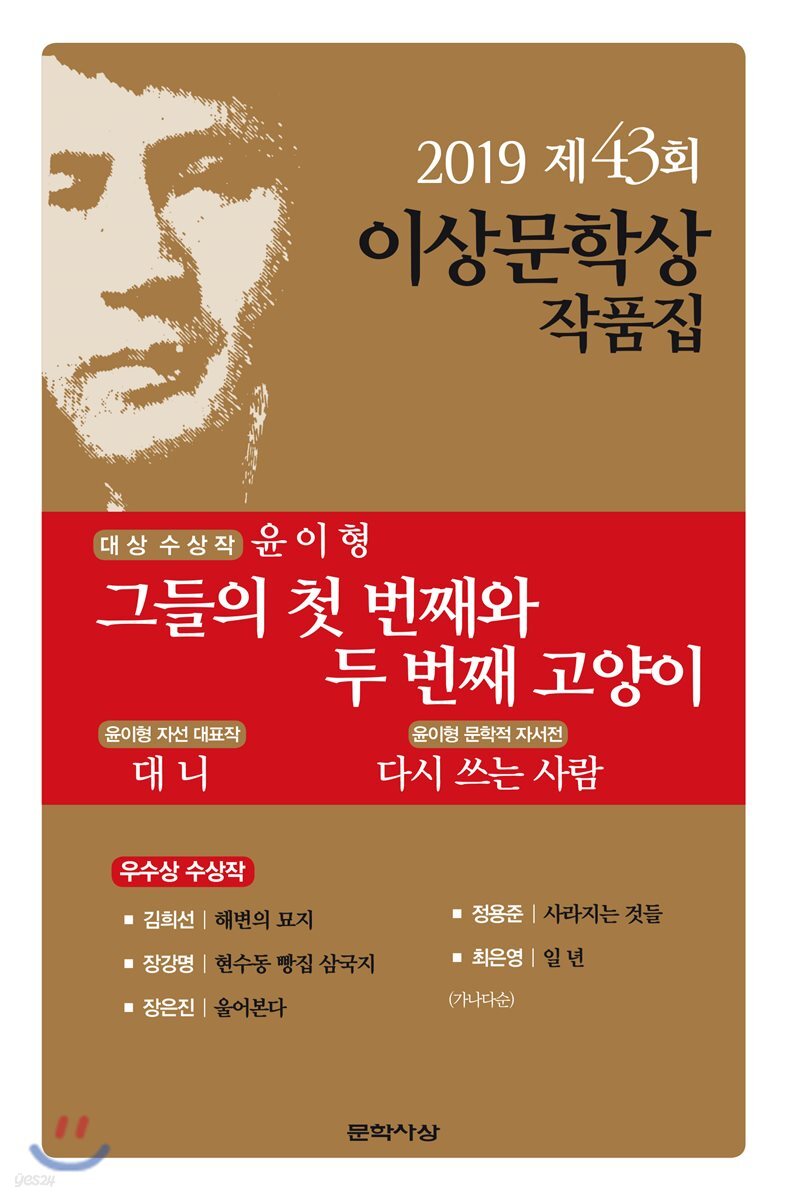
Their first and second cats
 |
Description
Book Introduction
- A word from MD
-
2019 43rd Yi Sang Literary Award AnthologyThe Yi Sang Literary Award selects the best novel published in a year.
This year, Yoon I-hyung's short story "Their First and Second Cats" won the grand prize.
Through the life and death of two companion cats, the bleakness of modern society and the loneliness of modern people are depicted with flowing prose and outstanding sensitivity.
January 22, 2019. Novel/Poetry PD Kim Do-hoon
Novelist Yoon Yi-hyung Wins Grand Prize at the 43rd Yi Sang Literary Award in 2019
The 43rd collection of the 'Lee Sang Literary Award', which compiles short stories published throughout the year, has been published.
The five judges for the 2019 Yi Sang Literary Award (Kwon Young-min, Kwon Taek-young, Kim Seong-gon, Jeong Gwa-ri, and Chae Ho-seok) unanimously selected Yun I-hyeong's "Their First and Second Cats" as the grand prize winner.
The winner of the Yi Sang Literary Award, “Their First and Second Cats” by Yun I-hyeong, is a medium-length novel.
Here, the requirements of the novella format inevitably become the first concern.
The place for the novella arises at the point where the situationality required by the short story and the historicity pursued by the long novel are uniquely integrated within the narrative form.
Yoon Hyung did not miss this point.
The absurdity of real life and the way of enduring its pain are balanced appropriately for the weight of a novella.
In the title, “Their First and Second Cats,” the problematic entities are not actually the cats, but the people referred to by the pronoun “they.”
Strictly speaking, 'they' are a family that should be grouped together under the first-person pronoun 'we', but in the novel, they are ultimately separated from each other.
Here, 'they' refers to a young couple and their son.
The story continues with their meeting, the reality of pain and hardship in life reflected on from each person's perspective, and ultimately, the process of separation.
However, the author brings the two cats that 'they' have raised to the forefront of the narrative, and delves into the life problems that each character shares from their own perspectives.
Therefore, the narrative reveals structural layering, although the story itself does not rush into a complex aspect.
This is because 'they' all share the difficulties of real life and empathize with each other's pain.
And of course, that empathy is centered around two cats and leads to a warm love for all living beings and their lives.
This collection includes the grand prize-winning work, “Their First and Second Cats” by Yoon I-hyung, and the charity work “Danny,” as well as five other excellence award-winning works.
All of these were praised as having sufficient value as contemporary writing.
The Excellence Award winners are as follows:
Kim Hee-sun's "Cemetery on the Beach"
Jang Gang-myeong, "The Three Kingdoms of the Hyeonsu-dong Bakery"
Jang Eun-jin "I Cry"
Jeong Yong-jun's "Things That Disappear"
Choi Eun-young, "One Year"
The 43rd collection of the 'Lee Sang Literary Award', which compiles short stories published throughout the year, has been published.
The five judges for the 2019 Yi Sang Literary Award (Kwon Young-min, Kwon Taek-young, Kim Seong-gon, Jeong Gwa-ri, and Chae Ho-seok) unanimously selected Yun I-hyeong's "Their First and Second Cats" as the grand prize winner.
The winner of the Yi Sang Literary Award, “Their First and Second Cats” by Yun I-hyeong, is a medium-length novel.
Here, the requirements of the novella format inevitably become the first concern.
The place for the novella arises at the point where the situationality required by the short story and the historicity pursued by the long novel are uniquely integrated within the narrative form.
Yoon Hyung did not miss this point.
The absurdity of real life and the way of enduring its pain are balanced appropriately for the weight of a novella.
In the title, “Their First and Second Cats,” the problematic entities are not actually the cats, but the people referred to by the pronoun “they.”
Strictly speaking, 'they' are a family that should be grouped together under the first-person pronoun 'we', but in the novel, they are ultimately separated from each other.
Here, 'they' refers to a young couple and their son.
The story continues with their meeting, the reality of pain and hardship in life reflected on from each person's perspective, and ultimately, the process of separation.
However, the author brings the two cats that 'they' have raised to the forefront of the narrative, and delves into the life problems that each character shares from their own perspectives.
Therefore, the narrative reveals structural layering, although the story itself does not rush into a complex aspect.
This is because 'they' all share the difficulties of real life and empathize with each other's pain.
And of course, that empathy is centered around two cats and leads to a warm love for all living beings and their lives.
This collection includes the grand prize-winning work, “Their First and Second Cats” by Yoon I-hyung, and the charity work “Danny,” as well as five other excellence award-winning works.
All of these were praised as having sufficient value as contemporary writing.
The Excellence Award winners are as follows:
Kim Hee-sun's "Cemetery on the Beach"
Jang Gang-myeong, "The Three Kingdoms of the Hyeonsu-dong Bakery"
Jang Eun-jin "I Cry"
Jeong Yong-jun's "Things That Disappear"
Choi Eun-young, "One Year"
- You can preview some of the book's contents.
Preview
index
Reasons for Selecting the 43rd Yi Sang Literary Award Grand Prize Winner
Part 1 Grand Prize Winner and Yoon I-hyung as a Writer
Grand Prize Winner | Yoon Lee-hyung · Their First and Second Cats
Charity Masterpiece|Danny
Acceptance Speech|Nothing has changed
My Literary Autobiography | The Rewriter
Author's Note | The Lantern of the Black Forest and Leila's Gift · Yoo Hyeong-jin
Works | Thinking for a Better World · So Young-hyun
Part 2 Excellence Award Winner
Kim Hee-sun's Beach Cemetery
Jang Gang-myeong's Samgukji Bakery in Hyeonsu-dong
Jang Eun-jin cries
Jeong Yong-jun's Disappearing Things
Choi Eun-young, one year
Part 3 Selection Process and Judging Comments
Evaluation and selection process
Review comments
- The multi-layered nature of Kwon Young-min's narrative, or the warm love found in the midst of painful reality.
- Kwon Taek-young: A grand narrative hidden in front of small, warm happiness
- A masterpiece written with Kim Seong-gon's elegant prose and outstanding sensibility.
- In the jungle of psychological diagrams of 'one man against all'
- Chae Ho-seok The tension between what already exists and what does not yet exist
The purpose and selection rules of the 'Lee Sang Literary Award'
Part 1 Grand Prize Winner and Yoon I-hyung as a Writer
Grand Prize Winner | Yoon Lee-hyung · Their First and Second Cats
Charity Masterpiece|Danny
Acceptance Speech|Nothing has changed
My Literary Autobiography | The Rewriter
Author's Note | The Lantern of the Black Forest and Leila's Gift · Yoo Hyeong-jin
Works | Thinking for a Better World · So Young-hyun
Part 2 Excellence Award Winner
Kim Hee-sun's Beach Cemetery
Jang Gang-myeong's Samgukji Bakery in Hyeonsu-dong
Jang Eun-jin cries
Jeong Yong-jun's Disappearing Things
Choi Eun-young, one year
Part 3 Selection Process and Judging Comments
Evaluation and selection process
Review comments
- The multi-layered nature of Kwon Young-min's narrative, or the warm love found in the midst of painful reality.
- Kwon Taek-young: A grand narrative hidden in front of small, warm happiness
- A masterpiece written with Kim Seong-gon's elegant prose and outstanding sensibility.
- In the jungle of psychological diagrams of 'one man against all'
- Chae Ho-seok The tension between what already exists and what does not yet exist
The purpose and selection rules of the 'Lee Sang Literary Award'
Into the book
"Their First and Second Cats" is a work that portrays the absurdity of real life and the way to endure its suffering in a weighty and balanced story that fits the narrative framework of a novella.
The warm love for all living beings and their lives, embodied through the novel's multi-layered narrative structure, enhances the story's tone.
In particular, I would like to note that the novelistic achievements achieved through delicate linguistic sense and impressive descriptions are Yun I-hyeong's literary virtues.
---From “Reasons for Selecting the 43rd Yi Sang Literary Award Winner”
Since one day a few years ago
About the desire to stop writing rather than the desire to write,
I love writing so much
About the mind of a person who has no choice but to quit
There were more days when I thought about it.
Those days continued, and last year around this time
My beloved cat died.
I took a taxi and picked up the cat's body.
The cat's bones melted and turned to stone.
After that too
A friend who has been sick for a long time is still sick
The mosquito bite left a scar.
Some bad things are still going on
Some nightmares don't go away even with medication.
I cook delicious meals all year round
I read a lot of books about death.
I was tired of the hatred that was scattered everywhere like cherry blossom petals.
I wasn't as good a person as I thought I was.
I bought a bouquet of flowers too late
I looked at the child's front tooth for a long time, just as it had fallen out for the first time.
And then
Adding 'please' before the wish 'May something good happen'
I ended up in a group of people who were just throwing things at each other.
In the meantime, I mustered up the strength to write a novel.
That's all, nothing has changed.
Still, using this incident as an excuse
It's nice to be able to tell people I'm grateful for.
Thank you for being there for me when I was having the hardest time.
(Please) may many happy things happen to you.
These are days when I can't say that just being alive is good.
I live happily sometimes, making excuses for this and that.
Nothing grand or great
Doing what I always do.
I'll try that too.
The warm love for all living beings and their lives, embodied through the novel's multi-layered narrative structure, enhances the story's tone.
In particular, I would like to note that the novelistic achievements achieved through delicate linguistic sense and impressive descriptions are Yun I-hyeong's literary virtues.
---From “Reasons for Selecting the 43rd Yi Sang Literary Award Winner”
Since one day a few years ago
About the desire to stop writing rather than the desire to write,
I love writing so much
About the mind of a person who has no choice but to quit
There were more days when I thought about it.
Those days continued, and last year around this time
My beloved cat died.
I took a taxi and picked up the cat's body.
The cat's bones melted and turned to stone.
After that too
A friend who has been sick for a long time is still sick
The mosquito bite left a scar.
Some bad things are still going on
Some nightmares don't go away even with medication.
I cook delicious meals all year round
I read a lot of books about death.
I was tired of the hatred that was scattered everywhere like cherry blossom petals.
I wasn't as good a person as I thought I was.
I bought a bouquet of flowers too late
I looked at the child's front tooth for a long time, just as it had fallen out for the first time.
And then
Adding 'please' before the wish 'May something good happen'
I ended up in a group of people who were just throwing things at each other.
In the meantime, I mustered up the strength to write a novel.
That's all, nothing has changed.
Still, using this incident as an excuse
It's nice to be able to tell people I'm grateful for.
Thank you for being there for me when I was having the hardest time.
(Please) may many happy things happen to you.
These are days when I can't say that just being alive is good.
I live happily sometimes, making excuses for this and that.
Nothing grand or great
Doing what I always do.
I'll try that too.
---From "Acceptance Speech - Nothing Has Changed"
Publisher's Review
The grand prize winner, "Their First and Second Cats",
And introducing the five excellent award-winning pieces.
1.
Yoon Lee-hyung, "Their First and Second Cats"
The award-winning work, "Their First and Second Cats," is a masterpiece that depicts the bleakness of a completely disconnected and isolated modern society and the heartbreaking loneliness of modern people through the lives and deaths of two companion cats, using elegant prose and outstanding sensitivity.
At the same time, this work also attempts to offer a sharp critique of the disintegrating marriage system in Korean society today, the disconnection from the parental generation, the difficulty of finding a job, and the government's empty policies to encourage childbirth.
It also vividly portrays the anxiety and frustration of young Koreans today, who feel they are wasting their short lives and growing old helplessly under the pressure and constraints of social institutions such as marriage, economic instability due to unemployment, and disappointment with their parents' generation.
A man and a woman meet, have a child, and then get married.
Although it is not what they wanted, they willingly enter into it and dream of the consummation of marriage that their parents could not achieve.
But what they gain in marriage, in becoming a wife and husband, and in becoming parents, is the loss of 'themselves'.
And the loss of self leads to the dissolution of the marriage.
Outside the institution of marriage, they finally find their place.
Institutions are fixtures of relationships.
And society will be maintained by such institutions.
But such a fixed relationship would be a relationship of the past.
By institutionalizing and absolutizing the old relationship, the violence within it becomes invisible, and any act of imagining something outside of that system becomes subversive.
When Yun I-hyeong confronts the violence hidden within this system and reproduced through the system and its ideology, his novels can be said to be in some ways in line with previous novelistic traditions.
But the alternative world that Yoon dreams of cannot be the same as before.
The light shining through his novels is still dim.
Even when Yoon Lee-hyung speaks of 'self' and imagines an alternative community, the light is dim and uncertain.
Of course, the power of a novel does not only come from the alternative world it presents.
As I said before, the power of the novel comes from the tension between what is and what is not yet.
The power of Yun I-hyeong's novels lies not in the alternatives he presents, but in the tension that precedes that alternative, the negativity toward the world that already exists.
This tension that is evident in Yoon I-hyung's novels is very precious.
In a reality where vain self-deception is rampant, Yun I-hyeong's novel painfully shows what makes self-deception possible.
Problems that are difficult on their own are tightly woven together in this novel.
This may be possible because it is a medium-length story.
Of course, the tension that comes from this can make reading the novel breathless.
However, this burden and duty of holding one's breath makes the reader feel empathy for the suffering of 'us' who are living in the present.
Thus, this work conveys the loneliness and heartbreaking solitude of each character through the intersecting perspectives of each character, and in turn, consoles us.
2.
Kim Hee-sun's "Cemetery on the Beach"
One day, a small boat appeared on the East Sea.
On board the ship were Park Heung-sik, who had been stranded on an ocean-going fishing boat, and a young man trying to escape a mountain of garbage in Guatemala.
The two claim to have been transported through space by an unrealistic phenomenon.
No one believes their story, but their fearful premonitions become reality.
As with the future of artificial intelligence, technoscience foresees fears but cannot prevent them.
This work stands out for its profound exploration of the issues of 'you' and 'me' or 'us' and 'the other' through the issues of Koreans and foreigners.
It is also a noteworthy work in that it reminds us once again of the importance of humanism and humanity.
3.
Jang Gang-myeong's "The Three Kingdoms of the Hyeonsu-dong Bakery"
This is an interesting work that literary explores the structural and serious problems facing Korean society today through the difficult lives of people working in chain bakeries and individual bakeries, which can be considered microcosms of our society.
Through the relationships between the bakery owner, employees, and customers, as well as the powerless chain store owner and the oppressive corporate headquarters, the film persuasively points out the structural problems of modern Korean society.
This work, reminiscent of works like "The Little Ball Launched by a Dwarf" and "The Man Left with Nine Pairs of Shoes," which depicted the joys and sorrows of the common people in the 1970s, a time of industrialization, will make readers living in 2019 reflect on what has changed in our society.
4.
Jang Eun-jin "I Cry"
This work deeply reflects on the aesthetics of modern people's longing and disappointment, loneliness and isolation, laughter and tears, and the warmth and coldness of life through the motif of a refrigerator with which the protagonist has always had a connection.
The intermittent cries of the refrigerator, the protagonist's cries, and the line, "You need something cold to get warm, and you need something warm to get cold," provide us with a lot of enlightenment as we open and close the refrigerator every day without thinking.
5.
Jeong Yong-jun's "Things That Disappear"
This work metaphorically criticizes our society, which places blame on others and lacks a sense of guilt and responsibility, through the story of the protagonist, his wife, and the mother who tries to repay her debt by dying, claiming that her granddaughter's tragedy was her fault, after suffering from a sense of guilt and responsibility due to a traffic accident that killed her three-year-old second daughter.
This work makes us reconsider whether the "disappearing things" represent what we hold dear, our memories, or our sense of guilt and responsibility.
6.
Choi Eun-young, "One Year"
Against the backdrop of today's reality where employment is extremely difficult, the novel successfully portrays the narrator's feelings as he reflects on his life within the organization through his encounter with Da-hee, a woman who joined the company he worked for as an intern and then quit.
. This work makes us realize how limited modern people's communication is in the face of true relationships, empathy, and the difficulties of finding a job.
Review of "Their First and Second Cats"
The novel "Their First and Second Cats," which balances the absurdity of real life and the way in which the author endures its suffering, is appropriately weighted as a novella, and succeeds to a certain extent in revealing the inner world of the characters by changing the way they view the internal situations of the novel.
I believe that all readers of this novel will agree that the delicate linguistic sense and impressive descriptions also enhance the quality of the narrative.
- Kwon Young-min, Monthly [Literary Thought] Weekly
This work stands out most when viewed in the context of an era where the efforts of the past to dismantle traditional family relationships and assert women's rights have taken the direction of awareness and action.
Perhaps the pain we feel over the cat's death hints at how lonely we are, how anxious we live in these times, and how fragile and difficult our love and empathy are to practice. The process of deducing the meaning of the title is also a delightful part of reading this work.
- Kwon Taek-young, literary critic
Yun I-hyeong's "Their First and Second Cats," the winner of the 43rd Yi Sang Literary Award, is a masterpiece that depicts the bleakness of a completely disconnected and isolated modern society and the heartbreaking loneliness of modern people through the lives and deaths of two companion cats, using elegant prose and outstanding sensibility.
- Kim Seong-gon, literary critic
In Yoon I-hyung's "Their First and Second Cats," the 'fight of one against all' is a central issue.
Here, 'everyone' does not refer to specific people, but to a multitude of incomprehensible and threatening beings, and refers to a dominant psychology rather than a fact.
All modern Koreans view and judge the world through the lens of this subjectivity.
In this way, ‘I’ was outside of everyone and then suddenly found myself inside of them.
Yun I-hyeong's novel gradually advances toward that recognition.
It plunges the reader into an abyss of deep thought.
- Jeong Gwa-ri, literary critic
The violence of the world has nothing to do with the goodness of individuals.
The violence of the world exists despite the goodness of individuals, and sometimes it preys on the goodness of individuals.
So, the downfall of an individual in the world is not 'despite' his goodness, but 'because of' it.
The winning entry changes the word ‘despite’ to ‘because of’.
In this way, this novel continues to address numerous problems in the world.
Problems that are difficult on their own are tightly woven together in this novel.
- Chae Ho-seok, literary critic
And introducing the five excellent award-winning pieces.
1.
Yoon Lee-hyung, "Their First and Second Cats"
The award-winning work, "Their First and Second Cats," is a masterpiece that depicts the bleakness of a completely disconnected and isolated modern society and the heartbreaking loneliness of modern people through the lives and deaths of two companion cats, using elegant prose and outstanding sensitivity.
At the same time, this work also attempts to offer a sharp critique of the disintegrating marriage system in Korean society today, the disconnection from the parental generation, the difficulty of finding a job, and the government's empty policies to encourage childbirth.
It also vividly portrays the anxiety and frustration of young Koreans today, who feel they are wasting their short lives and growing old helplessly under the pressure and constraints of social institutions such as marriage, economic instability due to unemployment, and disappointment with their parents' generation.
A man and a woman meet, have a child, and then get married.
Although it is not what they wanted, they willingly enter into it and dream of the consummation of marriage that their parents could not achieve.
But what they gain in marriage, in becoming a wife and husband, and in becoming parents, is the loss of 'themselves'.
And the loss of self leads to the dissolution of the marriage.
Outside the institution of marriage, they finally find their place.
Institutions are fixtures of relationships.
And society will be maintained by such institutions.
But such a fixed relationship would be a relationship of the past.
By institutionalizing and absolutizing the old relationship, the violence within it becomes invisible, and any act of imagining something outside of that system becomes subversive.
When Yun I-hyeong confronts the violence hidden within this system and reproduced through the system and its ideology, his novels can be said to be in some ways in line with previous novelistic traditions.
But the alternative world that Yoon dreams of cannot be the same as before.
The light shining through his novels is still dim.
Even when Yoon Lee-hyung speaks of 'self' and imagines an alternative community, the light is dim and uncertain.
Of course, the power of a novel does not only come from the alternative world it presents.
As I said before, the power of the novel comes from the tension between what is and what is not yet.
The power of Yun I-hyeong's novels lies not in the alternatives he presents, but in the tension that precedes that alternative, the negativity toward the world that already exists.
This tension that is evident in Yoon I-hyung's novels is very precious.
In a reality where vain self-deception is rampant, Yun I-hyeong's novel painfully shows what makes self-deception possible.
Problems that are difficult on their own are tightly woven together in this novel.
This may be possible because it is a medium-length story.
Of course, the tension that comes from this can make reading the novel breathless.
However, this burden and duty of holding one's breath makes the reader feel empathy for the suffering of 'us' who are living in the present.
Thus, this work conveys the loneliness and heartbreaking solitude of each character through the intersecting perspectives of each character, and in turn, consoles us.
2.
Kim Hee-sun's "Cemetery on the Beach"
One day, a small boat appeared on the East Sea.
On board the ship were Park Heung-sik, who had been stranded on an ocean-going fishing boat, and a young man trying to escape a mountain of garbage in Guatemala.
The two claim to have been transported through space by an unrealistic phenomenon.
No one believes their story, but their fearful premonitions become reality.
As with the future of artificial intelligence, technoscience foresees fears but cannot prevent them.
This work stands out for its profound exploration of the issues of 'you' and 'me' or 'us' and 'the other' through the issues of Koreans and foreigners.
It is also a noteworthy work in that it reminds us once again of the importance of humanism and humanity.
3.
Jang Gang-myeong's "The Three Kingdoms of the Hyeonsu-dong Bakery"
This is an interesting work that literary explores the structural and serious problems facing Korean society today through the difficult lives of people working in chain bakeries and individual bakeries, which can be considered microcosms of our society.
Through the relationships between the bakery owner, employees, and customers, as well as the powerless chain store owner and the oppressive corporate headquarters, the film persuasively points out the structural problems of modern Korean society.
This work, reminiscent of works like "The Little Ball Launched by a Dwarf" and "The Man Left with Nine Pairs of Shoes," which depicted the joys and sorrows of the common people in the 1970s, a time of industrialization, will make readers living in 2019 reflect on what has changed in our society.
4.
Jang Eun-jin "I Cry"
This work deeply reflects on the aesthetics of modern people's longing and disappointment, loneliness and isolation, laughter and tears, and the warmth and coldness of life through the motif of a refrigerator with which the protagonist has always had a connection.
The intermittent cries of the refrigerator, the protagonist's cries, and the line, "You need something cold to get warm, and you need something warm to get cold," provide us with a lot of enlightenment as we open and close the refrigerator every day without thinking.
5.
Jeong Yong-jun's "Things That Disappear"
This work metaphorically criticizes our society, which places blame on others and lacks a sense of guilt and responsibility, through the story of the protagonist, his wife, and the mother who tries to repay her debt by dying, claiming that her granddaughter's tragedy was her fault, after suffering from a sense of guilt and responsibility due to a traffic accident that killed her three-year-old second daughter.
This work makes us reconsider whether the "disappearing things" represent what we hold dear, our memories, or our sense of guilt and responsibility.
6.
Choi Eun-young, "One Year"
Against the backdrop of today's reality where employment is extremely difficult, the novel successfully portrays the narrator's feelings as he reflects on his life within the organization through his encounter with Da-hee, a woman who joined the company he worked for as an intern and then quit.
. This work makes us realize how limited modern people's communication is in the face of true relationships, empathy, and the difficulties of finding a job.
Review of "Their First and Second Cats"
The novel "Their First and Second Cats," which balances the absurdity of real life and the way in which the author endures its suffering, is appropriately weighted as a novella, and succeeds to a certain extent in revealing the inner world of the characters by changing the way they view the internal situations of the novel.
I believe that all readers of this novel will agree that the delicate linguistic sense and impressive descriptions also enhance the quality of the narrative.
- Kwon Young-min, Monthly [Literary Thought] Weekly
This work stands out most when viewed in the context of an era where the efforts of the past to dismantle traditional family relationships and assert women's rights have taken the direction of awareness and action.
Perhaps the pain we feel over the cat's death hints at how lonely we are, how anxious we live in these times, and how fragile and difficult our love and empathy are to practice. The process of deducing the meaning of the title is also a delightful part of reading this work.
- Kwon Taek-young, literary critic
Yun I-hyeong's "Their First and Second Cats," the winner of the 43rd Yi Sang Literary Award, is a masterpiece that depicts the bleakness of a completely disconnected and isolated modern society and the heartbreaking loneliness of modern people through the lives and deaths of two companion cats, using elegant prose and outstanding sensibility.
- Kim Seong-gon, literary critic
In Yoon I-hyung's "Their First and Second Cats," the 'fight of one against all' is a central issue.
Here, 'everyone' does not refer to specific people, but to a multitude of incomprehensible and threatening beings, and refers to a dominant psychology rather than a fact.
All modern Koreans view and judge the world through the lens of this subjectivity.
In this way, ‘I’ was outside of everyone and then suddenly found myself inside of them.
Yun I-hyeong's novel gradually advances toward that recognition.
It plunges the reader into an abyss of deep thought.
- Jeong Gwa-ri, literary critic
The violence of the world has nothing to do with the goodness of individuals.
The violence of the world exists despite the goodness of individuals, and sometimes it preys on the goodness of individuals.
So, the downfall of an individual in the world is not 'despite' his goodness, but 'because of' it.
The winning entry changes the word ‘despite’ to ‘because of’.
In this way, this novel continues to address numerous problems in the world.
Problems that are difficult on their own are tightly woven together in this novel.
- Chae Ho-seok, literary critic
GOODS SPECIFICS
- Date of issue: January 18, 2019
- Page count, weight, size: 368 pages | 502g | 143*218*30mm
- ISBN13: 9788970129983
- ISBN10: 8970129987
You may also like
카테고리
korean


korean

![GQ KOREA Mark (Monthly): December [2025]](http://librairie.coreenne.fr/cdn/shop/files/8ef265dbbfbf186523ed75ba7319009d.jpg?v=1765340328&width=3840)


