

Paper Zoo
 |
Description
Book Introduction
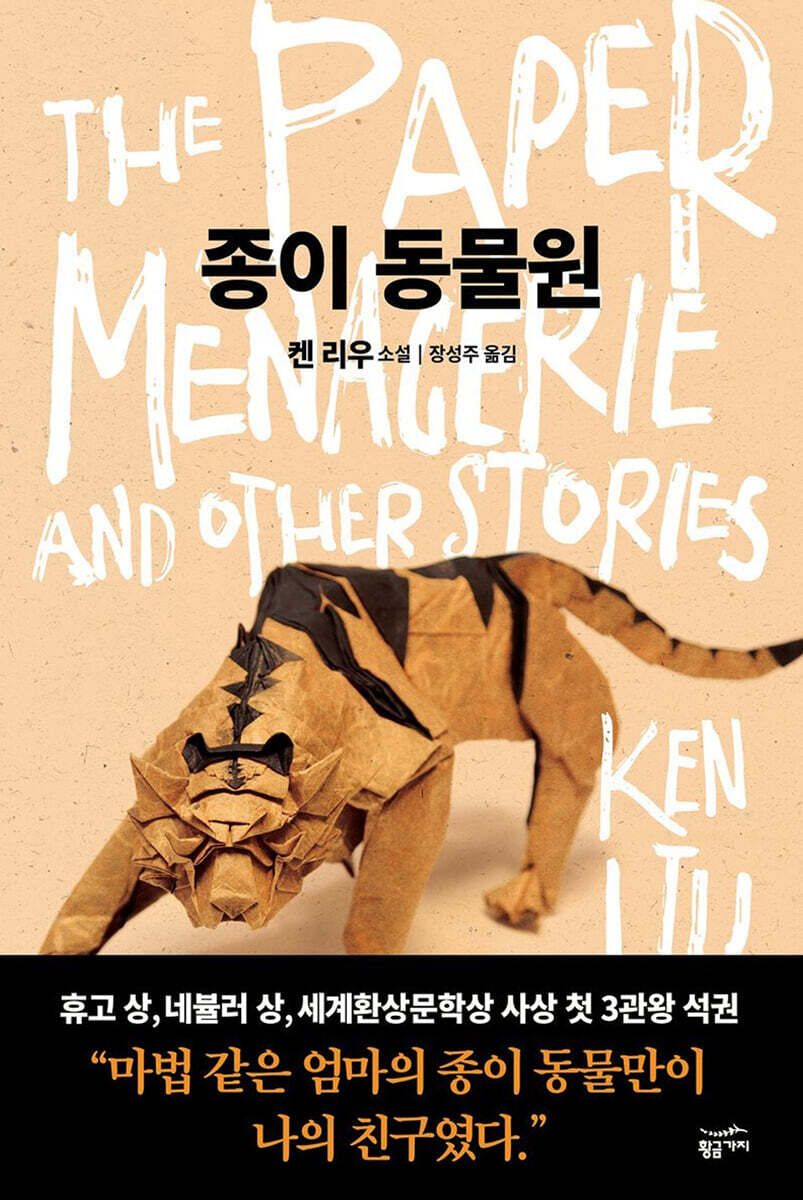
“My only friends were my mother’s magical paper animals.”
A representative collection of short stories by Ken Liu, one of the most notable contemporary science fiction and fantasy writers, has been published by Golden Bough.
This collection of works offers a glimpse into Ken Liu's world of work, from science fiction to fantasy, hard-boiled, alternate history, and biographical novels, including his masterpiece "The Paper Menagerie," which won the prestigious Hugo Award, Nebula Award, and World Fantasy Award for the first time in 40 years.
The title piece, "Paper Menagerie," is a short but poignant story about a Chinese mother and her son who, as children, created paper animals using gift wrapping paper and brought them to life. It quickly catapulted Ken Liu to the ranks of bestselling authors.
Also included are a number of short stories that incorporate the science fiction and fantasy genres into the historical events of Northeast Asia as seen from the perspective of a Chinese-American author. These include “The People Who Put an End to History,” which depicts a scientist couple’s journey to experience the past and the brutality of the Japanese military’s Unit 731 in documentary format; “A Brief History of the Trans-Pacific Tunnel,” which depicts an alternative history in which Japan, which did not fall, connects the United States with an undersea tunnel through forced conscription; “The Fortune Teller,” which is based on the 2.28 Incident in Taiwan, which resembles the painful history of the Jeju 4.3 Incident; “The Paper Menagerie,” which deals with the Cultural Revolution; and “Happy Hunting,” which deals with the economic invasion of Western powers through the fantasy and steampunk genres. You can find several short stories that will elicit emotional resonance from domestic readers.
A representative collection of short stories by Ken Liu, one of the most notable contemporary science fiction and fantasy writers, has been published by Golden Bough.
This collection of works offers a glimpse into Ken Liu's world of work, from science fiction to fantasy, hard-boiled, alternate history, and biographical novels, including his masterpiece "The Paper Menagerie," which won the prestigious Hugo Award, Nebula Award, and World Fantasy Award for the first time in 40 years.
The title piece, "Paper Menagerie," is a short but poignant story about a Chinese mother and her son who, as children, created paper animals using gift wrapping paper and brought them to life. It quickly catapulted Ken Liu to the ranks of bestselling authors.
Also included are a number of short stories that incorporate the science fiction and fantasy genres into the historical events of Northeast Asia as seen from the perspective of a Chinese-American author. These include “The People Who Put an End to History,” which depicts a scientist couple’s journey to experience the past and the brutality of the Japanese military’s Unit 731 in documentary format; “A Brief History of the Trans-Pacific Tunnel,” which depicts an alternative history in which Japan, which did not fall, connects the United States with an undersea tunnel through forced conscription; “The Fortune Teller,” which is based on the 2.28 Incident in Taiwan, which resembles the painful history of the Jeju 4.3 Incident; “The Paper Menagerie,” which deals with the Cultural Revolution; and “Happy Hunting,” which deals with the economic invasion of Western powers through the fantasy and steampunk genres. You can find several short stories that will elicit emotional resonance from domestic readers.
- You can preview some of the book's contents.
Preview
index
preface
Paper Zoo
A match made in heaven
Happy hunting!
Change of status
fortune teller
Book-making habits of advanced intelligent species
Simulacrum
Regular
Comparative Cognitive Picture Books for Advanced Readers
wave
Monono Aware
A Brief History of the Trans-Pacific Tunnel
Songsa and the Monkey King
People Who Put an End to History ⓘ A documentary on modern Northeast Asian history
Translator's Note
Paper Zoo
A match made in heaven
Happy hunting!
Change of status
fortune teller
Book-making habits of advanced intelligent species
Simulacrum
Regular
Comparative Cognitive Picture Books for Advanced Readers
wave
Monono Aware
A Brief History of the Trans-Pacific Tunnel
Songsa and the Monkey King
People Who Put an End to History ⓘ A documentary on modern Northeast Asian history
Translator's Note
Publisher's Review
“My only friends were my mother’s magical paper animals.”
Included in "Paper Menagerie," the first triple crown winner of the Hugo Award, Nebula Award, and World Fantasy Award.
Winner of the 2017 Locus Best Anthology Award.
Includes the Hugo Award-winning work "Mono no Aware."
A representative collection of short stories by Ken Liu, one of the most notable contemporary science fiction and fantasy writers, has been published by Golden Bough.
This collection of works offers a glimpse into Ken Liu's world of work, from science fiction to fantasy, hard-boiled, alternate history, and biographical novels, including his masterpiece "The Paper Menagerie," which won the prestigious Hugo Award, Nebula Award, and World Fantasy Award for the first time in 40 years.
The title piece, "Paper Menagerie," is a short but poignant story about a Chinese mother and her son who, as children, created paper animals using gift wrapping paper and brought them to life. It quickly catapulted Ken Liu to the ranks of bestselling authors.
Also included are a number of short stories that incorporate the science fiction and fantasy genres into the historical events of Northeast Asia as seen from the perspective of a Chinese-American author. These include “The People Who Put an End to History,” which depicts a scientist couple’s journey to experience the past and the brutality of the Japanese military’s Unit 731 in documentary format; “A Brief History of the Trans-Pacific Tunnel,” which depicts an alternative history in which Japan, which did not fall, connects the United States with an undersea tunnel through forced conscription; “The Fortune Teller,” which is based on the 2.28 Incident in Taiwan, which resembles the painful history of the Jeju 4.3 Incident; “The Paper Menagerie,” which deals with the Cultural Revolution; and “Happy Hunting,” which deals with the economic invasion of Western powers through the fantasy and steampunk genres. You can find several short stories that will elicit emotional resonance from domestic readers.
In addition to these, there are also masterpieces that are both genre-specific and complete, such as "Made in Heaven," which warns of a dystopia where all of an individual's decisions are made by artificial intelligence; "Regular," a hard-boiled story about a detective tracking down a hidden camera and related incidents; and "Simulacrum," which is about a machine that replicates a personality in virtual reality and lets you experience it.
Comprised of 14 short stories, Paper Menagerie won the prestigious Locus Award for Best Anthology in 2017.
In addition to this, Ken Liu also translated Liu Cixin's The Three-Body Problem, which became the first Chinese science fiction writer to win the Hugo Award in 2015, into English, thereby playing a role in facilitating science fiction exchange between the East and the West.
In 2019, Ken Liu's novel "Dandelion Dynasty 1 - The Majesty of the Emperor" and "Ken Liu Short Story Collection 1 and 2" will be translated and published in succession.
“This collection of short stories brings back memories for me.
It contains my most popular stories (by the standards of literary award nominees and winners), as well as stories I'm proud of but haven't seen the light of day.
I think these stories clearly show my interests, obsessions, and creative goals.” ⓘ From the author’s preface
“The title of this short story (menagerie instead of zoo) is actually an allusion to Williams’ play “The Glass Menagerie.”
Because in the story, it becomes clear that the mother, who appears to be a weak and delicate being (like Laura in “The Glass Menagerie”), has great power within her heart, just like the paper animals.” ⓘ Japanese edition author’s note
'What kind of woman puts her picture in a catalog just to be sold as a bride?' As a high school student, I thought I knew everything about the world.
The taste of contempt was sweet.
Like wine.
ⓘ From "Paper Zoo"
Novels that combine science fiction and historical awareness, resonating with Koreans.
Among the included works, "People Who Put an End to History" is a documentary-style novel that uses technology that allows the victims of Unit 731 to experience past information and memories as they are, sending them back in time to uncover the truth about the past.
While the work vividly depicts the actions of Unit 731, it realistically depicts the testimonies of those involved, lobbying in Japan, and conflicts in American politics, and it became such a hot topic that it was nominated for the Nebula Award and Hugo Award.
The author states in his comments that he consulted numerous interviews with actual people involved, articles, books, and especially hearings held before the U.S. House of Representatives passed House Resolution 121 on Comfort Women, and that he wrote this book in memory of all the victims of Unit 731.
He has also revealed in several interviews that it is 'the story I cherish and am most proud of.'
However, this work was not included in the official publication of Ken Liu's short story collection in Japan, and in China it was also published in an incomplete edition with passages critical of the Communist Party omitted.
The alternative history novel "The Transpacific Tunnel Chronicles" begins with the premise of what would happen if, instead of World War II, Japan had established friendly relations with the United States and China and ruled over Korea and Manchuria. It deals with the shocking reality of forced labor, the illegal exploitation of laborers, and the massacre of the conscripts to conceal their secrets.
In "The Fortune Teller", which is based on the 2.28 Incident in Taiwan, it is said that the origin of "gook" was that it became a derogatory term for Asians during the Korean War due to the American soldiers who took "America" as "me gook."
This work provides historical resonance to Koreans as well, as it is based on Taiwan during the Cold War.
In this way, Ken Liu actively reflects his interest in Northeast Asian history in his work.
His other anthology, scheduled to be published in Korea in 2019, will include a short story about the Battle of Pyongyang Castle by Ming general Li Rusong during the Imjin War, and a work based on the shape of the Korean alphabet.
“Men who could no longer bear their desires sought out comfort women from Korea.
Although I had to pay a day's wages.
I only went once.
Both of them looked very dirty, and the woman didn't move at all like a dead fish.
I never looked for comfort women again.
I heard from a colleague that among the comfort women, there were some who were trafficked by the Imperial Army rather than coming there of their own free will. It seems that the woman I bought was one of those cases.
I didn't feel particularly sorry towards that woman.
“Because I was so tired.” ⓘ From “The History of the Trans-Pacific Tunnel”
“People who tell stories like that are just looking for attention.
Why, like the Korean prostitutes who claimed to have been kidnapped by the Japanese military during World War II.” ⓘ Anonymous interview from “People Who Put an End to History”
Captivating the public with idealistic and unique ideas in the SF fantasy genre
Ken Liu's works break the stereotype that science fiction and fantasy are difficult for the general public to understand.
Although they each deal with unique topics, they are topics that the general public can think about in real life.
"Simulacrum" is a work that unfolds the perspectives of a father and daughter in an interview format, based on an incident in which a daughter witnessed her father having a virtual affair with a special device during her childhood, and ended up avoiding him for the rest of her life.
"Made in Heaven" depicts a future where everything from dating partners to restaurants and work is entrusted to artificial intelligence, and where companies operating artificial intelligence become more powerful than nations.
The image of humanity being unable to do anything without artificial intelligence delivers an interesting message to modern people, for whom smartphones have become the center of their lives.
In addition to this, there are many works that incorporate various genre imaginations. "Happy Hunting" shows an interesting combination of fantasy and SF steampunk genres by dealing with the story of a Taoist priest's son who hunted zombies and nine-tailed foxes and a nine-tailed fox's daughter adapting to the new future world in the early 20th century as the fantasy era disappears and the era of steam science begins.
"The Wave," nominated for the Nebula Award for Best Novel, is an explosively imaginative account of a distant future where humanity has gained immortality.
"Mono no Aware," which won the Hugo Award for Best Short Story, is also a work about humanity going into space.
“See? You can’t do your job without Tilly.
He can't even remember his own life, and can't even make a single phone call to his mother.
Now humanity is cyborgs.
We have long since begun to expand our consciousness into the realm of electronics, and it is now impossible to cram the ego back into the brain.
“The electronic copy of you that you were trying to destroy is literally the real you.” ⓘ From “Made in Heaven”
Included in "Paper Menagerie," the first triple crown winner of the Hugo Award, Nebula Award, and World Fantasy Award.
Winner of the 2017 Locus Best Anthology Award.
Includes the Hugo Award-winning work "Mono no Aware."
A representative collection of short stories by Ken Liu, one of the most notable contemporary science fiction and fantasy writers, has been published by Golden Bough.
This collection of works offers a glimpse into Ken Liu's world of work, from science fiction to fantasy, hard-boiled, alternate history, and biographical novels, including his masterpiece "The Paper Menagerie," which won the prestigious Hugo Award, Nebula Award, and World Fantasy Award for the first time in 40 years.
The title piece, "Paper Menagerie," is a short but poignant story about a Chinese mother and her son who, as children, created paper animals using gift wrapping paper and brought them to life. It quickly catapulted Ken Liu to the ranks of bestselling authors.
Also included are a number of short stories that incorporate the science fiction and fantasy genres into the historical events of Northeast Asia as seen from the perspective of a Chinese-American author. These include “The People Who Put an End to History,” which depicts a scientist couple’s journey to experience the past and the brutality of the Japanese military’s Unit 731 in documentary format; “A Brief History of the Trans-Pacific Tunnel,” which depicts an alternative history in which Japan, which did not fall, connects the United States with an undersea tunnel through forced conscription; “The Fortune Teller,” which is based on the 2.28 Incident in Taiwan, which resembles the painful history of the Jeju 4.3 Incident; “The Paper Menagerie,” which deals with the Cultural Revolution; and “Happy Hunting,” which deals with the economic invasion of Western powers through the fantasy and steampunk genres. You can find several short stories that will elicit emotional resonance from domestic readers.
In addition to these, there are also masterpieces that are both genre-specific and complete, such as "Made in Heaven," which warns of a dystopia where all of an individual's decisions are made by artificial intelligence; "Regular," a hard-boiled story about a detective tracking down a hidden camera and related incidents; and "Simulacrum," which is about a machine that replicates a personality in virtual reality and lets you experience it.
Comprised of 14 short stories, Paper Menagerie won the prestigious Locus Award for Best Anthology in 2017.
In addition to this, Ken Liu also translated Liu Cixin's The Three-Body Problem, which became the first Chinese science fiction writer to win the Hugo Award in 2015, into English, thereby playing a role in facilitating science fiction exchange between the East and the West.
In 2019, Ken Liu's novel "Dandelion Dynasty 1 - The Majesty of the Emperor" and "Ken Liu Short Story Collection 1 and 2" will be translated and published in succession.
“This collection of short stories brings back memories for me.
It contains my most popular stories (by the standards of literary award nominees and winners), as well as stories I'm proud of but haven't seen the light of day.
I think these stories clearly show my interests, obsessions, and creative goals.” ⓘ From the author’s preface
“The title of this short story (menagerie instead of zoo) is actually an allusion to Williams’ play “The Glass Menagerie.”
Because in the story, it becomes clear that the mother, who appears to be a weak and delicate being (like Laura in “The Glass Menagerie”), has great power within her heart, just like the paper animals.” ⓘ Japanese edition author’s note
'What kind of woman puts her picture in a catalog just to be sold as a bride?' As a high school student, I thought I knew everything about the world.
The taste of contempt was sweet.
Like wine.
ⓘ From "Paper Zoo"
Novels that combine science fiction and historical awareness, resonating with Koreans.
Among the included works, "People Who Put an End to History" is a documentary-style novel that uses technology that allows the victims of Unit 731 to experience past information and memories as they are, sending them back in time to uncover the truth about the past.
While the work vividly depicts the actions of Unit 731, it realistically depicts the testimonies of those involved, lobbying in Japan, and conflicts in American politics, and it became such a hot topic that it was nominated for the Nebula Award and Hugo Award.
The author states in his comments that he consulted numerous interviews with actual people involved, articles, books, and especially hearings held before the U.S. House of Representatives passed House Resolution 121 on Comfort Women, and that he wrote this book in memory of all the victims of Unit 731.
He has also revealed in several interviews that it is 'the story I cherish and am most proud of.'
However, this work was not included in the official publication of Ken Liu's short story collection in Japan, and in China it was also published in an incomplete edition with passages critical of the Communist Party omitted.
The alternative history novel "The Transpacific Tunnel Chronicles" begins with the premise of what would happen if, instead of World War II, Japan had established friendly relations with the United States and China and ruled over Korea and Manchuria. It deals with the shocking reality of forced labor, the illegal exploitation of laborers, and the massacre of the conscripts to conceal their secrets.
In "The Fortune Teller", which is based on the 2.28 Incident in Taiwan, it is said that the origin of "gook" was that it became a derogatory term for Asians during the Korean War due to the American soldiers who took "America" as "me gook."
This work provides historical resonance to Koreans as well, as it is based on Taiwan during the Cold War.
In this way, Ken Liu actively reflects his interest in Northeast Asian history in his work.
His other anthology, scheduled to be published in Korea in 2019, will include a short story about the Battle of Pyongyang Castle by Ming general Li Rusong during the Imjin War, and a work based on the shape of the Korean alphabet.
“Men who could no longer bear their desires sought out comfort women from Korea.
Although I had to pay a day's wages.
I only went once.
Both of them looked very dirty, and the woman didn't move at all like a dead fish.
I never looked for comfort women again.
I heard from a colleague that among the comfort women, there were some who were trafficked by the Imperial Army rather than coming there of their own free will. It seems that the woman I bought was one of those cases.
I didn't feel particularly sorry towards that woman.
“Because I was so tired.” ⓘ From “The History of the Trans-Pacific Tunnel”
“People who tell stories like that are just looking for attention.
Why, like the Korean prostitutes who claimed to have been kidnapped by the Japanese military during World War II.” ⓘ Anonymous interview from “People Who Put an End to History”
Captivating the public with idealistic and unique ideas in the SF fantasy genre
Ken Liu's works break the stereotype that science fiction and fantasy are difficult for the general public to understand.
Although they each deal with unique topics, they are topics that the general public can think about in real life.
"Simulacrum" is a work that unfolds the perspectives of a father and daughter in an interview format, based on an incident in which a daughter witnessed her father having a virtual affair with a special device during her childhood, and ended up avoiding him for the rest of her life.
"Made in Heaven" depicts a future where everything from dating partners to restaurants and work is entrusted to artificial intelligence, and where companies operating artificial intelligence become more powerful than nations.
The image of humanity being unable to do anything without artificial intelligence delivers an interesting message to modern people, for whom smartphones have become the center of their lives.
In addition to this, there are many works that incorporate various genre imaginations. "Happy Hunting" shows an interesting combination of fantasy and SF steampunk genres by dealing with the story of a Taoist priest's son who hunted zombies and nine-tailed foxes and a nine-tailed fox's daughter adapting to the new future world in the early 20th century as the fantasy era disappears and the era of steam science begins.
"The Wave," nominated for the Nebula Award for Best Novel, is an explosively imaginative account of a distant future where humanity has gained immortality.
"Mono no Aware," which won the Hugo Award for Best Short Story, is also a work about humanity going into space.
“See? You can’t do your job without Tilly.
He can't even remember his own life, and can't even make a single phone call to his mother.
Now humanity is cyborgs.
We have long since begun to expand our consciousness into the realm of electronics, and it is now impossible to cram the ego back into the brain.
“The electronic copy of you that you were trying to destroy is literally the real you.” ⓘ From “Made in Heaven”
GOODS SPECIFICS
- Publication date: November 29, 2018
- Page count, weight, size: 568 pages | 620g | 140*210*35mm
- ISBN13: 9791158884680
- ISBN10: 1158884680
You may also like
카테고리
korean


korean

![GQ KOREA Mark (Monthly): December [2025]](http://librairie.coreenne.fr/cdn/shop/files/8ef265dbbfbf186523ed75ba7319009d.jpg?v=1765340328&width=3840)


