

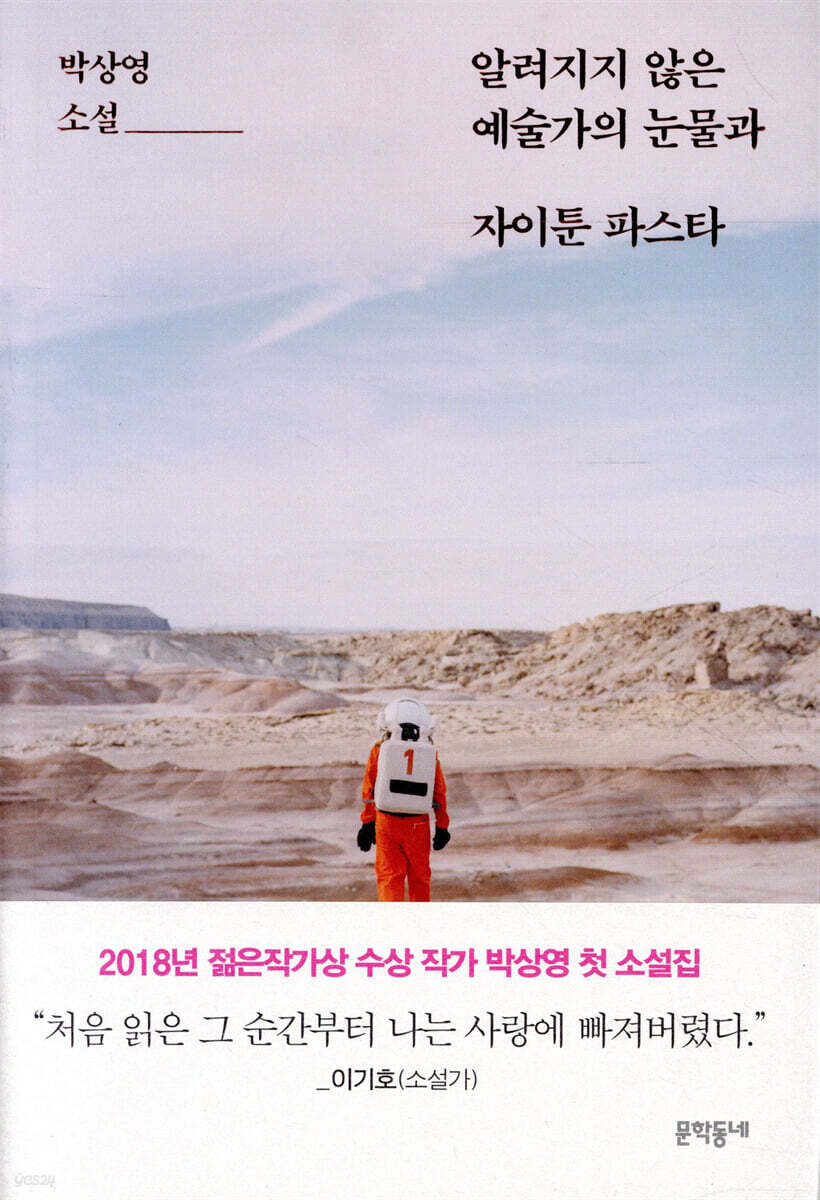
Tears of an Unknown Artist and Zaytun Pasta
 |
Description
Book Introduction
The first novel collection by Park Sang-young, winner of the 2018 Young Writer's Award
The first collection of short stories by Park Sang-young, a young writer who has been showing off his outstanding novelistic talents to the fullest (although it may be a cliché) by winning the Munhakdongne New Writer's Award in 2016 for his short story "Looking for Paris Hilton," has been published.
From his debut work, he has received comments such as, “We can expect this aspiring writer to play the role that early Kim Young-ha played in Korean literature in the 1990s in the 21st century” (literary critic Kim Hyeong-jung), “I think it will evoke common sympathy and charm from many people” (novelist Jeong Yong-jun), and “Somehow, it seems like he is ready to write his third and fourth works in his own style” (novelist Yoon Go-eun), hinting at his tremendous writing ability.
Since then, he has fearlessly incorporated social issues and materials into his works with his signature rhythmic and humorous style, and has proven that his guess was correct by winning the Young Writer Award in 2018 for his title work, “Tears of an Unknown Artist and Zaytun Pasta.”
There is no reason to hesitate to place Park Sang-young's name and his first collection of short stories at the forefront of the list of talented young writers who will broaden the boundaries and deepen the depth of Korean literature.
The first collection of short stories by Park Sang-young, a young writer who has been showing off his outstanding novelistic talents to the fullest (although it may be a cliché) by winning the Munhakdongne New Writer's Award in 2016 for his short story "Looking for Paris Hilton," has been published.
From his debut work, he has received comments such as, “We can expect this aspiring writer to play the role that early Kim Young-ha played in Korean literature in the 1990s in the 21st century” (literary critic Kim Hyeong-jung), “I think it will evoke common sympathy and charm from many people” (novelist Jeong Yong-jun), and “Somehow, it seems like he is ready to write his third and fourth works in his own style” (novelist Yoon Go-eun), hinting at his tremendous writing ability.
Since then, he has fearlessly incorporated social issues and materials into his works with his signature rhythmic and humorous style, and has proven that his guess was correct by winning the Young Writer Award in 2018 for his title work, “Tears of an Unknown Artist and Zaytun Pasta.”
There is no reason to hesitate to place Park Sang-young's name and his first collection of short stories at the forefront of the list of talented young writers who will broaden the boundaries and deepen the depth of Korean literature.
- You can preview some of the book's contents.
Preview
index
A Short Joke About Chinese Counterfeit Viagra and Its Preparations, and Urine That Doesn't Stop Anywhere_7
Looking for Paris Hilton _55
Busan International Film Festival _83
Tears and Zaytun Pasta by an Unknown Artist _137
Joe's Room _217
How about Hamlet? _249
Ceramic _279
Commentary | Jae-min Yoon (literary critic)
A compilation of lesser-known K-pop hits for the solitary gourmet who appreciates the "red flavor" of capsaicin bombs topped with cheese _325
Author's Note _347
Looking for Paris Hilton _55
Busan International Film Festival _83
Tears and Zaytun Pasta by an Unknown Artist _137
Joe's Room _217
How about Hamlet? _249
Ceramic _279
Commentary | Jae-min Yoon (literary critic)
A compilation of lesser-known K-pop hits for the solitary gourmet who appreciates the "red flavor" of capsaicin bombs topped with cheese _325
Author's Note _347
Into the book
Born.
And that too, being born homosexual.
Meeting Q and starting to date.
Q, who was on a 100-day vacation, shared pesticides with him and went into the bathtub.
I am the only one who survived.
I've developed a habit of not being able to sleep without having sex.
Having sex with men I don't know without using a condom.
If I could change just one of these, would my life be different now?
---From "A Short Joke About Chinese Counterfeit Viagra and Its Preparations, and Urine That Doesn't Get Anywhere"
It was a very precious item.
I treasured it so much that I buried it deep so no one could take it away.
But now I don't even remember where I buried it or what it was.
---From "A Short Joke About Chinese Counterfeit Viagra and Its Preparations, and Urine That Doesn't Get Anywhere"
We share so many dirty things, yet we never talk about our most intimate parts.
In fact, our relationship, where we hide the truth from each other and live desiring other things, may be an extremely common and normal type of couple.
---From the Busan International Film Festival
So don't tell me the truth that I can't handle.
Don't try to figure out my sore spots.
Don't even try to be special.
Just stay the guy who meets up when he's bored, has sex, and talks about useless things.
Please.
---From the Busan International Film Festival
If, as Confucius said, true success comes from knowing how to enjoy life, then Wang Xia should have been a star.
I didn't know then that those who enjoy something are just people who know how to enjoy it, those who are good at something are just good at it, and that there are people who are truly good at something.
---From "The Tears of an Unknown Artist and Zaytun Pasta"
We are ruined.
I was ruined and became nothing.
We are just a bunch of gay guys who laugh, chat, drink, have sex and die, nothing more than that, and we never will be anything more than that.
We were nothing in the beginning, we are nothing, and therefore we will always be nothing.
Really, it's nothing.
---From "The Tears of an Unknown Artist and Zaytun Pasta"
Failure makes people feel very crumpled and shriveled.
It rips the skin with its sharp tip and dissects it piece by piece.
Failure is the experience of being forced to look into the dark parts of one's internal organs that need not be seen.
I believe that no one who attaches plausible meaning to failure has ever truly achieved success.
---From "How about Hamlet?"
The reality I believed I was firmly rooted in was actually nothing more than a helium-filled balloon, fluttering aimlessly here and there.
Reality is not refined or beautiful at all, and there is no such thing as practice in everyday life.
That this moment is my life.
And that too, being born homosexual.
Meeting Q and starting to date.
Q, who was on a 100-day vacation, shared pesticides with him and went into the bathtub.
I am the only one who survived.
I've developed a habit of not being able to sleep without having sex.
Having sex with men I don't know without using a condom.
If I could change just one of these, would my life be different now?
---From "A Short Joke About Chinese Counterfeit Viagra and Its Preparations, and Urine That Doesn't Get Anywhere"
It was a very precious item.
I treasured it so much that I buried it deep so no one could take it away.
But now I don't even remember where I buried it or what it was.
---From "A Short Joke About Chinese Counterfeit Viagra and Its Preparations, and Urine That Doesn't Get Anywhere"
We share so many dirty things, yet we never talk about our most intimate parts.
In fact, our relationship, where we hide the truth from each other and live desiring other things, may be an extremely common and normal type of couple.
---From the Busan International Film Festival
So don't tell me the truth that I can't handle.
Don't try to figure out my sore spots.
Don't even try to be special.
Just stay the guy who meets up when he's bored, has sex, and talks about useless things.
Please.
---From the Busan International Film Festival
If, as Confucius said, true success comes from knowing how to enjoy life, then Wang Xia should have been a star.
I didn't know then that those who enjoy something are just people who know how to enjoy it, those who are good at something are just good at it, and that there are people who are truly good at something.
---From "The Tears of an Unknown Artist and Zaytun Pasta"
We are ruined.
I was ruined and became nothing.
We are just a bunch of gay guys who laugh, chat, drink, have sex and die, nothing more than that, and we never will be anything more than that.
We were nothing in the beginning, we are nothing, and therefore we will always be nothing.
Really, it's nothing.
---From "The Tears of an Unknown Artist and Zaytun Pasta"
Failure makes people feel very crumpled and shriveled.
It rips the skin with its sharp tip and dissects it piece by piece.
Failure is the experience of being forced to look into the dark parts of one's internal organs that need not be seen.
I believe that no one who attaches plausible meaning to failure has ever truly achieved success.
---From "How about Hamlet?"
The reality I believed I was firmly rooted in was actually nothing more than a helium-filled balloon, fluttering aimlessly here and there.
Reality is not refined or beautiful at all, and there is no such thing as practice in everyday life.
That this moment is my life.
---From "How about Hamlet?"
Publisher's Review
“I didn’t know at the time
How to love someone.
The characters in Park Sang-young's novels are constantly in love, but then they 'fail' at it, and eventually 'ruin'.
The objects of their love have nothing in common.
There is no basis for imposing any rules on the emotion called love, and their love is especially spectacular.
It seems difficult to say that the feelings of 'Jeje', a gay male prostitute who loves his job and spends every night with a new man at a fancy hotel despite his pennilessness, and 'I' who stays by his side even though I don't understand Jeje ("Chinese Counterfeit Viagra and Jeje, a Short Joke About Urine That Never Gathers Anywhere"), a couple who constantly doubt each other's love and want to be confirmed, but do not shy away from living a double life both online and offline ("Looking for Paris Hilton", "Busan International Film Festival"), and 'I' and 'Wangsha' ("Tears of an Unknown Artist and Zaytun Pasta") who feel that "the point is strangely gay" in the limited space of the 'Zaytun Unit' but are not sure if "he's from our side" or deny it, saying "I'm not the type of person who does that with men" are not love.
The reason they are so obsessed with love is because they have been pushed out of or rejected by the 'mainstream world'.
For these people, loving the object of their love more ‘hard’ is the ‘best life.’
They don't care if they are far from economic activity or if they are not welcomed and recognized by others.
The most shining point of Park Sang-young's novel is also here.
Park Sang-young vividly portrays the lives, loves, dreams, and desires of people outside the mainstream world, sharply criticizing the "mainstream-oriented" and "other-oriented" nature of Korean society.
Even though the current reality is overwhelming, through those who love and live in their own way without being bound by it, “one aspect of ‘Koreanness’ that is materially constructed is depicted more accurately than any social scientific insight” (Yoon Jae-min, commentary on the work).
Furthermore, Park Sang-young's novel shows that failure and ruin can also be a plausible way of living.
Representative examples include the figure of 'I' and Wangsha from "The Unknown Artist's Tears and Zaytun Pasta," the winner of the 2018 Young Writer's Award and a work that will surely be mentioned in the genealogy of Korean 'queer novels' someday.
'I' dreams of becoming the darling of the Cannes Film Festival and wants to make a film that depicts the reality of gays, that is, a "queer film that doesn't exist in the world" that is "not overly emotional or falls into political propaganda" like queer films made by straight directors. However, 'I's' first and last feature film is harshly criticized by straight film critics for lacking realism.
To me, the reality of gays is no different from that of heterosexuals: “just young people drinking and having sex” or “just dating,” but in the end, I am treated as a “fake Hong Sang-soo” and pushed out of the film industry.
Wang Xia also dreams of becoming “the Charles Wideman of the East” and devotes herself to modern dance, but in the end, as the title of the piece she performs suggests, she is unable to become even “a small dot in the world.”
What's interesting, though, is that their failures don't feel disheartening or miserable at all.
As literary critic Shin Hyeong-cheol said, “Only one person is qualified to dare to declare someone’s failure, and this novel is a declaration of failure by those who are qualified to declare failure, and therefore it is unprecedentedly confident” (Young Writer’s Award judges’ comments) and rather brimming with passion.
How many people can shout out loud that they are ruined?
We are not ruined, but “completed,” and that is why the scene where ‘I’ and Wang Xia dance together to Yoo Chae-young’s techno number (“I Didn’t Know Back Then How to Love Someone”) feels thrilling.
A couple in their thirties who are obsessed with Instagram in the form of different dreams, a soldier in his twenties who is surprisingly naive and “just the right amount of things that should be big,” a queer person, a “fake gay” film director who maintains “a shallow influence through social media activities,” an idol trainee who never makes it to the debut stage, a teenage boy oppressed by his mother’s violence, etc. The “tragic adventures” of various characters appearing in Park Sang-young’s novels well show “the cheerful yet lonely aspect of a youth novel” (novelist Lee Jang-wook, Young Writer’s Award judge’s commentary).
In particular, the figures of 'Na' ("How About Hamlet?") who was selected to debut as a member of a girl group at an early age and "prepared for her debut by splitting her time" but ultimately failed, and 'Soo' ("Jo's Room") who, in order to pay for her tuition and living expenses, ends up working as a traveling prostitute and ends up uploading a secret video of herself filmed by her lover to a file sharing site as a means of making money, vividly reveal the reality of youth in our time who do their best to live toward their dreams but end up being frustrated by prejudice and social class.
However, Park Sang-young does not portray this reality as only sad and painful.
Just as novelist Lee Ki-ho, who can be called the 'representative humorist' of the Korean literary world, welcomed the emergence of his junior, saying in his recommendation that Park Sang-young was "the emergence of a 'natural humorist'", Park Sang-young's novels are humorous and rhythmic, making them fun to read.
Park Sang-young is more likely to throw out a joke directly without being shy, rather than just blurting it out.
We can't help but chuckle when we hear the "funny story of the day" that Jeje sent to 'me', and the conversation that 'me' and Wangsha have while causing a commotion at 'Chanel Karaoke' and 'Beyoncé Sundae Gukbap' ends up making us burst out laughing.
And beyond the commotion and laughter, it is Park Sang-young's novel that ultimately moves us to tears and makes us "helplessly empathize" with the stories of those living in the same era (Jeong I-hyeon, recommendation).
How to love someone.
The characters in Park Sang-young's novels are constantly in love, but then they 'fail' at it, and eventually 'ruin'.
The objects of their love have nothing in common.
There is no basis for imposing any rules on the emotion called love, and their love is especially spectacular.
It seems difficult to say that the feelings of 'Jeje', a gay male prostitute who loves his job and spends every night with a new man at a fancy hotel despite his pennilessness, and 'I' who stays by his side even though I don't understand Jeje ("Chinese Counterfeit Viagra and Jeje, a Short Joke About Urine That Never Gathers Anywhere"), a couple who constantly doubt each other's love and want to be confirmed, but do not shy away from living a double life both online and offline ("Looking for Paris Hilton", "Busan International Film Festival"), and 'I' and 'Wangsha' ("Tears of an Unknown Artist and Zaytun Pasta") who feel that "the point is strangely gay" in the limited space of the 'Zaytun Unit' but are not sure if "he's from our side" or deny it, saying "I'm not the type of person who does that with men" are not love.
The reason they are so obsessed with love is because they have been pushed out of or rejected by the 'mainstream world'.
For these people, loving the object of their love more ‘hard’ is the ‘best life.’
They don't care if they are far from economic activity or if they are not welcomed and recognized by others.
The most shining point of Park Sang-young's novel is also here.
Park Sang-young vividly portrays the lives, loves, dreams, and desires of people outside the mainstream world, sharply criticizing the "mainstream-oriented" and "other-oriented" nature of Korean society.
Even though the current reality is overwhelming, through those who love and live in their own way without being bound by it, “one aspect of ‘Koreanness’ that is materially constructed is depicted more accurately than any social scientific insight” (Yoon Jae-min, commentary on the work).
Furthermore, Park Sang-young's novel shows that failure and ruin can also be a plausible way of living.
Representative examples include the figure of 'I' and Wangsha from "The Unknown Artist's Tears and Zaytun Pasta," the winner of the 2018 Young Writer's Award and a work that will surely be mentioned in the genealogy of Korean 'queer novels' someday.
'I' dreams of becoming the darling of the Cannes Film Festival and wants to make a film that depicts the reality of gays, that is, a "queer film that doesn't exist in the world" that is "not overly emotional or falls into political propaganda" like queer films made by straight directors. However, 'I's' first and last feature film is harshly criticized by straight film critics for lacking realism.
To me, the reality of gays is no different from that of heterosexuals: “just young people drinking and having sex” or “just dating,” but in the end, I am treated as a “fake Hong Sang-soo” and pushed out of the film industry.
Wang Xia also dreams of becoming “the Charles Wideman of the East” and devotes herself to modern dance, but in the end, as the title of the piece she performs suggests, she is unable to become even “a small dot in the world.”
What's interesting, though, is that their failures don't feel disheartening or miserable at all.
As literary critic Shin Hyeong-cheol said, “Only one person is qualified to dare to declare someone’s failure, and this novel is a declaration of failure by those who are qualified to declare failure, and therefore it is unprecedentedly confident” (Young Writer’s Award judges’ comments) and rather brimming with passion.
How many people can shout out loud that they are ruined?
We are not ruined, but “completed,” and that is why the scene where ‘I’ and Wang Xia dance together to Yoo Chae-young’s techno number (“I Didn’t Know Back Then How to Love Someone”) feels thrilling.
A couple in their thirties who are obsessed with Instagram in the form of different dreams, a soldier in his twenties who is surprisingly naive and “just the right amount of things that should be big,” a queer person, a “fake gay” film director who maintains “a shallow influence through social media activities,” an idol trainee who never makes it to the debut stage, a teenage boy oppressed by his mother’s violence, etc. The “tragic adventures” of various characters appearing in Park Sang-young’s novels well show “the cheerful yet lonely aspect of a youth novel” (novelist Lee Jang-wook, Young Writer’s Award judge’s commentary).
In particular, the figures of 'Na' ("How About Hamlet?") who was selected to debut as a member of a girl group at an early age and "prepared for her debut by splitting her time" but ultimately failed, and 'Soo' ("Jo's Room") who, in order to pay for her tuition and living expenses, ends up working as a traveling prostitute and ends up uploading a secret video of herself filmed by her lover to a file sharing site as a means of making money, vividly reveal the reality of youth in our time who do their best to live toward their dreams but end up being frustrated by prejudice and social class.
However, Park Sang-young does not portray this reality as only sad and painful.
Just as novelist Lee Ki-ho, who can be called the 'representative humorist' of the Korean literary world, welcomed the emergence of his junior, saying in his recommendation that Park Sang-young was "the emergence of a 'natural humorist'", Park Sang-young's novels are humorous and rhythmic, making them fun to read.
Park Sang-young is more likely to throw out a joke directly without being shy, rather than just blurting it out.
We can't help but chuckle when we hear the "funny story of the day" that Jeje sent to 'me', and the conversation that 'me' and Wangsha have while causing a commotion at 'Chanel Karaoke' and 'Beyoncé Sundae Gukbap' ends up making us burst out laughing.
And beyond the commotion and laughter, it is Park Sang-young's novel that ultimately moves us to tears and makes us "helplessly empathize" with the stories of those living in the same era (Jeong I-hyeon, recommendation).
GOODS SPECIFICS
- Date of publication: September 7, 2018
- Page count, weight, size: 352 pages | 422g | 133*200*30mm
- ISBN13: 9788954652865
- ISBN10: 8954652867
You may also like
카테고리
korean


korean

![GQ KOREA Mark (Monthly): December [2025]](http://librairie.coreenne.fr/cdn/shop/files/8ef265dbbfbf186523ed75ba7319009d.jpg?v=1765340328&width=3840)


