

I said I had a dream
 |
Description
Book Introduction
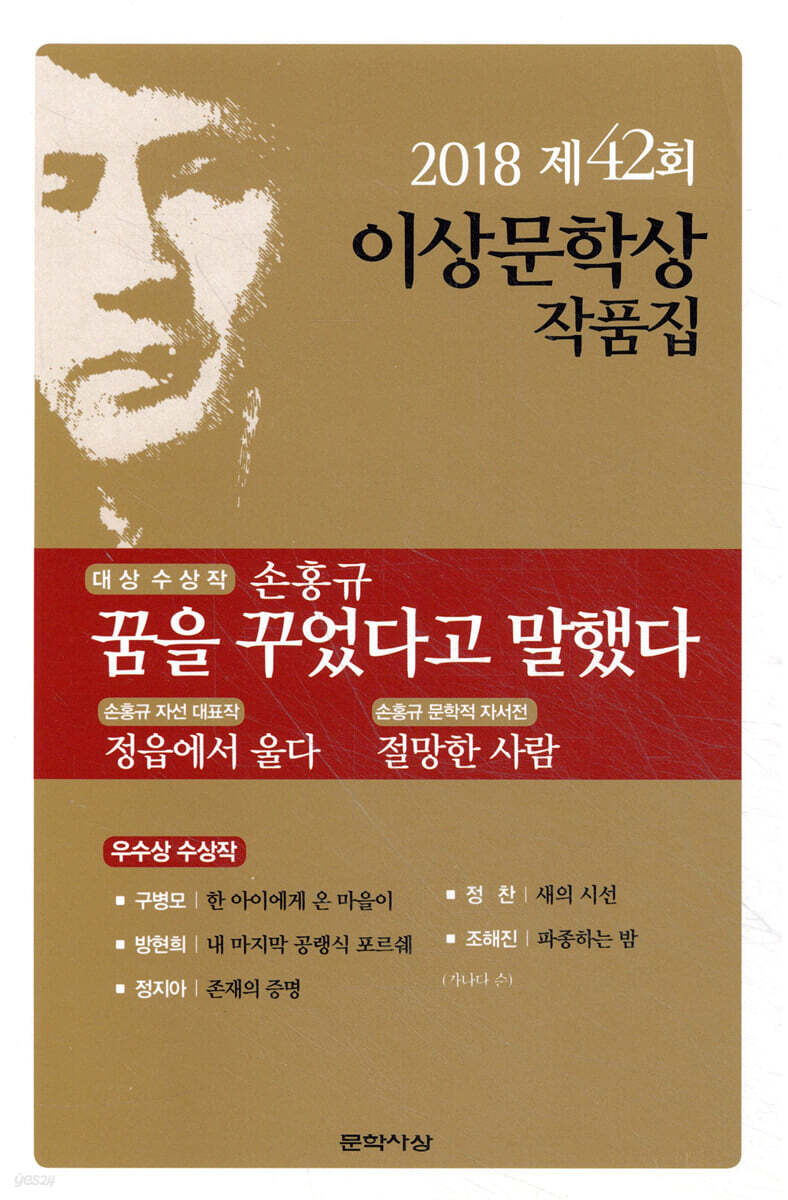
Novelist Son Hong-gyu wins the 42nd Yi Sang Literary Award in 2018! The 『Lee Sang Literary Award Anthology』, which all readers who love Korean literature eagerly await every year, has finally been published. The Yi Sang Literary Award selects the best short and medium-length novels published throughout the year through a fair and rational review process. The Yi Sang Literary Award is comprised of award-winning works of exceptional quality, and is considered the pinnacle of novel aesthetics that represents the current trend of modern novels. The five judges for the 2018 Yi Sang Literary Award (Kwon Young-min, Kwon Taek-young, Kim Seong-gon, Yoon Hu-myeong, and Jeong Gwa-ri) unanimously selected Son Hong-gyu's "I Said I Had a Dream" as the grand prize winner. "I Said I Had a Dream" utilizes the power of a strong narrative and experimental writing style to present a unique narrative progression that interweaves the perspectives of multiple characters. The author uses a unique technique to describe the subject of communication difficulties from the character's perspective. The narrative of the young man, first introduced, later leads to reflection on violence and redemption from the husband's perspective. My wife is rather envious of her mother-in-law who has dementia and speaks through illusions. The author suggests a disconnected self through a unique format in which characters narrate only from their own perspectives. By utilizing the narrative progression from the present to the past, the empirical past becomes a recollection in memory, but is treated as a kind of fantasy, and through this technical invention, author Son Hong-gyu offers words of comfort to all those who are desperate in their daily lives. This collection of works includes the grand prize winner, Son Hong-gyu's "I Said I Had a Dream" and the charity work, "Crying in Jeongeup," as well as the excellence award winners, Gu Byeong-mo's "A Village for One Child," Bang Hyeon-hui's "My Last Air-Cooled Porsche," Jeong Ji-ah's "Proof of Existence," Jeong Chan's "A Bird's Eye View," and Jo Hae-jin's "Sowing Night." All of these were praised as having sufficient value as contemporary writing. |
- You can preview some of the book's contents.
Preview
index
Reasons for Selecting the 42nd Yi Sang Literary Award Grand Prize Winner
Part 1: Selection process, judging comments, and the author and work
Evaluation and selection process
Judges' comments
- Kwon Young-min's true thematic consciousness and novelistic achievement that seeks to penetrate the essence of humanity
- Kwon Taek-young's experimental narrative that traces the origins of violence through the language of dreams
- Kim Seong-gon's remarkable work metaphorically explores frustration, loss, and failure.
- A novel that you can trust and hope for the future.
- A work that makes us look forward to the day when Jeong Gwa-ri will rise into the universe of world literature.
Author's Note | Immersion Leads to Love - Eunmi Choi
Work Review | After Death Passes by Kim Hyung-jung
Part 2 Grand Prize Winner and Son Hong-gyu as an Author
Grand Prize Winner|Son Hong-gyu, "I Said I Had a Dream"
Charity Masterpiece | "Crying in Jeongeup"
Acceptance Speech|These words I treasure like a will
My Literary Autobiography | A Desperate Man
3rd Division Excellence Award Winner
Koo Byung-mo, "A Village for One Child"
Bang Hyun-hee, "My Last Air-Cooled Porsche"
Jeong Ji-ah, "Proof of Existence"
Jeong Chan "Bird's Eye View"
Jo Hae-jin's "Sowing Night"
The purpose and selection rules of the 'Lee Sang Literary Award'
Part 1: Selection process, judging comments, and the author and work
Evaluation and selection process
Judges' comments
- Kwon Young-min's true thematic consciousness and novelistic achievement that seeks to penetrate the essence of humanity
- Kwon Taek-young's experimental narrative that traces the origins of violence through the language of dreams
- Kim Seong-gon's remarkable work metaphorically explores frustration, loss, and failure.
- A novel that you can trust and hope for the future.
- A work that makes us look forward to the day when Jeong Gwa-ri will rise into the universe of world literature.
Author's Note | Immersion Leads to Love - Eunmi Choi
Work Review | After Death Passes by Kim Hyung-jung
Part 2 Grand Prize Winner and Son Hong-gyu as an Author
Grand Prize Winner|Son Hong-gyu, "I Said I Had a Dream"
Charity Masterpiece | "Crying in Jeongeup"
Acceptance Speech|These words I treasure like a will
My Literary Autobiography | A Desperate Man
3rd Division Excellence Award Winner
Koo Byung-mo, "A Village for One Child"
Bang Hyun-hee, "My Last Air-Cooled Porsche"
Jeong Ji-ah, "Proof of Existence"
Jeong Chan "Bird's Eye View"
Jo Hae-jin's "Sowing Night"
The purpose and selection rules of the 'Lee Sang Literary Award'
Publisher's Review
Living different lives
Located in our hearts
The universality of grief and loss, and its recurrence.
A masterpiece written with excellent writing style!
"I Said I Had a Dream" displays the weight of a medium-length novel in that it exquisitely combines the narrative historical nature pursued by a full-length novel with the situational nature emphasized in a short story.
In particular, it is noteworthy that the way author Son Hong-gyu approaches the problem of reality, which he often dealt with, is novel and unique in this work.
The novel's narrative progression moves from the present to the past, and in this process, the empirical past becomes a recollection in memory, but is treated as a kind of fantasy.
This technical invention can be said to be a new experiment by the author himself, who has been obsessed with the pursuit of reality.
―Among the reasons for selecting the grand prize winner
The grand prize winner, “I Said I Had a Dream,”
And introducing the five excellent award-winning pieces.
1.
Son Hong-gyu: "I said I had a dream."
The award-winning work, "I Said I Had a Dream," displays the weight of a medium-length novel in its exquisite combination of the narrative historical nature pursued by a full-length novel and the situational nature emphasized in a short story. It can be said to be a masterpiece in which the author's new experimentation with the pursuit of reality has led to a high degree of novelistic achievement.
Son Hong-gyu's "I Said I Had a Dream" is a novel that deals with the loss and dark past of failed people.
A young man wearing black mourning clothes and a medal on his arm appears in a bar where gangsters gather.
In the young man, the gangsters see a symbol of their own unfulfilled youth and of what they have lost.
They realize that the image of the young man is another version of themselves that has grown old together with them.
The gangsters try to erase the dragon tattoo they had on their bodies when they were young, but it doesn't erase well and the marks still remain on their skin.
A dark past doesn't easily disappear.
Among the people in the bar looking at the young man are some older people, so the work now shifts to his recollection.
He too is a man living a life of loss and failure.
His wife refuses to cook for him anymore, he goes to work and goes on strike, his daughter runs away and has no phone, and his son is nowhere to be found.
He once had a dream, but now that it has become impossible, he tries not to have dreams anymore.
In such a dark situation, he realizes that if he does not turn the past into a memory, it could easily become a nightmare.
From the second half onwards, the novel shifts to his wife's perspective.
Then we move on to the stories of countless women in this land who have lost their dreams and confined themselves.
This final episode delves deeply into what many women in this land have lost, tormented at home by their failing husbands and sexually harassed by their superiors at work.
Son Hong-gyu's "I Said I Had a Dream" is a remarkable work that metaphorically explores the frustration, loss, and failure experienced by the young and old generations, as well as women, in this land.
The 'sadness of life' and 'loss' conveyed through the lives of each character demonstrate universal and recurring attributes.
Thus, this work comforts us by talking about the sadness, loss, and repetitiveness that have taken root in our hearts as we live different lives.
2.
Koo Byung-mo, "A Village for One Child"
This work depicts human prejudice, rude interference, and the resulting psychological discomfort of the protagonist through the story of Jeong-ju, a pregnant woman who has to move to the countryside due to her teacher husband's transfer.
The author sets a rural village as a microcosm of our society, and through the events that occur there, he vividly illuminates and sharply criticizes various problems in human history.
In that sense, the protagonist Jeong-ju's rural life can be a temporary escape from everyday life and a spiritual journey, and the great enlightenment he gains from it resonates with us as we live our daily lives.
3.
Bang Hyun-hee, "My Last Air-Cooled Porsche"
This work metaphorically depicts the protagonist's desire to escape from an unsatisfactory reality through his love for a 1989 Porsche, as well as the difficulties of doing so.
The protagonist's father, who drives a fruit truck, wanted the stable life of a 9th-grade civil servant, but after failing the exam repeatedly, he drives his truck recklessly and dies. The protagonist's friend, who was pursuing a free-spirited life driving a Porsche, also dies in a car accident.
Even knowing this, the protagonist cannot give up his love for the Porsche that will take him to another world.
The author's ability to skillfully handle a weighty subject using automobiles as a metaphor and his extensive knowledge surpassing that of automotive experts lend persuasive power to the work.
4.
Jeong Ji-ah, "Proof of Existence"
This work reflects on who I am and where I come from through the dilemma of the protagonist who has lost his memory.
It's ironic that the protagonist of Amnesia is a coffee drinker, a caffeinated beverage that "summons humans and makes them feel like me."
The author uses a sophisticated style to portray the fact that one's 'self' is something one creates through 'memory', which can be manipulated at will and is inevitably extremely relative.
5.
Jeong Chan "Bird's Eye View"
This work discusses the issues of understanding historical truth and testifying to facts from a new angle.
The author presents a new perspective on the Yongsan tragedy, which shocked us all after the turbulent democratization movement of the 1980s, and the meaning of the sacrifice through the camera angle and still photographs.
This approach raises the question of how one can explain the context of a historical event captured in a single photograph.
6.
Jo Hae-jin's "Sowing Night"
This work deals with the enlightenment experienced by the protagonist, a media artist, while planning a documentary about a factory that was closed due to an industrial accident.
The author emphasizes the importance of communion with the dead and the memory of the dead by dealing with people who died from mercury poisoning due to the ignorance of factory owners in the early days of industrialization.
From the 'Acceptance Speech' of Grand Prize winner Son Hong-gyu
As if sitting still and caressing the question given from the beginning
Looking back on the path I've taken.
A road that cannot be described, a road that must be taken
Perhaps a road that can never be taken.
I'll stumble and fall down that road again.
Those were the days, and those will be the days.
Sit still and try to answer the question given from the beginning.
I realize that many people have been welcoming me for a very long time.
I wonder how I have lived, but why are you all so welcoming?
I despair at the reality of being a novelist.
I will walk this path with doubts and regrets.
Those who deeply love novels
Every time I realize that I am a person who deeply doubts and hates novels.
I guess so.
That's what it should be.
I guess that's the only way.
There are so many people I am grateful for, I will keep them in my heart.
There are so many people I feel sorry for, so I will keep them in my heart.
The words, "I'm sorry," "thank you," and "I'm sorry."
These words are cherished like a will.
Review of "I Said I Had a Dream"
In this novel, the author emphasizes the restoration of humanity.
And we want to explore the possibility of forgiving even the perpetrator.
Because in the true sense, reconciliation is ultimately possible when the victim forgives the perpetrator.
―Kwon Young-min, editor-in-chief of the monthly magazine Literature and Thought
"I Said I Had a Dream" presents an unusual narrative that traces the origins of violence through the language of dreams.
This novella, which explores the origins of violence through the breakdown of a family, reflects the violence-ridden society of our time.
―Kwon Taek-young, literary critic
This is an excellent work that metaphorically explores the frustration, loss, and failure experienced by the young and old generations, as well as women, in this land.
What is unique about this work is that it deals with a speculative and heavy subject in a medium-length piece, giving it a weighty feel.
―Kim Seong-gon, literary critic
The sensational title and persistent writing skills stand out.
Because this power still exists in our novels, we can believe in them and have hope for the future.
I was amazed by the author's spirit in pushing through a difficult structure to the end.
―Novelist Yoon Hu-myeong
The author achieves his novel's distinctiveness by transforming reality into fantasy in a way that suits the tastes of the younger generation while grounding it in Korean reality.
In this way, reality is expanded sensorially and thematically universalized.
Transcending the boundaries of 'here and now', it transforms into a vast landscape of life; in short, reality is transformed into a tale.
―Jeong Gwa-ri, literary critic
Located in our hearts
The universality of grief and loss, and its recurrence.
A masterpiece written with excellent writing style!
"I Said I Had a Dream" displays the weight of a medium-length novel in that it exquisitely combines the narrative historical nature pursued by a full-length novel with the situational nature emphasized in a short story.
In particular, it is noteworthy that the way author Son Hong-gyu approaches the problem of reality, which he often dealt with, is novel and unique in this work.
The novel's narrative progression moves from the present to the past, and in this process, the empirical past becomes a recollection in memory, but is treated as a kind of fantasy.
This technical invention can be said to be a new experiment by the author himself, who has been obsessed with the pursuit of reality.
―Among the reasons for selecting the grand prize winner
The grand prize winner, “I Said I Had a Dream,”
And introducing the five excellent award-winning pieces.
1.
Son Hong-gyu: "I said I had a dream."
The award-winning work, "I Said I Had a Dream," displays the weight of a medium-length novel in its exquisite combination of the narrative historical nature pursued by a full-length novel and the situational nature emphasized in a short story. It can be said to be a masterpiece in which the author's new experimentation with the pursuit of reality has led to a high degree of novelistic achievement.
Son Hong-gyu's "I Said I Had a Dream" is a novel that deals with the loss and dark past of failed people.
A young man wearing black mourning clothes and a medal on his arm appears in a bar where gangsters gather.
In the young man, the gangsters see a symbol of their own unfulfilled youth and of what they have lost.
They realize that the image of the young man is another version of themselves that has grown old together with them.
The gangsters try to erase the dragon tattoo they had on their bodies when they were young, but it doesn't erase well and the marks still remain on their skin.
A dark past doesn't easily disappear.
Among the people in the bar looking at the young man are some older people, so the work now shifts to his recollection.
He too is a man living a life of loss and failure.
His wife refuses to cook for him anymore, he goes to work and goes on strike, his daughter runs away and has no phone, and his son is nowhere to be found.
He once had a dream, but now that it has become impossible, he tries not to have dreams anymore.
In such a dark situation, he realizes that if he does not turn the past into a memory, it could easily become a nightmare.
From the second half onwards, the novel shifts to his wife's perspective.
Then we move on to the stories of countless women in this land who have lost their dreams and confined themselves.
This final episode delves deeply into what many women in this land have lost, tormented at home by their failing husbands and sexually harassed by their superiors at work.
Son Hong-gyu's "I Said I Had a Dream" is a remarkable work that metaphorically explores the frustration, loss, and failure experienced by the young and old generations, as well as women, in this land.
The 'sadness of life' and 'loss' conveyed through the lives of each character demonstrate universal and recurring attributes.
Thus, this work comforts us by talking about the sadness, loss, and repetitiveness that have taken root in our hearts as we live different lives.
2.
Koo Byung-mo, "A Village for One Child"
This work depicts human prejudice, rude interference, and the resulting psychological discomfort of the protagonist through the story of Jeong-ju, a pregnant woman who has to move to the countryside due to her teacher husband's transfer.
The author sets a rural village as a microcosm of our society, and through the events that occur there, he vividly illuminates and sharply criticizes various problems in human history.
In that sense, the protagonist Jeong-ju's rural life can be a temporary escape from everyday life and a spiritual journey, and the great enlightenment he gains from it resonates with us as we live our daily lives.
3.
Bang Hyun-hee, "My Last Air-Cooled Porsche"
This work metaphorically depicts the protagonist's desire to escape from an unsatisfactory reality through his love for a 1989 Porsche, as well as the difficulties of doing so.
The protagonist's father, who drives a fruit truck, wanted the stable life of a 9th-grade civil servant, but after failing the exam repeatedly, he drives his truck recklessly and dies. The protagonist's friend, who was pursuing a free-spirited life driving a Porsche, also dies in a car accident.
Even knowing this, the protagonist cannot give up his love for the Porsche that will take him to another world.
The author's ability to skillfully handle a weighty subject using automobiles as a metaphor and his extensive knowledge surpassing that of automotive experts lend persuasive power to the work.
4.
Jeong Ji-ah, "Proof of Existence"
This work reflects on who I am and where I come from through the dilemma of the protagonist who has lost his memory.
It's ironic that the protagonist of Amnesia is a coffee drinker, a caffeinated beverage that "summons humans and makes them feel like me."
The author uses a sophisticated style to portray the fact that one's 'self' is something one creates through 'memory', which can be manipulated at will and is inevitably extremely relative.
5.
Jeong Chan "Bird's Eye View"
This work discusses the issues of understanding historical truth and testifying to facts from a new angle.
The author presents a new perspective on the Yongsan tragedy, which shocked us all after the turbulent democratization movement of the 1980s, and the meaning of the sacrifice through the camera angle and still photographs.
This approach raises the question of how one can explain the context of a historical event captured in a single photograph.
6.
Jo Hae-jin's "Sowing Night"
This work deals with the enlightenment experienced by the protagonist, a media artist, while planning a documentary about a factory that was closed due to an industrial accident.
The author emphasizes the importance of communion with the dead and the memory of the dead by dealing with people who died from mercury poisoning due to the ignorance of factory owners in the early days of industrialization.
From the 'Acceptance Speech' of Grand Prize winner Son Hong-gyu
As if sitting still and caressing the question given from the beginning
Looking back on the path I've taken.
A road that cannot be described, a road that must be taken
Perhaps a road that can never be taken.
I'll stumble and fall down that road again.
Those were the days, and those will be the days.
Sit still and try to answer the question given from the beginning.
I realize that many people have been welcoming me for a very long time.
I wonder how I have lived, but why are you all so welcoming?
I despair at the reality of being a novelist.
I will walk this path with doubts and regrets.
Those who deeply love novels
Every time I realize that I am a person who deeply doubts and hates novels.
I guess so.
That's what it should be.
I guess that's the only way.
There are so many people I am grateful for, I will keep them in my heart.
There are so many people I feel sorry for, so I will keep them in my heart.
The words, "I'm sorry," "thank you," and "I'm sorry."
These words are cherished like a will.
Review of "I Said I Had a Dream"
In this novel, the author emphasizes the restoration of humanity.
And we want to explore the possibility of forgiving even the perpetrator.
Because in the true sense, reconciliation is ultimately possible when the victim forgives the perpetrator.
―Kwon Young-min, editor-in-chief of the monthly magazine Literature and Thought
"I Said I Had a Dream" presents an unusual narrative that traces the origins of violence through the language of dreams.
This novella, which explores the origins of violence through the breakdown of a family, reflects the violence-ridden society of our time.
―Kwon Taek-young, literary critic
This is an excellent work that metaphorically explores the frustration, loss, and failure experienced by the young and old generations, as well as women, in this land.
What is unique about this work is that it deals with a speculative and heavy subject in a medium-length piece, giving it a weighty feel.
―Kim Seong-gon, literary critic
The sensational title and persistent writing skills stand out.
Because this power still exists in our novels, we can believe in them and have hope for the future.
I was amazed by the author's spirit in pushing through a difficult structure to the end.
―Novelist Yoon Hu-myeong
The author achieves his novel's distinctiveness by transforming reality into fantasy in a way that suits the tastes of the younger generation while grounding it in Korean reality.
In this way, reality is expanded sensorially and thematically universalized.
Transcending the boundaries of 'here and now', it transforms into a vast landscape of life; in short, reality is transformed into a tale.
―Jeong Gwa-ri, literary critic
GOODS SPECIFICS
- Date of publication: January 18, 2018
- Page count, weight, size: 320 pages | 442g | 143*218*30mm
- ISBN13: 9788970129792
- ISBN10: 8970129790
You may also like
카테고리
korean


korean

![GQ KOREA Mark (Monthly): December [2025]](http://librairie.coreenne.fr/cdn/shop/files/8ef265dbbfbf186523ed75ba7319009d.jpg?v=1765340328&width=3840)


