

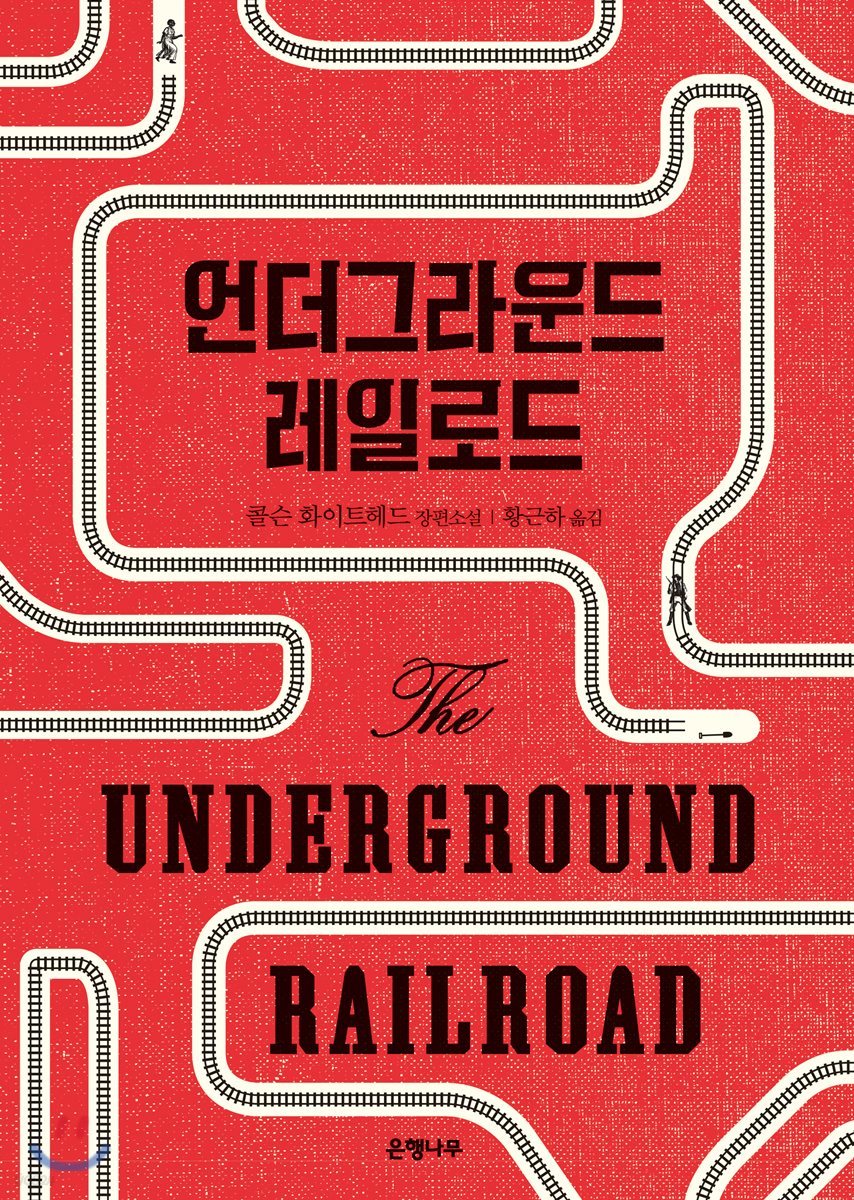
Underground Railroad
 |
Description
Book Introduction
“This book will define our freedom in the future.”
The first book to win both the Pulitzer Prize and the National Book Award in 24 years
Amazon's #1 Book of the Year
Selected as a 'Book of the Year' by 24 major American media outlets, including the New York Times
[Moonlight] Drama adaptation written and directed by Barry Jenkins
Colson Whitehead's novel, "The Underground Railroad," which has captivated American critics and readers alike and set new records every day, is now being published in Korea.
This is the story of a slave girl's escape from the 19th century secret slave escape organization, the 'Underground Railroad', which is imagined as an actual 'underground railroad', and the savagery of the time is melted into a thrilling chase between the girl and the slave hunter.
It is the first book in 24 years to win both the Pulitzer Prize and the National Book Award, and has swept numerous prestigious awards, receiving rave reviews for its “genius fusion of realism and fiction.”
By acquiring literary imagination and tremendous immersion through the idea of 'escape via the underground railroad', it was well-received by readers, and was on the New York Times bestseller list for 37 weeks and the Publisher's Weekly bestseller list for 45 weeks.
This masterpiece transcends the limitations of the subject matter of "racial discrimination" and powerfully raises the issues of "human dignity" and "freedom" that still resonate deeply today, while also providing an overwhelming experience of a narrative that perfectly blends history and fiction.
The first book to win both the Pulitzer Prize and the National Book Award in 24 years
Amazon's #1 Book of the Year
Selected as a 'Book of the Year' by 24 major American media outlets, including the New York Times
[Moonlight] Drama adaptation written and directed by Barry Jenkins
Colson Whitehead's novel, "The Underground Railroad," which has captivated American critics and readers alike and set new records every day, is now being published in Korea.
This is the story of a slave girl's escape from the 19th century secret slave escape organization, the 'Underground Railroad', which is imagined as an actual 'underground railroad', and the savagery of the time is melted into a thrilling chase between the girl and the slave hunter.
It is the first book in 24 years to win both the Pulitzer Prize and the National Book Award, and has swept numerous prestigious awards, receiving rave reviews for its “genius fusion of realism and fiction.”
By acquiring literary imagination and tremendous immersion through the idea of 'escape via the underground railroad', it was well-received by readers, and was on the New York Times bestseller list for 37 weeks and the Publisher's Weekly bestseller list for 45 weeks.
This masterpiece transcends the limitations of the subject matter of "racial discrimination" and powerfully raises the issues of "human dignity" and "freedom" that still resonate deeply today, while also providing an overwhelming experience of a narrative that perfectly blends history and fiction.
Detailed image
Publisher's Review
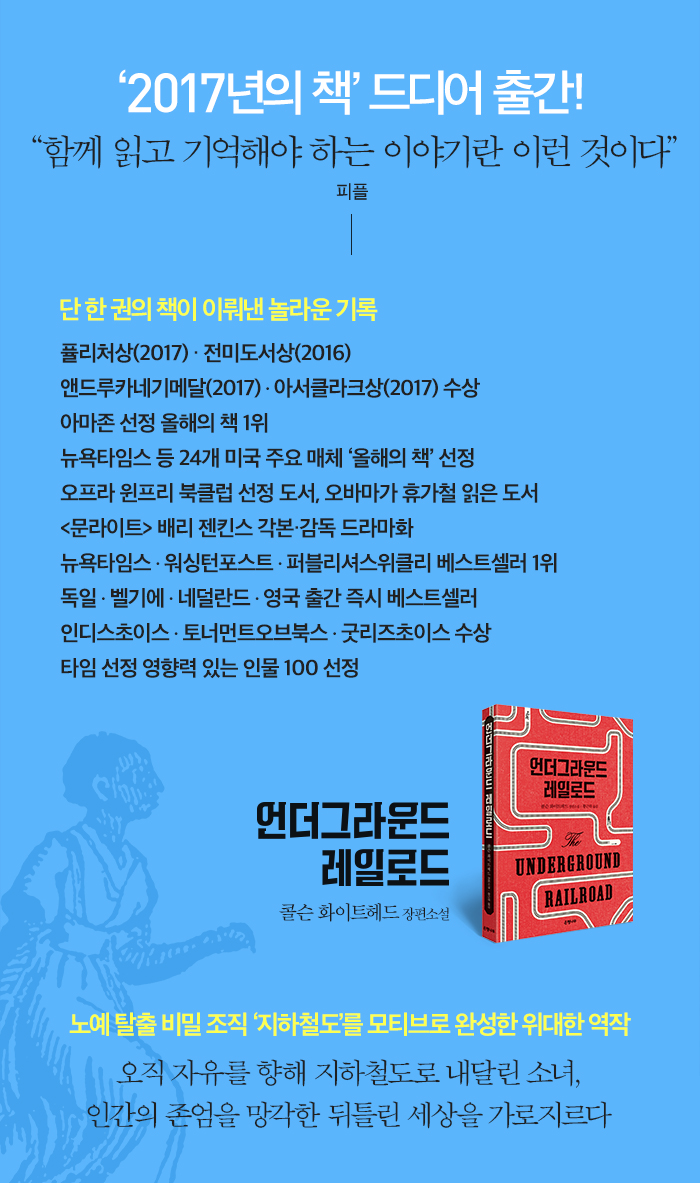
A great record achieved by a single book
Pulitzer Prize (2017), National Book Award (2016), Andrew Carnegie Medal (2017), Arthur Clarke Award (2017)
Amazon's #1 Book of the Year (2016), Oprah Winfrey Book Club Selection, Obama's Vacation Reading
#1 New York Times, Washington Post, Los Angeles Times, and Publisher's Weekly bestseller
An instant bestseller in Germany, Belgium, the Netherlands, and the UK.
Indie Choice? Tournament of Books? Goodreads Choice Award Winner
Selected as one of Time's 100 Most Influential People
“A story that reaches deep into your bones and will never leave you.
“A true masterpiece.” - Oprah Winfrey
This book, which was mentioned as a book to watch even before its publication, was selected for the Oprah Winfrey Book Club and appeared on various bestseller lists as soon as it was published.
Obama also highly praised the book, saying, "It shows how slavery has psychologically affected us from the past to the present," and introduced it as a book to read during the vacation.
Additionally, there was news that it would be made into a drama, written and directed by Barry Jenkins, who won an Oscar for [Moonlight].
This book, which initially received great acclaim from celebrities and readers, went on to win the 2016 National Book Award, the Andrew Carnegie Medal, and the Pulitzer Prize.
In particular, it was widely recalled that it was the first work since Annie Proulx's "The Shipping News" in 1993 to receive both the National Book Award and the Pulitzer Prize, and it also received the Arthur C. Clarke Award, given to the best science fiction novel, and enjoyed almost every honor given to English-speaking writers in one year.
In addition, news of awards continues to be delivered from Indie Choice, Tournament of Books, Goodreads Choice, etc., and it is currently on the Man Booker Prize longlist.
The author who made a name for himself worldwide with his sixth novel,
Colson Whitehead
“I wrote this book for myself.
As always, I hope that if I write well, people will gain something from it.”
-From an interview at the National Book Award
Colson Whitehead, who studied English and American literature and comparative literature at Harvard University, is a writer who is being introduced to Korea for the first time, but he has built a reputation by winning the MacArthur Fellowship and the Guggenheim Fellowship, which are called “genius awards” in the United States, and by being nominated for the Pulitzer Prize with his second work.
He has been praised as a writer who knows how to deal with racial consciousness in a new and interesting way across genres such as comedy, history, horror, and science fiction.
He has tried different styles and genres in each work, to the point that it can be said that 'his spirit of challenge has been what has held back his fame so far.'
Of course, 『Underground Railroad』, which made his name known around the world, is also a product of such adventurous writing.
The new US $20 bill features Harriet Tubman
A masterpiece based on the secret slave escape organization 'Underground Railroad'
"The Underground Railroad" is a novel that imagines the real-life "Underground Railroad," a secret black slave escape organization, as an actual "Underground Railroad," and depicts the escape of a slave girl.
It was in the spring of 2000 that the author first thought of writing about the 'underground railway'.
He heard about it as a child and imagined it to be a real underground railway, but was later a little upset when he found out it was not a real railway but a metaphor. He conceived the idea for this novel from the question, "What would it be like if it were a real railway?"
The Underground Railroad was a network of organizations that helped slaves in the South escape to free states in the North or Canada in the 1800s before slavery was abolished. Numerous white and black people who shared the same goal of abolition secretly provided food and shelter to runaway slaves and showed them how to get to the North.
They called themselves "stationmaster," "engineer," and "conductor," and used actual railroad jargon, such as referring to runaway slaves as "passengers" and the homes of those who harbored them as "stations," as they led over 100,000 slaves to freedom.
Harriet Tubman, the new face of the American $20 bill, was a 'conductor' on this Underground Railroad, and she is reminiscent of the protagonist in the novel in that she also escaped the South via the Underground Railroad.
Incredible suction and gripping tension
Cora, trying to soothe her sleeplessness, came out to the garden and sat down on a pile of maple trees, breathing in the air and listening to the sounds.
The things in the swamp made loud noises and splashed water as they hunted in the living, breathing darkness.
To walk there at night is to go to the north, the land of the free.
To do that, you have to lose your sanity.
But Mom did it.
-Page 52
In this novel, the protagonist, Cora, is a girl who was born on a plantation and has never been outside the swamp surrounding the plantation since her grandmother was taken as a slave from Africa.
When she was ten, her mother abandoned her, leaving her as the 'only escaped slave on the plantation'.
As she was living a desperate life alone, a young man named Caesar, who had been sold from the North, appeared before her, and he asked her to run away with him.
Cora initially refuses to participate in this work, which would only result in her being "killed more quickly by the white man," but changes her mind after her master burns his captured comrade alive in front of white onlookers.
And for the first time, we learn that there is a subway line to the south as well.
Now she sets foot in the swamp, heading towards a place where she can live as a free person, just like her mother did.
What awaits her as she arrives at the station and goes out into the world?
The subway reborn through imagination,
Traversing a twisted world that has forgotten human dignity
Corpses hung from the trees like rotting ornaments.
Some were naked, others were only slightly clothed, their trousers blackened by the contents of their intestines spilling out when their necks were broken.
The two corpses closest to Cora had gruesome wounds clearly visible in the stationmaster's light.
One had his genitals cut off, leaving an ugly gaping hole where his manhood had been.
The other one was a woman.
The woman's belly was bulging.
Cora had never seen a pregnant body so close before.
Their bulging eyes seemed to scold Cora, but compared to the world that had beaten them since the day they were born, what could the gaze of a girl disturbing their rest be?
“People now call this road the ‘Freedom Road,’” he said, covering the carriage with a tarp again.
“These corpses are hanging all the way to downtown.”
What kind of hell did the train land Cora in? - Page 173
The protagonist, Cora, encounters a new, horrific tragedy every time she arrives at a new station.
The miserable lives of slaves in the 19th-century American South who were not treated as human beings, the madness of human beings based on racial superiority, and the struggles of the Underground Railroad agents who tried to follow their conscience even in such urgency are depicted through Cora's escape journey.
As the author revealed, he received much help from the Federal Writers Project in the 1930s, which collected true stories from people of slave origin, and these stories are vivid in their realism.
The author's characteristically short sentences, almost devoid of formalities, and the device of constantly placing big and small twists between sentences, paragraphs, and chapters further enhance this sense of realism and create tension.
“If you want to know what this country is like, you have to take a train.
“When you look outside as the train speeds by, you will see the real face of America.” - Page 84
Above all, the reason this book captivated both critics and readers was because it cleverly transformed the metaphorical 'underground railroad' into an actual 'underground railroad.'
Cora's journey, reminiscent of Gulliver's Travels, gradually reveals the invisible side of slavery, allowing us to see its tragedy and absurdity from a broader perspective.
The author powerfully reminds us of how not only blacks but also whites were impoverished under the slavery system, what conflicts existed within the black community, and ultimately how this system tormented all humanity.
Furthermore, how should we, as human beings, enjoy the freedom we now hold in our hands?
Considering the recent surge in long-form works in Anglo-American literature, it is astonishing that all these messages were so concisely captured in just 350 pages.
Pulitzer Prize (2017), National Book Award (2016), Andrew Carnegie Medal (2017), Arthur Clarke Award (2017)
Amazon's #1 Book of the Year (2016), Oprah Winfrey Book Club Selection, Obama's Vacation Reading
#1 New York Times, Washington Post, Los Angeles Times, and Publisher's Weekly bestseller
An instant bestseller in Germany, Belgium, the Netherlands, and the UK.
Indie Choice? Tournament of Books? Goodreads Choice Award Winner
Selected as one of Time's 100 Most Influential People
“A story that reaches deep into your bones and will never leave you.
“A true masterpiece.” - Oprah Winfrey
This book, which was mentioned as a book to watch even before its publication, was selected for the Oprah Winfrey Book Club and appeared on various bestseller lists as soon as it was published.
Obama also highly praised the book, saying, "It shows how slavery has psychologically affected us from the past to the present," and introduced it as a book to read during the vacation.
Additionally, there was news that it would be made into a drama, written and directed by Barry Jenkins, who won an Oscar for [Moonlight].
This book, which initially received great acclaim from celebrities and readers, went on to win the 2016 National Book Award, the Andrew Carnegie Medal, and the Pulitzer Prize.
In particular, it was widely recalled that it was the first work since Annie Proulx's "The Shipping News" in 1993 to receive both the National Book Award and the Pulitzer Prize, and it also received the Arthur C. Clarke Award, given to the best science fiction novel, and enjoyed almost every honor given to English-speaking writers in one year.
In addition, news of awards continues to be delivered from Indie Choice, Tournament of Books, Goodreads Choice, etc., and it is currently on the Man Booker Prize longlist.
The author who made a name for himself worldwide with his sixth novel,
Colson Whitehead
“I wrote this book for myself.
As always, I hope that if I write well, people will gain something from it.”
-From an interview at the National Book Award
Colson Whitehead, who studied English and American literature and comparative literature at Harvard University, is a writer who is being introduced to Korea for the first time, but he has built a reputation by winning the MacArthur Fellowship and the Guggenheim Fellowship, which are called “genius awards” in the United States, and by being nominated for the Pulitzer Prize with his second work.
He has been praised as a writer who knows how to deal with racial consciousness in a new and interesting way across genres such as comedy, history, horror, and science fiction.
He has tried different styles and genres in each work, to the point that it can be said that 'his spirit of challenge has been what has held back his fame so far.'
Of course, 『Underground Railroad』, which made his name known around the world, is also a product of such adventurous writing.
The new US $20 bill features Harriet Tubman
A masterpiece based on the secret slave escape organization 'Underground Railroad'
"The Underground Railroad" is a novel that imagines the real-life "Underground Railroad," a secret black slave escape organization, as an actual "Underground Railroad," and depicts the escape of a slave girl.
It was in the spring of 2000 that the author first thought of writing about the 'underground railway'.
He heard about it as a child and imagined it to be a real underground railway, but was later a little upset when he found out it was not a real railway but a metaphor. He conceived the idea for this novel from the question, "What would it be like if it were a real railway?"
The Underground Railroad was a network of organizations that helped slaves in the South escape to free states in the North or Canada in the 1800s before slavery was abolished. Numerous white and black people who shared the same goal of abolition secretly provided food and shelter to runaway slaves and showed them how to get to the North.
They called themselves "stationmaster," "engineer," and "conductor," and used actual railroad jargon, such as referring to runaway slaves as "passengers" and the homes of those who harbored them as "stations," as they led over 100,000 slaves to freedom.
Harriet Tubman, the new face of the American $20 bill, was a 'conductor' on this Underground Railroad, and she is reminiscent of the protagonist in the novel in that she also escaped the South via the Underground Railroad.
Incredible suction and gripping tension
Cora, trying to soothe her sleeplessness, came out to the garden and sat down on a pile of maple trees, breathing in the air and listening to the sounds.
The things in the swamp made loud noises and splashed water as they hunted in the living, breathing darkness.
To walk there at night is to go to the north, the land of the free.
To do that, you have to lose your sanity.
But Mom did it.
-Page 52
In this novel, the protagonist, Cora, is a girl who was born on a plantation and has never been outside the swamp surrounding the plantation since her grandmother was taken as a slave from Africa.
When she was ten, her mother abandoned her, leaving her as the 'only escaped slave on the plantation'.
As she was living a desperate life alone, a young man named Caesar, who had been sold from the North, appeared before her, and he asked her to run away with him.
Cora initially refuses to participate in this work, which would only result in her being "killed more quickly by the white man," but changes her mind after her master burns his captured comrade alive in front of white onlookers.
And for the first time, we learn that there is a subway line to the south as well.
Now she sets foot in the swamp, heading towards a place where she can live as a free person, just like her mother did.
What awaits her as she arrives at the station and goes out into the world?
The subway reborn through imagination,
Traversing a twisted world that has forgotten human dignity
Corpses hung from the trees like rotting ornaments.
Some were naked, others were only slightly clothed, their trousers blackened by the contents of their intestines spilling out when their necks were broken.
The two corpses closest to Cora had gruesome wounds clearly visible in the stationmaster's light.
One had his genitals cut off, leaving an ugly gaping hole where his manhood had been.
The other one was a woman.
The woman's belly was bulging.
Cora had never seen a pregnant body so close before.
Their bulging eyes seemed to scold Cora, but compared to the world that had beaten them since the day they were born, what could the gaze of a girl disturbing their rest be?
“People now call this road the ‘Freedom Road,’” he said, covering the carriage with a tarp again.
“These corpses are hanging all the way to downtown.”
What kind of hell did the train land Cora in? - Page 173
The protagonist, Cora, encounters a new, horrific tragedy every time she arrives at a new station.
The miserable lives of slaves in the 19th-century American South who were not treated as human beings, the madness of human beings based on racial superiority, and the struggles of the Underground Railroad agents who tried to follow their conscience even in such urgency are depicted through Cora's escape journey.
As the author revealed, he received much help from the Federal Writers Project in the 1930s, which collected true stories from people of slave origin, and these stories are vivid in their realism.
The author's characteristically short sentences, almost devoid of formalities, and the device of constantly placing big and small twists between sentences, paragraphs, and chapters further enhance this sense of realism and create tension.
“If you want to know what this country is like, you have to take a train.
“When you look outside as the train speeds by, you will see the real face of America.” - Page 84
Above all, the reason this book captivated both critics and readers was because it cleverly transformed the metaphorical 'underground railroad' into an actual 'underground railroad.'
Cora's journey, reminiscent of Gulliver's Travels, gradually reveals the invisible side of slavery, allowing us to see its tragedy and absurdity from a broader perspective.
The author powerfully reminds us of how not only blacks but also whites were impoverished under the slavery system, what conflicts existed within the black community, and ultimately how this system tormented all humanity.
Furthermore, how should we, as human beings, enjoy the freedom we now hold in our hands?
Considering the recent surge in long-form works in Anglo-American literature, it is astonishing that all these messages were so concisely captured in just 350 pages.
GOODS SPECIFICS
- Date of issue: September 1, 2017
- Page count, weight, size: 348 pages | 476g | 150*210*30mm
- ISBN13: 9791196165833
- ISBN10: 1196165831
You may also like
카테고리
korean


korean

![GQ KOREA Mark (Monthly): December [2025]](http://librairie.coreenne.fr/cdn/shop/files/8ef265dbbfbf186523ed75ba7319009d.jpg?v=1765340328&width=3840)


