

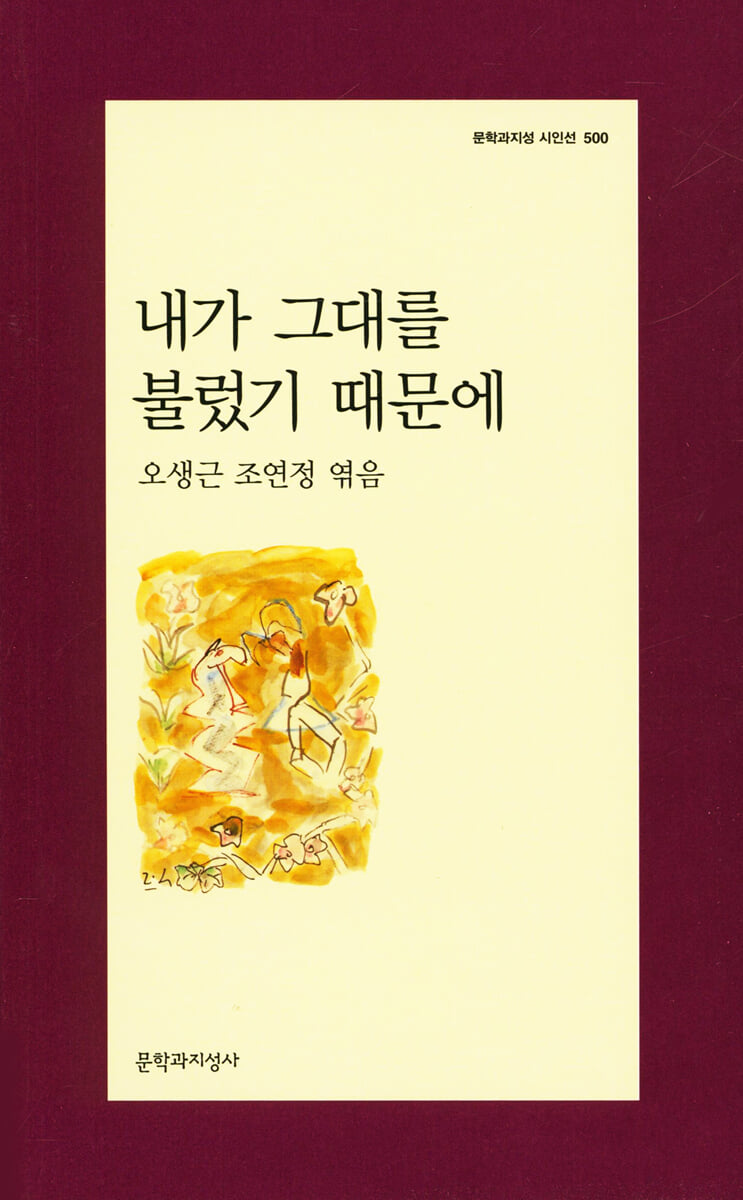
Because I called you
 |
Description
Book Introduction
[Literature and Intelligence Poet Selection], which has been drawing a clear line in modern Korean current affairs for the past 40 years, has now published its 500th issue.
The commemorative poetry collection 『Because I Called You』, planned for all the poems in the series, selected 85 poetry collections that have been consistently loved by readers for 10 years since their first editions were published and have updated their literary meaning without being bound by time. Under the responsibility of literary critics Oh Saeng-geun and Jo Yeon-jeong, who are members of the editorial committee, two representative works were selected from each of the 65 poets who wrote the poetry collections, and a total of 130 poems were bound together.
The commemorative poetry collection 『Because I Called You』, planned for all the poems in the series, selected 85 poetry collections that have been consistently loved by readers for 10 years since their first editions were published and have updated their literary meaning without being bound by time. Under the responsibility of literary critics Oh Saeng-geun and Jo Yeon-jeong, who are members of the editorial committee, two representative works were selected from each of the 65 poets who wrote the poetry collections, and a total of 130 poems were bound together.
- You can preview some of the book's contents.
Preview
index
Hwang Dong-gyu's Little Love Song
When I see a wheel, I want to roll it.
The wind of the Majonggi horse
River of Fables
Kim Young-tae's rag
Like a life-size figure
Choi Ha-rim, I'm too far away
empty house
Like a ball that bounces even when dropped, Jeong Hyeon-jong
People bloom into the scenery
Kim Hyung-young flower viewing
Deer ear flower
O Gyu-won, the setting sun
river and dam
Shin Dae-cheol Our Land
polar night
Jo Jeong-kwon Sacred Forest 1
Blood sellers
Lee Ha-seok's transparent body
junkyard
Kim Myeong-in, Dongducheon 1
silence
Jang Young-soo, Donghae 1
The sound of poetry falling on me
Kim Gwang-gyu, Yeongsan
little men
Go Jeong-hee's Spring in Jirisan 1
Putting on the shroud
Jang Seok-ju's nostalgic memories
big, baggy pants
Park Nam-cheol, a human being on earth
The Lord's Prayer, damn it
Kim Jeong-ran's poetry and power
My poem
Moon Chung-seong Jeju Sea 1
gravestone
Lee Seong-bok, 1959
Geumsan, Namhae
Choi Seung-ho's three toilets
vending machine
Choi Seung-ja, 30 years old
Happy Diary
Kim Hye-soon, another Titanic
A glass of red mirror
Kim Jung-hwan's Love Song 2
a pair of shoes
Lotus in the Eyes of Hwang Ji-woo
One day I'll be sitting in a cloudy tavern
Park Tae-il, a minor
Gucheon-dong
Choi Du-seok's songs and stories
Chunyeol Yangbanjeon
Nam Jin-woo's Prayer for the Dead
thorn
Hwang In-sook: I will be born as a cat.
Sadness wakes me up
Jang Kyung-rin, the lion is running away. Catch the lion.
Where is the next stop?
Advice at Gihyeongdo Station
empty house
Kim Yun-bae's excitement makes you and I one
Beautiful disaster
Song Jae-hak blushes
There is a story about finding a star and changing one's body into a star.
Song Chan-ho's shoes
Camellia Train
Heo Su-gyeong goes to a distant house alone
disadvantaged instrument
Jang Seok-nam's exile to the birds
Whose hardships are all those stars?
Yoo Ha, on a windy day, you must go to Apgujeong-dong 6
Seun Shopping Mall Kid's Love 2
Are you Kim Hwi-seung?
They say it had a tail
Why Joe Haunts the Grave
The tree is pulled to the very roots
Chae Ho-gi's desperate love
pond
Kim Ki-taek's Storm Through the Eye of a Needle
aperture
Na Hee-deok, the flower in the ground
The missing palm
Cha Chang-ryong's shit is a sharp reflection of class.
Our Crumpled Hero
Lee Jeong-rok's dog poop melon
chair
Park Ra-yeon's Fig Tree Flower
Princess Pyeonggang living in Seoul
Ham Seong-ho's 5.67 billion years of solitude
In the spring, I would have died there
Lee Yoon-hak's Dream of Maggots
A room just for sleeping
Lee Jin-myeong counts down the days until he can return home.
A note about summer
Kim Jung-sik, who suddenly left
There are still some melodramatic things
Choi Jeong-rye Sunshine Studio
Lebanese sentiment
Self-portrait in hemp clothes by Jo Yong-mi
Under the flowering paulownia tree
Park Hyung-jun's snail
I will now talk about extinction.
Kim Tae-dong played with a blue dog
The last lover of my soul
This circle I click, therefore I am
To survive in the electronic desert
Kim So-yeon reaches the peak
To buy some fruit
Lee Su-myeong's Zebra Phenomenology
cat watching cat videos
Seong Gi-wan's poem
46 Empty-handed
Moon Tae-jun, who is crying?
flounder
Lee Jang-wook's Hope Song at Noon
You and I are like flowers
Kim Seon-woo, who is sleeping inside my body?
Aukguk
Lee Ki-seong's passion
hand
Kim Haeng-sook's friends
The ability to break up
Jin Eun-young's seven-word dictionary
Thirty years old
Lee Seong-mi, what do you dream of?
I write
Kim I-deum's Siren's Song
Siren of Sunday
Ha Jae-yeon Radio Days
Sunday Antique Shop
When I see a wheel, I want to roll it.
The wind of the Majonggi horse
River of Fables
Kim Young-tae's rag
Like a life-size figure
Choi Ha-rim, I'm too far away
empty house
Like a ball that bounces even when dropped, Jeong Hyeon-jong
People bloom into the scenery
Kim Hyung-young flower viewing
Deer ear flower
O Gyu-won, the setting sun
river and dam
Shin Dae-cheol Our Land
polar night
Jo Jeong-kwon Sacred Forest 1
Blood sellers
Lee Ha-seok's transparent body
junkyard
Kim Myeong-in, Dongducheon 1
silence
Jang Young-soo, Donghae 1
The sound of poetry falling on me
Kim Gwang-gyu, Yeongsan
little men
Go Jeong-hee's Spring in Jirisan 1
Putting on the shroud
Jang Seok-ju's nostalgic memories
big, baggy pants
Park Nam-cheol, a human being on earth
The Lord's Prayer, damn it
Kim Jeong-ran's poetry and power
My poem
Moon Chung-seong Jeju Sea 1
gravestone
Lee Seong-bok, 1959
Geumsan, Namhae
Choi Seung-ho's three toilets
vending machine
Choi Seung-ja, 30 years old
Happy Diary
Kim Hye-soon, another Titanic
A glass of red mirror
Kim Jung-hwan's Love Song 2
a pair of shoes
Lotus in the Eyes of Hwang Ji-woo
One day I'll be sitting in a cloudy tavern
Park Tae-il, a minor
Gucheon-dong
Choi Du-seok's songs and stories
Chunyeol Yangbanjeon
Nam Jin-woo's Prayer for the Dead
thorn
Hwang In-sook: I will be born as a cat.
Sadness wakes me up
Jang Kyung-rin, the lion is running away. Catch the lion.
Where is the next stop?
Advice at Gihyeongdo Station
empty house
Kim Yun-bae's excitement makes you and I one
Beautiful disaster
Song Jae-hak blushes
There is a story about finding a star and changing one's body into a star.
Song Chan-ho's shoes
Camellia Train
Heo Su-gyeong goes to a distant house alone
disadvantaged instrument
Jang Seok-nam's exile to the birds
Whose hardships are all those stars?
Yoo Ha, on a windy day, you must go to Apgujeong-dong 6
Seun Shopping Mall Kid's Love 2
Are you Kim Hwi-seung?
They say it had a tail
Why Joe Haunts the Grave
The tree is pulled to the very roots
Chae Ho-gi's desperate love
pond
Kim Ki-taek's Storm Through the Eye of a Needle
aperture
Na Hee-deok, the flower in the ground
The missing palm
Cha Chang-ryong's shit is a sharp reflection of class.
Our Crumpled Hero
Lee Jeong-rok's dog poop melon
chair
Park Ra-yeon's Fig Tree Flower
Princess Pyeonggang living in Seoul
Ham Seong-ho's 5.67 billion years of solitude
In the spring, I would have died there
Lee Yoon-hak's Dream of Maggots
A room just for sleeping
Lee Jin-myeong counts down the days until he can return home.
A note about summer
Kim Jung-sik, who suddenly left
There are still some melodramatic things
Choi Jeong-rye Sunshine Studio
Lebanese sentiment
Self-portrait in hemp clothes by Jo Yong-mi
Under the flowering paulownia tree
Park Hyung-jun's snail
I will now talk about extinction.
Kim Tae-dong played with a blue dog
The last lover of my soul
This circle I click, therefore I am
To survive in the electronic desert
Kim So-yeon reaches the peak
To buy some fruit
Lee Su-myeong's Zebra Phenomenology
cat watching cat videos
Seong Gi-wan's poem
46 Empty-handed
Moon Tae-jun, who is crying?
flounder
Lee Jang-wook's Hope Song at Noon
You and I are like flowers
Kim Seon-woo, who is sleeping inside my body?
Aukguk
Lee Ki-seong's passion
hand
Kim Haeng-sook's friends
The ability to break up
Jin Eun-young's seven-word dictionary
Thirty years old
Lee Seong-mi, what do you dream of?
I write
Kim I-deum's Siren's Song
Siren of Sunday
Ha Jae-yeon Radio Days
Sunday Antique Shop
Publisher's Review
The first poetry collection in Korean literature history to reach 500 issues
A new beginning for the next 40 years
You are here because I called you.
The distant Stone Age, when we remember fire,
Like breaking a stone to put out fire
Break my heart and take my name away
- Hwang Ji-woo, from “Lotus in the Crab’s Eyes”
The largest collection of key scenes from Korean poetry
[Literature and Intelligence Poet Selection], which has been drawing a clear direction in modern Korean poetry for the past 40 years, has now surpassed its 500th issue and published a commemorative poetry collection, “Because I Called You.”
The Munji Poet Series, which began in 1978 with Hwang Dong-gyu's "When I See a Wheel, I Want to Roll It," is Korea's first and largest poetry collection series, consisting of 492 volumes of poetry collections by 211 poets, one volume of poetry collections by four sijo poets, one volume of poetry collections by Koreans living in Yanbian, and six commemorative poetry collections compiled by ten critics.
From Kihyungdo's 『Black Leaves in the Mouth』, which recently reached its 82nd printing, to Hwang Jiwoo's 『Birds Leave the World Too』 (63rd printing), Lee Seongbok's 『When Will the Rolling Stone Wake Up』 (52nd printing), and Choi Seungja's 『Love in This Era』 (46th printing), it has a wide range of contemporary bestsellers and steady sellers.
The Munhak-kwa-Jisung Poet Selection reached its 500th issue in the summer of 2017, a literary "event" imbued with the fervent passion of many poets who, amidst a literary landscape that has steadily changed along with its turbulent history, have asked and answered essential questions about humanity and life with novel language and imagination.
A 40-year history of slow but steady progress toward the world
Munhak-kwa-Jiseongsa has been publishing an anthology of poetry to commemorate the addition of 100 poetry collections to its collection.
Starting with the 100th poetry collection, 『The Road Begins Again Where the Road Ends』 (edited by Kim Ju-yeon, 1990), 『Poetry, Isn't It You』 (edited by Seong Min-yeop and Jeong Gwa-ri, 1997), which is a collection of only the introductory poems from the 100th poetry collection, 『A Refreshing Love Song』 (edited by Park Hye-gyeong and Lee Gwang-ho, 2005), which is a selection of poems about love from the 200th poetry collection, and 『The Gravity of My Life』 (edited by Hong Jeong-seon and Kang Gye-sook, 2011), which is a collection of poets' charity works on the theme of 'the poet's self-portrait' from the 300th poetry collection, were published in succession.
Since the 100th issue was published 12 years after the poet selection began, 100 volumes of poetry collections have been accumulated at a rate of approximately 6 to 8 years.
As critic Jo Yeon-jeong pointed out in the preface, considering how the status of literature, and poetry in particular, has diminished in Korean society over the past 40 years, the fact that poetry collections have been published one after another without significant fluctuations over a certain period of time is in itself significant.
Furthermore, the fact that 439 books, or approximately 88% of the 499 books published this year, including those published this year, have been reprinted at least once can be read as evidence that the Munhak-kwa-Jiseong Poetry Collection has not remained at a self-sufficient level, but has steadily advanced toward readers and the world.
The 500th book created by poets and readers
“It is no exaggeration to say that this poetry collection is one created by readers.
[… … ] In fact, it can be said that the 130 poems included in 『Because I Called You』 are poems from a happy time when the poet was able to fully express his own potential because there were readers who found them beautiful and useful.
These poems enabled us to not give up the belief that our lives could be saved, but it is also true that this belief, in turn, made these poems come to life.
“The reason why poet Munji Poet Seon was able to publish 500 poetry collections over 40 years was because poetry and we completely relied on each other.”
- Jo Yeon-jeong's preface, from "Because We Singed Poetry"
The 500th poetry collection, and a commemorative collection planned for all the works in the series, 『Because I Called You』, selected 85 poetry collections that have been consistently loved by readers for 10 years since their first editions were published and have updated their literary meaning without being bound by time. Under the responsibility of literary critics Oh Saeng-geun and Jo Yeon-jeong, who served as editors, two representative works were selected from each of the 65 poets who wrote the collections, making a total of 130 poems.
The title is borrowed from a part of the phrase “You exist because I called you” from poet Hwang Ji-woo’s “Lotus in the Crab’s Eyes,” one of the included works. The book consists of a preface, an introduction to the poet, and a list of his previous poetry collections, along with the poem.
A starting point with challenges for a new beginning
Even without discussing the crisis of poetry that has been continuously raised since the 1990s, today, with the number of poetry readers gradually decreasing, there is a considerable tendency to regard poetry as valuable only to poets and a select few literature lovers.
Moreover, as with many artists, the very survival of poets is threatened by the lack of a social safety net.
On the other hand, it has been pointed out that poetry, which has symbolized the possibility of a life without oppression, has been mystified as a genre in itself, or that the poet himself has been romanticized, allowing him to function as an oppressor to some.
“The Usefulness of the Useless”: Poetry, which has long been an art form that liberates readers and writers as beings independent of power, must live fiercely through the times ahead of us, facing many pressing challenges.
[Munhak-kwa-Jisung Poets' Selection], which has created "the world of extremes with avant-garde language" (poet Lee Won) while preserving "the unique characteristic of literature that traces the complex connections between literature and society while maintaining the autonomy of literature" (literary critic Jeong Gwa-ri), "hopes that it will survive for a long time, renew its own history, and ultimately prove the possibility of poetry" (literary critic Jo Yeon-jeong), "even if the incompetence of poetry is proven more than its possibility for the time being, and even if it is not easily proven that there are things that only poetry can do."
Over the next 40 years, I hope that through poetry, the belief that "someone's life can become something completely different" can be preserved through this new 500-volume poetry collection.
Recommendation
In fact, it could be said that the 130 poems included in "Because I Called You" are poems from a happy time when the poet was able to fully express his potential because there were readers who found them beautiful and useful.
These poems enabled us to not give up the belief that our lives could be saved, but it is also true that this belief, in turn, made these poems come to life.
The reason why poet Munji Poet Seon was able to publish 500 poetry collections over 40 years was because poetry and we completely relied on each other.
- Jo Yeon-jeong's preface, from "Because We Singed Poetry"
A new beginning for the next 40 years
You are here because I called you.
The distant Stone Age, when we remember fire,
Like breaking a stone to put out fire
Break my heart and take my name away
- Hwang Ji-woo, from “Lotus in the Crab’s Eyes”
The largest collection of key scenes from Korean poetry
[Literature and Intelligence Poet Selection], which has been drawing a clear direction in modern Korean poetry for the past 40 years, has now surpassed its 500th issue and published a commemorative poetry collection, “Because I Called You.”
The Munji Poet Series, which began in 1978 with Hwang Dong-gyu's "When I See a Wheel, I Want to Roll It," is Korea's first and largest poetry collection series, consisting of 492 volumes of poetry collections by 211 poets, one volume of poetry collections by four sijo poets, one volume of poetry collections by Koreans living in Yanbian, and six commemorative poetry collections compiled by ten critics.
From Kihyungdo's 『Black Leaves in the Mouth』, which recently reached its 82nd printing, to Hwang Jiwoo's 『Birds Leave the World Too』 (63rd printing), Lee Seongbok's 『When Will the Rolling Stone Wake Up』 (52nd printing), and Choi Seungja's 『Love in This Era』 (46th printing), it has a wide range of contemporary bestsellers and steady sellers.
The Munhak-kwa-Jisung Poet Selection reached its 500th issue in the summer of 2017, a literary "event" imbued with the fervent passion of many poets who, amidst a literary landscape that has steadily changed along with its turbulent history, have asked and answered essential questions about humanity and life with novel language and imagination.
A 40-year history of slow but steady progress toward the world
Munhak-kwa-Jiseongsa has been publishing an anthology of poetry to commemorate the addition of 100 poetry collections to its collection.
Starting with the 100th poetry collection, 『The Road Begins Again Where the Road Ends』 (edited by Kim Ju-yeon, 1990), 『Poetry, Isn't It You』 (edited by Seong Min-yeop and Jeong Gwa-ri, 1997), which is a collection of only the introductory poems from the 100th poetry collection, 『A Refreshing Love Song』 (edited by Park Hye-gyeong and Lee Gwang-ho, 2005), which is a selection of poems about love from the 200th poetry collection, and 『The Gravity of My Life』 (edited by Hong Jeong-seon and Kang Gye-sook, 2011), which is a collection of poets' charity works on the theme of 'the poet's self-portrait' from the 300th poetry collection, were published in succession.
Since the 100th issue was published 12 years after the poet selection began, 100 volumes of poetry collections have been accumulated at a rate of approximately 6 to 8 years.
As critic Jo Yeon-jeong pointed out in the preface, considering how the status of literature, and poetry in particular, has diminished in Korean society over the past 40 years, the fact that poetry collections have been published one after another without significant fluctuations over a certain period of time is in itself significant.
Furthermore, the fact that 439 books, or approximately 88% of the 499 books published this year, including those published this year, have been reprinted at least once can be read as evidence that the Munhak-kwa-Jiseong Poetry Collection has not remained at a self-sufficient level, but has steadily advanced toward readers and the world.
The 500th book created by poets and readers
“It is no exaggeration to say that this poetry collection is one created by readers.
[… … ] In fact, it can be said that the 130 poems included in 『Because I Called You』 are poems from a happy time when the poet was able to fully express his own potential because there were readers who found them beautiful and useful.
These poems enabled us to not give up the belief that our lives could be saved, but it is also true that this belief, in turn, made these poems come to life.
“The reason why poet Munji Poet Seon was able to publish 500 poetry collections over 40 years was because poetry and we completely relied on each other.”
- Jo Yeon-jeong's preface, from "Because We Singed Poetry"
The 500th poetry collection, and a commemorative collection planned for all the works in the series, 『Because I Called You』, selected 85 poetry collections that have been consistently loved by readers for 10 years since their first editions were published and have updated their literary meaning without being bound by time. Under the responsibility of literary critics Oh Saeng-geun and Jo Yeon-jeong, who served as editors, two representative works were selected from each of the 65 poets who wrote the collections, making a total of 130 poems.
The title is borrowed from a part of the phrase “You exist because I called you” from poet Hwang Ji-woo’s “Lotus in the Crab’s Eyes,” one of the included works. The book consists of a preface, an introduction to the poet, and a list of his previous poetry collections, along with the poem.
A starting point with challenges for a new beginning
Even without discussing the crisis of poetry that has been continuously raised since the 1990s, today, with the number of poetry readers gradually decreasing, there is a considerable tendency to regard poetry as valuable only to poets and a select few literature lovers.
Moreover, as with many artists, the very survival of poets is threatened by the lack of a social safety net.
On the other hand, it has been pointed out that poetry, which has symbolized the possibility of a life without oppression, has been mystified as a genre in itself, or that the poet himself has been romanticized, allowing him to function as an oppressor to some.
“The Usefulness of the Useless”: Poetry, which has long been an art form that liberates readers and writers as beings independent of power, must live fiercely through the times ahead of us, facing many pressing challenges.
[Munhak-kwa-Jisung Poets' Selection], which has created "the world of extremes with avant-garde language" (poet Lee Won) while preserving "the unique characteristic of literature that traces the complex connections between literature and society while maintaining the autonomy of literature" (literary critic Jeong Gwa-ri), "hopes that it will survive for a long time, renew its own history, and ultimately prove the possibility of poetry" (literary critic Jo Yeon-jeong), "even if the incompetence of poetry is proven more than its possibility for the time being, and even if it is not easily proven that there are things that only poetry can do."
Over the next 40 years, I hope that through poetry, the belief that "someone's life can become something completely different" can be preserved through this new 500-volume poetry collection.
Recommendation
In fact, it could be said that the 130 poems included in "Because I Called You" are poems from a happy time when the poet was able to fully express his potential because there were readers who found them beautiful and useful.
These poems enabled us to not give up the belief that our lives could be saved, but it is also true that this belief, in turn, made these poems come to life.
The reason why poet Munji Poet Seon was able to publish 500 poetry collections over 40 years was because poetry and we completely relied on each other.
- Jo Yeon-jeong's preface, from "Because We Singed Poetry"
GOODS SPECIFICS
- Date of issue: July 10, 2017
- Page count, weight, size: 288 pages | 328g | 125*205*20mm
- ISBN13: 9788932030272
- ISBN10: 8932030278
You may also like
카테고리
korean


korean

![GQ KOREA Mark (Monthly): December [2025]](http://librairie.coreenne.fr/cdn/shop/files/8ef265dbbfbf186523ed75ba7319009d.jpg?v=1765340328&width=3840)


