

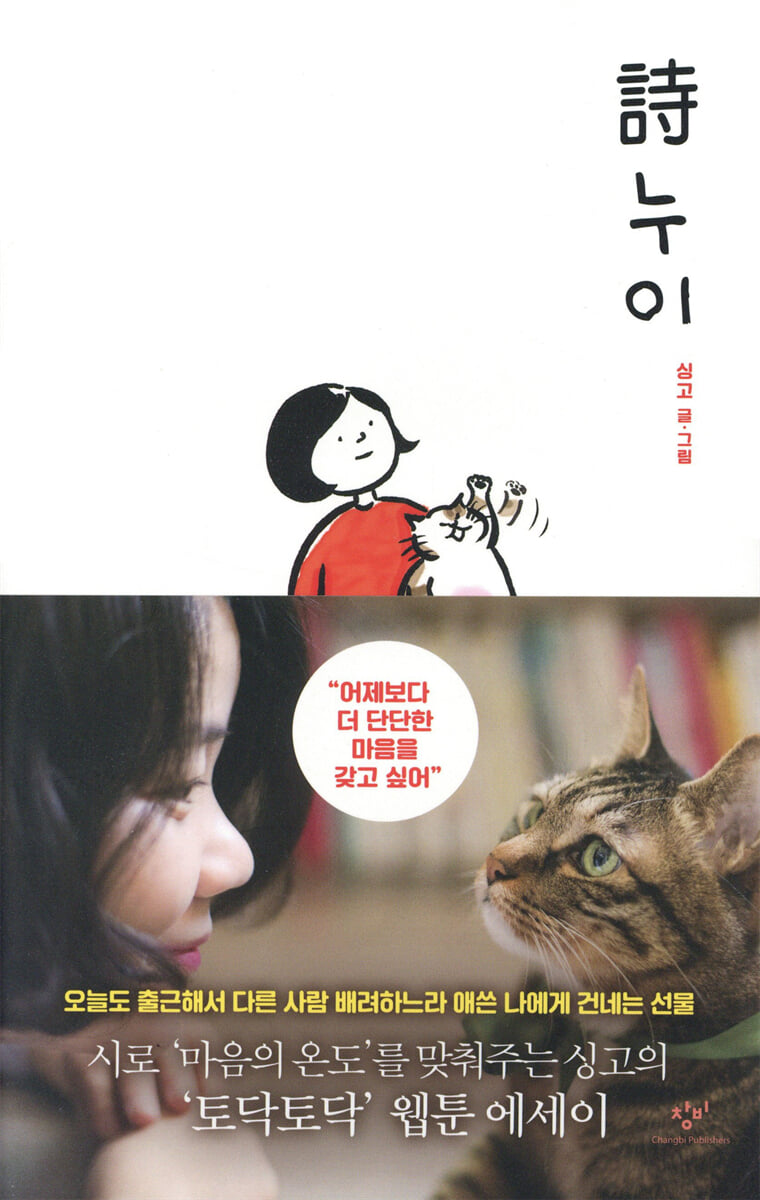
Poet Sister
 |
Description
Book Introduction
“I want to have a stronger heart than yesterday.” Shingo's "Pat Pat" Webtoon Essay That Matches the "Temperature of the Heart" with Shiro Poet Shin Mina, who had been actively working as a poet since publishing her first poetry collection, “Called Shingo,” in 2014, one day handed out sketchbooks to her readers under the name “Singo.” The sketchbook contained neat and lovely drawings, poetic essays, and a poem. Shingo's poetry webtoon, which warmly depicts the worries of everyday life and memories of childhood, drew a warm response and empathy from readers, and garnered great anticipation even before its publication as he serialized 'Poetry Reading Sister, Poetry Sister' on Changbi's Naver blog for about six months starting in the winter of 2015. Shingo's webtoon essay, which began with the question, "What if we read poetry in a different way, outside of paper books?" (Author's Note, p. 295), suggests a new direction for reading poetry and soothes our hearts, weary from our daily lives. In 『Poetry Sister』, the main characters are the poet's own character, 'Singo', and 'Lee Eung-ong', a 69-year-old human cat who has lived with her for over ten years. “When I read good poetry, my eyes sparkle” (page 7), Singo is an ordinary woman in her 30s who was born as the youngest daughter of seven siblings and has lived in South Korea, a country that has experienced the difficulties of unemployment and irregular employment. She dreams of “aging gracefully like a Finnish grandmother and becoming a hip grandmother who doesn’t lose her swagger even after she turns 60” (page 8). “It’s round when you look at it from the left, and it’s round when you look at it from the right” (page 11) Lee Eung, a giant cat who lives with Shingo and is called ‘Lee Eung’, often nags Shingo, but he is a very special friend to Shingo. They share the joys and sorrows of daily life, share each other's warmth, and learn the value of life, even while teasing each other. |
- You can preview some of the book's contents.
Preview
index
Character Introduction / Are You a Kind Person? / Fantasy Light / Time of Goldfish / Spring Days / My Heart is Like a Stone / After My Sisters Left / Potato Was Brave / Mom's Worries / I Live Next Door to You / Boring Holiday / Cool Curves / Our Last Faces / Stars Hidden in the Clouds / I Need a Tutu Tutu Sensor / Real and Fake / Local Autonomy in My Body / Things That Don't Go My Way / Being Tamed by Each Other / Fearless Love / Growing Old / Mother's Time / Where You Point / The Child Who Was Me / My Name is Hong Soon-young / Transparent Cat / Not to Put Weight on Anything / Just One Person, a Poor Person / Just Because You Are a Woman / Just Because You Are a Man / I'll Always Keep the Engine On / The Candle Won't Go Out / Come, Shima / The Beauty of Winter / Quiet Things / Author's Note / List of Included Poems
Publisher's Review
Shingo asks quietly
“Am I doing okay with myself? Am I really okay?”
For Singo, poetry is both a starting point for his worries and a source of comfort.
While eating shaved ice, we feel refreshed when we think of Song Seung-eon's poem "Curve" that draws a "cool curve" ("Cool Curve"), but on the way home, when "you almost fall while walking or you miss your stop" (p. 33), or "you say a lot of things you don't mean" (p. 17), a poem that Shingo picks up on the street moves our hearts.
Today, I went to work and tried to be considerate of others regardless of my own feelings. Singo asked himself a question while handing me Park So-ran's poem "Sugar."
“Am I doing well with myself, am I really okay?” (page 21).
If you try to force yourself to please others,
The other person gets to choose what they want to say
In a heart that was tightly clenched
Because the thread came loose
The feeling that the most important thing is missing (…)
It's okay now
I put sugar in my mouth because it feels much lighter.
The sweetness that remains in the mouth
Feeling it with your tongue
Wait, I'll ask you
I am me
I hope you are doing well
Are you really okay? (Are you a kind person?)
While walking down the street or riding the bus, Singo often finds himself lost in thought.
On sleepless nights, when I kick the blanket again, I have cute fantasies about how nice it would be to have a 'tututu sensor' that tells me my emotional state ("I need a tututu sensor"), and I think about my relationships with others through a pair of shoes that I bought because they were pretty but couldn't break in ("Becoming Tamed by Each Other").
When I recall my childhood, when I was born the youngest of seven children and had many siblings, I smile at the anecdotes I tell about my older sisters, but my heart aches when I think about the day when “I will no longer be able to taste the kimchi or sesame oil my mother made” (page 188).
When Shingo talks about the small anecdotes and memories of everyday life, he is plain and humorous, but he also speaks with a strong voice as a poet, Shin Mina, without turning a blind eye to the problems of our society.
To remember the Sewol Ferry disaster for a long time, we read Jeong Ho-seung's poem ("My Name is Hong Soon-young"), and we give Kim Hye-soon and Do Jong-hwan's poems to those of us who had to experience the Gangnam Station murder ("Just Because You Are a Woman" and "Just Because You Are a Man"), and we tell Kim Hyeon's poem that anyone's love should be respected ("Love Without Fear").
Violence is common
That kind of thing could happen because of my fault.
I just learned that I have to be careful about my conduct.
That means, being born is a minefield.
You never know where a landmine might be hiding.
It was like telling me to avoid it on my own (…)
But I
When and where
You might step on a landmine
I don't want to be a mermaid princess who lost her legs ("Just because you're a girl")
While reading poetry and drawing, Shingo says, “I waited for a poem to speak to me and for another story to naturally flow out” (p. 296).
Shingo's wish for poetry and pictures to blend well is fully captured in this warm book.
When you feel prejudiced and think, “Why is youth so trivial?” (page 222), when you feel it is difficult to “live in tune with others” (page 120), when you feel lost after working overtime, or when you simply miss your mother, I hope you will receive the poetry and drawings from ‘Poetry Sister’ Shingo as a gift.
If you want to become familiar with poetry but are unsure of where to start, open this book with an open mind.
Please read it slowly, one story at a time, whenever you have time.
If, after pretending to forget, you recall the poems and illustrations in this book, that in itself will be rewarding. (Author's Note, p. 297)
List of included poems
Kang Seong-eun, "The Light of Fantasy" and "Just a Little Strange" (Munhak-kwa-Jiseongsa, 2013)
Kwon Hyuk-woong's "Cheonbyeon Gymnastics Classroom," "The Lover Cries Like a Broken Sundae" (Changbi, 2013)
Kihyung Do, "Mom's Worries," Black Leaf in the Mouth (Munhak-kwa-Jiseongsa, 1989)
Kim Kyung-mi, "Memoir," Shh, My Second (Munhakdongne Publishing, 2006)
Kim Ki-taek, "Spring Day," Office Worker (Changbi Publishing, 1999)
Kim Min-jeong, "A Sonata of Excellence," in "I Wish to Be Beautiful and Useless" (Munhakdongne Publishing, 2016)
Kim Sa-in, "Quiet Things," "Liking Quietly" (Changbi, 2006)
Kim Hyun, "Fearless Love," Literature 3 (Changbi, Issue 1, 2017)
Kim Hye-sun, "Why Are All Mermaids Women?", Your First (Munhak-kwa-Jiseongsa, 2008)
Na Hee-deok, "Like Pig Heads," Wild Apples (Changbi 2009)
Do Jong-hwan, "Ivy," in "Who Are You?" (Changbi Publishing, 1993)
Moon Tae-jun, "In Gangchon - Waterside Psalm 5," Our Last Face (Changbi 2015)
Park So-ran, "Sugar," Words Close to the Heart (Changbi 2015)
Park Yong-rae's "Winter Night," from "The Distant Sea" (Changbi Publishing, 1984)
Park Jun, "Family Holiday," "I Made Up Your Name and Ate It for Several Days" (Munhakdongne Publishing, 2012)
Park Hyung-jun, "Over There," in "Leaves Bloom Even Under the Water" (Changbi 2002)
Seong Dong-hyeok, "I Live Next Door to You," 6 (Minumsa, 2014)
Son Taek-su, "Chasim," in "The Floating Dust Shines" (Changbi Publishing, 2014)
Song Seung-eon, "Curve," Iron and Oak (Munhak-kwa-Jiseongsa, 2015)
Sim Bo-seon, "First Line," in "The Person Who Is Not Before Us" (Munhak-kwa-Jiseongsa, 2011)
Ahn Hyun-mi, "Transparent Cat," in "Love Will Be Repaired One Day" (Changbi Publishing, 2014)
Ahn Hee-yeon, "Dreamland Book," When Your Sorrow Intervenes (Changbi Publishing, 2015)
Oh Eun, "Pebbles," Running on a Chair (Changbi Education, 2015)
Lee Gyu-bo, "Poetry Passion," A Walk Through the Aesthetics of Chinese Poetry (Jeong Min, Humanist, 1996)
Lee Geun-hwa, "Engine," Our Evolution (Munhak-kwa-Jiseongsa, 2009)
Lee Byeong-gi, "Star," in Garam Sijo Collection (edited by Kwon Chae-rin, Jimanji 2012)
Lee Seon-yeong, "Candlelight and Shield," The Future Left Behind by Grapes (Changbi Publishing, 2009)
Lee Si-young, "Sadness," Hoyane's Words (Changbi 2015)
Lee Hyun-seung, "A Walk in the Clouds," in "The Thought of Life" (Changbi Publishing, 2015)
Lee Hong-seop, "The Master," Terminal (Munhakdongne Publishing, 2011)
Lim Yeong-jo, "Like a bonus, like a gap," The Poet's Hat (Changbi, 2003)
Jang Seok-ju, "Midnight Kitchen," Sunday and Bad Weather (Minumsa, 2015)
Jeong Ho-seung, "I Never Forgot You Even When Flowers Wither," from I Reject Hope (Changbi Publishing, 2017)
Pablo Neruda, "44," The Book of Questions (translated by Jeong Hyeon-jong, Munhakdongne Publishing, 2013)
“Am I doing okay with myself? Am I really okay?”
For Singo, poetry is both a starting point for his worries and a source of comfort.
While eating shaved ice, we feel refreshed when we think of Song Seung-eon's poem "Curve" that draws a "cool curve" ("Cool Curve"), but on the way home, when "you almost fall while walking or you miss your stop" (p. 33), or "you say a lot of things you don't mean" (p. 17), a poem that Shingo picks up on the street moves our hearts.
Today, I went to work and tried to be considerate of others regardless of my own feelings. Singo asked himself a question while handing me Park So-ran's poem "Sugar."
“Am I doing well with myself, am I really okay?” (page 21).
If you try to force yourself to please others,
The other person gets to choose what they want to say
In a heart that was tightly clenched
Because the thread came loose
The feeling that the most important thing is missing (…)
It's okay now
I put sugar in my mouth because it feels much lighter.
The sweetness that remains in the mouth
Feeling it with your tongue
Wait, I'll ask you
I am me
I hope you are doing well
Are you really okay? (Are you a kind person?)
While walking down the street or riding the bus, Singo often finds himself lost in thought.
On sleepless nights, when I kick the blanket again, I have cute fantasies about how nice it would be to have a 'tututu sensor' that tells me my emotional state ("I need a tututu sensor"), and I think about my relationships with others through a pair of shoes that I bought because they were pretty but couldn't break in ("Becoming Tamed by Each Other").
When I recall my childhood, when I was born the youngest of seven children and had many siblings, I smile at the anecdotes I tell about my older sisters, but my heart aches when I think about the day when “I will no longer be able to taste the kimchi or sesame oil my mother made” (page 188).
When Shingo talks about the small anecdotes and memories of everyday life, he is plain and humorous, but he also speaks with a strong voice as a poet, Shin Mina, without turning a blind eye to the problems of our society.
To remember the Sewol Ferry disaster for a long time, we read Jeong Ho-seung's poem ("My Name is Hong Soon-young"), and we give Kim Hye-soon and Do Jong-hwan's poems to those of us who had to experience the Gangnam Station murder ("Just Because You Are a Woman" and "Just Because You Are a Man"), and we tell Kim Hyeon's poem that anyone's love should be respected ("Love Without Fear").
Violence is common
That kind of thing could happen because of my fault.
I just learned that I have to be careful about my conduct.
That means, being born is a minefield.
You never know where a landmine might be hiding.
It was like telling me to avoid it on my own (…)
But I
When and where
You might step on a landmine
I don't want to be a mermaid princess who lost her legs ("Just because you're a girl")
While reading poetry and drawing, Shingo says, “I waited for a poem to speak to me and for another story to naturally flow out” (p. 296).
Shingo's wish for poetry and pictures to blend well is fully captured in this warm book.
When you feel prejudiced and think, “Why is youth so trivial?” (page 222), when you feel it is difficult to “live in tune with others” (page 120), when you feel lost after working overtime, or when you simply miss your mother, I hope you will receive the poetry and drawings from ‘Poetry Sister’ Shingo as a gift.
If you want to become familiar with poetry but are unsure of where to start, open this book with an open mind.
Please read it slowly, one story at a time, whenever you have time.
If, after pretending to forget, you recall the poems and illustrations in this book, that in itself will be rewarding. (Author's Note, p. 297)
List of included poems
Kang Seong-eun, "The Light of Fantasy" and "Just a Little Strange" (Munhak-kwa-Jiseongsa, 2013)
Kwon Hyuk-woong's "Cheonbyeon Gymnastics Classroom," "The Lover Cries Like a Broken Sundae" (Changbi, 2013)
Kihyung Do, "Mom's Worries," Black Leaf in the Mouth (Munhak-kwa-Jiseongsa, 1989)
Kim Kyung-mi, "Memoir," Shh, My Second (Munhakdongne Publishing, 2006)
Kim Ki-taek, "Spring Day," Office Worker (Changbi Publishing, 1999)
Kim Min-jeong, "A Sonata of Excellence," in "I Wish to Be Beautiful and Useless" (Munhakdongne Publishing, 2016)
Kim Sa-in, "Quiet Things," "Liking Quietly" (Changbi, 2006)
Kim Hyun, "Fearless Love," Literature 3 (Changbi, Issue 1, 2017)
Kim Hye-sun, "Why Are All Mermaids Women?", Your First (Munhak-kwa-Jiseongsa, 2008)
Na Hee-deok, "Like Pig Heads," Wild Apples (Changbi 2009)
Do Jong-hwan, "Ivy," in "Who Are You?" (Changbi Publishing, 1993)
Moon Tae-jun, "In Gangchon - Waterside Psalm 5," Our Last Face (Changbi 2015)
Park So-ran, "Sugar," Words Close to the Heart (Changbi 2015)
Park Yong-rae's "Winter Night," from "The Distant Sea" (Changbi Publishing, 1984)
Park Jun, "Family Holiday," "I Made Up Your Name and Ate It for Several Days" (Munhakdongne Publishing, 2012)
Park Hyung-jun, "Over There," in "Leaves Bloom Even Under the Water" (Changbi 2002)
Seong Dong-hyeok, "I Live Next Door to You," 6 (Minumsa, 2014)
Son Taek-su, "Chasim," in "The Floating Dust Shines" (Changbi Publishing, 2014)
Song Seung-eon, "Curve," Iron and Oak (Munhak-kwa-Jiseongsa, 2015)
Sim Bo-seon, "First Line," in "The Person Who Is Not Before Us" (Munhak-kwa-Jiseongsa, 2011)
Ahn Hyun-mi, "Transparent Cat," in "Love Will Be Repaired One Day" (Changbi Publishing, 2014)
Ahn Hee-yeon, "Dreamland Book," When Your Sorrow Intervenes (Changbi Publishing, 2015)
Oh Eun, "Pebbles," Running on a Chair (Changbi Education, 2015)
Lee Gyu-bo, "Poetry Passion," A Walk Through the Aesthetics of Chinese Poetry (Jeong Min, Humanist, 1996)
Lee Geun-hwa, "Engine," Our Evolution (Munhak-kwa-Jiseongsa, 2009)
Lee Byeong-gi, "Star," in Garam Sijo Collection (edited by Kwon Chae-rin, Jimanji 2012)
Lee Seon-yeong, "Candlelight and Shield," The Future Left Behind by Grapes (Changbi Publishing, 2009)
Lee Si-young, "Sadness," Hoyane's Words (Changbi 2015)
Lee Hyun-seung, "A Walk in the Clouds," in "The Thought of Life" (Changbi Publishing, 2015)
Lee Hong-seop, "The Master," Terminal (Munhakdongne Publishing, 2011)
Lim Yeong-jo, "Like a bonus, like a gap," The Poet's Hat (Changbi, 2003)
Jang Seok-ju, "Midnight Kitchen," Sunday and Bad Weather (Minumsa, 2015)
Jeong Ho-seung, "I Never Forgot You Even When Flowers Wither," from I Reject Hope (Changbi Publishing, 2017)
Pablo Neruda, "44," The Book of Questions (translated by Jeong Hyeon-jong, Munhakdongne Publishing, 2013)
GOODS SPECIFICS
- Date of publication: June 12, 2017
- Page count, weight, size: 300 pages | 512g | 143*225*20mm
- ISBN13: 9788936473617
- ISBN10: 8936473611
You may also like
카테고리
korean


korean

![ELLE 엘르 스페셜 에디션 A형 : 12월 [2025]](http://librairie.coreenne.fr/cdn/shop/files/b8e27a3de6c9538896439686c6b0e8fb.jpg?v=1766436872&width=3840)


