

History of bees
 |
Description
Book Introduction
“If bees disappear, humanity will be extinct within four years.
No more bees, no more pollination,
There are no more plants,
“No more animals, no more humans.”
Albert Einstein
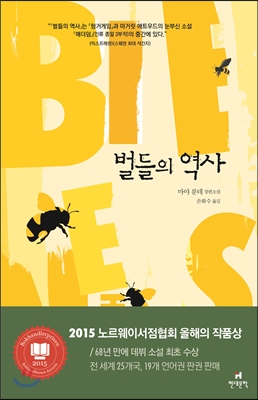
2015 Norwegian Booksellers Association
First award for a debut novel in 68 years
Publishing contracts in 25 countries and 19 languages worldwide
Maya Lunde's debut novel, "The History of Bees," which begins with the imagination and fear of a dystopian future where bees have gone extinct, has been translated and published by Hyundae Munhak.
"The History of Bees" is the winner of the 2015 Norwegian Booksellers' Association Award, following previous winners such as Jo Nesbø's "The Snowman" and Per Pettersson's "The Horse Thief Game." This is the first time in the 68-year history of the award that a debut work has won the award.
This work, which attracted international attention with contracts signed in 15 countries before its publication, is currently published in Denmark, Sweden, Poland, Finland, the Netherlands, Spain, and Brazil, and has been praised as “an impressive and impressive exploration of the author who has laid the foundation for a global expansion” (Poland’s Gazeta Wyborcza) and “a novel that is complex, brilliantly written, and as exciting as a psychological thriller” (Sweden’s Svenska Dagbladet).
"The History of Bees" is scheduled to be published by major publishers such as Bertelsmann Random House in Germany and Simon & Schuster in the English-speaking world in 2017, and will be translated and introduced in 17 additional countries in the future.
No more bees, no more pollination,
There are no more plants,
“No more animals, no more humans.”
Albert Einstein
2015 Norwegian Booksellers Association
First award for a debut novel in 68 years
Publishing contracts in 25 countries and 19 languages worldwide
Maya Lunde's debut novel, "The History of Bees," which begins with the imagination and fear of a dystopian future where bees have gone extinct, has been translated and published by Hyundae Munhak.
"The History of Bees" is the winner of the 2015 Norwegian Booksellers' Association Award, following previous winners such as Jo Nesbø's "The Snowman" and Per Pettersson's "The Horse Thief Game." This is the first time in the 68-year history of the award that a debut work has won the award.
This work, which attracted international attention with contracts signed in 15 countries before its publication, is currently published in Denmark, Sweden, Poland, Finland, the Netherlands, Spain, and Brazil, and has been praised as “an impressive and impressive exploration of the author who has laid the foundation for a global expansion” (Poland’s Gazeta Wyborcza) and “a novel that is complex, brilliantly written, and as exciting as a psychological thriller” (Sweden’s Svenska Dagbladet).
"The History of Bees" is scheduled to be published by major publishers such as Bertelsmann Random House in Germany and Simon & Schuster in the English-speaking world in 2017, and will be translated and introduced in 17 additional countries in the future.
- You can preview some of the book's contents.
Preview
Into the book
I turned my head and looked at the northern horizon.
There were countless trees lined up so far that the end was not visible.
I once read in a book a story about people traveling in the past.
I also read that people who travel are called tourists.
It's all just a new story to me.
They said that when spring comes and the weather gets better, they go out to see and enjoy nature.
It was said that many people set out to see the fruit trees in full bloom.
Did it really look beautiful to them? I couldn't be sure.
To me, fruit trees in bloom represent nothing more than labor… … but each tree represented dozens of hours of work.
Whenever I saw trees laden with fruit, the thought would automatically come to mind that I should climb up the tree and pollinate the flowers.
Countless fruit trees were just a chore for a whole day, a few months, or even a few years.
Nevertheless, we went out for a picnic today under the lush fruit trees.
That's because I wanted it.
---From "Tao"
No one knew the cause.
When I first heard the story, I assumed it was because the beekeeper had not properly maintained and managed his hives.
I thought that Hackenberg must have not been taking proper care of his bees.
I have seen many beekeepers who are unaware of their own mistakes and only blame others.
Every year, when the results were bad, they all said it was because the weather was unusually hot or cold, or sometimes because the pollen was lacking sugar.
Frankly, what we do is not as difficult as astrophysics.
But as more and more beekeepers began claiming that their bees had vanished, I instinctively knew something strange was happening.
---From "George"
That was the end of the story of Svammerdam.
I couldn't bear to tell the story of poor Svammerdam being unable to do anything after his research on bees.
He studied bees and eventually became caught up in a whirlpool of religious speculation.
Because the perfection of the bee scared him.
Even while conducting his research, he constantly reminded himself that only God is perfect, and he had to brainwash himself into believing that his research, love, and passion should ultimately be directed towards God, not towards punishment.
But the more he studied bees, the more he realized that there was nothing more perfect in this world than bees.
Even the thought that even God could not compare to punishment came to mind.
It is no exaggeration to say that the five years he devoted to studying bees ended up ruining his life.
I couldn't possibly bring myself to tell this story to the audience.
If I told the story, I was sure to become their laughing stock.
It was obvious that he would be branded as someone who challenged the authority of the omnipotent god and would be the subject of the villagers' contempt and hatred.
I folded the manuscript.
My face turned red with shame.
I even stumbled as I came down from the podium.
Professor Ram, whom I wanted to impress more than anyone else, had his facial muscles tense as he tried to hold back a laugh.
His appearance reminded me of my father.
My blood-related father.
---From "William"
Finally, all the bees were moved to the new hive.
I took a step back and looked at the bees with satisfaction.
It is up to the bees to evaluate the new hive.
If the bees are satisfied, the new hive becomes their new home.
A considerable number of bees were still circling around the old hive, searching for the queen.
I put the old hive on a wheelbarrow to burn it.
Success will come to me soon.
---From "William"
“Why did you do that?” Tom suddenly asked.
I looked at Tom with a look of confusion on my face.
“What? What do you mean?”
“Why are you carrying bees around here and there?”
"what?"
“The bees,” Tom sighed and continued.
“I lost three beehives on this trip.
“The bees that lived in that hive lost their nest.” Tom’s voice rose and his eyes widened.
He crossed his arms over his chest as if looking for something to grab onto.
“Do you know how much stress that puts on the bees, transporting the hives around on trucks?”
It wasn't easy for me to accept the seriousness of my child's situation.
I also thought it was funny.
I tried to make the smile on my lips into a laugh, but the laugh that escaped my throat was incredibly fake.
---From "George"
“Come to think of it, it’s been a while since I’ve heard anything about that area,” the hotel concierge said softly.
“Maybe no one lives there now.
Anyway, we were told that it would be best not to set foot in that area.”
“There’s a hospital there, right?”
“The hospital is at the border,” she continued, pointing to the map.
“The uncontrollable area starts here.
Passage to the southern region is still possible.
But… …are you really going to go there?”
I nodded.
She looked into my eyes and seemed to understand.
She knew full well that I was looking for my son.
I didn't go into further detail.
Because I thought that alone would be enough.
Any parent who has children can understand the feelings of a parent willing to face any shame or risk to find their lost child.
---From "Tao"
I swallowed my saliva repeatedly.
I couldn't breathe.
I was struggling in a virtual puddle, but I steeled myself, pulled myself up, and looked at the bees.
They were fighting for their lives.
Laying eggs, raising young, collecting pollen, and making honey.
There were countless trees lined up so far that the end was not visible.
I once read in a book a story about people traveling in the past.
I also read that people who travel are called tourists.
It's all just a new story to me.
They said that when spring comes and the weather gets better, they go out to see and enjoy nature.
It was said that many people set out to see the fruit trees in full bloom.
Did it really look beautiful to them? I couldn't be sure.
To me, fruit trees in bloom represent nothing more than labor… … but each tree represented dozens of hours of work.
Whenever I saw trees laden with fruit, the thought would automatically come to mind that I should climb up the tree and pollinate the flowers.
Countless fruit trees were just a chore for a whole day, a few months, or even a few years.
Nevertheless, we went out for a picnic today under the lush fruit trees.
That's because I wanted it.
---From "Tao"
No one knew the cause.
When I first heard the story, I assumed it was because the beekeeper had not properly maintained and managed his hives.
I thought that Hackenberg must have not been taking proper care of his bees.
I have seen many beekeepers who are unaware of their own mistakes and only blame others.
Every year, when the results were bad, they all said it was because the weather was unusually hot or cold, or sometimes because the pollen was lacking sugar.
Frankly, what we do is not as difficult as astrophysics.
But as more and more beekeepers began claiming that their bees had vanished, I instinctively knew something strange was happening.
---From "George"
That was the end of the story of Svammerdam.
I couldn't bear to tell the story of poor Svammerdam being unable to do anything after his research on bees.
He studied bees and eventually became caught up in a whirlpool of religious speculation.
Because the perfection of the bee scared him.
Even while conducting his research, he constantly reminded himself that only God is perfect, and he had to brainwash himself into believing that his research, love, and passion should ultimately be directed towards God, not towards punishment.
But the more he studied bees, the more he realized that there was nothing more perfect in this world than bees.
Even the thought that even God could not compare to punishment came to mind.
It is no exaggeration to say that the five years he devoted to studying bees ended up ruining his life.
I couldn't possibly bring myself to tell this story to the audience.
If I told the story, I was sure to become their laughing stock.
It was obvious that he would be branded as someone who challenged the authority of the omnipotent god and would be the subject of the villagers' contempt and hatred.
I folded the manuscript.
My face turned red with shame.
I even stumbled as I came down from the podium.
Professor Ram, whom I wanted to impress more than anyone else, had his facial muscles tense as he tried to hold back a laugh.
His appearance reminded me of my father.
My blood-related father.
---From "William"
Finally, all the bees were moved to the new hive.
I took a step back and looked at the bees with satisfaction.
It is up to the bees to evaluate the new hive.
If the bees are satisfied, the new hive becomes their new home.
A considerable number of bees were still circling around the old hive, searching for the queen.
I put the old hive on a wheelbarrow to burn it.
Success will come to me soon.
---From "William"
“Why did you do that?” Tom suddenly asked.
I looked at Tom with a look of confusion on my face.
“What? What do you mean?”
“Why are you carrying bees around here and there?”
"what?"
“The bees,” Tom sighed and continued.
“I lost three beehives on this trip.
“The bees that lived in that hive lost their nest.” Tom’s voice rose and his eyes widened.
He crossed his arms over his chest as if looking for something to grab onto.
“Do you know how much stress that puts on the bees, transporting the hives around on trucks?”
It wasn't easy for me to accept the seriousness of my child's situation.
I also thought it was funny.
I tried to make the smile on my lips into a laugh, but the laugh that escaped my throat was incredibly fake.
---From "George"
“Come to think of it, it’s been a while since I’ve heard anything about that area,” the hotel concierge said softly.
“Maybe no one lives there now.
Anyway, we were told that it would be best not to set foot in that area.”
“There’s a hospital there, right?”
“The hospital is at the border,” she continued, pointing to the map.
“The uncontrollable area starts here.
Passage to the southern region is still possible.
But… …are you really going to go there?”
I nodded.
She looked into my eyes and seemed to understand.
She knew full well that I was looking for my son.
I didn't go into further detail.
Because I thought that alone would be enough.
Any parent who has children can understand the feelings of a parent willing to face any shame or risk to find their lost child.
---From "Tao"
I swallowed my saliva repeatedly.
I couldn't breathe.
I was struggling in a virtual puddle, but I steeled myself, pulled myself up, and looked at the bees.
They were fighting for their lives.
Laying eggs, raising young, collecting pollen, and making honey.
---From "George"
Publisher's Review
Democracy has collapsed, and digital networks have lost their functionality.
The world population is now just over 1 billion.
All this happened after the bees disappeared.
"A History of Bees" chronicles the lives of three people: William, a British zoologist in 1852; George, an American beekeeper in 2007; and Tao, a worker engaged in artificial pollination in China in 2098 during the "Age of Collapse" when bees became extinct.
The novel, which is structured in alternating short chapters, weaves together on a vast canvas the early days of beekeeping in Europe in the mid-19th century, the realities of industrialized modern agriculture, and the prospects for a future world without bees.
As the individual chronologies listed horizontally interlock and transition vertically from past to present to future, the novel expands from individual histories to view the entire history.
Meanwhile, beneath the novel's superficial theme of beekeeping and the ecological crisis, the deeper theme driving the story is the lives of ordinary people who simultaneously harbor fear and hope, a spirit of challenge and resignation, and the love between parents and children.
William, George, and Tao are all ordinary parents who constantly worry and struggle for their children, and their life stories resemble the ecology of honeybees, which diligently gather nectar and pollen for the queen bee and her offspring.
However, as these bees abandon their mothers and their young in the hive, an act that goes against the laws of nature (George, p. 150), the novel shows how the lives of humans, who have an ecological system similar to that of bees, also face a crisis over time.
England, 1852.
William's Chronicles
William, once a promising scholar, has since fathered eight children and is now reduced to a merchant running a grain seed shop.
After being criticized by his former professor for not being able to escape the life of a piglet, he falls into a deep depression. However, thanks to a book left behind by his eldest son, he develops an innovative beehive, which leads to wealth and fame, and he dreams of becoming a proud father.
“Beehives must be made by humans.
A glance at every corner
We need to create a structure that can be controlled.
“A structure that can be controlled by humans, not by nature.”
2007, United States.
George's Chronicles
George, a beekeeper for generations, hopes his son will take over the family business and expand it with him, but their relationship is growing increasingly distant due to career issues.
He feels like an extinct mammoth, stuck between his wife, who wants him to give up beekeeping, and his son, who has inexplicably become a vegetarian, but he stubbornly continues to run the business when he suddenly hears news that bees are disappearing from the southern region.
“Everyone had the same story.
All the healthy bees disappeared in an instant.
There was plenty of food and healthy larvae inside the hive.
It is said that within a few days, or even just a few hours, the bees had disappeared without a trace.
The bees, having abandoned their eggs, larvae, and young bees, disappeared and never returned.”
China, 2098.
Tao's Chronicles
Tao, a young mother of a three-year-old son, spent more than twelve hours a day climbing trees, pollinating flowers like a human bee, after losing the opportunity to continue her education as a child due to her parents' opposition.
She wants her son to get a proper education and live a better life, but her husband doesn't understand her.
Then one day, her son disappears, and Tao embarks on an unpredictable journey to find him.
“Every time I see trees laden with fruit,
The thought of having to climb up a tree and spread some pollen soon came to mind.
It would come to mind automatically.
Countless fruit trees
“It was just a day’s work, a few months, or even a few years.”
In a story that moves between the past, present, and future, events that were scattered like mysterious puzzle pieces come together over hundreds of years to complete a large picture. The novel tells the surprising story of how the fates of three main characters living in completely different times and spaces are ultimately intertwined by the entity called a "bee."
The novel, which narrates the history of humanity and nature as a whole, raises fundamental questions about the relationship between humanity and nature by allowing us to study and understand the ecology of insects like bees and reflect on what humanity, once fascinated by them, has gained and lost through its civilizational challenge to tame them.
Despite its length of over 600 pages, the novel moves along at a brisk pace, drawing readers into the story with the captivating narrative of Maya Lunde, an exceptional storyteller who has written television scripts in various genres and achieved high viewership ratings.
The detailed and chilling descriptions of the devastated city where all civilization has collapsed, the strangely unfamiliar landscapes where not even the sound of birds or insects' wings can be heard in the forest full of flowers, are vivid, like a scene from a movie, and leave a lingering impression between each line.
■ Press reviews
Maya Lunde has created a moving and compelling life story while addressing the global catastrophe caused by the extinction of bees.
_《VG》(Norway's largest daily newspaper)
A magnificent story about bees and the importance of human existence.
_Dagblade (Norwegian daily newspaper)
As the story progresses, the book shifts sensitively from 'the history of bees' to 'our history.'
_《Klassekampen》(Norwegian daily newspaper)
It's not every day that a debut novelist unfolds a vast, sweeping canvas and transposes provocative and topical themes onto it.
_Aftenposten (Norwegian daily newspaper)
A captivating and brilliant novel that elegantly moves between multi-layered narratives and chronologies.
_Dag Og Tid (Norwegian weekly)
"The History of Bees" is an outstanding work of literature.
Here are the characters you'll fall in love with, and the intense excitement.
_Paedrelandsvenen (Norwegian daily newspaper)
Many people will read Maya Lunde's novels in one sitting, sit down with the bookcase covered, and think about life, the world, and the future.
_littkritikk.no (Norwegian literary criticism site)
The three intersecting stories that conclude the book speak particularly to family relationships and the independence of humans and nature.
This novel perhaps conveys more than abstract ideas that the future of our descendants (and the fate of this planet) depends on us.
Whether we create the future or avoid it.
_Jeru Ora (Brazilian daily newspaper)
Those who think this book is a novel about the impending catastrophe of beekeeping and ecological nature should immediately realize that this is only what is on the surface.
This story takes us to something heavier and more intense.
(……) 『The History of Bees』 is a complex and exceptionally well-written novel that is as exciting as a psychological thriller.
_Svenska Dagbladet (Swedish daily newspaper)
"A History of Bees" sits between "The Hunger Games" and Margaret Atwood's brilliant novel "Matherdom" (her third novel about the end of humanity).
Although the story centers around the possibility of a global environmental catastrophe, it is filled with nuanced depictions of parent-child relationships.
The book moves between the dynamics of deeply personal family relationships and the superstructure of a science fiction novel.
The character descriptions are delicate, and the scenes are clearly captivating, like a movie.
Expressen (Sweden's largest evening newspaper)
■ Into the book
I turned my head and looked at the northern horizon.
There were countless trees lined up so far that the end was not visible.
I once read a book about people traveling in the past.
I also read that people who travel are called tourists.
It's all just a new story to me.
They said that when spring comes and the weather gets better, they go out to see and enjoy nature.
It was said that many people set out to see the fruit trees in full bloom.
Did it really look beautiful to them? I couldn't be sure.
To me, fruit trees in bloom represent nothing more than labor… … but each tree represented dozens of hours of work.
Whenever I saw trees laden with fruit, the thought would automatically come to mind that I should climb up the tree and pollinate the flowers.
Countless fruit trees were just a chore for a whole day, a few months, or even a few years.
Nevertheless, we went out for a picnic today under the lush fruit trees.
That's because I wanted it.
_「Tao」
No one knew the cause.
When I first heard the story, I assumed it was because the beekeeper had not properly maintained and managed his hives.
I thought that Hackenberg must have not been taking proper care of his bees.
I have seen many beekeepers who are unaware of their own mistakes and only blame others.
Every year, when the results were bad, they all said it was because the weather was unusually hot or cold, or sometimes because the pollen was lacking sugar.
Frankly, what we do is not as difficult as astrophysics.
But as more and more beekeepers began claiming that their bees had vanished, I instinctively knew something strange was happening.
_「George」
That was the end of the story of Svammerdam.
I couldn't bear to tell the story of poor Svammerdam being unable to do anything after his research on bees.
He studied bees and eventually became caught up in a whirlpool of religious speculation.
Because the perfection of the bee scared him.
Even while conducting his research, he constantly reminded himself that only God is perfect, and he had to brainwash himself into believing that his research, love, and passion should ultimately be directed towards God, not towards punishment.
But the more he studied bees, the more he realized that there was nothing more perfect in this world than bees.
Even the thought that even God could not compare to punishment came to mind.
It is no exaggeration to say that the five years he devoted to studying bees ended up ruining his life.
I couldn't possibly bring myself to tell this story to the audience.
If I told the story, I was sure to become their laughing stock.
It was obvious that he would be branded as someone who challenged the authority of the omnipotent god and would be the subject of the contempt and hatred of the villagers.
I folded the manuscript.
My face turned red with shame.
I even stumbled as I came down from the podium.
Professor Ram, whom I wanted to impress more than anyone else, had his facial muscles tense as he tried to hold back a laugh.
His appearance reminded me of my father.
My blood-related father.
_「William」
Finally, all the bees were moved to the new hive.
I took a step back and looked at the bees with satisfaction.
It is up to the bees to evaluate the new hive.
If the bees are satisfied, the new hive becomes their new home.
A considerable number of bees were still circling around the old hive, searching for the queen.
I put the old hive on a wheelbarrow to burn it.
Success will come to me soon.
_「William」
“Why did you do that?” Tom suddenly asked.
I looked at Tom with a look of confusion on my face.
“What? What do you mean?”
“Why are you carrying bees around here and there?”
"what?"
“The bees,” Tom sighed and continued.
“I lost three beehives on this trip.
“The bees that lived in that hive lost their nest.” Tom’s voice rose and his eyes widened.
He crossed his arms over his chest as if looking for something to grab onto.
“Do you know how much stress that puts on the bees, transporting the hives around on trucks?”
It wasn't easy for me to accept the seriousness of my child's situation.
I also thought it was funny.
I tried to make the smile on my lips into a laugh, but the laugh that escaped my throat was incredibly fake.
_「George」
“Come to think of it, it’s been a while since I’ve heard anything about that area,” the hotel concierge said softly.
“Maybe no one lives there now.
Anyway, we were told that it would be best not to set foot in that area.”
“There’s a hospital there, right?”
“The hospital is at the border,” she continued, pointing to the map.
“The uncontrollable area starts here.
Passage to the southern region is still possible.
But… …are you really going to go there?”
I nodded.
She looked into my eyes and seemed to understand.
She knew full well that I was looking for my son.
I didn't go into further detail.
Because I thought that alone would be enough.
Any parent who has children can understand the shame and risk a parent would take to find their lost child.
_「Tao」
I swallowed my saliva repeatedly.
I couldn't breathe.
I was struggling in a virtual puddle, but I steeled myself, pulled myself up, and looked at the bees.
They were fighting for their lives.
Laying eggs, raising young, collecting pollen, and making honey.
_「George」
The world population is now just over 1 billion.
All this happened after the bees disappeared.
"A History of Bees" chronicles the lives of three people: William, a British zoologist in 1852; George, an American beekeeper in 2007; and Tao, a worker engaged in artificial pollination in China in 2098 during the "Age of Collapse" when bees became extinct.
The novel, which is structured in alternating short chapters, weaves together on a vast canvas the early days of beekeeping in Europe in the mid-19th century, the realities of industrialized modern agriculture, and the prospects for a future world without bees.
As the individual chronologies listed horizontally interlock and transition vertically from past to present to future, the novel expands from individual histories to view the entire history.
Meanwhile, beneath the novel's superficial theme of beekeeping and the ecological crisis, the deeper theme driving the story is the lives of ordinary people who simultaneously harbor fear and hope, a spirit of challenge and resignation, and the love between parents and children.
William, George, and Tao are all ordinary parents who constantly worry and struggle for their children, and their life stories resemble the ecology of honeybees, which diligently gather nectar and pollen for the queen bee and her offspring.
However, as these bees abandon their mothers and their young in the hive, an act that goes against the laws of nature (George, p. 150), the novel shows how the lives of humans, who have an ecological system similar to that of bees, also face a crisis over time.
England, 1852.
William's Chronicles
William, once a promising scholar, has since fathered eight children and is now reduced to a merchant running a grain seed shop.
After being criticized by his former professor for not being able to escape the life of a piglet, he falls into a deep depression. However, thanks to a book left behind by his eldest son, he develops an innovative beehive, which leads to wealth and fame, and he dreams of becoming a proud father.
“Beehives must be made by humans.
A glance at every corner
We need to create a structure that can be controlled.
“A structure that can be controlled by humans, not by nature.”
2007, United States.
George's Chronicles
George, a beekeeper for generations, hopes his son will take over the family business and expand it with him, but their relationship is growing increasingly distant due to career issues.
He feels like an extinct mammoth, stuck between his wife, who wants him to give up beekeeping, and his son, who has inexplicably become a vegetarian, but he stubbornly continues to run the business when he suddenly hears news that bees are disappearing from the southern region.
“Everyone had the same story.
All the healthy bees disappeared in an instant.
There was plenty of food and healthy larvae inside the hive.
It is said that within a few days, or even just a few hours, the bees had disappeared without a trace.
The bees, having abandoned their eggs, larvae, and young bees, disappeared and never returned.”
China, 2098.
Tao's Chronicles
Tao, a young mother of a three-year-old son, spent more than twelve hours a day climbing trees, pollinating flowers like a human bee, after losing the opportunity to continue her education as a child due to her parents' opposition.
She wants her son to get a proper education and live a better life, but her husband doesn't understand her.
Then one day, her son disappears, and Tao embarks on an unpredictable journey to find him.
“Every time I see trees laden with fruit,
The thought of having to climb up a tree and spread some pollen soon came to mind.
It would come to mind automatically.
Countless fruit trees
“It was just a day’s work, a few months, or even a few years.”
In a story that moves between the past, present, and future, events that were scattered like mysterious puzzle pieces come together over hundreds of years to complete a large picture. The novel tells the surprising story of how the fates of three main characters living in completely different times and spaces are ultimately intertwined by the entity called a "bee."
The novel, which narrates the history of humanity and nature as a whole, raises fundamental questions about the relationship between humanity and nature by allowing us to study and understand the ecology of insects like bees and reflect on what humanity, once fascinated by them, has gained and lost through its civilizational challenge to tame them.
Despite its length of over 600 pages, the novel moves along at a brisk pace, drawing readers into the story with the captivating narrative of Maya Lunde, an exceptional storyteller who has written television scripts in various genres and achieved high viewership ratings.
The detailed and chilling descriptions of the devastated city where all civilization has collapsed, the strangely unfamiliar landscapes where not even the sound of birds or insects' wings can be heard in the forest full of flowers, are vivid, like a scene from a movie, and leave a lingering impression between each line.
■ Press reviews
Maya Lunde has created a moving and compelling life story while addressing the global catastrophe caused by the extinction of bees.
_《VG》(Norway's largest daily newspaper)
A magnificent story about bees and the importance of human existence.
_Dagblade (Norwegian daily newspaper)
As the story progresses, the book shifts sensitively from 'the history of bees' to 'our history.'
_《Klassekampen》(Norwegian daily newspaper)
It's not every day that a debut novelist unfolds a vast, sweeping canvas and transposes provocative and topical themes onto it.
_Aftenposten (Norwegian daily newspaper)
A captivating and brilliant novel that elegantly moves between multi-layered narratives and chronologies.
_Dag Og Tid (Norwegian weekly)
"The History of Bees" is an outstanding work of literature.
Here are the characters you'll fall in love with, and the intense excitement.
_Paedrelandsvenen (Norwegian daily newspaper)
Many people will read Maya Lunde's novels in one sitting, sit down with the bookcase covered, and think about life, the world, and the future.
_littkritikk.no (Norwegian literary criticism site)
The three intersecting stories that conclude the book speak particularly to family relationships and the independence of humans and nature.
This novel perhaps conveys more than abstract ideas that the future of our descendants (and the fate of this planet) depends on us.
Whether we create the future or avoid it.
_Jeru Ora (Brazilian daily newspaper)
Those who think this book is a novel about the impending catastrophe of beekeeping and ecological nature should immediately realize that this is only what is on the surface.
This story takes us to something heavier and more intense.
(……) 『The History of Bees』 is a complex and exceptionally well-written novel that is as exciting as a psychological thriller.
_Svenska Dagbladet (Swedish daily newspaper)
"A History of Bees" sits between "The Hunger Games" and Margaret Atwood's brilliant novel "Matherdom" (her third novel about the end of humanity).
Although the story centers around the possibility of a global environmental catastrophe, it is filled with nuanced depictions of parent-child relationships.
The book moves between the dynamics of deeply personal family relationships and the superstructure of a science fiction novel.
The character descriptions are delicate, and the scenes are clearly captivating, like a movie.
Expressen (Sweden's largest evening newspaper)
■ Into the book
I turned my head and looked at the northern horizon.
There were countless trees lined up so far that the end was not visible.
I once read a book about people traveling in the past.
I also read that people who travel are called tourists.
It's all just a new story to me.
They said that when spring comes and the weather gets better, they go out to see and enjoy nature.
It was said that many people set out to see the fruit trees in full bloom.
Did it really look beautiful to them? I couldn't be sure.
To me, fruit trees in bloom represent nothing more than labor… … but each tree represented dozens of hours of work.
Whenever I saw trees laden with fruit, the thought would automatically come to mind that I should climb up the tree and pollinate the flowers.
Countless fruit trees were just a chore for a whole day, a few months, or even a few years.
Nevertheless, we went out for a picnic today under the lush fruit trees.
That's because I wanted it.
_「Tao」
No one knew the cause.
When I first heard the story, I assumed it was because the beekeeper had not properly maintained and managed his hives.
I thought that Hackenberg must have not been taking proper care of his bees.
I have seen many beekeepers who are unaware of their own mistakes and only blame others.
Every year, when the results were bad, they all said it was because the weather was unusually hot or cold, or sometimes because the pollen was lacking sugar.
Frankly, what we do is not as difficult as astrophysics.
But as more and more beekeepers began claiming that their bees had vanished, I instinctively knew something strange was happening.
_「George」
That was the end of the story of Svammerdam.
I couldn't bear to tell the story of poor Svammerdam being unable to do anything after his research on bees.
He studied bees and eventually became caught up in a whirlpool of religious speculation.
Because the perfection of the bee scared him.
Even while conducting his research, he constantly reminded himself that only God is perfect, and he had to brainwash himself into believing that his research, love, and passion should ultimately be directed towards God, not towards punishment.
But the more he studied bees, the more he realized that there was nothing more perfect in this world than bees.
Even the thought that even God could not compare to punishment came to mind.
It is no exaggeration to say that the five years he devoted to studying bees ended up ruining his life.
I couldn't possibly bring myself to tell this story to the audience.
If I told the story, I was sure to become their laughing stock.
It was obvious that he would be branded as someone who challenged the authority of the omnipotent god and would be the subject of the contempt and hatred of the villagers.
I folded the manuscript.
My face turned red with shame.
I even stumbled as I came down from the podium.
Professor Ram, whom I wanted to impress more than anyone else, had his facial muscles tense as he tried to hold back a laugh.
His appearance reminded me of my father.
My blood-related father.
_「William」
Finally, all the bees were moved to the new hive.
I took a step back and looked at the bees with satisfaction.
It is up to the bees to evaluate the new hive.
If the bees are satisfied, the new hive becomes their new home.
A considerable number of bees were still circling around the old hive, searching for the queen.
I put the old hive on a wheelbarrow to burn it.
Success will come to me soon.
_「William」
“Why did you do that?” Tom suddenly asked.
I looked at Tom with a look of confusion on my face.
“What? What do you mean?”
“Why are you carrying bees around here and there?”
"what?"
“The bees,” Tom sighed and continued.
“I lost three beehives on this trip.
“The bees that lived in that hive lost their nest.” Tom’s voice rose and his eyes widened.
He crossed his arms over his chest as if looking for something to grab onto.
“Do you know how much stress that puts on the bees, transporting the hives around on trucks?”
It wasn't easy for me to accept the seriousness of my child's situation.
I also thought it was funny.
I tried to make the smile on my lips into a laugh, but the laugh that escaped my throat was incredibly fake.
_「George」
“Come to think of it, it’s been a while since I’ve heard anything about that area,” the hotel concierge said softly.
“Maybe no one lives there now.
Anyway, we were told that it would be best not to set foot in that area.”
“There’s a hospital there, right?”
“The hospital is at the border,” she continued, pointing to the map.
“The uncontrollable area starts here.
Passage to the southern region is still possible.
But… …are you really going to go there?”
I nodded.
She looked into my eyes and seemed to understand.
She knew full well that I was looking for my son.
I didn't go into further detail.
Because I thought that alone would be enough.
Any parent who has children can understand the shame and risk a parent would take to find their lost child.
_「Tao」
I swallowed my saliva repeatedly.
I couldn't breathe.
I was struggling in a virtual puddle, but I steeled myself, pulled myself up, and looked at the bees.
They were fighting for their lives.
Laying eggs, raising young, collecting pollen, and making honey.
_「George」
GOODS SPECIFICS
- Date of issue: December 30, 2016
- Format: Hardcover book binding method guide
- Page count, weight, size: 608 pages | 734g | 130*205*35mm
- ISBN13: 9788972758020
- ISBN10: 8972758027
You may also like
카테고리
korean


korean

![GQ KOREA Mark (Monthly): December [2025]](http://librairie.coreenne.fr/cdn/shop/files/8ef265dbbfbf186523ed75ba7319009d.jpg?v=1765340328&width=3840)


