

Punishment of the Sky
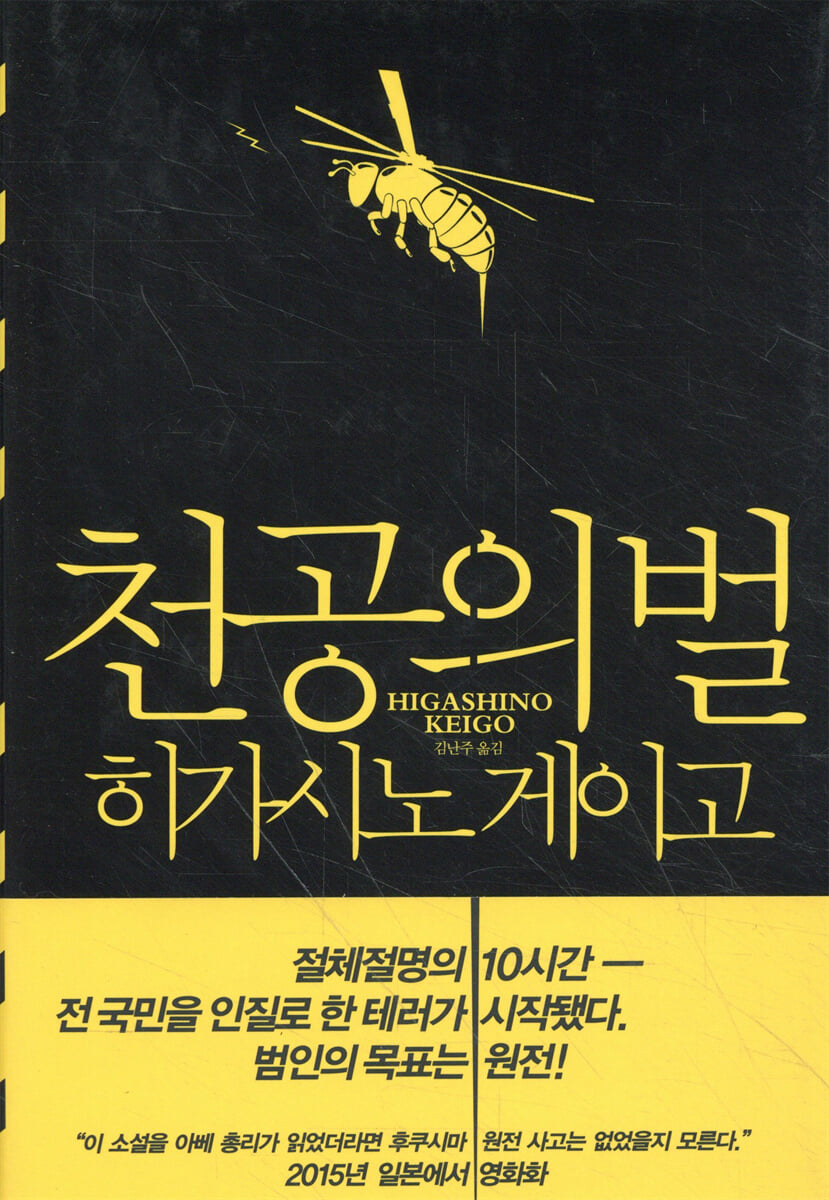 |
Description
Book Introduction
10 hours of life and death
A terrorist attack has begun, taking the entire nation hostage.
The criminal's target is the nuclear power plant!
The 'Big B', a state-of-the-art, large combat helicopter destined for the Japan Self-Defense Forces, is hijacked ahead of its final test flight.
'Big B', carrying a large amount of explosives, is remotely controlled by a criminal who calls himself 'Sky Punisher' and moves into the sky above the high-speed breeder prototype reactor 'Shinyang' in Tsuruga City, Fukui Prefecture.
A helicopter circling 800 meters above the nuclear power plant.
The perpetrator sends a message to the government, threatening, "If you don't shut down all nuclear power plants in Japan, I will crash a helicopter into the plant."
And he demands that his demands and the situation on the ground be broadcast live across the country on TV.
8 hours left.
The Japanese archipelago is instantly gripped by a state of imminent terror.
The government, local governments, the Self-Defense Forces, the police, fire departments, and nuclear power plant officials are all in disarray, being dragged around by the criminal's demands without any countermeasures.
As the helicopter's fuel runs out by the minute and residents around the nuclear power plant are forced to flee, an unexpected truth, unexpected by both the government and the criminals, is revealed: the young son of a researcher who participated in the helicopter's development is alone inside the 'Big B'.
A terrorist attack has begun, taking the entire nation hostage.
The criminal's target is the nuclear power plant!
The 'Big B', a state-of-the-art, large combat helicopter destined for the Japan Self-Defense Forces, is hijacked ahead of its final test flight.
'Big B', carrying a large amount of explosives, is remotely controlled by a criminal who calls himself 'Sky Punisher' and moves into the sky above the high-speed breeder prototype reactor 'Shinyang' in Tsuruga City, Fukui Prefecture.
A helicopter circling 800 meters above the nuclear power plant.
The perpetrator sends a message to the government, threatening, "If you don't shut down all nuclear power plants in Japan, I will crash a helicopter into the plant."
And he demands that his demands and the situation on the ground be broadcast live across the country on TV.
8 hours left.
The Japanese archipelago is instantly gripped by a state of imminent terror.
The government, local governments, the Self-Defense Forces, the police, fire departments, and nuclear power plant officials are all in disarray, being dragged around by the criminal's demands without any countermeasures.
As the helicopter's fuel runs out by the minute and residents around the nuclear power plant are forced to flee, an unexpected truth, unexpected by both the government and the criminals, is revealed: the young son of a researcher who participated in the helicopter's development is alone inside the 'Big B'.
- You can preview some of the book's contents.
Preview
Publisher's Review
10 hours of life and death
A terrorist attack has begun, taking the entire nation hostage.
The criminal's target is the nuclear power plant!
The 'Big B', a state-of-the-art, large combat helicopter destined for the Japan Self-Defense Forces, is hijacked ahead of its final test flight.
'Big B', carrying a large amount of explosives, is remotely controlled by a criminal who calls himself 'Sky Punisher' and moves into the sky above the high-speed breeder prototype reactor 'Shinyang' in Tsuruga City, Fukui Prefecture.
A helicopter circling 800 meters above the nuclear power plant.
The perpetrator sends a message to the government, threatening, "If you don't shut down all nuclear power plants in Japan, I will crash a helicopter into the plant."
And he demands that his demands and the situation on the ground be broadcast live across the country on TV.
8 hours left.
The Japanese archipelago is instantly gripped by a state of imminent terror.
The government, local governments, the Self-Defense Forces, the police, fire departments, and nuclear power plant officials are all in disarray, being dragged around by the criminal's demands without any countermeasures.
As the helicopter's fuel runs out by the minute and residents around the nuclear power plant are forced to flee, an unexpected truth, unexpected by both the government and the criminals, is revealed: the young son of a researcher who participated in the helicopter's development is alone inside the 'Big B'.
A chilling prophecy!
The 'punishment from the sky' came to our reality in the form of a disaster called the Great East Japan Earthquake.
Keigo Higashino's novel "The Punishment of the Sky" is a masterpiece of suspense depicting the bloody psychological warfare between the Japanese authorities and helicopter hijackers who demand the destruction of a nuclear power plant using the people as bait.
The breathtaking 10-hour drama from the helicopter hijacking to the end of the incident is depicted in a 676-page novel.
The announcement date was 1995.
Immediately after that, in December of the same year, an astonishing accident actually occurred at the dream reactor 'Monju', which the author had used as a model for the 'Shinyang' reactor in the novel.
The fire was caused by a sodium leak, which was also pointed out as the most serious incident predicted in the novel.
After being shut down for a long time due to frequent accidents, 'Monju' is now practically on the verge of being phased out due to safety issues.
I cannot help but be amazed by the author's foresight and critical awareness.
What's even more surprising is that in March 2011, 16 years after the publication of "The Punishment of the Sky," the Fukushima nuclear disaster actually occurred due to the Great East Japan Earthquake.
This accident, which shocked the world, prompted serious reflection on nuclear power plants in each country, and some countries, including Germany, ended up completely abandoning their nuclear power policies.
In Japan, there was so much interest in the issues raised by Keigo Higashino that there was even talk that “If Prime Minister Abe had read ‘The Punishment of the Sky’ in advance, the Fukushima nuclear accident might not have happened.” This interest eventually led to a movie based on the novel being made in Japan in 2015, 20 years after its publication.
When the film's production was announced, the general opinion in Japan was that "it would touch on the taboo of nuclear power and be impossible to make into a film," but veteran director Yukihiko Tsutsumi pushed ahead with the film despite these concerns, and it eventually became an explosive hit.
The film "The Punishment of the Sky" won the Best Director Award at last year's Hochi Film Awards and the Best Editing Award at this year's Japan Film Critics Awards.
It was a hot topic that resonated especially with the Japanese who still have painful memories of the atomic bomb.
Additionally, 『Sky Punishment』 was nominated for the Yoshikawa Eiji Literary Newcomer Award at the time of its publication, and was recognized for its literary value as well as its entertainment value, which is rare for a suspense novel.
Authentic crisis suspense with overwhelming tension
The first half of the novel quickly depicts the helicopter hijacking, the criminal's threats, and the government's response.
Keigo Higashino, with his background in science and engineering, uses his specialized knowledge of helicopters and nuclear power plants to develop the story in a breathless manner with vivid realism and dense composition.
To achieve this, the author revealed that he invested three years in research and reporting.
The highlight of the first half is the scene where they rescue Keita, the nine-year-old son of a helicopter development researcher who accidentally gets on a helicopter.
On the morning of the test flight, Keita followed his father to the test airfield, but out of curiosity, he sneaked into the helicopter and was kidnapped along with him.
The perpetrator, faced with an unexpected situation, reluctantly complies with the authorities' humanitarian appeal, but demands to be rescued from the air, leaving the helicopter circling over the nuclear power plant in place.
This creates a sense of urgency as the rescue team of the Air Self-Defense Force, who launched another combat helicopter to rescue the victims, risk their lives in the air.
From then on, the novel unfolds as a push-and-pull psychological warfare between the criminal and the authorities.
In urgent situations where no margin for error is allowed, there are authorities who are willing to take a reckless gamble, risking the lives of citizens. On the other hand, there are those who remain on the scene and resolve the issue, even in dangerous situations where the helicopter could crash at any moment, which is moving.
Authorities are parroting the government's safety myth that "even if a helicopter falls, the nuclear power plant is safe" in an attempt to fool the perpetrator into shutting down the Shinyang plant.
Additionally, some leaders are preoccupied with plotting ways to escape for their own safety.
As the residents' escape commotion continues, the police, who have begun searching for the culprit, gradually narrow down the scope of the investigation through persistent investigation.
Eventually, the outline of the criminal and the motive for the crime slowly emerge to the surface, and surprising facts begin to be revealed one by one.
A problematic work that exposes the 'silent crowd' that refuses to see or hear anything bothersome.
Unlike Keigo Higashino's other works, one of the culprits in "The Punishment of the Sky" is revealed early on, around the middle of the novel.
Therefore, readers who already know the culprit can enjoy the conversation between the culprit and the characters who do not know the culprit's identity at the crime scene from an omniscient point of view, and experience a strange thrill as they follow the culprit's secret movements.
Of course, as the police investigation net narrows, the fun of seeing the identities of the accomplices and their motives for the crimes revealed one by one cannot be overlooked.
As the story reaches its conclusion, readers find themselves nodding their heads in agreement with the reckless but necessary motive for the crime and the profound humanity hidden behind the incident.
And it makes us ponder how to answer the fundamental questions surrounding nuclear power plants.
The author says this through the criminal's mouth.
“If a major accident occurs at a nuclear power plant, even innocent people will be affected.
It's like the entire country is on a plane called a nuclear power plant.
I don't remember anyone buying a ticket.
But the truth is, it's not impossible to keep that plane from flying.
… … But I don’t see any will to do that.
I don't even know what the passengers are thinking.
“Except for a few opposition members, most of them just sit in their seats in silence and don’t even bother to lift their butts.”
Keigo Higashino says, “I tried to maintain a completely neutral stance on nuclear power.”
The story is that there are no sides for or against nuclear power plants.
However, in this work, he criticizes the government authorities who created the myth of the safety of nuclear power plants without clear evidence, and sends a stern message to the "silent crowd" who close their eyes to reality in pursuit of immediate profits, amidst the contradictory statement that "we recognize the need for nuclear power plants, but we are afraid of their proximity."
“Nuclear reactors have many faces.
It can smile at humanity or show its fangs.
It is human arrogance to demand only a smile.
… …We must not let the silent crowd forget the reactor.
Always be conscious and choose your own path.
“A child only knows the fear of a bee after being stung.”
(From the work)
A terrorist attack has begun, taking the entire nation hostage.
The criminal's target is the nuclear power plant!
The 'Big B', a state-of-the-art, large combat helicopter destined for the Japan Self-Defense Forces, is hijacked ahead of its final test flight.
'Big B', carrying a large amount of explosives, is remotely controlled by a criminal who calls himself 'Sky Punisher' and moves into the sky above the high-speed breeder prototype reactor 'Shinyang' in Tsuruga City, Fukui Prefecture.
A helicopter circling 800 meters above the nuclear power plant.
The perpetrator sends a message to the government, threatening, "If you don't shut down all nuclear power plants in Japan, I will crash a helicopter into the plant."
And he demands that his demands and the situation on the ground be broadcast live across the country on TV.
8 hours left.
The Japanese archipelago is instantly gripped by a state of imminent terror.
The government, local governments, the Self-Defense Forces, the police, fire departments, and nuclear power plant officials are all in disarray, being dragged around by the criminal's demands without any countermeasures.
As the helicopter's fuel runs out by the minute and residents around the nuclear power plant are forced to flee, an unexpected truth, unexpected by both the government and the criminals, is revealed: the young son of a researcher who participated in the helicopter's development is alone inside the 'Big B'.
A chilling prophecy!
The 'punishment from the sky' came to our reality in the form of a disaster called the Great East Japan Earthquake.
Keigo Higashino's novel "The Punishment of the Sky" is a masterpiece of suspense depicting the bloody psychological warfare between the Japanese authorities and helicopter hijackers who demand the destruction of a nuclear power plant using the people as bait.
The breathtaking 10-hour drama from the helicopter hijacking to the end of the incident is depicted in a 676-page novel.
The announcement date was 1995.
Immediately after that, in December of the same year, an astonishing accident actually occurred at the dream reactor 'Monju', which the author had used as a model for the 'Shinyang' reactor in the novel.
The fire was caused by a sodium leak, which was also pointed out as the most serious incident predicted in the novel.
After being shut down for a long time due to frequent accidents, 'Monju' is now practically on the verge of being phased out due to safety issues.
I cannot help but be amazed by the author's foresight and critical awareness.
What's even more surprising is that in March 2011, 16 years after the publication of "The Punishment of the Sky," the Fukushima nuclear disaster actually occurred due to the Great East Japan Earthquake.
This accident, which shocked the world, prompted serious reflection on nuclear power plants in each country, and some countries, including Germany, ended up completely abandoning their nuclear power policies.
In Japan, there was so much interest in the issues raised by Keigo Higashino that there was even talk that “If Prime Minister Abe had read ‘The Punishment of the Sky’ in advance, the Fukushima nuclear accident might not have happened.” This interest eventually led to a movie based on the novel being made in Japan in 2015, 20 years after its publication.
When the film's production was announced, the general opinion in Japan was that "it would touch on the taboo of nuclear power and be impossible to make into a film," but veteran director Yukihiko Tsutsumi pushed ahead with the film despite these concerns, and it eventually became an explosive hit.
The film "The Punishment of the Sky" won the Best Director Award at last year's Hochi Film Awards and the Best Editing Award at this year's Japan Film Critics Awards.
It was a hot topic that resonated especially with the Japanese who still have painful memories of the atomic bomb.
Additionally, 『Sky Punishment』 was nominated for the Yoshikawa Eiji Literary Newcomer Award at the time of its publication, and was recognized for its literary value as well as its entertainment value, which is rare for a suspense novel.
Authentic crisis suspense with overwhelming tension
The first half of the novel quickly depicts the helicopter hijacking, the criminal's threats, and the government's response.
Keigo Higashino, with his background in science and engineering, uses his specialized knowledge of helicopters and nuclear power plants to develop the story in a breathless manner with vivid realism and dense composition.
To achieve this, the author revealed that he invested three years in research and reporting.
The highlight of the first half is the scene where they rescue Keita, the nine-year-old son of a helicopter development researcher who accidentally gets on a helicopter.
On the morning of the test flight, Keita followed his father to the test airfield, but out of curiosity, he sneaked into the helicopter and was kidnapped along with him.
The perpetrator, faced with an unexpected situation, reluctantly complies with the authorities' humanitarian appeal, but demands to be rescued from the air, leaving the helicopter circling over the nuclear power plant in place.
This creates a sense of urgency as the rescue team of the Air Self-Defense Force, who launched another combat helicopter to rescue the victims, risk their lives in the air.
From then on, the novel unfolds as a push-and-pull psychological warfare between the criminal and the authorities.
In urgent situations where no margin for error is allowed, there are authorities who are willing to take a reckless gamble, risking the lives of citizens. On the other hand, there are those who remain on the scene and resolve the issue, even in dangerous situations where the helicopter could crash at any moment, which is moving.
Authorities are parroting the government's safety myth that "even if a helicopter falls, the nuclear power plant is safe" in an attempt to fool the perpetrator into shutting down the Shinyang plant.
Additionally, some leaders are preoccupied with plotting ways to escape for their own safety.
As the residents' escape commotion continues, the police, who have begun searching for the culprit, gradually narrow down the scope of the investigation through persistent investigation.
Eventually, the outline of the criminal and the motive for the crime slowly emerge to the surface, and surprising facts begin to be revealed one by one.
A problematic work that exposes the 'silent crowd' that refuses to see or hear anything bothersome.
Unlike Keigo Higashino's other works, one of the culprits in "The Punishment of the Sky" is revealed early on, around the middle of the novel.
Therefore, readers who already know the culprit can enjoy the conversation between the culprit and the characters who do not know the culprit's identity at the crime scene from an omniscient point of view, and experience a strange thrill as they follow the culprit's secret movements.
Of course, as the police investigation net narrows, the fun of seeing the identities of the accomplices and their motives for the crimes revealed one by one cannot be overlooked.
As the story reaches its conclusion, readers find themselves nodding their heads in agreement with the reckless but necessary motive for the crime and the profound humanity hidden behind the incident.
And it makes us ponder how to answer the fundamental questions surrounding nuclear power plants.
The author says this through the criminal's mouth.
“If a major accident occurs at a nuclear power plant, even innocent people will be affected.
It's like the entire country is on a plane called a nuclear power plant.
I don't remember anyone buying a ticket.
But the truth is, it's not impossible to keep that plane from flying.
… … But I don’t see any will to do that.
I don't even know what the passengers are thinking.
“Except for a few opposition members, most of them just sit in their seats in silence and don’t even bother to lift their butts.”
Keigo Higashino says, “I tried to maintain a completely neutral stance on nuclear power.”
The story is that there are no sides for or against nuclear power plants.
However, in this work, he criticizes the government authorities who created the myth of the safety of nuclear power plants without clear evidence, and sends a stern message to the "silent crowd" who close their eyes to reality in pursuit of immediate profits, amidst the contradictory statement that "we recognize the need for nuclear power plants, but we are afraid of their proximity."
“Nuclear reactors have many faces.
It can smile at humanity or show its fangs.
It is human arrogance to demand only a smile.
… …We must not let the silent crowd forget the reactor.
Always be conscious and choose your own path.
“A child only knows the fear of a bee after being stung.”
(From the work)
GOODS SPECIFICS
- Date of issue: September 12, 2016
- Format: Hardcover book binding method guide
- Page count, weight, size: 676 pages | 698g | 130*198*43mm
- ISBN13: 9788990982667
- ISBN10: 8990982669
You may also like
카테고리
korean


korean

![GQ KOREA Mark (Monthly): December [2025]](http://librairie.coreenne.fr/cdn/shop/files/8ef265dbbfbf186523ed75ba7319009d.jpg?v=1765340328&width=3840)


