

Romantic love and the afterlife
 |
Description
Book Introduction
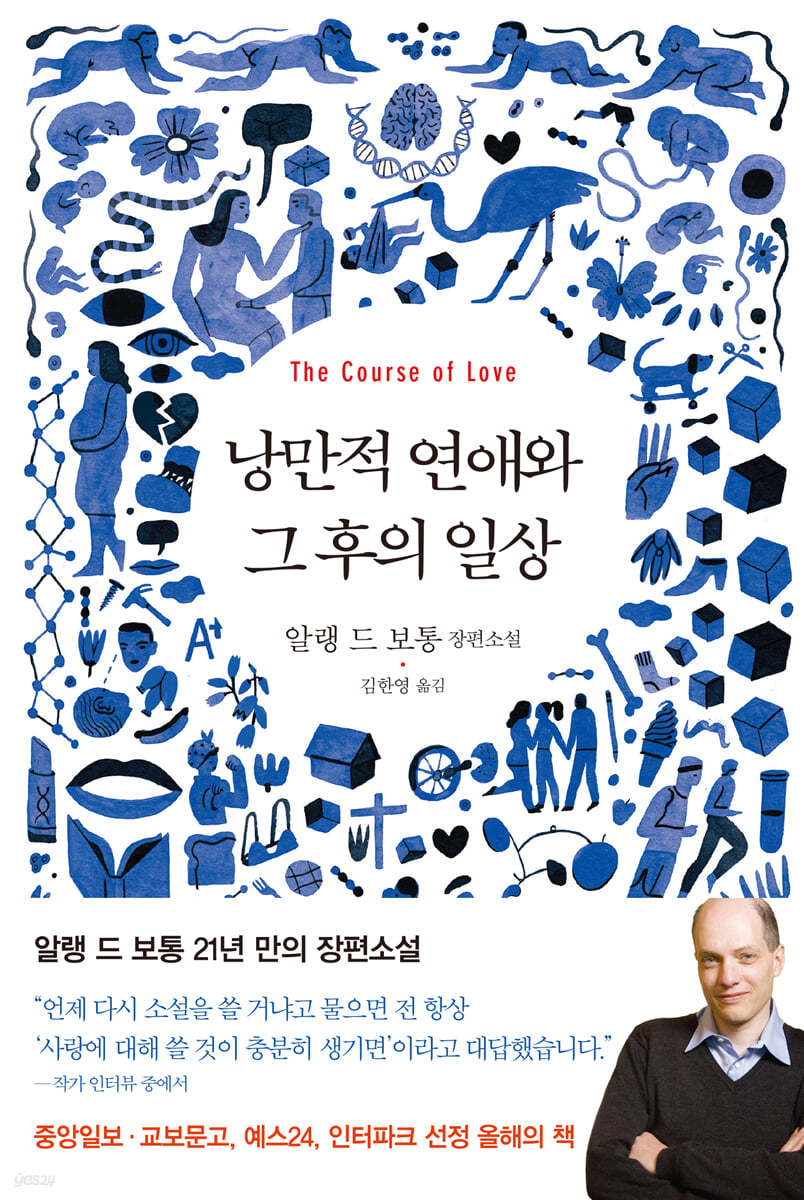
Alain de Botton's first full-length novel in 21 years “Whenever I’m asked when I’ll write a novel again, I always say “When I have enough to write about love,” he replied. What happens to lovers after love is fulfilled? Alain de Botton's novel, released after 21 years, offers insight into love, a concept that has become a part of everyday life, through the life of a married couple. Even lovers who passionately confess their love and promise eternity are bound to begin to doubt each other's uniqueness at some point. So, rather than jumping to the romantic conclusion that it wasn't love in the first place or the pessimistic conclusion that love itself doesn't exist, Alain de Botton presents a realistic discussion on how to make the love we have today sustainable. Readers follow the lives of the two main characters, Ravi and Kirsten, as they gradually lose the thrill of sex, the joy of togetherness gives way to the need for solitude, struggle with parenting, and are swayed by the temptation of infidelity, encountering moments of rupture that can come to one's own love. Alain de Botton argues that it is not the individual's fault but the misconceptions about love and marriage that create such moments, and that by breaking free from such misconceptions, we can also escape a pessimistic future. This book contains the flexible way of loving that he proposes, condensed into the phrase, “Love is a technique rather than a passionate emotion.” In these times when it is difficult to be optimistic about living a stable life with someone, this book gives us the courage to build a long-term life with one person. |
- You can preview some of the book's contents.
Preview
index
Romantic love and the afterlife
Part 1 | Romanticism
fascination
Divine Beginning
Fall in love
Sex and Love
proposal of marriage
Part 2 | Long After That
Insignificant things
About Torajim
Sex and Censorship
Emotional transference
It's all your fault
Teaching and Learning
Part 3 | Children
Teachings of Love
Loveliness
The limits of love
Sex and Parenting
The prestige of laundry
Part 4 | Adultery
cheating man
pro
oppositionism
Incompatible desires
secret
Part 5 | Beyond Romanticism
attachment theory
Towards maturity
Ready to get married
future
Translator's Note
Part 1 | Romanticism
fascination
Divine Beginning
Fall in love
Sex and Love
proposal of marriage
Part 2 | Long After That
Insignificant things
About Torajim
Sex and Censorship
Emotional transference
It's all your fault
Teaching and Learning
Part 3 | Children
Teachings of Love
Loveliness
The limits of love
Sex and Parenting
The prestige of laundry
Part 4 | Adultery
cheating man
pro
oppositionism
Incompatible desires
secret
Part 5 | Beyond Romanticism
attachment theory
Towards maturity
Ready to get married
future
Translator's Note
Detailed image
Into the book
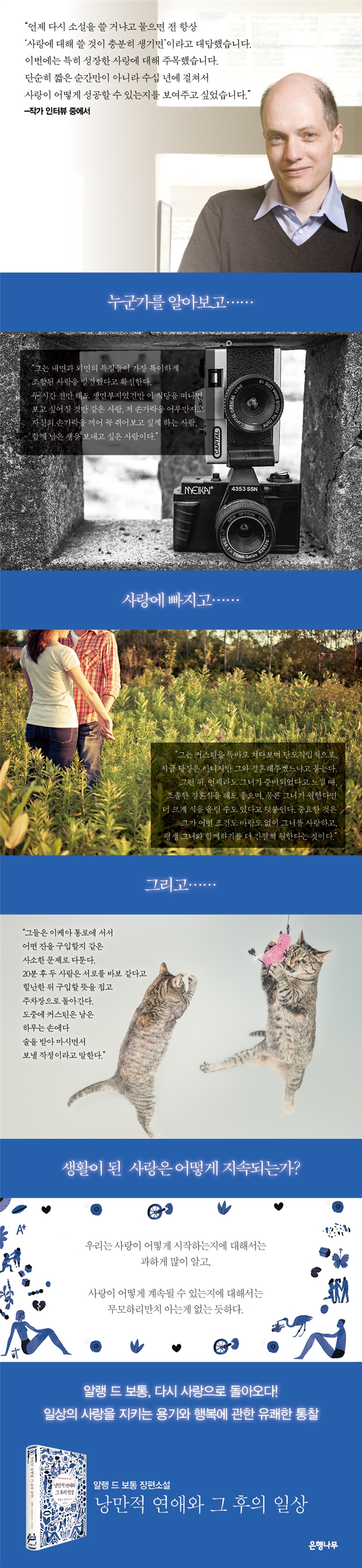
He could have resisted the thought that Kirsten was a pretty decent person to spend the morning with.
One could even admit that her pale complexion and the slant of her neck made it difficult to discern her soul.
… … Instead, Ravi is convinced that he has discovered a person with the most unique combination of inner and outer qualities.
Even though we were complete strangers just two hours ago, he's the person you'll miss the moment you leave this restaurant, the person whose fingers you want to stroke and squeeze tightly with your own, the person you want to spend the rest of your life with. --- p.22~23
That's when I realized that I couldn't survive on my own.
Walking home alone after a distracting party, Sundays slipping by without a word to exchange, vacations following couples too exhausted by their children to even have the energy to talk—the desolate realization that I hadn't occupied a significant place in anyone's heart was enough. --- p.60
You don't have to be constantly rational to maintain a good relationship.
What we need to cultivate is the occasional ability to readily admit that we are somewhat out of our minds in one or two respects. --- p.116
It's wonderful to live in a world where so many people show affection to children.
It would be wonderful if we lived in a world where we showed a little more affection for the childlike side of others. --- p.163
If love is defined as genuine concern for another's happiness, then it should be considered consistent with love to give your often-troubled and timid husband a lift to the 18th floor and enjoy revitalizing oral sex with a near-stranger for ten minutes.
Otherwise, what we are dealing with is not love at all, but a narrow-minded and hypocritical possessiveness, a desire to desire the other's happiness only if and only if their happiness includes our own.
It's already past midnight, but Ravi is just getting back on track.
He quickly dodges any objections he might receive, clinging to a more fragile self-righteousness. --- p.216
Our romantic lives are destined to end sadly and imperfectly.
Because we are beings driven by two fundamental desires that point in diametrically opposed directions.
Even more troubling, we utopianly refuse to accept this division, naively hoping that we can somehow find common ground without any cost.
That freethinkers can live adventurous lives while avoiding loneliness and confusion, and that married romantics can integrate sex, affection, passion, and everyday life.
One could even admit that her pale complexion and the slant of her neck made it difficult to discern her soul.
… … Instead, Ravi is convinced that he has discovered a person with the most unique combination of inner and outer qualities.
Even though we were complete strangers just two hours ago, he's the person you'll miss the moment you leave this restaurant, the person whose fingers you want to stroke and squeeze tightly with your own, the person you want to spend the rest of your life with. --- p.22~23
That's when I realized that I couldn't survive on my own.
Walking home alone after a distracting party, Sundays slipping by without a word to exchange, vacations following couples too exhausted by their children to even have the energy to talk—the desolate realization that I hadn't occupied a significant place in anyone's heart was enough. --- p.60
You don't have to be constantly rational to maintain a good relationship.
What we need to cultivate is the occasional ability to readily admit that we are somewhat out of our minds in one or two respects. --- p.116
It's wonderful to live in a world where so many people show affection to children.
It would be wonderful if we lived in a world where we showed a little more affection for the childlike side of others. --- p.163
If love is defined as genuine concern for another's happiness, then it should be considered consistent with love to give your often-troubled and timid husband a lift to the 18th floor and enjoy revitalizing oral sex with a near-stranger for ten minutes.
Otherwise, what we are dealing with is not love at all, but a narrow-minded and hypocritical possessiveness, a desire to desire the other's happiness only if and only if their happiness includes our own.
It's already past midnight, but Ravi is just getting back on track.
He quickly dodges any objections he might receive, clinging to a more fragile self-righteousness. --- p.216
Our romantic lives are destined to end sadly and imperfectly.
Because we are beings driven by two fundamental desires that point in diametrically opposed directions.
Even more troubling, we utopianly refuse to accept this division, naively hoping that we can somehow find common ground without any cost.
That freethinkers can live adventurous lives while avoiding loneliness and confusion, and that married romantics can integrate sex, affection, passion, and everyday life.
--- p.234
Publisher's Review
“Whenever I’m asked when I’ll write a novel again, I always say
“When I have enough to write about love,” he replied.
Alain de Botton's first full-length novel in 21 years: A New Look at Love
Alain de Botton, the 'philosopher of everyday life', returns to the novel.
In his first full-length novel, The Course of Love, published 21 years after Kiss and Tell, he offers insight into love that has become part of everyday life.
Unlike previous works that depicted the process of love and separation, this is a story about what happens after a promise of eternity is made.
Alain de Botton explores how love can succeed over decades through the lives of an ordinary couple from Edinburgh, Rabih and Kirsten.
The author states that "what we call love is merely the beginning of love," and presents an honest and bold discussion on how to move beyond the limits of romance and the contradictions of the institution of marriage to make a leap toward mature love.
You can encounter the flexible way of love suggested by the author, condensed into the phrase, 'Love is a skill rather than an emotion.'
'Ordinary Style', which combines novels and philosophical essays,
The intellectual wit and delicate insight everyone has been waiting for
Alain de Botton, one of Korea's most beloved authors, has built a reputation as a "philosopher of everyday life" by providing new opportunities and frameworks for thinking about various areas of life.
In particular, the novels called the 'Trilogy of Love and Human Relationships', 'Why Do I Love You', 'Are We in Love', and 'Kiss and Tell', have left their mark on his unique style, exquisitely combining the formats of novel and essay, or novel and biography.
His approach to dealing with the universal human emotion of love through intentionally ordinary characters and plots, detailed psychological descriptions, and philosophical suggestions has garnered great sympathy and response from readers.
The charm of his novels lies in the surprise of encountering characters who most resemble our own selves.
He himself also stated, "Novels are the most suitable format for talking about love, as they allow for the free movement of a character's perception and psychology, allowing for a multi-faceted examination. If I ever find myself with enough to write about love, I will write a novel."
In this novel, which returns to the theme of 'love' after a long time, he displays his unique sensibility.
“What we call love is only the beginning of love.”
Transition from romantic love to realistic and mature love
“After many years and many essays on love, Ravi will come to the conclusion that love can only endure when we turn away from the mysterious passion that gave rise to it, and that for a relationship to be effective, we need to give up the feelings that first drew us into it.
Now he must learn that love is a skill rather than a passion.” (p.16)
While previous works depicted the dilemma of love revealed in the process of meeting and parting between a man and a woman, this novel unfolds a new phase: marriage.
The author focuses on the difficulties of love that come to those who have been promised eternity.
(Like the characters in his previous works) Why do our loves often face crises and even greater destruction, even though after much trial and error we meet someone we are sure we will spend the rest of our lives with?
He explains that the reason is that our perception of love is ingrained in romanticism.
The lives of the two protagonists in the novel show that moments that might otherwise be dismissed as the gradual fading or decay of love when focusing on the initial passion and ecstasy can actually become opportunities for love to develop and mature.
The author focuses on the various aspects of everyday life, as if rehearsing the entire process of marriage, and draws out the discourse on love that we need from it.
This is how the discussion of how love can succeed over decades, not just months or years, begins.
From choosing an IKEA cup to cheating,
How does love change when it becomes a part of life?
“He and Kirsten get married, have their ups and downs, worry about money often, have a daughter and a son, one of them has an affair, they have boring times, sometimes they feel like killing each other, and a few times they feel like killing themselves.
“This is a real love story.” (p28)
The two main characters, Ravi and Kirsten, who each grew up without one of their parents, fall in love and get married.
Cracks start from small things.
They go to IKEA to buy a cup, but come back empty-handed after a disagreement, and for the first time, they question their life together.
'How can I endure this for the rest of my life?'
The author then depicts a series of events that are inevitable in married life, such as clashing values, sex losing its thrill, childcare taking over life, and the suffering caused by the imbalance between one's social self and one's home self.
In it, it is revealed how fragile the love we have been relying on is.
For example, the sense of fulfillment in mutual compatibility, where one is completely accepted by the other and becomes their absolute supporter, can easily lose its balance, and the moment society recognizes each other as legitimate sexual partners, the drive to bridge the gap diminishes.
Moreover, we cannot control the leap of mind that all wrong results are the responsibility of the other person.
Now Kirsten's wisdom has been transformed into an unsympathetic coldness, and Ravi's excessive self-pity is more noticeable in Kirsten's eyes than his kindness.
What was once a 'soul mate' ends up being a 'bad relationship'.
“Love is a skill, not a feeling.”
A true love story about navigating life without going crazy.
Advanced romantic pessimism assumes that one person cannot be everything to another.
We must find the gentlest and kindest way to adapt ourselves to the reality of living alongside other fallen creatures.
Marriage can only be a 'reasonably good' marriage. (p.279)
Their problems revolve around infidelity.
The author reveals the blind spot of the romantic view of marriage by following the character's consciousness as he rushes into petty self-rationalization after an affair.
'We are driven by two fundamental desires, stability and adventure, which point in diametrically opposed directions, and our romantic lives are destined to end sadly and imperfectly.'
Therefore, the author proposes a new look at the concept of marriage as an institution.
In a life where desires are so fickle and enlightenment comes too late, it is a guide that will keep us consistent.
This is why the author emphasizes that 'love is not an emotion, but a skill.'
We need insight to avoid being swayed by immediate desires and anger.
As we witness Ravi and Kirsten's trials and tribulations and moments of shining enlightenment, we are given the opportunity to move forward into a more mature love.
Alain de Botton says:
We are all slightly flawed people, who may or may not be fully understood.
The love story we should strive for is one where we bravely overcome the difficulties of love and marriage without going crazy.
Recommendation
In this book, Alain de Botton demonstrates once again his ability to capture our desires, our anxieties, and the ways we choose to act on the page.
-[New York Times]
"What is it like to be married?" To answer this question, the author returns to writing novels after a 20-year hiatus.
It's funny, touching, and thought-provoking.
-[Booklist]
There is no intellectual or emotional problem that Alain de Botton cannot solve. - Matthew Thomas, author
A must-read for anyone considering marriage. - [Daily Mail]
Alain de Botton is a writer who knows that negotiating between two types of cups at Ikea is as tricky as negotiating whether your spouse will go on a Mars expedition or join ISIS.
-[times]
“When I have enough to write about love,” he replied.
Alain de Botton's first full-length novel in 21 years: A New Look at Love
Alain de Botton, the 'philosopher of everyday life', returns to the novel.
In his first full-length novel, The Course of Love, published 21 years after Kiss and Tell, he offers insight into love that has become part of everyday life.
Unlike previous works that depicted the process of love and separation, this is a story about what happens after a promise of eternity is made.
Alain de Botton explores how love can succeed over decades through the lives of an ordinary couple from Edinburgh, Rabih and Kirsten.
The author states that "what we call love is merely the beginning of love," and presents an honest and bold discussion on how to move beyond the limits of romance and the contradictions of the institution of marriage to make a leap toward mature love.
You can encounter the flexible way of love suggested by the author, condensed into the phrase, 'Love is a skill rather than an emotion.'
'Ordinary Style', which combines novels and philosophical essays,
The intellectual wit and delicate insight everyone has been waiting for
Alain de Botton, one of Korea's most beloved authors, has built a reputation as a "philosopher of everyday life" by providing new opportunities and frameworks for thinking about various areas of life.
In particular, the novels called the 'Trilogy of Love and Human Relationships', 'Why Do I Love You', 'Are We in Love', and 'Kiss and Tell', have left their mark on his unique style, exquisitely combining the formats of novel and essay, or novel and biography.
His approach to dealing with the universal human emotion of love through intentionally ordinary characters and plots, detailed psychological descriptions, and philosophical suggestions has garnered great sympathy and response from readers.
The charm of his novels lies in the surprise of encountering characters who most resemble our own selves.
He himself also stated, "Novels are the most suitable format for talking about love, as they allow for the free movement of a character's perception and psychology, allowing for a multi-faceted examination. If I ever find myself with enough to write about love, I will write a novel."
In this novel, which returns to the theme of 'love' after a long time, he displays his unique sensibility.
“What we call love is only the beginning of love.”
Transition from romantic love to realistic and mature love
“After many years and many essays on love, Ravi will come to the conclusion that love can only endure when we turn away from the mysterious passion that gave rise to it, and that for a relationship to be effective, we need to give up the feelings that first drew us into it.
Now he must learn that love is a skill rather than a passion.” (p.16)
While previous works depicted the dilemma of love revealed in the process of meeting and parting between a man and a woman, this novel unfolds a new phase: marriage.
The author focuses on the difficulties of love that come to those who have been promised eternity.
(Like the characters in his previous works) Why do our loves often face crises and even greater destruction, even though after much trial and error we meet someone we are sure we will spend the rest of our lives with?
He explains that the reason is that our perception of love is ingrained in romanticism.
The lives of the two protagonists in the novel show that moments that might otherwise be dismissed as the gradual fading or decay of love when focusing on the initial passion and ecstasy can actually become opportunities for love to develop and mature.
The author focuses on the various aspects of everyday life, as if rehearsing the entire process of marriage, and draws out the discourse on love that we need from it.
This is how the discussion of how love can succeed over decades, not just months or years, begins.
From choosing an IKEA cup to cheating,
How does love change when it becomes a part of life?
“He and Kirsten get married, have their ups and downs, worry about money often, have a daughter and a son, one of them has an affair, they have boring times, sometimes they feel like killing each other, and a few times they feel like killing themselves.
“This is a real love story.” (p28)
The two main characters, Ravi and Kirsten, who each grew up without one of their parents, fall in love and get married.
Cracks start from small things.
They go to IKEA to buy a cup, but come back empty-handed after a disagreement, and for the first time, they question their life together.
'How can I endure this for the rest of my life?'
The author then depicts a series of events that are inevitable in married life, such as clashing values, sex losing its thrill, childcare taking over life, and the suffering caused by the imbalance between one's social self and one's home self.
In it, it is revealed how fragile the love we have been relying on is.
For example, the sense of fulfillment in mutual compatibility, where one is completely accepted by the other and becomes their absolute supporter, can easily lose its balance, and the moment society recognizes each other as legitimate sexual partners, the drive to bridge the gap diminishes.
Moreover, we cannot control the leap of mind that all wrong results are the responsibility of the other person.
Now Kirsten's wisdom has been transformed into an unsympathetic coldness, and Ravi's excessive self-pity is more noticeable in Kirsten's eyes than his kindness.
What was once a 'soul mate' ends up being a 'bad relationship'.
“Love is a skill, not a feeling.”
A true love story about navigating life without going crazy.
Advanced romantic pessimism assumes that one person cannot be everything to another.
We must find the gentlest and kindest way to adapt ourselves to the reality of living alongside other fallen creatures.
Marriage can only be a 'reasonably good' marriage. (p.279)
Their problems revolve around infidelity.
The author reveals the blind spot of the romantic view of marriage by following the character's consciousness as he rushes into petty self-rationalization after an affair.
'We are driven by two fundamental desires, stability and adventure, which point in diametrically opposed directions, and our romantic lives are destined to end sadly and imperfectly.'
Therefore, the author proposes a new look at the concept of marriage as an institution.
In a life where desires are so fickle and enlightenment comes too late, it is a guide that will keep us consistent.
This is why the author emphasizes that 'love is not an emotion, but a skill.'
We need insight to avoid being swayed by immediate desires and anger.
As we witness Ravi and Kirsten's trials and tribulations and moments of shining enlightenment, we are given the opportunity to move forward into a more mature love.
Alain de Botton says:
We are all slightly flawed people, who may or may not be fully understood.
The love story we should strive for is one where we bravely overcome the difficulties of love and marriage without going crazy.
Recommendation
In this book, Alain de Botton demonstrates once again his ability to capture our desires, our anxieties, and the ways we choose to act on the page.
-[New York Times]
"What is it like to be married?" To answer this question, the author returns to writing novels after a 20-year hiatus.
It's funny, touching, and thought-provoking.
-[Booklist]
There is no intellectual or emotional problem that Alain de Botton cannot solve. - Matthew Thomas, author
A must-read for anyone considering marriage. - [Daily Mail]
Alain de Botton is a writer who knows that negotiating between two types of cups at Ikea is as tricky as negotiating whether your spouse will go on a Mars expedition or join ISIS.
-[times]
GOODS SPECIFICS
- Date of issue: August 24, 2016
- Format: Hardcover book binding method guide
- Page count, weight, size: 300 pages | 442g | 140*210*20mm
- ISBN13: 9788956608846
- ISBN10: 8956608849
You may also like
카테고리
korean


korean

![GQ KOREA Mark (Monthly): December [2025]](http://librairie.coreenne.fr/cdn/shop/files/8ef265dbbfbf186523ed75ba7319009d.jpg?v=1765340328&width=3840)


