

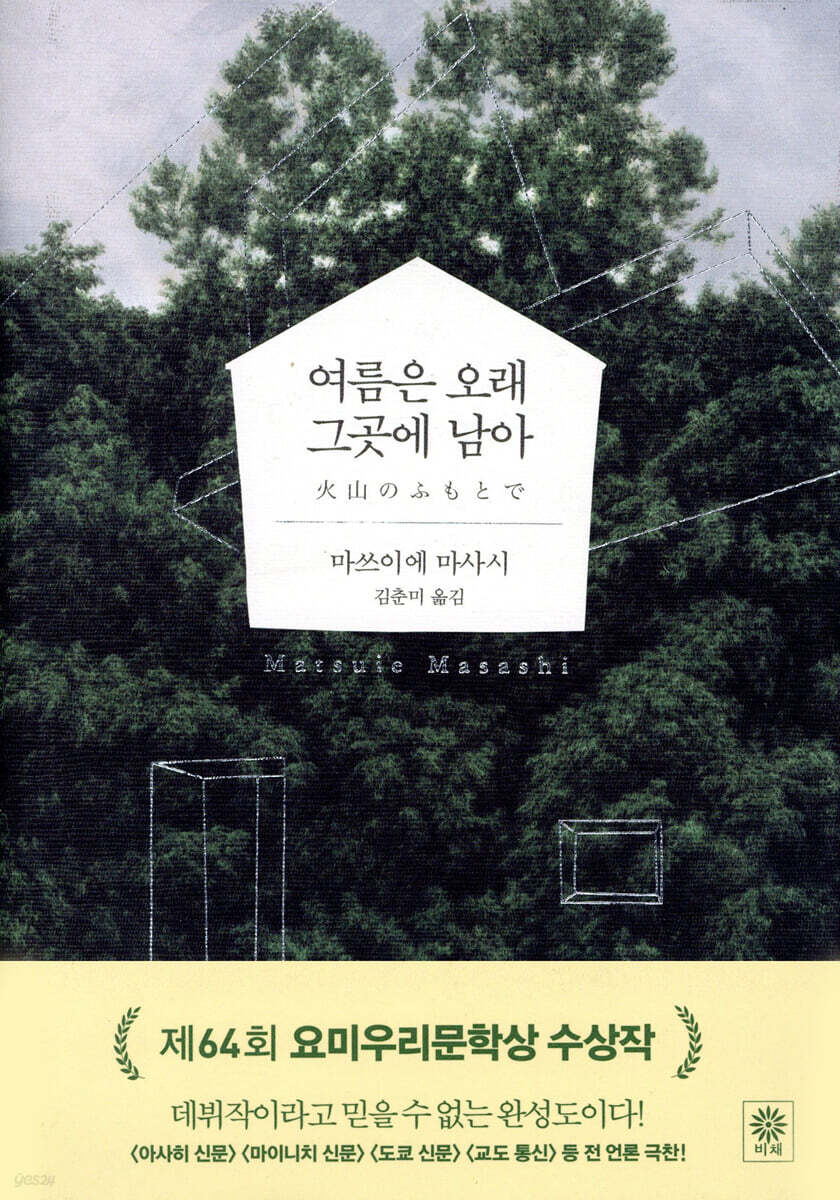
Summer lingers there for a long time
 |
Description
Book Introduction
Winner of the 64th Yomiuri Literary Award!
A surprising debut work by Masashi Matsuie, a new giant who continues the legacy of Japanese literature!
Is there any opening verse as beautiful as "As I came out of the long tunnel at the border, I found myself in a snowy land" (from Yasunari Kawabata's "Snow Country")?
Is there any sentence that is as immersive as Osamu Dazai's confessional, calm monologue?
A work that will remain in the history of modern Japanese literature has appeared, evaluated to have the powerful descriptions of Yasunari Kawabata, the deep thought of Osamu Dazai, the bold tenacity of Kenji Maruyama, and the stylish margins of Haruki Murakami.
The protagonist is "Summer Stays There for a Long Time" by Masashi Matsuie, a new and great writer who debuted as a late-blooming writer after leaving behind his long career as an editor.
This novel depicts a beautiful summer day between an old architect who pursues architecture that encourages humanity and promotes life, and a young man who follows him in awe.
With this work, Masashi Matsuie won the 64th Yomiuri Literary Award, which is awarded to works of high quality that will be loved by readers for a long time, such as Kenzaburo Oe's "Women Listening to the Rain Tree" and Haruki Murakami's "The Wind-Up Bird Chronicle." The work also ranked in the top 5 of "Kinobesu! 2013," a bestseller chart selected by the staff of Kinokuniya, a representative Japanese bookstore.
The moment you open "Summer Stays There for a Long Time," you will encounter a new realm of Japanese literature, starting with the first sentence, "At the summer villa, the teacher wakes up the earliest."
A surprising debut work by Masashi Matsuie, a new giant who continues the legacy of Japanese literature!
Is there any opening verse as beautiful as "As I came out of the long tunnel at the border, I found myself in a snowy land" (from Yasunari Kawabata's "Snow Country")?
Is there any sentence that is as immersive as Osamu Dazai's confessional, calm monologue?
A work that will remain in the history of modern Japanese literature has appeared, evaluated to have the powerful descriptions of Yasunari Kawabata, the deep thought of Osamu Dazai, the bold tenacity of Kenji Maruyama, and the stylish margins of Haruki Murakami.
The protagonist is "Summer Stays There for a Long Time" by Masashi Matsuie, a new and great writer who debuted as a late-blooming writer after leaving behind his long career as an editor.
This novel depicts a beautiful summer day between an old architect who pursues architecture that encourages humanity and promotes life, and a young man who follows him in awe.
With this work, Masashi Matsuie won the 64th Yomiuri Literary Award, which is awarded to works of high quality that will be loved by readers for a long time, such as Kenzaburo Oe's "Women Listening to the Rain Tree" and Haruki Murakami's "The Wind-Up Bird Chronicle." The work also ranked in the top 5 of "Kinobesu! 2013," a bestseller chart selected by the staff of Kinokuniya, a representative Japanese bookstore.
The moment you open "Summer Stays There for a Long Time," you will encounter a new realm of Japanese literature, starting with the first sentence, "At the summer villa, the teacher wakes up the earliest."
- You can preview some of the book's contents.
Preview
Into the book
Since it was the New Year, I decided to go to the office from the morning on Monday, Wednesday, and Saturday, excluding the days I had to go to school.
A desk was assigned to the far corner of the design room.
But there was no time to sit still.
Days went by as I learned the ropes by barely managing to do chores given to me by Mr. Uchida, who was twelve years older than me and was in charge of the education at the seat next to me.
Even if it was a chore, there was a reason for every detail, and everything was moving as rationally as possible.
After two or three weeks, it became clear that the work of Murai Design Office was being put together in a way that was as clear as a building perspective.
There were no unreasonable orders or wasted chores.
So, rather, I couldn't let my guard down.
In the architectural world of the early 1980s, which was somewhat chaotic, noisy, and windswept, your work was considered somewhat old-fashioned, inheriting the universal flow of tradition, but I didn't think so.
This is because a rationality that is difficult to call Japanese was applied to both office operations and architecture.
(…syncopation…)
“A bedroom that is not too large will help you calm your mind and sleep well.
I like it when the ceiling isn't too high.
“If the space up to the ceiling is too wide, there’s room for ghosts to wander around,” he said jokingly.
“I mean, between the bed and the wall.
When I wake up in the middle of the night and go to the bathroom, I like it to be within easy reach with just one hand.
Even if it's dark, you can still follow the wall to the door.
In the case of a dining kitchen, the smell of cooking is only pleasant until you start eating, and you start to dislike it as soon as you finish eating.
“The height of the kitchen ceiling, the location of the gas stove, and the ventilation duct are crucial factors in controlling odors.” It was similar to the secret recipe the craftsman shared.
--- pp.19-21
The 'Forest Crematorium' was completed in 1940.
Asplund was fifty-five years old.
As if someone had been waiting patiently for its completion, a sudden heart attack struck Asplund.
The architect's final work, which began as a 'forest graveyard', became a 'forest graveyard' as if the circle was closing.
Asplund was cremated in a crematorium of his own design and his ashes were buried in the Forest Cemetery.
Sketches for the 'Forest Crematorium' began a decade before its completion, and initially, an obelisk, rather than a cross, was planned to be erected near the entrance.
The obelisk was inscribed with the words, 'Today is me, tomorrow is you.'
The words Asplund wrote in his sketch for the 'Forest Chapel' were 'Today you, tomorrow me'.
When did 'I' and 'you' change?
--- pp.187-188
After the teacher poured milk into the black tea, he looked around at everyone and said.
The three people in charge of designing the modern library are Kawarazaki, Kobayashi, and Kasai.
Uchida, Nakao, and Sakanishi will be in charge of the furniture construction.
Hearing my name from the teacher's lips, I felt a renewed sense of recognition as a member of the Murai Design Firm.
You can't stay a new employee in an office of this size forever.
With a new oar in my hand that I wasn't very good at handling, and without a life jacket on, I started rowing the small boat.
If you keep looking sideways, you will quickly lose your balance.
The boat had somehow managed to leave the calm bay and was clumsily trying to move forward amidst the rolling waves of the vast ocean.
A desk was assigned to the far corner of the design room.
But there was no time to sit still.
Days went by as I learned the ropes by barely managing to do chores given to me by Mr. Uchida, who was twelve years older than me and was in charge of the education at the seat next to me.
Even if it was a chore, there was a reason for every detail, and everything was moving as rationally as possible.
After two or three weeks, it became clear that the work of Murai Design Office was being put together in a way that was as clear as a building perspective.
There were no unreasonable orders or wasted chores.
So, rather, I couldn't let my guard down.
In the architectural world of the early 1980s, which was somewhat chaotic, noisy, and windswept, your work was considered somewhat old-fashioned, inheriting the universal flow of tradition, but I didn't think so.
This is because a rationality that is difficult to call Japanese was applied to both office operations and architecture.
(…syncopation…)
“A bedroom that is not too large will help you calm your mind and sleep well.
I like it when the ceiling isn't too high.
“If the space up to the ceiling is too wide, there’s room for ghosts to wander around,” he said jokingly.
“I mean, between the bed and the wall.
When I wake up in the middle of the night and go to the bathroom, I like it to be within easy reach with just one hand.
Even if it's dark, you can still follow the wall to the door.
In the case of a dining kitchen, the smell of cooking is only pleasant until you start eating, and you start to dislike it as soon as you finish eating.
“The height of the kitchen ceiling, the location of the gas stove, and the ventilation duct are crucial factors in controlling odors.” It was similar to the secret recipe the craftsman shared.
--- pp.19-21
The 'Forest Crematorium' was completed in 1940.
Asplund was fifty-five years old.
As if someone had been waiting patiently for its completion, a sudden heart attack struck Asplund.
The architect's final work, which began as a 'forest graveyard', became a 'forest graveyard' as if the circle was closing.
Asplund was cremated in a crematorium of his own design and his ashes were buried in the Forest Cemetery.
Sketches for the 'Forest Crematorium' began a decade before its completion, and initially, an obelisk, rather than a cross, was planned to be erected near the entrance.
The obelisk was inscribed with the words, 'Today is me, tomorrow is you.'
The words Asplund wrote in his sketch for the 'Forest Chapel' were 'Today you, tomorrow me'.
When did 'I' and 'you' change?
--- pp.187-188
After the teacher poured milk into the black tea, he looked around at everyone and said.
The three people in charge of designing the modern library are Kawarazaki, Kobayashi, and Kasai.
Uchida, Nakao, and Sakanishi will be in charge of the furniture construction.
Hearing my name from the teacher's lips, I felt a renewed sense of recognition as a member of the Murai Design Firm.
You can't stay a new employee in an office of this size forever.
With a new oar in my hand that I wasn't very good at handling, and without a life jacket on, I started rowing the small boat.
If you keep looking sideways, you will quickly lose your balance.
The boat had somehow managed to leave the calm bay and was clumsily trying to move forward amidst the rolling waves of the vast ocean.
--- pp.214-215
Publisher's Review
“The charm of this book lies, first of all, in its clear and unhindered use of language.
The author describes in detail various buildings and various places—things that exist in our real world, not fictional ones in novels.
The language of description never ends with the language of explanation.
Those languages themselves become the process and result that enriches the novel.
The fresh breath felt in the sentences that are free from any unnecessary or insufficient parts in the task of description tells us that the protagonist's description of the teacher's work as 'a practical and timeless beauty that has nothing to do with showy desires' and 'every detail had a reason and everything worked as rationally as possible' is the author's own goal.
“The language used is all familiar to us, but when author Masashi Matsui combines it, it creates a reading experience that feels like a gentle caress.”
Hiromi Kawakami (novelist)
Important things are often spoken in such plain language that it's easy to miss them…
A long novel that resembles a building that is not influenced by the times, and a river that flows eternally!
The novel's protagonist and narrator, 'I', is a young man who has just graduated from the architecture department.
I have no intention of getting a job at a large general construction company, nor do I have any plans to go to graduate school.
The only place I want to go is the architectural design office of Mr. Murai, an architect I respect.
However, Director Murai, already in his seventies, had not responded to any applications from new and experienced recruits for several years.
I submitted my resume with my graduation project just in case, and somehow I was hired.
Both the senior at the office who delivered the news and I, who had been accepted, were puzzled, but it turned out to be part of the preparations for the massive project called the 'National Modern Library'.
Mr. Murai, whom I respect, pursues architecture that is simple and elegant, rather than overwhelmingly showy and flashy, spaces that don't stand out but blend in with their surroundings, and comfortable homes with devices scattered throughout that users only notice after a long time.
"Summer Stays There for a Long Time" contains the year or so that a new architect, "I," spent with Mr. Murai, and a day of "I" thirty years later.
People who dream of architecture that touches life, and the lonely days of that summer that they wish would last forever... ... A pure epic of youth unfolds, woven with endlessly concise sentences.
“This seemingly simple work is surprisingly rich in color, fragrance, and beauty.
Above all, it makes us realize that architecture, one of the necessities of life, is directly connected to our lives.
Every piece of furniture, every home appliance… … Like all fields, architecture also plays a role in enriching and making everyday life more comfortable.
And it is directly connected to the life attitude of an architect who constantly thinks and studies about what kind of house can provide the homeowner with spiritual rest, physical peace, and functionality and convenience at the same time.”
_Kim Chun-mi (translator)
A beautiful requiem for all who are lost!
Even if it is not realized like an unfinished blueprint, it is clear,
Something that is deeply engraved in someone's heart…
In "Summer Stays There for a Long Time," the dignified episodes of two masters who left their mark on the history of modern Japanese architecture, although they walked in different directions, are interestingly incorporated.
Mr. Murai seems to have modeled himself after Junzo Yoshimura, a Japanese architect who has received more attention in the United States.
Junzo Yoshimura, who brings to mind practical simplicity, is also the teacher of architect Kim Swoo-geun.
In addition, the prototype of the 'summer villa' can be guessed to be the 'house in the forest' actually built by Junzo Yoshimura in Karuizawa.
The Asukayama Church, which is the teacher's work that 'I' measured in the novel, can be said to be a reproduction of the 'Sanrizuka Church.'
Also, the architect 'Funayama', who is the teacher's rival and opposite, is reminiscent of 'Kenzo Tange', who designed the National Yoyogi Stadium and the Fuji TV Building.
In the work, after a competition, Funayama's splendid plan was adopted and realized as the National Library of Modern and Contemporary Art, but the author undoubtedly wanted to talk about Mr. Murai's architecture.
(The author actually entrusted the construction of his own house to a disciple of Junzo Yoshimura.) Borrowing from Professor Murai's plan for the National Modern Library, the author speaks respectfully about something that, even if it is not realized, is deeply imprinted in someone's heart as if it had been realized.
The meeting between 'I', a sincere young man who never has time to act rashly anywhere and anytime, and Mr. 'Murai', who has quietly walked the path of an architect with his own philosophy for many years, can only be described as the beauty of a hot and blue 'summer', even though it is known that it will end someday.
The author describes in detail various buildings and various places—things that exist in our real world, not fictional ones in novels.
The language of description never ends with the language of explanation.
Those languages themselves become the process and result that enriches the novel.
The fresh breath felt in the sentences that are free from any unnecessary or insufficient parts in the task of description tells us that the protagonist's description of the teacher's work as 'a practical and timeless beauty that has nothing to do with showy desires' and 'every detail had a reason and everything worked as rationally as possible' is the author's own goal.
“The language used is all familiar to us, but when author Masashi Matsui combines it, it creates a reading experience that feels like a gentle caress.”
Hiromi Kawakami (novelist)
Important things are often spoken in such plain language that it's easy to miss them…
A long novel that resembles a building that is not influenced by the times, and a river that flows eternally!
The novel's protagonist and narrator, 'I', is a young man who has just graduated from the architecture department.
I have no intention of getting a job at a large general construction company, nor do I have any plans to go to graduate school.
The only place I want to go is the architectural design office of Mr. Murai, an architect I respect.
However, Director Murai, already in his seventies, had not responded to any applications from new and experienced recruits for several years.
I submitted my resume with my graduation project just in case, and somehow I was hired.
Both the senior at the office who delivered the news and I, who had been accepted, were puzzled, but it turned out to be part of the preparations for the massive project called the 'National Modern Library'.
Mr. Murai, whom I respect, pursues architecture that is simple and elegant, rather than overwhelmingly showy and flashy, spaces that don't stand out but blend in with their surroundings, and comfortable homes with devices scattered throughout that users only notice after a long time.
"Summer Stays There for a Long Time" contains the year or so that a new architect, "I," spent with Mr. Murai, and a day of "I" thirty years later.
People who dream of architecture that touches life, and the lonely days of that summer that they wish would last forever... ... A pure epic of youth unfolds, woven with endlessly concise sentences.
“This seemingly simple work is surprisingly rich in color, fragrance, and beauty.
Above all, it makes us realize that architecture, one of the necessities of life, is directly connected to our lives.
Every piece of furniture, every home appliance… … Like all fields, architecture also plays a role in enriching and making everyday life more comfortable.
And it is directly connected to the life attitude of an architect who constantly thinks and studies about what kind of house can provide the homeowner with spiritual rest, physical peace, and functionality and convenience at the same time.”
_Kim Chun-mi (translator)
A beautiful requiem for all who are lost!
Even if it is not realized like an unfinished blueprint, it is clear,
Something that is deeply engraved in someone's heart…
In "Summer Stays There for a Long Time," the dignified episodes of two masters who left their mark on the history of modern Japanese architecture, although they walked in different directions, are interestingly incorporated.
Mr. Murai seems to have modeled himself after Junzo Yoshimura, a Japanese architect who has received more attention in the United States.
Junzo Yoshimura, who brings to mind practical simplicity, is also the teacher of architect Kim Swoo-geun.
In addition, the prototype of the 'summer villa' can be guessed to be the 'house in the forest' actually built by Junzo Yoshimura in Karuizawa.
The Asukayama Church, which is the teacher's work that 'I' measured in the novel, can be said to be a reproduction of the 'Sanrizuka Church.'
Also, the architect 'Funayama', who is the teacher's rival and opposite, is reminiscent of 'Kenzo Tange', who designed the National Yoyogi Stadium and the Fuji TV Building.
In the work, after a competition, Funayama's splendid plan was adopted and realized as the National Library of Modern and Contemporary Art, but the author undoubtedly wanted to talk about Mr. Murai's architecture.
(The author actually entrusted the construction of his own house to a disciple of Junzo Yoshimura.) Borrowing from Professor Murai's plan for the National Modern Library, the author speaks respectfully about something that, even if it is not realized, is deeply imprinted in someone's heart as if it had been realized.
The meeting between 'I', a sincere young man who never has time to act rashly anywhere and anytime, and Mr. 'Murai', who has quietly walked the path of an architect with his own philosophy for many years, can only be described as the beauty of a hot and blue 'summer', even though it is known that it will end someday.
GOODS SPECIFICS
- Date of publication: August 19, 2016
- Format: Hardcover book binding method guide
- Page count, weight, size: 432 pages | 584g | 137*210*36mm
- ISBN13: 9788934972204
- ISBN10: 8934972203
You may also like
카테고리
korean


korean

![GQ KOREA Mark (Monthly): December [2025]](http://librairie.coreenne.fr/cdn/shop/files/8ef265dbbfbf186523ed75ba7319009d.jpg?v=1765340328&width=3840)


