

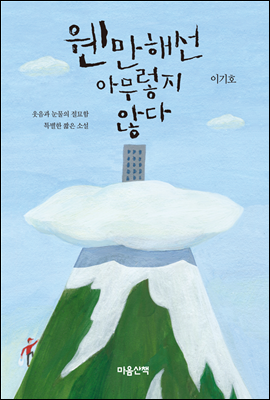
It's usually okay
 |
Description
Book Introduction
A lively writing style, engaging characters, and a sharp narrative that captures the times.
A delicate blend of laughter and tears: 40 short stories by author Lee Ki-ho.
"Among the many delights offered by literature in the 2000s, this is one of the most 'conceptual' delights (literary critic Shin Hyeong-cheol)."
"Do you want to laugh or cry? Then read 'Lee Ki-ho' (Novelist Park Beom-shin)."
"Lee Ki-ho's novels resonate with the sound of a heartbeat (poet Ham Min-bok)"
He has continued his storytelling career with honesty, without any fancy packaging or clever lies.
Even though it has been over 15 years since his debut, he is still trusted as a unique storyteller with a new sensibility without any signs of fatigue or exhaustion.
Since his emergence in the 2000s, author Lee Ki-ho has created his own world of tragicomedy.
His special short stories are collected in one volume.
A delicate blend of laughter and tears: 40 short stories by author Lee Ki-ho.
"Among the many delights offered by literature in the 2000s, this is one of the most 'conceptual' delights (literary critic Shin Hyeong-cheol)."
"Do you want to laugh or cry? Then read 'Lee Ki-ho' (Novelist Park Beom-shin)."
"Lee Ki-ho's novels resonate with the sound of a heartbeat (poet Ham Min-bok)"
He has continued his storytelling career with honesty, without any fancy packaging or clever lies.
Even though it has been over 15 years since his debut, he is still trusted as a unique storyteller with a new sensibility without any signs of fatigue or exhaustion.
Since his emergence in the 2000s, author Lee Ki-ho has created his own world of tragicomedy.
His special short stories are collected in one volume.
- You can preview some of the book's contents.
Preview
index
Author's Note
One year for us, seven years for someone else
The reason cherry blossoms fall
Come down to the low place
Lovers at the Zoo
Tain virus
Wife's room
One afternoon I met her
Beach Boys
To a friend who is running for office
Midnight Highway
My Husband's Double Life
One year for us, seven years for someone else
Please date
bed
The night before the ancestral rite
Aaaah
Moments when the lights turn on
Run, son
That's what I mean
Midnight Jump
fugitive
You are Kafka, I am Januch
Apartment Sherpa
Just wait and see
It's not as easy as it sounds
Croak croak
smiling bride
Aaaah
Born on May 8th
Can't you take a break?
Super Easy Tortilla Toast Recipe
Speak with your eyes
Can't you take a break?
spring rain
What kind of consultation
Two hands clasped together
You don't have to try hard anymore
Obsessed Man
Saying it's useless
The Last Smoker
Who is this
David Lodge's Year-End Diary
Before and after moving in
One year for us, seven years for someone else
The reason cherry blossoms fall
Come down to the low place
Lovers at the Zoo
Tain virus
Wife's room
One afternoon I met her
Beach Boys
To a friend who is running for office
Midnight Highway
My Husband's Double Life
One year for us, seven years for someone else
Please date
bed
The night before the ancestral rite
Aaaah
Moments when the lights turn on
Run, son
That's what I mean
Midnight Jump
fugitive
You are Kafka, I am Januch
Apartment Sherpa
Just wait and see
It's not as easy as it sounds
Croak croak
smiling bride
Aaaah
Born on May 8th
Can't you take a break?
Super Easy Tortilla Toast Recipe
Speak with your eyes
Can't you take a break?
spring rain
What kind of consultation
Two hands clasped together
You don't have to try hard anymore
Obsessed Man
Saying it's useless
The Last Smoker
Who is this
David Lodge's Year-End Diary
Before and after moving in
Detailed image
Publisher's Review
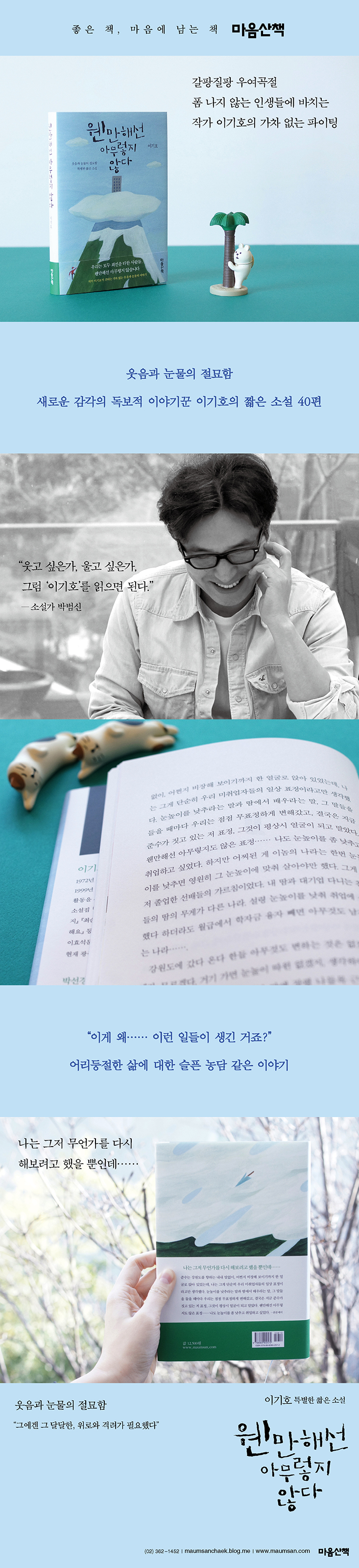
A lively writing style, engaging characters, and a sharp narrative that captures the times.
A delicate blend of laughter and tears: 40 short stories by author Lee Ki-ho.
“Among the many pleasures offered by literature in the 2000s, this is one of the most ‘conceptual’ pleasures (literary critic Shin Hyeong-cheol)” “Do you want to laugh or cry? Then read ‘Lee Ki-ho’ (novelist Park Beom-shin)” “You can hear the sound of a heartbeat in Lee Ki-ho’s novels (poet Ham Min-bok)”.
He has continued his storytelling career with honesty, without any fancy packaging or clever lies.
Even though it has been over 15 years since his debut, he is still trusted as a unique storyteller with a new sensibility without any signs of fatigue or exhaustion.
Since his emergence in the 2000s, author Lee Ki-ho has created his own world of tragicomedy.
His special short stories are collected in one volume.
This book is the third in the Mind Walk short story series, following Park Wan-seo's "Three Wishes" and Jeong I-hyeon's "A Good Person, So to Speak." It is a collection of stories shorter than short stories, but the aftertaste is even longer.
It presents a compact and dense writing style that is easy to read anywhere.
These short stories are enjoyable to read and offer profound insights, making them a good read for reflection, as if they recreate the depth of Yasunari Kawabata's palm-length novels.
Among the short stories serialized in daily newspapers, the author personally selected 40 pieces with great affection, and reworked them into a collection that is no less in scale and weight than a typical novel.
"It's okay if you try hard" is a story that resonates with all of us today, where the question of how to live in an unstable reality that doesn't improve no matter how hard we try has become the most important question for each individual.
The author calls out to ordinary people who are struggling and struggling with many twists and turns, not people who are flashy or sophisticated, but people who have done their best and faced certain moments.
The 'difficult times' of these honest and upright people are brought to life with their own unique sadness and humor.
The stories of 'people who are usually okay', called 'stories that are usually okay'.
The story of 'us', who have been failing to find a job after graduating from college and are turning into 'almost indifferent faces', and how they are about to ship cabbages from a field in Gangwon-do; the ending of 'he', who has never had a girlfriend until he is 30, his first date at the zoo; the moment when a man who has lost his wife and child in an accident and cannot sleep in his bed at home finally sheds hot tears in bed; the honest feelings of a wife who sees her husband's double life living as a 'cool guy' in the world of social media; one night when 'I', who is attempting suicide at a highway 'rest stop', ends up spending it with a suspicious man; what a father says to Byul after running away to the mountains to stay overnight to avoid his wife because of his credit card bill; what happens on the day a man who has become increasingly isolated from the world and shut himself in at home goes out for the first time in years... ... These are the 'embarrassing' moments faced by those who have all lived their best lives but have come to realize that life is not as easy as they wish.
But these moments, which are 'normally insignificant', do not mean resignation or self-mockery to them, but rather a positive attitude that willingly accepts the inexplicable pain of life.
There is no impurity in sincere affirmation of things that cannot be helped, rather than blind affirmation.
In this way, the author consoles all the 'amateurs' of the world who are usually indifferent.
Full of humor.
This book adds to the pleasure of viewing illustrator Park Seon-gyeong's illustrations.
Park Seon-kyung has actively participated in various exhibitions, including the Haebangchon Studio Opening Exhibition, and has made her presence felt by having her illustrations featured in numerous books.
The 18 witty illustrations that stimulate the imagination maximize the book's appeal in and of themselves.
“Why is this happening…?”
A sad, joke-like story about a bewildered life
All of the people who appear in the 40 stories are ordinary people who are forced into helpless situations.
Even in the midst of difficult situations that you cannot do anything about, accept the situation honestly and honestly.
This is a deep consolation for our 'sad and funny' life story, full of twists and turns.
“Do you think this is a world where you can get a job just by setting your mind to it?” shouts Junsu in “Go to a Low Place” and takes me, another unemployed person, to Gangwon-do as a “bait” to get business funds from my parents, but I end up being mobilized to ship cabbages.
Junsu sat silently the entire way to Gangwon-do, his face looking almost solemn, but I just assumed it was the everyday expression of us unemployed people.
Every time we heard the words, "Lower your gaze," and "Learn from sweat," we became more and more expressionless, and eventually, the expression Junsu is making now became his normal face.
An expression that is usually indifferent... I also wanted to lower my standards and get a job.
But somehow, in this country, once you lower your standards, you have to live at those standards forever.
That was the teaching of the seniors who graduated first.
A country where the weight of my sweat and the sweat of my friends working at large corporations are different.
Even if you lower your expectations and succeed in getting a job, this is a country where you have nothing left after subtracting student loans from your salary…
Even if I go to Gangwon-do, nothing will change, but, hey, I don't know, there won't be any eye level there, I thought, closing my eyes.
―From “Come to a Low Place”
In "The Fugitive," he runs away to the hill behind his apartment to escape his scary wife who is angry at him for the credit card bill and ends up sleeping rough.
He was so frightened by his wife's constant barrage of text messages that he ended up buying camping gear and spending the fourth night in the mountains.
In his sleeping bag, he quietly gazed at the stars.
It would be nice to have stars, not having to worry about card bills… … .
He muttered to himself like that for no reason.
The moonlight was soft, and the surroundings were surprisingly quiet.
The cell phone battery had been dead for a long time.
He remembered the last text his wife had sent him.
“Just come back, you can do better starting next month.
“I have to go on a field trip with my youngest child tomorrow.” He closed his eyes for a moment and then looked at the moon.
Then he muttered to himself again.
The moon is nice, next month will be just another moon… … .
He then curled up tightly in his sleeping bag.
Slowly, I felt like I was falling asleep.
―From “The Fugitive”
These works, which depict the difficult moments faced by everyday people who are simply trying to “do something again,” with the author’s characteristic wit and pathos, evoke sufficient immersion and empathy despite being less than 15 pages long.
Each story, paired with witty illustrations, is a message of encouragement for the most ordinary people.
“He needed that sweet, comforting encouragement.”
A warm consolation for a life that must be endured despite all this
For those who live with the loneliness that comes from the death or absence of someone close to them, or for those who must live as unemployed contract workers and marginalized members of society, life is not as 'easy as it sounds.'
These short stories, which capture the moments in each person's life that must be endured, truly shine through the author's sharp yet warm gaze and voice.
In "Ahhhhhhh," the "child" and the child's father, "he," wait for the mother to go into labor and scream together whenever they hear her scream, showing an exquisite scene of life where laughter and tears intersect.
People who face birth and death equally.
In this way, we come to realize once again that we are enduring this world that we know but do not know as ‘people who are usually okay’ and ‘people who are okay enough’.
With such selfish tears and laughter.
The child, whose cheeks were red from crying, stopped crying as soon as he saw his facial expression.
Aaaah.
It seemed that only then did the child realize that his mother's voice from the delivery room was just a joke.
He continued to scream without stopping, laughing.
Aaaah.
We are beings born in pain without you.
Aaaah.
He screamed and spoke his heart out to the child.
Only after suffering is one given a family name.
Aaaah.
That's why they say that when you hear the word 'family', tears come out.
He kept screaming and replaying it.
Aaaah.
He really looked like he was going to cry.
Still, I held it in and looked at the child, screaming for a long time.
Aaaah.
―From "Ahhhhh"
A delicate blend of laughter and tears: 40 short stories by author Lee Ki-ho.
“Among the many pleasures offered by literature in the 2000s, this is one of the most ‘conceptual’ pleasures (literary critic Shin Hyeong-cheol)” “Do you want to laugh or cry? Then read ‘Lee Ki-ho’ (novelist Park Beom-shin)” “You can hear the sound of a heartbeat in Lee Ki-ho’s novels (poet Ham Min-bok)”.
He has continued his storytelling career with honesty, without any fancy packaging or clever lies.
Even though it has been over 15 years since his debut, he is still trusted as a unique storyteller with a new sensibility without any signs of fatigue or exhaustion.
Since his emergence in the 2000s, author Lee Ki-ho has created his own world of tragicomedy.
His special short stories are collected in one volume.
This book is the third in the Mind Walk short story series, following Park Wan-seo's "Three Wishes" and Jeong I-hyeon's "A Good Person, So to Speak." It is a collection of stories shorter than short stories, but the aftertaste is even longer.
It presents a compact and dense writing style that is easy to read anywhere.
These short stories are enjoyable to read and offer profound insights, making them a good read for reflection, as if they recreate the depth of Yasunari Kawabata's palm-length novels.
Among the short stories serialized in daily newspapers, the author personally selected 40 pieces with great affection, and reworked them into a collection that is no less in scale and weight than a typical novel.
"It's okay if you try hard" is a story that resonates with all of us today, where the question of how to live in an unstable reality that doesn't improve no matter how hard we try has become the most important question for each individual.
The author calls out to ordinary people who are struggling and struggling with many twists and turns, not people who are flashy or sophisticated, but people who have done their best and faced certain moments.
The 'difficult times' of these honest and upright people are brought to life with their own unique sadness and humor.
The stories of 'people who are usually okay', called 'stories that are usually okay'.
The story of 'us', who have been failing to find a job after graduating from college and are turning into 'almost indifferent faces', and how they are about to ship cabbages from a field in Gangwon-do; the ending of 'he', who has never had a girlfriend until he is 30, his first date at the zoo; the moment when a man who has lost his wife and child in an accident and cannot sleep in his bed at home finally sheds hot tears in bed; the honest feelings of a wife who sees her husband's double life living as a 'cool guy' in the world of social media; one night when 'I', who is attempting suicide at a highway 'rest stop', ends up spending it with a suspicious man; what a father says to Byul after running away to the mountains to stay overnight to avoid his wife because of his credit card bill; what happens on the day a man who has become increasingly isolated from the world and shut himself in at home goes out for the first time in years... ... These are the 'embarrassing' moments faced by those who have all lived their best lives but have come to realize that life is not as easy as they wish.
But these moments, which are 'normally insignificant', do not mean resignation or self-mockery to them, but rather a positive attitude that willingly accepts the inexplicable pain of life.
There is no impurity in sincere affirmation of things that cannot be helped, rather than blind affirmation.
In this way, the author consoles all the 'amateurs' of the world who are usually indifferent.
Full of humor.
This book adds to the pleasure of viewing illustrator Park Seon-gyeong's illustrations.
Park Seon-kyung has actively participated in various exhibitions, including the Haebangchon Studio Opening Exhibition, and has made her presence felt by having her illustrations featured in numerous books.
The 18 witty illustrations that stimulate the imagination maximize the book's appeal in and of themselves.
“Why is this happening…?”
A sad, joke-like story about a bewildered life
All of the people who appear in the 40 stories are ordinary people who are forced into helpless situations.
Even in the midst of difficult situations that you cannot do anything about, accept the situation honestly and honestly.
This is a deep consolation for our 'sad and funny' life story, full of twists and turns.
“Do you think this is a world where you can get a job just by setting your mind to it?” shouts Junsu in “Go to a Low Place” and takes me, another unemployed person, to Gangwon-do as a “bait” to get business funds from my parents, but I end up being mobilized to ship cabbages.
Junsu sat silently the entire way to Gangwon-do, his face looking almost solemn, but I just assumed it was the everyday expression of us unemployed people.
Every time we heard the words, "Lower your gaze," and "Learn from sweat," we became more and more expressionless, and eventually, the expression Junsu is making now became his normal face.
An expression that is usually indifferent... I also wanted to lower my standards and get a job.
But somehow, in this country, once you lower your standards, you have to live at those standards forever.
That was the teaching of the seniors who graduated first.
A country where the weight of my sweat and the sweat of my friends working at large corporations are different.
Even if you lower your expectations and succeed in getting a job, this is a country where you have nothing left after subtracting student loans from your salary…
Even if I go to Gangwon-do, nothing will change, but, hey, I don't know, there won't be any eye level there, I thought, closing my eyes.
―From “Come to a Low Place”
In "The Fugitive," he runs away to the hill behind his apartment to escape his scary wife who is angry at him for the credit card bill and ends up sleeping rough.
He was so frightened by his wife's constant barrage of text messages that he ended up buying camping gear and spending the fourth night in the mountains.
In his sleeping bag, he quietly gazed at the stars.
It would be nice to have stars, not having to worry about card bills… … .
He muttered to himself like that for no reason.
The moonlight was soft, and the surroundings were surprisingly quiet.
The cell phone battery had been dead for a long time.
He remembered the last text his wife had sent him.
“Just come back, you can do better starting next month.
“I have to go on a field trip with my youngest child tomorrow.” He closed his eyes for a moment and then looked at the moon.
Then he muttered to himself again.
The moon is nice, next month will be just another moon… … .
He then curled up tightly in his sleeping bag.
Slowly, I felt like I was falling asleep.
―From “The Fugitive”
These works, which depict the difficult moments faced by everyday people who are simply trying to “do something again,” with the author’s characteristic wit and pathos, evoke sufficient immersion and empathy despite being less than 15 pages long.
Each story, paired with witty illustrations, is a message of encouragement for the most ordinary people.
“He needed that sweet, comforting encouragement.”
A warm consolation for a life that must be endured despite all this
For those who live with the loneliness that comes from the death or absence of someone close to them, or for those who must live as unemployed contract workers and marginalized members of society, life is not as 'easy as it sounds.'
These short stories, which capture the moments in each person's life that must be endured, truly shine through the author's sharp yet warm gaze and voice.
In "Ahhhhhhh," the "child" and the child's father, "he," wait for the mother to go into labor and scream together whenever they hear her scream, showing an exquisite scene of life where laughter and tears intersect.
People who face birth and death equally.
In this way, we come to realize once again that we are enduring this world that we know but do not know as ‘people who are usually okay’ and ‘people who are okay enough’.
With such selfish tears and laughter.
The child, whose cheeks were red from crying, stopped crying as soon as he saw his facial expression.
Aaaah.
It seemed that only then did the child realize that his mother's voice from the delivery room was just a joke.
He continued to scream without stopping, laughing.
Aaaah.
We are beings born in pain without you.
Aaaah.
He screamed and spoke his heart out to the child.
Only after suffering is one given a family name.
Aaaah.
That's why they say that when you hear the word 'family', tears come out.
He kept screaming and replaying it.
Aaaah.
He really looked like he was going to cry.
Still, I held it in and looked at the child, screaming for a long time.
Aaaah.
―From "Ahhhhh"
GOODS SPECIFICS
- Date of publication: February 25, 2016
- Format: Hardcover book binding method guide
- Page count, weight, size: 252 pages | 390g | 128*185*20mm
- ISBN13: 9788960902572
- ISBN10: 8960902578
You may also like
카테고리
korean


korean

![GQ KOREA Mark (Monthly): December [2025]](http://librairie.coreenne.fr/cdn/shop/files/8ef265dbbfbf186523ed75ba7319009d.jpg?v=1765340328&width=3840)


