

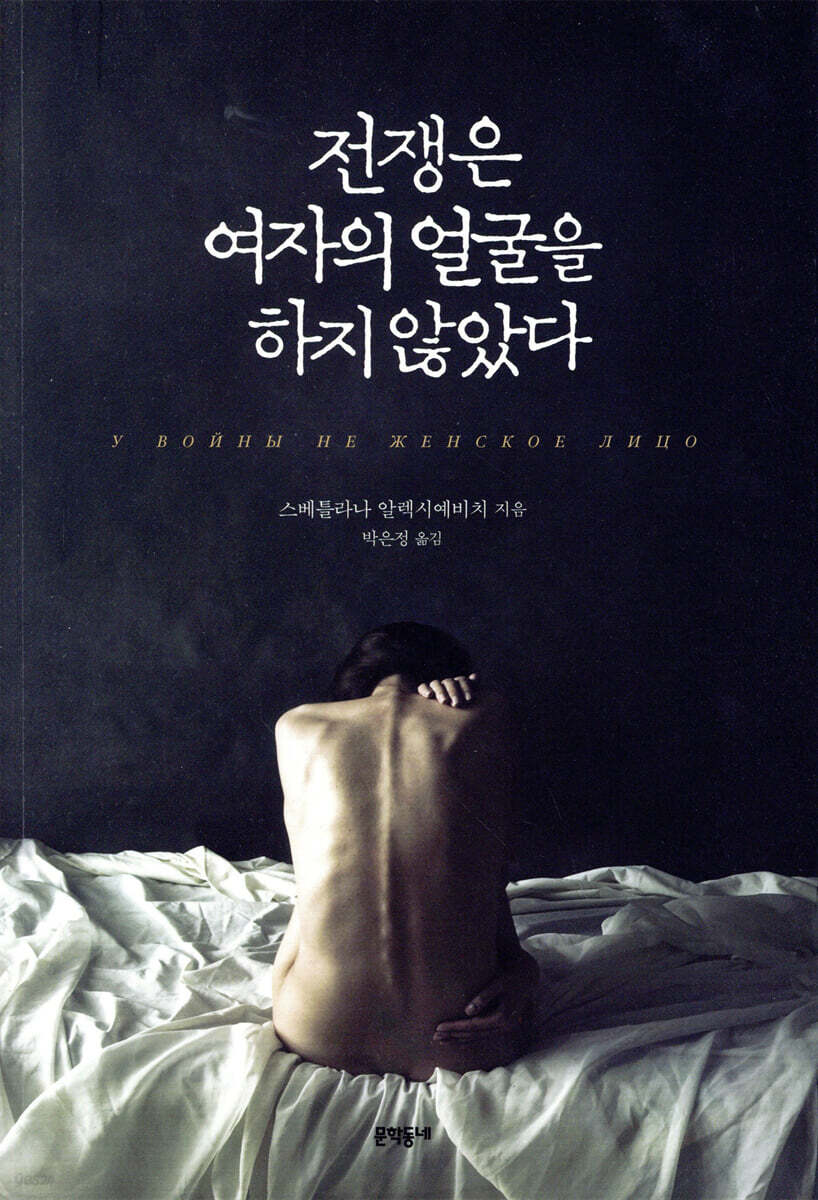
War has no woman's face
 |
Description
Book Introduction
Winner of the 2015 Nobel Prize in Literature! The voices of over 200 women who directly participated in and survived the war. Completed with the tears and screams of those who were forced into silence A monumental masterpiece of war literature “I feel sorry for the people who will read this book. I feel sorry for those who don't read it, I just feel bad for everyone… … ” The book “The Unwomanly Face of War” by Belarusian journalist and writer Svetlana Alexievich, winner of the 2015 Nobel Prize in Literature, has been published by Munhakdongne. Svetlana Alexievich is neither a novelist nor a poet. However, he created his own unique literary genre. It is a genre called 'Novels of Voices', which the author himself calls 'novel-chorus'. Although the story is compiled from interviews with hundreds of people over many years and written in the format of general non-fiction rather than Q&A, it is evaluated as documentary prose with a strong charm that reads like a novel, and prose that feels soulful. During World War II, over a million women fought in the war. But I can't remember the names or faces of any of them. This book is a collection of stories from about 200 women who participated in the war. Women fought in the war, becoming snipers, driving tanks, and working in hospitals, but their stories are not part of the war. What happened to the women who lived through the war? How did they change after the war, and what was it like learning how to kill? Almost all of the women who speak in this book speak for the first time about their experiences of war. The war memoirs told by women are stories that have been completely excluded from the war memoirs told by veteran soldiers or men. |
- You can preview some of the book's contents.
Preview
index
People are more precious than war (from the diary) _11
1978~1985 _13
17 years later 2002-2004 _37
_41 from content deleted by publication censorship authorities
In a conversation with a publication censor _44
In the story I erased _51
I don't even want to think about that _61
Come on, kids, you're still young. _87
On Oaths and Prayers _91
About the Smell of Fear and the Candy Bag _110
On Daily Life and Existence _137
I Alone Came Back to Mom _159
Two Wars Live in Our House _189
The phone doesn't shoot people _203
We got a small medal _225
About the Doll and the Rifle _233
On Death and the Surprise in the Face of Death _239
About Horses and Birds _245
That Wasn't Me _253
I still can't forget those eyes _269
We didn't shoot _297
About the shorts and the damn wooden leg _300
About the special soap 'K' and Youngchang _310
About melted bearings and Russian baths _322
I need a soldier. I still want to be prettier. _335
About Men's Boots and Women's Hats _337
On the Lady's High Notes and the Marine's Superstitions _353
On the Silence of Horror and the Beauty of Fiction _366
Ladies! You know that the engineer commander has only two months left to live, right? _371
If I could see you just once _391
About the Damned Woman and the May Rose _396
About the Strange Stillness Before the Sky and the Lost Ring _413
On Bullets and Human Loneliness _427
About Seed Potatoes _433
About the Mines Basket and the Velvet Toy _438
About Mom and Dad _454
On Small Lives and Great Ideas _464
Mom, what is 'Dad'? _477
About a Child's Bath, and About a Mother Who Takes After Her Father _479
About Little Red Riding Hood and the Joy of Meeting a Cat on the Battlefield _492
On the Silence of Those Who Can Now Speak _503
And she put her hand where her heart was _509
On the End of War, When Murder Became Abominable _511
On Childish, Flawless Writing and Comedy _524
On the Motherland, Stalin, and Red Karakter _531
I suddenly wanted to live like crazy _539
Translator's Note: The voices of women who survived the ugliest and most brutal depths of humanity.
_555
1978~1985 _13
17 years later 2002-2004 _37
_41 from content deleted by publication censorship authorities
In a conversation with a publication censor _44
In the story I erased _51
I don't even want to think about that _61
Come on, kids, you're still young. _87
On Oaths and Prayers _91
About the Smell of Fear and the Candy Bag _110
On Daily Life and Existence _137
I Alone Came Back to Mom _159
Two Wars Live in Our House _189
The phone doesn't shoot people _203
We got a small medal _225
About the Doll and the Rifle _233
On Death and the Surprise in the Face of Death _239
About Horses and Birds _245
That Wasn't Me _253
I still can't forget those eyes _269
We didn't shoot _297
About the shorts and the damn wooden leg _300
About the special soap 'K' and Youngchang _310
About melted bearings and Russian baths _322
I need a soldier. I still want to be prettier. _335
About Men's Boots and Women's Hats _337
On the Lady's High Notes and the Marine's Superstitions _353
On the Silence of Horror and the Beauty of Fiction _366
Ladies! You know that the engineer commander has only two months left to live, right? _371
If I could see you just once _391
About the Damned Woman and the May Rose _396
About the Strange Stillness Before the Sky and the Lost Ring _413
On Bullets and Human Loneliness _427
About Seed Potatoes _433
About the Mines Basket and the Velvet Toy _438
About Mom and Dad _454
On Small Lives and Great Ideas _464
Mom, what is 'Dad'? _477
About a Child's Bath, and About a Mother Who Takes After Her Father _479
About Little Red Riding Hood and the Joy of Meeting a Cat on the Battlefield _492
On the Silence of Those Who Can Now Speak _503
And she put her hand where her heart was _509
On the End of War, When Murder Became Abominable _511
On Childish, Flawless Writing and Comedy _524
On the Motherland, Stalin, and Red Karakter _531
I suddenly wanted to live like crazy _539
Translator's Note: The voices of women who survived the ugliest and most brutal depths of humanity.
_555
Publisher's Review
The voices of over 200 women who directly participated in and survived the war.
Completed with the tears and screams of those who were forced into silence
A monumental masterpiece of war literature
The book “The Unwomanly Face of War” by Belarusian journalist and writer Svetlana Alexievich, winner of the 2015 Nobel Prize in Literature, has been published by Munhakdongne.
Svetlana Alexievich is neither a novelist nor a poet.
However, he created his own unique literary genre.
It is a genre called 'Novels of Voices', which the author himself calls 'novel-chorus'.
Although the story is compiled from interviews with hundreds of people over many years and written in the format of general non-fiction rather than Q&A, it is evaluated as documentary prose with a strong charm that reads like a novel, and prose that feels soulful.
During World War II, over a million women fought in the war.
But I can't remember the names or faces of any of them.
This book is a collection of stories from about 200 women who participated in the war.
Women fought in the war, becoming snipers, driving tanks, and working in hospitals, but their stories are not part of the war.
What happened to the women who lived through the war? How did they change after the war, and what was it like learning how to kill?
Almost all of the women who speak in this book speak for the first time about their experiences of war.
The war memoirs told by women are stories that have been completely excluded from the war memoirs told by veteran soldiers or men.
Women speak of the ugly and cruel face of war, hunger, sexual violence, their anger, and the shadow of death that still lingers…
This book was first published in 1985, and in 2002 the author republished it with additional parts that had been censored.
The 200 or so women interviewed by the author who had either fought in the war or witnessed it tell us a different story.
They do not speak of lofty ideals, victory, defeat, strategy, or heroes.
It simply tells the story of ordinary people who face the harsh fate of war, the story of our lives.
Even on the battlefield, women were still innocent girls, young ladies who wanted to look pretty, and mothers whose hearts were burning with thought for their children.
A girl who cried after killing a person for the first time, a girl whose legs were crippled by enemy bullets on the day of her first period, a girl whose hair turned white at the age of nineteen on the battlefield, a girl who naturally spent all her money on candy on the day she volunteered to go to war, a woman who couldn't pass a flower shop because she couldn't see the color red even after the war was over, a mother who didn't recognize her daughter who returned from the battlefield and treated her as a guest, an old mother who prayed day and night for her daughter to return alive even after receiving her daughter's death notice...
As we follow the women's stories, we meet people with warm blood and a beating pulse, and encounter lives in the midst of a battlefield where death hovers.
Our ordinary and innocent younger sisters and older sisters or older sisters and mothers.
Their daily lives, dreams, and loves were shattered by war.
That's why war is more brutal and scary.
Without any loud slogans or grand speeches, the women quietly denounce the horrors of war and make us reflect on who the war is for.
_From the translator's note
This book talks about women's war.
The war stories men don't tell us, the true face of war.
We have never known such a war.
Men talk about their victories, exploits, and achievements in war, about battles on the front lines, and about commanders and soldiers, but women talk about something entirely different.
Even on the battlefield, women see people, feel everyday life, and notice the ordinary.
It speaks of the fear and despair of killing someone for the first time, or the horror and devastation of walking through a field strewn with corpses after a battle.
There are also stories of first menstrual bleeding on the battlefield and love blossoming on the front lines.
All the warriors in their eyes are young or underage soldiers.
Both the enemy German soldiers and the friendly Russian soldiers are pitiful.
Even after the war is over, another war awaits women.
Women were forced to hide books documenting the war and documents about the wounded.
Because I had to go back to being a pretty woman, wearing high heels, and preparing for marriage.
Men have forgotten and betrayed the women who were their comrades.
He stole and monopolized the victory he had achieved with his female comrades.
So, the women's war was forgotten.
Women's place is in the home, where they give birth to children and take care of their families, but World War II, the most horrific war in human history, sent women, even young girls, to the battlefield.
In the name of their country and family, women had to take up arms and fight on the front lines just like men.
The author compiled the stories of over 200 women who directly participated in or witnessed the war into this one book.
Their desperate and heartbreaking stories are told in their vivid voices without any exaggeration.
Each of their stories has the impact of 200 novels.
The protagonists of each story, who were ordinary girls and young ladies, all begin their stories calmly, but in the end, they shed tears and scream in pain at that time.
Completed with the tears and screams of those who were forced into silence
A monumental masterpiece of war literature
The book “The Unwomanly Face of War” by Belarusian journalist and writer Svetlana Alexievich, winner of the 2015 Nobel Prize in Literature, has been published by Munhakdongne.
Svetlana Alexievich is neither a novelist nor a poet.
However, he created his own unique literary genre.
It is a genre called 'Novels of Voices', which the author himself calls 'novel-chorus'.
Although the story is compiled from interviews with hundreds of people over many years and written in the format of general non-fiction rather than Q&A, it is evaluated as documentary prose with a strong charm that reads like a novel, and prose that feels soulful.
During World War II, over a million women fought in the war.
But I can't remember the names or faces of any of them.
This book is a collection of stories from about 200 women who participated in the war.
Women fought in the war, becoming snipers, driving tanks, and working in hospitals, but their stories are not part of the war.
What happened to the women who lived through the war? How did they change after the war, and what was it like learning how to kill?
Almost all of the women who speak in this book speak for the first time about their experiences of war.
The war memoirs told by women are stories that have been completely excluded from the war memoirs told by veteran soldiers or men.
Women speak of the ugly and cruel face of war, hunger, sexual violence, their anger, and the shadow of death that still lingers…
This book was first published in 1985, and in 2002 the author republished it with additional parts that had been censored.
The 200 or so women interviewed by the author who had either fought in the war or witnessed it tell us a different story.
They do not speak of lofty ideals, victory, defeat, strategy, or heroes.
It simply tells the story of ordinary people who face the harsh fate of war, the story of our lives.
Even on the battlefield, women were still innocent girls, young ladies who wanted to look pretty, and mothers whose hearts were burning with thought for their children.
A girl who cried after killing a person for the first time, a girl whose legs were crippled by enemy bullets on the day of her first period, a girl whose hair turned white at the age of nineteen on the battlefield, a girl who naturally spent all her money on candy on the day she volunteered to go to war, a woman who couldn't pass a flower shop because she couldn't see the color red even after the war was over, a mother who didn't recognize her daughter who returned from the battlefield and treated her as a guest, an old mother who prayed day and night for her daughter to return alive even after receiving her daughter's death notice...
As we follow the women's stories, we meet people with warm blood and a beating pulse, and encounter lives in the midst of a battlefield where death hovers.
Our ordinary and innocent younger sisters and older sisters or older sisters and mothers.
Their daily lives, dreams, and loves were shattered by war.
That's why war is more brutal and scary.
Without any loud slogans or grand speeches, the women quietly denounce the horrors of war and make us reflect on who the war is for.
_From the translator's note
This book talks about women's war.
The war stories men don't tell us, the true face of war.
We have never known such a war.
Men talk about their victories, exploits, and achievements in war, about battles on the front lines, and about commanders and soldiers, but women talk about something entirely different.
Even on the battlefield, women see people, feel everyday life, and notice the ordinary.
It speaks of the fear and despair of killing someone for the first time, or the horror and devastation of walking through a field strewn with corpses after a battle.
There are also stories of first menstrual bleeding on the battlefield and love blossoming on the front lines.
All the warriors in their eyes are young or underage soldiers.
Both the enemy German soldiers and the friendly Russian soldiers are pitiful.
Even after the war is over, another war awaits women.
Women were forced to hide books documenting the war and documents about the wounded.
Because I had to go back to being a pretty woman, wearing high heels, and preparing for marriage.
Men have forgotten and betrayed the women who were their comrades.
He stole and monopolized the victory he had achieved with his female comrades.
So, the women's war was forgotten.
Women's place is in the home, where they give birth to children and take care of their families, but World War II, the most horrific war in human history, sent women, even young girls, to the battlefield.
In the name of their country and family, women had to take up arms and fight on the front lines just like men.
The author compiled the stories of over 200 women who directly participated in or witnessed the war into this one book.
Their desperate and heartbreaking stories are told in their vivid voices without any exaggeration.
Each of their stories has the impact of 200 novels.
The protagonists of each story, who were ordinary girls and young ladies, all begin their stories calmly, but in the end, they shed tears and scream in pain at that time.
GOODS SPECIFICS
- Date of issue: October 8, 2015
- Page count, weight, size: 560 pages | 806g | 153*224*25mm
- ISBN13: 9788954637954
- ISBN10: 8954637957
You may also like
카테고리
korean


korean

![GQ KOREA Mark (Monthly): December [2025]](http://librairie.coreenne.fr/cdn/shop/files/8ef265dbbfbf186523ed75ba7319009d.jpg?v=1765340328&width=3840)


