

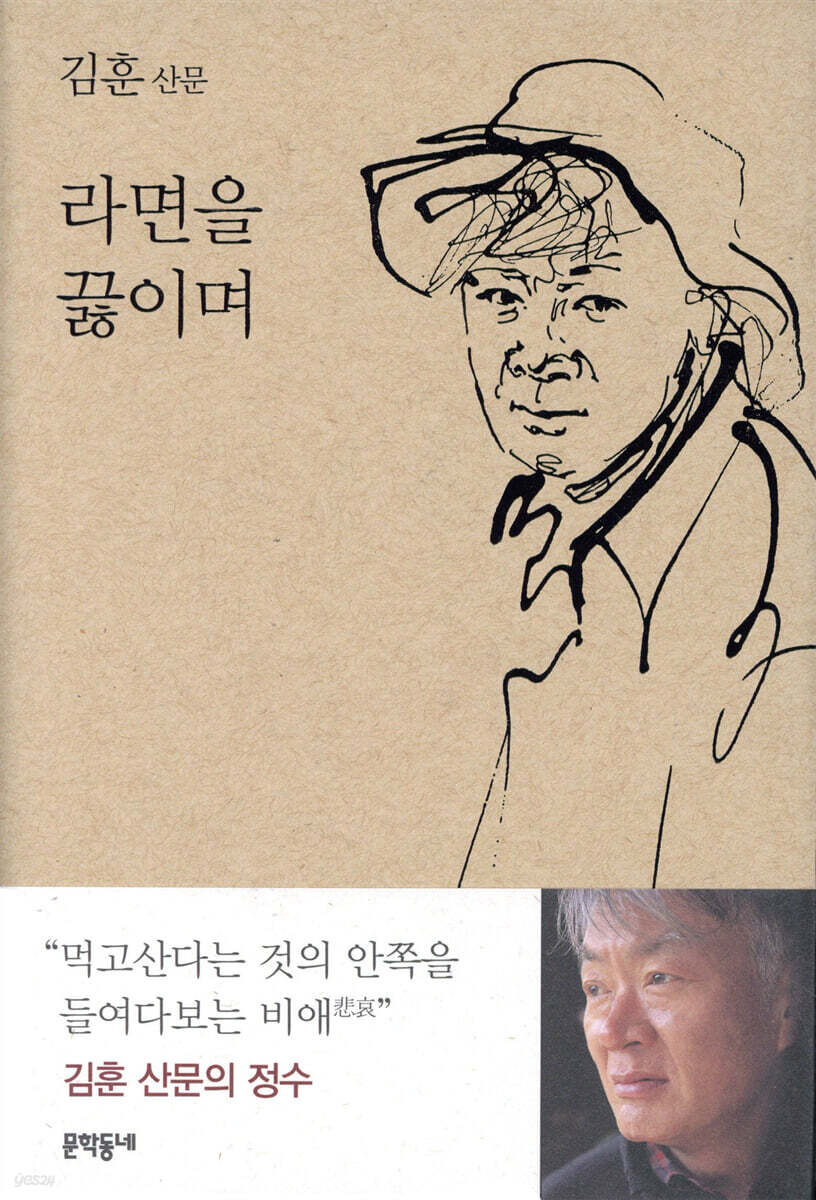
Boiling ramen
 |
Description
Book Introduction
“The sorrow of looking into the inner workings of life”
The Essence of Kim Hoon's Prose
Novelist Kim Hoon's prose has been published.
This book is a compilation of timeless and memorable prose pieces from Kim Hoon's legendary prose works, "The Boredom of Earning a Living," "Regarding the Words Asking Which Side Are You On," and "Message from the Sea," which have long since gone out of print and made bibliophiles seek out used bookstores. It also includes approximately 400 new prose manuscripts.
This book contains Kim Hoon's past and present, from his family story to the writings he wrote on the streets during his days as a reporter, to the writings he recently wrote while waiting for a new language on islands in the East and West Seas, unable to endure the city.
The world and the harsh landscapes of his inner self that he records as he still writes by hand on manuscript paper, rides a bicycle instead of driving a car, and moves through the world with his two feet.
This book contains the joy of reading Kim Hoon's famous lines that are often recalled, such as "The Boredom of Earning a Living" and "Son, Don't Stick Out Your Flat Feet Again," as well as his "sad and astonished" writings about those in power who are caught up in partisan logic and making a fuss in an era when the country cannot protect its people, and the "essence of Kim Hoon's prose" that still touches the hearts of ordinary people who are "wandering through the hell of making a living."
The Essence of Kim Hoon's Prose
Novelist Kim Hoon's prose has been published.
This book is a compilation of timeless and memorable prose pieces from Kim Hoon's legendary prose works, "The Boredom of Earning a Living," "Regarding the Words Asking Which Side Are You On," and "Message from the Sea," which have long since gone out of print and made bibliophiles seek out used bookstores. It also includes approximately 400 new prose manuscripts.
This book contains Kim Hoon's past and present, from his family story to the writings he wrote on the streets during his days as a reporter, to the writings he recently wrote while waiting for a new language on islands in the East and West Seas, unable to endure the city.
The world and the harsh landscapes of his inner self that he records as he still writes by hand on manuscript paper, rides a bicycle instead of driving a car, and moves through the world with his two feet.
This book contains the joy of reading Kim Hoon's famous lines that are often recalled, such as "The Boredom of Earning a Living" and "Son, Don't Stick Out Your Flat Feet Again," as well as his "sad and astonished" writings about those in power who are caught up in partisan logic and making a fuss in an era when the country cannot protect its people, and the "essence of Kim Hoon's prose" that still touches the hearts of ordinary people who are "wandering through the hell of making a living."
- You can preview some of the book's contents.
Preview
index
Part 1 Rice
Boiling Ramen _11
Horses Running Through the Wilderness _32
Sea _48
Rice 1 _70
Rice 2_74
South Pacific _76
Tidal flat _94
Border _98
Ball _122
Carpenter _127
Line _131
Life 1_137
Life 2 _142
Part 2 Money
Sewol Ferry _153
Money 1_178
Money 2_182
Money 3_186
Signal _191
Raphael's House _195
Commoner_197
Love _201
Fire Truck _205
Death of a Firefighter _215
Part 3 Body
Message from the Sea _223
Woman 1 _232
Woman 2 _238
Woman 3_243
Woman 4 _247
Woman 5 _251
Woman 6_256
Woman 7 _262
Hand 1 _267
Hand 2 _278
Foot 1 _283
Foot 2 _289
Flat feet _293
Part 4 Road
Road _299
Wheel _303
Hometown 1_307
Hometown 2 _317
Hometown 3_327
Iron _332
Kiln _343
Set _349
Magpie _353
Flower _357
Leaf _361
Watermelon _365
November _370
Wind _374
Part 5
Chiljangsa Temple_ Im Kkeokjeong 379
Salmon_ Gohyeongryeol 391
Park Kyung-ni 397 on February 15, 1975
Author's Note 410
Boiling Ramen _11
Horses Running Through the Wilderness _32
Sea _48
Rice 1 _70
Rice 2_74
South Pacific _76
Tidal flat _94
Border _98
Ball _122
Carpenter _127
Line _131
Life 1_137
Life 2 _142
Part 2 Money
Sewol Ferry _153
Money 1_178
Money 2_182
Money 3_186
Signal _191
Raphael's House _195
Commoner_197
Love _201
Fire Truck _205
Death of a Firefighter _215
Part 3 Body
Message from the Sea _223
Woman 1 _232
Woman 2 _238
Woman 3_243
Woman 4 _247
Woman 5 _251
Woman 6_256
Woman 7 _262
Hand 1 _267
Hand 2 _278
Foot 1 _283
Foot 2 _289
Flat feet _293
Part 4 Road
Road _299
Wheel _303
Hometown 1_307
Hometown 2 _317
Hometown 3_327
Iron _332
Kiln _343
Set _349
Magpie _353
Flower _357
Leaf _361
Watermelon _365
November _370
Wind _374
Part 5
Chiljangsa Temple_ Im Kkeokjeong 379
Salmon_ Gohyeongryeol 391
Park Kyung-ni 397 on February 15, 1975
Author's Note 410
Detailed image
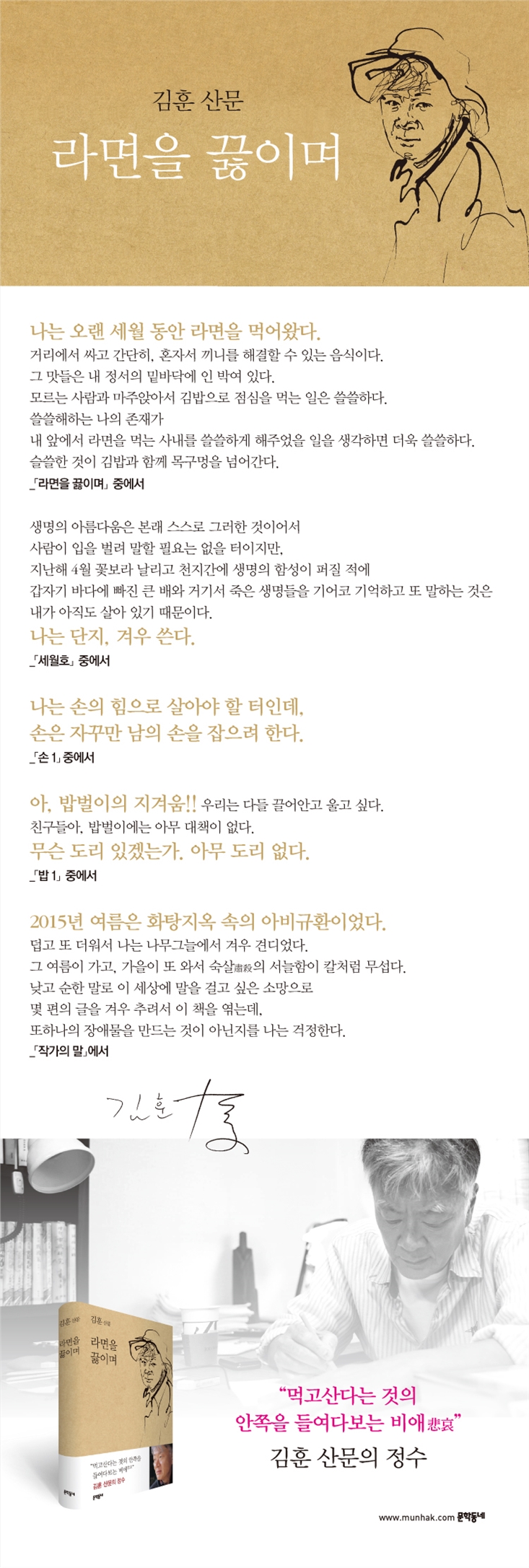
Into the book
*
As I bury my face in the thick steam and drink the hot soup, the sharp taste of the seasoning runs down my throat, sending shivers down my spine, and my intestines, twisted from the cold, melt.
It's sad, where does the market's origin lie?
---「Boiling Ramen」
*
In the morning sea of Uljin, I felt ashamed of the trash in my heart filled with memories of the days I had lived.
I was pondering on the morning sea of Uljin whether I could erase the memories and traces of life from my heart, just as waves and light break apart on their own, endlessly renewing themselves, and write a single sentence with the new words that come to me.
Oh, I have never taken a shit in my entire life, and I have piled up so much shit in my heart that it has already hardened like a rock.
Reflecting on the Uljin Sea, the diagnosis of my heart's illness was lifelong constipation.
The sea taught me the name of my illness.
The most urgent prescription for me would be to get rid of the shit that has accumulated in my heart over a lifetime and become new.
I was always exhausted from the sea in Uljin, overwhelmed by the incomprehensible strangeness of the sea.
From beyond the horizon, the new language I was waiting for never arrived, and the time I spent looking out towards the sea grew longer each day.
I worked little by little and wandered a lot.
My job was to write, but wandering around was more difficult than working.
The birds that had gone out to sea returned to the forest, and I returned to my room.
Countless blank spaces on manuscript paper were spread out on the desk.
---From "The Sea"
*
The peaceful, fishy smell of rice cooking in an electric rice cooker has choked me up my entire life.
This sorrow brings families together and forces people into the streets to earn a living.
There is no solution for rice.
It is not something that can be done by eating one or two meals, but something that must be eaten at all times until the day you die.
This is rice.
This is what they call a chilling meal.
---From "Rice 1"
*
Every meal has a fishhook in it.
When we swallow rice, we swallow a fishhook as well.
So the gills are pierced and pulled towards the rice.
Who is that sitting on the shore with his fishing rod, pulling me out?
That person is me.
This is why I can't take it out or go back or forward.
You have to be drawn towards food to earn more food.
---From "Rice 1"
*
I hate this world of labor inspectors who keep pushing people to work harder while insisting that work is sacred.
I love the wise self-defense of people who run away from the so-called 3D industries and preserve their dignity.
Therefore, labor inspectors of this world, please do not pressure people to work hard.
Please tell him to rest now.
I've already worked hard to the point where I'm in a mess.
---From "Rice 1"
*
For me, traveling is the work of observing the contents and expressions of the world.
The purpose of my travels is to preserve in my mind the scenery that cycles with the seasons, the way people live their lives while repeating work and rest, the passing forms of things passing by, and the feelings, smells, and textures.
---From "South Pacific"
*
I came back and sat down at my desk.
When I pick up a pencil, tropical forests and the sea unfold in my mind.
Even though I feel like I have a lot to say to the forest, the words just won't come out.
The seething words rush to the outskirts of my heart and fade away.
When I enter the forest, I find that I don't need to talk to the forest, but the unborn words still swarm inside me.
---From "South Pacific"
*
The young carpenter, hanging from the eaves of a house under construction and hammering nails, awes me with his beauty.
But whose life is not difficult and bleak?
As I look into the corn, its roots hanging out because the wooden barrel is too narrow, I console the old sorrow with a new one.
---From "The Carpenter"
*
From the distant red darkness, fishing boats emerge.
The fishing boats, worn out from the exhaustion of tiring labor, return to the port with torn fishing flags fluttering. Fatigue is life itself, so there seems to be no need to mention it separately.
---From "Line"
*
My daughter finished her studies, got a job, and received her first paycheck.
My daughter bought me a cell phone and gave me 150,000 won as allowance.
That child will live a hard life like me, eating only as a reward for his labor.
How sacred is the tedious, tedious routine of this life.
Even if there is no happiness or joy in that banal everyday life, how serious is this repeated cycle and repetition?
---From "Life 1"
*
The beauty of life is inherently so, there is no need for people to open their mouths and speak of it. However, last April, when flowers were falling and the shouts of life were spreading throughout the world, I remember and speak of the great ship that suddenly fell into the sea and the lives that died there because I am still alive.
I just, barely write.
---From "Sewol"
*
Everyone I met on my travels was either injured or broken.
They were people who could not escape the pain that the times inflicted on humans.
But within those broken people, there were still parts that could never be broken, still intact.
It is always tearful to find faith in life in a life that has been uprooted and torn apart.
---From "Hometown 1"
*
When I rode my bike along the Seomjin River on a spring day in my early years, growing old alone, the mountains sprouting new leaves were reflected in the water, and my bike felt like it was riding on a path to the sky.
Ah, there was another world within this unbearable world! How arduous was this insignificant life.
---From "Leaves"
*
It was a cold and dark winter.
There was no hope.
It may not be something that can be divided into one side or the other, but people were divided into two groups.
There were people who had given up and people who had not given up yet.
I guess I was probably on the side of those who gave up.
At that time, I was a young man of twenty-seven.
Even those who did not give up accepted the reality that there was no longer any hope in this world.
Those who did not give up were sending desperate gestures toward things that did not exist, things that could not possibly exist.
As I bury my face in the thick steam and drink the hot soup, the sharp taste of the seasoning runs down my throat, sending shivers down my spine, and my intestines, twisted from the cold, melt.
It's sad, where does the market's origin lie?
---「Boiling Ramen」
*
In the morning sea of Uljin, I felt ashamed of the trash in my heart filled with memories of the days I had lived.
I was pondering on the morning sea of Uljin whether I could erase the memories and traces of life from my heart, just as waves and light break apart on their own, endlessly renewing themselves, and write a single sentence with the new words that come to me.
Oh, I have never taken a shit in my entire life, and I have piled up so much shit in my heart that it has already hardened like a rock.
Reflecting on the Uljin Sea, the diagnosis of my heart's illness was lifelong constipation.
The sea taught me the name of my illness.
The most urgent prescription for me would be to get rid of the shit that has accumulated in my heart over a lifetime and become new.
I was always exhausted from the sea in Uljin, overwhelmed by the incomprehensible strangeness of the sea.
From beyond the horizon, the new language I was waiting for never arrived, and the time I spent looking out towards the sea grew longer each day.
I worked little by little and wandered a lot.
My job was to write, but wandering around was more difficult than working.
The birds that had gone out to sea returned to the forest, and I returned to my room.
Countless blank spaces on manuscript paper were spread out on the desk.
---From "The Sea"
*
The peaceful, fishy smell of rice cooking in an electric rice cooker has choked me up my entire life.
This sorrow brings families together and forces people into the streets to earn a living.
There is no solution for rice.
It is not something that can be done by eating one or two meals, but something that must be eaten at all times until the day you die.
This is rice.
This is what they call a chilling meal.
---From "Rice 1"
*
Every meal has a fishhook in it.
When we swallow rice, we swallow a fishhook as well.
So the gills are pierced and pulled towards the rice.
Who is that sitting on the shore with his fishing rod, pulling me out?
That person is me.
This is why I can't take it out or go back or forward.
You have to be drawn towards food to earn more food.
---From "Rice 1"
*
I hate this world of labor inspectors who keep pushing people to work harder while insisting that work is sacred.
I love the wise self-defense of people who run away from the so-called 3D industries and preserve their dignity.
Therefore, labor inspectors of this world, please do not pressure people to work hard.
Please tell him to rest now.
I've already worked hard to the point where I'm in a mess.
---From "Rice 1"
*
For me, traveling is the work of observing the contents and expressions of the world.
The purpose of my travels is to preserve in my mind the scenery that cycles with the seasons, the way people live their lives while repeating work and rest, the passing forms of things passing by, and the feelings, smells, and textures.
---From "South Pacific"
*
I came back and sat down at my desk.
When I pick up a pencil, tropical forests and the sea unfold in my mind.
Even though I feel like I have a lot to say to the forest, the words just won't come out.
The seething words rush to the outskirts of my heart and fade away.
When I enter the forest, I find that I don't need to talk to the forest, but the unborn words still swarm inside me.
---From "South Pacific"
*
The young carpenter, hanging from the eaves of a house under construction and hammering nails, awes me with his beauty.
But whose life is not difficult and bleak?
As I look into the corn, its roots hanging out because the wooden barrel is too narrow, I console the old sorrow with a new one.
---From "The Carpenter"
*
From the distant red darkness, fishing boats emerge.
The fishing boats, worn out from the exhaustion of tiring labor, return to the port with torn fishing flags fluttering. Fatigue is life itself, so there seems to be no need to mention it separately.
---From "Line"
*
My daughter finished her studies, got a job, and received her first paycheck.
My daughter bought me a cell phone and gave me 150,000 won as allowance.
That child will live a hard life like me, eating only as a reward for his labor.
How sacred is the tedious, tedious routine of this life.
Even if there is no happiness or joy in that banal everyday life, how serious is this repeated cycle and repetition?
---From "Life 1"
*
The beauty of life is inherently so, there is no need for people to open their mouths and speak of it. However, last April, when flowers were falling and the shouts of life were spreading throughout the world, I remember and speak of the great ship that suddenly fell into the sea and the lives that died there because I am still alive.
I just, barely write.
---From "Sewol"
*
Everyone I met on my travels was either injured or broken.
They were people who could not escape the pain that the times inflicted on humans.
But within those broken people, there were still parts that could never be broken, still intact.
It is always tearful to find faith in life in a life that has been uprooted and torn apart.
---From "Hometown 1"
*
When I rode my bike along the Seomjin River on a spring day in my early years, growing old alone, the mountains sprouting new leaves were reflected in the water, and my bike felt like it was riding on a path to the sky.
Ah, there was another world within this unbearable world! How arduous was this insignificant life.
---From "Leaves"
*
It was a cold and dark winter.
There was no hope.
It may not be something that can be divided into one side or the other, but people were divided into two groups.
There were people who had given up and people who had not given up yet.
I guess I was probably on the side of those who gave up.
At that time, I was a young man of twenty-seven.
Even those who did not give up accepted the reality that there was no longer any hope in this world.
Those who did not give up were sending desperate gestures toward things that did not exist, things that could not possibly exist.
---From "Park Kyung-ni on February 15, 1975"
Publisher's Review
“I have been living off the land for many years.”
Ah, the boredom of earning a living!!
We all want to hug each other and cry.”
The book's title, "Boiling Ramen," is a story about the lives of the average Korean who eats 3.6 billion packages of ramen each year, or 74.1 per person, and about people who have to "eat cheap, simple meals on the street, and eat alone."
There are people in the world who eat elegantly in fancy places where they can eat and socialize, but there are also people who endure the hardships of earning a living on the streets and eat alone in shabby snack bars, looking out the window, or sitting across from strangers.
There are more people around us who have to quickly gulp down spicy soups that 'tear the throat' and then walk back to their own labor and hardship.
“Everyone has to eat it whether they have it or not, and it’s not something you can just eat once, but when the time comes, you have to eat it again,” so for those who “live from month to month,” ramen is an obvious and sad food.
I have been eating ramen for a long time.
It is a cheap and simple food that you can eat alone on the street.
Those tastes are ingrained in the very depths of my emotions.
It's lonely to sit down with strangers and eat kimbap for lunch.
It makes me even more lonely when I think about how my lonely existence made the man eating ramen in front of me feel lonely.
A feeling of loneliness goes down my throat along with the kimbap.
We shouldn't laugh at this foolishness.
The same goes for you all.
It's obvious what kind of food a person who lives from hand to mouth can buy on the street.
If you eat ramen or jajangmyeon with a long handle, you will get a bad taste in your mouth.
If you don't eat those pitiful things for a while, you'll start to want to eat them even if you're not hungry.
The human spirit is not like a pattern imprinted on the tongue, but on the emotions.
The comfort of resignation that the world will be dark and dreary like jajangmyeon or flimsy like ramen caresses the depths of my heart.
In one way or another, humanity is like osteomyelitis, burrowing deep into the bones.
_In the text
Kim Hoon's meal.
money .
body .
road .
writing
This book is divided into five parts, each covering five themes that shaped Kim Hoon's past.
Food, money, body, road, writing.
These five themes are concise and honest, like his writing style.
Kim Hoon exists in this unique world that needs no addition or subtraction.
In “Hand 1,” he wrote, “I have to live by the power of my hands, but my hands keep trying to hold other people’s hands.”
This book is a place where he, who barely manages to endure the tangled relationships of reality with his pitiful hands that keep trying to hold on to others' hands, and him, who writes alone in his study, his hand firmly gripping a pencil, slowly meet.
In a past interview, Kim Hoon said this:
“I am drawn to a certain voltage when I write.
High voltage sentences are good.
It takes a lot of buildup to get voltage.
That much must be thrown away.
Voltage is generated during the discarding process.
“If you don’t throw it away, voltage cannot be generated.”
In the process of compiling this book, he discarded many writings and rewrote sentences anew.
This book, which is filled with only the most precious pieces of prose he has accumulated, and even recent writings that embody his desire to speak to readers in a more humble and gentle tone than novels, has a high-voltage current that will instantly captivate readers.
The power of Kim Hoon's writing comes from letting go and holding on.
This book is a collection of prose that allows you to fully experience the joy and emotion of reading the 'essence of Kim Hoon's prose', with the power of his sentences, which he mercilessly discards and refines, added to the life he has accumulated.
I have been repeating myself to myself for a long time about such things.
I have been talking nonsense, mistaking things I couldn't write for things I could write.
Even the things I wrote with sincerity fade away with time, and what I wanted to say was always beyond words.
The ultimate words are born from the freedom from the shackles of words.
Now, I must make it my life's work to repent for the careless words and writings I have spoken, but even if I repent, I cannot take them back, so it is sad and miserable.
I try to face things directly.
The summer of 2015 was a hellish mess.
It was so hot that I could barely stand it in the shade of a tree.
That summer passed, and autumn came again, and the chill of the slaughter was as frightening as a knife.
I have compiled this book by carefully selecting a few essays with the hope of speaking to the world in a low and gentle tone, but I worry that I might be creating yet another obstacle.
_Author's Note
Ah, the boredom of earning a living!!
We all want to hug each other and cry.”
The book's title, "Boiling Ramen," is a story about the lives of the average Korean who eats 3.6 billion packages of ramen each year, or 74.1 per person, and about people who have to "eat cheap, simple meals on the street, and eat alone."
There are people in the world who eat elegantly in fancy places where they can eat and socialize, but there are also people who endure the hardships of earning a living on the streets and eat alone in shabby snack bars, looking out the window, or sitting across from strangers.
There are more people around us who have to quickly gulp down spicy soups that 'tear the throat' and then walk back to their own labor and hardship.
“Everyone has to eat it whether they have it or not, and it’s not something you can just eat once, but when the time comes, you have to eat it again,” so for those who “live from month to month,” ramen is an obvious and sad food.
I have been eating ramen for a long time.
It is a cheap and simple food that you can eat alone on the street.
Those tastes are ingrained in the very depths of my emotions.
It's lonely to sit down with strangers and eat kimbap for lunch.
It makes me even more lonely when I think about how my lonely existence made the man eating ramen in front of me feel lonely.
A feeling of loneliness goes down my throat along with the kimbap.
We shouldn't laugh at this foolishness.
The same goes for you all.
It's obvious what kind of food a person who lives from hand to mouth can buy on the street.
If you eat ramen or jajangmyeon with a long handle, you will get a bad taste in your mouth.
If you don't eat those pitiful things for a while, you'll start to want to eat them even if you're not hungry.
The human spirit is not like a pattern imprinted on the tongue, but on the emotions.
The comfort of resignation that the world will be dark and dreary like jajangmyeon or flimsy like ramen caresses the depths of my heart.
In one way or another, humanity is like osteomyelitis, burrowing deep into the bones.
_In the text
Kim Hoon's meal.
money .
body .
road .
writing
This book is divided into five parts, each covering five themes that shaped Kim Hoon's past.
Food, money, body, road, writing.
These five themes are concise and honest, like his writing style.
Kim Hoon exists in this unique world that needs no addition or subtraction.
In “Hand 1,” he wrote, “I have to live by the power of my hands, but my hands keep trying to hold other people’s hands.”
This book is a place where he, who barely manages to endure the tangled relationships of reality with his pitiful hands that keep trying to hold on to others' hands, and him, who writes alone in his study, his hand firmly gripping a pencil, slowly meet.
In a past interview, Kim Hoon said this:
“I am drawn to a certain voltage when I write.
High voltage sentences are good.
It takes a lot of buildup to get voltage.
That much must be thrown away.
Voltage is generated during the discarding process.
“If you don’t throw it away, voltage cannot be generated.”
In the process of compiling this book, he discarded many writings and rewrote sentences anew.
This book, which is filled with only the most precious pieces of prose he has accumulated, and even recent writings that embody his desire to speak to readers in a more humble and gentle tone than novels, has a high-voltage current that will instantly captivate readers.
The power of Kim Hoon's writing comes from letting go and holding on.
This book is a collection of prose that allows you to fully experience the joy and emotion of reading the 'essence of Kim Hoon's prose', with the power of his sentences, which he mercilessly discards and refines, added to the life he has accumulated.
I have been repeating myself to myself for a long time about such things.
I have been talking nonsense, mistaking things I couldn't write for things I could write.
Even the things I wrote with sincerity fade away with time, and what I wanted to say was always beyond words.
The ultimate words are born from the freedom from the shackles of words.
Now, I must make it my life's work to repent for the careless words and writings I have spoken, but even if I repent, I cannot take them back, so it is sad and miserable.
I try to face things directly.
The summer of 2015 was a hellish mess.
It was so hot that I could barely stand it in the shade of a tree.
That summer passed, and autumn came again, and the chill of the slaughter was as frightening as a knife.
I have compiled this book by carefully selecting a few essays with the hope of speaking to the world in a low and gentle tone, but I worry that I might be creating yet another obstacle.
_Author's Note
GOODS SPECIFICS
- Date of issue: September 30, 2015
- Format: Hardcover book binding method guide
- Page count, weight, size: 412 pages | 505g | 128*188*30mm
- ISBN13: 9788954637770
- ISBN10: 8954637779
You may also like
카테고리
korean


korean

![ELLE 엘르 스페셜 에디션 A형 : 12월 [2025]](http://librairie.coreenne.fr/cdn/shop/files/b8e27a3de6c9538896439686c6b0e8fb.jpg?v=1766436872&width=3840)


