

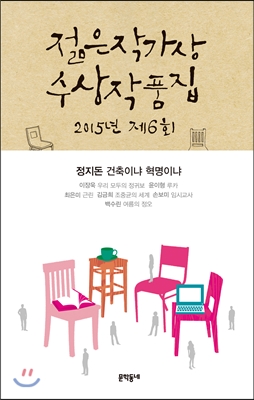
2015 6th Young Writer's Award Winners' Collection
 |
Description
Book Introduction
“The unique twist of literary texts was refreshingly realized in this evaluation!”
The 'Young Writer's Award', established by Munhakdongne in 2010 and now in its 6th year, considers short stories written by authors who have been in the literary world for less than ten years.
The Young Writer's Award encourages young writers and allows readers to experience the energy of young novels filled with new sensibilities and bold spirit.
The 6th winners of the 2015 Young Writers Award, which accompanies the future of Korean literature with unique individuality, are Jeong Ji-don, Lee Jang-wook, Yoon I-hyeong, Choi Eun-mi, Kim Geum-hee, Son Bo-mi, and Baek Su-rin.
Through the works of these most active writers, we have a topographical map that allows us to gauge the present and future of Korean literature.
The 'Young Writer's Award', established by Munhakdongne in 2010 and now in its 6th year, considers short stories written by authors who have been in the literary world for less than ten years.
The Young Writer's Award encourages young writers and allows readers to experience the energy of young novels filled with new sensibilities and bold spirit.
The 6th winners of the 2015 Young Writers Award, which accompanies the future of Korean literature with unique individuality, are Jeong Ji-don, Lee Jang-wook, Yoon I-hyeong, Choi Eun-mi, Kim Geum-hee, Son Bo-mi, and Baek Su-rin.
Through the works of these most active writers, we have a topographical map that allows us to gauge the present and future of Korean literature.
index
Is this a construction project or a revolution? 007
Lee Jang-wook, our all-time Jeong Gwi-bo… 069
Yoon Lee-hyung Luca… 115
Eunmi Choi's neighborhood… 165
The World of Kim Geum-hee and Jo Jung-gyun… 203
Son Bo-mi, temporary teacher… 245
Baek Su-rin, Summer Noon… 287
2015 6th Young Writer Award
Judging process… 329
Review comments… 331
Lee Jang-wook, our all-time Jeong Gwi-bo… 069
Yoon Lee-hyung Luca… 115
Eunmi Choi's neighborhood… 165
The World of Kim Geum-hee and Jo Jung-gyun… 203
Son Bo-mi, temporary teacher… 245
Baek Su-rin, Summer Noon… 287
2015 6th Young Writer Award
Judging process… 329
Review comments… 331
Publisher's Review
★
The judging panel, comprised of seven young critics, reviewed short stories published in 2014 by authors who debuted after 2005.
Quarterly and monthly magazines, as well as various webzines and literary magazines, were reviewed, including works that had not been published and were immediately published as books. After lengthy discussions, a total of seventeen works were selected.
The main characters were Ku Hyo-seo, Kwon Hee-chul, Ryu Bo-seon, Shin Kyung-sook, Jeong Yeong-mun, and Hwang Jong-yeon.
Even just sharing our thoughts on the final nominees took a long time, but there was no major disagreement in selecting the seven winners and one grand prize winner.
This may be because Jeong Ji-don's work possesses a freshness and vitality worthy of the Young Artist Award.
Additionally, Kim Geum-hee and Baek Su-rin, who each published their first collection of short stories last year, won the Young Writer's Award for the first time.
It is surprising and cause for celebration that Yoon I-hyung and Choi Eun-mi, who have been steadily building their own unique novel worlds, have won awards for two consecutive years, and Lee Jang-wook, who is celebrating his tenth anniversary since his debut this year, has won four awards, the most in total, and Son Bo-mi is expected to break her own record by winning four consecutive awards.
We hope that the Young Writer Award will continue to discover talented new writers at the right time and continue to pleasantly surprise them.
★
Ji-don Jeong, who debuted in 2013 with the Literature and Society New Writer Award, is a formidable newcomer in his third year, boasting a “unique charm” with “lively intellect and earnest wit” and “opening the door to destructive experiences in a world where experience seems impossible, through a kind of melancholic nostalgia.”
Ji-don Jeong's "Architecture or Revolution," which was selected as the winner of the 6th Young Writer's Award, is, in a word, "a monstrous work" (literary critic Jong-yeon Hwang).
The author presents a model intellectual novel by performing a dazzling acrobatics between history and fiction in the form of collecting and telling anecdotes about a real person named Lee Gu, the last crown prince of the Korean Empire and a modern architect.
By giving the temporal depth they have passed through to facts with very little room for fiction, Jeong Ji-don created a novelistic territory called the 'disastrous' joke.
With its deep and broad knowledge of architectural history, humorous prose, and vibrant storytelling, this novel offers a meaningful glimpse into modern history not only in Korea but also around the world. Readers will experience the thrill of genre-defying narrative art in a refreshing way.
★
Jeong Ji-don, "Architecture or Revolution" This work, which effectively depicts one aspect of the history of modern Korean architecture in a narrow sense and modern Korean society in a broader sense, is an exemplary example of intellectual fiction that skillfully combines facts with fiction, and I personally wanted to give it a high rating.
And the virtue of this novel lies in the humorous sentences that emerge when read carefully.
_Jeong Young-moon (novelist)
In 1957, every college student in America pretended to be a member of the Beat Generation, and even MIT engineering students were talking about Ginsberg and Jack Kerouac.
Igu smiled as he listened to their story. Despite attending MIT for four years, his classmates couldn't tell whether Igu was Japanese or Chinese.
I once said, "I'm a member of the royal family of the Republic of Korea," but my classmates didn't know much about the Republic of Korea or that it had a royal family, and ultimately, they had no interest in this country. (21st Century Literature, Winter 2014)
■ Born in Daegu in 1983.
Debuted in 2013 when his short story "The Blind Owl" won the Literature and Society New Writer's Award.
Post-mortem realist.
Lee Jang-wook, "Our Jeong Gwi-bo" is also a novel worthy of Lee Jang-wook.
Through a simple story, he presents the paradoxes or ironies of life, while naturally conveying Lee Jang-wook's own artistic philosophy.
(…) It could be said that this is Lee Jang-wook’s version of Badiou’s categorical imperative: ‘Love what you will never believe twice.’
_Ryu Bo-seon (literary critic, professor of Korean literature at Kunsan National University)
But in 2002, at the age of just over thirty, Jeong Gwi-bo suddenly quit his job.
It wasn't because I suddenly developed a passion for art or was disillusioned with organizational life.
It had nothing to do with the sink, and it certainly wasn't because of the cheers of the World Cup semi-finals.
Perhaps it was because I saw raindrops falling, pitter-patter, on the bus stop sign on my way to work one rainy morning, but perhaps it was also because I thought, "There's no reason to be quiet." (『21st Century Literature』, Spring 2014)
■ Born in Seoul in 1968.
Debuted in 2005 by winning the Literature Notebook Writer's Award.
There are short story collections 『The King of Confessions』 and 『Everything But Giraffes』, and novels 『The Merry Demons of the Sword』 and 『Stranger than Paradise』.
He won the Young Writer's Award in 2010, 2011, and 2013, the 1st Munji Literary Award, and the 8th Kim Yu-jeong Literary Award.
Yoon Lee-hyung, "Luca" talks about the poignant moments that we cannot give up even after we have acknowledged ourselves as a lump of difficulty to deal with.
Unless you're a serious writer about life, you can't write something like this.
Kwon Hee-chul (literary critic, professor of playwriting at the Korea National University of Arts)
It was then, sitting in my mother's hospital room, that I realized the simple truth that nothing in this world is free.
You can't live in this world without hurting anyone.
Someone's bones are always broken.
I realized it, but I wanted to pretend not to know. (Consonants and Vowels, Summer 2014)
■ Born in Seoul in 1976.
Debuted in 2005 when his short story “Black Starfish” won the JoongAng New Writer’s Award.
There are short story collections 『Waltz for Three』 and 『Big Wolf Blue』.
He won the Young Writer Award in 2014 and the 5th Munji Literary Award.
Eunmi Choi, "Neighborhood" What is the joke?
Couldn't it be said that the stories in these novels are a wonder that they reveal that things are not far from our daily lives, but close to us, and that they seem distant, not close.
It is a feat that requires considerable skill to cross a radius of several kilometers from a ghostly perspective, neither from a point of view nor from an omniscient perspective.
_Gu Hyo-seo (novelist)
The women who were scattered within fifty meters of the gym at four o'clock suddenly stopped moving at the sound of a loud noise.
A woman about to meet her lover, a woman chasing red shoes, a woman turning over empty chestnut shells, a woman searching from one end of the forest to the other, a woman crying at the other end of the forest.
They looked up at their heads as if they had made a promise.
Only Shichu ran to the place covered with fallen leaves, as if he could not hear any sound.
“Alright, al ...
■ Born in Inje, Gangwon-do in 1978.
Debuted in 2008 when his short story "I Cry and Go" won the "Modern Literature" New Writer's Award.
There is a collection of short stories titled “A Very Beautiful Dream.”
Won the Young Writer Award in 2014.
Kim Geum-hee, "The World of Jo Jung-gyun" How many novels have been written about youth, love, and revolution that have disappeared into the black hole of capitalism?
But this short story doesn't fall into the trap of cliché.
It is thanks to the humor that comes from recognizing the “ghostly” nature of Jo Jung-gyun, a figure who is like an incarnation of the past world, that it comes from recognizing the duality of the aura surrounding him—both dignity and shabbiness.
Hwang Jong-yeon (literary critic, professor of Korean language and literature and creative writing, Dongguk University)
“Ma’am.” After going to the bathroom, I sat down in the hall instead of returning to the company dinner table.
If I sat down and drank any more, I felt like I would get completely drunk.
“Why can’t I find a seat?” the restaurant owner looked back.
“No, why is it called fist meat?” The woman walked towards me while diligently mixing bean sprouts in a bowl.
And then he put his left fist in front of his eyes and said, “You know? A fist?”
"i know."
“It’s because it resembles a fist.” (Hanpan, Winter 2014)
■ Born in Busan in 1979.
Debuted in 2009 when his short story "Your Document" was selected for the Hankook Ilbo New Year's Literary Contest.
There is a collection of short stories titled “Sentimentality for a Day or Two.”
Son Bo-mi, "Temporary Teacher" I was reading along absentmindedly when for a moment I felt like my mind went black.
(…) When you witness a scene where someone who has been used like a consumable and has already betrayed you or will betray you turns off the lights on the same night with the same sky without any resentment, muttering, “That’s how life is,” you can’t help but feel a chill in your heart.
Shin Kyung-sook (novelist)
Was that a mistake?
She thought about the repeated wrong choices, delusions, unfounded expectations, surrenders and defeats in her life.
It's always like that.
She always thought that was courage.
And only later did she realize that it wasn't courage.
So what was it? (『Munhakdongne』, Winter 2014)
■ Born in Seoul in 1980.
Debuted in 2009 with the short story "Silence" winning the 21st Century Literature New Writer's Award, and in 2011 with the short story "Blanket" winning the Dong-A Ilbo New Year's Literary Contest.
There is a collection of short stories titled "Lindy Hop for Them."
He won the Grand Prize at the Young Writer's Award in 2012, the Young Writer's Award in 2013 and 2014, the 46th Hankook Ilbo Literary Award, and the 21st Kim Jun-seong Literary Award.
Baek Su-rin, "Summer Noon" talks about the lonely sense of alienation that arises when surrounded by things similar to oneself and familiar to oneself, and conversely, about the relationship with the unfamiliar that can understand that sense of alienation.
This novel contains a delicate touch that understands and expresses such things.
Kwon Hee-chul (literary critic, professor of playwriting at the Korea National University of Arts)
Why were there always people yelling from all sides at random times during those times?
I didn't tell Takahiro that the fifth floor of the liberal arts building on the hill was very tall.
I took the eraser out of my pencil case and threw it outside.
The eraser fell down, down, in a parabolic arc.
Actually, I didn't want to die.
I didn't make excuses to Takahiro, saying I simply wanted to understand J. (Bungei Joongang, Fall 2014)
■ Born in Incheon in 1982.
Debuted in 2011 when his short story "Lying Practice" was selected for the Kyunghyang Shinmun New Year's Literary Contest.
There is a collection of short stories titled “Falling in Fall.”
★
The winners of the Young Writer's Award will each receive a prize of 5 million won and a trophy. If the royalties (10%) of the winning collection exceed the prize money, the excess royalties will be divided equally among all winners.
In line with the purpose of the award to promote young writers, the collection of award-winning works will be sold at a special price for one year after publication.
The judging panel, comprised of seven young critics, reviewed short stories published in 2014 by authors who debuted after 2005.
Quarterly and monthly magazines, as well as various webzines and literary magazines, were reviewed, including works that had not been published and were immediately published as books. After lengthy discussions, a total of seventeen works were selected.
The main characters were Ku Hyo-seo, Kwon Hee-chul, Ryu Bo-seon, Shin Kyung-sook, Jeong Yeong-mun, and Hwang Jong-yeon.
Even just sharing our thoughts on the final nominees took a long time, but there was no major disagreement in selecting the seven winners and one grand prize winner.
This may be because Jeong Ji-don's work possesses a freshness and vitality worthy of the Young Artist Award.
Additionally, Kim Geum-hee and Baek Su-rin, who each published their first collection of short stories last year, won the Young Writer's Award for the first time.
It is surprising and cause for celebration that Yoon I-hyung and Choi Eun-mi, who have been steadily building their own unique novel worlds, have won awards for two consecutive years, and Lee Jang-wook, who is celebrating his tenth anniversary since his debut this year, has won four awards, the most in total, and Son Bo-mi is expected to break her own record by winning four consecutive awards.
We hope that the Young Writer Award will continue to discover talented new writers at the right time and continue to pleasantly surprise them.
★
Ji-don Jeong, who debuted in 2013 with the Literature and Society New Writer Award, is a formidable newcomer in his third year, boasting a “unique charm” with “lively intellect and earnest wit” and “opening the door to destructive experiences in a world where experience seems impossible, through a kind of melancholic nostalgia.”
Ji-don Jeong's "Architecture or Revolution," which was selected as the winner of the 6th Young Writer's Award, is, in a word, "a monstrous work" (literary critic Jong-yeon Hwang).
The author presents a model intellectual novel by performing a dazzling acrobatics between history and fiction in the form of collecting and telling anecdotes about a real person named Lee Gu, the last crown prince of the Korean Empire and a modern architect.
By giving the temporal depth they have passed through to facts with very little room for fiction, Jeong Ji-don created a novelistic territory called the 'disastrous' joke.
With its deep and broad knowledge of architectural history, humorous prose, and vibrant storytelling, this novel offers a meaningful glimpse into modern history not only in Korea but also around the world. Readers will experience the thrill of genre-defying narrative art in a refreshing way.
★
Jeong Ji-don, "Architecture or Revolution" This work, which effectively depicts one aspect of the history of modern Korean architecture in a narrow sense and modern Korean society in a broader sense, is an exemplary example of intellectual fiction that skillfully combines facts with fiction, and I personally wanted to give it a high rating.
And the virtue of this novel lies in the humorous sentences that emerge when read carefully.
_Jeong Young-moon (novelist)
In 1957, every college student in America pretended to be a member of the Beat Generation, and even MIT engineering students were talking about Ginsberg and Jack Kerouac.
Igu smiled as he listened to their story. Despite attending MIT for four years, his classmates couldn't tell whether Igu was Japanese or Chinese.
I once said, "I'm a member of the royal family of the Republic of Korea," but my classmates didn't know much about the Republic of Korea or that it had a royal family, and ultimately, they had no interest in this country. (21st Century Literature, Winter 2014)
■ Born in Daegu in 1983.
Debuted in 2013 when his short story "The Blind Owl" won the Literature and Society New Writer's Award.
Post-mortem realist.
Lee Jang-wook, "Our Jeong Gwi-bo" is also a novel worthy of Lee Jang-wook.
Through a simple story, he presents the paradoxes or ironies of life, while naturally conveying Lee Jang-wook's own artistic philosophy.
(…) It could be said that this is Lee Jang-wook’s version of Badiou’s categorical imperative: ‘Love what you will never believe twice.’
_Ryu Bo-seon (literary critic, professor of Korean literature at Kunsan National University)
But in 2002, at the age of just over thirty, Jeong Gwi-bo suddenly quit his job.
It wasn't because I suddenly developed a passion for art or was disillusioned with organizational life.
It had nothing to do with the sink, and it certainly wasn't because of the cheers of the World Cup semi-finals.
Perhaps it was because I saw raindrops falling, pitter-patter, on the bus stop sign on my way to work one rainy morning, but perhaps it was also because I thought, "There's no reason to be quiet." (『21st Century Literature』, Spring 2014)
■ Born in Seoul in 1968.
Debuted in 2005 by winning the Literature Notebook Writer's Award.
There are short story collections 『The King of Confessions』 and 『Everything But Giraffes』, and novels 『The Merry Demons of the Sword』 and 『Stranger than Paradise』.
He won the Young Writer's Award in 2010, 2011, and 2013, the 1st Munji Literary Award, and the 8th Kim Yu-jeong Literary Award.
Yoon Lee-hyung, "Luca" talks about the poignant moments that we cannot give up even after we have acknowledged ourselves as a lump of difficulty to deal with.
Unless you're a serious writer about life, you can't write something like this.
Kwon Hee-chul (literary critic, professor of playwriting at the Korea National University of Arts)
It was then, sitting in my mother's hospital room, that I realized the simple truth that nothing in this world is free.
You can't live in this world without hurting anyone.
Someone's bones are always broken.
I realized it, but I wanted to pretend not to know. (Consonants and Vowels, Summer 2014)
■ Born in Seoul in 1976.
Debuted in 2005 when his short story “Black Starfish” won the JoongAng New Writer’s Award.
There are short story collections 『Waltz for Three』 and 『Big Wolf Blue』.
He won the Young Writer Award in 2014 and the 5th Munji Literary Award.
Eunmi Choi, "Neighborhood" What is the joke?
Couldn't it be said that the stories in these novels are a wonder that they reveal that things are not far from our daily lives, but close to us, and that they seem distant, not close.
It is a feat that requires considerable skill to cross a radius of several kilometers from a ghostly perspective, neither from a point of view nor from an omniscient perspective.
_Gu Hyo-seo (novelist)
The women who were scattered within fifty meters of the gym at four o'clock suddenly stopped moving at the sound of a loud noise.
A woman about to meet her lover, a woman chasing red shoes, a woman turning over empty chestnut shells, a woman searching from one end of the forest to the other, a woman crying at the other end of the forest.
They looked up at their heads as if they had made a promise.
Only Shichu ran to the place covered with fallen leaves, as if he could not hear any sound.
“Alright, al ...
■ Born in Inje, Gangwon-do in 1978.
Debuted in 2008 when his short story "I Cry and Go" won the "Modern Literature" New Writer's Award.
There is a collection of short stories titled “A Very Beautiful Dream.”
Won the Young Writer Award in 2014.
Kim Geum-hee, "The World of Jo Jung-gyun" How many novels have been written about youth, love, and revolution that have disappeared into the black hole of capitalism?
But this short story doesn't fall into the trap of cliché.
It is thanks to the humor that comes from recognizing the “ghostly” nature of Jo Jung-gyun, a figure who is like an incarnation of the past world, that it comes from recognizing the duality of the aura surrounding him—both dignity and shabbiness.
Hwang Jong-yeon (literary critic, professor of Korean language and literature and creative writing, Dongguk University)
“Ma’am.” After going to the bathroom, I sat down in the hall instead of returning to the company dinner table.
If I sat down and drank any more, I felt like I would get completely drunk.
“Why can’t I find a seat?” the restaurant owner looked back.
“No, why is it called fist meat?” The woman walked towards me while diligently mixing bean sprouts in a bowl.
And then he put his left fist in front of his eyes and said, “You know? A fist?”
"i know."
“It’s because it resembles a fist.” (Hanpan, Winter 2014)
■ Born in Busan in 1979.
Debuted in 2009 when his short story "Your Document" was selected for the Hankook Ilbo New Year's Literary Contest.
There is a collection of short stories titled “Sentimentality for a Day or Two.”
Son Bo-mi, "Temporary Teacher" I was reading along absentmindedly when for a moment I felt like my mind went black.
(…) When you witness a scene where someone who has been used like a consumable and has already betrayed you or will betray you turns off the lights on the same night with the same sky without any resentment, muttering, “That’s how life is,” you can’t help but feel a chill in your heart.
Shin Kyung-sook (novelist)
Was that a mistake?
She thought about the repeated wrong choices, delusions, unfounded expectations, surrenders and defeats in her life.
It's always like that.
She always thought that was courage.
And only later did she realize that it wasn't courage.
So what was it? (『Munhakdongne』, Winter 2014)
■ Born in Seoul in 1980.
Debuted in 2009 with the short story "Silence" winning the 21st Century Literature New Writer's Award, and in 2011 with the short story "Blanket" winning the Dong-A Ilbo New Year's Literary Contest.
There is a collection of short stories titled "Lindy Hop for Them."
He won the Grand Prize at the Young Writer's Award in 2012, the Young Writer's Award in 2013 and 2014, the 46th Hankook Ilbo Literary Award, and the 21st Kim Jun-seong Literary Award.
Baek Su-rin, "Summer Noon" talks about the lonely sense of alienation that arises when surrounded by things similar to oneself and familiar to oneself, and conversely, about the relationship with the unfamiliar that can understand that sense of alienation.
This novel contains a delicate touch that understands and expresses such things.
Kwon Hee-chul (literary critic, professor of playwriting at the Korea National University of Arts)
Why were there always people yelling from all sides at random times during those times?
I didn't tell Takahiro that the fifth floor of the liberal arts building on the hill was very tall.
I took the eraser out of my pencil case and threw it outside.
The eraser fell down, down, in a parabolic arc.
Actually, I didn't want to die.
I didn't make excuses to Takahiro, saying I simply wanted to understand J. (Bungei Joongang, Fall 2014)
■ Born in Incheon in 1982.
Debuted in 2011 when his short story "Lying Practice" was selected for the Kyunghyang Shinmun New Year's Literary Contest.
There is a collection of short stories titled “Falling in Fall.”
★
The winners of the Young Writer's Award will each receive a prize of 5 million won and a trophy. If the royalties (10%) of the winning collection exceed the prize money, the excess royalties will be divided equally among all winners.
In line with the purpose of the award to promote young writers, the collection of award-winning works will be sold at a special price for one year after publication.
GOODS SPECIFICS
- Date of issue: May 1, 2015
- Page count, weight, size: 364 pages | 425g | 130*205*30mm
- ISBN13: 9788954636179
- ISBN10: 8954636179
You may also like
카테고리
korean


korean

![GQ KOREA Mark (Monthly): December [2025]](http://librairie.coreenne.fr/cdn/shop/files/8ef265dbbfbf186523ed75ba7319009d.jpg?v=1765340328&width=3840)


