

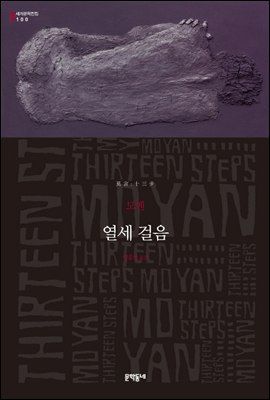
thirteen steps
 |
Description
Book Introduction
A representative novel by Mo Yan, winner of the 2012 Nobel Prize in Literature
Munhakdongne World Literature Collection, 100 volumes
The works of Mo Yan, the first Chinese writer to win the Nobel Prize in Literature in 2012, can be summed up in one word: “fantastic realism.”
Mo Yan's work, "Thirteen Steps," which contains his essence, was published as the 100th volume of the Munhakdongne World Literature Collection.
If you see a sparrow hopping on one leg, you will receive good luck. For the first twelve steps, you will receive good luck in wealth, officialdom, peach blossoms, and business. However, the moment you see the thirteenth step, all the luck you have received so far will turn into bad luck. Based on this Russian folk tale, this work realistically satirizes the lives of the Chinese people, crossing the boundaries between fantasy and reality.
This novel takes a unique form in which the narrator, 'you', locked in a zoo cage, tells the story of 'them' to the listener, 'we'.
'You' chews and swallows chalk and tells the tragic life of 'them', namely Fang Fugui, Zhang Ziqiu, and their families, intellectuals from a small provincial town.
But as the story progresses, the boundaries between 'you', 'us', and 'them' become blurred, and the flow of time becomes entangled.
The novel, which progresses as the narrator's thoughts arise, mixed with the narrator's subjective feelings and Chinese folk tales, best exemplifies Mo Yan's style of work, where the boundary between story and reality becomes blurred.
But this story, like a legend, a folk tale, or a myth, depicts 20th-century China.
Mo Yan penetrates the reality that we cannot and do not want to believe in, but which exists inevitably, with fantastical realism, eloquently asserting that no single event or single perspective of history is the truth, and refusing to allow a single point of view or a single narrator to dominate and control the fate and events of the characters.
Munhakdongne World Literature Collection, 100 volumes
The works of Mo Yan, the first Chinese writer to win the Nobel Prize in Literature in 2012, can be summed up in one word: “fantastic realism.”
Mo Yan's work, "Thirteen Steps," which contains his essence, was published as the 100th volume of the Munhakdongne World Literature Collection.
If you see a sparrow hopping on one leg, you will receive good luck. For the first twelve steps, you will receive good luck in wealth, officialdom, peach blossoms, and business. However, the moment you see the thirteenth step, all the luck you have received so far will turn into bad luck. Based on this Russian folk tale, this work realistically satirizes the lives of the Chinese people, crossing the boundaries between fantasy and reality.
This novel takes a unique form in which the narrator, 'you', locked in a zoo cage, tells the story of 'them' to the listener, 'we'.
'You' chews and swallows chalk and tells the tragic life of 'them', namely Fang Fugui, Zhang Ziqiu, and their families, intellectuals from a small provincial town.
But as the story progresses, the boundaries between 'you', 'us', and 'them' become blurred, and the flow of time becomes entangled.
The novel, which progresses as the narrator's thoughts arise, mixed with the narrator's subjective feelings and Chinese folk tales, best exemplifies Mo Yan's style of work, where the boundary between story and reality becomes blurred.
But this story, like a legend, a folk tale, or a myth, depicts 20th-century China.
Mo Yan penetrates the reality that we cannot and do not want to believe in, but which exists inevitably, with fantastical realism, eloquently asserting that no single event or single perspective of history is the truth, and refusing to allow a single point of view or a single narrator to dominate and control the fate and events of the characters.
- You can preview some of the book's contents.
Preview
index
One step
Two steps
three steps
Four steps
Five steps
six steps
Seven steps
Eight steps
Nine steps
Ten steps
Eleven steps
twelve steps
thirteen steps
Commentary | A Tragic Transformation of People Driven into an Oppressive Reality (Lee Wook-yeon)
Mo Yan's chronology
Two steps
three steps
Four steps
Five steps
six steps
Seven steps
Eight steps
Nine steps
Ten steps
Eleven steps
twelve steps
thirteen steps
Commentary | A Tragic Transformation of People Driven into an Oppressive Reality (Lee Wook-yeon)
Mo Yan's chronology
Publisher's Review
A representative novel by Mo Yan, winner of the 2012 Nobel Prize in Literature
Munhakdongne World Literature Collection, 100 volumes
“Mo Yan is a fantastic realist
“It fuses folk tales, history, and contemporary reality.”
Reasons for being selected for the 2012 Nobel Prize in Literature
“A fantastic tale drawn from Chinese culture.
“It’s brutal and fascinating.”
Rexpress
Mo Yan, the first Chinese mainlander to win the Nobel Prize in Literature in 2012.
The world of works by Mo Yan, a master of modern Chinese literature who is called the Chinese Franz Kafka and William Faulkner, can be simply defined as “fantastic realism.”
『Thirteen Steps』, which contains the essence of Mo Yan, was published as the 100th volume of the Munhakdongne World Literature Collection.
Since his debut in 1981 with the short story "A Shower on a Spring Night," Mo Yan has been very active, publishing eleven novels and eight short story collections, and successfully staging his original play "Farewell My Concubine" for 40 consecutive performances.
Mo Yan, who has been working as a writer for over 30 years and has depicted the primal vitality of the Chinese people against the backdrop of the rural life in his hometown of Gaomi, Shandong Province, first wrote "Thirteen Steps" in his hometown of Gaomi in 1987.
"Thirteen Steps" is based on a Russian folk tale that says that if you see a sparrow take twelve steps one by one instead of jumping on two feet, you will be blessed with good luck, but the moment you see it take the thirteenth step, all the luck you had up to the twelfth step will be doubled. It was first published in 1989, but was republished in 2003 after being significantly revised over ten years later.
Experiments and challenges in the novel format that unfolds without hesitation
A fantasy that blooms like a thick fog where boundaries disappear!
Mo Yan is a writer famous for “combining history and fantasy, reality and imagination against the backdrop of Chinese history and reality, to create a continuous stream of bizarre, absurd, and amazing stories” (Lee Wook-yeon).
It is also famous for its world where the speaker and listener frequently change positions, the flow of time becomes entangled, objective facts and subjective impressions are mixed, and the boundary between story and reality becomes unclear.
Through this type of experimentation, Mo Yan has built his own unique literary world, defined as “fantastic realism.” Among Mo Yan’s numerous works, “Thirteen Steps” in particular is the essence of Mo Yan’s literature, as it best embodies the reasons given by the Swedish Academy when it selected Mo Yan as the winner of the 2012 Nobel Prize in Literature.
"Thirteen Steps" takes the form of a narrator trapped in a zoo cage chewing and swallowing chalk while telling the listener (or reader) about events that happened in their city.
However, as the narrative point of view constantly changes, the narrator is sometimes 'I' and then 'you', and the listener also seems to be 'we' at first, but soon becomes 'you' and then at some point appears as 'I'.
In the narrator's story, 'they' also appear alternately as 'I' and 'you'.
The story also does not unfold in chronological order.
It unfolds as the narrator's thoughts come to mind, mixed with the narrator's subjective feelings and Chinese folk tales.
But these stories, which sound like legends, folktales, or myths, depict the reality of 20th-century China.
Mo Yan penetrates the reality that we cannot and do not want to believe in, but which exists inevitably, with fantastical realism, eloquently asserting that no single event or single perspective of history is the truth, and refusing to allow a single point of view or a single narrator to dominate and control the fate and events of the characters.
A tragic transformation of a human being losing his or her subjectivity in an oppressive reality.
Are you a human or a beast?
In a small town in China in the 1980s, Zhang Ziqiu and Fang Fugui are neighbors and physics teachers at the same school, living in poverty with only a thin wall between them.
These two are college-educated intellectuals, but their reality is extremely poor and miserable.
At home, he is a miserable head of the household, and at school, he is just a teacher who has to constantly whip and push his students to increase their college admission rates.
Then one day, when Pang Fugui faints during class, the school treats it as a death from overwork.
As news of Fang Fugui's "death on duty" spreads beyond the school, a campaign to help teachers driven to death by low wages and overwork begins, and the city government decides to invest heavily in improving teachers' treatment.
Meanwhile, Fang Fugui, who is not dead, regains consciousness in the car being taken to the funeral home, but the principal forces Fang Fugui to die, saying that if he dies, the lives of all the teachers will improve, and that he will 'exchange a little inhumanity for a great humanitarianism'.
It all started with a middle school teacher in a small town fainting from overwork on the podium.
However, when that small incident intertwined with the oppressive reality of Chinese intellectuals after the Cultural Revolution, the inhumane educational culture focused on college entrance exams, and the poverty that made it difficult to even afford a single piece of meat, it developed into something abnormal that no one could have imagined.
And in it, Fang Fugui, Zhang Ziqiu, and their families begin to take steps toward tragedy, gradually losing the humanity they had barely maintained as an illusion.
Mo Yan combines history and fantasy, reality and imagination against the backdrop of Chinese history and reality, creating a continuous stream of bizarre, absurd, and wondrous stories.
This is where Mo Yan's story has its unique personality.
The countless bizarre, absurd, and bizarre stories that appear in his novels are not simply entertainment, but symbols and evidence of the madness of history and the oppressed reality.
_From the commentary
“There is a very old and beautiful legend.
There was a man who saw a sparrow take one step at a time.
They say that if you see a sparrow walking step by step like a chick, good luck will fall from the sky.
If a sparrow takes one step, it will bring you windfall fortune. If it takes two steps, it will bring you good fortune. If it takes three steps, it will bring you good luck. If it takes four steps, it will bring you good health. If it takes five steps, it will always be in a good mood. If it takes six steps, it will make your business go smoothly.
If you take seven steps, your wisdom will double. If you take eight steps, your wife will do well. If you take nine steps, your name will spread throughout the world. If you take ten steps, your appearance will change. If you take eleven steps, your wife will become beautiful. If you take twelve steps, your wife and lover will get along harmoniously and become close like sisters.
But you should never look at the thirteenth step.
If you see a sparrow take its thirteenth step, all your previous good luck will turn into double bad luck and fall on your head!” _Page 552
Munhakdongne World Literature Collection, 100 volumes
“Mo Yan is a fantastic realist
“It fuses folk tales, history, and contemporary reality.”
Reasons for being selected for the 2012 Nobel Prize in Literature
“A fantastic tale drawn from Chinese culture.
“It’s brutal and fascinating.”
Rexpress
Mo Yan, the first Chinese mainlander to win the Nobel Prize in Literature in 2012.
The world of works by Mo Yan, a master of modern Chinese literature who is called the Chinese Franz Kafka and William Faulkner, can be simply defined as “fantastic realism.”
『Thirteen Steps』, which contains the essence of Mo Yan, was published as the 100th volume of the Munhakdongne World Literature Collection.
Since his debut in 1981 with the short story "A Shower on a Spring Night," Mo Yan has been very active, publishing eleven novels and eight short story collections, and successfully staging his original play "Farewell My Concubine" for 40 consecutive performances.
Mo Yan, who has been working as a writer for over 30 years and has depicted the primal vitality of the Chinese people against the backdrop of the rural life in his hometown of Gaomi, Shandong Province, first wrote "Thirteen Steps" in his hometown of Gaomi in 1987.
"Thirteen Steps" is based on a Russian folk tale that says that if you see a sparrow take twelve steps one by one instead of jumping on two feet, you will be blessed with good luck, but the moment you see it take the thirteenth step, all the luck you had up to the twelfth step will be doubled. It was first published in 1989, but was republished in 2003 after being significantly revised over ten years later.
Experiments and challenges in the novel format that unfolds without hesitation
A fantasy that blooms like a thick fog where boundaries disappear!
Mo Yan is a writer famous for “combining history and fantasy, reality and imagination against the backdrop of Chinese history and reality, to create a continuous stream of bizarre, absurd, and amazing stories” (Lee Wook-yeon).
It is also famous for its world where the speaker and listener frequently change positions, the flow of time becomes entangled, objective facts and subjective impressions are mixed, and the boundary between story and reality becomes unclear.
Through this type of experimentation, Mo Yan has built his own unique literary world, defined as “fantastic realism.” Among Mo Yan’s numerous works, “Thirteen Steps” in particular is the essence of Mo Yan’s literature, as it best embodies the reasons given by the Swedish Academy when it selected Mo Yan as the winner of the 2012 Nobel Prize in Literature.
"Thirteen Steps" takes the form of a narrator trapped in a zoo cage chewing and swallowing chalk while telling the listener (or reader) about events that happened in their city.
However, as the narrative point of view constantly changes, the narrator is sometimes 'I' and then 'you', and the listener also seems to be 'we' at first, but soon becomes 'you' and then at some point appears as 'I'.
In the narrator's story, 'they' also appear alternately as 'I' and 'you'.
The story also does not unfold in chronological order.
It unfolds as the narrator's thoughts come to mind, mixed with the narrator's subjective feelings and Chinese folk tales.
But these stories, which sound like legends, folktales, or myths, depict the reality of 20th-century China.
Mo Yan penetrates the reality that we cannot and do not want to believe in, but which exists inevitably, with fantastical realism, eloquently asserting that no single event or single perspective of history is the truth, and refusing to allow a single point of view or a single narrator to dominate and control the fate and events of the characters.
A tragic transformation of a human being losing his or her subjectivity in an oppressive reality.
Are you a human or a beast?
In a small town in China in the 1980s, Zhang Ziqiu and Fang Fugui are neighbors and physics teachers at the same school, living in poverty with only a thin wall between them.
These two are college-educated intellectuals, but their reality is extremely poor and miserable.
At home, he is a miserable head of the household, and at school, he is just a teacher who has to constantly whip and push his students to increase their college admission rates.
Then one day, when Pang Fugui faints during class, the school treats it as a death from overwork.
As news of Fang Fugui's "death on duty" spreads beyond the school, a campaign to help teachers driven to death by low wages and overwork begins, and the city government decides to invest heavily in improving teachers' treatment.
Meanwhile, Fang Fugui, who is not dead, regains consciousness in the car being taken to the funeral home, but the principal forces Fang Fugui to die, saying that if he dies, the lives of all the teachers will improve, and that he will 'exchange a little inhumanity for a great humanitarianism'.
It all started with a middle school teacher in a small town fainting from overwork on the podium.
However, when that small incident intertwined with the oppressive reality of Chinese intellectuals after the Cultural Revolution, the inhumane educational culture focused on college entrance exams, and the poverty that made it difficult to even afford a single piece of meat, it developed into something abnormal that no one could have imagined.
And in it, Fang Fugui, Zhang Ziqiu, and their families begin to take steps toward tragedy, gradually losing the humanity they had barely maintained as an illusion.
Mo Yan combines history and fantasy, reality and imagination against the backdrop of Chinese history and reality, creating a continuous stream of bizarre, absurd, and wondrous stories.
This is where Mo Yan's story has its unique personality.
The countless bizarre, absurd, and bizarre stories that appear in his novels are not simply entertainment, but symbols and evidence of the madness of history and the oppressed reality.
_From the commentary
“There is a very old and beautiful legend.
There was a man who saw a sparrow take one step at a time.
They say that if you see a sparrow walking step by step like a chick, good luck will fall from the sky.
If a sparrow takes one step, it will bring you windfall fortune. If it takes two steps, it will bring you good fortune. If it takes three steps, it will bring you good luck. If it takes four steps, it will bring you good health. If it takes five steps, it will always be in a good mood. If it takes six steps, it will make your business go smoothly.
If you take seven steps, your wisdom will double. If you take eight steps, your wife will do well. If you take nine steps, your name will spread throughout the world. If you take ten steps, your appearance will change. If you take eleven steps, your wife will become beautiful. If you take twelve steps, your wife and lover will get along harmoniously and become close like sisters.
But you should never look at the thirteenth step.
If you see a sparrow take its thirteenth step, all your previous good luck will turn into double bad luck and fall on your head!” _Page 552
GOODS SPECIFICS
- Date of publication: October 29, 2012
- Page count, weight, size: 572 pages | 730g | 140*210*35mm
- ISBN13: 9788954619554
- ISBN10: 895461955X
You may also like
카테고리
korean


korean

![GQ KOREA Mark (Monthly): December [2025]](http://librairie.coreenne.fr/cdn/shop/files/8ef265dbbfbf186523ed75ba7319009d.jpg?v=1765340328&width=3840)


