

From eternity to eternity
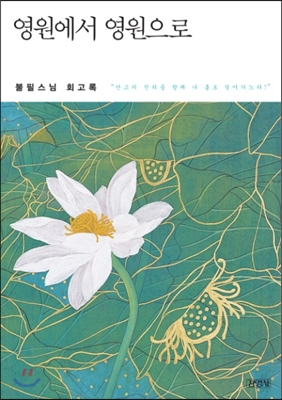 |
Description
Book Introduction
100th anniversary of the birth of Monk Seongcheol, the story of the great monk revealed for the first time by his daughter and disciple, Monk Bulpil!
An essay by Monk Bulpil, the only blood relative of Monk Seongcheol, titled “From Eternity to Eternity.”
Published to commemorate the 100th anniversary of the birth of the great monk, this book reveals for the first time the family history of the great monk Seongcheol, from the practice of Zen masters who transcended human limitations, to the teachings of the great monks who warmly embraced their disciples, to the dharma talks of the great monks who inspired the public, the history of Korean Buddhism is subtly imbued in each bookmark, and the beautiful fragrance of the monks is deeply engraved in the pattern.
In this book, Monk Seongcheol reveals his true self, which was both most thorough and most compassionate, through the eyes of Monk Bulpil, who was the closest to him and yet the most distant.
Instead of being called 'Father', the decision to take the role of a priest who guides the path of the great free being 'from eternity to eternity' was an example of a practitioner who walks alone and aloof toward the eternal truth.
In this, Monk Bulpil bows nine times, promising to meet Monk Seongcheol again in all three times, past, present, and future, and pledges to meet Monk Seongcheol again as an eternal great free being.
This book contains the saintly lives of great monks such as Inhong, Beopjeon, Hyanggok, Myoeom, and Beopjeong.
For example, Venerable Beopjeon, the 11th head of the Jogye Order, was called the “monk with a mortarboard” because he sat motionless in the meditation room at Haeinsa Temple.
Even during the traditional Yongmaeng Jeongjin of Haeinsa Temple, where one does not sleep for a week, the only person who did not sleep was Monk Beopjeon.
It is said that when his disciples asked him the secret to not falling asleep, Monk Beopjeon said this.
“If you think that you will die if you fall asleep, can you sleep?” This kind of thorough mental and practice made Venerable Beopjeon a great monk of our time.
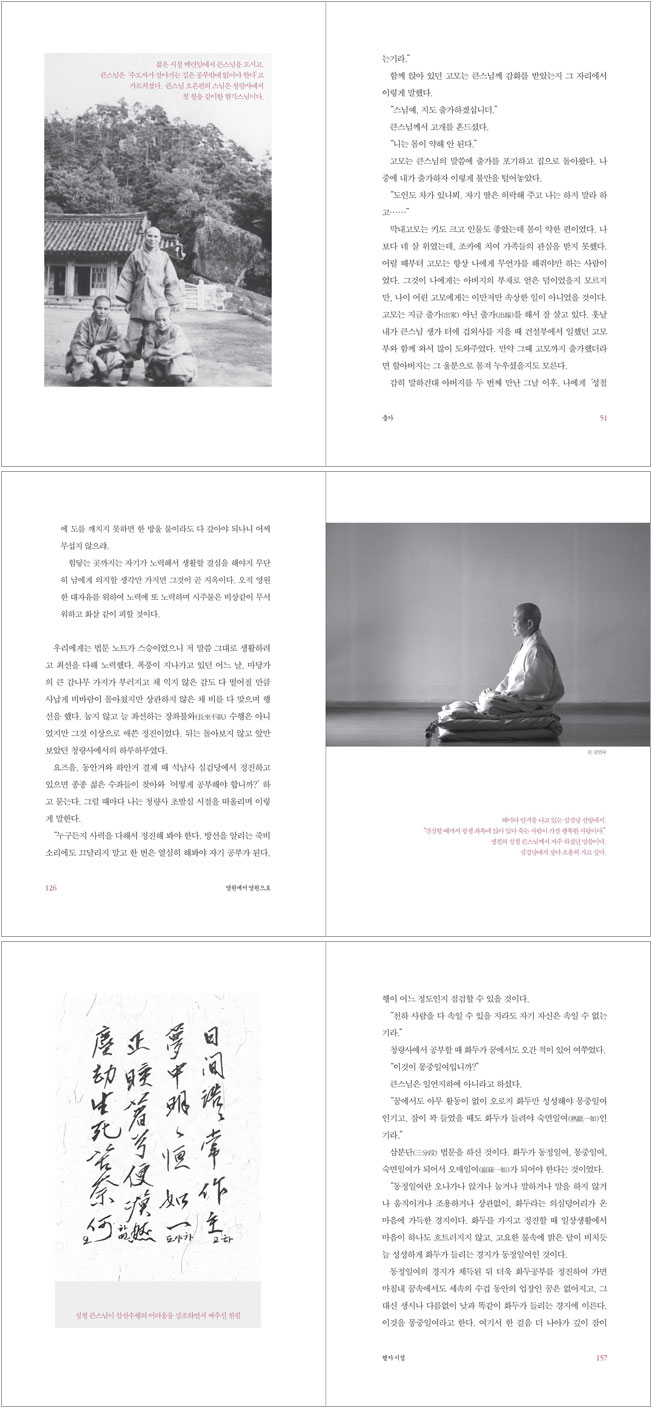
Additionally, this book contains Buddhist scriptures, letters, and photographs of Monk Seongcheol that were previously kept privately by Monk Bulpil and unknown to the world, as well as Monk Seongcheol's handwritten Buddhist scripture notes that were previously published in an edited form, in their original form.
It is also a good guidebook for beginners studying Buddhism, as it contains various materials such as “Jeungdoga,” “Shinsimmyeong,” and “Togulga,” which can serve as guides for Buddhist practitioners.
An essay by Monk Bulpil, the only blood relative of Monk Seongcheol, titled “From Eternity to Eternity.”
Published to commemorate the 100th anniversary of the birth of the great monk, this book reveals for the first time the family history of the great monk Seongcheol, from the practice of Zen masters who transcended human limitations, to the teachings of the great monks who warmly embraced their disciples, to the dharma talks of the great monks who inspired the public, the history of Korean Buddhism is subtly imbued in each bookmark, and the beautiful fragrance of the monks is deeply engraved in the pattern.
In this book, Monk Seongcheol reveals his true self, which was both most thorough and most compassionate, through the eyes of Monk Bulpil, who was the closest to him and yet the most distant.
Instead of being called 'Father', the decision to take the role of a priest who guides the path of the great free being 'from eternity to eternity' was an example of a practitioner who walks alone and aloof toward the eternal truth.
In this, Monk Bulpil bows nine times, promising to meet Monk Seongcheol again in all three times, past, present, and future, and pledges to meet Monk Seongcheol again as an eternal great free being.
This book contains the saintly lives of great monks such as Inhong, Beopjeon, Hyanggok, Myoeom, and Beopjeong.
For example, Venerable Beopjeon, the 11th head of the Jogye Order, was called the “monk with a mortarboard” because he sat motionless in the meditation room at Haeinsa Temple.
Even during the traditional Yongmaeng Jeongjin of Haeinsa Temple, where one does not sleep for a week, the only person who did not sleep was Monk Beopjeon.
It is said that when his disciples asked him the secret to not falling asleep, Monk Beopjeon said this.
“If you think that you will die if you fall asleep, can you sleep?” This kind of thorough mental and practice made Venerable Beopjeon a great monk of our time.
Additionally, this book contains Buddhist scriptures, letters, and photographs of Monk Seongcheol that were previously kept privately by Monk Bulpil and unknown to the world, as well as Monk Seongcheol's handwritten Buddhist scripture notes that were previously published in an edited form, in their original form.
It is also a good guidebook for beginners studying Buddhism, as it contains various materials such as “Jeungdoga,” “Shinsimmyeong,” and “Togulga,” which can serve as guides for Buddhist practitioners.
- You can preview some of the book's contents.
Preview
index
When Monk Seongcheol left home: Alone, I am heading towards the eternal truth.
Preface: Where Are We Going?
Chapter 1: Fate: Where and in What Form Will We Meet Again?
My hometown, Mukgok-ri
Meeting Father Seongcheol for the first time
The experience of war that made me feel the transience of life
Chapter 2: Leaving Home: Eternal Happiness and Temporary Happiness
“What is eternal happiness?”
The night before leaving home
Grandmother's sacred maternal love
A mother's dream buried in my heart
Chapter 3 Handwritten Dharma Talk Notes: I am originally a Buddha, but I do not know it.
A practitioner must learn from poverty.
A textbook for practitioners written by the great monk
The Eight Precepts of the Capital: From Sacrifice to Asceticism
Chapter 4: The Practitioner's Day: The Beginnings of the Short-Haired Practitioners
There is no tomorrow
I remember
“Aman is a strong offering maker!”
When Emperor Shunzhi left home in Togulga
Even in dreams, if the topic is clear
Song of Enlightenment
Beware of reason
Chapter 5: Seoknamsa Temple: Serving the Tiger of Gajisan Mountain as a Teacher
Of all things, it's unavoidable
Go to Jeongjindo
The great monks' dharma talk surprised the entire public.
Balwoo offering ceremony for 100 people
Healing a friend's incurable illness through 3,000 repetitions
The secret to not falling asleep at the mortarboard
The monk who saved my life through three days of prayer
Mother, become a monk
Chapter 6: Practice: Finding the Path to Eternal Freedom
Breaking a 10-year silence, he speaks out.
The three-year struggle of the Simgeomdang, which gave its all
Bravery and diligence, don't even lean on a chair
A mission for harmony
The innocent heart of adult monks
Intoxicated by the summer flowers of Gajisan Mountain
Chapter 7 Haeinsa Temple: A Temple of Wisdom and Compassion
The first and last letter I received from the great monk
Buddhist scenery
No one dies from bowing down
Family practice
Chapter 8 Eternal Times
The bell of nirvana
My power will not move
A place beyond time and space, a place of fear
A spring day in March of the lunar calendar in 1997
From eternity to eternity
Here we erect a monument to the great monk.
Preface: Where Are We Going?
Chapter 1: Fate: Where and in What Form Will We Meet Again?
My hometown, Mukgok-ri
Meeting Father Seongcheol for the first time
The experience of war that made me feel the transience of life
Chapter 2: Leaving Home: Eternal Happiness and Temporary Happiness
“What is eternal happiness?”
The night before leaving home
Grandmother's sacred maternal love
A mother's dream buried in my heart
Chapter 3 Handwritten Dharma Talk Notes: I am originally a Buddha, but I do not know it.
A practitioner must learn from poverty.
A textbook for practitioners written by the great monk
The Eight Precepts of the Capital: From Sacrifice to Asceticism
Chapter 4: The Practitioner's Day: The Beginnings of the Short-Haired Practitioners
There is no tomorrow
I remember
“Aman is a strong offering maker!”
When Emperor Shunzhi left home in Togulga
Even in dreams, if the topic is clear
Song of Enlightenment
Beware of reason
Chapter 5: Seoknamsa Temple: Serving the Tiger of Gajisan Mountain as a Teacher
Of all things, it's unavoidable
Go to Jeongjindo
The great monks' dharma talk surprised the entire public.
Balwoo offering ceremony for 100 people
Healing a friend's incurable illness through 3,000 repetitions
The secret to not falling asleep at the mortarboard
The monk who saved my life through three days of prayer
Mother, become a monk
Chapter 6: Practice: Finding the Path to Eternal Freedom
Breaking a 10-year silence, he speaks out.
The three-year struggle of the Simgeomdang, which gave its all
Bravery and diligence, don't even lean on a chair
A mission for harmony
The innocent heart of adult monks
Intoxicated by the summer flowers of Gajisan Mountain
Chapter 7 Haeinsa Temple: A Temple of Wisdom and Compassion
The first and last letter I received from the great monk
Buddhist scenery
No one dies from bowing down
Family practice
Chapter 8 Eternal Times
The bell of nirvana
My power will not move
A place beyond time and space, a place of fear
A spring day in March of the lunar calendar in 1997
From eternity to eternity
Here we erect a monument to the great monk.
Detailed image
Into the book
Great monk Seongcheol, who led the way to great freedom from eternity to eternity.
I was born the daughter of a great monk by a great fate, but I never once called him father.
And from the moment I met him at the Cheonjegul Cave in Anjeongsa Temple at the age of seventeen, the great monk was not a father to me, but only a teacher.
Yet, it seems like people around me only see me as the daughter of a great monk.
I was the one who was closest to the great monk, yet had to be the farthest away.
That is why I was unable to attend the great monk's funeral or the cremation ceremony at Yeonhwadae, and it was only late in the afternoon on the day of the cremation that I was able to bow while watching the flames fading away at the crematorium above Geumganggul Cave.
It was a nine-fold bow, a promise to meet again in the past, present, and future.
- From “Preparing a Book: Where Are We Going?”
When I arrived at the entrance to Myogwaneumsa Temple, it was already sunset.
After climbing up the mountainside with a view of the sea for a while, I saw a monk with a scary appearance.
It wasn't the image of my father I had imagined.
I later found out that it was my father's disciple, Monk Hyanggok.
… … Father, the great monk, probably knew we were coming and had fled somewhere.
After a while, a monk with sharp eyes and wearing tattered rags appeared with Monk Hyanggok.
The moment I thought to myself, 'Is that him?', he shouted loudly.
“Go, go!”
The moment I heard those words, I grabbed my uncle's hand tightly and turned around without a single second of hesitation.
“Let’s go home, Uncle!” - From “Meeting Father, Monk Seongcheol for the First Time”
Once, I went to visit the great monk at Beomeosa Temple's Wonhyoam Temple, and heard that he had been at Donghwasa Temple's Geumdang Seonwon Temple, then went to Eunhyesa Temple and Unbuam Temple, and then went to Geumgangsan Mountain.
The year that the great monk meditated at Mahayana in Geumgangsan was 1940, so it was about four years after he became a monk.
The grandmother asked for directions and endured all kinds of hardships to find her way to Mahayeon in Geumgangsan Mountain, but the great monk treated her very coldly, shouting at her, “Why did you come such a long way?”
Grandma said, “No, I didn’t come to see you.
“I heard that Geumgangsan is so nice that I came to see it,” he said.
Even the great monk could not continue speaking at this answer.
What more can one say in that situation?
Only the people involved will know the shocking feelings of the mother who came all this way to visit her son during the difficult times of the Japanese colonial period, when transportation was not as convenient as it is today.
-From “Grandmother’s Sacred Maternal Love”
At that time, there were three monks in Seongjeonam who were serving a great monk. This is a story I heard from one of them, a fellow monk (Monk Cheonje).
“I heard noises and went outside, and there was a young woman asking to see the monk.
Even though I told him, 'The great monk is not meeting anyone right now, so please just go back,' he just kept repeating that he had to meet the monk.
As the sun set, he disappeared somewhere.
I thought he must have gone back, so I finished the dinner offering.
After the offering, the great monk came to the attendant’s room and was about to speak when the door creaked open and the man I had seen during the day barged in.”
“Monk, I have something to tell you!”
… … The reason she went to see the great monk, knowing full well that her mother would be expelled, was because she wanted to negotiate, saying, ‘If you are so good, why don’t you go alone? Why did you take my only daughter with you? If you give me back my daughter, I will raise her to be as wonderful as anyone in this world.’
But, he was kicked out without being able to say a single word, so how did he feel as he returned with empty steps?
-From "Mother's Dream Buried in My Heart"
Even now, when I read the great monk's sermons, they are written in clear and modern language, so they are easy to understand.
It was written in the 1950s, when the great monk was in his mid-40s, and I cannot help but be amazed at how clear the content is and how logical the sentences are without any unnecessary details.
… …
When the Buddha attained enlightenment, he exclaimed for the first time, “How wonderful, how wonderful!
“All living beings possess Buddha-nature that is ever-present and never-ending! It is truly a pity that they do not know this and wander aimlessly, suffering endlessly.”
This is the first news that declares to us vain humans that there is an immortal being.
Thus, all lives that were immersed in darkness have found the path to eternal salvation. How can we repay this grace?
Let us worship, make offerings, and praise Him for countless kalpas.
Even this eternally shining being, before it cultivates the Way and emits its light, is always shrouded in darkness, its front and back dark.
So when you change your body, you completely forget your past life and don't know that your true life continues without disappearing.
- From “The Practitioner’s Textbook Written by the Great Monk”
The great monk also made this vow about helping others:
I pray with the utmost sincerity to all the Buddhas who are always present in the present world.
/ Oh, holy Buddha! / I have realized that harming others for my own sake is the root of unhappiness, / and that true happiness comes only from abandoning myself and helping others. / Please lead me to the path of eternal happiness by becoming a person who always neglects my own body and lives only for others.
/ I will serve all living beings with all my heart, without distinction between close and enemies, / as if I were my parents or the Buddha, / and I will do my best to help with anything that benefits living beings.
/ Oh Buddha! / I will repent for all the many sins committed by all living beings due to their foolishness, / and I will take upon myself all the unspeakable / and extremely bitter suffering that all living beings suffer as a result of their sins. / I pray and pray endlessly that all those poor living beings will be freed from all suffering / and that they will all attain eternal happiness together, never to be surpassed again.
/ From the Wooden Shakyamuni Buddha - "Cure a Friend's Incurable Illness with 3,000 Bows" (first published sermon by Monk Seongcheol)
I was born the daughter of a great monk by a great fate, but I never once called him father.
And from the moment I met him at the Cheonjegul Cave in Anjeongsa Temple at the age of seventeen, the great monk was not a father to me, but only a teacher.
Yet, it seems like people around me only see me as the daughter of a great monk.
I was the one who was closest to the great monk, yet had to be the farthest away.
That is why I was unable to attend the great monk's funeral or the cremation ceremony at Yeonhwadae, and it was only late in the afternoon on the day of the cremation that I was able to bow while watching the flames fading away at the crematorium above Geumganggul Cave.
It was a nine-fold bow, a promise to meet again in the past, present, and future.
- From “Preparing a Book: Where Are We Going?”
When I arrived at the entrance to Myogwaneumsa Temple, it was already sunset.
After climbing up the mountainside with a view of the sea for a while, I saw a monk with a scary appearance.
It wasn't the image of my father I had imagined.
I later found out that it was my father's disciple, Monk Hyanggok.
… … Father, the great monk, probably knew we were coming and had fled somewhere.
After a while, a monk with sharp eyes and wearing tattered rags appeared with Monk Hyanggok.
The moment I thought to myself, 'Is that him?', he shouted loudly.
“Go, go!”
The moment I heard those words, I grabbed my uncle's hand tightly and turned around without a single second of hesitation.
“Let’s go home, Uncle!” - From “Meeting Father, Monk Seongcheol for the First Time”
Once, I went to visit the great monk at Beomeosa Temple's Wonhyoam Temple, and heard that he had been at Donghwasa Temple's Geumdang Seonwon Temple, then went to Eunhyesa Temple and Unbuam Temple, and then went to Geumgangsan Mountain.
The year that the great monk meditated at Mahayana in Geumgangsan was 1940, so it was about four years after he became a monk.
The grandmother asked for directions and endured all kinds of hardships to find her way to Mahayeon in Geumgangsan Mountain, but the great monk treated her very coldly, shouting at her, “Why did you come such a long way?”
Grandma said, “No, I didn’t come to see you.
“I heard that Geumgangsan is so nice that I came to see it,” he said.
Even the great monk could not continue speaking at this answer.
What more can one say in that situation?
Only the people involved will know the shocking feelings of the mother who came all this way to visit her son during the difficult times of the Japanese colonial period, when transportation was not as convenient as it is today.
-From “Grandmother’s Sacred Maternal Love”
At that time, there were three monks in Seongjeonam who were serving a great monk. This is a story I heard from one of them, a fellow monk (Monk Cheonje).
“I heard noises and went outside, and there was a young woman asking to see the monk.
Even though I told him, 'The great monk is not meeting anyone right now, so please just go back,' he just kept repeating that he had to meet the monk.
As the sun set, he disappeared somewhere.
I thought he must have gone back, so I finished the dinner offering.
After the offering, the great monk came to the attendant’s room and was about to speak when the door creaked open and the man I had seen during the day barged in.”
“Monk, I have something to tell you!”
… … The reason she went to see the great monk, knowing full well that her mother would be expelled, was because she wanted to negotiate, saying, ‘If you are so good, why don’t you go alone? Why did you take my only daughter with you? If you give me back my daughter, I will raise her to be as wonderful as anyone in this world.’
But, he was kicked out without being able to say a single word, so how did he feel as he returned with empty steps?
-From "Mother's Dream Buried in My Heart"
Even now, when I read the great monk's sermons, they are written in clear and modern language, so they are easy to understand.
It was written in the 1950s, when the great monk was in his mid-40s, and I cannot help but be amazed at how clear the content is and how logical the sentences are without any unnecessary details.
… …
When the Buddha attained enlightenment, he exclaimed for the first time, “How wonderful, how wonderful!
“All living beings possess Buddha-nature that is ever-present and never-ending! It is truly a pity that they do not know this and wander aimlessly, suffering endlessly.”
This is the first news that declares to us vain humans that there is an immortal being.
Thus, all lives that were immersed in darkness have found the path to eternal salvation. How can we repay this grace?
Let us worship, make offerings, and praise Him for countless kalpas.
Even this eternally shining being, before it cultivates the Way and emits its light, is always shrouded in darkness, its front and back dark.
So when you change your body, you completely forget your past life and don't know that your true life continues without disappearing.
- From “The Practitioner’s Textbook Written by the Great Monk”
The great monk also made this vow about helping others:
I pray with the utmost sincerity to all the Buddhas who are always present in the present world.
/ Oh, holy Buddha! / I have realized that harming others for my own sake is the root of unhappiness, / and that true happiness comes only from abandoning myself and helping others. / Please lead me to the path of eternal happiness by becoming a person who always neglects my own body and lives only for others.
/ I will serve all living beings with all my heart, without distinction between close and enemies, / as if I were my parents or the Buddha, / and I will do my best to help with anything that benefits living beings.
/ Oh Buddha! / I will repent for all the many sins committed by all living beings due to their foolishness, / and I will take upon myself all the unspeakable / and extremely bitter suffering that all living beings suffer as a result of their sins. / I pray and pray endlessly that all those poor living beings will be freed from all suffering / and that they will all attain eternal happiness together, never to be surpassed again.
/ From the Wooden Shakyamuni Buddha - "Cure a Friend's Incurable Illness with 3,000 Bows" (first published sermon by Monk Seongcheol)
--- From the text
Publisher's Review
“I walk alone toward the eternal truth!”
100th anniversary of the birth of Monk Seongcheol, the story of the great monk revealed for the first time by his daughter and disciple, Monk Bulpil!
From the family history of Monk Seongcheol, revealed for the first time, to the practices of Zen masters who transcended human limitations, from Monk Inhong, who warmly embraced his disciples, to the sermons of great monks who inspired the public, this book subtly reflects the history of Korean Buddhism in every page, and the beautiful fragrance of monks is deeply engraved in the book.
In this book, Monk Bulpil, the only blood relative of Monk Seongcheol, weaves together the heartbreaking family history of his grandparents and mother, the saintly lives of Zen masters such as Monk Hyanggok, Monk Beopjeon, and Monk Inhong, and the history of Korean Buddhism from the three-year retreat at Bongam Temple to the present.
In addition, it includes Buddhist sermons, letters, and photographic materials of Monk Seongcheol that were privately owned and unknown to the world, as well as Monk Seongcheol's handwritten Buddhist sermon notes that were previously published in an edited form, in their original form.
And it is also a good guidebook for beginners studying Buddhism, as it contains various materials such as “Jeungdoga,” “Shinsimmyeong,” and “Togulga,” which can serve as guides for Buddhist practitioners.
Monk Bulpil wrote this book over the past few years, his fingers growing calluses as he worked on it.
At first, I declined several publishing offers because I was not sure if it was right for a Zen monk who had lived in the mountains to publish a book. However, to mark the 100th anniversary of the birth of my father, Monk Seongcheol, I could not refuse the request to share with others what I had truly practiced with the public at Seoknamsa Temple, following the great monk's teachings.
Monk Bulpil expressed his thoughts on the publication, saying, “If even one person can live a life of eternal truth by receiving the great monk’s teachings through this book, I would be grateful.”
From heartbreaking family stories to the lives of our time's prophets.
In this book, Monk Seongcheol reveals his true self, which was both most thorough and most compassionate, through the eyes of Monk Bulpil, who was the closest to him and yet the most distant.
One day, a young Bodhisattva came to visit Haeinsa Temple, where Monk Seongcheol was staying.
When I heard the story, I realized that his son, who had fought in the Vietnam War, was worried that he might not return alive.
Monk Seongcheol first told the Bodhisattva to bring rice, cook it, and offer it to the Buddha.
And when he finished his work, he ordered him to pray three thousand times at once and then leave.
At first, they were given tasks that they could do on their own, and when they were finished, they were given bigger tasks to help them build their faith.
After completing the three thousand prostrations, the Bodhisattva came out as if waiting, but later he came to Baekryeonam on his own to pray.
It is said that Bodhisattva wanted to recite the Neung-eom-ju that everyone else did, but he was worried because he couldn't read Korean. So, he called the neighborhood children to his country house and bought them candy while having them recite the Neung-eom-ju and memorized it line by line.
The confession of Monk Bulpil, who has never once called Monk Seongcheol “father,” is also heartbreaking.
Even after Monk Bulpil passed away, Monk Seongcheol was unable to attend the funeral or cremation ceremony.
This is because there was a lot of talk in the newspaper about the meaning of the name of the monk Bulpil, which means 'no need [不必]', being interpreted as having a similar meaning to that of Rahula (必), the son of Shakyamuni.
On the late afternoon of the cremation day, Monk Bulpil bowed while watching the dying flames at the crematorium above Geumganggul Cave.
It was a nine-fold bow, a promise to meet again in the past, present, and future.
Monk Bulpil pledges, “I will open my mind’s eye in the sea of life and death and meet Monk Seongcheol again as an eternally free person.”
This book contains the saintly lives of great monks such as Inhong, Beopjeon, Hyanggok, Myoeom, and Beopjeong.
For example, Venerable Beopjeon, the 11th head of the Jogye Order, was called the “monk with a mortarboard” because he sat motionless in the meditation room at Haeinsa Temple.
Even during the traditional Yongmaeng Jeongjin of Haeinsa Temple, where one does not sleep for a week, the only person who did not sleep was Monk Beopjeon.
It is said that when his disciples asked him the secret to not falling asleep, Monk Beopjeon said this.
“If you think that you will die if you fall asleep, can you sleep?” This kind of thorough mental and practice made Venerable Beopjeon a great monk of our time.
The heartbreaking family history of Monk Seongcheol and Monk Bulpil is a precious story that can only be found in this book.
When Monk Bulpil decided to become a monk, his mother went to see her husband, Monk Seongcheol, to prevent her daughter from becoming a monk.
The mother, who had been waiting all day for Monk Seongcheol, who was meditating behind a barbed wire fence, breaks down the door and barges in while the monk is in the study.
Monk Seongcheol was furious and shouted at his disciples to kick him out immediately, and his mother shouted at her husband, Monk Seongcheol, “Monk, I have something to tell you!”
However, the mother was dragged out by the servants and eventually had to turn back without saying anything.
The mother, whose husband and daughter had left her, could not help but become a monk at the age of fifty-seven, perhaps because she had no choice but to live a life of Buddhahood.
To those who have lost their humanity in their hearts
Our society today may seem to be materially rich, but it is deeply mentally ill.
It is a tragedy of people who have lost their humanity in their hearts.
At the end of the book, Venerable Bulpil delivers a true message to readers by quoting Venerable Seongcheol’s dharma talk, “Let us look at ourselves properly.”
Man is originally a saved being and is already a Buddha.
However, we live our lives mistaking ourselves for scrap metal, because we cannot see ourselves as pure gold.
If you can let go of greed and use all your strength to help others, you will be able to see yourself clearly and become an enlightened Buddha.
This year is a significant year as it marks the 100th anniversary of the birth of the Venerable Seongcheol, the Buddha who came to us.
Let us reflect on the life and legacy of the great monk by listening to the vivid and trembling voice of his daughter and disciple, Monk Bulpil.
100th anniversary of the birth of Monk Seongcheol, the story of the great monk revealed for the first time by his daughter and disciple, Monk Bulpil!
From the family history of Monk Seongcheol, revealed for the first time, to the practices of Zen masters who transcended human limitations, from Monk Inhong, who warmly embraced his disciples, to the sermons of great monks who inspired the public, this book subtly reflects the history of Korean Buddhism in every page, and the beautiful fragrance of monks is deeply engraved in the book.
In this book, Monk Bulpil, the only blood relative of Monk Seongcheol, weaves together the heartbreaking family history of his grandparents and mother, the saintly lives of Zen masters such as Monk Hyanggok, Monk Beopjeon, and Monk Inhong, and the history of Korean Buddhism from the three-year retreat at Bongam Temple to the present.
In addition, it includes Buddhist sermons, letters, and photographic materials of Monk Seongcheol that were privately owned and unknown to the world, as well as Monk Seongcheol's handwritten Buddhist sermon notes that were previously published in an edited form, in their original form.
And it is also a good guidebook for beginners studying Buddhism, as it contains various materials such as “Jeungdoga,” “Shinsimmyeong,” and “Togulga,” which can serve as guides for Buddhist practitioners.
Monk Bulpil wrote this book over the past few years, his fingers growing calluses as he worked on it.
At first, I declined several publishing offers because I was not sure if it was right for a Zen monk who had lived in the mountains to publish a book. However, to mark the 100th anniversary of the birth of my father, Monk Seongcheol, I could not refuse the request to share with others what I had truly practiced with the public at Seoknamsa Temple, following the great monk's teachings.
Monk Bulpil expressed his thoughts on the publication, saying, “If even one person can live a life of eternal truth by receiving the great monk’s teachings through this book, I would be grateful.”
From heartbreaking family stories to the lives of our time's prophets.
In this book, Monk Seongcheol reveals his true self, which was both most thorough and most compassionate, through the eyes of Monk Bulpil, who was the closest to him and yet the most distant.
One day, a young Bodhisattva came to visit Haeinsa Temple, where Monk Seongcheol was staying.
When I heard the story, I realized that his son, who had fought in the Vietnam War, was worried that he might not return alive.
Monk Seongcheol first told the Bodhisattva to bring rice, cook it, and offer it to the Buddha.
And when he finished his work, he ordered him to pray three thousand times at once and then leave.
At first, they were given tasks that they could do on their own, and when they were finished, they were given bigger tasks to help them build their faith.
After completing the three thousand prostrations, the Bodhisattva came out as if waiting, but later he came to Baekryeonam on his own to pray.
It is said that Bodhisattva wanted to recite the Neung-eom-ju that everyone else did, but he was worried because he couldn't read Korean. So, he called the neighborhood children to his country house and bought them candy while having them recite the Neung-eom-ju and memorized it line by line.
The confession of Monk Bulpil, who has never once called Monk Seongcheol “father,” is also heartbreaking.
Even after Monk Bulpil passed away, Monk Seongcheol was unable to attend the funeral or cremation ceremony.
This is because there was a lot of talk in the newspaper about the meaning of the name of the monk Bulpil, which means 'no need [不必]', being interpreted as having a similar meaning to that of Rahula (必), the son of Shakyamuni.
On the late afternoon of the cremation day, Monk Bulpil bowed while watching the dying flames at the crematorium above Geumganggul Cave.
It was a nine-fold bow, a promise to meet again in the past, present, and future.
Monk Bulpil pledges, “I will open my mind’s eye in the sea of life and death and meet Monk Seongcheol again as an eternally free person.”
This book contains the saintly lives of great monks such as Inhong, Beopjeon, Hyanggok, Myoeom, and Beopjeong.
For example, Venerable Beopjeon, the 11th head of the Jogye Order, was called the “monk with a mortarboard” because he sat motionless in the meditation room at Haeinsa Temple.
Even during the traditional Yongmaeng Jeongjin of Haeinsa Temple, where one does not sleep for a week, the only person who did not sleep was Monk Beopjeon.
It is said that when his disciples asked him the secret to not falling asleep, Monk Beopjeon said this.
“If you think that you will die if you fall asleep, can you sleep?” This kind of thorough mental and practice made Venerable Beopjeon a great monk of our time.
The heartbreaking family history of Monk Seongcheol and Monk Bulpil is a precious story that can only be found in this book.
When Monk Bulpil decided to become a monk, his mother went to see her husband, Monk Seongcheol, to prevent her daughter from becoming a monk.
The mother, who had been waiting all day for Monk Seongcheol, who was meditating behind a barbed wire fence, breaks down the door and barges in while the monk is in the study.
Monk Seongcheol was furious and shouted at his disciples to kick him out immediately, and his mother shouted at her husband, Monk Seongcheol, “Monk, I have something to tell you!”
However, the mother was dragged out by the servants and eventually had to turn back without saying anything.
The mother, whose husband and daughter had left her, could not help but become a monk at the age of fifty-seven, perhaps because she had no choice but to live a life of Buddhahood.
To those who have lost their humanity in their hearts
Our society today may seem to be materially rich, but it is deeply mentally ill.
It is a tragedy of people who have lost their humanity in their hearts.
At the end of the book, Venerable Bulpil delivers a true message to readers by quoting Venerable Seongcheol’s dharma talk, “Let us look at ourselves properly.”
Man is originally a saved being and is already a Buddha.
However, we live our lives mistaking ourselves for scrap metal, because we cannot see ourselves as pure gold.
If you can let go of greed and use all your strength to help others, you will be able to see yourself clearly and become an enlightened Buddha.
This year is a significant year as it marks the 100th anniversary of the birth of the Venerable Seongcheol, the Buddha who came to us.
Let us reflect on the life and legacy of the great monk by listening to the vivid and trembling voice of his daughter and disciple, Monk Bulpil.
GOODS SPECIFICS
- Date of publication: September 21, 2012
- Page count, weight, size: 395 pages | 680g | 152*216*30mm
- ISBN13: 9788934959052
- ISBN10: 8934959053
You may also like
카테고리
korean


korean

![ELLE 엘르 스페셜 에디션 A형 : 12월 [2025]](http://librairie.coreenne.fr/cdn/shop/files/b8e27a3de6c9538896439686c6b0e8fb.jpg?v=1766436872&width=3840)


