

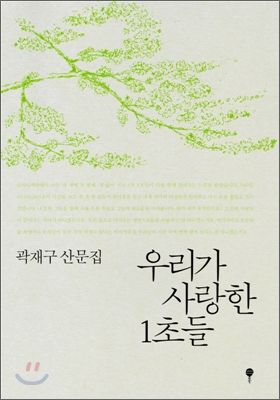
The seconds we loved
 |
Description
Book Introduction
Love every second that passes by you right now… This is a new collection of essays by Kwak Jae-gu, who has given readers a heartwarming feeling and warmth and comfort through works such as “At Sapyeong Station” and “Port Travel.” A record of the author's soul reflecting on the value and meaning of the countless seconds and fleeting moments of our lives while living for 540 days in Santiniketan, the hometown of Indian poet Tagore. The book tells the story of people who are poor, struggling, and having a hard time, but for whom earth is always heaven and life is a blessing. The wind sings and the flowers dance. He takes a small paper boat and travels back to his childhood memories, drifting down the stream of dreams. People, each a star, come together to form the Milky Way. In the world seen through the eyes of a poet, the insignificant everyday life we take for granted becomes a miracle and a source of happiness. The poet's trip to Santiniketan, not a famous holy site in India or a tourist destination with magnificent scenery, was to realize his 'meeting' with Tagore, which he had dreamed of for 40 years. Santiniketan, meaning 'village of peace', was an ordinary farming village before Tagore achieved international fame as a writer. The poet's stay in Santiniketan, born of his love and yearning for Tagore, brought him moments of nirvana, self-love and understanding, as he interacted with and empathized with the Santi people, who preserved the simplest yet most perfect way of life. These are times like an offering that invites us to the happy and precious seconds we wish to welcome in the future by learning the wisdom to love each and every second that passes by us now. The ordinary lives the poet encountered in Santi were sometimes beautiful, sometimes difficult and painful, but they were all wonderful. The traces of time and hardships of a life lived are transformed into a long lyric poem through the poet's eyes without any special rhetoric or decoration. * Go to related video |
- You can preview some of the book's contents.
Preview
index
At the beginning of the book
1.
When we travel between the stars
There was a boy selling paper boats.
There was a boy selling paper boats.
tie
At the outdoor cafe in Rattanpalli
The fourth most beautiful school in the world
When we travel between the stars
Greetings of love
When the Bosunto Baha flowers bloom
White paper boat going to the Akashi River
Square Dream
2.
The most beautiful rickshaw stand on earth
Subor, my poetry teacher
The most beautiful rickshaw stand on earth
The joy of meeting in Kwai
Amrita Chatterjee
Army, what are you doing?
Chaos Mahatto: The Fastest Path to Happiness
A good day to get hit by bird droppings
Visit Samvati Village, full of lotus flowers
The Story of Hanssem Rock
Traveling the Himalayas with a Child Who Wants to Be a Farmer Part 1
Traveling the Himalayas with a Child Who Wants to Be a Farmer Part 2
Traveling the Himalayas with a Child Who Wants to Be a Farmer Part 3
3.
Marcy's story
July 29, 2009, Mina and Sorumila
July 30, 2009
July 31, 2009
August 1, 2009
August 4, 2009
August 5, 2009, Window
August 27, 2009
September 1, 2009, Fl Fl Fl
September 2, 2009
September 4, 2009
September 5, 2009
September 6, 2009
September 7, 2009, Eunjoli
September 9, 2009, Potato Picnic
September 10, 2009
September 11, 2009, Sunduri Pool
September 16, 2009 Do you know Zorba?
September 17, 2009
Mina's lunch invitation, September 19, 2009
September 21, 2009
September 23, 2009
September 26, 2009
October 28, 2009, did you know?
November 15, 2009, Champagne Flower and Miso Sandwich
January 12, 2010, Washing the Blanket
4.
Taking a happy picture with a poor god
When the flowers bloom 1
When the flowers bloom 2
Spending 10 rupees in India
gift
Going on a picnic to Kolkata with a broken laptop
Watching a movie with Rondinine's family at Gitanjali
There is a lake in the dung, and there is a village in the dung.
How lovers talk
A dazzling festival of light and life unfolding in the crematorium
How to go another way
Taking a happy picture with a poor god
1.
When we travel between the stars
There was a boy selling paper boats.
There was a boy selling paper boats.
tie
At the outdoor cafe in Rattanpalli
The fourth most beautiful school in the world
When we travel between the stars
Greetings of love
When the Bosunto Baha flowers bloom
White paper boat going to the Akashi River
Square Dream
2.
The most beautiful rickshaw stand on earth
Subor, my poetry teacher
The most beautiful rickshaw stand on earth
The joy of meeting in Kwai
Amrita Chatterjee
Army, what are you doing?
Chaos Mahatto: The Fastest Path to Happiness
A good day to get hit by bird droppings
Visit Samvati Village, full of lotus flowers
The Story of Hanssem Rock
Traveling the Himalayas with a Child Who Wants to Be a Farmer Part 1
Traveling the Himalayas with a Child Who Wants to Be a Farmer Part 2
Traveling the Himalayas with a Child Who Wants to Be a Farmer Part 3
3.
Marcy's story
July 29, 2009, Mina and Sorumila
July 30, 2009
July 31, 2009
August 1, 2009
August 4, 2009
August 5, 2009, Window
August 27, 2009
September 1, 2009, Fl Fl Fl
September 2, 2009
September 4, 2009
September 5, 2009
September 6, 2009
September 7, 2009, Eunjoli
September 9, 2009, Potato Picnic
September 10, 2009
September 11, 2009, Sunduri Pool
September 16, 2009 Do you know Zorba?
September 17, 2009
Mina's lunch invitation, September 19, 2009
September 21, 2009
September 23, 2009
September 26, 2009
October 28, 2009, did you know?
November 15, 2009, Champagne Flower and Miso Sandwich
January 12, 2010, Washing the Blanket
4.
Taking a happy picture with a poor god
When the flowers bloom 1
When the flowers bloom 2
Spending 10 rupees in India
gift
Going on a picnic to Kolkata with a broken laptop
Watching a movie with Rondinine's family at Gitanjali
There is a lake in the dung, and there is a village in the dung.
How lovers talk
A dazzling festival of light and life unfolding in the crematorium
How to go another way
Taking a happy picture with a poor god
Detailed image

Into the book
The little girl I met at the flea market in Kwai was selling seven paper boats with colorful pictures on them.
Our childhood was spent folding paper boats, and future generations will also fold paper boats and float them on the stream.
Though we are shabby souls, we will all become small paper boats and float into the river of life. ---p.19
On a lucky day, a breeze might blow through, and you can briefly escape the heat by sitting on a wooden chair and looking at the stars.
As I watch the fireflies twinkle and fly, I feel compassion for all the scenery unfolding in the darkness.
The roads, the trees, the houses, the birds and monkeys of the forest, today too, everyone worked hard to live their own lives.
Wouldn't that be truly great? ---p.37
This school is the fourth most beautiful school on earth.
This is the most beautiful school I've ever seen on earth, but I wish there were three more schools somewhere in the world that were even more beautiful.
Because the world created by children raised in a beautiful school will also be beautiful. ---p.47
Children who were playing with flowers would sometimes just throw them away without a care.
I pick up the flower and return home.
Take a rickshaw while holding a beautiful lotus flower.
Everyone I met on the street waved at me.
I wave lotus buds at them.
Just holding a bunch of lotus flowers makes everyone happy. ---p.135
You and I have all lived our lives waiting.
Isn't a time without waiting a time of despair?
We all live diligently.
Until the flower trees lining the riverside path inside my body spread the scent of moonlight.
Our childhood was spent folding paper boats, and future generations will also fold paper boats and float them on the stream.
Though we are shabby souls, we will all become small paper boats and float into the river of life. ---p.19
On a lucky day, a breeze might blow through, and you can briefly escape the heat by sitting on a wooden chair and looking at the stars.
As I watch the fireflies twinkle and fly, I feel compassion for all the scenery unfolding in the darkness.
The roads, the trees, the houses, the birds and monkeys of the forest, today too, everyone worked hard to live their own lives.
Wouldn't that be truly great? ---p.37
This school is the fourth most beautiful school on earth.
This is the most beautiful school I've ever seen on earth, but I wish there were three more schools somewhere in the world that were even more beautiful.
Because the world created by children raised in a beautiful school will also be beautiful. ---p.47
Children who were playing with flowers would sometimes just throw them away without a care.
I pick up the flower and return home.
Take a rickshaw while holding a beautiful lotus flower.
Everyone I met on the street waved at me.
I wave lotus buds at them.
Just holding a bunch of lotus flowers makes everyone happy. ---p.135
You and I have all lived our lives waiting.
Isn't a time without waiting a time of despair?
We all live diligently.
Until the flower trees lining the riverside path inside my body spread the scent of moonlight.
---p.278
Publisher's Review
Love every second that passes by you right now…
“This book is full of the scent of wind, trees, and flowers.
It is filled with the fragrance of the self-sufficient hearts of the poor but happy Bengali people, the fragrance of that absolute time.
Where in the world do we find stories of such innocent and pure people living on the same planet?
As I read this book, I heard the voice of a soul whispering that life is about living for a second, that I should not be too greedy, that I should love myself and be happy on my own.” _Poet Jeong Ho-seung
After nine years, a new collection of essays by Kwak Jae-gu, who has given readers a heartwarming feeling and warmth through works such as “At Sapyeong Station” and “Port Travels,” has been published.
This collection of essays, “The Seconds We Loved,” is a record of the author’s soul reflecting on the value and meaning of the countless seconds and fleeting moments of our lives while living for 540 days in Santiniketan, the hometown of Indian poet Tagore.
This book tells the story of people who are poor, struggling, and having a hard time, but for whom earth is always heaven and life is a blessing.
The wind sings and the flowers dance.
He takes a small paper boat and travels back to his childhood memories, drifting down the stream of dreams.
People, each a star, come together to form the Milky Way.
In the world seen through the eyes of a poet, the insignificant everyday life we take for granted becomes a miracle and a source of happiness.
A wise man's song dedicated to the fearful and lonely souls of the earth
In July 2009, poet Kwak Jae-gu took a break from his poetry lectures at the Department of Creative Writing at Suncheon National University and traveled to Shantiniketan, Tagore's hometown.
And for 540 days until December 28, 2010, he stayed in Santiniketan, writing, drawing, taking photographs and traveling.
After 『Port Travel』, which was one of the best sellers in the 2000s, the poet published one piece at a time in anthologies with other writers, wrote fairy tales, and serialized newspaper columns.
However, the new prose collection, “The Seconds We Loved,” which is being published this time, is a “previous work” that has never been published in any publication, and is in fact a collection of essays that were “inevitably written” without any awareness of the book’s publication.
Although this collection of essays is set in the secluded rural town of Santiniketan, home to Vishwabharati University, its starting point is different from other travelogues or collections of proverbs about India.
For the poet, it was “a long-simmered journey of the mind.”
“There were times when I wanted to remember all 86,400 seconds of the 24 hours in a day.
I was twenty years old.
It was the mid-1970s and life was harsh.
In a time of extreme political devastation, the moments when I read Tagore's poems, which I love, were a little paradise.
I was happy because of poetry, and because of Tagore, I thought I could walk endlessly on any path on earth.
Every morning when I opened my eyes, I wanted to show Tagore a line of the first poem I wrote.
I thought the countless stars in the night sky were his shining eyes.
I thought that the shabby poems I wrote would be filtered through his sharp eyes and not a single line would remain on earth.
However, I had a deep desire to one day write and show him a poem that would not be filtered by his stern face.
Hey, Tagore… Come to me now.
“Please look at my poem…”
The poet's trip to Santiniketan, not a famous holy site in India or a tourist destination with awe-inspiring scenery, was to realize the 'encounter' he had been dreaming of for 40 years.
Santiniketan, meaning 'village of peace', was an ordinary farming village before Tagore achieved international fame as a writer.
Tagore was born into an aristocratic family and was an elite who received the best education of his time. However, he harbored revolutionary ideals to overcome class and wealth gaps and established a rural community called 'Amar Kutir' (My Hut) in his family's hometown, Santiniketan.
Although these traces remain to this day, Tagore's influence in Santiniketan is more internal than material, closer to a 'spirit' that penetrates deeply into people's lives and is transmitted.
The poet's stay in Santiniketan, born of his love and yearning for Tagore, brought him moments of nirvana, self-love and understanding, as he interacted with and empathized with the Santi people, who preserved the simplest yet most perfect way of life.
These are times like an offering that invites us to the happy and precious seconds we want to welcome in the future by learning the wisdom to love each and every second that passes by us now.
1.
When we travel between stars | If man were a star
The Santiniketan described by the poet resembles the rural landscape of our country in the 1960s.
Thatched huts, farmers working in the rice paddies under the scorching sun, women drawing water from a well, a girl riding a bicycle on a dusty country road, cows, dogs, goats, children running around barefoot, fireflies twinkling like Christmas trees every evening when the lights go out… The Santi people, who serve God, farm, raise children, and live in harmony with nature, do not know greed, competition, pain, or despair.
The poet calls them 'stars'.
Part 1 tells stories about the 'fate' that entangles people like stars.
The poet buys a paper boat from a young girl at a flea market for ten rupees.
10 rupees is about 250 won in Korean currency, but it is enough to buy a full meal in India.
Therefore, it is obviously pointless to buy a paper boat made by a child for 10 rupees.
However, the poet, looking at the girl's paper boat, is reminded of Tagore's poem "Paper Boat" and believes that the girl is a gift from the poet Tagore.
And he bought a paper boat and brought it home to show off to the villagers. A young lady who was listening to his story spoke to the poet.
A girl named Amrita, meaning water of life, is moved by the story that the poet came to Santiniketan because he loved Tagore.
And he teaches us to read the most beautiful poem of Tagore, “The Golden Boat.”
This is another connection brought about by the girl's paper boat.
("There Was a Boy Selling Paper Boats 1, 2")
One day, as he was passing by a tea shop, an Indian girl smiled at him, invited him in, and offered him tea.
One night, after getting a cup of tea without knowing English, the poet went up to the rooftop and lay down looking at the stars when he suddenly woke up.
The poet had also stayed in Santiniketan for a few days eight years ago.
At that time, he gave money for shoes to a barefoot little girl.
I wanted to buy him shoes, but I gave him money because I thought he would not be able to buy new shoes once the old ones were worn out.
The girl in the Jjai shop was the barefoot child from eight years ago.
The poet had forgotten, but the girl named Rondini still remembered him.
("tie")
The story of Kaluda, a tea shop owner who is proud of the fact that his father was poet Tagore's chef, the exchange with young people from all over the world who came to study in India, and the story of Tutul, a Brahmin girl who is an English lecturer at Vishwabharati University and translated Tagore's literature into English and published a book, etc. The poet calls these times of togetherness that transcend social status, age, wealth, and nationality a 'journey between stars.'
And in the poem "Bougainvillea," our lives, which are made up of these encounters between people and each precious and warm second, become the time when stars gather to form the Milky Way.
(When We Travel Between the Stars)
2.
The Most Beautiful Rickshaw Stand on Earth | The Fastest Path to Happiness
There were people who always accompanied the poet during his stay in Santiniketan.
These are the 'rickshaw-wallahs' who drive bicycle taxis called 'rickshaws'.
The poet decides to call out the names of all the rickshaw-wallahs in Santiniketan.
So, I always ask the name of any rickshawala I see for the first time.
Word of his habit quickly spread among Santi's rickshaw-wallahs, and at some point, some rickshaw-wallahs began approaching him first and saying his name.
Subor, who is in his fifties, drives a new rickshaw and always wears white socks, clean shoes, and carries a cell phone.
A rickshaw-walla is someone who has no business being friendly with a poet who deliberately chooses to ride in an ugly and shabby rickshaw.
But one day he approached the poet and said, “My name is Suborya,” and the poet liked him.
Subor greets everyone he meets while driving his rickshaw: people, dogs, grass, flowers – “Hello, friend!”
It was Subhor who taught the poet the names of many flowers in Santi in Bengali.
To the poet who loves flowers, Subor is a 'flower teacher' and a rickshawala with a poet's soul even greater than the poet himself.
(Subor, My Poetry Teacher)
Davos is a rickshaw-wallah and also a 'singing gypsy' named Paul.
The poet received a lesson in flute from Davos once.
Although he could not make a proper sound, the poet always greeted Davos with a polite “Zaiguru!” (Bow to your teacher!) whenever he met him.
One day, the poet stops by the village of Sambhati, where poor people live in Santiniketan, and meets Davos by chance.
Davos takes the poet in a rickshaw and takes him down a very narrow alley in the village.
Although he did not know English, the poet followed the rickshawala's lead without asking any questions.
Inside the village, there is a pond unexpectedly full of lotus flowers.
Davos wanted to show the poet the lotus lake.
The poet does not first decide what to see or think in Santiniketan.
If you just open your heart, meet people, and follow their lead, you will encounter a real life that no stranger can see.
There, the poet experiences the happiest and most brilliant moments of life and discovers poetry.
(Going to Samvati Village, Filled with Lotus Flowers)
3.
Masi's Story | Precious Seconds in Everyday Life
Masi is a Bengali word meaning 'housekeeper'.
In India, middle-class and higher-class families hire mahsi.
There are separate mahashis for cooking and mahashis for cleaning, and separate gardeners and drivers.
The existence of Masih makes us realize that India is a class society with a severe gap between the rich and the poor.
The poet, who settled in India, found a house and inherited the masih who worked there.
The poet is suddenly in a situation where he has to employ two mahis, as if he did not hire them, they would have to find work in other houses.
Mashi's salary is 20,000 won per month.
There is no financial burden even if two people use it.
But the real problem arises elsewhere.
In an effort to communicate with the workers on a human level, I told them, "As long as you do your assigned work properly, you can come and go freely," but from the next day on, the workers started coming in too late and leaving too early, telling lies, and sometimes not coming at all.
The poet, who is unable to communicate freely, worries, feels disappointed, doubts, and boils over alone, and ends up asking for advice from fellow international students.
These scenes are described in detail in "Marsi's Story," a diary-style account of daily life in Santi.
The tug-of-war between the 'easy master' and the 'tough masters' is sometimes funny, sometimes heartbreaking, and sometimes sad or infuriating, but ultimately leads to a touching communication.
These are passages that offer a glimpse into the common wisdom that what we should love includes not only happiness and joy, but also the process of overcoming conflict and discord.
4.
Taking a happy photo with a poor god | The time when heaven is on earth is here
Studying Bengali and translating Tagore's poems into Korean was the central task of the poet's one-year and six-month stay in Santiniketan, but as he spent time with the people of Santhi, it was natural for him to develop a desire to record the situation there as a writer.
“I remember the day I first entered Santiniketan.
As I was driving from the airport, the asphalt road seemed to be melting and burning like glass.
It's already over 40 degrees here at the end of February.
It's a scorching heat hell with temperatures exceeding 48 degrees every day.
It's so hot that I can't do anything, but there's one thing I can do.
“From just before sunrise until midnight, I spend the time having fun writing.”
Part 4 mainly consists of writings about the life wisdom acquired during this period of seclusion.
The poet goes to 'Rattanpalli', the street of open-air cafes in Santi, every day without fail.
I sit under the shade of a banyan tree, drink tea, write, and draw.
There is a reason why he is sitting under this tree.
This is because there is a 'jojeongeonda' tree standing opposite, which is said to have the 'scent of moonlight'.
It was a flower tree that a girl named Amrita told me about when she spoke to the little girl on the day she bought a paper boat.
He watched the zelkova tree for a year, waiting for it to bloom, and in May 2010, he finally witnessed a spectacle that was like a brilliant festival of light.
(When the Flowers Bloom in the Morning Glory 1, 2)
Meanwhile, while staying in India, the poet writes for the first time using a notebook instead of a fountain pen.
But when one of the keys on his keyboard broke and he couldn't write, he had to make two round trips from Santi to Kolkata, a four-hour drive away, to get it fixed.
First to get my computer repaired, then to find a repaired computer.
The poet calmly describes the arduous journey of taking a train, a taxi, walking, running, and braving the traffic hell of Kolkata to board a night train back to Santi as a 'picnic.'
This is a passage that gives a glimpse into the reflections of a wise man who has learned the wisdom of living slowly.
("A Picnic to Kolkata with a Broken Laptop")
The poet also realizes that 10 rupees is “the kindest and most beautiful money in the world” after counting the many things he can do in India, and he writes about the heartbreaking story of going to the movies with an Indian family who have no concept of time commitment, and gains the broadness of heart to say, “I wish life were a series of invitations like this.”
“The Seconds We Loved” is a story by poet Kwak Jae-gu about the “scent of time he encountered in Santiniketan” and a record of the “journey between the stars” he dreamed of his entire life.
The ordinary lives the poet encountered in Santi were sometimes beautiful, sometimes difficult and painful, but they were all wonderful.
The traces of time and hardships of a life lived are transformed into a long lyric poem through the poet's eyes without any special rhetoric or decoration.
“What is poetry after all? Isn’t it also a story about people’s lives?
Isn't it about loving every second of life that comes our way?
“Isn’t it that in our selfish and contradictory lives, the most virtuous and shining images we dream of are shining brightly in our time?” _From the preface
“This book is full of the scent of wind, trees, and flowers.
It is filled with the fragrance of the self-sufficient hearts of the poor but happy Bengali people, the fragrance of that absolute time.
Where in the world do we find stories of such innocent and pure people living on the same planet?
As I read this book, I heard the voice of a soul whispering that life is about living for a second, that I should not be too greedy, that I should love myself and be happy on my own.” _Poet Jeong Ho-seung
After nine years, a new collection of essays by Kwak Jae-gu, who has given readers a heartwarming feeling and warmth through works such as “At Sapyeong Station” and “Port Travels,” has been published.
This collection of essays, “The Seconds We Loved,” is a record of the author’s soul reflecting on the value and meaning of the countless seconds and fleeting moments of our lives while living for 540 days in Santiniketan, the hometown of Indian poet Tagore.
This book tells the story of people who are poor, struggling, and having a hard time, but for whom earth is always heaven and life is a blessing.
The wind sings and the flowers dance.
He takes a small paper boat and travels back to his childhood memories, drifting down the stream of dreams.
People, each a star, come together to form the Milky Way.
In the world seen through the eyes of a poet, the insignificant everyday life we take for granted becomes a miracle and a source of happiness.
A wise man's song dedicated to the fearful and lonely souls of the earth
In July 2009, poet Kwak Jae-gu took a break from his poetry lectures at the Department of Creative Writing at Suncheon National University and traveled to Shantiniketan, Tagore's hometown.
And for 540 days until December 28, 2010, he stayed in Santiniketan, writing, drawing, taking photographs and traveling.
After 『Port Travel』, which was one of the best sellers in the 2000s, the poet published one piece at a time in anthologies with other writers, wrote fairy tales, and serialized newspaper columns.
However, the new prose collection, “The Seconds We Loved,” which is being published this time, is a “previous work” that has never been published in any publication, and is in fact a collection of essays that were “inevitably written” without any awareness of the book’s publication.
Although this collection of essays is set in the secluded rural town of Santiniketan, home to Vishwabharati University, its starting point is different from other travelogues or collections of proverbs about India.
For the poet, it was “a long-simmered journey of the mind.”
“There were times when I wanted to remember all 86,400 seconds of the 24 hours in a day.
I was twenty years old.
It was the mid-1970s and life was harsh.
In a time of extreme political devastation, the moments when I read Tagore's poems, which I love, were a little paradise.
I was happy because of poetry, and because of Tagore, I thought I could walk endlessly on any path on earth.
Every morning when I opened my eyes, I wanted to show Tagore a line of the first poem I wrote.
I thought the countless stars in the night sky were his shining eyes.
I thought that the shabby poems I wrote would be filtered through his sharp eyes and not a single line would remain on earth.
However, I had a deep desire to one day write and show him a poem that would not be filtered by his stern face.
Hey, Tagore… Come to me now.
“Please look at my poem…”
The poet's trip to Santiniketan, not a famous holy site in India or a tourist destination with awe-inspiring scenery, was to realize the 'encounter' he had been dreaming of for 40 years.
Santiniketan, meaning 'village of peace', was an ordinary farming village before Tagore achieved international fame as a writer.
Tagore was born into an aristocratic family and was an elite who received the best education of his time. However, he harbored revolutionary ideals to overcome class and wealth gaps and established a rural community called 'Amar Kutir' (My Hut) in his family's hometown, Santiniketan.
Although these traces remain to this day, Tagore's influence in Santiniketan is more internal than material, closer to a 'spirit' that penetrates deeply into people's lives and is transmitted.
The poet's stay in Santiniketan, born of his love and yearning for Tagore, brought him moments of nirvana, self-love and understanding, as he interacted with and empathized with the Santi people, who preserved the simplest yet most perfect way of life.
These are times like an offering that invites us to the happy and precious seconds we want to welcome in the future by learning the wisdom to love each and every second that passes by us now.
1.
When we travel between stars | If man were a star
The Santiniketan described by the poet resembles the rural landscape of our country in the 1960s.
Thatched huts, farmers working in the rice paddies under the scorching sun, women drawing water from a well, a girl riding a bicycle on a dusty country road, cows, dogs, goats, children running around barefoot, fireflies twinkling like Christmas trees every evening when the lights go out… The Santi people, who serve God, farm, raise children, and live in harmony with nature, do not know greed, competition, pain, or despair.
The poet calls them 'stars'.
Part 1 tells stories about the 'fate' that entangles people like stars.
The poet buys a paper boat from a young girl at a flea market for ten rupees.
10 rupees is about 250 won in Korean currency, but it is enough to buy a full meal in India.
Therefore, it is obviously pointless to buy a paper boat made by a child for 10 rupees.
However, the poet, looking at the girl's paper boat, is reminded of Tagore's poem "Paper Boat" and believes that the girl is a gift from the poet Tagore.
And he bought a paper boat and brought it home to show off to the villagers. A young lady who was listening to his story spoke to the poet.
A girl named Amrita, meaning water of life, is moved by the story that the poet came to Santiniketan because he loved Tagore.
And he teaches us to read the most beautiful poem of Tagore, “The Golden Boat.”
This is another connection brought about by the girl's paper boat.
("There Was a Boy Selling Paper Boats 1, 2")
One day, as he was passing by a tea shop, an Indian girl smiled at him, invited him in, and offered him tea.
One night, after getting a cup of tea without knowing English, the poet went up to the rooftop and lay down looking at the stars when he suddenly woke up.
The poet had also stayed in Santiniketan for a few days eight years ago.
At that time, he gave money for shoes to a barefoot little girl.
I wanted to buy him shoes, but I gave him money because I thought he would not be able to buy new shoes once the old ones were worn out.
The girl in the Jjai shop was the barefoot child from eight years ago.
The poet had forgotten, but the girl named Rondini still remembered him.
("tie")
The story of Kaluda, a tea shop owner who is proud of the fact that his father was poet Tagore's chef, the exchange with young people from all over the world who came to study in India, and the story of Tutul, a Brahmin girl who is an English lecturer at Vishwabharati University and translated Tagore's literature into English and published a book, etc. The poet calls these times of togetherness that transcend social status, age, wealth, and nationality a 'journey between stars.'
And in the poem "Bougainvillea," our lives, which are made up of these encounters between people and each precious and warm second, become the time when stars gather to form the Milky Way.
(When We Travel Between the Stars)
2.
The Most Beautiful Rickshaw Stand on Earth | The Fastest Path to Happiness
There were people who always accompanied the poet during his stay in Santiniketan.
These are the 'rickshaw-wallahs' who drive bicycle taxis called 'rickshaws'.
The poet decides to call out the names of all the rickshaw-wallahs in Santiniketan.
So, I always ask the name of any rickshawala I see for the first time.
Word of his habit quickly spread among Santi's rickshaw-wallahs, and at some point, some rickshaw-wallahs began approaching him first and saying his name.
Subor, who is in his fifties, drives a new rickshaw and always wears white socks, clean shoes, and carries a cell phone.
A rickshaw-walla is someone who has no business being friendly with a poet who deliberately chooses to ride in an ugly and shabby rickshaw.
But one day he approached the poet and said, “My name is Suborya,” and the poet liked him.
Subor greets everyone he meets while driving his rickshaw: people, dogs, grass, flowers – “Hello, friend!”
It was Subhor who taught the poet the names of many flowers in Santi in Bengali.
To the poet who loves flowers, Subor is a 'flower teacher' and a rickshawala with a poet's soul even greater than the poet himself.
(Subor, My Poetry Teacher)
Davos is a rickshaw-wallah and also a 'singing gypsy' named Paul.
The poet received a lesson in flute from Davos once.
Although he could not make a proper sound, the poet always greeted Davos with a polite “Zaiguru!” (Bow to your teacher!) whenever he met him.
One day, the poet stops by the village of Sambhati, where poor people live in Santiniketan, and meets Davos by chance.
Davos takes the poet in a rickshaw and takes him down a very narrow alley in the village.
Although he did not know English, the poet followed the rickshawala's lead without asking any questions.
Inside the village, there is a pond unexpectedly full of lotus flowers.
Davos wanted to show the poet the lotus lake.
The poet does not first decide what to see or think in Santiniketan.
If you just open your heart, meet people, and follow their lead, you will encounter a real life that no stranger can see.
There, the poet experiences the happiest and most brilliant moments of life and discovers poetry.
(Going to Samvati Village, Filled with Lotus Flowers)
3.
Masi's Story | Precious Seconds in Everyday Life
Masi is a Bengali word meaning 'housekeeper'.
In India, middle-class and higher-class families hire mahsi.
There are separate mahashis for cooking and mahashis for cleaning, and separate gardeners and drivers.
The existence of Masih makes us realize that India is a class society with a severe gap between the rich and the poor.
The poet, who settled in India, found a house and inherited the masih who worked there.
The poet is suddenly in a situation where he has to employ two mahis, as if he did not hire them, they would have to find work in other houses.
Mashi's salary is 20,000 won per month.
There is no financial burden even if two people use it.
But the real problem arises elsewhere.
In an effort to communicate with the workers on a human level, I told them, "As long as you do your assigned work properly, you can come and go freely," but from the next day on, the workers started coming in too late and leaving too early, telling lies, and sometimes not coming at all.
The poet, who is unable to communicate freely, worries, feels disappointed, doubts, and boils over alone, and ends up asking for advice from fellow international students.
These scenes are described in detail in "Marsi's Story," a diary-style account of daily life in Santi.
The tug-of-war between the 'easy master' and the 'tough masters' is sometimes funny, sometimes heartbreaking, and sometimes sad or infuriating, but ultimately leads to a touching communication.
These are passages that offer a glimpse into the common wisdom that what we should love includes not only happiness and joy, but also the process of overcoming conflict and discord.
4.
Taking a happy photo with a poor god | The time when heaven is on earth is here
Studying Bengali and translating Tagore's poems into Korean was the central task of the poet's one-year and six-month stay in Santiniketan, but as he spent time with the people of Santhi, it was natural for him to develop a desire to record the situation there as a writer.
“I remember the day I first entered Santiniketan.
As I was driving from the airport, the asphalt road seemed to be melting and burning like glass.
It's already over 40 degrees here at the end of February.
It's a scorching heat hell with temperatures exceeding 48 degrees every day.
It's so hot that I can't do anything, but there's one thing I can do.
“From just before sunrise until midnight, I spend the time having fun writing.”
Part 4 mainly consists of writings about the life wisdom acquired during this period of seclusion.
The poet goes to 'Rattanpalli', the street of open-air cafes in Santi, every day without fail.
I sit under the shade of a banyan tree, drink tea, write, and draw.
There is a reason why he is sitting under this tree.
This is because there is a 'jojeongeonda' tree standing opposite, which is said to have the 'scent of moonlight'.
It was a flower tree that a girl named Amrita told me about when she spoke to the little girl on the day she bought a paper boat.
He watched the zelkova tree for a year, waiting for it to bloom, and in May 2010, he finally witnessed a spectacle that was like a brilliant festival of light.
(When the Flowers Bloom in the Morning Glory 1, 2)
Meanwhile, while staying in India, the poet writes for the first time using a notebook instead of a fountain pen.
But when one of the keys on his keyboard broke and he couldn't write, he had to make two round trips from Santi to Kolkata, a four-hour drive away, to get it fixed.
First to get my computer repaired, then to find a repaired computer.
The poet calmly describes the arduous journey of taking a train, a taxi, walking, running, and braving the traffic hell of Kolkata to board a night train back to Santi as a 'picnic.'
This is a passage that gives a glimpse into the reflections of a wise man who has learned the wisdom of living slowly.
("A Picnic to Kolkata with a Broken Laptop")
The poet also realizes that 10 rupees is “the kindest and most beautiful money in the world” after counting the many things he can do in India, and he writes about the heartbreaking story of going to the movies with an Indian family who have no concept of time commitment, and gains the broadness of heart to say, “I wish life were a series of invitations like this.”
“The Seconds We Loved” is a story by poet Kwak Jae-gu about the “scent of time he encountered in Santiniketan” and a record of the “journey between the stars” he dreamed of his entire life.
The ordinary lives the poet encountered in Santi were sometimes beautiful, sometimes difficult and painful, but they were all wonderful.
The traces of time and hardships of a life lived are transformed into a long lyric poem through the poet's eyes without any special rhetoric or decoration.
“What is poetry after all? Isn’t it also a story about people’s lives?
Isn't it about loving every second of life that comes our way?
“Isn’t it that in our selfish and contradictory lives, the most virtuous and shining images we dream of are shining brightly in our time?” _From the preface
GOODS SPECIFICS
- Date of publication: July 25, 2011
- Page count, weight, size: 352 pages | 578g | 147*217*30mm
- ISBN13: 9788954615525
- ISBN10: 895461552X
You may also like
카테고리
korean


korean

![ELLE 엘르 스페셜 에디션 A형 : 12월 [2025]](http://librairie.coreenne.fr/cdn/shop/files/b8e27a3de6c9538896439686c6b0e8fb.jpg?v=1766436872&width=3840)


