

Children in politics
 |
Description
Book Introduction
- A word from MD
-
A living democracy lesson that started in the classroomA fairy tale depicting the process of children 'growing up as citizens' through participation, discussion, and practice, based on a special class held in an elementary school classroom the day after martial law was declared.
Through things like the meal order and library book selection, we naturally realize that politics is not a distant topic, but something that is 'close to our lives.'
July 29, 2025. Children's PD Baek Jeong-min
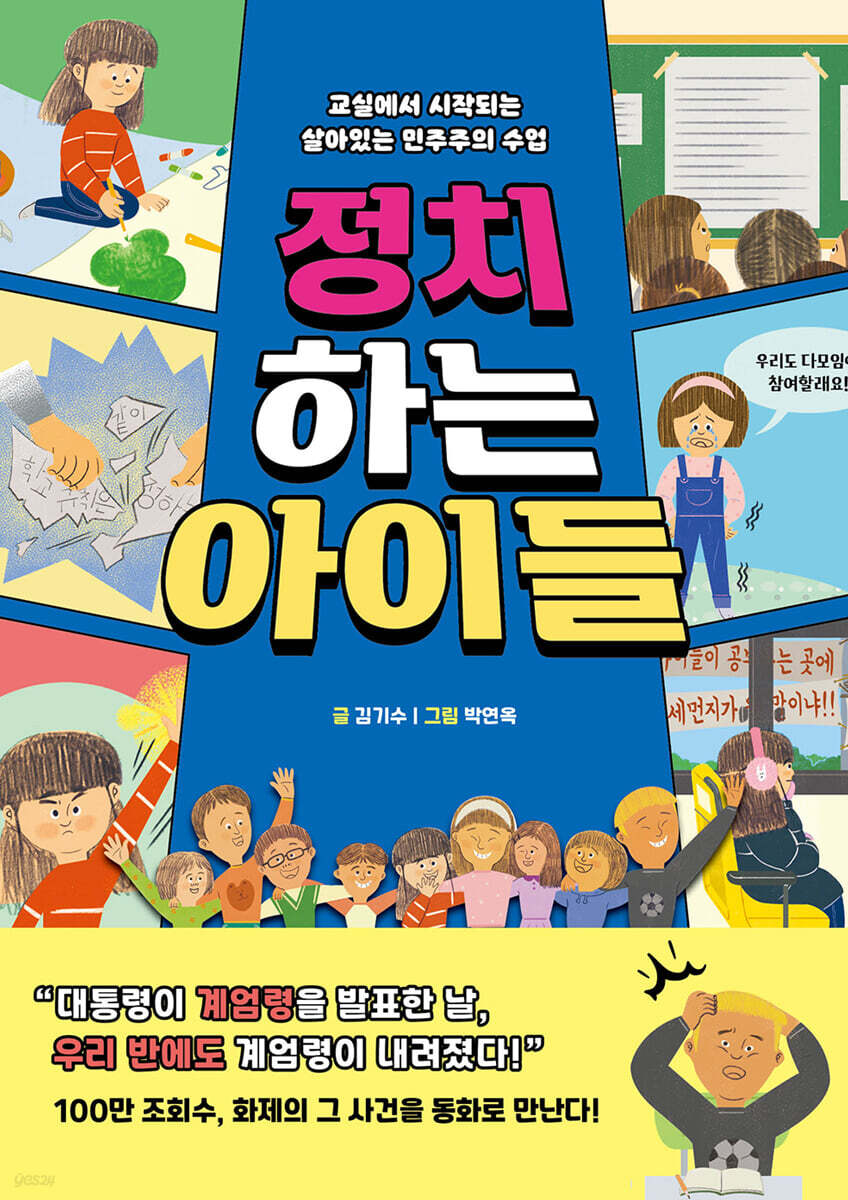
“On the day the president declared martial law, martial law was also declared in our class!”
A martial law class held in an elementary school classroom the day after the president declared martial law.
It is attracting attention as a ‘living democracy class’
Meet the hot topic that garnered 1 million views in a fairy tale!
At 10 p.m. on December 3, 2024, the day martial law was declared in South Korea for the first time in 45 years, is vividly etched in the minds of all Koreans.
The day after martial law was declared, many schools held classes on martial law and democracy.
Among them, a teacher at a small school in Gangwon Province who conducted a special class outside of the social studies textbook particularly caught my attention.
"Children in Politics" is a children's story written by a current teacher who taught children the values of democracy and politics through "Mr. Kim's Law."
This book teaches us what politics in everyday life is and what true civic spirit is through the stories of children who solve everyday problems on their own.
Through the stories of nine young citizens who discover the inconveniences around them, find wise solutions through deliberation and discussion, and put their decisions into practice, readers can develop a perspective on the world and social literacy.
A martial law class held in an elementary school classroom the day after the president declared martial law.
It is attracting attention as a ‘living democracy class’
Meet the hot topic that garnered 1 million views in a fairy tale!
At 10 p.m. on December 3, 2024, the day martial law was declared in South Korea for the first time in 45 years, is vividly etched in the minds of all Koreans.
The day after martial law was declared, many schools held classes on martial law and democracy.
Among them, a teacher at a small school in Gangwon Province who conducted a special class outside of the social studies textbook particularly caught my attention.
"Children in Politics" is a children's story written by a current teacher who taught children the values of democracy and politics through "Mr. Kim's Law."
This book teaches us what politics in everyday life is and what true civic spirit is through the stories of children who solve everyday problems on their own.
Through the stories of nine young citizens who discover the inconveniences around them, find wise solutions through deliberation and discussion, and put their decisions into practice, readers can develop a perspective on the world and social literacy.
- You can preview some of the book's contents.
Preview
index
prolog.
The day I transferred to a strange school
Chapter 1.
Mr. Kim's Law and Our Class's Law
The 'Mr. Kim Law' is declared!
Is it okay for a teacher to do this?
Not Mr. Kim's law, but our class's law!
Chapter 2.
Since we're all gathered together, it's a gathering
Do I have to follow these rules?
Don't ignore me because I'm young
Participate directly and make decisions directly
Chapter 3.
We decide what we do
From lower grades vs. from upper grades
You shouldn't buy this book
I oppose rice farming
Chapter 4.
A gathering in crisis
A note in question
Declaring a strike by all members
Master of Negotiation
Chapter 5.
We all get together to do things outside of school
I don't want to donate
Let's get the missing bus back!
Where there is support, there is also opposition.
I'm on TV!
Chapter 6.
Plazas, gatherings, and democracy
Citizens of the Square, Children of the Gathering
A gathering without 6th graders
As a little citizen, not a child
The day I transferred to a strange school
Chapter 1.
Mr. Kim's Law and Our Class's Law
The 'Mr. Kim Law' is declared!
Is it okay for a teacher to do this?
Not Mr. Kim's law, but our class's law!
Chapter 2.
Since we're all gathered together, it's a gathering
Do I have to follow these rules?
Don't ignore me because I'm young
Participate directly and make decisions directly
Chapter 3.
We decide what we do
From lower grades vs. from upper grades
You shouldn't buy this book
I oppose rice farming
Chapter 4.
A gathering in crisis
A note in question
Declaring a strike by all members
Master of Negotiation
Chapter 5.
We all get together to do things outside of school
I don't want to donate
Let's get the missing bus back!
Where there is support, there is also opposition.
I'm on TV!
Chapter 6.
Plazas, gatherings, and democracy
Citizens of the Square, Children of the Gathering
A gathering without 6th graders
As a little citizen, not a child
Detailed image
.jpg)
Into the book
“Hyun-tae! Sang-hyeon, stop hitting me!”
“Why? Sang-Hyeon said it was okay to hit me?”
“That’s right! That’s how we always play.”
“Ahyeon, you’re saying that without knowing anything?”
The teacher listened to Ahyeon's words and looked as if he was thinking deeply about something.
Will he scold me? Will he punish me? I stared at the teacher, wondering what would happen.
“Ahem, everyone, attention!”
After a few seconds, the teacher cleared his throat and spoke, word for word.
“From this moment on, I declare the ‘Mr. Kim Law.’”
The teacher who had been smiling brightly just a moment ago disappeared without a trace.
My friends also became silent, as if they thought something was strange.
The noisy classroom suddenly became quiet.
“Teacher, what is Mr. Kim’s law?”
“What happens if I don’t follow Mr. Kim’s law?”
The teacher, without saying anything, picked up a red marker and wrote two large letters on the blackboard.
'Cut. Off.'
--- 「Chapter 1.
From "Mr. Kim's Law and Our Class's Law"
“At today’s meeting, we will discuss whether first and second year students can participate in the meeting.”
There was a heated debate at the gathering.
“We are having a meeting at a gathering, but 8 and 9 years old are too young.
Do you understand what we're saying? Even adults have to be over 19 to vote.
There's a reason age is a factor when making important decisions.”
“I also felt wronged when I couldn’t participate in the gathering.
“It doesn’t make sense to say that we must follow the rules unconditionally when we didn’t even participate in setting them.”
“It’s like a jerk who tells his younger siblings not to do what he couldn’t do himself… What did he say? That’s right.
Old fart! I think that's something only old farts do.
Let's not do that!”
--- Chapter 2.
From "Everyone Gathers Together"
Did I hear wrong? I looked at Jiwoo, unable to believe what just came out of the microphone.
Jiwoo's eyes also widened.
“Someone left a letter saying, ‘XX kids, 6th graders,’ without revealing their names.
Today, we will hold an emergency meeting on this topic.”
The gathering place became as quiet as a mouse.
The sixth graders' expressions were serious.
Everyone seems really angry.
I felt like I wanted to quickly type the paper and leave the meeting place.
--- 「Chapter 3.
From "Gathering in Crisis"
"Did you know that the wildfires in Gyeongsang Province have been going on for over a week? Some of you may have already seen it, as it's a story you've probably seen on the news.
We also had a major wildfire in the area we live in a few years ago. You all remember, right? So, the field trip was canceled.
“We understand the pain and damage caused by wildfires, so we believe that if we collect and deliver donations, it will be a great comfort to those affected.”
The chairman thanked them for their kind words and asked those who were for or against the motion or had other opinions to raise their hands.
“Donating again? I don’t want to.
I already don't have enough money, and now I have to donate to people I don't even know.
I am against it.”
“I get a small allowance.
So, it is burdensome to donate.”
Contrary to my thoughts, there were many opposing opinions.
Of course, there were many opinions in favor, so it was a tense situation.
Through my past experiences, I learned that new opinions are needed to gather opinions from both sides.
Most people who oppose sending donations say that it is a waste to spend their own allowance.
If you think about this part a little, I think the answer will come out.
--- Chapter 5.
From "Everything Outside of School Gathers Together"
“Sometimes some adults say that children are immature.
We often refer to children as the "future generation," but we often leave them out of the conversations that need to be had today, right now.
It's like saying, 'You can't vote because you're young, you can't think as well as adults because you're young, you can't express your thoughts because you're young.'
Do you remember back in the day, at our school, we didn't allow younger students to participate in group activities because they were too young? Back then, students might have unknowingly imitated the adults."
The teacher is right.
Just because you're young doesn't mean you're young in your thinking.
Like adults, we also pay attention to forest fires that occur in other areas and try to help.
Like adults, we also worry about environmental pollution around schools.
Like adults, when we find a problem, we discuss it with each other and try to solve it.
“Why? Sang-Hyeon said it was okay to hit me?”
“That’s right! That’s how we always play.”
“Ahyeon, you’re saying that without knowing anything?”
The teacher listened to Ahyeon's words and looked as if he was thinking deeply about something.
Will he scold me? Will he punish me? I stared at the teacher, wondering what would happen.
“Ahem, everyone, attention!”
After a few seconds, the teacher cleared his throat and spoke, word for word.
“From this moment on, I declare the ‘Mr. Kim Law.’”
The teacher who had been smiling brightly just a moment ago disappeared without a trace.
My friends also became silent, as if they thought something was strange.
The noisy classroom suddenly became quiet.
“Teacher, what is Mr. Kim’s law?”
“What happens if I don’t follow Mr. Kim’s law?”
The teacher, without saying anything, picked up a red marker and wrote two large letters on the blackboard.
'Cut. Off.'
--- 「Chapter 1.
From "Mr. Kim's Law and Our Class's Law"
“At today’s meeting, we will discuss whether first and second year students can participate in the meeting.”
There was a heated debate at the gathering.
“We are having a meeting at a gathering, but 8 and 9 years old are too young.
Do you understand what we're saying? Even adults have to be over 19 to vote.
There's a reason age is a factor when making important decisions.”
“I also felt wronged when I couldn’t participate in the gathering.
“It doesn’t make sense to say that we must follow the rules unconditionally when we didn’t even participate in setting them.”
“It’s like a jerk who tells his younger siblings not to do what he couldn’t do himself… What did he say? That’s right.
Old fart! I think that's something only old farts do.
Let's not do that!”
--- Chapter 2.
From "Everyone Gathers Together"
Did I hear wrong? I looked at Jiwoo, unable to believe what just came out of the microphone.
Jiwoo's eyes also widened.
“Someone left a letter saying, ‘XX kids, 6th graders,’ without revealing their names.
Today, we will hold an emergency meeting on this topic.”
The gathering place became as quiet as a mouse.
The sixth graders' expressions were serious.
Everyone seems really angry.
I felt like I wanted to quickly type the paper and leave the meeting place.
--- 「Chapter 3.
From "Gathering in Crisis"
"Did you know that the wildfires in Gyeongsang Province have been going on for over a week? Some of you may have already seen it, as it's a story you've probably seen on the news.
We also had a major wildfire in the area we live in a few years ago. You all remember, right? So, the field trip was canceled.
“We understand the pain and damage caused by wildfires, so we believe that if we collect and deliver donations, it will be a great comfort to those affected.”
The chairman thanked them for their kind words and asked those who were for or against the motion or had other opinions to raise their hands.
“Donating again? I don’t want to.
I already don't have enough money, and now I have to donate to people I don't even know.
I am against it.”
“I get a small allowance.
So, it is burdensome to donate.”
Contrary to my thoughts, there were many opposing opinions.
Of course, there were many opinions in favor, so it was a tense situation.
Through my past experiences, I learned that new opinions are needed to gather opinions from both sides.
Most people who oppose sending donations say that it is a waste to spend their own allowance.
If you think about this part a little, I think the answer will come out.
--- Chapter 5.
From "Everything Outside of School Gathers Together"
“Sometimes some adults say that children are immature.
We often refer to children as the "future generation," but we often leave them out of the conversations that need to be had today, right now.
It's like saying, 'You can't vote because you're young, you can't think as well as adults because you're young, you can't express your thoughts because you're young.'
Do you remember back in the day, at our school, we didn't allow younger students to participate in group activities because they were too young? Back then, students might have unknowingly imitated the adults."
The teacher is right.
Just because you're young doesn't mean you're young in your thinking.
Like adults, we also pay attention to forest fires that occur in other areas and try to help.
Like adults, we also worry about environmental pollution around schools.
Like adults, when we find a problem, we discuss it with each other and try to solve it.
--- Chapter 6.
From “The Square, the Gathering, and Democracy”
From “The Square, the Gathering, and Democracy”
Publisher's Review
“On the day the president declared martial law, martial law was also declared in our class!”
"Attention everyone! From this moment on, we declare the 'Mr. Kim Law' in our classroom!"
The children who felt something strange suddenly became quiet.
“Mr. Kim’s law? What is it?”
“What happens if you don’t keep it?”
"If you don't follow Mr. Kim's law, I'll 'punish you.'"
.
.
At 10 p.m. on December 3, 2024, the day martial law was declared in South Korea for the first time in 45 years, is vividly etched in the minds of all Koreans.
The day after martial law was declared, many schools held classes on martial law and democracy.
Among them, a teacher at a small school in Gangwon Province who conducted a special class outside of the social studies textbook particularly caught my attention.
This book is a fairy tale written by a current teacher who taught children the values of democracy and politics through 'Mr. Kim's Law.'
The author recreated events that actually happened in the classroom into an entertaining fairy tale.
When older students arbitrarily set unfair rules and force younger students to follow them, when we create a playground that satisfies both older students who want to play soccer and younger students who want to ride bikes, when the bus stop in front of the school suddenly disappears and we want to protest to city hall.
What should we do?
Are you saying that politics is something that adults only talk about on the news?
Children who don't have the right to vote can't participate in politics?
No, that's not true.
Because everything around us is politics!
Hara transfers to a small school in the countryside.
But this school is a little strange.
Students hold meetings called "Damoim" to decide everything from the order in which they eat lunch to where they go for field trips, to deciding on the list of books to buy at the library, and even to build a bus stop in front of the school.
If something absolutely necessary happens, I go to the city hall and protest.
Hara was surprised, having always thought that children had no choice but to follow adults' important decisions, even if they didn't like them.
I didn't even believe it, thinking, "Hey, no way! My opinion can really change our school?"
But after spending a year with Mr. Kim and the children in that class, Hara's thoughts completely changed.
While attending school, I learned how to actively express my opinion on things that were wrong, inconvenient, or better, and how to persuade people by finding valid reasons and evidence.
This book is about Hara, Mr. Kim, and the classmates who are learning about 'politics that changes my life' while experiencing the process of creating a better school and a better neighborhood.
It teaches us about ‘true civic spirit’ and ‘politics that changes my life’.
A very special fairy tale!
"Children in Politics" is a book that teaches children what politics is in everyday life and what true civic spirit is through the story of children who solve problems that arise in their daily lives on their own.
Through the stories of nine young citizens who discover the inconveniences around them, find wise solutions through deliberation and discussion, and put their decisions into practice, readers can develop a perspective on the world and social literacy.
"Attention everyone! From this moment on, we declare the 'Mr. Kim Law' in our classroom!"
The children who felt something strange suddenly became quiet.
“Mr. Kim’s law? What is it?”
“What happens if you don’t keep it?”
"If you don't follow Mr. Kim's law, I'll 'punish you.'"
.
.
At 10 p.m. on December 3, 2024, the day martial law was declared in South Korea for the first time in 45 years, is vividly etched in the minds of all Koreans.
The day after martial law was declared, many schools held classes on martial law and democracy.
Among them, a teacher at a small school in Gangwon Province who conducted a special class outside of the social studies textbook particularly caught my attention.
This book is a fairy tale written by a current teacher who taught children the values of democracy and politics through 'Mr. Kim's Law.'
The author recreated events that actually happened in the classroom into an entertaining fairy tale.
When older students arbitrarily set unfair rules and force younger students to follow them, when we create a playground that satisfies both older students who want to play soccer and younger students who want to ride bikes, when the bus stop in front of the school suddenly disappears and we want to protest to city hall.
What should we do?
Are you saying that politics is something that adults only talk about on the news?
Children who don't have the right to vote can't participate in politics?
No, that's not true.
Because everything around us is politics!
Hara transfers to a small school in the countryside.
But this school is a little strange.
Students hold meetings called "Damoim" to decide everything from the order in which they eat lunch to where they go for field trips, to deciding on the list of books to buy at the library, and even to build a bus stop in front of the school.
If something absolutely necessary happens, I go to the city hall and protest.
Hara was surprised, having always thought that children had no choice but to follow adults' important decisions, even if they didn't like them.
I didn't even believe it, thinking, "Hey, no way! My opinion can really change our school?"
But after spending a year with Mr. Kim and the children in that class, Hara's thoughts completely changed.
While attending school, I learned how to actively express my opinion on things that were wrong, inconvenient, or better, and how to persuade people by finding valid reasons and evidence.
This book is about Hara, Mr. Kim, and the classmates who are learning about 'politics that changes my life' while experiencing the process of creating a better school and a better neighborhood.
It teaches us about ‘true civic spirit’ and ‘politics that changes my life’.
A very special fairy tale!
"Children in Politics" is a book that teaches children what politics is in everyday life and what true civic spirit is through the story of children who solve problems that arise in their daily lives on their own.
Through the stories of nine young citizens who discover the inconveniences around them, find wise solutions through deliberation and discussion, and put their decisions into practice, readers can develop a perspective on the world and social literacy.
GOODS SPECIFICS
- Date of issue: July 25, 2025
- Page count, weight, size: 208 pages | 384g | 158*221*13mm
- ISBN13: 9791199247864
- ISBN10: 1199247863
- KC Certification: Certification Type: Conformity Confirmation
You may also like
카테고리
korean


korean

![ELLE 엘르 스페셜 에디션 A형 : 12월 [2025]](http://librairie.coreenne.fr/cdn/shop/files/b8e27a3de6c9538896439686c6b0e8fb.jpg?v=1766436872&width=3840)


