

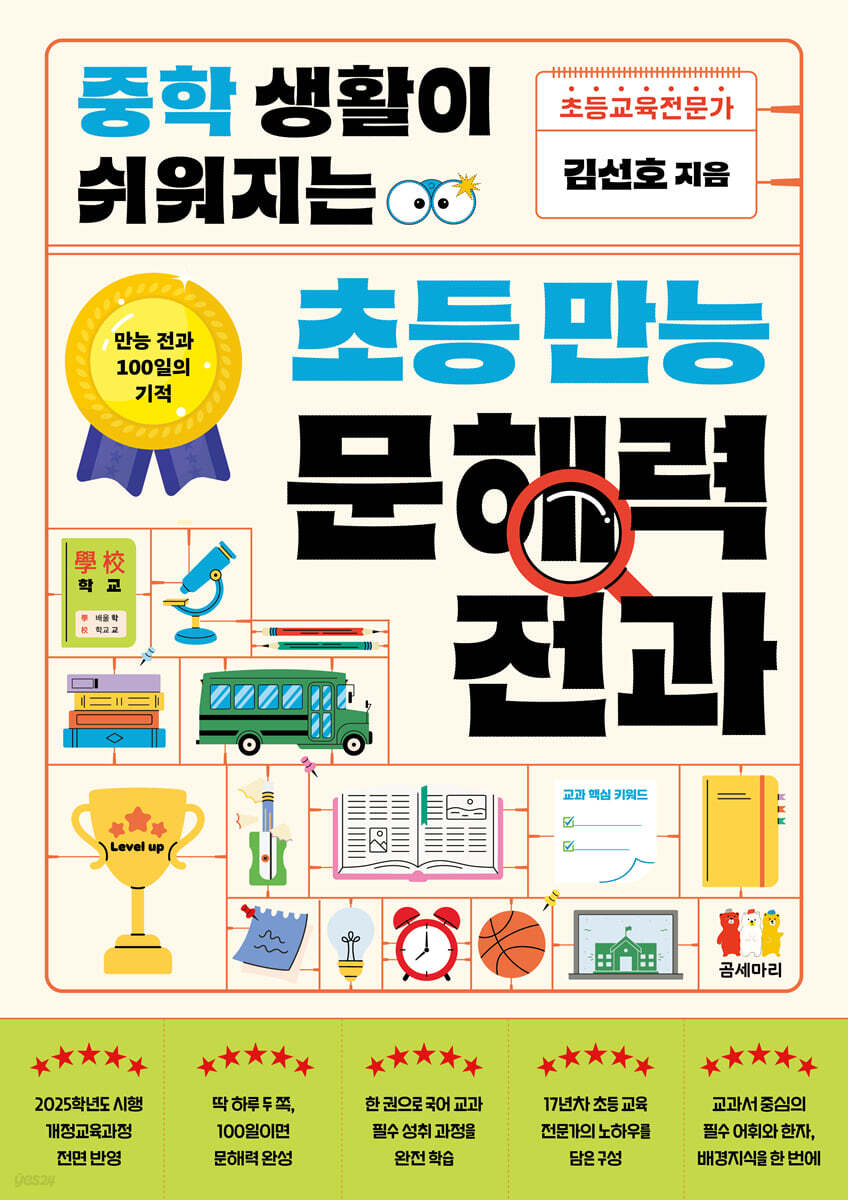
Elementary all-round literacy course that makes middle school life easier
 |
Description
Book Introduction
“Praise to the 119 elementary, middle, and high school teachers who are driving education in Korea!”
It covers all subjects, liberal arts, reading comprehension, reasoning, and vocabulary.
Elementary universal literacy course
Develop literacy skills through various writing formats,
Develop solid thinking through 4-step problems,
Develop your curiosity with fun common sense!
Just two pages a day, in 100 days, our child will also
You will say, “The textbook was the easiest!”
Starting today, 100 days from now, start the miracle.
Elementary universal curriculum, which is a reinterpretation of 'previous subjects' that every parent has encountered, is composed of various types of texts, niche knowledge, words, and problems linked to the curriculum.
The text-related presentations include the structure of the text, such as introduction-body-conclusion, introduction-development-climax-conclusion, etc., so that children can naturally learn the structure of the text and even write on their own.
Through the four-step problem, we will check your reading comprehension skills and your ability to reason independently.
By summarizing the text, you will develop the ability to summarize the content of the text in one sentence.
After you have a solid grasp of reading comprehension and the subject matter, you can build your general knowledge and lay the foundation for writing essays through niche knowledge provided by the teacher.
We will also learn about Chinese characters, which are said to be the core of literacy decline, one by one.
Read 100 well-planned passages, one per day, learn vocabulary, solve problems, and build general knowledge.
One a day, in 100 days, your child will soon become an all-rounder.
It covers all subjects, liberal arts, reading comprehension, reasoning, and vocabulary.
Elementary universal literacy course
Develop literacy skills through various writing formats,
Develop solid thinking through 4-step problems,
Develop your curiosity with fun common sense!
Just two pages a day, in 100 days, our child will also
You will say, “The textbook was the easiest!”
Starting today, 100 days from now, start the miracle.
Elementary universal curriculum, which is a reinterpretation of 'previous subjects' that every parent has encountered, is composed of various types of texts, niche knowledge, words, and problems linked to the curriculum.
The text-related presentations include the structure of the text, such as introduction-body-conclusion, introduction-development-climax-conclusion, etc., so that children can naturally learn the structure of the text and even write on their own.
Through the four-step problem, we will check your reading comprehension skills and your ability to reason independently.
By summarizing the text, you will develop the ability to summarize the content of the text in one sentence.
After you have a solid grasp of reading comprehension and the subject matter, you can build your general knowledge and lay the foundation for writing essays through niche knowledge provided by the teacher.
We will also learn about Chinese characters, which are said to be the core of literacy decline, one by one.
Read 100 well-planned passages, one per day, learn vocabulary, solve problems, and build general knowledge.
One a day, in 100 days, your child will soon become an all-rounder.
- You can preview some of the book's contents.
Preview
index
Introduction ─ 4
The structure and features of this book ─ 14
STEP 1
01.
The Talking Tree and the Curious Child ─ 18
02.
Little Detective's Clue Notes ─ 20
03.
The Salt Struggler's Big Mistake ─ 22
04.
The Day the Acorns Disappeared ─ 24
05.
A Special Letter from the Starlight Post Office ─ 26
06.
A Little Inventor's Collection of Ideas ─ 28
07.
Why the Wolf Moved ─ 30
08.
Why Frogs and Butterflies Became Friends ─ 32
09.
The Fox Who Talks with His Tail - 34
10.
Different Footsteps, Same Path ─ 36
11.
Reconciliation between Dog and Cat ─ 38
12.
A Special Meeting of Ants and Bees ─ 40
13.
My First Pet ─ 42
14.
How will library books await us? ─ 44
15.
Why Cats Sleep Near Windows ─ 46
16.
I was a little unfamiliar with my new friend ─ 48
17.
Three Things You Need to Nurture Your Dreams ─ 50
18.
What is the "Butterfly Effect"? A Small Flap of Wings ─ 52
19.
We need more parks in our neighborhood ─ 54
20.
False Rumors About Wolves and the Truth About the Forest ─ 56
21.
A Conversation Between the Writer, the Rabbit, and the Reader, the Turtle - 58
22.
The Fox and the Mole Debate ─ 60
23.
A Letter to Mimi the Cat ─ 62
24.
The Cat Writer's First Paragraph ─ 64
25.
The Wolf Who Asked Why I Wrote This Story ─ 66
Take a break ─ 68
26.
Special Notice from Pine Tree Post Office ─ 70
27.
Four Steps to Perfecting a Magic Potion ─ 72
28.
The Little Squirrel's Inaccurate Meeting Place ─ 74
29.
The Cat Who Walked Backwards - 76
30.
Magic Speech Bubble Shop ─ 78
31.
How to Talk to an Angry Friend ─ 80
32.
The Great Turmoil of the Opposite Country ─ 82
33.
Flying Verbs and Sitting Nouns ─ 84
34.
The Secret of the "Object" Everyone Seeks ─ 86
35.
How to Speak to the King? ─ 88
36.
The Pronunciation War of ㄴ and ㄹ ─ 90
37.
A period lost in a sentence ─ 92
38.
They look similar, but how are they different? ─ 94
39.
Look up unknown words in the dictionary ─ 96
40.
Appropriate Expressions to Express My Heart ─ 98
41.
The Lost Puppy ─ 100
42.
Adventures in Dreams and Reality ─ 102
43.
The Brave Girl and the Quiet Dragon ─ 104
44.
The Boy Who Followed the Starlight ─ 106
45.
My Own Hero Found in a Book ─ 108
46.
A Snowy Night, a Scary Sound ─ 110
47.
Unraveling the Mystery with Internet Resources ─ 112
48.
The Chocolate Factory's Suspicious Internet Ad ─ 114
49.
Preparing for Your Presentation: A Successful First Presentation ─ 116
50.
Let's Observe Netiquette ─ 118
Take a break ─ 120
STEP 2
51.
The last sentence of the letter ─ 124
52.
Are zoos really necessary for animals? ─ 126
53.
Fun news from the sports day to be broadcast on the school broadcast - 128
54.
Class Meeting Minutes for Selecting a Location for Our Class's Experiential Learning Program ─ 130
55.
Five Characteristics of My Favorite Animals ─ 132
56.
Why You Should Increase Your Exercise Time and What It Does ─ 134
57.
My Day in Video ─ 136
58.
How do animals communicate with each other? ─ 138
59.
140: A Guide to Preparing Class Presentations
60.
Painting a School Mural: Let's Divide the Roles ─ 142
61.
How to Overcome Differences of Opinion - 144
62.
Diverse Cultures: How to Live Together ─ 146
63.
Interpreting the Meaning of Children's Day from Various Perspectives ─ 148
64.
How to Build Confidence ─ 150
65.
The End of the Day, My Heart's Story ─ 152
66.
The Secret to Easily Understanding Text Structure ─ 154
67.
Finding the Hidden Theme in a Text ─ 156
68.
Organizing Key Points Following the Structure of the Text ─ 158
69.
How to Infer Omissions and Implications in the Text? ─ 160
70.
Evaluating Content and Expression Based on My Own Standards ─ 162
71.
The Book-Reading Lion, the Problem-Solving Hero ─ 164
72.
Each Tree Has a Different Personality: A Story from the Forest ─ 166
73.
A Little Ant's Big Claim: In Search of Evidence ─ 168
74.
An Adventure on a Bicycle, the Freedom I Felt on the Road ─ 170
75. Our Precious Secrets Shared on Social Media ─ 172
Take a break ─ 174
76.
Time Travel Through the Stages ─ 176
77.
Forest Stories to Tell Your Friends ─ 178
78.
A Little Seed's Big Adventure ─ 180
79.
Letters from Heaven ─ 182
80.
A crow speaking in dialect and a sparrow speaking standard Korean ─ 184
81.
Fun Idioms to Learn with the Goblin's Club ─ 186
82.
Vocabulary Magic School ─ 188
83.
The Incident in the Village Where Subjects and Objects Disappeared ─ 190
84.
Complex but Interesting Time Terminology ─ 192
85.
The Lost Spelling, The Forest Detective's Ruckus ─ 194
86.
Decipher the Forest Library Code ─ 196
87.
The Little Wizard Who Analyzes Magical Sentences ─ 198
88.
The Kingdom's Council: Solving Problems with Appropriate Words ─ 200
89.
Korean Language Life Checklist ─ 202
90.
Master of Language ─ 204
91.
Author's Secret Message ─ 206
92.
Story within a Story ─ 208
93.
The Flying Book: Finding the Characters in the Story ─ 210
94.
Parables in the Starlight: Drawing Pictures of the Heart ─ 212
95.
Talking Trees, Sharing Memorable Stories ─ 214
96.
Reporter Rabbit's Report: Forest Incidents ─ 216
97.
The Secret Map: Find the Information That Fits Your Goal ─ 218
98.
Internet Detectives: Spotting Misinformation ─ 220
99.
Digital Magic: Transforming the World through Complex Media ─ 222
100.
An Ocean of Information: Checking Your Media Use ─ 224
Correct answer: 226
The structure and features of this book ─ 14
STEP 1
01.
The Talking Tree and the Curious Child ─ 18
02.
Little Detective's Clue Notes ─ 20
03.
The Salt Struggler's Big Mistake ─ 22
04.
The Day the Acorns Disappeared ─ 24
05.
A Special Letter from the Starlight Post Office ─ 26
06.
A Little Inventor's Collection of Ideas ─ 28
07.
Why the Wolf Moved ─ 30
08.
Why Frogs and Butterflies Became Friends ─ 32
09.
The Fox Who Talks with His Tail - 34
10.
Different Footsteps, Same Path ─ 36
11.
Reconciliation between Dog and Cat ─ 38
12.
A Special Meeting of Ants and Bees ─ 40
13.
My First Pet ─ 42
14.
How will library books await us? ─ 44
15.
Why Cats Sleep Near Windows ─ 46
16.
I was a little unfamiliar with my new friend ─ 48
17.
Three Things You Need to Nurture Your Dreams ─ 50
18.
What is the "Butterfly Effect"? A Small Flap of Wings ─ 52
19.
We need more parks in our neighborhood ─ 54
20.
False Rumors About Wolves and the Truth About the Forest ─ 56
21.
A Conversation Between the Writer, the Rabbit, and the Reader, the Turtle - 58
22.
The Fox and the Mole Debate ─ 60
23.
A Letter to Mimi the Cat ─ 62
24.
The Cat Writer's First Paragraph ─ 64
25.
The Wolf Who Asked Why I Wrote This Story ─ 66
Take a break ─ 68
26.
Special Notice from Pine Tree Post Office ─ 70
27.
Four Steps to Perfecting a Magic Potion ─ 72
28.
The Little Squirrel's Inaccurate Meeting Place ─ 74
29.
The Cat Who Walked Backwards - 76
30.
Magic Speech Bubble Shop ─ 78
31.
How to Talk to an Angry Friend ─ 80
32.
The Great Turmoil of the Opposite Country ─ 82
33.
Flying Verbs and Sitting Nouns ─ 84
34.
The Secret of the "Object" Everyone Seeks ─ 86
35.
How to Speak to the King? ─ 88
36.
The Pronunciation War of ㄴ and ㄹ ─ 90
37.
A period lost in a sentence ─ 92
38.
They look similar, but how are they different? ─ 94
39.
Look up unknown words in the dictionary ─ 96
40.
Appropriate Expressions to Express My Heart ─ 98
41.
The Lost Puppy ─ 100
42.
Adventures in Dreams and Reality ─ 102
43.
The Brave Girl and the Quiet Dragon ─ 104
44.
The Boy Who Followed the Starlight ─ 106
45.
My Own Hero Found in a Book ─ 108
46.
A Snowy Night, a Scary Sound ─ 110
47.
Unraveling the Mystery with Internet Resources ─ 112
48.
The Chocolate Factory's Suspicious Internet Ad ─ 114
49.
Preparing for Your Presentation: A Successful First Presentation ─ 116
50.
Let's Observe Netiquette ─ 118
Take a break ─ 120
STEP 2
51.
The last sentence of the letter ─ 124
52.
Are zoos really necessary for animals? ─ 126
53.
Fun news from the sports day to be broadcast on the school broadcast - 128
54.
Class Meeting Minutes for Selecting a Location for Our Class's Experiential Learning Program ─ 130
55.
Five Characteristics of My Favorite Animals ─ 132
56.
Why You Should Increase Your Exercise Time and What It Does ─ 134
57.
My Day in Video ─ 136
58.
How do animals communicate with each other? ─ 138
59.
140: A Guide to Preparing Class Presentations
60.
Painting a School Mural: Let's Divide the Roles ─ 142
61.
How to Overcome Differences of Opinion - 144
62.
Diverse Cultures: How to Live Together ─ 146
63.
Interpreting the Meaning of Children's Day from Various Perspectives ─ 148
64.
How to Build Confidence ─ 150
65.
The End of the Day, My Heart's Story ─ 152
66.
The Secret to Easily Understanding Text Structure ─ 154
67.
Finding the Hidden Theme in a Text ─ 156
68.
Organizing Key Points Following the Structure of the Text ─ 158
69.
How to Infer Omissions and Implications in the Text? ─ 160
70.
Evaluating Content and Expression Based on My Own Standards ─ 162
71.
The Book-Reading Lion, the Problem-Solving Hero ─ 164
72.
Each Tree Has a Different Personality: A Story from the Forest ─ 166
73.
A Little Ant's Big Claim: In Search of Evidence ─ 168
74.
An Adventure on a Bicycle, the Freedom I Felt on the Road ─ 170
75. Our Precious Secrets Shared on Social Media ─ 172
Take a break ─ 174
76.
Time Travel Through the Stages ─ 176
77.
Forest Stories to Tell Your Friends ─ 178
78.
A Little Seed's Big Adventure ─ 180
79.
Letters from Heaven ─ 182
80.
A crow speaking in dialect and a sparrow speaking standard Korean ─ 184
81.
Fun Idioms to Learn with the Goblin's Club ─ 186
82.
Vocabulary Magic School ─ 188
83.
The Incident in the Village Where Subjects and Objects Disappeared ─ 190
84.
Complex but Interesting Time Terminology ─ 192
85.
The Lost Spelling, The Forest Detective's Ruckus ─ 194
86.
Decipher the Forest Library Code ─ 196
87.
The Little Wizard Who Analyzes Magical Sentences ─ 198
88.
The Kingdom's Council: Solving Problems with Appropriate Words ─ 200
89.
Korean Language Life Checklist ─ 202
90.
Master of Language ─ 204
91.
Author's Secret Message ─ 206
92.
Story within a Story ─ 208
93.
The Flying Book: Finding the Characters in the Story ─ 210
94.
Parables in the Starlight: Drawing Pictures of the Heart ─ 212
95.
Talking Trees, Sharing Memorable Stories ─ 214
96.
Reporter Rabbit's Report: Forest Incidents ─ 216
97.
The Secret Map: Find the Information That Fits Your Goal ─ 218
98.
Internet Detectives: Spotting Misinformation ─ 220
99.
Digital Magic: Transforming the World through Complex Media ─ 222
100.
An Ocean of Information: Checking Your Media Use ─ 224
Correct answer: 226
Detailed image

Into the book
There are children who have a good ‘study mindset.’
It refers to children who have a strong motivation to learn anything and are not afraid to face new things.
When I see those kids, their daily routine is tight.
But I consider reading as a form of relaxation rather than study.
These children who have a good emotional attachment to learning have something in common.
Even before entering elementary school, their vocabulary is three times better than that of their peers.
Based on your vocabulary, you will immediately understand and absorb everything you learn.
Literacy skills, which allow you to understand letters, sentences, and paragraphs, and to grasp the central sentence and the author's intention, develop day by day.
If you read the textbooks and study guides on your own, you can understand them right away, so it's a waste of time going to an academy.
This is the power of literacy.
--- p.4
If you're worried that you're too late, or want to accelerate your learning, the method is simple.
Just read and solve 2 pages for 30 minutes a day.
That's 100 days.
I hope that from today onward, our children will experience the miracle of those 100 days.
Children with good literacy skills say:
“The textbook was the easiest.”
I hope many children will become like that.
It refers to children who have a strong motivation to learn anything and are not afraid to face new things.
When I see those kids, their daily routine is tight.
But I consider reading as a form of relaxation rather than study.
These children who have a good emotional attachment to learning have something in common.
Even before entering elementary school, their vocabulary is three times better than that of their peers.
Based on your vocabulary, you will immediately understand and absorb everything you learn.
Literacy skills, which allow you to understand letters, sentences, and paragraphs, and to grasp the central sentence and the author's intention, develop day by day.
If you read the textbooks and study guides on your own, you can understand them right away, so it's a waste of time going to an academy.
This is the power of literacy.
--- p.4
If you're worried that you're too late, or want to accelerate your learning, the method is simple.
Just read and solve 2 pages for 30 minutes a day.
That's 100 days.
I hope that from today onward, our children will experience the miracle of those 100 days.
Children with good literacy skills say:
“The textbook was the easiest.”
I hope many children will become like that.
--- p.5
Publisher's Review
Recommended by 119 elementary, middle, and high school teachers
The ultimate guide to raising your child's literacy skills
It covers all subjects, knowledge, culture, reading, and writing.
The road to becoming an all-rounder child!
“The textbook was the easiest.”
How to develop the strength to speak confidently?
Literacy, the ability to read and understand text, is the beginning of all learning.
The literacy problem of children in today's digital generation is serious.
These are words I've heard a lot.
I know literacy is important, and it's urgent to develop my child's literacy skills. But what's the right way to develop strong literacy skills?
Thanks to the numerous media spotlights on the topic, there is no longer anyone who does not know what literacy is.
Many people probably already know that reading a lot is a skill.
However, with the increasing number of digital contents that capture children's attention, it is not easy for parents to guide their children along the path of reading, no matter how much they know.
A book that children can enjoy reading on their own
The Beginning of Self-Directed Learning
That's why the Bears' "Elementary All-in-One Course to Make Middle School Life Easier" series was released.
Elementary universal curriculum, which is a reinterpretation of 'previous subjects' that every parent has encountered, is composed of various types of texts, niche knowledge, words, and problems linked to the curriculum.
The interesting presentation written by the teacher himself will be read easily by both children who do not know the joy of reading and children who love reading.
The text presents the structure of the text, including introduction-body-conclusion, introduction-development-climax-conclusion, etc., so that children can naturally learn the structure of the text and even write on their own.
Linked to the revised curriculum that will be implemented from 2025, it will help students develop literacy skills while also developing their subject learning skills.
Through three-step questions, we will check your reading comprehension skills and your ability to reason independently.
By summarizing the text, you will develop the ability to summarize the content of the text in one sentence.
After you have a solid grasp of reading comprehension and the subject matter, you can build your general knowledge and lay the foundation for writing essays through niche knowledge provided by the teacher.
We will also learn about Chinese characters, which are said to be the core of literacy decline, one by one.
Read 100 well-planned passages, one per day, learn vocabulary, solve problems, and build general knowledge.
One a day, in 100 days, your child will soon become an all-rounder.
The first of the universal battles,
Literacy skills from elementary education expert Kim Seon-ho
This book is designed to help you acquire the vocabulary and essential achievements of elementary Korean language curriculum in just 100 days by reading and solving 2 pages a day for 30 minutes.
We created a topic-centered text comprised of a variety of case-specific sentences that meet the Korean language achievement standards.
In particular, we have helped children learn key words related to the Korean language that they find difficult, and have made the paragraph format structure visible so that they can intuitively understand it just by reading the text.
- Author Kim Seon-ho
The first in the elementary school all-purpose textbook series, "Elementary All-Purpose Literacy: Making Middle School Life Easier," was written by Kim Seon-ho, a 17-year teacher at Seoul's private Yuseok Elementary School and an elementary education expert.
Author Kim Seon-ho, who has spent a long time in the field of education and studied the "study emotions" of elementary school students, has compiled the know-how he has gained in the field into "Literacy Preliminary."
It includes various types of writing, including stories, editorials, YouTube subtitles, and library guides, and aims to enhance both reading enjoyment and comprehension.
The 'study emotion' that elementary education expert Kim Seon-ho has talked about many times.
If you catch children's study habits early, they will soon grow into students who can find books to read on their own and find their own study methods.
It is truly a panacea that one book can both teach literacy and the spirit of studying.
The ultimate guide to raising your child's literacy skills
It covers all subjects, knowledge, culture, reading, and writing.
The road to becoming an all-rounder child!
“The textbook was the easiest.”
How to develop the strength to speak confidently?
Literacy, the ability to read and understand text, is the beginning of all learning.
The literacy problem of children in today's digital generation is serious.
These are words I've heard a lot.
I know literacy is important, and it's urgent to develop my child's literacy skills. But what's the right way to develop strong literacy skills?
Thanks to the numerous media spotlights on the topic, there is no longer anyone who does not know what literacy is.
Many people probably already know that reading a lot is a skill.
However, with the increasing number of digital contents that capture children's attention, it is not easy for parents to guide their children along the path of reading, no matter how much they know.
A book that children can enjoy reading on their own
The Beginning of Self-Directed Learning
That's why the Bears' "Elementary All-in-One Course to Make Middle School Life Easier" series was released.
Elementary universal curriculum, which is a reinterpretation of 'previous subjects' that every parent has encountered, is composed of various types of texts, niche knowledge, words, and problems linked to the curriculum.
The interesting presentation written by the teacher himself will be read easily by both children who do not know the joy of reading and children who love reading.
The text presents the structure of the text, including introduction-body-conclusion, introduction-development-climax-conclusion, etc., so that children can naturally learn the structure of the text and even write on their own.
Linked to the revised curriculum that will be implemented from 2025, it will help students develop literacy skills while also developing their subject learning skills.
Through three-step questions, we will check your reading comprehension skills and your ability to reason independently.
By summarizing the text, you will develop the ability to summarize the content of the text in one sentence.
After you have a solid grasp of reading comprehension and the subject matter, you can build your general knowledge and lay the foundation for writing essays through niche knowledge provided by the teacher.
We will also learn about Chinese characters, which are said to be the core of literacy decline, one by one.
Read 100 well-planned passages, one per day, learn vocabulary, solve problems, and build general knowledge.
One a day, in 100 days, your child will soon become an all-rounder.
The first of the universal battles,
Literacy skills from elementary education expert Kim Seon-ho
This book is designed to help you acquire the vocabulary and essential achievements of elementary Korean language curriculum in just 100 days by reading and solving 2 pages a day for 30 minutes.
We created a topic-centered text comprised of a variety of case-specific sentences that meet the Korean language achievement standards.
In particular, we have helped children learn key words related to the Korean language that they find difficult, and have made the paragraph format structure visible so that they can intuitively understand it just by reading the text.
- Author Kim Seon-ho
The first in the elementary school all-purpose textbook series, "Elementary All-Purpose Literacy: Making Middle School Life Easier," was written by Kim Seon-ho, a 17-year teacher at Seoul's private Yuseok Elementary School and an elementary education expert.
Author Kim Seon-ho, who has spent a long time in the field of education and studied the "study emotions" of elementary school students, has compiled the know-how he has gained in the field into "Literacy Preliminary."
It includes various types of writing, including stories, editorials, YouTube subtitles, and library guides, and aims to enhance both reading enjoyment and comprehension.
The 'study emotion' that elementary education expert Kim Seon-ho has talked about many times.
If you catch children's study habits early, they will soon grow into students who can find books to read on their own and find their own study methods.
It is truly a panacea that one book can both teach literacy and the spirit of studying.
GOODS SPECIFICS
- Date of issue: May 15, 2025
- Page count, weight, size: 232 pages | 802g | 210*297*18mm
- ISBN13: 9791193366158
- ISBN10: 1193366151
- KC Certification: Certification Type: Conformity Confirmation
You may also like
카테고리
korean


korean

![ELLE 엘르 스페셜 에디션 A형 : 12월 [2025]](http://librairie.coreenne.fr/cdn/shop/files/b8e27a3de6c9538896439686c6b0e8fb.jpg?v=1766436872&width=3840)


