

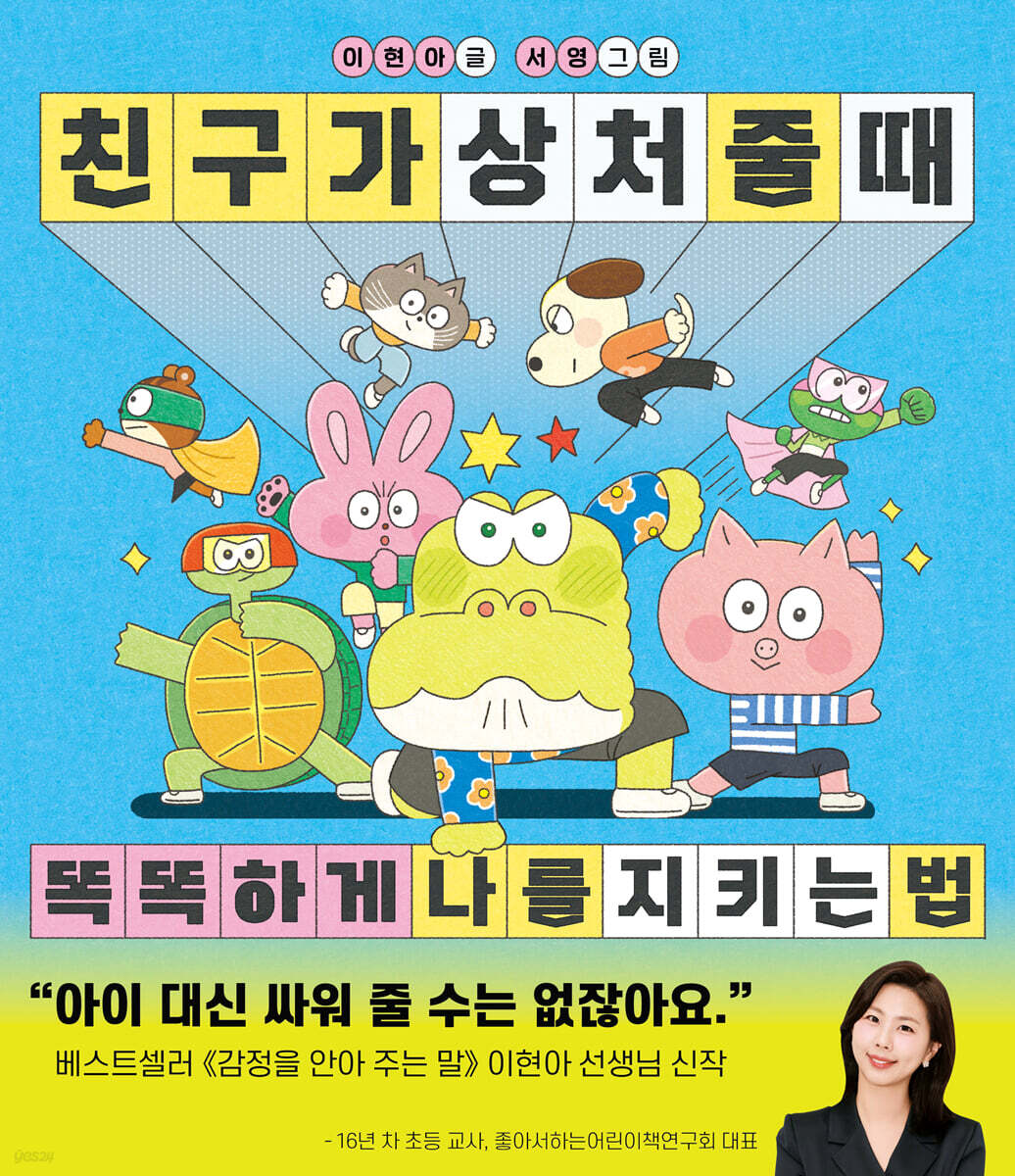
How to Smartly Protect Yourself When Your Friends Hurt You
 |
Description
Book Introduction
- A word from MD
-
My friends and my heart are both precious.
Friendships are the number one concern for elementary school students. How can we help them? Lee Hyun-ah, an elementary school teacher with 16 years of experience, shares tips for resolving conflicts wisely, drawing on real-life classroom experiences.
We've also included practical tips and advice to help children build healthy relationships with their friends without getting hurt.
May 13, 2025. Children's PD Baek Jeong- min
A new book by Hyunah Lee, author of the best-selling book "Words that Embrace Emotions."
A guide to friendships, compiled from the experience and research of a 16-year elementary school teacher.
Parents who send their children to school for the first time often worry that their children will not be able to get along with their peers or will be bullied by bad peers.
For children who are just starting out in society, making friends is by no means an easy task.
However, parents cannot prevent the hurt their children will receive, and they cannot take their place in the conflicts and reconciliation processes that their children will experience.
Because resolving difficulties in friendships on your own is an essential experience for a child's growth.
"How to Smartly Protect Yourself When Your Friends Hurt You" is a book that teaches children who struggle with friendships how to protect both their precious hearts and their friendships.
Teacher Lee Hyeon-a, an elementary school teacher with 16 years of experience, has unraveled the essential issues of peer conflict through ten stories based on her experience and research, and includes practical coping strategies that can be applied to each situation.
A guide to friendships, compiled from the experience and research of a 16-year elementary school teacher.
Parents who send their children to school for the first time often worry that their children will not be able to get along with their peers or will be bullied by bad peers.
For children who are just starting out in society, making friends is by no means an easy task.
However, parents cannot prevent the hurt their children will receive, and they cannot take their place in the conflicts and reconciliation processes that their children will experience.
Because resolving difficulties in friendships on your own is an essential experience for a child's growth.
"How to Smartly Protect Yourself When Your Friends Hurt You" is a book that teaches children who struggle with friendships how to protect both their precious hearts and their friendships.
Teacher Lee Hyeon-a, an elementary school teacher with 16 years of experience, has unraveled the essential issues of peer conflict through ten stories based on her experience and research, and includes practical coping strategies that can be applied to each situation.
- You can preview some of the book's contents.
Preview
index
-Introductory remarks
01 I yelled at my friend who was teasing me to stop, but he teased me even more.
02 I can't refuse when my friend asks me to do something I don't want to do.
03 My friends posted my picture in a group chat and made fun of me.
04 During break time, my partner won't play with me, so I'm hiding in the bathroom.
05 My best friend is bullying me, but I don't want to be left out, so I hold it in.
06 I feel intimidated by my friends who tease me for being short and fat.
07 I feel uncomfortable when my friend touches or pokes my body.
08 My friend spreads lies and bad rumors behind my back.
09 I was so angry that I pushed my friend who was giving me medicine.
10 I was scared because the kids were hitting a friend, so I just watched.
Smart Friends Checklist ①, ②
-A word to my parents
01 I yelled at my friend who was teasing me to stop, but he teased me even more.
02 I can't refuse when my friend asks me to do something I don't want to do.
03 My friends posted my picture in a group chat and made fun of me.
04 During break time, my partner won't play with me, so I'm hiding in the bathroom.
05 My best friend is bullying me, but I don't want to be left out, so I hold it in.
06 I feel intimidated by my friends who tease me for being short and fat.
07 I feel uncomfortable when my friend touches or pokes my body.
08 My friend spreads lies and bad rumors behind my back.
09 I was so angry that I pushed my friend who was giving me medicine.
10 I was scared because the kids were hitting a friend, so I just watched.
Smart Friends Checklist ①, ②
-A word to my parents
Detailed image

Publisher's Review
For 10 consecutive years, the number one concern for elementary school students has been friendships.
Is there any way to protect both my precious friend and my heart?
Children who have just started their social lives as elementary school students meet new types of friends they have never met before and face numerous peer conflicts.
“Why doesn’t he include me?”, “Even if my best friend bullies me, I have to endure it so I don’t end up alone?”, “I clearly told him not to do it, so why does he tease me even more?”
Teacher Lee Hyeon-a, who has long been a "mental pharmacist" in the classroom, has focused on the fact that the most pressing and painful concern for children today is "difficulty in making friends."
I asked this question when I met children who felt like arguing with a friend was the scariest thing in the world, who were heartbroken by even the smallest misunderstandings between friends, and who groaned inwardly, especially when their friends hurt or bullied them, not knowing how to respond.
"How can we help these children build healthy friendships without getting hurt and protecting their hearts?" "How to Smartly Protect Yourself When a Friend Hurts You" is the result of my observations, concerns, and research on this question as a teacher.
Want to have healthy friendships?
Even if you make mistakes, practice and move forward little by little!
The author first explains 10 problematic situations encountered in friendships.
Then, we arranged the text and pictures like a scene from a picture book, so that anyone could easily immerse themselves in the problematic situation and empathize with it.
The main characters in the ten stories are upset because of their friends, but they don't want to ruin their relationships, so they suffer in silence.
I'm afraid that if I tell my friend honestly how I feel, they might not play with me anymore, or they might get angry, or we might drift apart.
But the problem will never be solved by just enduring it or running away.
If you've fully empathized with the problem situation, it's time to try the following pages: "Try This" and "Go One Step Further."
Draw boundaries with friends who don't respect your boundaries, refuse requests you don't want to make, and try reaching out to new friends instead of your bullying best friend.
As you see how these ten different characters overcome the difficulties of friendship, you will realize what the book means by "smartness."
True intelligence isn't about getting a perfect score on a test or solving difficult problems. It's about "the power to wisely manage relationships with friends while protecting your own heart."
Of course, that power doesn't come naturally.
As the book says, the only way is to learn little by little by challenging yourself, making mistakes, and then mustering up the courage to practice again.
One important feature of this book is that the children are depicted as animals rather than people.
This is to minimize gender or appearance-related stereotypes that often appear when describing children's relationships.
We wanted to avoid stereotypes, such as portraying the bully as a big boy and the gossip as a sassy girl.
Another characteristic is that the children that appear cannot be clearly divided into good and bad.
Just as the child in the book who was bullied by his classmates acted maliciously by spreading false rumors in other groups, it is difficult to understand children's peer conflicts through a dichotomous perspective of good and evil.
Let the challenges of your friendships become opportunities for growth.
Becoming a strong supporter of children
Many parents ask the author whether they should teach their children self-defense skills because they are concerned about their children being hurt by their friends.
It's heartbreaking to see my child struggling with his or her friends, and sometimes I worry that it might be too painful for them.
However, when we think about the future of the child who will grow up in countless relationships, the attitude of the caregiver must also change.
Difficulties in friendships don't have to end in hurt; they can be a springboard for growth.
Because what children really need is not a relationship that is perfectly created by their caregivers, but the experience of learning and overcoming conflict and failure.
In the 'A Word to Parents' section at the end of the book, the author suggests opening children's hearts as follows:
Try talking about observations rather than questions, staying with the child to provide emotional warmth, and sharing your honest experiences as a caregiver rather than offering solutions.
Because it is so difficult and important for a child to let go of their fears and comfortably tell their story.
The most solid preparation a parent can make when sending a child out into the world is not to prevent them from falling, but to cultivate the mental resilience to get back up on their own even if they fall.
I hope this book will serve as a solid guide for children to strengthen their hearts amidst the challenges of friendship.
Is there any way to protect both my precious friend and my heart?
Children who have just started their social lives as elementary school students meet new types of friends they have never met before and face numerous peer conflicts.
“Why doesn’t he include me?”, “Even if my best friend bullies me, I have to endure it so I don’t end up alone?”, “I clearly told him not to do it, so why does he tease me even more?”
Teacher Lee Hyeon-a, who has long been a "mental pharmacist" in the classroom, has focused on the fact that the most pressing and painful concern for children today is "difficulty in making friends."
I asked this question when I met children who felt like arguing with a friend was the scariest thing in the world, who were heartbroken by even the smallest misunderstandings between friends, and who groaned inwardly, especially when their friends hurt or bullied them, not knowing how to respond.
"How can we help these children build healthy friendships without getting hurt and protecting their hearts?" "How to Smartly Protect Yourself When a Friend Hurts You" is the result of my observations, concerns, and research on this question as a teacher.
Want to have healthy friendships?
Even if you make mistakes, practice and move forward little by little!
The author first explains 10 problematic situations encountered in friendships.
Then, we arranged the text and pictures like a scene from a picture book, so that anyone could easily immerse themselves in the problematic situation and empathize with it.
The main characters in the ten stories are upset because of their friends, but they don't want to ruin their relationships, so they suffer in silence.
I'm afraid that if I tell my friend honestly how I feel, they might not play with me anymore, or they might get angry, or we might drift apart.
But the problem will never be solved by just enduring it or running away.
If you've fully empathized with the problem situation, it's time to try the following pages: "Try This" and "Go One Step Further."
Draw boundaries with friends who don't respect your boundaries, refuse requests you don't want to make, and try reaching out to new friends instead of your bullying best friend.
As you see how these ten different characters overcome the difficulties of friendship, you will realize what the book means by "smartness."
True intelligence isn't about getting a perfect score on a test or solving difficult problems. It's about "the power to wisely manage relationships with friends while protecting your own heart."
Of course, that power doesn't come naturally.
As the book says, the only way is to learn little by little by challenging yourself, making mistakes, and then mustering up the courage to practice again.
One important feature of this book is that the children are depicted as animals rather than people.
This is to minimize gender or appearance-related stereotypes that often appear when describing children's relationships.
We wanted to avoid stereotypes, such as portraying the bully as a big boy and the gossip as a sassy girl.
Another characteristic is that the children that appear cannot be clearly divided into good and bad.
Just as the child in the book who was bullied by his classmates acted maliciously by spreading false rumors in other groups, it is difficult to understand children's peer conflicts through a dichotomous perspective of good and evil.
Let the challenges of your friendships become opportunities for growth.
Becoming a strong supporter of children
Many parents ask the author whether they should teach their children self-defense skills because they are concerned about their children being hurt by their friends.
It's heartbreaking to see my child struggling with his or her friends, and sometimes I worry that it might be too painful for them.
However, when we think about the future of the child who will grow up in countless relationships, the attitude of the caregiver must also change.
Difficulties in friendships don't have to end in hurt; they can be a springboard for growth.
Because what children really need is not a relationship that is perfectly created by their caregivers, but the experience of learning and overcoming conflict and failure.
In the 'A Word to Parents' section at the end of the book, the author suggests opening children's hearts as follows:
Try talking about observations rather than questions, staying with the child to provide emotional warmth, and sharing your honest experiences as a caregiver rather than offering solutions.
Because it is so difficult and important for a child to let go of their fears and comfortably tell their story.
The most solid preparation a parent can make when sending a child out into the world is not to prevent them from falling, but to cultivate the mental resilience to get back up on their own even if they fall.
I hope this book will serve as a solid guide for children to strengthen their hearts amidst the challenges of friendship.
GOODS SPECIFICS
- Date of issue: April 25, 2025
- Format: Hardcover book binding method guide
- Page count, weight, size: 64 pages | 420g | 203*235*11mm
- ISBN13: 9791169213684
- ISBN10: 1169213685
- KC Certification: Certification Type: Conformity Confirmation
You may also like
카테고리
korean


korean

![ELLE 엘르 스페셜 에디션 A형 : 12월 [2025]](http://librairie.coreenne.fr/cdn/shop/files/b8e27a3de6c9538896439686c6b0e8fb.jpg?v=1766436872&width=3840)


