

The Nature of Money for Children
 |
Description
Book Introduction
- A word from MD
-
Now is the golden time for economic education."The Nature of Money," chosen by 800,000 readers, has returned as an economic and financial fairy tale for children.
From the basic 'uses' and 'roles' of money to organizing desk drawers and writing down allowances, children can naturally develop sound economic concepts using materials they can easily encounter in their daily lives.
April 26, 2024. Children's PD Park Eun-young
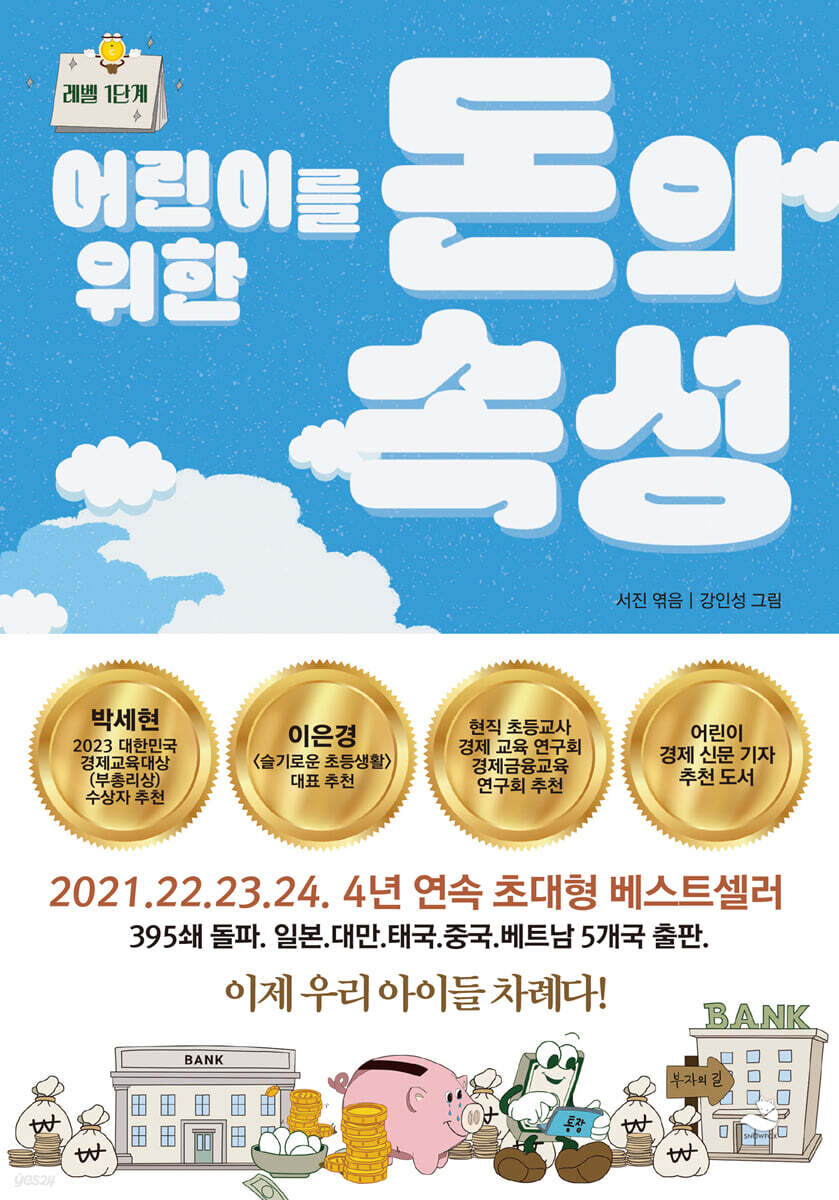
2020, 21, 22, 23.
The Nature of Money, a mega-bestseller for four consecutive years
395th printing.
Published in 5 countries: Japan, Taiwan, Thailand, China, and Vietnam
Now it's our children's turn!
Selected as a "Best Book" by the Korea Institute for Children's Education and Culture
Park Se-hyeon, winner of the 2023 Republic of Korea Economic Education Award (Deputy Prime Minister's Award), recommended
Recommended by Kim Ji-hwan, winner of the 2021 Financial Supervisory Service Outstanding Teacher Award
Recommended by Eun-kyung Lee, CEO of Smart Elementary School Life
Recommended by Cheon Sang-hee, President of the Economic and Financial Education Research Association
Recommended by Park Han-eul, a reporter for the Children's Economic Newspaper
Recommendation from a current elementary school teacher
The Nature of Money for Children is a book that reconstructs the content covered in the original book, The Nature of Money, from a child's perspective.
Regardless of the child's reading level, we focused on making it easy for any elementary school student to understand any part.
All the parts that were interesting and could be conveyed immediately through a story were developed and included, such as the four properties of money that were a hot topic even among adults, the view of money as a person, and the part where unnecessary items were referred to as pretty trash.
The twin sisters Won-young and Lee-seo who appear in this book each choose different actions under the same conditions, and the children are taught to distinguish and understand for themselves what consequences result from those actions.
Won-young and Lee-seo are used as a device to keep the entire book focused on the topic of 'realizing the importance of money' until the end of the book.
『The Nature of Money for Children』, which is composed of a total of five chapters, is divided or combined into the basic 'uses' of money in everyday spaces such as home or school, as well as the various 'roles' of money.
From there, topics such as 'Why do pretty trashes appear in desk drawers?', 'Banks are better than piggy banks, money works too,' and 'Do you always have a shortage of allowance?' were naturally learned within the manuscript.
It is also filled with materials that elementary school students can easily encounter in their daily lives, such as organizing desk drawers, participating in school flea markets, writing allowance records, saving supplies, and comparing product prices.
The space between the words was sufficiently widened to reduce the burden on children's reading, and the lesson of viewing money as a person was visualized with money-shaped illustrations.
A separate key point highlighted at the end of each episode can serve as a conversation topic between parents and children.
The Nature of Money, a mega-bestseller for four consecutive years
395th printing.
Published in 5 countries: Japan, Taiwan, Thailand, China, and Vietnam
Now it's our children's turn!
Selected as a "Best Book" by the Korea Institute for Children's Education and Culture
Park Se-hyeon, winner of the 2023 Republic of Korea Economic Education Award (Deputy Prime Minister's Award), recommended
Recommended by Kim Ji-hwan, winner of the 2021 Financial Supervisory Service Outstanding Teacher Award
Recommended by Eun-kyung Lee, CEO of Smart Elementary School Life
Recommended by Cheon Sang-hee, President of the Economic and Financial Education Research Association
Recommended by Park Han-eul, a reporter for the Children's Economic Newspaper
Recommendation from a current elementary school teacher
The Nature of Money for Children is a book that reconstructs the content covered in the original book, The Nature of Money, from a child's perspective.
Regardless of the child's reading level, we focused on making it easy for any elementary school student to understand any part.
All the parts that were interesting and could be conveyed immediately through a story were developed and included, such as the four properties of money that were a hot topic even among adults, the view of money as a person, and the part where unnecessary items were referred to as pretty trash.
The twin sisters Won-young and Lee-seo who appear in this book each choose different actions under the same conditions, and the children are taught to distinguish and understand for themselves what consequences result from those actions.
Won-young and Lee-seo are used as a device to keep the entire book focused on the topic of 'realizing the importance of money' until the end of the book.
『The Nature of Money for Children』, which is composed of a total of five chapters, is divided or combined into the basic 'uses' of money in everyday spaces such as home or school, as well as the various 'roles' of money.
From there, topics such as 'Why do pretty trashes appear in desk drawers?', 'Banks are better than piggy banks, money works too,' and 'Do you always have a shortage of allowance?' were naturally learned within the manuscript.
It is also filled with materials that elementary school students can easily encounter in their daily lives, such as organizing desk drawers, participating in school flea markets, writing allowance records, saving supplies, and comparing product prices.
The space between the words was sufficiently widened to reduce the burden on children's reading, and the lesson of viewing money as a person was visualized with money-shaped illustrations.
A separate key point highlighted at the end of each episode can serve as a conversation topic between parents and children.
- You can preview some of the book's contents.
Preview
index
Introduction
Recommendation
Chapter 1_ How to become rich?
1.
I want to be rich too
2.
Becoming rich is all about determination.
3.
I have a bankbook
4.
Deposit directly into your account
5.
You spend money without a plan?
6.
Treat money like a precious friend.
7.
No more excuses!
8.
Why is there such a pretty mess in my desk drawer?
Chapter 2_ Money! Who are you?
1.
What is the standard for being rich?
2.
Money works too
3.
How has money changed?
4.
Can't I use my card too?
5.
Why is a credit card called a credit card?
6.
Do you have any special money to spend abroad?
Chapter 3: Money! Use it Properly
1.
Are you always short on pocket money?
2.
Money once spent never comes back.
3.
A little goes a long way
4.
Should I buy it cheap even if it is uncomfortable?
5.
What is Anabada?
6.
Become happier and richer
Chapter 4: Money! Save it well
1.
Money makes money?
2.
Money coming in and money going out
3.
I want to save first
4.
Bank over piggy bank!
5.
Preparing to become rich
Chapter 5: Money! Slowly and steadily
1.
What if compound interest and time combined?
2.
What is investment?
3.
Can I become a businessman too?
4.
What kind of company will you be the owner of?
5.
Start investing in stocks early.
Recommendation
Chapter 1_ How to become rich?
1.
I want to be rich too
2.
Becoming rich is all about determination.
3.
I have a bankbook
4.
Deposit directly into your account
5.
You spend money without a plan?
6.
Treat money like a precious friend.
7.
No more excuses!
8.
Why is there such a pretty mess in my desk drawer?
Chapter 2_ Money! Who are you?
1.
What is the standard for being rich?
2.
Money works too
3.
How has money changed?
4.
Can't I use my card too?
5.
Why is a credit card called a credit card?
6.
Do you have any special money to spend abroad?
Chapter 3: Money! Use it Properly
1.
Are you always short on pocket money?
2.
Money once spent never comes back.
3.
A little goes a long way
4.
Should I buy it cheap even if it is uncomfortable?
5.
What is Anabada?
6.
Become happier and richer
Chapter 4: Money! Save it well
1.
Money makes money?
2.
Money coming in and money going out
3.
I want to save first
4.
Bank over piggy bank!
5.
Preparing to become rich
Chapter 5: Money! Slowly and steadily
1.
What if compound interest and time combined?
2.
What is investment?
3.
Can I become a businessman too?
4.
What kind of company will you be the owner of?
5.
Start investing in stocks early.
Detailed image
.jpg)
Into the book
Wonyoung thought deeply about money.
It seemed like my mom was right.
We also want to have long-term relationships with friends who cherish and care for us.
The same goes for money.
… (omitted)… Won-young thought that from now on, he should treat money like a precious friend.
--- p.52
"Using a credit card is debt? Then, all the money I pay with my parents' credit cards is debt, too?"
"that's right.
Credit in the context of credit cards refers to the ability to repay money used on the card.
For example, if you eat chicken and pay with a credit card, the credit card company pays the restaurant first.
And when the predetermined card payment date comes, the money is taken from Mom's bank account."
--- p.84
These days, Wonyoung feels good whenever he buys something cheap.
I guess I've become Scrooge before I knew it.
I'm more happy saving money than buying things.
…(syncopation)…
"How much are you saving by being so frugal that you're tapping away at the cash register at the supermarket? It's embarrassing."
Won-young did not back down from Lee Seo's sarcasm and responded.
“Don’t you know the saying, ‘Many a little makes a mickle’?”
--- pp.105~106
“Seo, if you have a friend who teases you about what you wear, you don’t have to play with them.
A real friend doesn't act like that.
If your friends are ignoring each other because of their clothes, you need to step in and stop them.”
“Is that easy? Then I might become an outcast.”
--- p.120
“They say you can’t become rich just by saving money.
Money should make money.
That money is 'seed money'.
What's a seed? A seed of a plant? The money that becomes the seed of money is seed money.
“You guys are students, so save up 10 million won first.”
“How do we save up ten million won?”
--- p.126
“If you steadily accumulate stocks of good companies for 5 or 10 years, you are a true entrepreneur.
Because I am the owner of that company.
A true owner! That's what it means to own stock.
Since it's your company, it would be good to use company products as well.
Think of every time a product is sold, a few ten millionths of that is your money.
“If you invest in stocks with that mindset, you will learn about economics and your profits will increase.”
It seemed like my mom was right.
We also want to have long-term relationships with friends who cherish and care for us.
The same goes for money.
… (omitted)… Won-young thought that from now on, he should treat money like a precious friend.
--- p.52
"Using a credit card is debt? Then, all the money I pay with my parents' credit cards is debt, too?"
"that's right.
Credit in the context of credit cards refers to the ability to repay money used on the card.
For example, if you eat chicken and pay with a credit card, the credit card company pays the restaurant first.
And when the predetermined card payment date comes, the money is taken from Mom's bank account."
--- p.84
These days, Wonyoung feels good whenever he buys something cheap.
I guess I've become Scrooge before I knew it.
I'm more happy saving money than buying things.
…(syncopation)…
"How much are you saving by being so frugal that you're tapping away at the cash register at the supermarket? It's embarrassing."
Won-young did not back down from Lee Seo's sarcasm and responded.
“Don’t you know the saying, ‘Many a little makes a mickle’?”
--- pp.105~106
“Seo, if you have a friend who teases you about what you wear, you don’t have to play with them.
A real friend doesn't act like that.
If your friends are ignoring each other because of their clothes, you need to step in and stop them.”
“Is that easy? Then I might become an outcast.”
--- p.120
“They say you can’t become rich just by saving money.
Money should make money.
That money is 'seed money'.
What's a seed? A seed of a plant? The money that becomes the seed of money is seed money.
“You guys are students, so save up 10 million won first.”
“How do we save up ten million won?”
--- p.126
“If you steadily accumulate stocks of good companies for 5 or 10 years, you are a true entrepreneur.
Because I am the owner of that company.
A true owner! That's what it means to own stock.
Since it's your company, it would be good to use company products as well.
Think of every time a product is sold, a few ten millionths of that is your money.
“If you invest in stocks with that mindset, you will learn about economics and your profits will increase.”
--- p.164
Publisher's Review
Childhood is the golden time to acquire sound financial knowledge!
What's more important than earning more and faster than others?
"The Nature of Money for Children" is an economic and financial fairy tale that broadens children's economic thinking and understanding from a child's perspective.
It is also an economic education guide that teaches children to use the weapons of welfare and time from a young age.
This book compares money to a precious friend, helping children develop a healthy relationship with money.
We introduce a healthy interest in money, how to spend money well, how to save money well, and how to make money grow well.
Through materials that elementary school students can easily encounter in their daily lives, such as organizing desk drawers, participating in school flea markets, writing allowance records, saving money, and comparing product prices, they can naturally understand rational consumption, honest saving, and sound investment.
This book appropriately places the basic concepts of economics and finance in the right places, including the role and history of money, the meaning of credit and check cards, types of cards and smart pay, currency exchange and exchange rates, price comparison, the meaning of seed money, and the role of banks.
What's more important than earning more and faster than others?
"The Nature of Money for Children" is an economic and financial fairy tale that broadens children's economic thinking and understanding from a child's perspective.
It is also an economic education guide that teaches children to use the weapons of welfare and time from a young age.
This book compares money to a precious friend, helping children develop a healthy relationship with money.
We introduce a healthy interest in money, how to spend money well, how to save money well, and how to make money grow well.
Through materials that elementary school students can easily encounter in their daily lives, such as organizing desk drawers, participating in school flea markets, writing allowance records, saving money, and comparing product prices, they can naturally understand rational consumption, honest saving, and sound investment.
This book appropriately places the basic concepts of economics and finance in the right places, including the role and history of money, the meaning of credit and check cards, types of cards and smart pay, currency exchange and exchange rates, price comparison, the meaning of seed money, and the role of banks.
GOODS SPECIFICS
- Date of issue: April 22, 2024
- Page count, weight, size: 172 pages | 288g | 145*210*10mm
- ISBN13: 9791191769678
- ISBN10: 1191769674
- KC Certification: Certification Type: Conformity Confirmation
You may also like
카테고리
korean


korean

![ELLE 엘르 스페셜 에디션 A형 : 12월 [2025]](http://librairie.coreenne.fr/cdn/shop/files/b8e27a3de6c9538896439686c6b0e8fb.jpg?v=1766436872&width=3840)


