

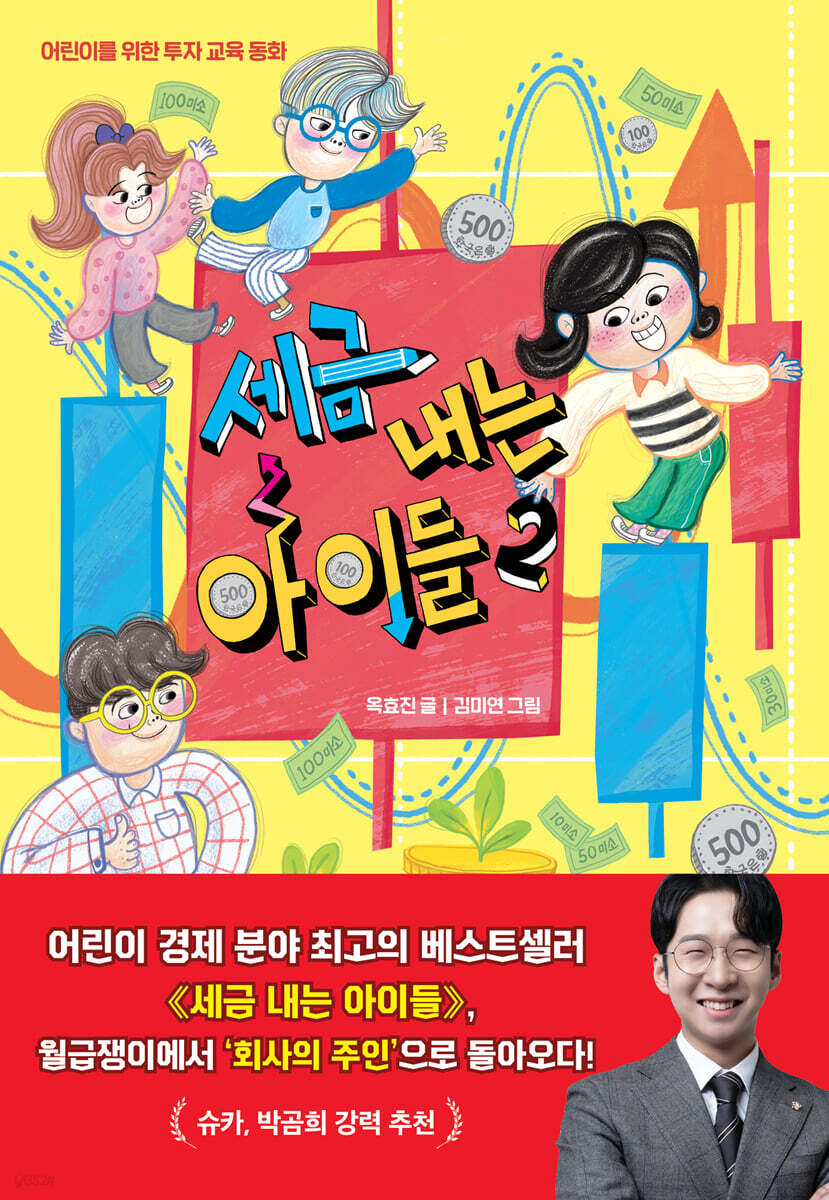
Taxpaying Kids 2
 |
Description
Book Introduction
Original content by teacher Ok Hyo-jin
The sequel to the children's economics bestseller, "The Taxpayer"
Educational hot topics highlighted by tvN's "You Quiz on the Block"
Highly recommended by financial creator Park Gom-hee
13-year-old salaried workers return as 'owners of the company'!
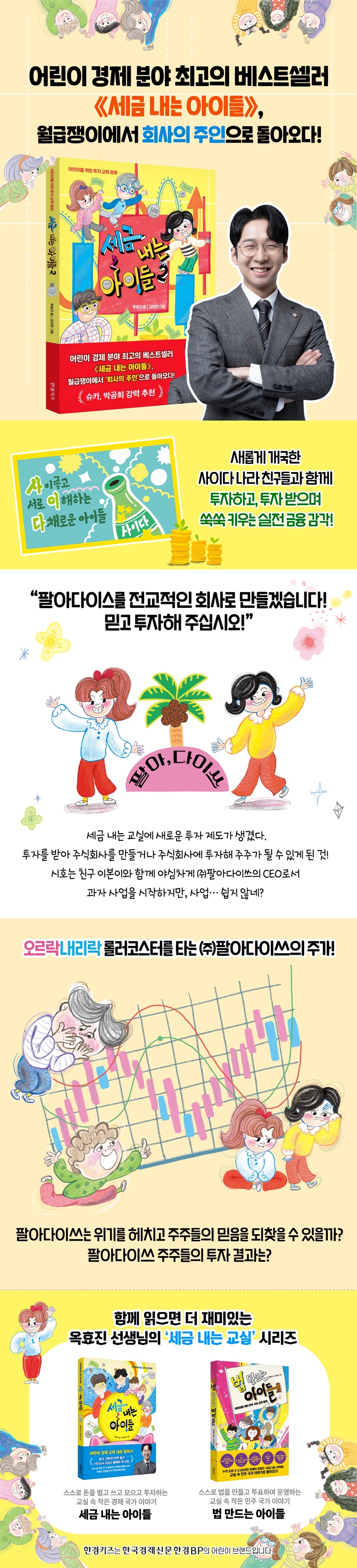
“We are recruiting valuable shareholders to invest in Paladaith Co., Ltd.”
Taste the sweet, salty, and bitter flavors of investing in a small stock market in the classroom!
"Taxpayers," a must-read for children's economics, returns with its second economics fairy tale, "Taxpayers 2"! Following the first installment, which taught children basic economic concepts through earning, spending, saving, and investing their salaries in the classroom, this second installment reflects the growing interest in investment, featuring an upgraded investment story where children invest and manage a "stock company" themselves.
What kind of stock companies will be created in the newly opened small economy country in the classroom?
A new nation has opened at Rainbow Elementary School, the nation of Cider (a colorful group of children who get along well and understand each other)! Teacher Min Jeong-hyeon introduces a new economic activity to her classmates, whose eyes sparkle with excitement and anticipation: the joint-stock company.
Citizens who wish to start a business can receive investment and establish a stock company, and citizens who wish to invest can purchase stocks in the stock company and become shareholders!
Siho and her friend Yvonne ambitiously start a confectionery business as CEOs of Pal-A-Dice Co., Ltd., but business... isn't easy?! Moreover, Yvonne, who left Pal-A-Dice due to differences in management opinions, appears as a rival by founding a new stock company called "Mugerba"! Due to losses caused by price competition with Mugerba and the jelly incident, shareholders sell Pal-A-Dice stock at a low price, and the stock price plummets... ... .
Can Paladaith Co., Ltd. become a paradise-like company that makes everyone happy?
The sequel to the children's economics bestseller, "The Taxpayer"
Educational hot topics highlighted by tvN's "You Quiz on the Block"
Highly recommended by financial creator Park Gom-hee
13-year-old salaried workers return as 'owners of the company'!
“We are recruiting valuable shareholders to invest in Paladaith Co., Ltd.”
Taste the sweet, salty, and bitter flavors of investing in a small stock market in the classroom!
"Taxpayers," a must-read for children's economics, returns with its second economics fairy tale, "Taxpayers 2"! Following the first installment, which taught children basic economic concepts through earning, spending, saving, and investing their salaries in the classroom, this second installment reflects the growing interest in investment, featuring an upgraded investment story where children invest and manage a "stock company" themselves.
What kind of stock companies will be created in the newly opened small economy country in the classroom?
A new nation has opened at Rainbow Elementary School, the nation of Cider (a colorful group of children who get along well and understand each other)! Teacher Min Jeong-hyeon introduces a new economic activity to her classmates, whose eyes sparkle with excitement and anticipation: the joint-stock company.
Citizens who wish to start a business can receive investment and establish a stock company, and citizens who wish to invest can purchase stocks in the stock company and become shareholders!
Siho and her friend Yvonne ambitiously start a confectionery business as CEOs of Pal-A-Dice Co., Ltd., but business... isn't easy?! Moreover, Yvonne, who left Pal-A-Dice due to differences in management opinions, appears as a rival by founding a new stock company called "Mugerba"! Due to losses caused by price competition with Mugerba and the jelly incident, shareholders sell Pal-A-Dice stock at a low price, and the stock price plummets... ... .
Can Paladaith Co., Ltd. become a paradise-like company that makes everyone happy?
- You can preview some of the book's contents.
Preview
index
Author's Note: A Newly Opened Classroom Powered by Money
Chapter 1: The Birth of a Thirteen-Year-Old CEO
○ I am also a child who pays taxes starting today!
○ Can I start a company by receiving investment?
○ What kind of business does our class need?
Chapter 2 Paladaith Co., Ltd.
○ Become the owner of the company!
○ What is the value of our company?
○ Should I sell my stock now or buy it?
Chapter 3 Is it right to sell it like this?
○ Cheap and a lot vs.
Even if you sell a little, it's worth it
○ 1st Paladaith Shareholders' Meeting
○ Selling Paladaith stocks at a low price
Chapter 4: The Rival Company, Mugerba, Emerges
○ Why are you lining up to buy something that is so expensive?!
○ Even if I suffer a loss, you can't do well!
○ Paladaith in a desperate crisis
Chapter 5: Opportunities Found in Crisis
○ Oh my, the company has to pay taxes too?
○ Find out what makes Paladaits unique!
○ Come to Paladaitsu, where taste and excitement come together!
Chapter 6 We can be anything!
○ Scoop! Paladaitsu and Mugerba's shocking ○○?
Thank you for your trust, shareholders!
○ My dream is to be the world's best CEO!
Chapter 1: The Birth of a Thirteen-Year-Old CEO
○ I am also a child who pays taxes starting today!
○ Can I start a company by receiving investment?
○ What kind of business does our class need?
Chapter 2 Paladaith Co., Ltd.
○ Become the owner of the company!
○ What is the value of our company?
○ Should I sell my stock now or buy it?
Chapter 3 Is it right to sell it like this?
○ Cheap and a lot vs.
Even if you sell a little, it's worth it
○ 1st Paladaith Shareholders' Meeting
○ Selling Paladaith stocks at a low price
Chapter 4: The Rival Company, Mugerba, Emerges
○ Why are you lining up to buy something that is so expensive?!
○ Even if I suffer a loss, you can't do well!
○ Paladaith in a desperate crisis
Chapter 5: Opportunities Found in Crisis
○ Oh my, the company has to pay taxes too?
○ Find out what makes Paladaits unique!
○ Come to Paladaitsu, where taste and excitement come together!
Chapter 6 We can be anything!
○ Scoop! Paladaitsu and Mugerba's shocking ○○?
Thank you for your trust, shareholders!
○ My dream is to be the world's best CEO!
Detailed image
Into the book
"that's right.
Until last year, there was an investment product called Teacher's Weight.
But this year, I'm going to invest in the stocks of the companies being created in our class."
The children were bewildered by the teacher's words.
The same was true for Siho and Yvonne.
Not only could they invest, but they could also receive investment! It seemed daunting, but the two friends were thrilled at the thought that they could build a company even without saving up 800 micro-dollars.
“Next week, I’m going to set up a stock company in Cider Country.
A stock company is a company that raises money by receiving investments from people and distributing stocks in return.
Investors pay money to start a company and receive stock as proof of their investment.
So, stocks are like certificates of ownership of a company.
And a company that raises money by selling stocks like this is called a joint stock company.”
The teacher wrote the word 'stock company' in large letters on the blackboard.
--- From "Chapter 1: The Birth of a Thirteen-Year-Old CEO_Can You Build a Company with Investments?"
“Hello! The name of the company we have prepared is….”
Yvonne turned the page.
“Sell it, it’s Daitsu.”
The logo of Paladaith appeared on the screen.
A palm tree laden with sweets and the words 'Sell, Daitsu' caught my eye.
There was a comma between the letters 'a' and 'da'.
“We are a company that sells snacks.”
As soon as Yvonne finished speaking, Siho continued.
“According to the survey, the favorite snack of the citizens of Cider Country is chocolate cookies.
“We plan to start out as a company selling chocolate cookies.”
--- From "Chapter 1: The Birth of a Thirteen-Year-Old CEO_What Business Does Our Class Need?"
"I bought so many cookies, and the company's assets decreased? If you divide 560 Miso by 80 shares, it only comes to 7 Miso.
I've had it for five weeks.
“If I used to get 10 smiles a week, I’d only get 7 smiles a week, so it’s a total loss!”
"If things continue this way, won't the company's assets be reduced to zero? If it reduces by 240 micrograms every month, there won't be any money left after three months."
The other friends also started to chatter.
Yunjae grumbled and then suddenly picked up a pen and ran off somewhere.
Then he wrote something diligently on a piece of paper.
Selling Paladais stock for 7 smiles.
-Jeong Yoon-jae-
--- From "Chapter 2, Selling Stock Company_Should I Sell or Buy My Stock Now?"
“Siho! Give me some ice cream.”
As Yunjae handed the bankbook back to Siho, someone shouted loudly.
“Guys, they’re selling ice cream for 75 smiles at the Muger Bar!”
“Let’s go right now, guys!”
The children who had flocked to Paladaitsu ran back to Mugerba as if the tide was going out.
Siho shouted in a loud voice, “Selling for 70 smiles!” to get the children to turn around.
Then Yvonne held up a price tag that read '65 Smiles'.
The classroom floor shook as the children ran back and forth.
“Huh, who knew they’d lose?”
Until last year, there was an investment product called Teacher's Weight.
But this year, I'm going to invest in the stocks of the companies being created in our class."
The children were bewildered by the teacher's words.
The same was true for Siho and Yvonne.
Not only could they invest, but they could also receive investment! It seemed daunting, but the two friends were thrilled at the thought that they could build a company even without saving up 800 micro-dollars.
“Next week, I’m going to set up a stock company in Cider Country.
A stock company is a company that raises money by receiving investments from people and distributing stocks in return.
Investors pay money to start a company and receive stock as proof of their investment.
So, stocks are like certificates of ownership of a company.
And a company that raises money by selling stocks like this is called a joint stock company.”
The teacher wrote the word 'stock company' in large letters on the blackboard.
--- From "Chapter 1: The Birth of a Thirteen-Year-Old CEO_Can You Build a Company with Investments?"
“Hello! The name of the company we have prepared is….”
Yvonne turned the page.
“Sell it, it’s Daitsu.”
The logo of Paladaith appeared on the screen.
A palm tree laden with sweets and the words 'Sell, Daitsu' caught my eye.
There was a comma between the letters 'a' and 'da'.
“We are a company that sells snacks.”
As soon as Yvonne finished speaking, Siho continued.
“According to the survey, the favorite snack of the citizens of Cider Country is chocolate cookies.
“We plan to start out as a company selling chocolate cookies.”
--- From "Chapter 1: The Birth of a Thirteen-Year-Old CEO_What Business Does Our Class Need?"
"I bought so many cookies, and the company's assets decreased? If you divide 560 Miso by 80 shares, it only comes to 7 Miso.
I've had it for five weeks.
“If I used to get 10 smiles a week, I’d only get 7 smiles a week, so it’s a total loss!”
"If things continue this way, won't the company's assets be reduced to zero? If it reduces by 240 micrograms every month, there won't be any money left after three months."
The other friends also started to chatter.
Yunjae grumbled and then suddenly picked up a pen and ran off somewhere.
Then he wrote something diligently on a piece of paper.
Selling Paladais stock for 7 smiles.
-Jeong Yoon-jae-
--- From "Chapter 2, Selling Stock Company_Should I Sell or Buy My Stock Now?"
“Siho! Give me some ice cream.”
As Yunjae handed the bankbook back to Siho, someone shouted loudly.
“Guys, they’re selling ice cream for 75 smiles at the Muger Bar!”
“Let’s go right now, guys!”
The children who had flocked to Paladaitsu ran back to Mugerba as if the tide was going out.
Siho shouted in a loud voice, “Selling for 70 smiles!” to get the children to turn around.
Then Yvonne held up a price tag that read '65 Smiles'.
The classroom floor shook as the children ran back and forth.
“Huh, who knew they’d lose?”
--- From "Chapter 4: The Appearance of Rival Company Mugerba_Even if I Lose, You Can't Prosper!"
Publisher's Review
“I will become the best CEO in the cider country!”
“I bought it for 10 miso a week, but now it’s 7 miso a week? That’s a total loss!”
The ups and downs of the stock market in a small economic nation within the classroom.
How do you spend your money? Some people buy things they've always wanted, while others save money in the bank.
Adults are similar too.
However, people who want to manage their money more actively may also 'invest'.
There are many different types of investments, but the most popular one is stocks.
'Stocks' are a certificate that gives those who have invested in a 'corporation' established with investments from many people the right to share in the company's profits.
In this way, you can invest, but you can also receive.
But did you know that, unlike the price of goods, the price of stocks (stock prices) does not have a set price?
Stock prices rise and fall depending on the company's circumstances and market changes.
When a company's business is good, it goes up, and when the company is in trouble, it goes down.
That's why, depending on how much and when you decide which company to invest, you can either become rich and make a lot of money, or you can suffer a lot of losses.
You can earn more money than with bank deposits and savings, but the risk is also high, so you need to invest wisely.
Investing is a great way to manage your money, as much as you are interested in it and know how to do it well.
"Taxpaying Children 2" is a story that takes place one year after "Taxpaying Children", and is about Siho, the younger brother of Siwoo, a main character in the previous work, becoming the CEO of Paladaits Co., Ltd. in Cider Country and running the company.
In the newly opened country of Cider, anyone can receive investment and establish a company, and can also invest in the company and become a shareholder.
Siho and Yvonne hold a 'business briefing session' to promote their snack business in order to secure the minimum investment of 800 micrograms to establish a company. After receiving investment from shareholders and establishing Paladaits Co., Ltd., they struggle with whether to sell the product cheaply to sell more or sell it at a fair price to make more profit.
Additionally, due to various unexpected incidents and accidents, the stock price plummets and the company is put on the verge of going out of business.
Shareholders who invested in Paladaith are also hesitant about whether or not to sell their stocks depending on the company's profits.
The only way to keep the volatile stock price and shareholders' hearts in check is to manage Palladys well! But what can be done to raise the stock price?! Will Palladys' CEO and shareholders succeed in their investment?
Learn about investment concepts in a fun way through Siho and his friends' turbulent journey of running a stock company, and discover the management strategies and marketing of companies hidden throughout our daily lives.
If I were the CEO of Cider Nara Corporation, I'd think about what kind of business I'd do, what I'd do to raise the stock price, or if I were an investor, how much I'd invest in which company, when, and when I'd sell. This would make the flow of money seem natural, and investing, which I'd vaguely considered a world for adults, would feel much closer.
The first step toward creating a better future
Teacher Ok Hyo-jin's 'Tax-Paying Classroom' series,
Back to 'The Story of a Small Stock Company in the Classroom'.
The 'Tax Paying Classroom' series is a collection of fairy tales adapted from various episodes experienced by teacher Ok Hyo-jin while running a 'Tax Paying Classroom' in her actual classroom.
Because it is based on stories that actually happened in a classroom, it accurately reflects today's children's values and behaviors regarding money.
Through classroom currency activities, children receive wages for the work they do and think about how to spend that money.
The expression 'paying taxes' in the title also carries the meaning of becoming an economic entity and a member of society engaged in economic activities.
In the previous work, "Children Who Pay Taxes," students in the small economic nation of Hwalmyeongsu, a classroom, become citizens and economic entities and use the class currency, "Smile."
It contains stories about what happens in the process of receiving a salary, paying taxes, spending money, saving money, and investing money through work activities.
There were friends who saved money without thinking, friends who spent it all without a plan, and friends who managed their money systematically by making spending, saving, and investment plans.
In the previous work, friends with various personalities learned basic economic concepts such as employment, taxes, business, unemployment, savings, investment, insurance, and auctions, and were able to develop basic economic concepts through the process of developing good money habits through trial and error.
《Children Who Make Laws》, set in the same classroom (the land of Hwalmyeongsu), also tells the story of children voting, debating, and creating their own laws, allowing them to learn about the duties and rights of citizens.
Nowadays, more parents feel the need for economic education for children than before, and more children are interested in the economy. This has led to a higher level of economic knowledge, and a growing demand for investment as well as money management.
《Taxpaying Kids 2》 reflects these needs and changes, focusing on 'investment' and 'business' that allow for more proactive and independent money earning and management.
This is a direct copy of the actual investment product management and operation in Professor Ok Hyo-jin's classroom.
In the previous work, through investment products such as "Teacher's Weight" and "Today's Music Rankings," I was able to learn the basic investment concept that unlike deposits and savings, investments can result in losses, and that it is one's own choice which investment product to invest in, so one must pay close attention to company news.
In "Children Who Pay Taxes 2," instead of the investment products provided by teachers, children can propose their own business ideas, receive investment, create a stock company, or invest in a stock company and become shareholders.
It is a new investment system that reflects the concept of stocks, the rights of shareholders, the role of the CEO, and the fluctuations in stock prices formed by supply and demand.
Small stock companies in the classroom sometimes see their stock prices fall due to the emergence of rival companies, or rise due to new marketing strategies.
Even if they own stocks of the same company, shareholders who bought them at a low price rejoice at the profits they made, while shareholders who bought them at a high price cry and say they suffered losses.
In this book, we've tried to capture the physiology of the actual stock market as closely as possible, reflecting the growing interest in stock investment.
Through the introduction and operation of various new businesses in the classroom, you can learn economic knowledge such as corporations, shareholders, stocks, stock prices, general shareholders' meetings, monopolies, chicken games, marketing, and mergers in a fun and natural way.
Teaching children to develop sound financial habits and wise investment methods will go a long way toward helping them dream of and achieve a brighter future.
“I bought it for 10 miso a week, but now it’s 7 miso a week? That’s a total loss!”
The ups and downs of the stock market in a small economic nation within the classroom.
How do you spend your money? Some people buy things they've always wanted, while others save money in the bank.
Adults are similar too.
However, people who want to manage their money more actively may also 'invest'.
There are many different types of investments, but the most popular one is stocks.
'Stocks' are a certificate that gives those who have invested in a 'corporation' established with investments from many people the right to share in the company's profits.
In this way, you can invest, but you can also receive.
But did you know that, unlike the price of goods, the price of stocks (stock prices) does not have a set price?
Stock prices rise and fall depending on the company's circumstances and market changes.
When a company's business is good, it goes up, and when the company is in trouble, it goes down.
That's why, depending on how much and when you decide which company to invest, you can either become rich and make a lot of money, or you can suffer a lot of losses.
You can earn more money than with bank deposits and savings, but the risk is also high, so you need to invest wisely.
Investing is a great way to manage your money, as much as you are interested in it and know how to do it well.
"Taxpaying Children 2" is a story that takes place one year after "Taxpaying Children", and is about Siho, the younger brother of Siwoo, a main character in the previous work, becoming the CEO of Paladaits Co., Ltd. in Cider Country and running the company.
In the newly opened country of Cider, anyone can receive investment and establish a company, and can also invest in the company and become a shareholder.
Siho and Yvonne hold a 'business briefing session' to promote their snack business in order to secure the minimum investment of 800 micrograms to establish a company. After receiving investment from shareholders and establishing Paladaits Co., Ltd., they struggle with whether to sell the product cheaply to sell more or sell it at a fair price to make more profit.
Additionally, due to various unexpected incidents and accidents, the stock price plummets and the company is put on the verge of going out of business.
Shareholders who invested in Paladaith are also hesitant about whether or not to sell their stocks depending on the company's profits.
The only way to keep the volatile stock price and shareholders' hearts in check is to manage Palladys well! But what can be done to raise the stock price?! Will Palladys' CEO and shareholders succeed in their investment?
Learn about investment concepts in a fun way through Siho and his friends' turbulent journey of running a stock company, and discover the management strategies and marketing of companies hidden throughout our daily lives.
If I were the CEO of Cider Nara Corporation, I'd think about what kind of business I'd do, what I'd do to raise the stock price, or if I were an investor, how much I'd invest in which company, when, and when I'd sell. This would make the flow of money seem natural, and investing, which I'd vaguely considered a world for adults, would feel much closer.
The first step toward creating a better future
Teacher Ok Hyo-jin's 'Tax-Paying Classroom' series,
Back to 'The Story of a Small Stock Company in the Classroom'.
The 'Tax Paying Classroom' series is a collection of fairy tales adapted from various episodes experienced by teacher Ok Hyo-jin while running a 'Tax Paying Classroom' in her actual classroom.
Because it is based on stories that actually happened in a classroom, it accurately reflects today's children's values and behaviors regarding money.
Through classroom currency activities, children receive wages for the work they do and think about how to spend that money.
The expression 'paying taxes' in the title also carries the meaning of becoming an economic entity and a member of society engaged in economic activities.
In the previous work, "Children Who Pay Taxes," students in the small economic nation of Hwalmyeongsu, a classroom, become citizens and economic entities and use the class currency, "Smile."
It contains stories about what happens in the process of receiving a salary, paying taxes, spending money, saving money, and investing money through work activities.
There were friends who saved money without thinking, friends who spent it all without a plan, and friends who managed their money systematically by making spending, saving, and investment plans.
In the previous work, friends with various personalities learned basic economic concepts such as employment, taxes, business, unemployment, savings, investment, insurance, and auctions, and were able to develop basic economic concepts through the process of developing good money habits through trial and error.
《Children Who Make Laws》, set in the same classroom (the land of Hwalmyeongsu), also tells the story of children voting, debating, and creating their own laws, allowing them to learn about the duties and rights of citizens.
Nowadays, more parents feel the need for economic education for children than before, and more children are interested in the economy. This has led to a higher level of economic knowledge, and a growing demand for investment as well as money management.
《Taxpaying Kids 2》 reflects these needs and changes, focusing on 'investment' and 'business' that allow for more proactive and independent money earning and management.
This is a direct copy of the actual investment product management and operation in Professor Ok Hyo-jin's classroom.
In the previous work, through investment products such as "Teacher's Weight" and "Today's Music Rankings," I was able to learn the basic investment concept that unlike deposits and savings, investments can result in losses, and that it is one's own choice which investment product to invest in, so one must pay close attention to company news.
In "Children Who Pay Taxes 2," instead of the investment products provided by teachers, children can propose their own business ideas, receive investment, create a stock company, or invest in a stock company and become shareholders.
It is a new investment system that reflects the concept of stocks, the rights of shareholders, the role of the CEO, and the fluctuations in stock prices formed by supply and demand.
Small stock companies in the classroom sometimes see their stock prices fall due to the emergence of rival companies, or rise due to new marketing strategies.
Even if they own stocks of the same company, shareholders who bought them at a low price rejoice at the profits they made, while shareholders who bought them at a high price cry and say they suffered losses.
In this book, we've tried to capture the physiology of the actual stock market as closely as possible, reflecting the growing interest in stock investment.
Through the introduction and operation of various new businesses in the classroom, you can learn economic knowledge such as corporations, shareholders, stocks, stock prices, general shareholders' meetings, monopolies, chicken games, marketing, and mergers in a fun and natural way.
Teaching children to develop sound financial habits and wise investment methods will go a long way toward helping them dream of and achieve a brighter future.
GOODS SPECIFICS
- Date of issue: April 25, 2024
- Page count, weight, size: 212 pages | 402g | 152*220*12mm
- ISBN13: 9788947549455
- ISBN10: 8947549452
You may also like
카테고리
korean


korean

![ELLE 엘르 스페셜 에디션 A형 : 12월 [2025]](http://librairie.coreenne.fr/cdn/shop/files/b8e27a3de6c9538896439686c6b0e8fb.jpg?v=1766436872&width=3840)


