

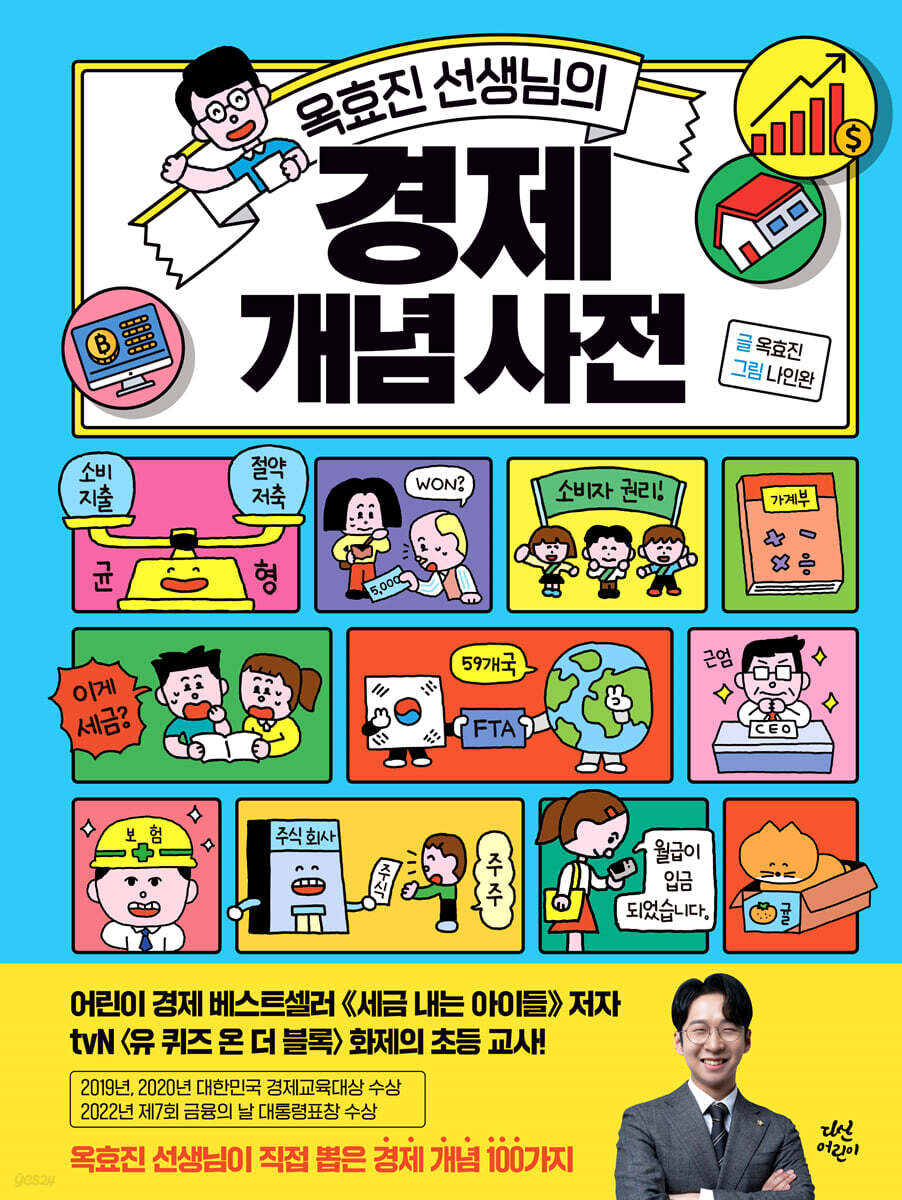
Professor Ok Hyo-jin's Dictionary of Economic Concepts
 |
Description
Book Introduction
- A word from MD
-
Economics Day 1 with Teacher Ok『Children Who Pay Taxes』 contains 100 essential economic concepts for elementary school students, personally selected by teacher Ok Hyo-jin.
If economics just feels difficult, it's because you've learned it in a boring way! With delightful, everyday episodes tailored to children's level, you can easily and enjoyably master economics.
July 4, 2023. Children's PD Park Eun-young
★ Author of the children's economics bestseller "Children Who Pay Taxes"
★ tvN's "You Quiz on the Block" features a popular elementary school teacher
★ 2019, 2020 Korea Economic Education Award Winner
2021 Deputy Prime Minister and Minister of Strategy and Finance Award
2022 Kyobo Education Awards Future Education Content Category Grand Prize
Received the Presidential Citation at the 7th Financial Day in 2022
With bestselling elementary economics author Ok Hyo-jin
Master the economy the easiest and fastest way
Let's become true honor students!
You're saying I don't need to know about economics because I'm young? NO!
Economics: An Essential Virtue for Leaders in Modern Society
A child who knows the economy well is a true model student!
The importance of the economy has always been emphasized, but its importance is increasing in modern society.
It may be because in a capitalist society, everyone has realized the importance of the economy.
In this situation, the economy is now a 'survival weapon' that must be possessed to manage one's life.
We all know in our heads that the economy is intertwined with our daily lives.
Income from work, the price you pay when buying something, currency exchange when traveling, management fees such as various water and electricity bills…
These are all stories from our daily lives.
The economy is so close to our daily lives, so why do children find it so difficult? It's because they've learned it in a difficult and boring way.
Knowing such realistic problems, this book thoroughly constructs characters and stories from a child's perspective.
When Teacher Ok and the children in the class, Sol-i and Tani, appear and show childlike curiosity and interest in various economic concepts, Teacher Ok explains them step by step from the children's eye level.
Also, the cute puppy Mong-i and the sassy cat Nyang-i appear to help children understand economic concepts that they may find difficult by using metaphors.
I hope that through "Teacher Ok Hyo-jin's Dictionary of Economic Concepts," children's understanding of economics will improve further.
★ tvN's "You Quiz on the Block" features a popular elementary school teacher
★ 2019, 2020 Korea Economic Education Award Winner
2021 Deputy Prime Minister and Minister of Strategy and Finance Award
2022 Kyobo Education Awards Future Education Content Category Grand Prize
Received the Presidential Citation at the 7th Financial Day in 2022
With bestselling elementary economics author Ok Hyo-jin
Master the economy the easiest and fastest way
Let's become true honor students!
You're saying I don't need to know about economics because I'm young? NO!
Economics: An Essential Virtue for Leaders in Modern Society
A child who knows the economy well is a true model student!
The importance of the economy has always been emphasized, but its importance is increasing in modern society.
It may be because in a capitalist society, everyone has realized the importance of the economy.
In this situation, the economy is now a 'survival weapon' that must be possessed to manage one's life.
We all know in our heads that the economy is intertwined with our daily lives.
Income from work, the price you pay when buying something, currency exchange when traveling, management fees such as various water and electricity bills…
These are all stories from our daily lives.
The economy is so close to our daily lives, so why do children find it so difficult? It's because they've learned it in a difficult and boring way.
Knowing such realistic problems, this book thoroughly constructs characters and stories from a child's perspective.
When Teacher Ok and the children in the class, Sol-i and Tani, appear and show childlike curiosity and interest in various economic concepts, Teacher Ok explains them step by step from the children's eye level.
Also, the cute puppy Mong-i and the sassy cat Nyang-i appear to help children understand economic concepts that they may find difficult by using metaphors.
I hope that through "Teacher Ok Hyo-jin's Dictionary of Economic Concepts," children's understanding of economics will improve further.
- You can preview some of the book's contents.
Preview
index
Chapter 1: Basic Economic Principles … … … … … … … … … … … 12
Economy | Free Market Economy | The Three Entities of the Economy | Money | Income | Consumption | Opportunity Cost | Scarcity | Supply and Demand | Market | Inflation and Deflation | The Value of Money | Easterlin's Paradox
Chapter 2 Various Financial Institutions … … … … … … … … … … 40
Banks | Deposit margins | Central banks | Interest rates | Money supply | Savings | Types of savings | Simple and compound interest | Housing subscription accounts | Loans | Credit scores | Types of loans | Credit and debit cards
Chapter 3 How to Manage Money … … … … … … … … … … … 68
Household Accounts | Investments | Various Investment Ventures | Corporations | Stocks | Financial Statements | Blue Chips and Promising Stocks | Funds | Financial Planners | Insurance | Types of Insurance
Chapter 4 Entrepreneurship … … … … … … … … … … … 92
CEO | Multinational Corporation | Startup | Monopoly | After-Sales Service and Recall | Social Enterprise | Mergers and Acquisitions | Marketing
Chapter 5: The State and Money … … … … … … … … … … … 110
Taxes | Types of Taxes | Taxes That Change with the Times | Value-Added Tax | Tax Collection Methods | Year-End Tax Settlement | Customs | FTAs | Social Insurance | Gross Domestic Product | Ministry of Planning and Finance
Chapter 6: The Economy in Life … … … … … … … … … … … 134
Depositor Protection System | Minimum Wage System | Consumer Protection Act | Real-Name Financial Transactions | Voice Phishing and Smishing | Proxy Deposits | Waste Currency | Counterfeit Currency | Exchange Rate | Exchange Rate Fluctuations | IMF Foreign Exchange Crisis | Industrial Revolution
Chapter 7: Interesting Economic Terms … … … … … … … … … … … 160
Surplus and Deficit | Blue Oceans and Red Oceans | The Law of Diminishing Marginal Utility | Comparative Advantage | Shrinkflation | Engel's Coefficient | The Sharing Economy | The Penguin Effect | The Veblen Effect | YOLO and the No-Spend Challenge
Chapter 8: I Want to Know More! Economic Concepts… … … … … … … … … … … 182
<real estate>
Real Estate Sales | Leases | Monthly Rent | Real Estate Brokers | Co-working Spaces | Gentrification | New Towns | Real Estate Taxes
<stock>
Stock | Dividend | Stock Price | KOSPI | KOSDAQ | NASDAQ
Virtual currency
Cryptocurrency | Fintech | Korea Exchange | Federal Reserve | The world's top three credit rating agencies | Financial Supervisory Service | Internet-only banks | Third-tier financial institutions
Economy | Free Market Economy | The Three Entities of the Economy | Money | Income | Consumption | Opportunity Cost | Scarcity | Supply and Demand | Market | Inflation and Deflation | The Value of Money | Easterlin's Paradox
Chapter 2 Various Financial Institutions … … … … … … … … … … 40
Banks | Deposit margins | Central banks | Interest rates | Money supply | Savings | Types of savings | Simple and compound interest | Housing subscription accounts | Loans | Credit scores | Types of loans | Credit and debit cards
Chapter 3 How to Manage Money … … … … … … … … … … … 68
Household Accounts | Investments | Various Investment Ventures | Corporations | Stocks | Financial Statements | Blue Chips and Promising Stocks | Funds | Financial Planners | Insurance | Types of Insurance
Chapter 4 Entrepreneurship … … … … … … … … … … … 92
CEO | Multinational Corporation | Startup | Monopoly | After-Sales Service and Recall | Social Enterprise | Mergers and Acquisitions | Marketing
Chapter 5: The State and Money … … … … … … … … … … … 110
Taxes | Types of Taxes | Taxes That Change with the Times | Value-Added Tax | Tax Collection Methods | Year-End Tax Settlement | Customs | FTAs | Social Insurance | Gross Domestic Product | Ministry of Planning and Finance
Chapter 6: The Economy in Life … … … … … … … … … … … 134
Depositor Protection System | Minimum Wage System | Consumer Protection Act | Real-Name Financial Transactions | Voice Phishing and Smishing | Proxy Deposits | Waste Currency | Counterfeit Currency | Exchange Rate | Exchange Rate Fluctuations | IMF Foreign Exchange Crisis | Industrial Revolution
Chapter 7: Interesting Economic Terms … … … … … … … … … … … 160
Surplus and Deficit | Blue Oceans and Red Oceans | The Law of Diminishing Marginal Utility | Comparative Advantage | Shrinkflation | Engel's Coefficient | The Sharing Economy | The Penguin Effect | The Veblen Effect | YOLO and the No-Spend Challenge
Chapter 8: I Want to Know More! Economic Concepts… … … … … … … … … … … 182
<real estate>
Real Estate Sales | Leases | Monthly Rent | Real Estate Brokers | Co-working Spaces | Gentrification | New Towns | Real Estate Taxes
<stock>
Stock | Dividend | Stock Price | KOSPI | KOSDAQ | NASDAQ
Virtual currency
Cryptocurrency | Fintech | Korea Exchange | Federal Reserve | The world's top three credit rating agencies | Financial Supervisory Service | Internet-only banks | Third-tier financial institutions
Detailed image

Publisher's Review
Selected by current elementary school teacher Ok Hyo-jin
100 Essential Economic Concepts for Kids!
Opportunity cost, inflation, central bank, interest rate margin, GDP… … .
It's something we've all probably heard at least once.
But when I try to explain this concept precisely, I hesitate a little.
Because if you don't know exactly, it's even more difficult to explain to others.
This book covers a variety of economic concepts, many of which we hear in everyday conversations and on the news, and which we may only know superficially, in chapters 1 through 8.
I avoided listing textbook-like economic concepts that people unconditionally study just because they think others should know them.
What makes this book even more special is that teacher Ok Hyo-jin, who has personally selected 100 essential economic concepts that she believes elementary school students should know while working with children as a current teacher.
It covers everything from basic concepts like income, consumption, and currency to concepts used in real life like taxes, insurance, and the real-name financial system, as well as trendy terms that reflect the current economic situation, such as the popular 'YOLO' and 'zero-spending challenge.'
From basic concepts to economic trends reflecting the current economic situation, the content is enriched with concepts selected directly by current teachers.
You will quickly become familiar with the concept through familiar everyday episodes,
Learn essential economic concepts faster and easier than anyone else with friendly explanations!
Although this book is titled and formatted as a dictionary, I have tried to present a variety of economic concepts in a format that is as informal as possible.
First, the students first encounter economic concepts through everyday episodes featuring Teacher Ok and the children, and then immediately understand the concepts accurately through dictionary definitions.
And, rather than just simple text, the explanations are in the form of comic panels, making it easier to understand concepts without getting bored.
The cute and adorable illustrations interspersed with the explanations help readers understand the concepts in an easy and fun way.
Finally, if you read the anecdotes related to the concepts that Teacher Ok tells, your knowledge of economic concepts will become richer.
100 Essential Economic Concepts for Kids!
Opportunity cost, inflation, central bank, interest rate margin, GDP… … .
It's something we've all probably heard at least once.
But when I try to explain this concept precisely, I hesitate a little.
Because if you don't know exactly, it's even more difficult to explain to others.
This book covers a variety of economic concepts, many of which we hear in everyday conversations and on the news, and which we may only know superficially, in chapters 1 through 8.
I avoided listing textbook-like economic concepts that people unconditionally study just because they think others should know them.
What makes this book even more special is that teacher Ok Hyo-jin, who has personally selected 100 essential economic concepts that she believes elementary school students should know while working with children as a current teacher.
It covers everything from basic concepts like income, consumption, and currency to concepts used in real life like taxes, insurance, and the real-name financial system, as well as trendy terms that reflect the current economic situation, such as the popular 'YOLO' and 'zero-spending challenge.'
From basic concepts to economic trends reflecting the current economic situation, the content is enriched with concepts selected directly by current teachers.
You will quickly become familiar with the concept through familiar everyday episodes,
Learn essential economic concepts faster and easier than anyone else with friendly explanations!
Although this book is titled and formatted as a dictionary, I have tried to present a variety of economic concepts in a format that is as informal as possible.
First, the students first encounter economic concepts through everyday episodes featuring Teacher Ok and the children, and then immediately understand the concepts accurately through dictionary definitions.
And, rather than just simple text, the explanations are in the form of comic panels, making it easier to understand concepts without getting bored.
The cute and adorable illustrations interspersed with the explanations help readers understand the concepts in an easy and fun way.
Finally, if you read the anecdotes related to the concepts that Teacher Ok tells, your knowledge of economic concepts will become richer.
GOODS SPECIFICS
- Date of issue: June 28, 2023
- Format: Hardcover book binding method guide
- Page count, weight, size: 196 pages | 740g | 196*257*18mm
- ISBN13: 9791130643519
- ISBN10: 1130643514
- KC Certification: Certification Type: Conformity Confirmation
You may also like
카테고리
korean


korean

![ELLE 엘르 스페셜 에디션 A형 : 12월 [2025]](http://librairie.coreenne.fr/cdn/shop/files/b8e27a3de6c9538896439686c6b0e8fb.jpg?v=1766436872&width=3840)


