

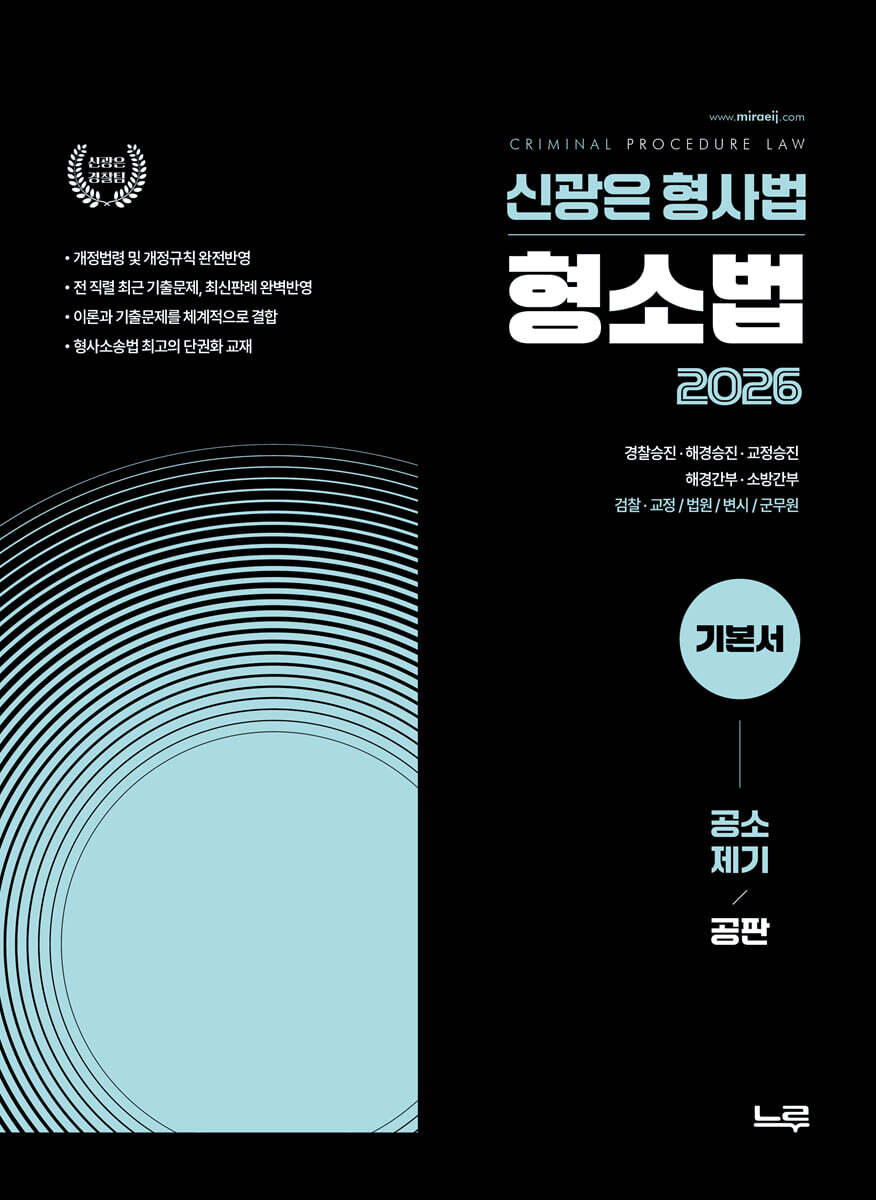
2026 Shin Gwang-eun Criminal Law Criminal Procedure Act 2 Public Prosecution/Trial Basic Book
 |
Description
Book Introduction
- Full reflection of revised laws and regulations
- Fully reflects the latest exam questions and case law from previous series
- Systematically combine theory and past exam questions
- The best single-volume textbook on criminal procedure law
- Fully reflects the latest exam questions and case law from previous series
- Systematically combine theory and past exam questions
- The best single-volume textbook on criminal procedure law
- You can preview some of the book's contents.
Preview
index
PART 1 Filing a Complaint
Chapter 1 Basic Principles of Filing a Public Prosecution 2
Section 1: Theory of Public Prosecution and Public Prosecution Rights 2
Ⅰ Indictment 2
Ⅱ Right of Prosecution 2
Section 2 Basic Principles of Filing a Public Prosecution 4
Ⅰ Basic Principles of Filing a Public Prosecution 4
Ⅱ Cancellation of the Indictment 7
Ⅲ Abuse of Prosecution Power Theory 10
Chapter 2: Method of Filing a Public Prosecution 15
Section 1 Indictment 15
Ⅰ Filing of the Indictment and Details of the Indictment 15
Ⅱ Required Information 17
Ⅲ Optional Descriptions (Preliminary and Optional Descriptions of Criminal Facts and Applicable Laws) 31
Section 2: Japanese Indictment 34
Ⅰ Significance and Basis 34
Ⅱ Contents of the Indictment on Japanism 34
Ⅲ Effects of Violation of the Japanese Rule of the Indictment 37
Ⅳ Scope of Application of the Japanese Indictment 38
Chapter 3 Effects of Filing a Public Prosecution 39
Section 1 Effect of Filing a Public Prosecution 39
Ⅰ Litigation Continued 39
Ⅱ Suspension of the Statute of Limitations 40
Ⅲ Limitation of the scope of judgment 40
Ⅳ Effects of Filing Other Public Prosecutions 42
Section 2 Issues Related to the Scope of Judgment 43
Ⅰ Indictment for Part of the Crime 43
Ⅱ Filing of a Public Prosecution for Part of the Comprehensive Crime 45
Ⅲ Change of Indictment (Change of Subject of Trial) 47
Section 3 Statute of Limitations 73
Ⅰ The Meaning and Essence of the Statute of Limitations 73
Ⅱ Period of Statute of Limitations 74
Ⅲ Suspension of the Statute of Limitations 80
Ⅳ Effect of Completion of the Statute of Limitations 86
V Special Provisions Regarding the Statute of Limitations 86
PART 2: Litigants and General Theory
Chapter 1 Subjects of the Litigation 90
Section 1. The Meaning of the Subject of the Litigation 90
Section 2 Court 91
Ⅰ The meaning and types of courts 91
Ⅱ Jurisdiction of the Court 93
Ⅲ Rejection, Avoidance, and Avoidance 112
Section 3 Inspection 123
Ⅰ The significance and nature of the examination 123
Ⅱ Principle of Inspection and Unity 124
Ⅲ The Minister of Justice's Command and Supervision Powers 125
Ⅳ Status of the Prosecutor in Procedural Law 126
Section 4 Defendant 128
Ⅰ Significance and Specifics 128
Ⅱ Defendant's Status under Procedural Law 135
Ⅲ Right to Remain Unconvinced 138
Ⅳ Principle of Presumption of Innocence 145
V. Capacity of Parties and Litigation Capacity 151
Section 5: Defense Attorney 156
Ⅰ The Significance of the Defense Counsel System 156
Ⅱ Appointment of Private Counsel 156
Ⅲ Selection of Public Defender 159
Ⅳ Status and Authority of the Attorney 170
Section 6 Other 174
Ⅰ Assistant 174
Ⅱ Professional Psychological Committee 175
Chapter 2 General Theory of Litigation Procedure 177
Section 1 Basic Structure of Litigation Procedures 177
Ⅰ The Substantive and Procedural Aspects of Litigation 177
Ⅱ Dichotomy of Litigation Procedure 178
Section 2 Litigation Act 179
Ⅰ Meaning and Types of Litigation 179
Ⅱ General Elements of Litigation 181
Ⅲ Value Judgments on Litigation 186
Section 3: Litigation Documents and Delivery 195
Ⅰ Significance and Types of Litigation Documents 195
II. Report 196
Ⅲ Delivery of Litigation Documents 201
Ⅳ Inspection and copying of litigation documents 207
Section 4 Conditions for Litigation 211
Ⅰ Meaning and Types of Litigation Conditions 211
PART 3 Trial
Chapter 1 Trial Procedure 216
Section 1: Basic Principles of Trial Procedure 216
Ⅰ The Significance of Trial Procedures 216
Ⅱ Basic Principles of Trial Procedure 217
Section 2: Trial of the Court 222
Ⅰ Composition of the Court 222
Ⅱ Right to Direct Litigation 228
Ⅲ Statutory Police Powers 230
Section 3 Trial Preparation Procedures 231
Ⅰ The Significance of Trial Preparation Procedures 231
Ⅱ Procedures before the trial date 232
Section 4 Trial Date Procedure 245
Ⅰ All procedures 245
Ⅱ Fact-finding Procedure 246
Ⅲ Judgment Procedure 257
Section 5: Witness Examination, Verification, and Appraisal 259
Ⅰ Witness Examination 259
Ⅱ Verification 284
Ⅲ Emotions, Interpretation, and Translation 286
Ⅳ Inquiries to public offices, etc. 289
Section 6 Special Issues in Trial Procedures 290
Ⅰ Summary Trial Procedure 290
Ⅱ Suspension and Renewal of Trial Proceedings 297
Ⅲ Merging, Separation, and Resumption of Arguments 301
Section 7: Citizen Participation Trial 303
Ⅰ Meaning 303
Ⅱ Cases and Jurisdiction 303
Ⅲ Referral to Citizen Participation Trial Procedure 305
Ⅳ Jury Selection 309
V. Citizen Participation Trial Procedures 316
Ⅵ Penalty 321
Chapter 2 Trial 322
Section 1: Basic Concepts of Trial 322
Ⅰ The Meaning and Types of Trials 322
Ⅱ Establishment and Method of Trial 325
Section 2 Finality and Effect of Judgment 330
Ⅰ Finalization of the Trial 330
Ⅱ Effect of Final Judgment 331
Ⅲ. Board of Directors 333
Section 3 Final Trial 343
Ⅰ Guilty Verdict 343
Ⅱ Not guilty verdict 350
Ⅲ Judgment on Infringement of Jurisdiction 352
Ⅳ Trial of Dismissal of Indictment 353
V. Judgment of Exemption 356
Ⅵ Side Effects of the Final Trial 358
Section 4 Litigation Costs 360
Ⅰ Meaning 360
Ⅱ. Who bears the costs of litigation? 360
Ⅲ Procedure for Burdening Litigation Costs 361
PART 4 APPEAL AND OTHER PROCEDURES
Chapter 1 Appeal 364
Section 1 General Appeals 364
Ⅰ The Meaning and Types of Petitions 364
Ⅱ Right to Appeal 365
Ⅲ Benefits of Appeal 371
Ⅳ Filing, Abandonment, and Withdrawal of Appeals 373
V Some Appeals 377
Ⅵ Principle of Prohibition of Unfavorable Changes 383
Ⅶ Binding Power of the Decision 397
Section 2 Appeal 399
Ⅰ The Significance of Appeals 399
Ⅱ Structure of the Appeal Tribunal 399
Ⅲ Grounds for Appeal 401
Ⅳ Appeal Procedure 403
Section 3 Appeal 415
Ⅰ The meaning and structure of the appeal 415
Ⅱ Grounds for Appeal (Article 383) 416
Ⅲ Appeals Procedure 418
Ⅳ Leap Forward 423
V Correction of the Supreme Court's Decision 424
Section 4 Appeal 425
Ⅰ Meaning and Types of Appeals 425
Ⅱ Appeal Procedure 427
Ⅲ Appeal 429
Chapter 2 Emergency Rescue Procedures 433
Section 1 Retrial 433
Ⅰ Significance and Objectives of Retrial 433
Ⅱ Reasons for Retrial (Article 420) 436
Ⅲ Retrial Initiation Procedure 444
Ⅳ Retrial Procedure 449
Section 2 Emergency Appeal 453
Ⅰ Meaning 453
Ⅱ Subjects and Reasons for Emergency Appeals 453
Ⅲ Procedure for Emergency Appeal 455
Chapter 3 Special Criminal Procedures 458
Section 1. Abbreviated Procedure 458
Ⅰ Meaning 458
Ⅱ Request for Summary Order 458
Ⅲ Summary Procedure Judgment 460
Ⅳ Request for a formal trial 462
Section 2 Summary Trial Procedure 466
Ⅰ Meaning 466
Ⅱ Request for Summary Judgment 467
Ⅲ. Trial of Summary Judgment Cases 469
Ⅳ Trial of a Case Requesting Summary Judgment 471
V. Request for a formal trial 473
Section 3 Criminal Procedures for Juveniles 476
Ⅰ Meaning 476
Ⅱ Case forwarding 477
Ⅲ Special Rules on Juvenile Criminal Procedure 478
Ⅳ Juvenile Protection Case 483
Section 4: Compensation Orders and Crime Victim Protection 484
Ⅰ Status of Crime Victims in Criminal Procedures 484
Ⅱ Crime Victim Relief System 484
Ⅲ Compensation Order 487
Chapter 4: Execution of Judgments and Compensation 492
Section 1: Execution of Judgment 492
Ⅰ Significance and General Principles 492
Type II Execution 494
Ⅲ Relief from Execution of Judgment 500
Section 2 Criminal Compensation 502
Ⅰ The Meaning and Nature of Criminal Compensation 502
Ⅱ Requirements for Criminal Compensation 503
Ⅲ Contents of Criminal Compensation 504
Ⅳ Procedure for Criminal Compensation 505
V. Not guilty verdict and compensation for costs 508
Ⅵ Acquittal and Publication 509
PART 5 INTRODUCTION
Chapter 1: Fundamentals of Criminal Procedure 512
Section 1: The Significance and Character of the Criminal Procedure Act 512
Ⅰ Meaning 512
Ⅱ Personality 513
Section 2 Courts and Scope of Application of the Criminal Procedure Act 514
Ⅰ Sources of Criminal Procedure Act 514
Ⅱ Scope of Application of the Criminal Procedure Act 520
Chapter 2: The Idea and Structure of Criminal Procedure Law 525
Section 1: Guiding Principles of Criminal Procedure Law 525
Ⅰ The Ideology and Interrelationship of Criminal Procedure Law 525
Ⅱ Substantive Truth 526
Ⅲ Principle of Due Process 529
Ⅳ Principle of Speedy Trial 534
Section 2: Basic Structure of Criminal Procedure 538
Ⅰ Litigation Structure Theory 538
Ⅱ. Ex officio and party principle 540
Appendix Supplementary Case Law
Chapter 1 Filing a Public Prosecution 546
Chapter 2: Litigants and General Theory 550
Chapter 3 Trial 552
Chapter 4 Appeals and Other Procedures 555
Chapter 1 Basic Principles of Filing a Public Prosecution 2
Section 1: Theory of Public Prosecution and Public Prosecution Rights 2
Ⅰ Indictment 2
Ⅱ Right of Prosecution 2
Section 2 Basic Principles of Filing a Public Prosecution 4
Ⅰ Basic Principles of Filing a Public Prosecution 4
Ⅱ Cancellation of the Indictment 7
Ⅲ Abuse of Prosecution Power Theory 10
Chapter 2: Method of Filing a Public Prosecution 15
Section 1 Indictment 15
Ⅰ Filing of the Indictment and Details of the Indictment 15
Ⅱ Required Information 17
Ⅲ Optional Descriptions (Preliminary and Optional Descriptions of Criminal Facts and Applicable Laws) 31
Section 2: Japanese Indictment 34
Ⅰ Significance and Basis 34
Ⅱ Contents of the Indictment on Japanism 34
Ⅲ Effects of Violation of the Japanese Rule of the Indictment 37
Ⅳ Scope of Application of the Japanese Indictment 38
Chapter 3 Effects of Filing a Public Prosecution 39
Section 1 Effect of Filing a Public Prosecution 39
Ⅰ Litigation Continued 39
Ⅱ Suspension of the Statute of Limitations 40
Ⅲ Limitation of the scope of judgment 40
Ⅳ Effects of Filing Other Public Prosecutions 42
Section 2 Issues Related to the Scope of Judgment 43
Ⅰ Indictment for Part of the Crime 43
Ⅱ Filing of a Public Prosecution for Part of the Comprehensive Crime 45
Ⅲ Change of Indictment (Change of Subject of Trial) 47
Section 3 Statute of Limitations 73
Ⅰ The Meaning and Essence of the Statute of Limitations 73
Ⅱ Period of Statute of Limitations 74
Ⅲ Suspension of the Statute of Limitations 80
Ⅳ Effect of Completion of the Statute of Limitations 86
V Special Provisions Regarding the Statute of Limitations 86
PART 2: Litigants and General Theory
Chapter 1 Subjects of the Litigation 90
Section 1. The Meaning of the Subject of the Litigation 90
Section 2 Court 91
Ⅰ The meaning and types of courts 91
Ⅱ Jurisdiction of the Court 93
Ⅲ Rejection, Avoidance, and Avoidance 112
Section 3 Inspection 123
Ⅰ The significance and nature of the examination 123
Ⅱ Principle of Inspection and Unity 124
Ⅲ The Minister of Justice's Command and Supervision Powers 125
Ⅳ Status of the Prosecutor in Procedural Law 126
Section 4 Defendant 128
Ⅰ Significance and Specifics 128
Ⅱ Defendant's Status under Procedural Law 135
Ⅲ Right to Remain Unconvinced 138
Ⅳ Principle of Presumption of Innocence 145
V. Capacity of Parties and Litigation Capacity 151
Section 5: Defense Attorney 156
Ⅰ The Significance of the Defense Counsel System 156
Ⅱ Appointment of Private Counsel 156
Ⅲ Selection of Public Defender 159
Ⅳ Status and Authority of the Attorney 170
Section 6 Other 174
Ⅰ Assistant 174
Ⅱ Professional Psychological Committee 175
Chapter 2 General Theory of Litigation Procedure 177
Section 1 Basic Structure of Litigation Procedures 177
Ⅰ The Substantive and Procedural Aspects of Litigation 177
Ⅱ Dichotomy of Litigation Procedure 178
Section 2 Litigation Act 179
Ⅰ Meaning and Types of Litigation 179
Ⅱ General Elements of Litigation 181
Ⅲ Value Judgments on Litigation 186
Section 3: Litigation Documents and Delivery 195
Ⅰ Significance and Types of Litigation Documents 195
II. Report 196
Ⅲ Delivery of Litigation Documents 201
Ⅳ Inspection and copying of litigation documents 207
Section 4 Conditions for Litigation 211
Ⅰ Meaning and Types of Litigation Conditions 211
PART 3 Trial
Chapter 1 Trial Procedure 216
Section 1: Basic Principles of Trial Procedure 216
Ⅰ The Significance of Trial Procedures 216
Ⅱ Basic Principles of Trial Procedure 217
Section 2: Trial of the Court 222
Ⅰ Composition of the Court 222
Ⅱ Right to Direct Litigation 228
Ⅲ Statutory Police Powers 230
Section 3 Trial Preparation Procedures 231
Ⅰ The Significance of Trial Preparation Procedures 231
Ⅱ Procedures before the trial date 232
Section 4 Trial Date Procedure 245
Ⅰ All procedures 245
Ⅱ Fact-finding Procedure 246
Ⅲ Judgment Procedure 257
Section 5: Witness Examination, Verification, and Appraisal 259
Ⅰ Witness Examination 259
Ⅱ Verification 284
Ⅲ Emotions, Interpretation, and Translation 286
Ⅳ Inquiries to public offices, etc. 289
Section 6 Special Issues in Trial Procedures 290
Ⅰ Summary Trial Procedure 290
Ⅱ Suspension and Renewal of Trial Proceedings 297
Ⅲ Merging, Separation, and Resumption of Arguments 301
Section 7: Citizen Participation Trial 303
Ⅰ Meaning 303
Ⅱ Cases and Jurisdiction 303
Ⅲ Referral to Citizen Participation Trial Procedure 305
Ⅳ Jury Selection 309
V. Citizen Participation Trial Procedures 316
Ⅵ Penalty 321
Chapter 2 Trial 322
Section 1: Basic Concepts of Trial 322
Ⅰ The Meaning and Types of Trials 322
Ⅱ Establishment and Method of Trial 325
Section 2 Finality and Effect of Judgment 330
Ⅰ Finalization of the Trial 330
Ⅱ Effect of Final Judgment 331
Ⅲ. Board of Directors 333
Section 3 Final Trial 343
Ⅰ Guilty Verdict 343
Ⅱ Not guilty verdict 350
Ⅲ Judgment on Infringement of Jurisdiction 352
Ⅳ Trial of Dismissal of Indictment 353
V. Judgment of Exemption 356
Ⅵ Side Effects of the Final Trial 358
Section 4 Litigation Costs 360
Ⅰ Meaning 360
Ⅱ. Who bears the costs of litigation? 360
Ⅲ Procedure for Burdening Litigation Costs 361
PART 4 APPEAL AND OTHER PROCEDURES
Chapter 1 Appeal 364
Section 1 General Appeals 364
Ⅰ The Meaning and Types of Petitions 364
Ⅱ Right to Appeal 365
Ⅲ Benefits of Appeal 371
Ⅳ Filing, Abandonment, and Withdrawal of Appeals 373
V Some Appeals 377
Ⅵ Principle of Prohibition of Unfavorable Changes 383
Ⅶ Binding Power of the Decision 397
Section 2 Appeal 399
Ⅰ The Significance of Appeals 399
Ⅱ Structure of the Appeal Tribunal 399
Ⅲ Grounds for Appeal 401
Ⅳ Appeal Procedure 403
Section 3 Appeal 415
Ⅰ The meaning and structure of the appeal 415
Ⅱ Grounds for Appeal (Article 383) 416
Ⅲ Appeals Procedure 418
Ⅳ Leap Forward 423
V Correction of the Supreme Court's Decision 424
Section 4 Appeal 425
Ⅰ Meaning and Types of Appeals 425
Ⅱ Appeal Procedure 427
Ⅲ Appeal 429
Chapter 2 Emergency Rescue Procedures 433
Section 1 Retrial 433
Ⅰ Significance and Objectives of Retrial 433
Ⅱ Reasons for Retrial (Article 420) 436
Ⅲ Retrial Initiation Procedure 444
Ⅳ Retrial Procedure 449
Section 2 Emergency Appeal 453
Ⅰ Meaning 453
Ⅱ Subjects and Reasons for Emergency Appeals 453
Ⅲ Procedure for Emergency Appeal 455
Chapter 3 Special Criminal Procedures 458
Section 1. Abbreviated Procedure 458
Ⅰ Meaning 458
Ⅱ Request for Summary Order 458
Ⅲ Summary Procedure Judgment 460
Ⅳ Request for a formal trial 462
Section 2 Summary Trial Procedure 466
Ⅰ Meaning 466
Ⅱ Request for Summary Judgment 467
Ⅲ. Trial of Summary Judgment Cases 469
Ⅳ Trial of a Case Requesting Summary Judgment 471
V. Request for a formal trial 473
Section 3 Criminal Procedures for Juveniles 476
Ⅰ Meaning 476
Ⅱ Case forwarding 477
Ⅲ Special Rules on Juvenile Criminal Procedure 478
Ⅳ Juvenile Protection Case 483
Section 4: Compensation Orders and Crime Victim Protection 484
Ⅰ Status of Crime Victims in Criminal Procedures 484
Ⅱ Crime Victim Relief System 484
Ⅲ Compensation Order 487
Chapter 4: Execution of Judgments and Compensation 492
Section 1: Execution of Judgment 492
Ⅰ Significance and General Principles 492
Type II Execution 494
Ⅲ Relief from Execution of Judgment 500
Section 2 Criminal Compensation 502
Ⅰ The Meaning and Nature of Criminal Compensation 502
Ⅱ Requirements for Criminal Compensation 503
Ⅲ Contents of Criminal Compensation 504
Ⅳ Procedure for Criminal Compensation 505
V. Not guilty verdict and compensation for costs 508
Ⅵ Acquittal and Publication 509
PART 5 INTRODUCTION
Chapter 1: Fundamentals of Criminal Procedure 512
Section 1: The Significance and Character of the Criminal Procedure Act 512
Ⅰ Meaning 512
Ⅱ Personality 513
Section 2 Courts and Scope of Application of the Criminal Procedure Act 514
Ⅰ Sources of Criminal Procedure Act 514
Ⅱ Scope of Application of the Criminal Procedure Act 520
Chapter 2: The Idea and Structure of Criminal Procedure Law 525
Section 1: Guiding Principles of Criminal Procedure Law 525
Ⅰ The Ideology and Interrelationship of Criminal Procedure Law 525
Ⅱ Substantive Truth 526
Ⅲ Principle of Due Process 529
Ⅳ Principle of Speedy Trial 534
Section 2: Basic Structure of Criminal Procedure 538
Ⅰ Litigation Structure Theory 538
Ⅱ. Ex officio and party principle 540
Appendix Supplementary Case Law
Chapter 1 Filing a Public Prosecution 546
Chapter 2: Litigants and General Theory 550
Chapter 3 Trial 552
Chapter 4 Appeals and Other Procedures 555
Publisher's Review
Preface
We have integrated the texts and theories, case law, and past exam questions into a single textbook.
First, Shin Kwang would like to express his sincere gratitude to the many test takers for their love and unstinting support, which has made Criminal Procedure II (Prosecution and Trial) the best textbook in name and reality.
To repay the affection of test takers and live up to their expectations, we have included all the essential and crucial surveys and case law that are essential for accurate understanding and memorization, and to serve as a foundation for test takers' success as a helper who does not disgrace their expectations.
? Key Features of "Shingwang's Criminal Procedure Act II (Prosecution and Trial)"
1. Fully reflecting revised laws and regulations in accordance with changes in examination trends.
All recent revisions to the Criminal Procedure Act and the Criminal Procedure Rules have been reflected, unnecessary content has been deleted, and changed or added content has been included.
In addition, as the recent trend in exam questions is to ask more questions about legal provisions and rules, we have reflected not only revised criminal law laws and rules, but also previously tested legal provisions and rules, and important laws and regulations that may be tested, so that you can sufficiently prepare without having to look at the laws separately.
2. Perfect reflection of the most recent past questions from the previous series
We have strived to make this a suitable textbook for test takers preparing for future exams by perfectly reflecting the existing police recruitment and promotion questions before the reorganization, as well as the previous questions for court positions, prosecutorial positions, correctional positions, protective positions, and firefighting positions.
3. Perfect reflection of the latest case law and previously published case law
This book covers all the case law that appeared in the exams of all series, including the most recent exam, the latest case law that has been changed or added this year, and even case law that is likely to appear on the exam, so that you can sufficiently prepare for the exam using only the basic book without a separate case law book.
4. Identify exam trends and improve problem-solving skills by displaying icons for past exam questions and important surveys.
Key passages, important questions, and keywords are marked as [Tips], and passages and keywords that are easy to fall into are marked as [Caution], etc., so that you can see at a glance where the important parts and parts that are easy to make mistakes are, allowing you to understand the test trends and increase your adaptability to the problems.
5. By emphasizing the core content of the textbook, learning effectiveness is improved and the problem of time constraints is solved.
Important content that must be seen is highlighted in color, and the next most important content is bolded to check the importance of the textbook content and to ensure that all key points can be grasped just by looking at the highlighted content.
? Upgrade of the "2026 Shin Gwang-eun Criminal Procedure Act II (Prosecution and Trial)"
To help you get closer to passing the exam in the shortest possible time using the textbook, we have made the following improvements.
1 Appendix - Learning by Difficulty Level through Supplementary Case Laws
Cases with a high level of difficulty or a low probability of appearing on the exam are provided as optional study materials through the 'Appendix - Supplementary Cases', allowing students to study at a level of difficulty appropriate to their abilities.
2 Add underline to the incorrect part of [Caution]
To help you clearly understand from the beginning which parts of the previous exam questions are incorrect and to help you grasp the points of the questions in the shortest possible time, we have added underlining to the incorrect parts in [Caution].
3. Saving space by using abbreviations for previous exam questions
We have summarized long sentences concisely to make it easier to understand multiple sentences at a glance.
●Changes in the presentation method of previous questions
·Patrol 1st, Patrol 2nd, Patrol 3rd → Patrol 1st, Patrol 2nd, Patrol 3rd/Police SWAT → Police Special Forces/Police Promotion → Police Superintendent/
Police officer → Superintendent/Superintendent → Superintendent/Police unit transfer → Superintendent
·9th grade national language introduction → 9th grade national language → 9th grade national language / 9th grade introduction → 9th grade national language introduction / 7th grade national language → 7th grade national language
·Coast Guard 1st, Coast Guard 2nd, Coast Guard 3rd → Coast Guard 1st, Coast Guard 2nd, Coast Guard 3rd / Coast Guard Special Recruitment 1st, Coast Guard Special Recruitment 2nd → Coast Guard 1st, Coast Guard 2nd / Coast Guard Promotion → Coast Guard Crew / Coast Guard Officer → Coast Guard Officer
·Firefighter → Sogan ·Bar exam → Bar exam ·Law special recruitment → Law special recruitment
·Intelligence special recruitment → intelligence ·Correctional special recruitment → Education special recruitment
※ Previous questions from 10 years ago have been deleted.
? In conclusion
As the author emphasizes the study method through 'single textbook' in "Shingwang Eun's Criminal Procedure Law II (Prosecution and Trial)", this time as well, we have tried to include all the essential and important contents for the exam, such as key precedents and important questionnaires, without leaving out any other content, so that you can sufficiently prepare for the exam with just this one textbook without having to look at a separate casebook or problem book.
Prior to the publication of this textbook, Shingwang would like to express his sincere gratitude to the many examinees who have generously provided support and advice. He hopes that this book will help examinees achieve perfect scores in Criminal Procedure Law.
I also hope that you will not lose your health despite the difficult times of preparing for the exam, and that you will be able to achieve your dream of becoming a conscientious and capable civil servant.
Bravo Your Life!!
The editor's confidence is
We have integrated the texts and theories, case law, and past exam questions into a single textbook.
First, Shin Kwang would like to express his sincere gratitude to the many test takers for their love and unstinting support, which has made Criminal Procedure II (Prosecution and Trial) the best textbook in name and reality.
To repay the affection of test takers and live up to their expectations, we have included all the essential and crucial surveys and case law that are essential for accurate understanding and memorization, and to serve as a foundation for test takers' success as a helper who does not disgrace their expectations.
? Key Features of "Shingwang's Criminal Procedure Act II (Prosecution and Trial)"
1. Fully reflecting revised laws and regulations in accordance with changes in examination trends.
All recent revisions to the Criminal Procedure Act and the Criminal Procedure Rules have been reflected, unnecessary content has been deleted, and changed or added content has been included.
In addition, as the recent trend in exam questions is to ask more questions about legal provisions and rules, we have reflected not only revised criminal law laws and rules, but also previously tested legal provisions and rules, and important laws and regulations that may be tested, so that you can sufficiently prepare without having to look at the laws separately.
2. Perfect reflection of the most recent past questions from the previous series
We have strived to make this a suitable textbook for test takers preparing for future exams by perfectly reflecting the existing police recruitment and promotion questions before the reorganization, as well as the previous questions for court positions, prosecutorial positions, correctional positions, protective positions, and firefighting positions.
3. Perfect reflection of the latest case law and previously published case law
This book covers all the case law that appeared in the exams of all series, including the most recent exam, the latest case law that has been changed or added this year, and even case law that is likely to appear on the exam, so that you can sufficiently prepare for the exam using only the basic book without a separate case law book.
4. Identify exam trends and improve problem-solving skills by displaying icons for past exam questions and important surveys.
Key passages, important questions, and keywords are marked as [Tips], and passages and keywords that are easy to fall into are marked as [Caution], etc., so that you can see at a glance where the important parts and parts that are easy to make mistakes are, allowing you to understand the test trends and increase your adaptability to the problems.
5. By emphasizing the core content of the textbook, learning effectiveness is improved and the problem of time constraints is solved.
Important content that must be seen is highlighted in color, and the next most important content is bolded to check the importance of the textbook content and to ensure that all key points can be grasped just by looking at the highlighted content.
? Upgrade of the "2026 Shin Gwang-eun Criminal Procedure Act II (Prosecution and Trial)"
To help you get closer to passing the exam in the shortest possible time using the textbook, we have made the following improvements.
1 Appendix - Learning by Difficulty Level through Supplementary Case Laws
Cases with a high level of difficulty or a low probability of appearing on the exam are provided as optional study materials through the 'Appendix - Supplementary Cases', allowing students to study at a level of difficulty appropriate to their abilities.
2 Add underline to the incorrect part of [Caution]
To help you clearly understand from the beginning which parts of the previous exam questions are incorrect and to help you grasp the points of the questions in the shortest possible time, we have added underlining to the incorrect parts in [Caution].
3. Saving space by using abbreviations for previous exam questions
We have summarized long sentences concisely to make it easier to understand multiple sentences at a glance.
●Changes in the presentation method of previous questions
·Patrol 1st, Patrol 2nd, Patrol 3rd → Patrol 1st, Patrol 2nd, Patrol 3rd/Police SWAT → Police Special Forces/Police Promotion → Police Superintendent/
Police officer → Superintendent/Superintendent → Superintendent/Police unit transfer → Superintendent
·9th grade national language introduction → 9th grade national language → 9th grade national language / 9th grade introduction → 9th grade national language introduction / 7th grade national language → 7th grade national language
·Coast Guard 1st, Coast Guard 2nd, Coast Guard 3rd → Coast Guard 1st, Coast Guard 2nd, Coast Guard 3rd / Coast Guard Special Recruitment 1st, Coast Guard Special Recruitment 2nd → Coast Guard 1st, Coast Guard 2nd / Coast Guard Promotion → Coast Guard Crew / Coast Guard Officer → Coast Guard Officer
·Firefighter → Sogan ·Bar exam → Bar exam ·Law special recruitment → Law special recruitment
·Intelligence special recruitment → intelligence ·Correctional special recruitment → Education special recruitment
※ Previous questions from 10 years ago have been deleted.
? In conclusion
As the author emphasizes the study method through 'single textbook' in "Shingwang Eun's Criminal Procedure Law II (Prosecution and Trial)", this time as well, we have tried to include all the essential and important contents for the exam, such as key precedents and important questionnaires, without leaving out any other content, so that you can sufficiently prepare for the exam with just this one textbook without having to look at a separate casebook or problem book.
Prior to the publication of this textbook, Shingwang would like to express his sincere gratitude to the many examinees who have generously provided support and advice. He hopes that this book will help examinees achieve perfect scores in Criminal Procedure Law.
I also hope that you will not lose your health despite the difficult times of preparing for the exam, and that you will be able to achieve your dream of becoming a conscientious and capable civil servant.
Bravo Your Life!!
The editor's confidence is
GOODS SPECIFICS
- Date of issue: July 21, 2025
- Page count, weight, size: 568 pages | 190*260*35mm
- ISBN13: 9791194635123
- ISBN10: 1194635121
You may also like
카테고리
korean


korean

![GQ KOREA Mark (Monthly): December [2025]](http://librairie.coreenne.fr/cdn/shop/files/8ef265dbbfbf186523ed75ba7319009d.jpg?v=1765340328&width=3840)


