

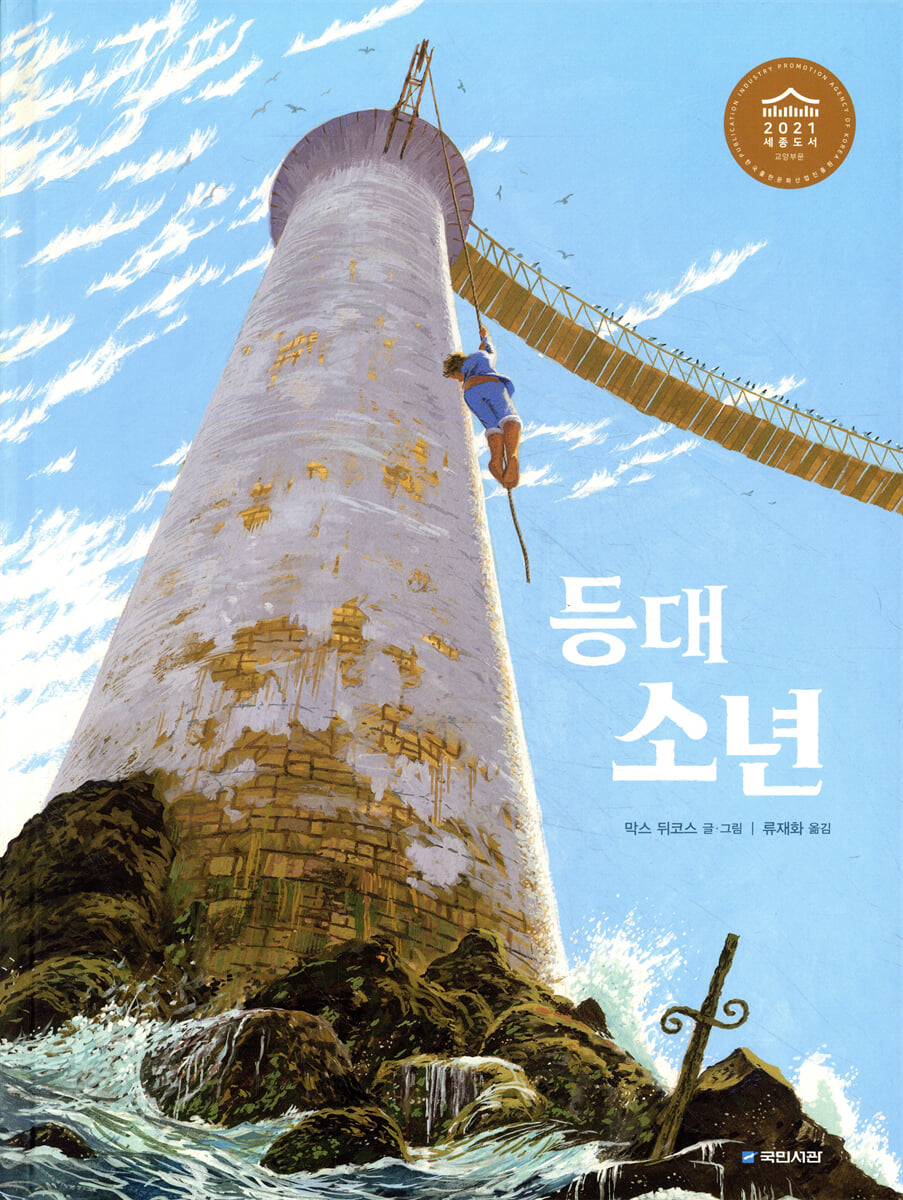
Lighthouse Boy
 |
Description
Book Introduction
- A word from MD
-
Embark on an adventure to a sea filled with friendship and imagination!A coming-of-age story by French children's literature writer Max Ducos.
When his older sister, who has reached puberty, stops playing with him, the boy is left alone in his room.
The protagonist embarks on an adventure through a lighthouse and the sea in a torn wallpaper, hears the story of a boy trapped on an island, and together they face a sea monster.
Will the boy ever be able to return home?December 8, 2020. Children's PD Kim Soo-yeon
A boy enters a painting and meets a boy trapped in a lighthouse.
After an argument with his sister Alize, who is going through a stormy period, Timothée returns to his room and tears down the picture of a ship he was trying to show his sister from the wall.
But isn't there a painting behind the torn wallpaper? A large rock and a tree are visible, along with a hot wind that seems to be blowing from there and the screeching sound of seagulls.
It's clearly a painting behind the wallpaper, but it looks like the painting is alive and moving.
Timothy couldn't stand it anymore and jumped into the painting.
Believe it or not, he went beyond the wall into an unknown world.
The unknown world was nothing but rocky hills and lighthouses.
On the way to the lighthouse, he meets a boy.
His name is Morgan.
It is said that he came here as a prisoner a long time ago.
Timothy heard Morgan's long story of how he came to the rocky hill.
He must return to his hometown, the Island of Orleans, but is prevented from doing so by a monster living under the sea.
If the narwhals don't return home before the autumn equinox, they may be in big trouble.
Timothy confidently says he will help them get home.
"I have a plan!" On a rocky hill where nothing but a lonely lighthouse stands, will Morgan ever find his way home?
After an argument with his sister Alize, who is going through a stormy period, Timothée returns to his room and tears down the picture of a ship he was trying to show his sister from the wall.
But isn't there a painting behind the torn wallpaper? A large rock and a tree are visible, along with a hot wind that seems to be blowing from there and the screeching sound of seagulls.
It's clearly a painting behind the wallpaper, but it looks like the painting is alive and moving.
Timothy couldn't stand it anymore and jumped into the painting.
Believe it or not, he went beyond the wall into an unknown world.
The unknown world was nothing but rocky hills and lighthouses.
On the way to the lighthouse, he meets a boy.
His name is Morgan.
It is said that he came here as a prisoner a long time ago.
Timothy heard Morgan's long story of how he came to the rocky hill.
He must return to his hometown, the Island of Orleans, but is prevented from doing so by a monster living under the sea.
If the narwhals don't return home before the autumn equinox, they may be in big trouble.
Timothy confidently says he will help them get home.
"I have a plan!" On a rocky hill where nothing but a lonely lighthouse stands, will Morgan ever find his way home?
- You can preview some of the book's contents.
Preview
Detailed image
.jpg)
Publisher's Review
Add friendship to imagination and an exciting adventure unfolds.
Timothy feels abandoned by his older sister.
I was gripped by loneliness and isolation.
Then, in an unknown world, he meets a new friend named Morgan.
They have completely different experiences and live in different worlds.
But the two boys overcome their shame and tell their stories, and as they empathize with each other, feelings of solidarity begin to sprout.
Timothy became a completely different person after deciding to help Morgan return home.
He is filled with a freedom, creativity, ambition, and courage he has never experienced before.
What made all this possible was none other than friendship.
Through adventure, children reconstruct their prior experiences, develop a sense of purpose, and develop artistic sensibilities.
Additionally, it can foster beautiful emotions and proper character, and create a foundation for joy such as curiosity, challenge, cooperation, and a sense of accomplishment.
Through the experience of interacting and communicating with friends in their daily lives, children naturally develop the right character and beautiful emotions to value each other.
It was as if both boys were moved by Morgan's story and had a good heart to help him, which made them grow up.
Reality becomes imagination, imagination becomes reality, breaking down the boundaries between reality and imagination.
The painting on the wall is a secret passage leading to another world.
Timothy freely moves between the real world and the unknown world through his paintings.
Children often see things that adults don't.
It may be a sublimated imagination of reality, or there may truly be a world that is invisible to adults.
Max Ducos said he wrote the book with the hope that children would be able to advance into a bigger world through their imagination without being blocked by the walls of reality.
“What I want to convey to children through picture books is to make them stop in front of the smallest ant and imagine a special microcosm that only they can create around it,” he says.
Timothy returns to the real world and falls asleep, exhausted from exhaustion.
When he wakes up, all his secret memories with Morgan are forgotten.
I don't remember anything.
Like a midsummer night's dream.
When the older sister removes all the wallpaper in Timothée's room, a mural unfolds covering the entire room.
Timothy looks at the mural and old memories come flooding back.
So, were Morgan's memories real? A dream? Or did imagination create reality? Like the question, "Which came first, the chicken or the egg?" For children, reality and imagination are indistinguishable.
Returning to a collection that stimulates the desire to own
From Robinson Crusoe and sea monsters to French history, a variety of borrowed materials are interwoven.
Not only the story, but the pictures are enough to lead children into a world of imagination.
The deep blue sea, the waves swaying in the wind, and the cloudy sky appear three-dimensional even in a flat painting, drawing you in like you are watching a movie and leading you into a world of imagination.
It is produced in a wide format so that you can enjoy the picture book with your eyes full.
Max Ducos's paintings are powerful even in thin lines, delicate yet deep and vibrant.
Every time I turn the page, I feel like I'm looking at a collection of works.
Once you see this new work, "The Lighthouse Boy," you will definitely want to own it.
Paintings using gouache are praised as the best works.
Gouache is a painting technique that mixes rubber with watercolor paint to create an opaque effect.
The author explains that this technique makes drawing technically accessible to children by working with paints actually used in schools.
Pictures drawn with easy-to-access paints will resonate with children.
In times when it's difficult to go out and play, why not embark on an adventure with "The Lighthouse Boy"? I hope the protagonist's adventures will resonate with children's lives and help them grow together.
Timothy feels abandoned by his older sister.
I was gripped by loneliness and isolation.
Then, in an unknown world, he meets a new friend named Morgan.
They have completely different experiences and live in different worlds.
But the two boys overcome their shame and tell their stories, and as they empathize with each other, feelings of solidarity begin to sprout.
Timothy became a completely different person after deciding to help Morgan return home.
He is filled with a freedom, creativity, ambition, and courage he has never experienced before.
What made all this possible was none other than friendship.
Through adventure, children reconstruct their prior experiences, develop a sense of purpose, and develop artistic sensibilities.
Additionally, it can foster beautiful emotions and proper character, and create a foundation for joy such as curiosity, challenge, cooperation, and a sense of accomplishment.
Through the experience of interacting and communicating with friends in their daily lives, children naturally develop the right character and beautiful emotions to value each other.
It was as if both boys were moved by Morgan's story and had a good heart to help him, which made them grow up.
Reality becomes imagination, imagination becomes reality, breaking down the boundaries between reality and imagination.
The painting on the wall is a secret passage leading to another world.
Timothy freely moves between the real world and the unknown world through his paintings.
Children often see things that adults don't.
It may be a sublimated imagination of reality, or there may truly be a world that is invisible to adults.
Max Ducos said he wrote the book with the hope that children would be able to advance into a bigger world through their imagination without being blocked by the walls of reality.
“What I want to convey to children through picture books is to make them stop in front of the smallest ant and imagine a special microcosm that only they can create around it,” he says.
Timothy returns to the real world and falls asleep, exhausted from exhaustion.
When he wakes up, all his secret memories with Morgan are forgotten.
I don't remember anything.
Like a midsummer night's dream.
When the older sister removes all the wallpaper in Timothée's room, a mural unfolds covering the entire room.
Timothy looks at the mural and old memories come flooding back.
So, were Morgan's memories real? A dream? Or did imagination create reality? Like the question, "Which came first, the chicken or the egg?" For children, reality and imagination are indistinguishable.
Returning to a collection that stimulates the desire to own
From Robinson Crusoe and sea monsters to French history, a variety of borrowed materials are interwoven.
Not only the story, but the pictures are enough to lead children into a world of imagination.
The deep blue sea, the waves swaying in the wind, and the cloudy sky appear three-dimensional even in a flat painting, drawing you in like you are watching a movie and leading you into a world of imagination.
It is produced in a wide format so that you can enjoy the picture book with your eyes full.
Max Ducos's paintings are powerful even in thin lines, delicate yet deep and vibrant.
Every time I turn the page, I feel like I'm looking at a collection of works.
Once you see this new work, "The Lighthouse Boy," you will definitely want to own it.
Paintings using gouache are praised as the best works.
Gouache is a painting technique that mixes rubber with watercolor paint to create an opaque effect.
The author explains that this technique makes drawing technically accessible to children by working with paints actually used in schools.
Pictures drawn with easy-to-access paints will resonate with children.
In times when it's difficult to go out and play, why not embark on an adventure with "The Lighthouse Boy"? I hope the protagonist's adventures will resonate with children's lives and help them grow together.
GOODS SPECIFICS
- Publication date: November 26, 2020
- Format: Hardcover book binding method guide
- Page count, weight, size: 72 pages | 638g | 241*322*11mm
- ISBN13: 9788911128358
- ISBN10: 891112835X
- KC Certification: Certification Type: Conformity Confirmation
You may also like
카테고리
korean


korean

![ELLE 엘르 스페셜 에디션 A형 : 12월 [2025]](http://librairie.coreenne.fr/cdn/shop/files/b8e27a3de6c9538896439686c6b0e8fb.jpg?v=1766436872&width=3840)


