

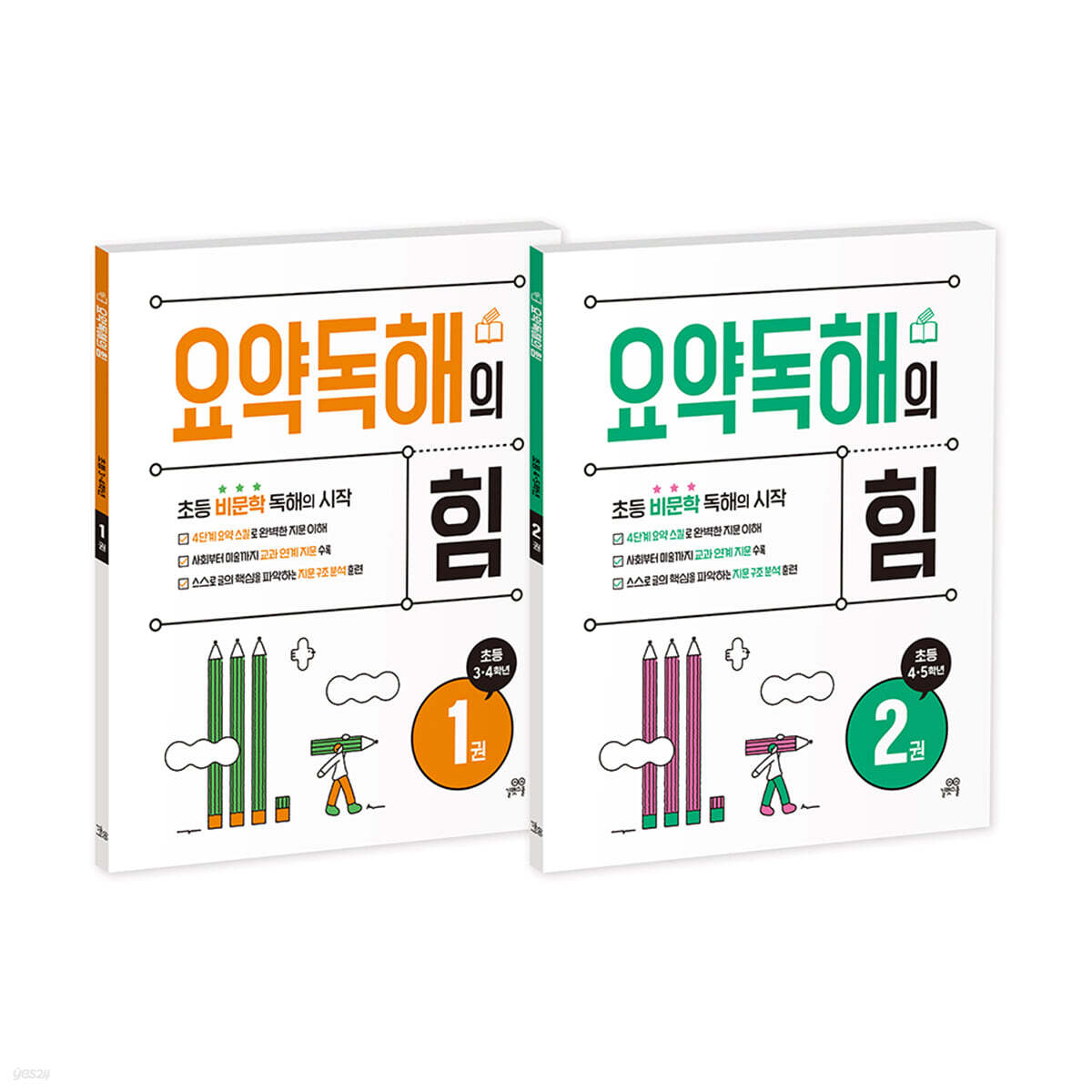
The Power of Summary Reading Volumes 1 and 2
 |
Description
Book Introduction
This product is a product made by YES24. (Individual returns are not possible.) [Book] The Power of Summary Reading, Vol. 1: Beginning Elementary Non-Fiction Reading (3rd and 4th Grades) If you read it and don't get anything out of it, then you didn't read it! Let's develop the power of 'summary reading' and start real reading! Reading and understanding a text properly depends on summarizing it. "The Power of Summary Reading" is a textbook that helps you develop your reading comprehension skills through "summaries," which involve understanding, interpreting, and expressing in new words or writing what you've read. Summarizing involves the activity of extracting the core information from the text I read by structurally understanding and organizing it and reconstructing it in my own words and writing. When reading, you should read while actively summarizing like this. That way, I can grasp the gist of what I read. Especially, elementary school students are exposed to a variety of non-fiction texts as they advance in grade level, and reading non-fiction texts also begins with summarizing them. Summarizing exercises that begin with finding the most important points in a text will help you read and understand even unfamiliar non-fiction texts with ease. Summary reading is ultimately the foundation for all learning. [Book] The Power of Summary Reading, Vol. 2: Beginning Elementary Non-Fiction Reading (4th and 5th Grades) If you read it and don't get anything out of it, then you didn't read it! Let's start real reading by developing the power of 'summary reading'! Reading and understanding a text properly depends on summarizing it. "The Power of Summary Reading" is a textbook that helps you develop your reading comprehension skills through "summaries," which involve understanding, interpreting, and expressing in new words or writing what you've read. Summarizing involves the activity of extracting the core information from the text I read by structurally understanding and organizing it and reconstructing it in my own words and writing. When reading, you should read while actively summarizing like this. That way, I can grasp the gist of what I read. Especially, elementary school students are exposed to a variety of non-fiction texts as they advance in grade level, and reading non-fiction texts also begins with summarizing them. Summarizing exercises that begin with finding the most important points in a text will help you read and understand even unfamiliar non-fiction texts with ease. Summary reading is ultimately the foundation for all learning. |
index
The Power of Summary Reading, Vol. 1
Basic parts
1DAY Keyword Search
2DAY Finding the Central Sentence
Organizing to fit the structure of the 3-day article 1
Organizing to fit the structure of the 4-day article 2
5DAY Summary
Practical part
6~30DAY
The Power of Summary Reading, Volume 2
Basic parts
1DAY Keyword Search
2DAY Finding the Central Sentence
Organizing to fit the structure of the 3-day article 1
Organizing to fit the structure of the 4-day article 2
5DAY Summary
Practical part
6~30DAY
Basic parts
1DAY Keyword Search
2DAY Finding the Central Sentence
Organizing to fit the structure of the 3-day article 1
Organizing to fit the structure of the 4-day article 2
5DAY Summary
Practical part
6~30DAY
The Power of Summary Reading, Volume 2
Basic parts
1DAY Keyword Search
2DAY Finding the Central Sentence
Organizing to fit the structure of the 3-day article 1
Organizing to fit the structure of the 4-day article 2
5DAY Summary
Practical part
6~30DAY
Detailed image

Publisher's Review
Understand fingerprints perfectly with the 4-step summary skill!
Summary also requires skill.
Step 1 is the keyword finding technique.
Learn two ways to find keywords that represent the most important things in a text, and practice the techniques through representative problems and practice questions.
Step 2 is to find the central sentence.
Learn how to find the main sentence in a paragraph and how to rephrase it to summarize the main idea.
Step 3 is to organize it to fit the structure of the text.
Learn the four types of structure: listing, ordering, comparing and contrasting, and problem-solving, and organize the content of your writing into a framework appropriate for each structure.
This will help you develop the ability to grasp the core content.
The final step is to summarize it in one or two sentences.
In the summarizing stage, where you organize the key points you found in the previous stage into your own words, you can even develop your writing skills.
From social studies to art, even your school grades will be improved with textbook-linked texts!
Summary reading comprehension skills are also closely related to subject learning ability.
Studying begins with finding the important parts of given materials or information, and the text given to students is a 'textbook'.
Even in the exam, questions are asked about important parts based on the textbook.
Ultimately, studying properly means finding the core of the text on your own, organizing it, and remembering it, and finding and organizing the core on your own is similar to the process of summarizing reading.
Therefore, summary reading comprehension is inevitably directly linked to grades, and students must have the basic ability to read textbooks.
The practical part includes related texts from subjects such as Korean, mathematics, social studies, science, ethics, physical education, music, and art.
Reading and summarizing various texts naturally develops the ability to read textbooks.
Visualize the text and get the gist of it with fingerprint structure analysis training!
Visualizing and organizing the structure of a text is a reading strategy that helps you organize the content of difficult text on your own.
Fingerprint structure analysis training is also an effective tool for improving reading comprehension.
Reading a text that uses a list structure, a sequence structure, a compare-and-contrast structure, or a problem-and-solution structure, and visualizing the structure of the text by finding the key points and putting them into a frame helps you understand the text more easily and quickly.
Summary also requires skill.
Step 1 is the keyword finding technique.
Learn two ways to find keywords that represent the most important things in a text, and practice the techniques through representative problems and practice questions.
Step 2 is to find the central sentence.
Learn how to find the main sentence in a paragraph and how to rephrase it to summarize the main idea.
Step 3 is to organize it to fit the structure of the text.
Learn the four types of structure: listing, ordering, comparing and contrasting, and problem-solving, and organize the content of your writing into a framework appropriate for each structure.
This will help you develop the ability to grasp the core content.
The final step is to summarize it in one or two sentences.
In the summarizing stage, where you organize the key points you found in the previous stage into your own words, you can even develop your writing skills.
From social studies to art, even your school grades will be improved with textbook-linked texts!
Summary reading comprehension skills are also closely related to subject learning ability.
Studying begins with finding the important parts of given materials or information, and the text given to students is a 'textbook'.
Even in the exam, questions are asked about important parts based on the textbook.
Ultimately, studying properly means finding the core of the text on your own, organizing it, and remembering it, and finding and organizing the core on your own is similar to the process of summarizing reading.
Therefore, summary reading comprehension is inevitably directly linked to grades, and students must have the basic ability to read textbooks.
The practical part includes related texts from subjects such as Korean, mathematics, social studies, science, ethics, physical education, music, and art.
Reading and summarizing various texts naturally develops the ability to read textbooks.
Visualize the text and get the gist of it with fingerprint structure analysis training!
Visualizing and organizing the structure of a text is a reading strategy that helps you organize the content of difficult text on your own.
Fingerprint structure analysis training is also an effective tool for improving reading comprehension.
Reading a text that uses a list structure, a sequence structure, a compare-and-contrast structure, or a problem-and-solution structure, and visualizing the structure of the text by finding the key points and putting them into a frame helps you understand the text more easily and quickly.
GOODS SPECIFICS
- Date of issue: November 18, 2024
- Pages, weight, size: 224 pages | 628g | 227*280*12mm
- KC Certification: Certification Type: Conformity Confirmation
You may also like
카테고리
korean


korean

![GQ KOREA Mark (Monthly): December [2025]](http://librairie.coreenne.fr/cdn/shop/files/8ef265dbbfbf186523ed75ba7319009d.jpg?v=1765340328&width=3840)


