

Your destiny is
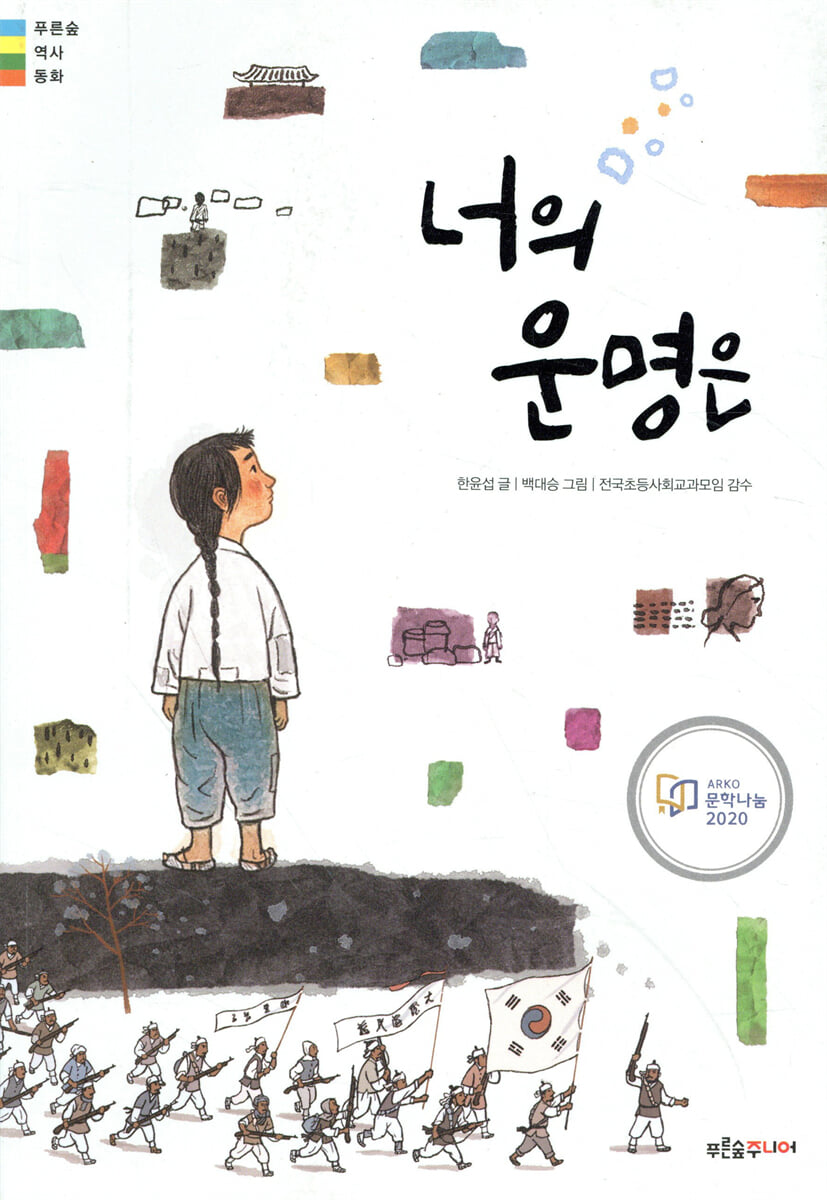 |
Description
Book Introduction
- A word from MD
-
A historical fairy tale by author Han Yun-seop, “The Boy Who Delivered Letters.”
A child who, as the Japanese colonial period began, felt darkness creep into his heart as he worried about what to eat each day.
The story unfolds as an illiterate boy seeks help from those around him, sometimes gets frustrated, and forges his own path in life in an attempt to change his destiny.
This is a deeply moving work that portrays the life of Su-gil, who finally finds his destiny as a 'righteous army soldier'.
September 8, 2020. Children's PD Kim Soo-yeon
A new historical fairy tale by Han Yun-seop, author of "The Boy Who Delivered the Letter,"
Reviving the memories of the Righteous Army, the front line of the anti-Japanese movement!
A warm historical imagination, the tension of restrained sentences, and the lingering aftertaste of intense growing pains…
Han Yun-seop, the author of 『The Child Who Delivers Letters』, which was loved by 100,000 readers, has returned after a long wait.
This is the sixth full-length fairy tale and the second historical fairy tale published in ten years.
The historical fairy tale "The Boy Who Delivers Letters," published in 2011, depicts the journey of a twelve-year-old peddler boy through the midst of the Donghak Peasant Revolution.
It received attention as a new grammatical growth fairy tale that combined historical and literary value with excellent composition and refined writing style.
Meanwhile, the author, who is also active as a playwright, is a storyteller of modern history who has presented plays based on the assassination of Empress Myeongseong, the flight of the Russian legation, and the new military academy.
This time, he relives the memories of the righteous army that stood at the forefront of the anti-Japanese movement, taking place 16 years after the Donghak Peasant Revolution, the setting of his previous work.
The year was 1910, when the child who delivered the letter would have become someone's father if he had grown up.
That is, two years after the start of the Japanese colonial period, an eleven-year-old illiterate boy with no dreams sets out to find his father's grave in order to change his fate, which was shrouded in darkness.
And in the process, he carves out his own destiny with a single shoulder.
The author tells the story of two generations of anti-Japanese resistance, from father (a member of the Eulsa Righteous Army) to son (a member of the Bongodong Battle Independence Army), and movingly compares the starting point of courage that overcame the darkest period in modern Korean history to the story of a child's growth.
In fact, the late Joseon Dynasty volunteer army is introduced for several pages in elementary school social studies textbooks, but it is not as clearly imprinted in our minds as the independence activists who had a strong presence.
However, the author reminds us that, even if they were ultimately frustrated, it was the volunteer army that first rose up and confronted the vivid horrors of imperialism head-on, and that it was the independence army that struggled to bring news of victory to their homeland from a cold and unfamiliar foreign land.
This work is even more meaningful in 2020, the 100th anniversary of the independence army's victory in the Battle of Bongodong and the Battle of Cheongsanri.
Above all, the true charm of this work comes from the growth of the main character, the child.
If the journey in 『The Child Who Delivers Letters』 was the child's own path to finding 'happiness', in 『Your Destiny』, the protagonist child pursues the keyword 'darkness'.
The keywords that the child persistently digs into will make us look back not only at the harsh landscape of the times, but also at the darkness deep within us.
Reviving the memories of the Righteous Army, the front line of the anti-Japanese movement!
A warm historical imagination, the tension of restrained sentences, and the lingering aftertaste of intense growing pains…
Han Yun-seop, the author of 『The Child Who Delivers Letters』, which was loved by 100,000 readers, has returned after a long wait.
This is the sixth full-length fairy tale and the second historical fairy tale published in ten years.
The historical fairy tale "The Boy Who Delivers Letters," published in 2011, depicts the journey of a twelve-year-old peddler boy through the midst of the Donghak Peasant Revolution.
It received attention as a new grammatical growth fairy tale that combined historical and literary value with excellent composition and refined writing style.
Meanwhile, the author, who is also active as a playwright, is a storyteller of modern history who has presented plays based on the assassination of Empress Myeongseong, the flight of the Russian legation, and the new military academy.
This time, he relives the memories of the righteous army that stood at the forefront of the anti-Japanese movement, taking place 16 years after the Donghak Peasant Revolution, the setting of his previous work.
The year was 1910, when the child who delivered the letter would have become someone's father if he had grown up.
That is, two years after the start of the Japanese colonial period, an eleven-year-old illiterate boy with no dreams sets out to find his father's grave in order to change his fate, which was shrouded in darkness.
And in the process, he carves out his own destiny with a single shoulder.
The author tells the story of two generations of anti-Japanese resistance, from father (a member of the Eulsa Righteous Army) to son (a member of the Bongodong Battle Independence Army), and movingly compares the starting point of courage that overcame the darkest period in modern Korean history to the story of a child's growth.
In fact, the late Joseon Dynasty volunteer army is introduced for several pages in elementary school social studies textbooks, but it is not as clearly imprinted in our minds as the independence activists who had a strong presence.
However, the author reminds us that, even if they were ultimately frustrated, it was the volunteer army that first rose up and confronted the vivid horrors of imperialism head-on, and that it was the independence army that struggled to bring news of victory to their homeland from a cold and unfamiliar foreign land.
This work is even more meaningful in 2020, the 100th anniversary of the independence army's victory in the Battle of Bongodong and the Battle of Cheongsanri.
Above all, the true charm of this work comes from the growth of the main character, the child.
If the journey in 『The Child Who Delivers Letters』 was the child's own path to finding 'happiness', in 『Your Destiny』, the protagonist child pursues the keyword 'darkness'.
The keywords that the child persistently digs into will make us look back not only at the harsh landscape of the times, but also at the darkness deep within us.
- You can preview some of the book's contents.
Preview
index
Seed of Darkness · 9
The First Death · 16
Close your eyes and count one, two, three · 26
Midnight Run · 39
How to Change Your Fortune · 53
Three Baskets of Barley Rice · 66
Small Carrier · 75
The Branch Thief and the Mountain Master · 83
Why does a lumberjack go to a private school? · 93
Winter Hunting · 104
Spring's Uninvited Guest · 117
The Second Death · 127
Sangyeotsori · 140
Father's Low Mountain · 147
Those Who Walk in the Dark · 157
Bongodong, 1920 · 166
Author's Note · 168
Reading History Through Fairy Tales: What Are the Anti-Japanese Righteous Army? · 171
The First Death · 16
Close your eyes and count one, two, three · 26
Midnight Run · 39
How to Change Your Fortune · 53
Three Baskets of Barley Rice · 66
Small Carrier · 75
The Branch Thief and the Mountain Master · 83
Why does a lumberjack go to a private school? · 93
Winter Hunting · 104
Spring's Uninvited Guest · 117
The Second Death · 127
Sangyeotsori · 140
Father's Low Mountain · 147
Those Who Walk in the Dark · 157
Bongodong, 1920 · 166
Author's Note · 168
Reading History Through Fairy Tales: What Are the Anti-Japanese Righteous Army? · 171
Detailed image
.jpg)
Into the book
Seed of Darkness
A thatched-roof house that was about to collapse, a rotting wooden fence, a door full of holes, a pot with a few potatoes left, a cold stove, tattered clothes, my mother's face that looked tired every day, a neat tiled house in the distance, a gentleman wearing a pure white robe and walking with a servant—they all caught my eye in their own individual forms.
But strangely enough, everything around me fit so well with the word 'darkness'.
--- p.
14
Three baskets of barley rice
“What will I do with my life when I grow up?”
At those words, the old man sharpening his sword stopped what he was doing and looked at the child for a while.
And then he opened his mouth as if he had decided on something.
“(Omitted) Since you have no land, you will eventually become a tenant farmer with a lot of debt, and if you don’t like that, you will run away and live as a wanderer.
Then, if you have bad intentions, you will steal, and if you don't like that, you will become a beggar.
Then, if you get sick, you will die without ever trying medicine.
Then it will be abandoned somewhere without a grave.”
The old man looked at the distant mountains for a moment.
And he added the final words.
“I don’t mean to scare you.
“This is the Joseon you live in.”
A bitter smile appeared on the old man's face as he finished speaking.
'Is that my future? Is my father also abandoned somewhere like that, without a grave? That's not possible.
I don't want to be that kind of adult.'
--- pp.
70~72
Why does a tree cutter go to a private school?
“You want to make money by selling other people’s trees?”
“I will bring the same kind of firewood to your house as well.”
“Why do you need money?”
“I will go to a private school.”
“Why does a tree cutter go to a private school?”
“I will change my fate.”
The child spoke confidently.
He was no longer a sinner.
“You’re going to cut down trees, sell them, go to a private school, and change your fate?”
"yes."
“Why, don’t you like your fortune right now?”
The child couldn't answer right away.
I was worried whether I could say everything I wanted to say to the nobleman.
But on the other hand, he wanted to speak confidently to the nobleman who had been exploiting him.
“I am living in a dark place right now.
It seems like many people, except for the nobles, live like that.
Winter is coming and there is no place to put a load of wood.
“I want to live better than I do now.”
There was so much more I wanted to say, but I couldn't say it all.
“So, are you saying you want to learn to write so you can become rich?”
Although he clearly wanted to become rich, the boy suddenly wanted to say something more plausible to the nobleman who had given him a hard time.
At that moment, the face of the scholar who had been crying came to mind.
"no.
It is said that Joseon was taken over by the Japanese not long ago.
“I will learn to read and write, become rich, and take back my lost country.”
--- pp.
95~98
Winter hunting
“Where did you get this?”
“I picked it up.”
“Where did you pick up the gun?”
I didn't understand what it meant to pick up a gun.
“I picked it up when the Righteous Army rose up in the year of Eulsa.”
“The volunteers lost their last battle against the Japanese and were scattered.”
The word 'righteous army' came out of the old man's mouth.
At that moment, the child's heart began to pound.
“I went to the place where that battle took place.
To find people.
I picked it up there.
I've been keeping it secretly all this time.
“I cleaned it well so it’s still usable.”
“Did a lot of people die back then?”
The child asked cautiously.
“A lot of people died.
Probably hundreds.
Quite a few Japanese people died too.
Of course, more Koreans died.
Because I lost the fight.
(Omitted) My younger brother fought there.
The Japanese kept looking down on Joseon, so I couldn't stand it anymore and stepped forward.
“I found that kid’s body there.”
As he said that, the old man looked at the gun.
It seemed like he was recalling that time.
“It was all in vain.”
“You say that the volunteer army is a useless thing?”
“The Japanese are well-trained soldiers and are even properly equipped with weapons.
Because the outcome was obvious.
So they're all dead."
The old man sharpening his sword never took his eyes off the gun, as if he were talking to it.
“What happens to those who die fighting like that?”
“If you don’t claim the body at home, the government troops or the Japanese will bury it in one place.”
A picture of hundreds of corpses lying in a large pit flashed through my mind.
“You said you wanted to become a volunteer soldier who seeks the country, right?”
The child was momentarily speechless at the old man's question.
“Yes, I will work to find the country.
“It’s a volunteer army.”
The child clenched his teeth to hide his fear.
Then the old man smiled.
“That’s why I wanted to show you this gun.
“You are a man of great things.”
“But is the volunteer army really a useless thing?”
The old man shook his head at the child's question.
“No, it’s the coolest thing.”
--- pp.
110~112
Uninvited guest of spring
Feeling regretful, the child raised both hands as if holding guns and aimed at the Japanese soldiers approaching from afar.
Then he took a slow breath and made a gesture of pulling the trigger with his finger.
'bang!'
He made a small sound with his mouth.
And just as the old man had taught me, I loaded the bullet and aimed again.
At that moment, the child felt as if he had made eye contact with the Japanese soldier he was aiming for.
I quickly lowered my hand.
Even though our eyes weren't close enough to meet, I felt a chill for some reason.
The old man sharpening his knife seemed to have noticed the situation as the child moved.
“You must remain silent and not say anything.
If you do something wrong, you will die a dog's death.”
The old man began sharpening his knife as if nothing had happened.
The child also kept his eyes fixed on the old man's whetstone and did not look anywhere else.
The sound of horse hooves was getting closer.
The child's heart began to pound wildly.
At some point, the sound of horse hooves stopped in front of the two people.
The child pretended not to know anything and did not raise his head.
The old man who sharpened his knife also continued to sharpen his knife.
There was no sound and everything was quiet.
A cold sweat ran down my back.
After a while, the sound of horse hooves began to be heard again.
The child did not raise his head until the sound of the Japanese soldiers' footsteps completely disappeared.
The first to raise his head was the old man sharpening his sword.
“I almost got into trouble.”
The old man sighed.
Only then did the child raise his head.
The Japanese soldiers had already disappeared.
A thatched-roof house that was about to collapse, a rotting wooden fence, a door full of holes, a pot with a few potatoes left, a cold stove, tattered clothes, my mother's face that looked tired every day, a neat tiled house in the distance, a gentleman wearing a pure white robe and walking with a servant—they all caught my eye in their own individual forms.
But strangely enough, everything around me fit so well with the word 'darkness'.
--- p.
14
Three baskets of barley rice
“What will I do with my life when I grow up?”
At those words, the old man sharpening his sword stopped what he was doing and looked at the child for a while.
And then he opened his mouth as if he had decided on something.
“(Omitted) Since you have no land, you will eventually become a tenant farmer with a lot of debt, and if you don’t like that, you will run away and live as a wanderer.
Then, if you have bad intentions, you will steal, and if you don't like that, you will become a beggar.
Then, if you get sick, you will die without ever trying medicine.
Then it will be abandoned somewhere without a grave.”
The old man looked at the distant mountains for a moment.
And he added the final words.
“I don’t mean to scare you.
“This is the Joseon you live in.”
A bitter smile appeared on the old man's face as he finished speaking.
'Is that my future? Is my father also abandoned somewhere like that, without a grave? That's not possible.
I don't want to be that kind of adult.'
--- pp.
70~72
Why does a tree cutter go to a private school?
“You want to make money by selling other people’s trees?”
“I will bring the same kind of firewood to your house as well.”
“Why do you need money?”
“I will go to a private school.”
“Why does a tree cutter go to a private school?”
“I will change my fate.”
The child spoke confidently.
He was no longer a sinner.
“You’re going to cut down trees, sell them, go to a private school, and change your fate?”
"yes."
“Why, don’t you like your fortune right now?”
The child couldn't answer right away.
I was worried whether I could say everything I wanted to say to the nobleman.
But on the other hand, he wanted to speak confidently to the nobleman who had been exploiting him.
“I am living in a dark place right now.
It seems like many people, except for the nobles, live like that.
Winter is coming and there is no place to put a load of wood.
“I want to live better than I do now.”
There was so much more I wanted to say, but I couldn't say it all.
“So, are you saying you want to learn to write so you can become rich?”
Although he clearly wanted to become rich, the boy suddenly wanted to say something more plausible to the nobleman who had given him a hard time.
At that moment, the face of the scholar who had been crying came to mind.
"no.
It is said that Joseon was taken over by the Japanese not long ago.
“I will learn to read and write, become rich, and take back my lost country.”
--- pp.
95~98
Winter hunting
“Where did you get this?”
“I picked it up.”
“Where did you pick up the gun?”
I didn't understand what it meant to pick up a gun.
“I picked it up when the Righteous Army rose up in the year of Eulsa.”
“The volunteers lost their last battle against the Japanese and were scattered.”
The word 'righteous army' came out of the old man's mouth.
At that moment, the child's heart began to pound.
“I went to the place where that battle took place.
To find people.
I picked it up there.
I've been keeping it secretly all this time.
“I cleaned it well so it’s still usable.”
“Did a lot of people die back then?”
The child asked cautiously.
“A lot of people died.
Probably hundreds.
Quite a few Japanese people died too.
Of course, more Koreans died.
Because I lost the fight.
(Omitted) My younger brother fought there.
The Japanese kept looking down on Joseon, so I couldn't stand it anymore and stepped forward.
“I found that kid’s body there.”
As he said that, the old man looked at the gun.
It seemed like he was recalling that time.
“It was all in vain.”
“You say that the volunteer army is a useless thing?”
“The Japanese are well-trained soldiers and are even properly equipped with weapons.
Because the outcome was obvious.
So they're all dead."
The old man sharpening his sword never took his eyes off the gun, as if he were talking to it.
“What happens to those who die fighting like that?”
“If you don’t claim the body at home, the government troops or the Japanese will bury it in one place.”
A picture of hundreds of corpses lying in a large pit flashed through my mind.
“You said you wanted to become a volunteer soldier who seeks the country, right?”
The child was momentarily speechless at the old man's question.
“Yes, I will work to find the country.
“It’s a volunteer army.”
The child clenched his teeth to hide his fear.
Then the old man smiled.
“That’s why I wanted to show you this gun.
“You are a man of great things.”
“But is the volunteer army really a useless thing?”
The old man shook his head at the child's question.
“No, it’s the coolest thing.”
--- pp.
110~112
Uninvited guest of spring
Feeling regretful, the child raised both hands as if holding guns and aimed at the Japanese soldiers approaching from afar.
Then he took a slow breath and made a gesture of pulling the trigger with his finger.
'bang!'
He made a small sound with his mouth.
And just as the old man had taught me, I loaded the bullet and aimed again.
At that moment, the child felt as if he had made eye contact with the Japanese soldier he was aiming for.
I quickly lowered my hand.
Even though our eyes weren't close enough to meet, I felt a chill for some reason.
The old man sharpening his knife seemed to have noticed the situation as the child moved.
“You must remain silent and not say anything.
If you do something wrong, you will die a dog's death.”
The old man began sharpening his knife as if nothing had happened.
The child also kept his eyes fixed on the old man's whetstone and did not look anywhere else.
The sound of horse hooves was getting closer.
The child's heart began to pound wildly.
At some point, the sound of horse hooves stopped in front of the two people.
The child pretended not to know anything and did not raise his head.
The old man who sharpened his knife also continued to sharpen his knife.
There was no sound and everything was quiet.
A cold sweat ran down my back.
After a while, the sound of horse hooves began to be heard again.
The child did not raise his head until the sound of the Japanese soldiers' footsteps completely disappeared.
The first to raise his head was the old man sharpening his sword.
“I almost got into trouble.”
The old man sighed.
Only then did the child raise his head.
The Japanese soldiers had already disappeared.
--- pp.
125~126
125~126
Publisher's Review
Everyone experiences dark times, but few know what darkness really is!
The story of a child who sought light in a time of darkness.
The author said that he got the motif for this work from a commemorative photo of the Battle of Cheongsan-ri.
Were the independence fighters in the photo barely in their teens? What made them so determined and resolute in their fight for independence at such a young age? "Your Destiny" delicately captures the storm of spiritual growth that unfolds at the crossroads of history and life, as if answering a question we've all asked ourselves at least once.
In 1910, an eleven-year-old boy, hearing the word "darkness" for the first time in his life in the lament of a scholar who was crying that his country had been taken over by Japan, felt a strange change.
Her life with her mother, who made a living by sewing and doing odd jobs, began to seem completely shrouded in darkness.
According to rumors, the wealthy man, Ahn, became rich by moving his ancestral tomb to a place of good fortune. The boy becomes obsessed with the idea that the only way to change his dark fate is to move his father's tomb to a place of good fortune.
The child climbs over the wall of a wealthy family's house in the middle of the night to meet the governor, but does not know where his father's grave is.
Come to think of it, the child's mother would freeze whenever her son brought up his father.
An Bu-ja looks at the child with pity, but gives him a sharp warning that if he wants to change his fate, he should learn to read and write…
The child wonders how his father died, and is afraid that he might have been a terrible sinner, but he feels even greater fear at the fact that he has no future.
According to the old man's story, Koreans born poor are likely to end up in debt, thieves, or sick people. And now that their country has been taken over by Japan, won't darkness follow them for the rest of their lives?
To change the cold reality, the child starts carrying a load earlier than others while still small.
But this time, the mountain owner, Kim Cheomji, appears in front of the child and punishes him by ordering him to transport all the stolen trees to his house.
After ten days of carrying firewood and paying the price for his sins, the boy learns a valuable lesson: nothing in this world comes without a price.
And using a small carrying pole as capital, he proposes a deal to Kim Cheomji.
And this turns into an amazing opportunity for the child that he never dreamed of… … .
Can humanity truly grow even in the face of seemingly endless despair? This is the question "Your Destiny" poses to us.
The darkness before the child's eyes continues to transform from the scholar's cries to dark clouds, to poverty and the reality of colonialism, to the blindness and despair of ignorance.
But in the final climax of the story, the child finally comes to terms with the reality of darkness.
“It wasn’t darkness, it was eyes that saw the world properly.”
Reading Han Yun-seop's historical fairy tales, I get the feeling that history is the footsteps of growing people.
Through the protagonist, 'Ai', whose name has been erased but whose presence remains clear, we can feel the precious fact that we are all historical beings struggling to achieve a better future in our own respective places.
Just as a child's world, which began as a small circle centered around his mother, gradually expands as he meets the old man sharpening the knife, the rich An family, and the Kim family, and eventually expands into a wider world, so too will our children and we expand our world.
From father to son, from anti-Japanese fighters to independence fighters
A story of courage across two generations
Many historical fairy tales set during the anti-Japanese movement tend to incite nationalist sentiment by treating Japanese oppression as the main event, but the author excludes brutal scenes from the work and instead features the Japanese military as a background device that creates a chilling sense of tension.
Why did the author focus on the child's growth rather than the brutal oppression of the Japanese? Perhaps he wanted to portray the will and courage of the countless independence fighters of his time, unadulterated by other emotions?
When I write and organize my material, I look into the choices made by people who were present at that moment in history.
And I often think about this.
'What choice would I have made in that moment?'
Some people made righteous choices, while others made shameful choices.
Those who made the righteous choice would have needed courage to support that choice.
While going out as volunteers, while leaving for Manchuria to fight for independence, while waiting for Ito Hirobumi at Harbin Station, while enduring the brutal torture at Seodaemun Prison, while throwing lunchbox bombs at Shanghai Hongkou Park, while waiting for the Japanese army at Bongodong, countless independence fighters must have suppressed the terrible fear rising deep within them with courage.
The world we live in today was created by such righteous courage.
_Author's Note
The image of a child who decides to leave for Manchuria alone at a young age to become an independence fighter is reminiscent of the graduates of the new military academy, like Kim San.
The image of the grandson of a wealthy family, who left for Manchuria after selling off his large land and property, saying, “I need comrades, not servants,” reflects the image of Lee Hoe-young, the godfather of the independence movement.
Above all, the father of the child who ran away as a volunteer soldier in the Eulsa year and became a huge dirt tomb is a portrait of the nameless volunteer soldiers who fought without yielding to the dark times.
Therefore, if adults read together, it will be especially fun to look up actual historical sites and historical figures and connect them with the characters in the fairy tale.
The back of the work also includes an appendix that examines the footsteps and historical background of the anti-Japanese volunteer army.
The story of a child who sought light in a time of darkness.
The author said that he got the motif for this work from a commemorative photo of the Battle of Cheongsan-ri.
Were the independence fighters in the photo barely in their teens? What made them so determined and resolute in their fight for independence at such a young age? "Your Destiny" delicately captures the storm of spiritual growth that unfolds at the crossroads of history and life, as if answering a question we've all asked ourselves at least once.
In 1910, an eleven-year-old boy, hearing the word "darkness" for the first time in his life in the lament of a scholar who was crying that his country had been taken over by Japan, felt a strange change.
Her life with her mother, who made a living by sewing and doing odd jobs, began to seem completely shrouded in darkness.
According to rumors, the wealthy man, Ahn, became rich by moving his ancestral tomb to a place of good fortune. The boy becomes obsessed with the idea that the only way to change his dark fate is to move his father's tomb to a place of good fortune.
The child climbs over the wall of a wealthy family's house in the middle of the night to meet the governor, but does not know where his father's grave is.
Come to think of it, the child's mother would freeze whenever her son brought up his father.
An Bu-ja looks at the child with pity, but gives him a sharp warning that if he wants to change his fate, he should learn to read and write…
The child wonders how his father died, and is afraid that he might have been a terrible sinner, but he feels even greater fear at the fact that he has no future.
According to the old man's story, Koreans born poor are likely to end up in debt, thieves, or sick people. And now that their country has been taken over by Japan, won't darkness follow them for the rest of their lives?
To change the cold reality, the child starts carrying a load earlier than others while still small.
But this time, the mountain owner, Kim Cheomji, appears in front of the child and punishes him by ordering him to transport all the stolen trees to his house.
After ten days of carrying firewood and paying the price for his sins, the boy learns a valuable lesson: nothing in this world comes without a price.
And using a small carrying pole as capital, he proposes a deal to Kim Cheomji.
And this turns into an amazing opportunity for the child that he never dreamed of… … .
Can humanity truly grow even in the face of seemingly endless despair? This is the question "Your Destiny" poses to us.
The darkness before the child's eyes continues to transform from the scholar's cries to dark clouds, to poverty and the reality of colonialism, to the blindness and despair of ignorance.
But in the final climax of the story, the child finally comes to terms with the reality of darkness.
“It wasn’t darkness, it was eyes that saw the world properly.”
Reading Han Yun-seop's historical fairy tales, I get the feeling that history is the footsteps of growing people.
Through the protagonist, 'Ai', whose name has been erased but whose presence remains clear, we can feel the precious fact that we are all historical beings struggling to achieve a better future in our own respective places.
Just as a child's world, which began as a small circle centered around his mother, gradually expands as he meets the old man sharpening the knife, the rich An family, and the Kim family, and eventually expands into a wider world, so too will our children and we expand our world.
From father to son, from anti-Japanese fighters to independence fighters
A story of courage across two generations
Many historical fairy tales set during the anti-Japanese movement tend to incite nationalist sentiment by treating Japanese oppression as the main event, but the author excludes brutal scenes from the work and instead features the Japanese military as a background device that creates a chilling sense of tension.
Why did the author focus on the child's growth rather than the brutal oppression of the Japanese? Perhaps he wanted to portray the will and courage of the countless independence fighters of his time, unadulterated by other emotions?
When I write and organize my material, I look into the choices made by people who were present at that moment in history.
And I often think about this.
'What choice would I have made in that moment?'
Some people made righteous choices, while others made shameful choices.
Those who made the righteous choice would have needed courage to support that choice.
While going out as volunteers, while leaving for Manchuria to fight for independence, while waiting for Ito Hirobumi at Harbin Station, while enduring the brutal torture at Seodaemun Prison, while throwing lunchbox bombs at Shanghai Hongkou Park, while waiting for the Japanese army at Bongodong, countless independence fighters must have suppressed the terrible fear rising deep within them with courage.
The world we live in today was created by such righteous courage.
_Author's Note
The image of a child who decides to leave for Manchuria alone at a young age to become an independence fighter is reminiscent of the graduates of the new military academy, like Kim San.
The image of the grandson of a wealthy family, who left for Manchuria after selling off his large land and property, saying, “I need comrades, not servants,” reflects the image of Lee Hoe-young, the godfather of the independence movement.
Above all, the father of the child who ran away as a volunteer soldier in the Eulsa year and became a huge dirt tomb is a portrait of the nameless volunteer soldiers who fought without yielding to the dark times.
Therefore, if adults read together, it will be especially fun to look up actual historical sites and historical figures and connect them with the characters in the fairy tale.
The back of the work also includes an appendix that examines the footsteps and historical background of the anti-Japanese volunteer army.
GOODS SPECIFICS
- Date of issue: August 31, 2020
- Page count, weight, size: 184 pages | 354g | 153*220*10mm
- ISBN13: 9791156752745
- ISBN10: 1156752744
- KC Certification: Certification Type: Conformity Confirmation
You may also like
카테고리
korean


korean

![ELLE 엘르 스페셜 에디션 A형 : 12월 [2025]](http://librairie.coreenne.fr/cdn/shop/files/b8e27a3de6c9538896439686c6b0e8fb.jpg?v=1766436872&width=3840)


