

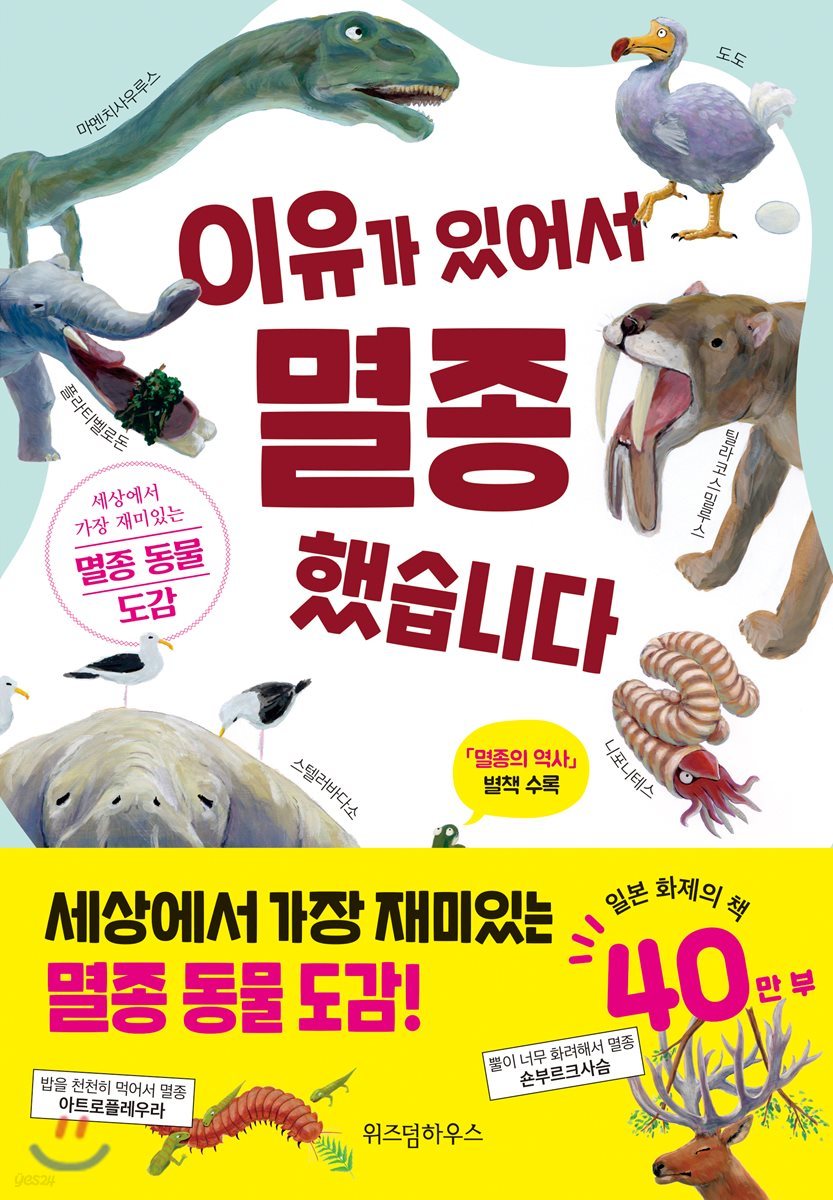
They became extinct for a reason
 |
Description
Book Introduction
Because you're too kind, because your jaw is too heavy, because your teeth don't fall out, because the river is completely dry? The reasons for extinction, as told directly by 70 extinct animals! The best-selling book that sold over 400,000 copies in Japan has finally been published in Korea. This is an extinct animal encyclopedia with a concept never seen before. Extinct animals themselves explain why they disappeared from Earth. Let's hear the reasons why extinct animals become extinct: being careless, going too far, being clumsy, being unlucky, etc. The story of 70 extinct animals unfolds in a way that is both amusing and heartbreaking, to the point where you might think that this is the kind of situation where the word "funny" should be used. Perhaps listening to and remembering their stories is something we can do for extinct animals. This book will lead you to think about how to live together with animals on Earth today. The special volume, “History of Extinction,” provides a quick overview of the history of the prosperity and extinction of living things. |
- You can preview some of the book's contents.
Preview
index
Opening remarks
We are all extinct
Living things are powerless against the Earth.
It's really hard to survive
So, is extinction a sad thing?
But still, I don't want to go extinct!
How to read this book differently
1. Extinction due to carelessness
The Steller's sea cow, too kind to be extinct
The slow-moving dodo is extinct
Gigantopithecus, pushed out by the panda
Ichthyosaurs went extinct due to lack of squid
Ogasawara Mashiko extinct due to gluttonous goats
Spinosaurus, which went extinct because it couldn't escape the river
Eat slowly and the extinct Atropleura
The Stevens Island wren, hunted to extinction by a single cat
The gastric brood frog, extinct due to mold
Giant Moa, which swallowed stones and went extinct
Dickinsonia, extinct because it is too soft
The pig-footed bandicoot, extinct after being attacked by foxes
Japanese wolves extinct after being infected by dogs
The extinct pocket wolf due to false accusations
Diatrima, extinct because it could not protect its eggs
Megatherium, an extinct species that was very strong
Take a break ① Song of the Fossil
2 It's too much and it's extinct
Platybelodon, extinct because its jaws were too heavy
Helicoprion, an extinct species whose teeth did not fall out
Passenger pigeons are so numerous that they are extinct.
Cameroceras, which is so upright that it is extinct
The bizarrely twisted and extinct Nipponites
The beautiful and extinct blue antelope
Opabinia is so beautiful that it is extinct
Fall in love with horses and become extinct
The extinct giant deer, whose antlers were stripped of their nutrients
The extinct Hawaiian honeyeater, with its unusual beak
Meganeura, which went extinct because it couldn't breathe
Thylacosmilus, extinct due to being stupid
Titanoboa, which was weak to both heat and cold and became extinct
The Schonburg deer, extinct because its horns were so ornate
Dimetrodon, extinct because of its cumbersome back sail
Mamenchisaurus, extinct because its neck was so long
Take a break ② Song of the Strata
3. Extinct because the craftsmanship is so bad
Archaeopteryx, which went extinct because it couldn't fly properly
Smilodon, an extinct animal with plump muscles
Neanderthals went extinct due to lack of imagination
Megalodon extinct due to whale counterattack
Anomalocaris, extinct due to weak teeth
Paraceratherium went extinct from eating too much
Dunkleosteus went extinct due to lack of oxygen
Argentavis extinct because the wind no longer blows
Pachycetus, which was in a state of limbo and then went extinct
Whales appear in Antarctica, driving giant penguins into extinction
Eating grass made the extinct cibatrium
Mastodonsaurus went extinct because the river dried up.
Ichthyostega, which came up on land without warning and became extinct
Take a break ③ Song of the Meteorite
4 Bad luck leads to extinction
Tyrannosaurus extinct due to meteorite strike
The Great Auk became extinct due to the sinking of the island.
Yangtze River dolphins go extinct due to turbid river water
Polynesian snails go extinct due to snail fighting
Magma all around, extinct sea scorpion
Andrewsarchus extinct due to Mount Everest's height
The extinct Machikane crocodile, unable to escape the cold
Conodont animals become extinct as the water heats up
Snowfall causes extinction of woolly mammoths
Cuban scarlet macaw extinct after being caught in a hurricane
The laughing owl that went extinct because it laughed too much
Trilobites that became extinct after being eaten by fish
Arsinoitherium, left in the desert and extinct
Guam's giant bat, hunted to extinction by curious humans
Stegosaurus extinct due to blooming flowers
Take a break ④ Song of the Great Extinction
5 Animals That Were Almost Extinct But Didn't
The platypus that survived by entering the water
A grouse that survived by climbing the mountain
Pygmy hippopotamus survives in the forest
The tuatara survived by living quietly for a long time
The nautilus that survived because it lacked motivation
Lord Howe's beetle survived by crossing the sea on a plank
Coelacanth that survived wandering in the deep sea
The opossum survived because its evolution was slow
When I came to my senses, I was in a different place and survived.
A dead fish that survived by hiding in a pond
Going out words
Recommended words
Search
Special volume… A History of Extinction
We are all extinct
Living things are powerless against the Earth.
It's really hard to survive
So, is extinction a sad thing?
But still, I don't want to go extinct!
How to read this book differently
1. Extinction due to carelessness
The Steller's sea cow, too kind to be extinct
The slow-moving dodo is extinct
Gigantopithecus, pushed out by the panda
Ichthyosaurs went extinct due to lack of squid
Ogasawara Mashiko extinct due to gluttonous goats
Spinosaurus, which went extinct because it couldn't escape the river
Eat slowly and the extinct Atropleura
The Stevens Island wren, hunted to extinction by a single cat
The gastric brood frog, extinct due to mold
Giant Moa, which swallowed stones and went extinct
Dickinsonia, extinct because it is too soft
The pig-footed bandicoot, extinct after being attacked by foxes
Japanese wolves extinct after being infected by dogs
The extinct pocket wolf due to false accusations
Diatrima, extinct because it could not protect its eggs
Megatherium, an extinct species that was very strong
Take a break ① Song of the Fossil
2 It's too much and it's extinct
Platybelodon, extinct because its jaws were too heavy
Helicoprion, an extinct species whose teeth did not fall out
Passenger pigeons are so numerous that they are extinct.
Cameroceras, which is so upright that it is extinct
The bizarrely twisted and extinct Nipponites
The beautiful and extinct blue antelope
Opabinia is so beautiful that it is extinct
Fall in love with horses and become extinct
The extinct giant deer, whose antlers were stripped of their nutrients
The extinct Hawaiian honeyeater, with its unusual beak
Meganeura, which went extinct because it couldn't breathe
Thylacosmilus, extinct due to being stupid
Titanoboa, which was weak to both heat and cold and became extinct
The Schonburg deer, extinct because its horns were so ornate
Dimetrodon, extinct because of its cumbersome back sail
Mamenchisaurus, extinct because its neck was so long
Take a break ② Song of the Strata
3. Extinct because the craftsmanship is so bad
Archaeopteryx, which went extinct because it couldn't fly properly
Smilodon, an extinct animal with plump muscles
Neanderthals went extinct due to lack of imagination
Megalodon extinct due to whale counterattack
Anomalocaris, extinct due to weak teeth
Paraceratherium went extinct from eating too much
Dunkleosteus went extinct due to lack of oxygen
Argentavis extinct because the wind no longer blows
Pachycetus, which was in a state of limbo and then went extinct
Whales appear in Antarctica, driving giant penguins into extinction
Eating grass made the extinct cibatrium
Mastodonsaurus went extinct because the river dried up.
Ichthyostega, which came up on land without warning and became extinct
Take a break ③ Song of the Meteorite
4 Bad luck leads to extinction
Tyrannosaurus extinct due to meteorite strike
The Great Auk became extinct due to the sinking of the island.
Yangtze River dolphins go extinct due to turbid river water
Polynesian snails go extinct due to snail fighting
Magma all around, extinct sea scorpion
Andrewsarchus extinct due to Mount Everest's height
The extinct Machikane crocodile, unable to escape the cold
Conodont animals become extinct as the water heats up
Snowfall causes extinction of woolly mammoths
Cuban scarlet macaw extinct after being caught in a hurricane
The laughing owl that went extinct because it laughed too much
Trilobites that became extinct after being eaten by fish
Arsinoitherium, left in the desert and extinct
Guam's giant bat, hunted to extinction by curious humans
Stegosaurus extinct due to blooming flowers
Take a break ④ Song of the Great Extinction
5 Animals That Were Almost Extinct But Didn't
The platypus that survived by entering the water
A grouse that survived by climbing the mountain
Pygmy hippopotamus survives in the forest
The tuatara survived by living quietly for a long time
The nautilus that survived because it lacked motivation
Lord Howe's beetle survived by crossing the sea on a plank
Coelacanth that survived wandering in the deep sea
The opossum survived because its evolution was slow
When I came to my senses, I was in a different place and survived.
A dead fish that survived by hiding in a pond
Going out words
Recommended words
Search
Special volume… A History of Extinction
Detailed image

Publisher's Review
#1 on Amazon Japan!
400,000 copies sold in just 8 months since publication!
The book that sparked a boom in extinct animals in Japan!
This book is another museum of natural history.
- Lee Jeong-mo (Director of Seoul Science Museum)
“Was there really such an animal?”
It introduces 70 species of extinct animals in the most interesting and fascinating way in the world.
I hope you remember this!
When we think of extinct animals, dinosaurs usually come to mind.
Besides dinosaurs, how many extinct animals do we know about? Perhaps the dodo from Alice in Wonderland is the only one we know about? It's hard to become familiar with extinct animals because we've never seen them before.
It has a long and unfamiliar name like a dinosaur's name, so it's hard to remember.
This book introduces 60 extinct animal species and 10 animals that were thought to be extinct but did not.
Each animal has a unique character, like the old man next door, the laid-back neighborhood older brother, the cute kindergartener, or the dignified king, and the reasons for their extinction are explained in a fun way for each animal.
As I read, I was filled with a constant sense of wonder, “Are there really animals like this on Earth?”
The cheerful and friendly writing style helps to remember extinct animals.
The author of this book, Mr. Maruyama, said, “If the time when something disappeared from the Earth is called the first extinction, then the time when it was truly forgotten can be called the second extinction.
“I wanted to avoid a second extinction, so I wanted to introduce as many extinct animals as possible,” he said.
Let's meet 60 extinct animals, including Steller's sea cow, dodo, Gigantopithecus, ichthyosaur, spinosaurus, and Helicoprion, as well as 10 animals that seemed to be on the verge of extinction but survived resolutely and survived, including platypus, ptarmigan, and pygmy hippopotamus.
And how about remembering them and their stories? It would be a truly meaningful time.
Extinction and fun? Laughing and then feeling sad?
Serious food for thought following this dissonance!
An endangered animal encyclopedia that is great for both children and adults who are interested in animals.
Extinction is when a species disappears completely from the Earth.
So extinction is considered a tragic event.
When an animal becomes extinct due to human error, it is even more regrettable, regrettable, and reflective.
But is extinction truly a sad thing? 99.9% of all life on Earth has gone extinct.
The reasons for extinction are truly varied.
The Earth's environment changes to a point where no matter how hard they try, life can become extinct, such as when a volcano erupts, a meteorite falls, or it becomes extremely cold or hot, or when a competitor appears and life becomes extinct, or when human error causes life to become extinct.
This book makes you think about the Earth's environment, the history of evolution, and human error on a grand scale.
It's even better when children and adults watch it together.
This is a very good book for expanding the scope of one's thinking by discussing these kinds of thoughts together.
99.9% of all living things are extinct.
Humans will also become extinct someday.
A chance to seriously think about extinction!
Humans are no exception and will eventually become extinct.
If we are to survive any longer, we must learn to survive.
Lee Jeong-mo, director of the Seoul Metropolitan Science Museum, said this in his letter of recommendation:
We have to survive no matter what.
To do that, we must learn about ‘extinction.’
We need to know how other life became extinct.
That way, we can avoid and delay our extinction.
That's why we learn history and why we go to natural history museums.
This book is another museum of natural history.
I learned a lot from this book.
The only sure way to avoid extinction is to live in harmony with other living beings.
The reason we must care for nature is, above all, for our survival.
- Among [recommended words] -
This book provides an opportunity to seriously consider extinction rather than dismiss it as someone else's problem.
You can take the time to delve deeper into why that animal became extinct, or to think about how we can coexist with other creatures, and why and how we should care for the Earth.
A time of growth for children to become interested in animals!
Among the extinct animals, some only have partial fossils found, so it's fun to imagine what kind of animal they were.
That's why extinct animals, including dinosaurs, are so fascinating to children.
Most of the extinct animals featured in this book are imagined by researchers by fitting together clues they have discovered so far, like a puzzle, to imagine what the animals looked like and why they became extinct.
The longer an animal has been extinct, the fewer clues there are, which often leads to conflicting opinions among researchers.
As you read this book, I encourage you to look at the world and its animals from a different perspective.
Readers may also come up with new hypotheses about the reasons for the extinction of unknown fossils.
Free imagination is the driving force behind the advancement of science and will be a time for children to grow.
400,000 copies sold in just 8 months since publication!
The book that sparked a boom in extinct animals in Japan!
This book is another museum of natural history.
- Lee Jeong-mo (Director of Seoul Science Museum)
“Was there really such an animal?”
It introduces 70 species of extinct animals in the most interesting and fascinating way in the world.
I hope you remember this!
When we think of extinct animals, dinosaurs usually come to mind.
Besides dinosaurs, how many extinct animals do we know about? Perhaps the dodo from Alice in Wonderland is the only one we know about? It's hard to become familiar with extinct animals because we've never seen them before.
It has a long and unfamiliar name like a dinosaur's name, so it's hard to remember.
This book introduces 60 extinct animal species and 10 animals that were thought to be extinct but did not.
Each animal has a unique character, like the old man next door, the laid-back neighborhood older brother, the cute kindergartener, or the dignified king, and the reasons for their extinction are explained in a fun way for each animal.
As I read, I was filled with a constant sense of wonder, “Are there really animals like this on Earth?”
The cheerful and friendly writing style helps to remember extinct animals.
The author of this book, Mr. Maruyama, said, “If the time when something disappeared from the Earth is called the first extinction, then the time when it was truly forgotten can be called the second extinction.
“I wanted to avoid a second extinction, so I wanted to introduce as many extinct animals as possible,” he said.
Let's meet 60 extinct animals, including Steller's sea cow, dodo, Gigantopithecus, ichthyosaur, spinosaurus, and Helicoprion, as well as 10 animals that seemed to be on the verge of extinction but survived resolutely and survived, including platypus, ptarmigan, and pygmy hippopotamus.
And how about remembering them and their stories? It would be a truly meaningful time.
Extinction and fun? Laughing and then feeling sad?
Serious food for thought following this dissonance!
An endangered animal encyclopedia that is great for both children and adults who are interested in animals.
Extinction is when a species disappears completely from the Earth.
So extinction is considered a tragic event.
When an animal becomes extinct due to human error, it is even more regrettable, regrettable, and reflective.
But is extinction truly a sad thing? 99.9% of all life on Earth has gone extinct.
The reasons for extinction are truly varied.
The Earth's environment changes to a point where no matter how hard they try, life can become extinct, such as when a volcano erupts, a meteorite falls, or it becomes extremely cold or hot, or when a competitor appears and life becomes extinct, or when human error causes life to become extinct.
This book makes you think about the Earth's environment, the history of evolution, and human error on a grand scale.
It's even better when children and adults watch it together.
This is a very good book for expanding the scope of one's thinking by discussing these kinds of thoughts together.
99.9% of all living things are extinct.
Humans will also become extinct someday.
A chance to seriously think about extinction!
Humans are no exception and will eventually become extinct.
If we are to survive any longer, we must learn to survive.
Lee Jeong-mo, director of the Seoul Metropolitan Science Museum, said this in his letter of recommendation:
We have to survive no matter what.
To do that, we must learn about ‘extinction.’
We need to know how other life became extinct.
That way, we can avoid and delay our extinction.
That's why we learn history and why we go to natural history museums.
This book is another museum of natural history.
I learned a lot from this book.
The only sure way to avoid extinction is to live in harmony with other living beings.
The reason we must care for nature is, above all, for our survival.
- Among [recommended words] -
This book provides an opportunity to seriously consider extinction rather than dismiss it as someone else's problem.
You can take the time to delve deeper into why that animal became extinct, or to think about how we can coexist with other creatures, and why and how we should care for the Earth.
A time of growth for children to become interested in animals!
Among the extinct animals, some only have partial fossils found, so it's fun to imagine what kind of animal they were.
That's why extinct animals, including dinosaurs, are so fascinating to children.
Most of the extinct animals featured in this book are imagined by researchers by fitting together clues they have discovered so far, like a puzzle, to imagine what the animals looked like and why they became extinct.
The longer an animal has been extinct, the fewer clues there are, which often leads to conflicting opinions among researchers.
As you read this book, I encourage you to look at the world and its animals from a different perspective.
Readers may also come up with new hypotheses about the reasons for the extinction of unknown fossils.
Free imagination is the driving force behind the advancement of science and will be a time for children to grow.
GOODS SPECIFICS
- Date of issue: April 15, 2019
- Page count, weight, size: 176 pages | 424g | 155*223*20mm
- ISBN13: 9791189938765
- ISBN10: 1189938766
- KC Certification: Certification Type: Conformity Confirmation
You may also like
카테고리
korean


korean

![GQ KOREA Mark (Monthly): December [2025]](http://librairie.coreenne.fr/cdn/shop/files/8ef265dbbfbf186523ed75ba7319009d.jpg?v=1765340328&width=3840)


