

Sunjae and Kiwan
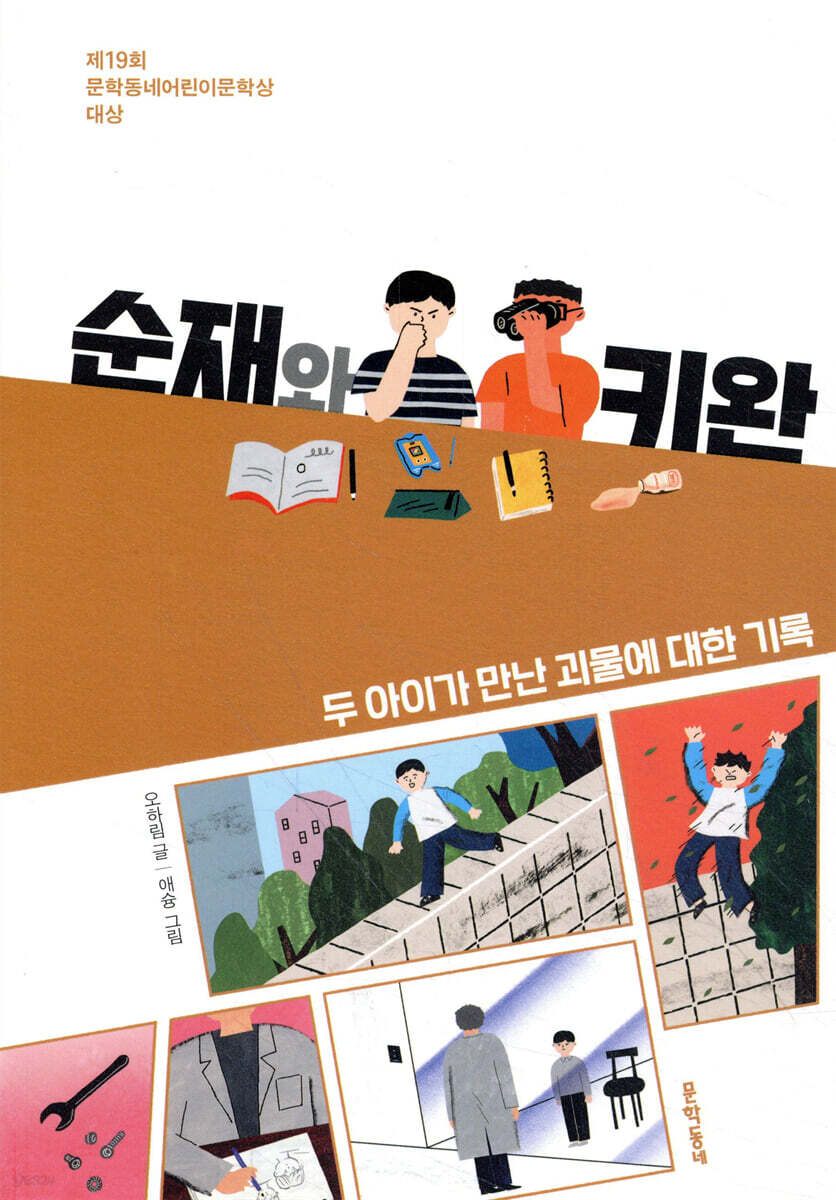 |
Description
Book Introduction
- A word from MD
-
The 19th Munhakdongne Children's Literature Award Grand Prize WinnerOne day, when he was nine years old, Sunjae heard of his own death.
Kiwan sends the robot Philip from the future to rescue Sunjae.
Philip is in danger of losing his life if he saves Sunjae.
What choices will save our future? A fairy tale that conveys a profound message through the honest hearts of children.
November 20, 2018. Children's PD Kim Tae-hee
“Do I have to really like anyone who helps me later?”
Winner of the 19th Munhakdongne Children's Literature Award for its weighty message, "This is the front line."
"Sunjae and Kiwan" won the grand prize at the 19th Munhakdongne Children's Literature Award for its message that "the here and now is at the forefront among works that depict the destruction of the Earth and humanity as if by some formula and the future prospects in desperate colors."
This is the first work by Oh Ha-rim, who studied psychology while living in Australia, and it was a controversial work that drew heated debate among the judges among 233 submissions.
Children's literature critic Kim Ji-eun commented that when you first read it, you may not be able to follow the flow of events as if someone had left the table unattended, but as you go towards the end, the outline of the story becomes clearer, it becomes more interesting the more you read it, and the story continues to expand as you chew on it.
Children's author Song Mi-kyung commented that if this story had simply been a question of choosing between saving a human life and losing a being in the face of scientific advancements in humanity, it might have been somewhat clichéd. However, by showing the character's inner conflict in a natural and unfamiliar way, it pushes the reader to ask questions in a completely new direction.
Children's literature critic Yoo Young-jin pointed out that this work clearly shows that the great power that saves humanity from destruction and ruin is childlikeness and the heart of a child.
At the intersection of diverse voices, there is a “heavy message that resonates when read to the end” and “the power of the speaker’s words at the end,” and this is what made “Sunjae and Kiwan” a worthy winner.
Winner of the 19th Munhakdongne Children's Literature Award for its weighty message, "This is the front line."
"Sunjae and Kiwan" won the grand prize at the 19th Munhakdongne Children's Literature Award for its message that "the here and now is at the forefront among works that depict the destruction of the Earth and humanity as if by some formula and the future prospects in desperate colors."
This is the first work by Oh Ha-rim, who studied psychology while living in Australia, and it was a controversial work that drew heated debate among the judges among 233 submissions.
Children's literature critic Kim Ji-eun commented that when you first read it, you may not be able to follow the flow of events as if someone had left the table unattended, but as you go towards the end, the outline of the story becomes clearer, it becomes more interesting the more you read it, and the story continues to expand as you chew on it.
Children's author Song Mi-kyung commented that if this story had simply been a question of choosing between saving a human life and losing a being in the face of scientific advancements in humanity, it might have been somewhat clichéd. However, by showing the character's inner conflict in a natural and unfamiliar way, it pushes the reader to ask questions in a completely new direction.
Children's literature critic Yoo Young-jin pointed out that this work clearly shows that the great power that saves humanity from destruction and ruin is childlikeness and the heart of a child.
At the intersection of diverse voices, there is a “heavy message that resonates when read to the end” and “the power of the speaker’s words at the end,” and this is what made “Sunjae and Kiwan” a worthy winner.
- You can preview some of the book's contents.
Preview
index
Knock knock, with a knock
01 The identity of that suspicious child
02 Suspicious Look
03 Suspicious Walk
04 Suspicious Score
05 Suspicious Woman
06 Suspicious Picture
07 Exposure
08 Suspicious Facility
09 Suspicious Wind
10 Suspicious Fate
Author's Note
Judges' comments
01 The identity of that suspicious child
02 Suspicious Look
03 Suspicious Walk
04 Suspicious Score
05 Suspicious Woman
06 Suspicious Picture
07 Exposure
08 Suspicious Facility
09 Suspicious Wind
10 Suspicious Fate
Author's Note
Judges' comments
Detailed image

Publisher's Review
The 19th Munhakdongne Children's Literature Award Grand Prize Winner
A good story begins after the book is closed._Reviews
★★★
“Don’t tell anyone, just keep it to yourself.”
A Strange Tale Told to the Author by a Midnight Visitor
A record of the monster encountered by two children, Sunjae and Kiwan.
On a midwinter night on January 1st, a time traveler comes to the writer with a knock on the door.
A time traveler, a long-time friend of the author, brings us an absurd and bizarre story.
The author decides to break his promise to the traveler to keep the story to himself and make it public.
By mixing truth and lies, adding flesh, and tearing and fixing it here and there.
This is 『Sunjae and Kiwan』, a record of the monsters that two children encountered.
★★★
“I hope that the accident that happened to a boy named Cha Sun-jae 74 years ago can be prevented.
“I will give you as many examples as you want.”
Sunjae decided to tell his mother.
Philip, a classmate, is watching Sunjae and, more than anything, wants Sunjae to die.
Just like Sunjae's mother, the reader is also bewildered by this unpredictable confession.
If you turn the next page without knowing English, you will encounter a scene where Sunjae and his best friend Kiwan form a duo of spies and plan to track down Philip.
Coincidentally, from then on, not only does Philip become indifferent to Sunjae, but his suspicious older sister also hangs around and interferes with the two of them.
Could Sunjae have misunderstood Philip? If Philip is hiding a secret, what is it, and what is his sister's true identity? Could this incompetent duo of spies have ever imagined that behind Philip lies a monster the two children will soon face?
74 years into the future, someone's request to change the past opens a new path before them.
★★★
“Oral narratives, long thought to have vanished, have made a splendid return, set against the backdrop of the future!”
Although the author says he loves cheerful stories, he asserts that not all childhoods are cheerful.
Nine-year-old Sunjae is told he will never be ten; Kiwan loses his parents overnight and transfers to an unfamiliar school; and Philip faces a fate completely opposite to Sunjae's as the statute of limitations approaches.
How will the friendship that was so precious that they were willing to give everything for 74 years and the hearts of the children who did not want to disappear from the world change the future of the three children?
The author occasionally pops in as a character, interrupting the story or speaking to us from outside the book, leaving us feeling embarrassed.
This unique narrative style, while leaving us confused as to whether the story is real or made up, reveals that the story is a living, breathing creature, not just a mere literal narrative.
It weaves together the past, present, and future, thrusting us into a vortex of time and scattering events in pieces.
As we pick up pieces we don't know where they are, stack question marks one by one, and imagine what kind of big picture the pieces will form, we move forward, and before we know it, we find ourselves pushed into a place where a warm pulse beats beneath our rough skin.
“The human heart, which cannot be reached by any excellent writing or style.”
There are still unanswered question marks floating around there.
Is it okay for that child to just disappear? What kind of map will the footprints those children just left draw? Where are the monsters, and where does the strength to confront or embrace them come from? What should we reflect on when faced with the ethical questions that accompany scientific and technological advancements? … The questions left behind become fuel that propels the reader forward beyond the story.
Because a good story begins after you close the book.
We dare to expect.
Young readers of this work will find themselves entering a cave where they cannot see clearly.
If you take slow, careful steps, you will find your way out of this labyrinthine cave, and after reading it, you will find yourself drawn back into the cave, as if by a magnet.
As you retrace your steps, you'll discover that the cards scattered here and there aren't just scattered pieces, but pieces of a carefully arranged puzzle and riddle, and you'll once again enjoy the pleasure of reading.
This is the power of literature, and the decisive appeal of "Sunjae and Kiwan." - Review
★★★
Impressive scenes captured through cut segmentation
Clean flow of pictures and stories
The artist who drew the picture, Ae-sung, is a beloved artist who creates simple and comfortable cartoons and cute and lovely illustrations.
In "Sunjae and Kiwan," the impressive events that occurred in each chapter were broken down into several screens, and scenes where emotions explode were devoted to an entire screen, maintaining an appropriate rhythm with the story.
The characters and colors that reflect the unique personality of artist Aesung will add a sense of familiarity and provide the fun of connecting the pictures.
★★★
Children's book reviews
I usually like comics, so I don't usually read long books, but I read "Sunjae and Kiwan" from beginning to end without stopping.
When my friends asked me what I found so interesting, "Is it more fun than comics?" I confidently answered, "Yes!" _Jeong Ye-jin, 6th grade, Pohang, Gyeongbuk
“Oh, I see! Ah, so that’s why that scene happened!” And as I thought about it, the fun of reading this book increased.
I would like to tell people who read this book to never judge it by its first scene.
"Sunjae and Kiwan" was the best novel I've ever read. _Cheonmaru, 5th grade, Namyangju, Gyeonggi Province
It's a difficult question: will you choose the best robot or save the living Sunjae?
The story of being close to a friend, then growing apart, and then becoming close again felt exactly like my own. _Shin Jun-ho, 4th grade, Guro-gu, Seoul
It made me think again about the idea that friends aren't just "people you play with," but "people in your heart who give you strength." _ Bae Seo-yoon, 4th grade, Guri City, Gyeonggi Province
My brain cells were working hard to reason, and I had to hold my chin and read the book.
Because it was a series of surprises. _Kang Da-in, 5th grade, Seongbuk-gu, Seoul
There were three scenes that were most memorable.
First, when I found out that Philip was from the future.
Second, when I found out that Kiwan had dedicated his life to saving Sunjae.
Third, when Kiwan gave up eternal honor to save Sunjae.
I wish I had a friend with whom I could share this kind of friendship. _Kim Ji-woo, 5th grade, Sejong City
★★★
Munhakdongne Children's Literature Award Judges' Comments
It conveys a weighty message that it is not scientific advancements, but the "earnestness" based on humanity that transforms human life. _Kim Li-ri (children's story writer)
Oral narratives, long thought to have vanished, have made a splendid comeback, set in the future. _Kim Ji-eun (children's literature critic)
Just as the texture of a material enhances and supports the subject matter when drawing, this story allowed me to experience how narratives sometimes choose the writing style that best suits them. _Song Mi-kyung (Children's Story Writer)
In a world filled with dystopian visions, the message that "here and now is the front line" is invaluable.
The future is made by the present._Jang Ju-sik (children's story writer)
Good music isn't something you listen to just once.
Even if no one tells you to, you have to listen to it many times, and you have to listen to it many times to really appreciate its flavor.
This work is also similar to music. —Yoo Young-jin (children's literature critic)
Based on reflections on the relationship between the individual and the world and a fresh imagination, it depicts what we should value in our present lives rather than in the future that has yet to come. _Im Jeong-ja (Children's Book Writer)
Author's Note
I hope we are not too ignorant of the pain and suffering of others, and I simply wrote what I heard and saw.
Although it has been edited to make it unrecognizable, please remember that many of the conversations and events in 『Sunjae and Kiwan』 actually took place and occurred.
If children who read the book promise themselves not to grow up to be monsters, then Sunjae has done his job. - Oh Ha-rim, from his acceptance speech
A good story begins after the book is closed._Reviews
★★★
“Don’t tell anyone, just keep it to yourself.”
A Strange Tale Told to the Author by a Midnight Visitor
A record of the monster encountered by two children, Sunjae and Kiwan.
On a midwinter night on January 1st, a time traveler comes to the writer with a knock on the door.
A time traveler, a long-time friend of the author, brings us an absurd and bizarre story.
The author decides to break his promise to the traveler to keep the story to himself and make it public.
By mixing truth and lies, adding flesh, and tearing and fixing it here and there.
This is 『Sunjae and Kiwan』, a record of the monsters that two children encountered.
★★★
“I hope that the accident that happened to a boy named Cha Sun-jae 74 years ago can be prevented.
“I will give you as many examples as you want.”
Sunjae decided to tell his mother.
Philip, a classmate, is watching Sunjae and, more than anything, wants Sunjae to die.
Just like Sunjae's mother, the reader is also bewildered by this unpredictable confession.
If you turn the next page without knowing English, you will encounter a scene where Sunjae and his best friend Kiwan form a duo of spies and plan to track down Philip.
Coincidentally, from then on, not only does Philip become indifferent to Sunjae, but his suspicious older sister also hangs around and interferes with the two of them.
Could Sunjae have misunderstood Philip? If Philip is hiding a secret, what is it, and what is his sister's true identity? Could this incompetent duo of spies have ever imagined that behind Philip lies a monster the two children will soon face?
74 years into the future, someone's request to change the past opens a new path before them.
★★★
“Oral narratives, long thought to have vanished, have made a splendid return, set against the backdrop of the future!”
Although the author says he loves cheerful stories, he asserts that not all childhoods are cheerful.
Nine-year-old Sunjae is told he will never be ten; Kiwan loses his parents overnight and transfers to an unfamiliar school; and Philip faces a fate completely opposite to Sunjae's as the statute of limitations approaches.
How will the friendship that was so precious that they were willing to give everything for 74 years and the hearts of the children who did not want to disappear from the world change the future of the three children?
The author occasionally pops in as a character, interrupting the story or speaking to us from outside the book, leaving us feeling embarrassed.
This unique narrative style, while leaving us confused as to whether the story is real or made up, reveals that the story is a living, breathing creature, not just a mere literal narrative.
It weaves together the past, present, and future, thrusting us into a vortex of time and scattering events in pieces.
As we pick up pieces we don't know where they are, stack question marks one by one, and imagine what kind of big picture the pieces will form, we move forward, and before we know it, we find ourselves pushed into a place where a warm pulse beats beneath our rough skin.
“The human heart, which cannot be reached by any excellent writing or style.”
There are still unanswered question marks floating around there.
Is it okay for that child to just disappear? What kind of map will the footprints those children just left draw? Where are the monsters, and where does the strength to confront or embrace them come from? What should we reflect on when faced with the ethical questions that accompany scientific and technological advancements? … The questions left behind become fuel that propels the reader forward beyond the story.
Because a good story begins after you close the book.
We dare to expect.
Young readers of this work will find themselves entering a cave where they cannot see clearly.
If you take slow, careful steps, you will find your way out of this labyrinthine cave, and after reading it, you will find yourself drawn back into the cave, as if by a magnet.
As you retrace your steps, you'll discover that the cards scattered here and there aren't just scattered pieces, but pieces of a carefully arranged puzzle and riddle, and you'll once again enjoy the pleasure of reading.
This is the power of literature, and the decisive appeal of "Sunjae and Kiwan." - Review
★★★
Impressive scenes captured through cut segmentation
Clean flow of pictures and stories
The artist who drew the picture, Ae-sung, is a beloved artist who creates simple and comfortable cartoons and cute and lovely illustrations.
In "Sunjae and Kiwan," the impressive events that occurred in each chapter were broken down into several screens, and scenes where emotions explode were devoted to an entire screen, maintaining an appropriate rhythm with the story.
The characters and colors that reflect the unique personality of artist Aesung will add a sense of familiarity and provide the fun of connecting the pictures.
★★★
Children's book reviews
I usually like comics, so I don't usually read long books, but I read "Sunjae and Kiwan" from beginning to end without stopping.
When my friends asked me what I found so interesting, "Is it more fun than comics?" I confidently answered, "Yes!" _Jeong Ye-jin, 6th grade, Pohang, Gyeongbuk
“Oh, I see! Ah, so that’s why that scene happened!” And as I thought about it, the fun of reading this book increased.
I would like to tell people who read this book to never judge it by its first scene.
"Sunjae and Kiwan" was the best novel I've ever read. _Cheonmaru, 5th grade, Namyangju, Gyeonggi Province
It's a difficult question: will you choose the best robot or save the living Sunjae?
The story of being close to a friend, then growing apart, and then becoming close again felt exactly like my own. _Shin Jun-ho, 4th grade, Guro-gu, Seoul
It made me think again about the idea that friends aren't just "people you play with," but "people in your heart who give you strength." _ Bae Seo-yoon, 4th grade, Guri City, Gyeonggi Province
My brain cells were working hard to reason, and I had to hold my chin and read the book.
Because it was a series of surprises. _Kang Da-in, 5th grade, Seongbuk-gu, Seoul
There were three scenes that were most memorable.
First, when I found out that Philip was from the future.
Second, when I found out that Kiwan had dedicated his life to saving Sunjae.
Third, when Kiwan gave up eternal honor to save Sunjae.
I wish I had a friend with whom I could share this kind of friendship. _Kim Ji-woo, 5th grade, Sejong City
★★★
Munhakdongne Children's Literature Award Judges' Comments
It conveys a weighty message that it is not scientific advancements, but the "earnestness" based on humanity that transforms human life. _Kim Li-ri (children's story writer)
Oral narratives, long thought to have vanished, have made a splendid comeback, set in the future. _Kim Ji-eun (children's literature critic)
Just as the texture of a material enhances and supports the subject matter when drawing, this story allowed me to experience how narratives sometimes choose the writing style that best suits them. _Song Mi-kyung (Children's Story Writer)
In a world filled with dystopian visions, the message that "here and now is the front line" is invaluable.
The future is made by the present._Jang Ju-sik (children's story writer)
Good music isn't something you listen to just once.
Even if no one tells you to, you have to listen to it many times, and you have to listen to it many times to really appreciate its flavor.
This work is also similar to music. —Yoo Young-jin (children's literature critic)
Based on reflections on the relationship between the individual and the world and a fresh imagination, it depicts what we should value in our present lives rather than in the future that has yet to come. _Im Jeong-ja (Children's Book Writer)
Author's Note
I hope we are not too ignorant of the pain and suffering of others, and I simply wrote what I heard and saw.
Although it has been edited to make it unrecognizable, please remember that many of the conversations and events in 『Sunjae and Kiwan』 actually took place and occurred.
If children who read the book promise themselves not to grow up to be monsters, then Sunjae has done his job. - Oh Ha-rim, from his acceptance speech
GOODS SPECIFICS
- Publication date: November 15, 2018
- Page count, weight, size: 124 pages | 296g | 153*220*9mm
- ISBN13: 9788954653503
- ISBN10: 8954653502
- KC Certification: Certification Type: Conformity Confirmation
You may also like
카테고리
korean


korean

![ELLE 엘르 스페셜 에디션 A형 : 12월 [2025]](http://librairie.coreenne.fr/cdn/shop/files/b8e27a3de6c9538896439686c6b0e8fb.jpg?v=1766436872&width=3840)


