

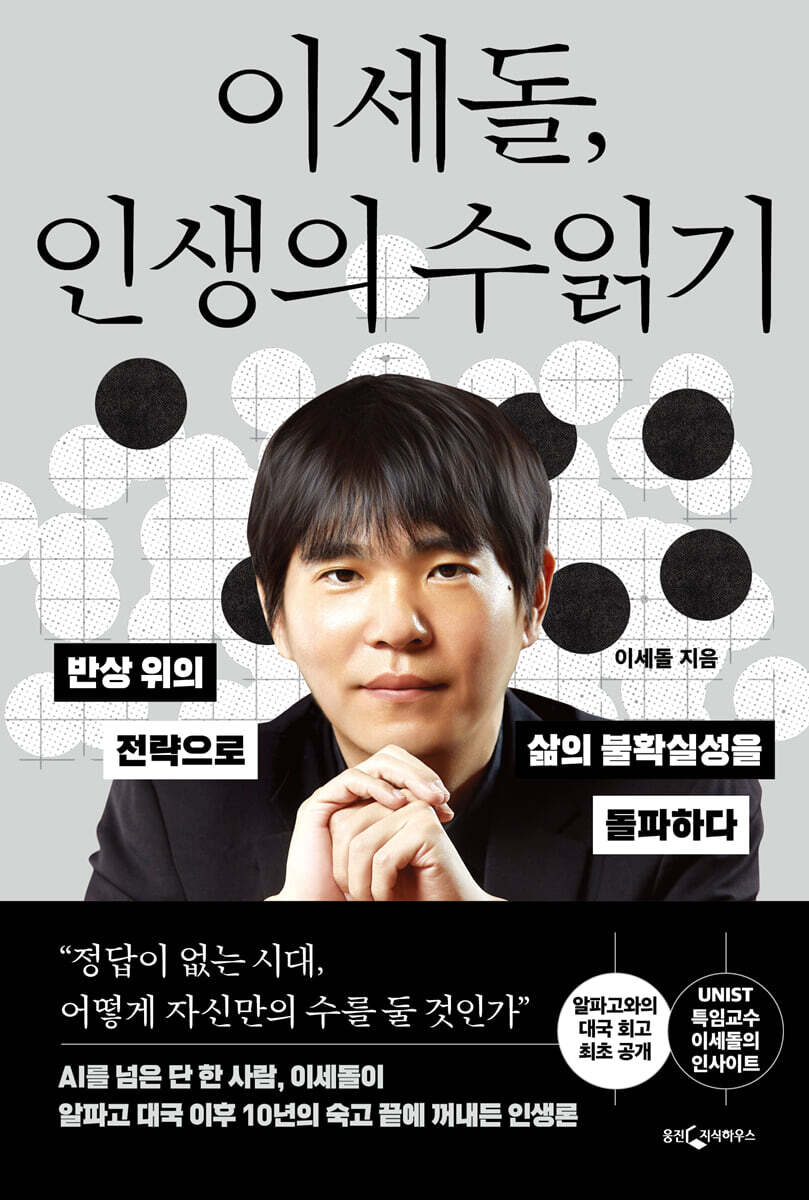
Lee Sedol, Reading the Numbers of Life
 |
Description
Book Introduction
- A word from MD
-
Baduk and Life: A World Without Correct AnswersA match against AlphaGo, the artificial intelligence that surprised the world.
And Lee Sedol, the first person in human history to win a game.
This book contains deep reflections on how to find one's own way in the uncertain times of the decade following that great nation.
The essence of life philosophy, similar to the game of Go, where you complete your own world amidst endless possibilities.
August 22, 2025. Self-Development PD Oh Da-eun
★First public recap of the match against AlphaGo
Insights from UNIST Distinguished Professor Lee Sedol
Lee Sedol, the first person in human history to win a game
A philosophy of life revealed after 10 years of reflection following the AlphaGo match.
“In an era without right answers,
How to make your own number”
In 2016, Lee Sedol, a Go player, gained worldwide attention by becoming the first human to win a match against the artificial intelligence AlphaGo.
He announced his retirement three years after the match, and found readers with his new book, "Lee Sedol, Reading the Moves of Life."
This book is the conclusion reached after 10 years of contemplation on what is uniquely human in the aftermath of the 'AlphaGo Shock' and how to overcome the unpredictability of life.
In Baduk, 'reading moves' is the process of interpreting the opponent's moves, predicting the flow, and deciding on the best move.
In an era where it is difficult to see even an inch ahead, he shares his 25 years of professional experience, having discovered his own unique method through thousands of readings, assessing the situation, and reviewing.
The insights he gained on the board of Go—“You must choose the best move rather than the winning move,” “Excessive caution is poisonous,” “You must finish when you must finish”—were no different from the tactics needed in life.
When life is shaky, you must become a gambler who believes in yourself and moves forward.
Lee Sedol has applied the principles he embodied in the world of Baduk to his life, and has maintained his own standards and determination at every crucial moment.
For him, reading was not just a skill, but a compass that kept him from losing his bearings in an uncertain world.
In an age without right answers, the teachings of Baduk, which involve finding your own moves in an infinite world, become even clearer.
This book teaches you how to make your own moves without backing down or doubting.
Insights from UNIST Distinguished Professor Lee Sedol
Lee Sedol, the first person in human history to win a game
A philosophy of life revealed after 10 years of reflection following the AlphaGo match.
“In an era without right answers,
How to make your own number”
In 2016, Lee Sedol, a Go player, gained worldwide attention by becoming the first human to win a match against the artificial intelligence AlphaGo.
He announced his retirement three years after the match, and found readers with his new book, "Lee Sedol, Reading the Moves of Life."
This book is the conclusion reached after 10 years of contemplation on what is uniquely human in the aftermath of the 'AlphaGo Shock' and how to overcome the unpredictability of life.
In Baduk, 'reading moves' is the process of interpreting the opponent's moves, predicting the flow, and deciding on the best move.
In an era where it is difficult to see even an inch ahead, he shares his 25 years of professional experience, having discovered his own unique method through thousands of readings, assessing the situation, and reviewing.
The insights he gained on the board of Go—“You must choose the best move rather than the winning move,” “Excessive caution is poisonous,” “You must finish when you must finish”—were no different from the tactics needed in life.
When life is shaky, you must become a gambler who believes in yourself and moves forward.
Lee Sedol has applied the principles he embodied in the world of Baduk to his life, and has maintained his own standards and determination at every crucial moment.
For him, reading was not just a skill, but a compass that kept him from losing his bearings in an uncertain world.
In an age without right answers, the teachings of Baduk, which involve finding your own moves in an infinite world, become even clearer.
This book teaches you how to make your own moves without backing down or doubting.
- You can preview some of the book's contents.
Preview
index
Prologue: Questions I Faced After the AlphaGo Match
Chapter 1: Baduk and Life: Lessons Learned in a World Without Correct Answers
You have to know when to end it
Artificial Intelligence Breaks Human Taboos
There are fights where there are no winners or losers.
Even a stone has its own dignity
A decisive move, a gamble
Time Attack, the opponent's time is soon my time
It's just a game of Go
Sedol's Comment_There are unfinished and finished lives.
Special Essay: Reflecting on the match against AlphaGo
Chapter 2: The moment your mentality wavers, it's over.
Collapse before reaching the summit
Concentration also requires strategy.
If it's not clear where to go, it's better to stop.
The irony of competition: victory or defeat is determined by a simple mistake.
I can't change the situation, but I can change my mind.
The absence of a routine is a routine
Sedol's Comment: There is no such thing as a great nation, but we are.
Chapter 3: The Path to Seeing is Only by Overturning Common Sense
Caution can sometimes be poisonous.
Too many experiences can bind me
Time to find your own answers
Confuse your opponent with ambiguous numbers
Even the best lose two out of ten games.
Sedol's Comment: Kibo: Evolving from Language to Data
Chapter 4: Setting Unbreakable Standards
A slump comes when my inner baseline crumbles.
What matters is common sense and efficiency.
Look broadly, but don't miss what's close at hand.
A lot of sewage must accumulate before pure water can be produced.
Life needs a refresher too
I must place my own stone.
Sedol's Comment_10, 20, 30, and 40
Chapter 5: Saying I'm Not Sure About Quality
Approach it with the mindset of winning
Trust your intuition, your senses
Sometimes unfounded confidence is necessary.
The experience of success awakens dulled senses.
Sedol's Comment_To love something passionately
Chapter 6: Humanity's Gamble for the Age of Artificial Intelligence
AlphaGo Shock: The Future Is Already Here
How to embrace technological evolution
When you need to build your abstract thinking skills
The crisis that came with abundance
Sedol's Comment: In the Age of AI, Should We Still Learn Baduk?
Epilogue Again, with a beginner's mind
Chapter 1: Baduk and Life: Lessons Learned in a World Without Correct Answers
You have to know when to end it
Artificial Intelligence Breaks Human Taboos
There are fights where there are no winners or losers.
Even a stone has its own dignity
A decisive move, a gamble
Time Attack, the opponent's time is soon my time
It's just a game of Go
Sedol's Comment_There are unfinished and finished lives.
Special Essay: Reflecting on the match against AlphaGo
Chapter 2: The moment your mentality wavers, it's over.
Collapse before reaching the summit
Concentration also requires strategy.
If it's not clear where to go, it's better to stop.
The irony of competition: victory or defeat is determined by a simple mistake.
I can't change the situation, but I can change my mind.
The absence of a routine is a routine
Sedol's Comment: There is no such thing as a great nation, but we are.
Chapter 3: The Path to Seeing is Only by Overturning Common Sense
Caution can sometimes be poisonous.
Too many experiences can bind me
Time to find your own answers
Confuse your opponent with ambiguous numbers
Even the best lose two out of ten games.
Sedol's Comment: Kibo: Evolving from Language to Data
Chapter 4: Setting Unbreakable Standards
A slump comes when my inner baseline crumbles.
What matters is common sense and efficiency.
Look broadly, but don't miss what's close at hand.
A lot of sewage must accumulate before pure water can be produced.
Life needs a refresher too
I must place my own stone.
Sedol's Comment_10, 20, 30, and 40
Chapter 5: Saying I'm Not Sure About Quality
Approach it with the mindset of winning
Trust your intuition, your senses
Sometimes unfounded confidence is necessary.
The experience of success awakens dulled senses.
Sedol's Comment_To love something passionately
Chapter 6: Humanity's Gamble for the Age of Artificial Intelligence
AlphaGo Shock: The Future Is Already Here
How to embrace technological evolution
When you need to build your abstract thinking skills
The crisis that came with abundance
Sedol's Comment: In the Age of AI, Should We Still Learn Baduk?
Epilogue Again, with a beginner's mind
Detailed image

Into the book
The charm of Baduk is that it is a game where no one can be blamed.
No one told me to put the stone there.
In the end, every move comes from me, who places the stone.
So, the glory, the regret of failure, and the responsibility are all mine.
---From "Chapter 1: Baduk and Life, What I Learned in a World Without Correct Answers"
In Baduk, a winning move has more meaning than simply making a move.
Because it is the final battlefield where you send your thoughts and will to your opponent.
From a broader perspective, it shows one's entire Go life beyond a single game of Go.
That's the winning move.
(…) Just as in a great game, the flow of the game must change and meaning must come alive when there is a decisive move, there comes a time in life when you must make a proper decisive move.
When the skills and insight honed over time, combined with the intuition that it must happen now, intertwine, and the courage to face that moment rather than avoid it, it becomes the power that changes the course of your life.
A gamble is risky, but at the same time it is a force that creates opportunities.
Sometimes you have to risk everything to open a new path.
---From "Chapter 1: Baduk and Life, What I Learned in a World Without Correct Answers"
'How can I play Go in this kind of environment?' The frustration grew with the defeat.
It was more painful to lose the momentum and be shaken than to lose.
If only it weren't for the loud music.
If only the atmosphere wasn't so distracting.
Deep down, I was blaming the noise for everything.
But when I thought about it carefully, it all came down to how I thought about it.
(…) because I couldn’t continue to be swayed by external stimuli that I couldn’t change.
I also realized that immersion is not something that is given when the environment is perfect, but something that must be created within me.
This is not just on the Go board.
In our lives, unwanted and unexpected difficulties happen at any time.
Getting annoyed and angry every time won't solve anything.
I'm the only one who suffers.
So I decided to control my attitude toward the situation, not the situation itself.
---From "Chapter 2: The moment your mentality wavers, it's over"
When is the most dangerous moment in Go? It's when you're winning.
When victory is within sight, we often doubt ourselves.
We strive to find a more certain path and make more perfect judgments.
But sometimes caution can be the biggest poison.
Because at the crucial moment, a bold move is more important than a perfect move.
---From "Chapter 3: Overturning Common Sense to See the Way"
After countless failures, experiments, and reflections, a number that finally emerges as a conclusion is the integer.
It can be said that it is a response that comes from accumulation, that is, the density of time, rather than sensation.
So, I have been trying to build the framework of Baduk by accumulating essence in countless sewage.
Flashy moves remain as fleeting moments, but the fundamental moves make up that person's baduk.
---From "Chapter 4: Setting Unbreakable Standards"
“I’m not confident, I’m not confident.” It was a joke, and everyone laughed at it.
But there was more than just a joke there was also emotion.
Maybe it was something like a promise to myself.
This is a pledge to believe in myself and take on the challenge.
In real life, there are many cases where victory is achieved by gaining momentum through confidence.
In the professional world where skills are equal, whoever manages their mentality better and whoever strengthens their inner self exerts great power.
---From "Chapter 5: Saying I'm Not Confident"
In the past, studying Baduk began with solving 'life-or-death problems'.
The method was to repeatedly solve classic workbooks without separate answer sheets and find the answers on one's own.
To use a math analogy, it was closer to training in deducing answers through logic and intuition rather than memorizing set formulas.
The process was not simply a practice of learning a skill, but rather a process of drawing a 'map of thoughts'.
It was a time to create my own path in my head, thinking about where to start and how to approach it, and which path would be more efficient.
In both baduk and mathematics, what is ultimately important is not the ‘answer’ itself.
The real test of your ability may be how you arrived at the answer, your attitude toward the problem, and how you accepted your mistakes.
Because the perspective that sees the whole picture and the judgment based on that perspective may be a more important force.
No one told me to put the stone there.
In the end, every move comes from me, who places the stone.
So, the glory, the regret of failure, and the responsibility are all mine.
---From "Chapter 1: Baduk and Life, What I Learned in a World Without Correct Answers"
In Baduk, a winning move has more meaning than simply making a move.
Because it is the final battlefield where you send your thoughts and will to your opponent.
From a broader perspective, it shows one's entire Go life beyond a single game of Go.
That's the winning move.
(…) Just as in a great game, the flow of the game must change and meaning must come alive when there is a decisive move, there comes a time in life when you must make a proper decisive move.
When the skills and insight honed over time, combined with the intuition that it must happen now, intertwine, and the courage to face that moment rather than avoid it, it becomes the power that changes the course of your life.
A gamble is risky, but at the same time it is a force that creates opportunities.
Sometimes you have to risk everything to open a new path.
---From "Chapter 1: Baduk and Life, What I Learned in a World Without Correct Answers"
'How can I play Go in this kind of environment?' The frustration grew with the defeat.
It was more painful to lose the momentum and be shaken than to lose.
If only it weren't for the loud music.
If only the atmosphere wasn't so distracting.
Deep down, I was blaming the noise for everything.
But when I thought about it carefully, it all came down to how I thought about it.
(…) because I couldn’t continue to be swayed by external stimuli that I couldn’t change.
I also realized that immersion is not something that is given when the environment is perfect, but something that must be created within me.
This is not just on the Go board.
In our lives, unwanted and unexpected difficulties happen at any time.
Getting annoyed and angry every time won't solve anything.
I'm the only one who suffers.
So I decided to control my attitude toward the situation, not the situation itself.
---From "Chapter 2: The moment your mentality wavers, it's over"
When is the most dangerous moment in Go? It's when you're winning.
When victory is within sight, we often doubt ourselves.
We strive to find a more certain path and make more perfect judgments.
But sometimes caution can be the biggest poison.
Because at the crucial moment, a bold move is more important than a perfect move.
---From "Chapter 3: Overturning Common Sense to See the Way"
After countless failures, experiments, and reflections, a number that finally emerges as a conclusion is the integer.
It can be said that it is a response that comes from accumulation, that is, the density of time, rather than sensation.
So, I have been trying to build the framework of Baduk by accumulating essence in countless sewage.
Flashy moves remain as fleeting moments, but the fundamental moves make up that person's baduk.
---From "Chapter 4: Setting Unbreakable Standards"
“I’m not confident, I’m not confident.” It was a joke, and everyone laughed at it.
But there was more than just a joke there was also emotion.
Maybe it was something like a promise to myself.
This is a pledge to believe in myself and take on the challenge.
In real life, there are many cases where victory is achieved by gaining momentum through confidence.
In the professional world where skills are equal, whoever manages their mentality better and whoever strengthens their inner self exerts great power.
---From "Chapter 5: Saying I'm Not Confident"
In the past, studying Baduk began with solving 'life-or-death problems'.
The method was to repeatedly solve classic workbooks without separate answer sheets and find the answers on one's own.
To use a math analogy, it was closer to training in deducing answers through logic and intuition rather than memorizing set formulas.
The process was not simply a practice of learning a skill, but rather a process of drawing a 'map of thoughts'.
It was a time to create my own path in my head, thinking about where to start and how to approach it, and which path would be more efficient.
In both baduk and mathematics, what is ultimately important is not the ‘answer’ itself.
The real test of your ability may be how you arrived at the answer, your attitude toward the problem, and how you accepted your mistakes.
Because the perspective that sees the whole picture and the judgment based on that perspective may be a more important force.
---From "Chapter 6: Humanity's Gamble for the Artificial Intelligence Era"
Publisher's Review
The more unfavorable the situation, the clearer the path becomes.
1,903 matches, 1,324 wins, 576 losses... A life strategy built over 25 years in the world of fierce competition.
When is the most dangerous moment in a game of Go? Ironically, it's when the odds are in your favor.
As choices increase, thinking becomes more complex, and mistakes are made in the process.
On the other hand, the disadvantaged side becomes simpler.
Since there is nothing to compromise, you can focus on just enduring and make fewer mistakes.
Life is no different.
Only when I'm on the defensive do I see what's important and the path I should take becomes clear.
1,903 matches, 1,324 wins, 3 draws, 576 losses.
Lee Sedol, who has been fighting fierce battles of his own for 25 years as a professional Go player, says that a crisis is the moment when he sharpens his skills the most and is the opportunity to find the best move.
And the best number is not the answer given by others, but 'my own number' that only I can discover and perfect.
People often say, “make a decisive move.”
In Baduk, a 'winning move' goes beyond the simple act of making a move and means showing one's thoughts, will, and even one's entire life.
It is a risky act as it involves risking everything, but at the same time it is a force that creates new opportunities.
Sometimes in life, you have to risk everything and open a new path.
Lee Sedol's game of Go demonstrates the strategy of a gambler who is prepared to lose if he wants to gain something.
“In the game of Baduk, nothing changes with just thoughts in your head or determination in your heart.
Because it is our choices and actions that change our lives.
“Ultimately, the person who advances to the next stage is the one who knows how to make a decisive move at the right time.” (p. 55)
“It’s not about making the winning move, it’s about making the ‘best move.’”
In an age of AI dominated by probability and efficiency, there are things only humans can do.
In "Lee Sedol, Reading the Moves of Life," Lee Sedol reveals for the first time his reflections on the 2016 AlphaGo match (pp. 82-124). From the moment he first encountered AlphaGo, to the shock of the first game, to the brilliant move he made in the fourth game after a string of defeats, and the aftereffects that followed, it is all captured in its entirety.
He personally experienced the changes that completely changed the landscape of Baduk through this great game.
Artificial intelligence prioritizes efficiency by choosing the 'move with the highest winning percentage' over the 'best move'.
But the Go he learned was closer to an art.
He grew up hearing from his father that “even a single stone has its own dignity, and each move carries its own responsibility.” To him, Baduk was not just a game, but an act of completing his own world amidst endless possibilities.
“While a cool-headed contest is important, I had my own world, and I expected it to develop in the long term, rather than the outcome of a single match.” (p. 46)
AlphaGo shattered these traditional values.
He broke stereotypes and took full advantage by boldly playing the 3-3 position, which had been taboo for over 2,000 years in the history of Baduk.
Seeing this, he realized the limits of human creativity and was forced to fundamentally question what the unique role of humans is.
The experience of seeing what I had believed to be true crumble was not simply a shock, but led to a long period of reflection.
But what was clear was that even though artificial intelligence could surpass humans in skill, humans had the power to create the essence of Go.
"The moment your mentality breaks down, it's over."
The feeling that holds me at the edge of a cliff: 'Inner Standard' and 'The Power of Self-Immersion'
In the final of the 2000 LG Cup World Go Championship, Lee Sedol faced off against the strongest player of the time, Lee Chang-ho, 9th dan.
Following their two consecutive victories, the momentum continued in the third match.
It was the moment when the 'Era of Lee Sedol' was about to open.
But from then on, thoughts like 'Am I really winning?' and 'Is the championship mine?' started to cloud my mind, and I suffered a reversal defeat in the three countries.
That day's defeat left a painful lesson: 'The moment your mentality wavers, everything falls apart.'
In the early days of my professional career, I was greatly influenced by the external environment.
There was even a time when loud music suddenly started blaring near the stadium, completely losing the flow of the game.
But at some point I realized.
The opponent also played the game while hearing that noise, and the difference was in their attitude towards the situation.
When I stress over things I can't control, I end up hurting myself.
“I also realized that immersion is not something that comes when the environment is perfect, but something that must be created within oneself.” (p. 154)
This experience made him realize the importance of having a baseline to maintain so as not to be shaken.
The slump came not because of poor performance or poor condition.
It was when my own standards were broken.
This baseline is not something that is visible or tangible in numbers, but rather an attitude that checks the density of concentration, mindset, and effort.
Anyone can become loose, but a person with a strong center cannot easily fall apart.
What held him back every time he faltered was his strong will and mental fortitude to 'not go below this standard'.
“If you don’t believe in yourself, you can’t do anything.”
Caution is sometimes poisonous: Why your odds of winning fall when you lack confidence.
“I have no confidence.
“Quality is your own.” This is Lee Sedol’s famous saying.
It was something I said in private as a joke, but it was actually a promise I made to myself.
If you feel intimidated or cower in a big game, you will lose momentum and ultimately not be able to fully demonstrate your skills.
He always approached the game with the mindset of winning.
He grew up believing that even if he failed, he had to challenge himself and face challenges to learn and open up unexpected possibilities.
The confidence that comes after building up your skills is different.
My efforts and achievements, the standards I've established after countless reflections, agonizing, and repeated choices at every moment, ultimately support my confidence because I believe in what I've done.
Just as a skilled pianist plays without looking at the score, thousands of repetitions and practices create the best moments.
Success never comes by accident.
In Baduk, judging the situation means judging who has the advantage in the current situation and what strategy to take going forward.
It is the basis of baduk, but it should not become the goal.
There are times when you lose a game that you had already won when you didn't trust your own numbers and only judged the situation endlessly.
If you don't believe in yourself and don't finish at an advantageous moment, the next opportunity will always be second best.
If you can't make a decision at an 80 percent win rate, the next time it drops to 70 percent, then 60 percent.
The power to make the right decision at the right time ultimately comes from believing in yourself.
“Still, we must choose and move forward.
In the end, the only person you can trust the most at that moment is yourself.
Prudence is important, but what good is it if you can't act on it?
“It is dangerous to have blind faith in yourself, but if you don’t believe in yourself, you won’t be able to do anything.” (pp. 173-175)
1,903 matches, 1,324 wins, 576 losses... A life strategy built over 25 years in the world of fierce competition.
When is the most dangerous moment in a game of Go? Ironically, it's when the odds are in your favor.
As choices increase, thinking becomes more complex, and mistakes are made in the process.
On the other hand, the disadvantaged side becomes simpler.
Since there is nothing to compromise, you can focus on just enduring and make fewer mistakes.
Life is no different.
Only when I'm on the defensive do I see what's important and the path I should take becomes clear.
1,903 matches, 1,324 wins, 3 draws, 576 losses.
Lee Sedol, who has been fighting fierce battles of his own for 25 years as a professional Go player, says that a crisis is the moment when he sharpens his skills the most and is the opportunity to find the best move.
And the best number is not the answer given by others, but 'my own number' that only I can discover and perfect.
People often say, “make a decisive move.”
In Baduk, a 'winning move' goes beyond the simple act of making a move and means showing one's thoughts, will, and even one's entire life.
It is a risky act as it involves risking everything, but at the same time it is a force that creates new opportunities.
Sometimes in life, you have to risk everything and open a new path.
Lee Sedol's game of Go demonstrates the strategy of a gambler who is prepared to lose if he wants to gain something.
“In the game of Baduk, nothing changes with just thoughts in your head or determination in your heart.
Because it is our choices and actions that change our lives.
“Ultimately, the person who advances to the next stage is the one who knows how to make a decisive move at the right time.” (p. 55)
“It’s not about making the winning move, it’s about making the ‘best move.’”
In an age of AI dominated by probability and efficiency, there are things only humans can do.
In "Lee Sedol, Reading the Moves of Life," Lee Sedol reveals for the first time his reflections on the 2016 AlphaGo match (pp. 82-124). From the moment he first encountered AlphaGo, to the shock of the first game, to the brilliant move he made in the fourth game after a string of defeats, and the aftereffects that followed, it is all captured in its entirety.
He personally experienced the changes that completely changed the landscape of Baduk through this great game.
Artificial intelligence prioritizes efficiency by choosing the 'move with the highest winning percentage' over the 'best move'.
But the Go he learned was closer to an art.
He grew up hearing from his father that “even a single stone has its own dignity, and each move carries its own responsibility.” To him, Baduk was not just a game, but an act of completing his own world amidst endless possibilities.
“While a cool-headed contest is important, I had my own world, and I expected it to develop in the long term, rather than the outcome of a single match.” (p. 46)
AlphaGo shattered these traditional values.
He broke stereotypes and took full advantage by boldly playing the 3-3 position, which had been taboo for over 2,000 years in the history of Baduk.
Seeing this, he realized the limits of human creativity and was forced to fundamentally question what the unique role of humans is.
The experience of seeing what I had believed to be true crumble was not simply a shock, but led to a long period of reflection.
But what was clear was that even though artificial intelligence could surpass humans in skill, humans had the power to create the essence of Go.
"The moment your mentality breaks down, it's over."
The feeling that holds me at the edge of a cliff: 'Inner Standard' and 'The Power of Self-Immersion'
In the final of the 2000 LG Cup World Go Championship, Lee Sedol faced off against the strongest player of the time, Lee Chang-ho, 9th dan.
Following their two consecutive victories, the momentum continued in the third match.
It was the moment when the 'Era of Lee Sedol' was about to open.
But from then on, thoughts like 'Am I really winning?' and 'Is the championship mine?' started to cloud my mind, and I suffered a reversal defeat in the three countries.
That day's defeat left a painful lesson: 'The moment your mentality wavers, everything falls apart.'
In the early days of my professional career, I was greatly influenced by the external environment.
There was even a time when loud music suddenly started blaring near the stadium, completely losing the flow of the game.
But at some point I realized.
The opponent also played the game while hearing that noise, and the difference was in their attitude towards the situation.
When I stress over things I can't control, I end up hurting myself.
“I also realized that immersion is not something that comes when the environment is perfect, but something that must be created within oneself.” (p. 154)
This experience made him realize the importance of having a baseline to maintain so as not to be shaken.
The slump came not because of poor performance or poor condition.
It was when my own standards were broken.
This baseline is not something that is visible or tangible in numbers, but rather an attitude that checks the density of concentration, mindset, and effort.
Anyone can become loose, but a person with a strong center cannot easily fall apart.
What held him back every time he faltered was his strong will and mental fortitude to 'not go below this standard'.
“If you don’t believe in yourself, you can’t do anything.”
Caution is sometimes poisonous: Why your odds of winning fall when you lack confidence.
“I have no confidence.
“Quality is your own.” This is Lee Sedol’s famous saying.
It was something I said in private as a joke, but it was actually a promise I made to myself.
If you feel intimidated or cower in a big game, you will lose momentum and ultimately not be able to fully demonstrate your skills.
He always approached the game with the mindset of winning.
He grew up believing that even if he failed, he had to challenge himself and face challenges to learn and open up unexpected possibilities.
The confidence that comes after building up your skills is different.
My efforts and achievements, the standards I've established after countless reflections, agonizing, and repeated choices at every moment, ultimately support my confidence because I believe in what I've done.
Just as a skilled pianist plays without looking at the score, thousands of repetitions and practices create the best moments.
Success never comes by accident.
In Baduk, judging the situation means judging who has the advantage in the current situation and what strategy to take going forward.
It is the basis of baduk, but it should not become the goal.
There are times when you lose a game that you had already won when you didn't trust your own numbers and only judged the situation endlessly.
If you don't believe in yourself and don't finish at an advantageous moment, the next opportunity will always be second best.
If you can't make a decision at an 80 percent win rate, the next time it drops to 70 percent, then 60 percent.
The power to make the right decision at the right time ultimately comes from believing in yourself.
“Still, we must choose and move forward.
In the end, the only person you can trust the most at that moment is yourself.
Prudence is important, but what good is it if you can't act on it?
“It is dangerous to have blind faith in yourself, but if you don’t believe in yourself, you won’t be able to do anything.” (pp. 173-175)
GOODS SPECIFICS
- Date of issue: August 18, 2025
- Page count, weight, size: 324 pages | 410g | 135*200*20mm
- ISBN13: 9788901296883
- ISBN10: 8901296888
You may also like
카테고리
korean


korean

![ELLE 엘르 스페셜 에디션 A형 : 12월 [2025]](http://librairie.coreenne.fr/cdn/shop/files/b8e27a3de6c9538896439686c6b0e8fb.jpg?v=1766436872&width=3840)


