

dopamine family
 |
Description
Book Introduction
- A word from MD
-
Where our eyes should be directed is people"The Dopamine Family" diagnoses the age of attention deficit disorder from a family perspective.
It's not just our personal concentration that cell phones have taken away.
The family was torn apart.
How to restore? Elementary education expert Eun-kyung Lee offers warm and practical advice.
November 11, 2025. Min-gyu Son, Humanities PD
Family conversation time drops by 50%, but parent-child conflict triples.
Seven out of ten families feel emotionally distant.
When toxic phentermine dominates a child's brain,
The only network that protects a child is family!
An invisible war is raging in every living room. With AI interfering with parenting and smartphones becoming a daily routine, children are more distracted than ever.
For a long time, many parents have been blaming their children for the problem.
But the problem is not the child's concentration, but the family system.
Eun-kyung Lee, who has been working as a teacher for 15 years and as an education expert for over 10 years, has observed thousands of children and their parents and interprets this phenomenon not as simple smartphone addiction, but as a sign of the breakdown of the family system.
"The Dopamine Family" uses the language of brain science, psychology, and education to connect the hyper-pleasure, chronic fatigue, loss of concentration, the daily routine of anxiety, and the breakdown of the living room and classroom into a single neural circuit.
In an age where smartphones and algorithms are rewiring children's brains and even encroaching on parents' attention spans.
What we've really lost isn't focus, it's relationships.
Seven out of ten families feel emotionally distant.
When toxic phentermine dominates a child's brain,
The only network that protects a child is family!
An invisible war is raging in every living room. With AI interfering with parenting and smartphones becoming a daily routine, children are more distracted than ever.
For a long time, many parents have been blaming their children for the problem.
But the problem is not the child's concentration, but the family system.
Eun-kyung Lee, who has been working as a teacher for 15 years and as an education expert for over 10 years, has observed thousands of children and their parents and interprets this phenomenon not as simple smartphone addiction, but as a sign of the breakdown of the family system.
"The Dopamine Family" uses the language of brain science, psychology, and education to connect the hyper-pleasure, chronic fatigue, loss of concentration, the daily routine of anxiety, and the breakdown of the living room and classroom into a single neural circuit.
In an age where smartphones and algorithms are rewiring children's brains and even encroaching on parents' attention spans.
What we've really lost isn't focus, it's relationships.
- You can preview some of the book's contents.
Preview
index
The Deficiency of Relationships in an Age of Dopamine Overload
Chapter 1.
Disconnection - Digital Family
: The moment dopamine took over the living room
The Dopamine Family - Uninvited Guests
The Birth of the Digital Family - Same Sofa, Different Screens
Dopamine Kids, the Algorithm Family - The Loss of Emotional Literacy
Emoji Family - A Family Chat Filled with Memes and Emojis
[Recovery] Communication: Practice Recovering Emotional Language in the Living Room
Chapter 2.
Stimulation - Bland Daily Life
: The Age of Stimulation, the Bored Family
Boredom Phobia: The Birth of a Generation Who Doesn't Know Waiting
Studying is boring, and I can't stop playing games - The asymmetry of the reward circuit.
Why Do We Always Get Angry? - The Breakdown of Emotional Control
A Family Obsessed with Achievement - Where Has the Process Gone?
[Recovery] Immersion: Small Practices to Recover Fragmented Attention
Chapter 3.
Addiction - Where Families Are Dragged
: The illusion of having chosen oneself
The Family in the Next Scene - How Dopamine Addiction Is Destroying Families
Sleepless Night - On the Electric Blanket at Midnight
Information Addiction: Today's Parents Need Information to Feel Safe
Emotional Consumption - A Family Accustomed to Fake Satisfaction
[Recovery] Regulation: A Self-Regulating Brain, a Recovering Family
Chapter 4.
Acceleration - The Extinction of Leisure
: The paradox of lost speed
The Disappearing Table: The Meal Prepared by Delivery Apps and Meal Kits
The Age of Instant Gratification - The Demise of Slow-Maturing Things
Fast Family - The Age of Reaction, the Loss of Listening
Triviality overtaken by speed - the quiet extinction of emotions
[Recovery] Balance: A Living Room Routine That Coexists with Dopamine
Chapter 5.
Anxiety - The Age of Comparison
: Why has the family's daily life become unstable?
Family travel specs - a family that tires out to get a good rest
Memories Competition - The Real Face of Family-Centered SNS Accounts
Certification Addiction: The Age of Achievement Obsession and Recognition Needs
Our relatively happy day - ranking your happiness
[Recovery] Rest: How to Recover with Unparalleled Rest
Conclusion: We Can Still Be Together
Chapter 1.
Disconnection - Digital Family
: The moment dopamine took over the living room
The Dopamine Family - Uninvited Guests
The Birth of the Digital Family - Same Sofa, Different Screens
Dopamine Kids, the Algorithm Family - The Loss of Emotional Literacy
Emoji Family - A Family Chat Filled with Memes and Emojis
[Recovery] Communication: Practice Recovering Emotional Language in the Living Room
Chapter 2.
Stimulation - Bland Daily Life
: The Age of Stimulation, the Bored Family
Boredom Phobia: The Birth of a Generation Who Doesn't Know Waiting
Studying is boring, and I can't stop playing games - The asymmetry of the reward circuit.
Why Do We Always Get Angry? - The Breakdown of Emotional Control
A Family Obsessed with Achievement - Where Has the Process Gone?
[Recovery] Immersion: Small Practices to Recover Fragmented Attention
Chapter 3.
Addiction - Where Families Are Dragged
: The illusion of having chosen oneself
The Family in the Next Scene - How Dopamine Addiction Is Destroying Families
Sleepless Night - On the Electric Blanket at Midnight
Information Addiction: Today's Parents Need Information to Feel Safe
Emotional Consumption - A Family Accustomed to Fake Satisfaction
[Recovery] Regulation: A Self-Regulating Brain, a Recovering Family
Chapter 4.
Acceleration - The Extinction of Leisure
: The paradox of lost speed
The Disappearing Table: The Meal Prepared by Delivery Apps and Meal Kits
The Age of Instant Gratification - The Demise of Slow-Maturing Things
Fast Family - The Age of Reaction, the Loss of Listening
Triviality overtaken by speed - the quiet extinction of emotions
[Recovery] Balance: A Living Room Routine That Coexists with Dopamine
Chapter 5.
Anxiety - The Age of Comparison
: Why has the family's daily life become unstable?
Family travel specs - a family that tires out to get a good rest
Memories Competition - The Real Face of Family-Centered SNS Accounts
Certification Addiction: The Age of Achievement Obsession and Recognition Needs
Our relatively happy day - ranking your happiness
[Recovery] Rest: How to Recover with Unparalleled Rest
Conclusion: We Can Still Be Together
Detailed image
Into the book
Seven out of ten households with middle and high school children spent more time focused on digital devices even when they were in the same space.
Parents complain that their children don't show their feelings, but in reality, the parents don't say anything either.
The family all spends their days and returns home, but they don't know what kind of day each other had.
What this means is clear.
We are becoming accustomed to a new family form called the 'quiet disconnection'.
--- From "The Birth of the Digital Family"
While it's natural for children to be excited about games due to their immature brains, adult gaming immersion is a different matter altogether.
The fact that you can't stop playing games despite having a fully developed prefrontal cortex means that the reward circuits your brain has learned are entrenched.
In other words, in the case of children, they cannot slow down because of incomplete brakes, while adults have the habit of stepping on the accelerator even when the brakes are working properly.
--- From "Studying is not fun, and I can't stop playing games"
Parents believe that saying, “I’m doing this for your well-being” will reach their children as a “love language,” but children are not fooled.
“If I do well… Mom will feel less anxious.” When love is directed toward the parent’s relief rather than the child’s, the dopamine system senses it.
The heart can be fooled by the emotions, but the brain can never be fooled.
--- From "A Family Obsessed with Achievement"
When feelings are repeatedly ignored or unresponsive within a family, it hurts more than just silence.
In family therapy, what is called "emotional neglect" gradually isolates a person without any noticeable fights or hurt feelings.
When attempts to share feelings are repeatedly ignored or overlooked, we learn that 'talking about it is useless' and the feelings are withdrawn.
If this is repeated, the expression of emotions itself will decrease, and unexpressed emotions will become misunderstood over time.
--- From "The Family in the Next Scene"
Information was a necessary tool to aid decision making.
However, in this age of information overload, information tends to delay rather than lead to clear judgment and decisions.
We keep searching for information to avoid making a choice right now, out of anxiety that there might be a better option, or because we want to avoid the worst.
Search instead of choosing, collect instead of deciding.
--- From "Information Addiction"
Another name for family is 'family'.
It literally refers to people who eat together.
Among the many shared experiences, meals were the source and starting point of family, the center of daily life that sustained relationships.
The meals that used to be like that are gradually fading away.
The dopamine-optimized structure made eating quick and convenient, but it also took away the meaning of the process of preparing, waiting, and sitting down to share together.
--- From "The Disappeared Table"
People who have accumulated experience in a slow-paced home become impatient members of society, and organizations with such members become busier and more exhausted.
The speed of the living room ultimately determines the speed of society.
--- From "The Age of Instant Gratification"
We seem to live in an age where emotional expression is at its most free, but in fact, we live in an age where emotions are expressed in the simplest, most condensed form.
Words abound, but the language to describe delicate thoughts and feelings has disappeared.
The feelings are still alive, but the vocabulary to express them is becoming increasingly impoverished.
So instead of saying we're sad, we say "boring," and we abbreviate uncomfortable feelings with "it was kind of like that."
--- From "Triviality Overtaken by Speed"
Envy, once a secret and private emotion, has been structured into a public evaluation system called “likes” and views.
Complaints like, “My family is always home alone?” or “I feel sorry for my kids when I see other families” are signs that comparison fatigue is starting to take effect.
I travel not because I want to go somewhere, but because I feel anxious if I don't go.
The time that should be fully guaranteed for family rest and happiness has become the subject of others' evaluation and a source of competition in feeds.
--- From "Specs of Family Travel"
What families obsessed with achievement need is not fancy meditation techniques, but a family atmosphere where they can pause anywhere.
The atmosphere is created from the small, repeated 'okay'.
And that okayness becomes the emotional immunity of the family.
A special universe filled with just being together, without asking what to do now.
We call that relationship family.
Parents complain that their children don't show their feelings, but in reality, the parents don't say anything either.
The family all spends their days and returns home, but they don't know what kind of day each other had.
What this means is clear.
We are becoming accustomed to a new family form called the 'quiet disconnection'.
--- From "The Birth of the Digital Family"
While it's natural for children to be excited about games due to their immature brains, adult gaming immersion is a different matter altogether.
The fact that you can't stop playing games despite having a fully developed prefrontal cortex means that the reward circuits your brain has learned are entrenched.
In other words, in the case of children, they cannot slow down because of incomplete brakes, while adults have the habit of stepping on the accelerator even when the brakes are working properly.
--- From "Studying is not fun, and I can't stop playing games"
Parents believe that saying, “I’m doing this for your well-being” will reach their children as a “love language,” but children are not fooled.
“If I do well… Mom will feel less anxious.” When love is directed toward the parent’s relief rather than the child’s, the dopamine system senses it.
The heart can be fooled by the emotions, but the brain can never be fooled.
--- From "A Family Obsessed with Achievement"
When feelings are repeatedly ignored or unresponsive within a family, it hurts more than just silence.
In family therapy, what is called "emotional neglect" gradually isolates a person without any noticeable fights or hurt feelings.
When attempts to share feelings are repeatedly ignored or overlooked, we learn that 'talking about it is useless' and the feelings are withdrawn.
If this is repeated, the expression of emotions itself will decrease, and unexpressed emotions will become misunderstood over time.
--- From "The Family in the Next Scene"
Information was a necessary tool to aid decision making.
However, in this age of information overload, information tends to delay rather than lead to clear judgment and decisions.
We keep searching for information to avoid making a choice right now, out of anxiety that there might be a better option, or because we want to avoid the worst.
Search instead of choosing, collect instead of deciding.
--- From "Information Addiction"
Another name for family is 'family'.
It literally refers to people who eat together.
Among the many shared experiences, meals were the source and starting point of family, the center of daily life that sustained relationships.
The meals that used to be like that are gradually fading away.
The dopamine-optimized structure made eating quick and convenient, but it also took away the meaning of the process of preparing, waiting, and sitting down to share together.
--- From "The Disappeared Table"
People who have accumulated experience in a slow-paced home become impatient members of society, and organizations with such members become busier and more exhausted.
The speed of the living room ultimately determines the speed of society.
--- From "The Age of Instant Gratification"
We seem to live in an age where emotional expression is at its most free, but in fact, we live in an age where emotions are expressed in the simplest, most condensed form.
Words abound, but the language to describe delicate thoughts and feelings has disappeared.
The feelings are still alive, but the vocabulary to express them is becoming increasingly impoverished.
So instead of saying we're sad, we say "boring," and we abbreviate uncomfortable feelings with "it was kind of like that."
--- From "Triviality Overtaken by Speed"
Envy, once a secret and private emotion, has been structured into a public evaluation system called “likes” and views.
Complaints like, “My family is always home alone?” or “I feel sorry for my kids when I see other families” are signs that comparison fatigue is starting to take effect.
I travel not because I want to go somewhere, but because I feel anxious if I don't go.
The time that should be fully guaranteed for family rest and happiness has become the subject of others' evaluation and a source of competition in feeds.
--- From "Specs of Family Travel"
What families obsessed with achievement need is not fancy meditation techniques, but a family atmosphere where they can pause anywhere.
The atmosphere is created from the small, repeated 'okay'.
And that okayness becomes the emotional immunity of the family.
A special universe filled with just being together, without asking what to do now.
We call that relationship family.
--- From "Authentication Addiction"
Publisher's Review
The collapse of emotional literacy,
The Birth of a Generation with Acquired Attention Deficit
Today, classrooms and homes in Korean society are facing a common crisis.
Smartphones have already become both parents and teachers for our children, and 'digital neglect' has become the new parenting style.
The World Health Organization (WHO) recommends that children aged 2 to 4 should use media for less than one hour a day, but Korean children spend 184 minutes in front of a screen, three times the recommended amount.
More than half of children are exposed to smartphones before 24 months of age, and a significant number are exposed to algorithm-based platforms.
Conversations are reduced to 'lol' and 'not fun', and the language of communication is becoming increasingly impoverished.
While digital literacy appears to be improving on the surface, in reality, a breakdown in emotional literacy is underway.
While you are unable to properly express your anger, joy, or even sadness, emotions you are not even aware of explode at any moment.
A normally gentle child starts crying because an eraser fell, and kicks the desk and swears at a friend's comment.
Children who shout “This is boring” at the teacher during class or run out of the classroom in a fit of anger.
This is not simply a 'problem behavior', but a result of structural changes in the brain caused by excessive dopamine stimulation.
"The Dopamine Family" dissects this broken emotional circuit through vivid observations of homes and classrooms.
Author Eun-kyung Lee has been a teacher for 15 years and an education expert for over 10 years, running the educational group “Smart Elementary School Life” with 300,000 parents.
Analyzing tens of thousands of cases collected from schools and lecture halls across the country, the author discovered a strikingly recurring pattern.
Families who become indifferent to each other rather than supporting each other, constantly compare each other, and live in self-reproach and urging.
Although it may seem ordinary on the surface, underneath our daily lives, a 'dopamine system' dominated by a circuit of stimulation is operating.
This book documents the landscape of classrooms and homes invaded by dopamine, and combines brain science and psychology to suggest causes and solutions.
The author asks:
“In an age of stimulation, how can we restore resilience for children and families?”
Over a long period of time, repeated dopamine overstimulation, suppression of emotional expression, and lack of empathy and communication accumulate and change the emotional circuit.
I get tired easily in slow and complex emotional situations.
As a result, the child quickly becomes saturated with even small stimuli and reacts with anger or irritation.
Rather than understanding them as “children who get angry,” we should understand them as children with “brains with overly sensitive emotional circuits.”
(Page 115)
A circuit of relationships stronger than a smartphone,
How the dopamine family transformed into the oxytocin family
The brains of children overexposed to short-form digital content show prefrontal activity patterns similar to those of children with ADHD.
This is not an innate attention deficit, but rather a result of the entire family learning 'acquired attention deficit'.
As the author diagnoses, "It's not that they can't focus, but rather that their brains have been recalibrated to the rhythm of short, rapid bursts of information" (p. 92), parents' brains are no exception. Adults, accustomed to social media, online shopping, and work messenger notifications, often tell their children, "Did you do your homework?" or "Put your phone down," yet they can't quite put their smartphones down.
A child's emotional regulation circuit develops through the parents' facial expressions, speech, and breathing.
From the mother's tired face and the short conversation with the father, the child learns anxiety and loses his emotional safety zone.
Ultimately, a child's smartphone usage patterns are reinforced "as much as parents look into it, as much as parents react, and as much as parents allow it" (p. 96).
"The Dopamine Family" interprets this phenomenon not as an individual problem, but as a result of the emotional structure of the entire family being reorganized by dopamine, and proposes a redesign of the family system rather than technological control.
The author emphasizes two abilities that parenting and education today must recover: "moderation," which slows down the dopamine rate, and "space," which creates a period of recovery without stimulation.
When parents log off the screen first, a "stop line" is created in the child's prefrontal cortex circuitry, and the relationship repair circuitry begins to work again.
At this time, the author finds the key to recovery in 'oxytocin'.
While dopamine reinforces pleasure through stimulation, oxytocin creates a sense of security through connection.
What families accustomed to the speed of dopamine need is not more intense stimulation, but a slower rhythm of relationship restoration.
Family is almost the only place where oxytocin is secreted reliably.
The exchange of glances and voices several times a day, the slow and ordinary rhythm of daily life, is the optimal environment for secreting oxytocin.
(Page 22)
Unfortunately, the emotional circuit waves that start at home are spreading to schools and society.
The disconnection within the home extends beyond the living room into the classroom, shaking the very fabric of relationships within society.
Digital violence, such as bullying in group chat rooms, exposing group chat rooms, and sharing illegally filmed footage, has become the center of school violence, and teachers point out the collapse of emotional control as a serious crisis.
The overabundance of the dopamine system is no longer an individual problem, but a social phenomenon that is destroying the emotional order of an entire generation.
Teen depression and self-harm have nearly doubled in the past five years, and a single "like" on social media can make a difference.
As emotional numbness becomes more ingrained in our social landscape, we need to chase oxytocin.
5 Recovery Networks We Need in the Dopamine Age
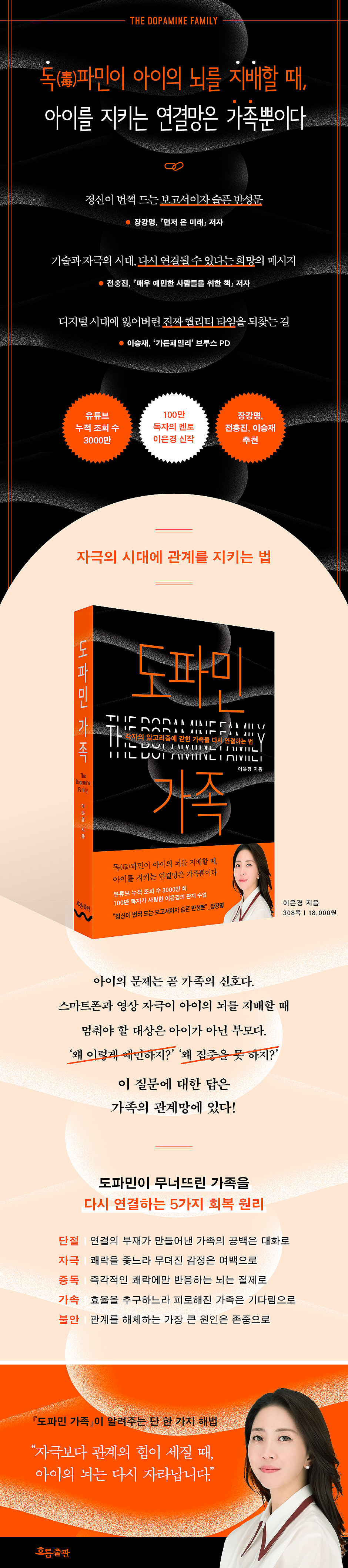
This book analyzes the dopamine system that has infiltrated our lives with five keywords: disconnection, stimulation, addiction, acceleration, and anxiety, and presents a recovery network on the other side: conversation, space, moderation, waiting, and respect.
Chapter 1, “Disconnection,” highlights emotional isolation amidst physical proximity through “a family that lives in the same house but is no longer together.”
Chapter 2, “Stimulation,” traces the process by which dopamine, once a signal of survival, was transformed into a “product of stimulation” by the content industry.
It also explains the neuroscientific mechanisms by which social media, games, and video platforms take control of children's reward circuits.
Chapter 3, “Addiction,” analyzes digital addiction not as a simple habit but as a symptom of relationship breakdown.
It deals with the process by which repeated release of dopamine weakens the function of the frontal lobe, resulting in parents choosing avoidance over discipline and children choosing immediate response over conversation.
Chapter 4, "Acceleration," shows how the structure of modern society, where speed and efficiency are considered virtues, distorts the emotional rhythm of the family, and suggests ways for the family to regain speed through "pausing" and "restoring rhythm."
The final chapter, "Anxiety," paints a portrait of a family that is constantly connected yet lonely, proposing family as the only restorative network that breaks the vicious cycle of comparison, stimulation, exhaustion, and self-loathing.
Novelist Jang Kang-myeong called the book “a sobering report and a sad reflection,” while Professor Jeon Hong-jin of Sungkyunkwan University School of Medicine said it was “a message of hope that in this age of technology and stimulation, we can reconnect.”
Seungjae Lee of the educational channel Garden Family recommended this book as a must-read, saying, “It is a book that will help you regain the lost quality time.”
"The Dopamine Family" is a survival guide for the digital age that parents and children should read together, and a new starting point for restoring a stronger connection than a smartphone.
It's a reminder that it's not YouTube that designs a child's brain, but the conversations at the dinner table tonight.
The Birth of a Generation with Acquired Attention Deficit
Today, classrooms and homes in Korean society are facing a common crisis.
Smartphones have already become both parents and teachers for our children, and 'digital neglect' has become the new parenting style.
The World Health Organization (WHO) recommends that children aged 2 to 4 should use media for less than one hour a day, but Korean children spend 184 minutes in front of a screen, three times the recommended amount.
More than half of children are exposed to smartphones before 24 months of age, and a significant number are exposed to algorithm-based platforms.
Conversations are reduced to 'lol' and 'not fun', and the language of communication is becoming increasingly impoverished.
While digital literacy appears to be improving on the surface, in reality, a breakdown in emotional literacy is underway.
While you are unable to properly express your anger, joy, or even sadness, emotions you are not even aware of explode at any moment.
A normally gentle child starts crying because an eraser fell, and kicks the desk and swears at a friend's comment.
Children who shout “This is boring” at the teacher during class or run out of the classroom in a fit of anger.
This is not simply a 'problem behavior', but a result of structural changes in the brain caused by excessive dopamine stimulation.
"The Dopamine Family" dissects this broken emotional circuit through vivid observations of homes and classrooms.
Author Eun-kyung Lee has been a teacher for 15 years and an education expert for over 10 years, running the educational group “Smart Elementary School Life” with 300,000 parents.
Analyzing tens of thousands of cases collected from schools and lecture halls across the country, the author discovered a strikingly recurring pattern.
Families who become indifferent to each other rather than supporting each other, constantly compare each other, and live in self-reproach and urging.
Although it may seem ordinary on the surface, underneath our daily lives, a 'dopamine system' dominated by a circuit of stimulation is operating.
This book documents the landscape of classrooms and homes invaded by dopamine, and combines brain science and psychology to suggest causes and solutions.
The author asks:
“In an age of stimulation, how can we restore resilience for children and families?”
Over a long period of time, repeated dopamine overstimulation, suppression of emotional expression, and lack of empathy and communication accumulate and change the emotional circuit.
I get tired easily in slow and complex emotional situations.
As a result, the child quickly becomes saturated with even small stimuli and reacts with anger or irritation.
Rather than understanding them as “children who get angry,” we should understand them as children with “brains with overly sensitive emotional circuits.”
(Page 115)
A circuit of relationships stronger than a smartphone,
How the dopamine family transformed into the oxytocin family
The brains of children overexposed to short-form digital content show prefrontal activity patterns similar to those of children with ADHD.
This is not an innate attention deficit, but rather a result of the entire family learning 'acquired attention deficit'.
As the author diagnoses, "It's not that they can't focus, but rather that their brains have been recalibrated to the rhythm of short, rapid bursts of information" (p. 92), parents' brains are no exception. Adults, accustomed to social media, online shopping, and work messenger notifications, often tell their children, "Did you do your homework?" or "Put your phone down," yet they can't quite put their smartphones down.
A child's emotional regulation circuit develops through the parents' facial expressions, speech, and breathing.
From the mother's tired face and the short conversation with the father, the child learns anxiety and loses his emotional safety zone.
Ultimately, a child's smartphone usage patterns are reinforced "as much as parents look into it, as much as parents react, and as much as parents allow it" (p. 96).
"The Dopamine Family" interprets this phenomenon not as an individual problem, but as a result of the emotional structure of the entire family being reorganized by dopamine, and proposes a redesign of the family system rather than technological control.
The author emphasizes two abilities that parenting and education today must recover: "moderation," which slows down the dopamine rate, and "space," which creates a period of recovery without stimulation.
When parents log off the screen first, a "stop line" is created in the child's prefrontal cortex circuitry, and the relationship repair circuitry begins to work again.
At this time, the author finds the key to recovery in 'oxytocin'.
While dopamine reinforces pleasure through stimulation, oxytocin creates a sense of security through connection.
What families accustomed to the speed of dopamine need is not more intense stimulation, but a slower rhythm of relationship restoration.
Family is almost the only place where oxytocin is secreted reliably.
The exchange of glances and voices several times a day, the slow and ordinary rhythm of daily life, is the optimal environment for secreting oxytocin.
(Page 22)
Unfortunately, the emotional circuit waves that start at home are spreading to schools and society.
The disconnection within the home extends beyond the living room into the classroom, shaking the very fabric of relationships within society.
Digital violence, such as bullying in group chat rooms, exposing group chat rooms, and sharing illegally filmed footage, has become the center of school violence, and teachers point out the collapse of emotional control as a serious crisis.
The overabundance of the dopamine system is no longer an individual problem, but a social phenomenon that is destroying the emotional order of an entire generation.
Teen depression and self-harm have nearly doubled in the past five years, and a single "like" on social media can make a difference.
As emotional numbness becomes more ingrained in our social landscape, we need to chase oxytocin.
5 Recovery Networks We Need in the Dopamine Age
This book analyzes the dopamine system that has infiltrated our lives with five keywords: disconnection, stimulation, addiction, acceleration, and anxiety, and presents a recovery network on the other side: conversation, space, moderation, waiting, and respect.
Chapter 1, “Disconnection,” highlights emotional isolation amidst physical proximity through “a family that lives in the same house but is no longer together.”
Chapter 2, “Stimulation,” traces the process by which dopamine, once a signal of survival, was transformed into a “product of stimulation” by the content industry.
It also explains the neuroscientific mechanisms by which social media, games, and video platforms take control of children's reward circuits.
Chapter 3, “Addiction,” analyzes digital addiction not as a simple habit but as a symptom of relationship breakdown.
It deals with the process by which repeated release of dopamine weakens the function of the frontal lobe, resulting in parents choosing avoidance over discipline and children choosing immediate response over conversation.
Chapter 4, "Acceleration," shows how the structure of modern society, where speed and efficiency are considered virtues, distorts the emotional rhythm of the family, and suggests ways for the family to regain speed through "pausing" and "restoring rhythm."
The final chapter, "Anxiety," paints a portrait of a family that is constantly connected yet lonely, proposing family as the only restorative network that breaks the vicious cycle of comparison, stimulation, exhaustion, and self-loathing.
Novelist Jang Kang-myeong called the book “a sobering report and a sad reflection,” while Professor Jeon Hong-jin of Sungkyunkwan University School of Medicine said it was “a message of hope that in this age of technology and stimulation, we can reconnect.”
Seungjae Lee of the educational channel Garden Family recommended this book as a must-read, saying, “It is a book that will help you regain the lost quality time.”
"The Dopamine Family" is a survival guide for the digital age that parents and children should read together, and a new starting point for restoring a stronger connection than a smartphone.
It's a reminder that it's not YouTube that designs a child's brain, but the conversations at the dinner table tonight.
GOODS SPECIFICS
- Date of issue: November 3, 2025
- Page count, weight, size: 308 pages | 494g | 138*210*19mm
- ISBN13: 9788965967576
- ISBN10: 8965967570
You may also like
카테고리
korean


korean

![ELLE 엘르 스페셜 에디션 A형 : 12월 [2025]](http://librairie.coreenne.fr/cdn/shop/files/b8e27a3de6c9538896439686c6b0e8fb.jpg?v=1766436872&width=3840)


