

Red winter is coming
 |
Description
Book Introduction
Even though we've stepped onto the threshold of autumn, the heat shows no signs of abating, with heat waves and heavy rains hitting us simultaneously, and the strange sight of snow covering cherry blossoms continues.
Climate change is completely changing the everyday landscape that we took for granted without even realizing it.
This book examines how climate change is shaking the world, from natural signals of impending crisis, such as earlier blooming of spring flowers and falling green leaves, to the realities we face in the future, such as rising prices, epidemics, and climate refugees.
In addition, we introduce ways to prevent the worst-case climate scenario, including the mindset we must have as we enter an era of extreme climate change, and measures that can be attempted at the corporate and societal levels, such as climate technology and climate policy.
Climate change is completely changing the everyday landscape that we took for granted without even realizing it.
This book examines how climate change is shaking the world, from natural signals of impending crisis, such as earlier blooming of spring flowers and falling green leaves, to the realities we face in the future, such as rising prices, epidemics, and climate refugees.
In addition, we introduce ways to prevent the worst-case climate scenario, including the mindset we must have as we enter an era of extreme climate change, and measures that can be attempted at the corporate and societal levels, such as climate technology and climate policy.
- You can preview some of the book's contents.
Preview
index
Introduction: Climate Sensitivity Classes: Reclaiming the Lost Landscapes of Life
Chapter 1: Nature is constantly signaling a crisis.
What is climate change?
A warning from spring flowers that defy time
Why we can't welcome early flowering
If bees disappear, the ecosystem will collapse.
The future of Earth engulfed in flames
The Earth has a deadly flu
The intense heat is just beginning.
The Secret of the Disaster Movie-Like Downpour
The red autumn leaves began to turn green.
Tears of the snowy field longing for the cold snow
Heavy snow, the counterattack of a heated Earth
Chapter 2: How Climate Change Changes the World
Climate inflation threatens the national and household economy.
How urban climate change is impacting cities.
The relentless scourge of climate change
The pandemic isn't over
Climate change is changing fashion trends.
Climate pandemic that will bring about social disaster
The climate crisis is sparking another war.
The Earth's breathing is accelerating
Carbon time passes terrifyingly quickly.
The damage from the climate crisis is not fair.
Chapter 3: Stopping the Climate Change Clock
Children must live in the world we leave behind.
A new culture is needed to navigate the era of extreme climates.
Climate change is a present threat, not a distant future threat.
Protecting our cultural heritage can change climate history.
Desert nations dream of a forest miracle.
Technology can change the reality of climate change.
Five Climate Tech Tips to Save the Planet
If we can't prevent climate disasters, let's reduce their damage.
Climate technology is a long-term survival strategy.
Is AI an enemy or a hero in the age of climate crisis?
Why New York Banned Gas Stoves
If we ignore the climate crisis, the Earth has no future.
Chapter 1: Nature is constantly signaling a crisis.
What is climate change?
A warning from spring flowers that defy time
Why we can't welcome early flowering
If bees disappear, the ecosystem will collapse.
The future of Earth engulfed in flames
The Earth has a deadly flu
The intense heat is just beginning.
The Secret of the Disaster Movie-Like Downpour
The red autumn leaves began to turn green.
Tears of the snowy field longing for the cold snow
Heavy snow, the counterattack of a heated Earth
Chapter 2: How Climate Change Changes the World
Climate inflation threatens the national and household economy.
How urban climate change is impacting cities.
The relentless scourge of climate change
The pandemic isn't over
Climate change is changing fashion trends.
Climate pandemic that will bring about social disaster
The climate crisis is sparking another war.
The Earth's breathing is accelerating
Carbon time passes terrifyingly quickly.
The damage from the climate crisis is not fair.
Chapter 3: Stopping the Climate Change Clock
Children must live in the world we leave behind.
A new culture is needed to navigate the era of extreme climates.
Climate change is a present threat, not a distant future threat.
Protecting our cultural heritage can change climate history.
Desert nations dream of a forest miracle.
Technology can change the reality of climate change.
Five Climate Tech Tips to Save the Planet
If we can't prevent climate disasters, let's reduce their damage.
Climate technology is a long-term survival strategy.
Is AI an enemy or a hero in the age of climate crisis?
Why New York Banned Gas Stoves
If we ignore the climate crisis, the Earth has no future.
Detailed image
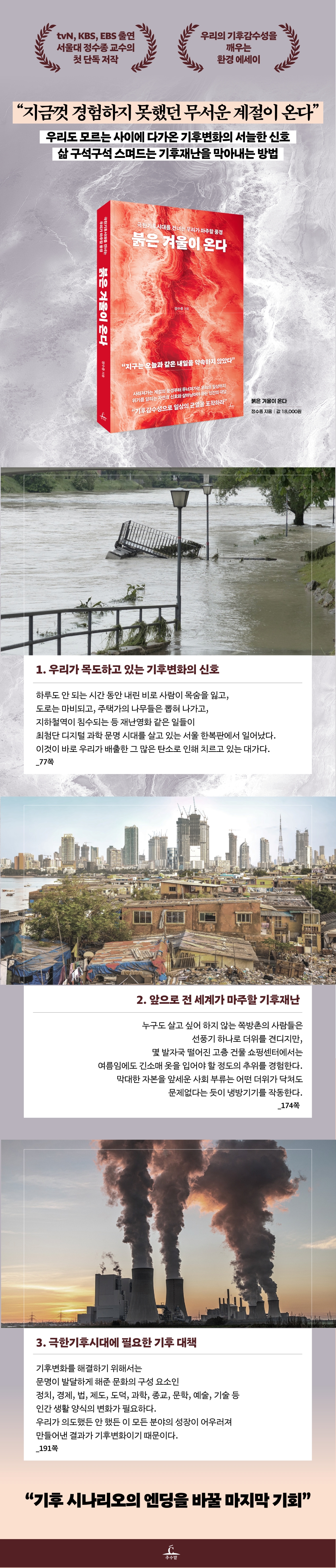
Into the book
A warning from spring flowers that defy time
Therefore, if a change in phenolics occurs to the extent that the balance that the plant tries to maintain itself is broken, it means that the plant has become vulnerable to climate change.
That is why, rather than being happy, you should be concerned when you see trees blooming in the bitter cold of winter or sprouting leaves unexpectedly on a winter hiking trail.
Because rapid phenolic changes may be distress signals that plants send us.
The future of Earth engulfed in flames
These wildfires have something in common.
It has spread significantly due to climate change.
Of course, it was all started by humans, but the reason it grew beyond human control is because global warming has dried out the atmosphere, vegetation, and soil.
So, compared to the past, the scale of fire and the extent of damage have become so large that it is difficult to handle.
The intense heat is just beginning.
If we think about Korea in the summer of 2025, we can foresee that we will soon be experiencing a heat wave on the level of India.
This heatwave could create wildfires far larger than any we've ever experienced.
In addition, it may lead to a dilemma regarding securing water resources and crop production.
Furthermore, a food crisis may pose a security threat.
It's not just about getting hotter, it's about the many problems that can cascade endlessly like dominoes.
Tears of the snowy field longing for the cold snow
So what happens, conversely, when snow cover decreases? As temperatures rise and the snow begins to melt, the ground surface absorbs more sunlight than when it was heavily snow-covered, warming the surrounding area.
Global warming does not simply cause snow to melt, but rather creates a positive feedback loop where melted snow leads to warming again, making the area warmer.
--- From "Chapter 1: Nature is constantly signaling a crisis"
Climate inflation threatens the national and household economy.
Climate inflation is a phenomenon in which prices rise due to damage to various sectors such as raw materials, supply chains, transportation, and infrastructure caused by abnormal weather, changes in the ecological environment, and natural disasters due to climate change caused by increased greenhouse gases.
This means that the direct and indirect economic costs we must pay due to climate change have increased.
The relentless scourge of climate change
Recent extreme weather events such as droughts, heavy rains, and heat waves are characterized by the fact that rather than appearing alone at a specific point in time, multiple phenomena appear sequentially or simultaneously over time.
Therefore, disasters caused by these continuous and simultaneous extreme climate phenomena are defined as complex disasters.
Climate pandemic that will bring about social disaster
As climate change worsens, older people are more likely to be at risk from heat waves.
Older adults may have a reduced ability to regulate their body temperature and may have chronic illnesses, making it difficult for them to recognize or respond appropriately to heat warning signs.
More than the fact that the heat is getting worse, the reality of the growing number of these socially vulnerable people is increasing society's climate vulnerability.
The damage from the climate crisis is not fair.
People who have lost their homes and become refugees due to climate change are called climate refugees.
Many futurists are issuing dire warnings that climate change could displace up to 1.2 billion people by 2050.
--- From "Chapter 2: How Climate Change Changes the World"
Children must live in the world we leave behind.
According to a World Bank report, a 10-year-old child in 2024 will have experienced three times more floods, five times more droughts, and 36 times more heat waves than a 10-year-old child in the 1970s.
Unfortunately, this trend will only intensify after 2030, when children born today will be 10 years old.
The climate crisis is imposing even harsher hardships on children.
A new culture is needed to navigate the era of extreme climates.
The definition of culture may vary depending on one's perspective, but it is universally defined as the product of material and spiritual processes through which individuals or groups in a society transform nature.
Especially in the West, the word culture is said to have originated from the word for cultivation or cultivation by humans.
Culture is fundamentally a consequence of changing human lifestyles, and thus aligns with the causes of climate change.
Protecting our cultural heritage can change climate history.
The urban forest within the palace not only serves as a beautiful backdrop to the palace facilities, but also has various environmental functions.
In other words, it can serve as the lungs that breathe life into the large city of Seoul.
Urban forests absorb massive amounts of greenhouse gases emitted from Seoul's buildings, cars, and power plants.
Five Climate Tech Tips to Save the Planet
Climate tech may still be an unfamiliar term, but it is a technology that has been around for quite some time.
However, in the past, it was often limited to experiments in laboratories or papers and patents, but now things have changed.
The main goal is to grow it into a real, profitable industry.
It is a technology that saves both the Earth and the economy.
Therefore, if a change in phenolics occurs to the extent that the balance that the plant tries to maintain itself is broken, it means that the plant has become vulnerable to climate change.
That is why, rather than being happy, you should be concerned when you see trees blooming in the bitter cold of winter or sprouting leaves unexpectedly on a winter hiking trail.
Because rapid phenolic changes may be distress signals that plants send us.
The future of Earth engulfed in flames
These wildfires have something in common.
It has spread significantly due to climate change.
Of course, it was all started by humans, but the reason it grew beyond human control is because global warming has dried out the atmosphere, vegetation, and soil.
So, compared to the past, the scale of fire and the extent of damage have become so large that it is difficult to handle.
The intense heat is just beginning.
If we think about Korea in the summer of 2025, we can foresee that we will soon be experiencing a heat wave on the level of India.
This heatwave could create wildfires far larger than any we've ever experienced.
In addition, it may lead to a dilemma regarding securing water resources and crop production.
Furthermore, a food crisis may pose a security threat.
It's not just about getting hotter, it's about the many problems that can cascade endlessly like dominoes.
Tears of the snowy field longing for the cold snow
So what happens, conversely, when snow cover decreases? As temperatures rise and the snow begins to melt, the ground surface absorbs more sunlight than when it was heavily snow-covered, warming the surrounding area.
Global warming does not simply cause snow to melt, but rather creates a positive feedback loop where melted snow leads to warming again, making the area warmer.
--- From "Chapter 1: Nature is constantly signaling a crisis"
Climate inflation threatens the national and household economy.
Climate inflation is a phenomenon in which prices rise due to damage to various sectors such as raw materials, supply chains, transportation, and infrastructure caused by abnormal weather, changes in the ecological environment, and natural disasters due to climate change caused by increased greenhouse gases.
This means that the direct and indirect economic costs we must pay due to climate change have increased.
The relentless scourge of climate change
Recent extreme weather events such as droughts, heavy rains, and heat waves are characterized by the fact that rather than appearing alone at a specific point in time, multiple phenomena appear sequentially or simultaneously over time.
Therefore, disasters caused by these continuous and simultaneous extreme climate phenomena are defined as complex disasters.
Climate pandemic that will bring about social disaster
As climate change worsens, older people are more likely to be at risk from heat waves.
Older adults may have a reduced ability to regulate their body temperature and may have chronic illnesses, making it difficult for them to recognize or respond appropriately to heat warning signs.
More than the fact that the heat is getting worse, the reality of the growing number of these socially vulnerable people is increasing society's climate vulnerability.
The damage from the climate crisis is not fair.
People who have lost their homes and become refugees due to climate change are called climate refugees.
Many futurists are issuing dire warnings that climate change could displace up to 1.2 billion people by 2050.
--- From "Chapter 2: How Climate Change Changes the World"
Children must live in the world we leave behind.
According to a World Bank report, a 10-year-old child in 2024 will have experienced three times more floods, five times more droughts, and 36 times more heat waves than a 10-year-old child in the 1970s.
Unfortunately, this trend will only intensify after 2030, when children born today will be 10 years old.
The climate crisis is imposing even harsher hardships on children.
A new culture is needed to navigate the era of extreme climates.
The definition of culture may vary depending on one's perspective, but it is universally defined as the product of material and spiritual processes through which individuals or groups in a society transform nature.
Especially in the West, the word culture is said to have originated from the word for cultivation or cultivation by humans.
Culture is fundamentally a consequence of changing human lifestyles, and thus aligns with the causes of climate change.
Protecting our cultural heritage can change climate history.
The urban forest within the palace not only serves as a beautiful backdrop to the palace facilities, but also has various environmental functions.
In other words, it can serve as the lungs that breathe life into the large city of Seoul.
Urban forests absorb massive amounts of greenhouse gases emitted from Seoul's buildings, cars, and power plants.
Five Climate Tech Tips to Save the Planet
Climate tech may still be an unfamiliar term, but it is a technology that has been around for quite some time.
However, in the past, it was often limited to experiments in laboratories or papers and patents, but now things have changed.
The main goal is to grow it into a real, profitable industry.
It is a technology that saves both the Earth and the economy.
--- From "Chapter 3: Stopping the Climate Change Clock"
Publisher's Review
"Winter, which should be covered in white snow, is burning red."
From the disappearing seasonal scenery to our crumbling daily lives.
Nature's signals of crisis and humanity's response to survival
"The Last Chance to Change the Ending of the Climate Scenario"
The first environmental essay written from the perspective of 'climate sensitivity'
“Climate change is the greatest hoax ever perpetrated on the world,” “If you don’t get out of this green hoax, your country will fail.” These were the words of US President Donald Trump, who denied climate change in his speech at the United Nations General Assembly.
Contrary to his claims, if we fail to overcome climate change now, the future of the entire world will be bleak.
Even without accessing the vast scientific evidence, we can guess the severity of climate change by looking at increasingly severe climate phenomena such as heat waves, cold waves, heavy rains, and large-scale wildfires.
So what does the future hold for humanity? Is the end of the world truly imminent? It would be better if, like in a typical disaster movie, a catastrophe suddenly struck and humanity was wiped out in an instant.
The reality that climate change will bring is different.
Climate disasters do not occur suddenly and simultaneously everywhere, but rather work by gradually tightening our leashes in various aspects of our daily lives.
This book shows how climate change is permeating our daily lives through various signals and discusses how we can respond to prevent the situation from worsening.
Professor Jeong Su-jong of Seoul National University, a climate scientist and rising environmental writer, discusses our current reality and response strategies from the perspective of "climate sensitivity," which sensitively captures everyday climate issues.
From natural changes like earlier blooming of spring flowers and falling green leaves to the crises we face like rising prices, epidemics, and climate refugees, we explore how climate change is shaking the world.
Furthermore, we introduce ways to prevent the worst-case climate scenario, including feasible measures such as climate technology and climate policy.
“Endless summer, green leaves, snow-covered spring flowers…”
Nature's Signals of Crisis and the Perpetrators of Climate Change
We can now capture scenes of climate change everywhere in our daily lives.
Flowers bloom before spring even arrives, and even though we're on the threshold of autumn, the heat shows no signs of ending. In one place, torrential rain pours down, while the next area sighs under drought, green leaves fall, and snow covers the cherry blossoms. This strange sight continues.
Chapter 1 presents a bleak picture of climate change as it appears in the natural world and examines its causes.
In particular, it emphasizes that these abnormal symptoms are not limited to individual problems, but can be linked like a chain and lead to other problems.
Earlier flowering times are a threat to biodiversity, hotter, drier climates mean more frequent wildfires, heat waves are causing food crises, and melting snow from warming is causing more warming.
This is the reality we face as we ignore the signals of crisis sent by nature.
Although the Earth's climate has changed throughout history, climate change is considered a serious problem today because the changes are so rapid and intense.
So what is the cause of such severe climate change? This book points to humans as the culprit.
The most important factor in climate change is greenhouse gases, and humans have exacerbated climate change through excessive greenhouse gas emissions.
Ultimately, it points out that the carbon emitted in the various processes of eating, drinking, living, producing, and enjoying ourselves is destroying our land.
“The Earth did not promise us a tomorrow like today.”
Climate disasters threaten not only food, clothing, shelter, and the economy, but also national security.
Climate change will change not only the natural world but also our lives.
“Changes in meteorological factors such as temperature, precipitation, and wind ultimately have a huge impact on various fields directly related to our lives.” (p. 102) Chapter 2 introduces how climate change is changing cities, society, and civilization in areas such as daily life, medicine, politics, economy, and security.
First, we will learn about "climate inflation," which is a phenomenon in which climate change damages sectors such as raw materials and supply chains, leading to rising prices.
Through domestic and international examples, we convey that climate change can have a direct impact not only on our own country but also on distant countries.
They also warn that complex disasters, such as torrential rains and heat waves, will become more unpredictable and frequent in the future, and that they could threaten not only crop damage but also the market economy and individual pocketbooks.
Climate change could recreate nightmares like the COVID-19 pandemic.
As the climate rises, the habitats of mosquitoes, which are vectors of infectious diseases, are expanding, increasing the risk of infectious diseases and epidemics. In addition, as the permafrost in polar regions melts, there is also the possibility that frozen viruses will escape into the atmosphere.
It also points out that socioeconomic instability in countries vulnerable to climate disasters could become a political and security issue between nations.
The problem becomes even more complex when climate change is coupled with demographic changes such as an aging population.
Older people, who have a reduced ability to regulate their body temperature and have difficulty recognizing warning signs of heat, are at greater risk from heat waves.
Another dark reality is that the impact of the climate crisis is not shared equally by everyone.
The extent of damage will inevitably vary depending on economic power, residential area, infrastructure, and country.
Amidst this climate inequality, we examine the potential disasters climate change poses to our lives, from the loss of our homes and the risk of climate refugees to international conflict.
“Only humans can restore the climate we have destroyed.”
A culture needed in the era of extreme climate change and realistic measures to cope with the crisis.
So what should we do? Chapter 3 discusses the mindset everyone should have as we navigate the era of extreme climate change, as well as practical measures at the societal level.
This book suggests that in order to respond to climate change, we must first change our culture.
The reason the climate is changing is because culture, that is, the way humans live, is changing, and to turn the climate around, we need changes in our lifestyles, including politics, economics, law, morality, and technology.
In this context, we present methods that are being attempted or are feasible at the government and corporate levels, beyond simply improving individual member awareness.
It provides a new perspective on solving climate problems by focusing on the palace city forest that absorbs carbon and preserves biodiversity.
Furthermore, it delivers a message of hope that the technologies that destroyed the climate can also save it, and introduces climate technologies that respond to the climate crisis.
We explore climate tech sectors that are saving the planet, including "cleantech" that replaces fossil fuels, "carbontech" that eliminates or utilizes carbon, and "ecotech" that reduces resource waste.
In addition, we discuss climate measures from a more macroscopic perspective, such as so-called "climate risk hedging" strategies to minimize the damage caused by climate change, "patient capital" that invests in long-term climate technology, climate finance that mitigates the impact of the climate crisis, and the use of artificial intelligence in the era of the climate crisis.
Now, old sayings like ‘the Earth is sick’ and ‘let’s protect the environment’ can no longer move people.
We must recognize the signs of climate change that are permeating every corner of our lives and begin taking action immediately to protect our present.
From the disappearing seasonal scenery to our crumbling daily lives.
Nature's signals of crisis and humanity's response to survival
"The Last Chance to Change the Ending of the Climate Scenario"
The first environmental essay written from the perspective of 'climate sensitivity'
“Climate change is the greatest hoax ever perpetrated on the world,” “If you don’t get out of this green hoax, your country will fail.” These were the words of US President Donald Trump, who denied climate change in his speech at the United Nations General Assembly.
Contrary to his claims, if we fail to overcome climate change now, the future of the entire world will be bleak.
Even without accessing the vast scientific evidence, we can guess the severity of climate change by looking at increasingly severe climate phenomena such as heat waves, cold waves, heavy rains, and large-scale wildfires.
So what does the future hold for humanity? Is the end of the world truly imminent? It would be better if, like in a typical disaster movie, a catastrophe suddenly struck and humanity was wiped out in an instant.
The reality that climate change will bring is different.
Climate disasters do not occur suddenly and simultaneously everywhere, but rather work by gradually tightening our leashes in various aspects of our daily lives.
This book shows how climate change is permeating our daily lives through various signals and discusses how we can respond to prevent the situation from worsening.
Professor Jeong Su-jong of Seoul National University, a climate scientist and rising environmental writer, discusses our current reality and response strategies from the perspective of "climate sensitivity," which sensitively captures everyday climate issues.
From natural changes like earlier blooming of spring flowers and falling green leaves to the crises we face like rising prices, epidemics, and climate refugees, we explore how climate change is shaking the world.
Furthermore, we introduce ways to prevent the worst-case climate scenario, including feasible measures such as climate technology and climate policy.
“Endless summer, green leaves, snow-covered spring flowers…”
Nature's Signals of Crisis and the Perpetrators of Climate Change
We can now capture scenes of climate change everywhere in our daily lives.
Flowers bloom before spring even arrives, and even though we're on the threshold of autumn, the heat shows no signs of ending. In one place, torrential rain pours down, while the next area sighs under drought, green leaves fall, and snow covers the cherry blossoms. This strange sight continues.
Chapter 1 presents a bleak picture of climate change as it appears in the natural world and examines its causes.
In particular, it emphasizes that these abnormal symptoms are not limited to individual problems, but can be linked like a chain and lead to other problems.
Earlier flowering times are a threat to biodiversity, hotter, drier climates mean more frequent wildfires, heat waves are causing food crises, and melting snow from warming is causing more warming.
This is the reality we face as we ignore the signals of crisis sent by nature.
Although the Earth's climate has changed throughout history, climate change is considered a serious problem today because the changes are so rapid and intense.
So what is the cause of such severe climate change? This book points to humans as the culprit.
The most important factor in climate change is greenhouse gases, and humans have exacerbated climate change through excessive greenhouse gas emissions.
Ultimately, it points out that the carbon emitted in the various processes of eating, drinking, living, producing, and enjoying ourselves is destroying our land.
“The Earth did not promise us a tomorrow like today.”
Climate disasters threaten not only food, clothing, shelter, and the economy, but also national security.
Climate change will change not only the natural world but also our lives.
“Changes in meteorological factors such as temperature, precipitation, and wind ultimately have a huge impact on various fields directly related to our lives.” (p. 102) Chapter 2 introduces how climate change is changing cities, society, and civilization in areas such as daily life, medicine, politics, economy, and security.
First, we will learn about "climate inflation," which is a phenomenon in which climate change damages sectors such as raw materials and supply chains, leading to rising prices.
Through domestic and international examples, we convey that climate change can have a direct impact not only on our own country but also on distant countries.
They also warn that complex disasters, such as torrential rains and heat waves, will become more unpredictable and frequent in the future, and that they could threaten not only crop damage but also the market economy and individual pocketbooks.
Climate change could recreate nightmares like the COVID-19 pandemic.
As the climate rises, the habitats of mosquitoes, which are vectors of infectious diseases, are expanding, increasing the risk of infectious diseases and epidemics. In addition, as the permafrost in polar regions melts, there is also the possibility that frozen viruses will escape into the atmosphere.
It also points out that socioeconomic instability in countries vulnerable to climate disasters could become a political and security issue between nations.
The problem becomes even more complex when climate change is coupled with demographic changes such as an aging population.
Older people, who have a reduced ability to regulate their body temperature and have difficulty recognizing warning signs of heat, are at greater risk from heat waves.
Another dark reality is that the impact of the climate crisis is not shared equally by everyone.
The extent of damage will inevitably vary depending on economic power, residential area, infrastructure, and country.
Amidst this climate inequality, we examine the potential disasters climate change poses to our lives, from the loss of our homes and the risk of climate refugees to international conflict.
“Only humans can restore the climate we have destroyed.”
A culture needed in the era of extreme climate change and realistic measures to cope with the crisis.
So what should we do? Chapter 3 discusses the mindset everyone should have as we navigate the era of extreme climate change, as well as practical measures at the societal level.
This book suggests that in order to respond to climate change, we must first change our culture.
The reason the climate is changing is because culture, that is, the way humans live, is changing, and to turn the climate around, we need changes in our lifestyles, including politics, economics, law, morality, and technology.
In this context, we present methods that are being attempted or are feasible at the government and corporate levels, beyond simply improving individual member awareness.
It provides a new perspective on solving climate problems by focusing on the palace city forest that absorbs carbon and preserves biodiversity.
Furthermore, it delivers a message of hope that the technologies that destroyed the climate can also save it, and introduces climate technologies that respond to the climate crisis.
We explore climate tech sectors that are saving the planet, including "cleantech" that replaces fossil fuels, "carbontech" that eliminates or utilizes carbon, and "ecotech" that reduces resource waste.
In addition, we discuss climate measures from a more macroscopic perspective, such as so-called "climate risk hedging" strategies to minimize the damage caused by climate change, "patient capital" that invests in long-term climate technology, climate finance that mitigates the impact of the climate crisis, and the use of artificial intelligence in the era of the climate crisis.
Now, old sayings like ‘the Earth is sick’ and ‘let’s protect the environment’ can no longer move people.
We must recognize the signs of climate change that are permeating every corner of our lives and begin taking action immediately to protect our present.
GOODS SPECIFICS
- Date of issue: October 29, 2025
- Page count, weight, size: 272 pages | 438g | 140*210*18mm
- ISBN13: 9791155402580
- ISBN10: 1155402588
You may also like
카테고리
korean


korean

![GQ KOREA Mark (Monthly): December [2025]](http://librairie.coreenne.fr/cdn/shop/files/8ef265dbbfbf186523ed75ba7319009d.jpg?v=1765340328&width=3840)


