

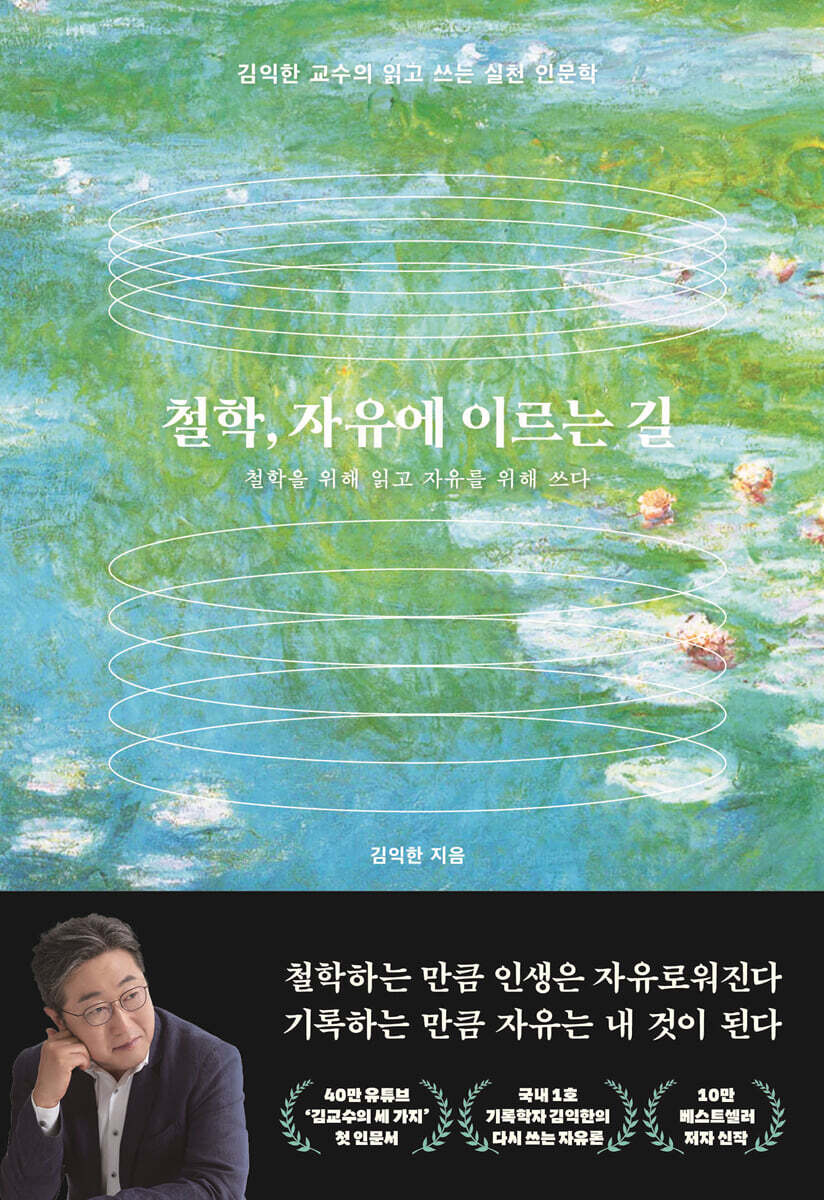
Philosophy: The Path to Freedom
 |
Description
Book Introduction
“Read for philosophy, write for freedom.”
"On Liberty," completed by Professor Kim Ik-han, Korea's first archivist
How does freedom become a skill for life?
The philosophy of freedom that begins with very small practices
With 400,000 subscribers on YouTube, "Professor Kim's Three Things" explores the practical humanities of reading and writing by Professor Kim Ik-han, Korea's first archivist.
Whose life am I living now? What should I think about and how should I live? These are the most crucial questions in life that you, who are still not free even as adults, must answer! From the philosophical reflections on freedom of John Stuart Mill, Erich Fromm, Michel Foucault, and Martha Nussbaum, to the everyday practices perfected by a historian.
If you want to be free, philosophize.
The more you read, the more you think.
The more you write, the more free you become.
It will be a map to liberation and happiness for lost adults.
"On Liberty," completed by Professor Kim Ik-han, Korea's first archivist
How does freedom become a skill for life?
The philosophy of freedom that begins with very small practices
With 400,000 subscribers on YouTube, "Professor Kim's Three Things" explores the practical humanities of reading and writing by Professor Kim Ik-han, Korea's first archivist.
Whose life am I living now? What should I think about and how should I live? These are the most crucial questions in life that you, who are still not free even as adults, must answer! From the philosophical reflections on freedom of John Stuart Mill, Erich Fromm, Michel Foucault, and Martha Nussbaum, to the everyday practices perfected by a historian.
If you want to be free, philosophize.
The more you read, the more you think.
The more you write, the more free you become.
It will be a map to liberation and happiness for lost adults.
- You can preview some of the book's contents.
Preview
index
Prologue _ Are you free?
Part 1: Exploring Why I Am Not Free
1 When I grow up, will I be able to live my life doing whatever I want?
- We have not learned freedom.
2 Why Freedom is a Matter of Survival
- Naming Freedom with John Stuart Mill
3 Does my role oppress me?
- Another perspective observing me on stage, metacognition
4 Is this desire really mine?
- About vanity, hypocrisy, and the gaze of others
5 Escape from the hell I created
- Standing alone from the supervisor within me
Part 2: Change - Breaking Free from What Binds Me
6. What is the speed and direction at which I can be happy?
- The myth and illusion of self-development
7 Growth is not about achieving goals or competing.
- A time of creation, not self-development
8 What can you do in front of a huge structure?
- I decided to become a strategist, not a victim of the structure.
9 The shackles called normal
- Re-asking the question of ethics, norms, and best practices in society
10 Why Do People Suffer in Relationships?
- Cool Trust and Healthy Distancing
11 The weight of the name family
- A psychological experiment in liberation and reconstruction
12 Freedom from Money and Livelihood
Beyond livelihood, building my own 'temple of values'
Part 3: Growth _ Finally, the Path of the Altruistic Individualist
13 Who Writes the Story of My Life?
- Saving the past through records and living in the present
14 When thoughts rule me
- Conscious practice of stopping the automatic piloting of thoughts
15 Where Should a Solitary Individual Go?
- Complete freedom lies in warm solidarity.
Epilogue _ Alone, Strong, Together, Warm
Appendix _ Guidelines for Action on the Path to Freedom
Appendix _ 15 Books Recommended for Expanded Reading
Part 1: Exploring Why I Am Not Free
1 When I grow up, will I be able to live my life doing whatever I want?
- We have not learned freedom.
2 Why Freedom is a Matter of Survival
- Naming Freedom with John Stuart Mill
3 Does my role oppress me?
- Another perspective observing me on stage, metacognition
4 Is this desire really mine?
- About vanity, hypocrisy, and the gaze of others
5 Escape from the hell I created
- Standing alone from the supervisor within me
Part 2: Change - Breaking Free from What Binds Me
6. What is the speed and direction at which I can be happy?
- The myth and illusion of self-development
7 Growth is not about achieving goals or competing.
- A time of creation, not self-development
8 What can you do in front of a huge structure?
- I decided to become a strategist, not a victim of the structure.
9 The shackles called normal
- Re-asking the question of ethics, norms, and best practices in society
10 Why Do People Suffer in Relationships?
- Cool Trust and Healthy Distancing
11 The weight of the name family
- A psychological experiment in liberation and reconstruction
12 Freedom from Money and Livelihood
Beyond livelihood, building my own 'temple of values'
Part 3: Growth _ Finally, the Path of the Altruistic Individualist
13 Who Writes the Story of My Life?
- Saving the past through records and living in the present
14 When thoughts rule me
- Conscious practice of stopping the automatic piloting of thoughts
15 Where Should a Solitary Individual Go?
- Complete freedom lies in warm solidarity.
Epilogue _ Alone, Strong, Together, Warm
Appendix _ Guidelines for Action on the Path to Freedom
Appendix _ 15 Books Recommended for Expanded Reading
Detailed image

Into the book
Through this book, I want to tell the story of practice created along with records.
I hope that readers will try it themselves and feel, 'Ah, I can look back on myself this way too.'
I hope you will read, think, write, and with a little courage put into practice to become free.
I hope that we can experience a sense of liberation by breaking free from the numerous bondages we face in our daily lives.
(…) Becoming an adult essentially means that no one else will make decisions for you.
While this may bring with it increased responsibility and anxiety, it can also be the beginning of a journey of creative freedom.
Perhaps the prison that confines me is not outside, but inside me.
The first step to breaking that prison is very small.
One note, one thought, one declaration.
“This is how I want to live.” This one sentence becomes the key that opens the door to freedom.
--- From the "Prologue"
On the subway on the way to work, in a conference room where meetings are endless, or after returning home exhausted from working overtime and finally putting the child to bed, sitting quietly on the sofa, the question, "Whose life am I living now?" suddenly strikes my mind like a bolt from the blue.
When you feel like your daily life is going on autopilot, like a pilotless airplane, freedom no longer feels like a achievable value, but like a distant fantasy you dreamed of as a child.
(…) This helplessness comes from a loss of self-determination.
Freedom is not just the ability to do what you want.
It is the power to ‘decide my own daily life’ at every moment without being pushed by external pressure or inertia.
In this situation, we must ask ourselves:
“Whose choice am I living by now?”
--- From "Chapter 1: Will I be able to live doing everything I want when I become an adult?"
Writing is the first step to getting those confusing thoughts and feelings out there and making them objects of objective observation.
My sentences written on paper are no longer me, but become 'data' that I can analyze.
As this data accumulates, previously invisible patterns of reaction and emotional waves are revealed.
At this point, metacognition expands into an active way of thinking that discovers recurring patterns in our inner records.
(…) Freedom is not a given reality, but a skill that must be constantly trained.
It is not a fixed state, but a point of orientation that must be actively renewed.
--- From "Chapter 3: Is My Role Suppressing Me?"
Freedom does not begin with a grand revolution or sudden change.
Rather, small practices in daily life accumulate to create big changes.
It is a 'micro-revolution' that fine-tunes our perceptions and actions, ultimately changing the landscape of our entire lives.
Every semester, I always ask one thing of the 'I Can University' graduates.
“Go on a solo trip, even if it’s just for one or two nights.” It’s a very simple recommendation.
But surprisingly few people actually put it into practice.
(…) There is actually a more fundamental reason behind all these words.
'Am I really the kind of person who can do that?' At the root of that question lies the fact that we have handed over the subjectivity of desire to others.
Rather than trusting our own desires, we are trapped in roles created by others and society, asking for permission to do this.
This issue touches on the fundamental question, 'Am I the master of my own life?'
--- From "Chapter 5: Escape from the Hell I Created"
We often think of relationships as a realm of emotions that should flow naturally like water.
However, truly healthy and free relationships are possible through conscious 'emotional design', that is, through subjective distance setting and standard setting.
Closeness should be a choice, not an obligation.
Cool Trust, based on this autonomy and respect, presents a new paradigm of relationships that enriches each person's life.
True freedom is not the severing of relationships.
It is the power to choose.
We become free from relationships only when we can decide for ourselves what kind of relationships we want to have, how far we want to go, and when we want to stop.
--- From "Chapter 10: Why Do Humans Suffer in Relationships?"
Freedom is often misunderstood as a state of freedom from constraints or restrictions, or as a realm of complete isolation from others.
But true freedom never exists alone.
Rather, a greater level of freedom blossoms only in relationships with others and within community.
(…) The beginning of ‘altruistic individualism’ is when an individual stands completely as himself, while at the same time discovering and expanding meaning in his existence through relationships with others.
I hope that readers will try it themselves and feel, 'Ah, I can look back on myself this way too.'
I hope you will read, think, write, and with a little courage put into practice to become free.
I hope that we can experience a sense of liberation by breaking free from the numerous bondages we face in our daily lives.
(…) Becoming an adult essentially means that no one else will make decisions for you.
While this may bring with it increased responsibility and anxiety, it can also be the beginning of a journey of creative freedom.
Perhaps the prison that confines me is not outside, but inside me.
The first step to breaking that prison is very small.
One note, one thought, one declaration.
“This is how I want to live.” This one sentence becomes the key that opens the door to freedom.
--- From the "Prologue"
On the subway on the way to work, in a conference room where meetings are endless, or after returning home exhausted from working overtime and finally putting the child to bed, sitting quietly on the sofa, the question, "Whose life am I living now?" suddenly strikes my mind like a bolt from the blue.
When you feel like your daily life is going on autopilot, like a pilotless airplane, freedom no longer feels like a achievable value, but like a distant fantasy you dreamed of as a child.
(…) This helplessness comes from a loss of self-determination.
Freedom is not just the ability to do what you want.
It is the power to ‘decide my own daily life’ at every moment without being pushed by external pressure or inertia.
In this situation, we must ask ourselves:
“Whose choice am I living by now?”
--- From "Chapter 1: Will I be able to live doing everything I want when I become an adult?"
Writing is the first step to getting those confusing thoughts and feelings out there and making them objects of objective observation.
My sentences written on paper are no longer me, but become 'data' that I can analyze.
As this data accumulates, previously invisible patterns of reaction and emotional waves are revealed.
At this point, metacognition expands into an active way of thinking that discovers recurring patterns in our inner records.
(…) Freedom is not a given reality, but a skill that must be constantly trained.
It is not a fixed state, but a point of orientation that must be actively renewed.
--- From "Chapter 3: Is My Role Suppressing Me?"
Freedom does not begin with a grand revolution or sudden change.
Rather, small practices in daily life accumulate to create big changes.
It is a 'micro-revolution' that fine-tunes our perceptions and actions, ultimately changing the landscape of our entire lives.
Every semester, I always ask one thing of the 'I Can University' graduates.
“Go on a solo trip, even if it’s just for one or two nights.” It’s a very simple recommendation.
But surprisingly few people actually put it into practice.
(…) There is actually a more fundamental reason behind all these words.
'Am I really the kind of person who can do that?' At the root of that question lies the fact that we have handed over the subjectivity of desire to others.
Rather than trusting our own desires, we are trapped in roles created by others and society, asking for permission to do this.
This issue touches on the fundamental question, 'Am I the master of my own life?'
--- From "Chapter 5: Escape from the Hell I Created"
We often think of relationships as a realm of emotions that should flow naturally like water.
However, truly healthy and free relationships are possible through conscious 'emotional design', that is, through subjective distance setting and standard setting.
Closeness should be a choice, not an obligation.
Cool Trust, based on this autonomy and respect, presents a new paradigm of relationships that enriches each person's life.
True freedom is not the severing of relationships.
It is the power to choose.
We become free from relationships only when we can decide for ourselves what kind of relationships we want to have, how far we want to go, and when we want to stop.
--- From "Chapter 10: Why Do Humans Suffer in Relationships?"
Freedom is often misunderstood as a state of freedom from constraints or restrictions, or as a realm of complete isolation from others.
But true freedom never exists alone.
Rather, a greater level of freedom blossoms only in relationships with others and within community.
(…) The beginning of ‘altruistic individualism’ is when an individual stands completely as himself, while at the same time discovering and expanding meaning in his existence through relationships with others.
--- From "Chapter 15: Where Should a Solitary Individual Go?"
Publisher's Review
★★★ The first humanities book on "Professor Kim's Three Things," which has 400,000 YouTube subscribers
★★★ Rewriting "On Liberty" by Korea's First Archivist, Kim Ik-han
★★★ New work by the author of 100,000 bestsellers
The more you philosophize, the freer your life becomes.
As I record, freedom becomes mine.
“For me, freedom was a matter of survival.”
Whose choices am I living by now? What should I think and how should I live? Why do we not feel free even as adults? Professor Kim Ik-han's new book, "Philosophy: The Path to Freedom," has been published, delving deeply into "freedom," the most pressing topic of our time.
The author is Korea's first archivist and has dedicated a long time to establishing the foundation of the national records management system.
In the turbulent 1980s, after much deliberation, he found his life's direction in archival studies. He then founded the National Archives of Korea, spearheaded the enactment of the Records Management Act, and established Korea's first graduate school specializing in archival studies (Myongji University Graduate School of Archival and Information Science).
In addition to these social activities, he has recently been focusing on operating a YouTube channel and educational platform to raise public awareness of the importance of personal records.
Why does he, who has traversed the spectrum between academia and practice, speak of freedom? What exactly is the difference between adult freedom and the freedom of others? How can records truly liberate us? This book begins with the author's own experience of performance-based self-exploitation, the sense of liberation he experienced breaking free from social norms, and the altruistic freedom he experienced through collaborative development of capabilities through relationships. His life, a journey of wandering between freedom and lack of freedom, begins with his own experiences.
In search of the answer, I devoured the works of various thinkers and explored ways to realize freedom through writing. As a result, I finally reached the realization that "a life with philosophy is a life of freedom."
And I completed this book with the hope that more people would read, think, and write about freedom.
His insights meet the philosophical thoughts on freedom of John Stuart Mill, Erich Fromm, Erving Goffman, Michel Foucault, Martha Nussbaum, and Byung-Chul Han, and lead to concrete practice.
This book goes beyond simply explaining theories and concepts. Each chapter incorporates a documentary approach called "practical reflection," allowing readers to ask and answer questions and regain their freedom.
By examining your daily actions and recording daily changes, you can embody freedom as an attitude toward life rather than an abstract discourse.
This process itself is a philosophical practice that we, who are not free even as adults, need now, and it will serve as a guide to liberation and happiness.
“I want to tell those who are swayed by their circumstances, crushed by responsibility, and suppressing themselves in the name of compromise and virtue, saying, ‘I have to endure it because I’m an adult,’ that they can breathe again.
…freedom is the reason we were born into this world, and it is the most essential path to a happy life.
I believe it.” _From 'Prologue'
A study of reflection and recovery to become the master of my life.
A Map to Liberation and Happiness for Lost Adults
This book presents freedom not as a mere ideal, but as a matter of survival, a life skill to be constantly practiced and trained.
So how do we begin our journey to freedom? The book outlines a journey in three major stages.
First, Part 1, ‘Exploration’, starts with the question, “Why am I not free?”
Having grown up under discipline and control without learning freedom, we are still bound by the gaze of others and our own self-imposed obsessions.
In this reality, this book seeks to explore the true meaning of freedom by following John Stuart Mill's "On Liberty" to confirm the essence of freedom as the "right to determine one's own life," and through Erving Goffman's stage theory, reflects on the "masks" we wear in our daily lives, thereby awakening us to the necessity of metacognition.
It also borrows the ideas of Lacan and Sartre to ask whether my desires are truly mine, and through the insights of Freud and Nietzsche, it makes me face my inner 'supervisor', that is, the superego.
We can see that freedom is an active state that can only be attained by enduring the lonely process of standing alone, transcending the desires of others and inner oppression.
Part 2, 'Change', is the stage of breaking away from all the shackles that bind us without freedom.
It points out how the myth of self-development, as pointed out by Michel Foucault's 'disciplinary society' and Byung-Chul Han's 'performance society', distorts individual subjectivity, and emphasizes true growth through Amartya Sen and Martha Nussbaum's 'competency', Deleuze's 'becoming', and Foucault's 'self-care'.
Meanwhile, it helps us understand the structural inequalities and social constraints that enforce normalcy, thereby securing strategic freedom within them and establishing our own standards of value.
Regarding the fatigue in relationships with others and family, we propose a 'cool trust' that reconstructs relationships through an ethical perspective and respects mutual independence.
How can we liberate ourselves from the most tangible of problems: money and livelihood? Ivan Ilyich's concept of "labor of value" allows us to reexamine the nature of labor and find a balance between work and freedom.
The final third part, 'Growth', unfolds the process of making freedom the fundamental principle of life through exploration and change.
By directly recording my past, I learn to weave scattered experiences into a meaningful narrative and become the 'author of my own life.'
It then teaches you how to shift your frame of mind so that you can make conscious choices instead of following automatic thinking habits and see possibilities in any situation.
This freedom, strengthened by inner strength, expands further when we seek connection with others and contribute to the community.
It shows that a free individual is not a selfish being, but is fulfilled in warm solidarity, and is ultimately realized as a mature form of 'altruistic individualism.'
“Adult freedom is the act of deciding for oneself ‘what to do,’ willingly taking responsibility for that decision, and creating one’s own life narrative.
It is the courage to face the weight of reality, establish one's own desires and values within it, and create one's life independently.
Through freedom, we can overcome the meaninglessness of life and create unique works of art that imprint our existence on the world.” _From the text
How does freedom become a skill for life?
The philosophy of freedom that begins with very small practices
ㆍWhose choice am I living by?
This book begins its discussion with John Stuart Mill's On Liberty.
Mill believed that freedom was only permitted to the extent that it did not infringe upon the rights and dignity of others.
Nietzsche also said, “A free being is responsible for himself.”
Soon, freedom is not the indulgence of doing whatever one wants, but rather the solitary journey of coexisting with others and regulating one's desires, and bearing the weight of responsibility and leading oneself.
As a first step, this book recommends 'free training'.
This is a task of reclassifying and visualizing the actions of the day based on ‘my will.’
By converting vague emotions and actions into data, we can objectively recognize what was our choice and what was driven by external pressure, allowing us to examine where the control lies in our lives.
How can we be free when society and structures are blocking us?
Even if you have excellent grades or impressive 'specs', there are many cases where you don't get opportunities due to uncontrollable factors such as your hometown, school, gender, or age.
However, evaluating only 'effort' while ignoring the inequality at the starting point is nothing more than structural violence that disguises competition as fairness.
So how can we turn this structure to our advantage? This book presents "SWOT analysis" as a method for finding strategies within the structure.
It's about drawing a crosshair on a piece of paper, writing down my strengths and weaknesses, and my opportunities and threats every day, revising them, and clearly recognizing my choices.
If structure and environment are the framework that defines us, then the ability to accurately understand that framework and move dynamically within it is the foundation of real freedom.
ㆍHow can I find the speed and direction that will make me happy?
The author criticizes the belief that everything can be solved by simply developing 'skills', which has created an era in which self-exploitation is taken for granted, and focuses on competence rather than skill.
Competence is different from income or performance.
It means the actual freedom and opportunity to choose and realize the life you want.
What matters is not how much you have, but what choices you can secure with it.
This book lists Martha Nussbaum's "10 essential competencies" and helps you draw a "competency map."
It's about reflecting on your current life through the lens of competency and writing down small daily plans for what competencies you will strengthen and develop in the future.
Every human being has the right to live at his own pace and in his own way.
The way to freedom is to not conform to the achievements of others, but to fill in your shortcomings and find your own life.
ㆍWhat can I choose here and now?
Many people find it difficult to find meaning in the work they are forced to do to make a living.
The author says that Ivan Ilyich's 'labor of value' is important at this very point.
Value labor is not a romantic slogan to chase your dreams right now, but rather a redefinition of the reason for labor that goes beyond economic compensation.
To this end, the author recommends first looking at the current situation through the ‘lens of meaning.’
It is an exercise in thinking about what kind of results your work leads to in the overall system and giving meaning to your role.
However, if your identity and work are at odds, I suggest trying a "parallel life" where you view your current job as a "stepping stone" toward your dream and use your time after work or on weekends to develop related skills.
Through this process, my current work ceases to be a burden that exhausts me and becomes a resource that prepares me for the future.
Ultimately, freedom from labor is not about denying labor, but about reconstructing it, and it shows that it is a noble journey to complete a life of working in my own way according to the values I have chosen, that is, a 'temple of life.'
★★★ Rewriting "On Liberty" by Korea's First Archivist, Kim Ik-han
★★★ New work by the author of 100,000 bestsellers
The more you philosophize, the freer your life becomes.
As I record, freedom becomes mine.
“For me, freedom was a matter of survival.”
Whose choices am I living by now? What should I think and how should I live? Why do we not feel free even as adults? Professor Kim Ik-han's new book, "Philosophy: The Path to Freedom," has been published, delving deeply into "freedom," the most pressing topic of our time.
The author is Korea's first archivist and has dedicated a long time to establishing the foundation of the national records management system.
In the turbulent 1980s, after much deliberation, he found his life's direction in archival studies. He then founded the National Archives of Korea, spearheaded the enactment of the Records Management Act, and established Korea's first graduate school specializing in archival studies (Myongji University Graduate School of Archival and Information Science).
In addition to these social activities, he has recently been focusing on operating a YouTube channel and educational platform to raise public awareness of the importance of personal records.
Why does he, who has traversed the spectrum between academia and practice, speak of freedom? What exactly is the difference between adult freedom and the freedom of others? How can records truly liberate us? This book begins with the author's own experience of performance-based self-exploitation, the sense of liberation he experienced breaking free from social norms, and the altruistic freedom he experienced through collaborative development of capabilities through relationships. His life, a journey of wandering between freedom and lack of freedom, begins with his own experiences.
In search of the answer, I devoured the works of various thinkers and explored ways to realize freedom through writing. As a result, I finally reached the realization that "a life with philosophy is a life of freedom."
And I completed this book with the hope that more people would read, think, and write about freedom.
His insights meet the philosophical thoughts on freedom of John Stuart Mill, Erich Fromm, Erving Goffman, Michel Foucault, Martha Nussbaum, and Byung-Chul Han, and lead to concrete practice.
This book goes beyond simply explaining theories and concepts. Each chapter incorporates a documentary approach called "practical reflection," allowing readers to ask and answer questions and regain their freedom.
By examining your daily actions and recording daily changes, you can embody freedom as an attitude toward life rather than an abstract discourse.
This process itself is a philosophical practice that we, who are not free even as adults, need now, and it will serve as a guide to liberation and happiness.
“I want to tell those who are swayed by their circumstances, crushed by responsibility, and suppressing themselves in the name of compromise and virtue, saying, ‘I have to endure it because I’m an adult,’ that they can breathe again.
…freedom is the reason we were born into this world, and it is the most essential path to a happy life.
I believe it.” _From 'Prologue'
A study of reflection and recovery to become the master of my life.
A Map to Liberation and Happiness for Lost Adults
This book presents freedom not as a mere ideal, but as a matter of survival, a life skill to be constantly practiced and trained.
So how do we begin our journey to freedom? The book outlines a journey in three major stages.
First, Part 1, ‘Exploration’, starts with the question, “Why am I not free?”
Having grown up under discipline and control without learning freedom, we are still bound by the gaze of others and our own self-imposed obsessions.
In this reality, this book seeks to explore the true meaning of freedom by following John Stuart Mill's "On Liberty" to confirm the essence of freedom as the "right to determine one's own life," and through Erving Goffman's stage theory, reflects on the "masks" we wear in our daily lives, thereby awakening us to the necessity of metacognition.
It also borrows the ideas of Lacan and Sartre to ask whether my desires are truly mine, and through the insights of Freud and Nietzsche, it makes me face my inner 'supervisor', that is, the superego.
We can see that freedom is an active state that can only be attained by enduring the lonely process of standing alone, transcending the desires of others and inner oppression.
Part 2, 'Change', is the stage of breaking away from all the shackles that bind us without freedom.
It points out how the myth of self-development, as pointed out by Michel Foucault's 'disciplinary society' and Byung-Chul Han's 'performance society', distorts individual subjectivity, and emphasizes true growth through Amartya Sen and Martha Nussbaum's 'competency', Deleuze's 'becoming', and Foucault's 'self-care'.
Meanwhile, it helps us understand the structural inequalities and social constraints that enforce normalcy, thereby securing strategic freedom within them and establishing our own standards of value.
Regarding the fatigue in relationships with others and family, we propose a 'cool trust' that reconstructs relationships through an ethical perspective and respects mutual independence.
How can we liberate ourselves from the most tangible of problems: money and livelihood? Ivan Ilyich's concept of "labor of value" allows us to reexamine the nature of labor and find a balance between work and freedom.
The final third part, 'Growth', unfolds the process of making freedom the fundamental principle of life through exploration and change.
By directly recording my past, I learn to weave scattered experiences into a meaningful narrative and become the 'author of my own life.'
It then teaches you how to shift your frame of mind so that you can make conscious choices instead of following automatic thinking habits and see possibilities in any situation.
This freedom, strengthened by inner strength, expands further when we seek connection with others and contribute to the community.
It shows that a free individual is not a selfish being, but is fulfilled in warm solidarity, and is ultimately realized as a mature form of 'altruistic individualism.'
“Adult freedom is the act of deciding for oneself ‘what to do,’ willingly taking responsibility for that decision, and creating one’s own life narrative.
It is the courage to face the weight of reality, establish one's own desires and values within it, and create one's life independently.
Through freedom, we can overcome the meaninglessness of life and create unique works of art that imprint our existence on the world.” _From the text
How does freedom become a skill for life?
The philosophy of freedom that begins with very small practices
ㆍWhose choice am I living by?
This book begins its discussion with John Stuart Mill's On Liberty.
Mill believed that freedom was only permitted to the extent that it did not infringe upon the rights and dignity of others.
Nietzsche also said, “A free being is responsible for himself.”
Soon, freedom is not the indulgence of doing whatever one wants, but rather the solitary journey of coexisting with others and regulating one's desires, and bearing the weight of responsibility and leading oneself.
As a first step, this book recommends 'free training'.
This is a task of reclassifying and visualizing the actions of the day based on ‘my will.’
By converting vague emotions and actions into data, we can objectively recognize what was our choice and what was driven by external pressure, allowing us to examine where the control lies in our lives.
How can we be free when society and structures are blocking us?
Even if you have excellent grades or impressive 'specs', there are many cases where you don't get opportunities due to uncontrollable factors such as your hometown, school, gender, or age.
However, evaluating only 'effort' while ignoring the inequality at the starting point is nothing more than structural violence that disguises competition as fairness.
So how can we turn this structure to our advantage? This book presents "SWOT analysis" as a method for finding strategies within the structure.
It's about drawing a crosshair on a piece of paper, writing down my strengths and weaknesses, and my opportunities and threats every day, revising them, and clearly recognizing my choices.
If structure and environment are the framework that defines us, then the ability to accurately understand that framework and move dynamically within it is the foundation of real freedom.
ㆍHow can I find the speed and direction that will make me happy?
The author criticizes the belief that everything can be solved by simply developing 'skills', which has created an era in which self-exploitation is taken for granted, and focuses on competence rather than skill.
Competence is different from income or performance.
It means the actual freedom and opportunity to choose and realize the life you want.
What matters is not how much you have, but what choices you can secure with it.
This book lists Martha Nussbaum's "10 essential competencies" and helps you draw a "competency map."
It's about reflecting on your current life through the lens of competency and writing down small daily plans for what competencies you will strengthen and develop in the future.
Every human being has the right to live at his own pace and in his own way.
The way to freedom is to not conform to the achievements of others, but to fill in your shortcomings and find your own life.
ㆍWhat can I choose here and now?
Many people find it difficult to find meaning in the work they are forced to do to make a living.
The author says that Ivan Ilyich's 'labor of value' is important at this very point.
Value labor is not a romantic slogan to chase your dreams right now, but rather a redefinition of the reason for labor that goes beyond economic compensation.
To this end, the author recommends first looking at the current situation through the ‘lens of meaning.’
It is an exercise in thinking about what kind of results your work leads to in the overall system and giving meaning to your role.
However, if your identity and work are at odds, I suggest trying a "parallel life" where you view your current job as a "stepping stone" toward your dream and use your time after work or on weekends to develop related skills.
Through this process, my current work ceases to be a burden that exhausts me and becomes a resource that prepares me for the future.
Ultimately, freedom from labor is not about denying labor, but about reconstructing it, and it shows that it is a noble journey to complete a life of working in my own way according to the values I have chosen, that is, a 'temple of life.'
GOODS SPECIFICS
- Date of issue: September 22, 2025
- Format: Hardcover book binding method guide
- Page count, weight, size: 224 pages | 388g | 148*212*18mm
- ISBN13: 9791173323324
- ISBN10: 1173323325
You may also like
카테고리
korean


korean

![ELLE 엘르 스페셜 에디션 A형 : 12월 [2025]](http://librairie.coreenne.fr/cdn/shop/files/b8e27a3de6c9538896439686c6b0e8fb.jpg?v=1766436872&width=3840)


