

The Decline and Fall of the Human Empire
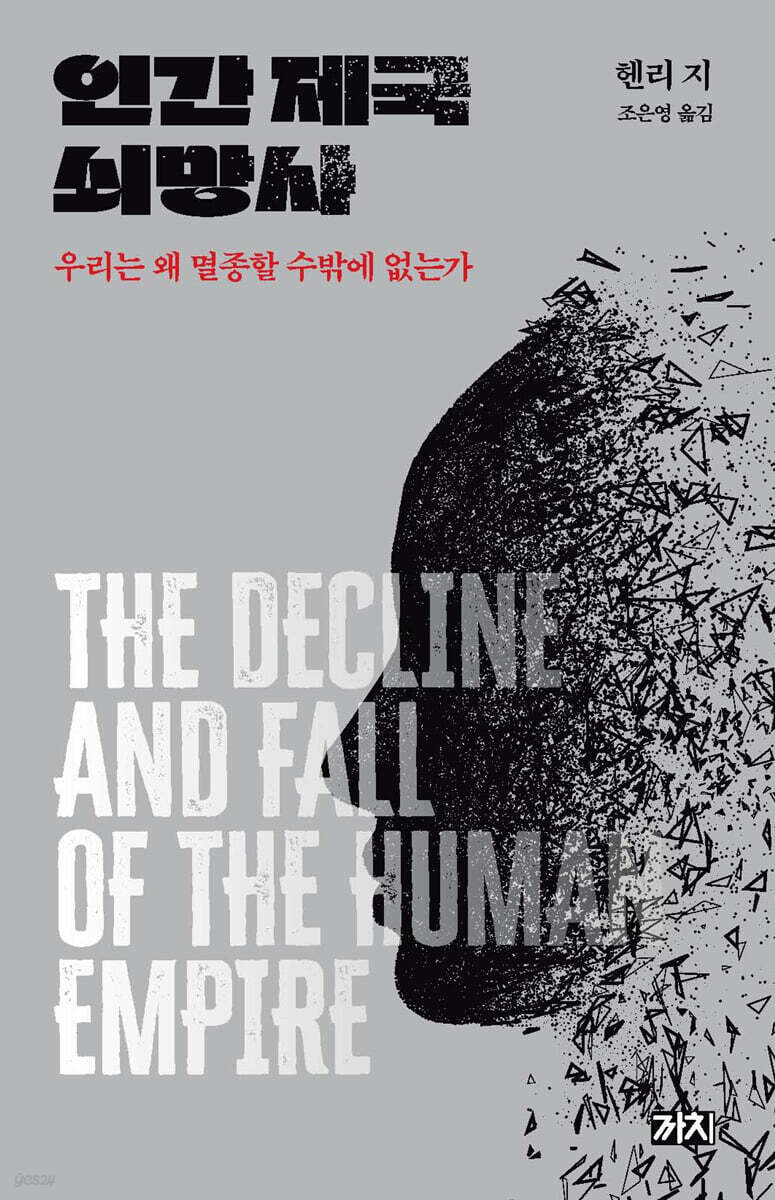 |
Description
Book Introduction
How Humanity's Brilliant Achievements Became the Seeds of Its Downfall
Dissecting the Rise and Fall of Humanity Through Science
A new book by Royal Society Science Book Award-winning author Henry Gee
Recommended by [Nature], [Science], [New Scientist], [Wall Street Journal], and [Washington Post]
Humanity has lived on Earth as the only human species, surpassing all other human species based on its unparalleled survival ability and technological ingenuity.
The agricultural revolution brought about abundance, and the population growth rate has been steadily increasing for the past 10,000 years thanks to the green revolution and genetic revolution.
However, the population, which had been on an upward curve, has now stagnated and entered a decline, and the climate crisis and resource depletion are threatening our very existence.
Royal Society Science Book Award winner and paleontologist Henry Gee says that creatures that reach the top cannot avoid extinction.
According to him, humans, without exception, are simply following the fate of all living things on Earth.
However, he simultaneously acknowledges that the achievements of modern humans in overcoming environmental constraints and infinitely expanding their ecological niche are clearly 'exceptional'.
So, at the intersection of the universal destiny of all species and the uniqueness of humanity, what kind of path of decline will we face? Can Homo sapiens, with its illustrious history, escape this downward spiral?
This book begins with the stark diagnosis that “we are doomed to extinction,” and explores the history of biological and human evolution behind it.
The author identifies signs of reflection and hope that we need now in eschatology that could easily sound like an apocalypse.
This book, which combines the macroscopic insights of a paleontologist with the latest scientific research, will serve as a most compassionate guide for those of us on the path to extinction.
Dissecting the Rise and Fall of Humanity Through Science
A new book by Royal Society Science Book Award-winning author Henry Gee
Recommended by [Nature], [Science], [New Scientist], [Wall Street Journal], and [Washington Post]
Humanity has lived on Earth as the only human species, surpassing all other human species based on its unparalleled survival ability and technological ingenuity.
The agricultural revolution brought about abundance, and the population growth rate has been steadily increasing for the past 10,000 years thanks to the green revolution and genetic revolution.
However, the population, which had been on an upward curve, has now stagnated and entered a decline, and the climate crisis and resource depletion are threatening our very existence.
Royal Society Science Book Award winner and paleontologist Henry Gee says that creatures that reach the top cannot avoid extinction.
According to him, humans, without exception, are simply following the fate of all living things on Earth.
However, he simultaneously acknowledges that the achievements of modern humans in overcoming environmental constraints and infinitely expanding their ecological niche are clearly 'exceptional'.
So, at the intersection of the universal destiny of all species and the uniqueness of humanity, what kind of path of decline will we face? Can Homo sapiens, with its illustrious history, escape this downward spiral?
This book begins with the stark diagnosis that “we are doomed to extinction,” and explores the history of biological and human evolution behind it.
The author identifies signs of reflection and hope that we need now in eschatology that could easily sound like an apocalypse.
This book, which combines the macroscopic insights of a paleontologist with the latest scientific research, will serve as a most compassionate guide for those of us on the path to extinction.
- You can preview some of the book's contents.
Preview
index
introduction
Part 1 | Injuries
1 person and science
2. Genus Homo
3 The Path to Humanity
4 Homo sapiens, the ultimate winner
Part 2 | Decline
5 Agriculture: The First Casualty
6 A messy world, rife with infectious diseases and parasites
7 Population growth and decline
Cross the 8th line
9 Free Fall and Beyond
Part 3 | Escape
10 The future is plants and women
11 Green Revolution 2.0
12 Humans Expand Their Ecological Niche
Acknowledgements
main
Translator's Note
Biographical Index
Part 1 | Injuries
1 person and science
2. Genus Homo
3 The Path to Humanity
4 Homo sapiens, the ultimate winner
Part 2 | Decline
5 Agriculture: The First Casualty
6 A messy world, rife with infectious diseases and parasites
7 Population growth and decline
Cross the 8th line
9 Free Fall and Beyond
Part 3 | Escape
10 The future is plants and women
11 Green Revolution 2.0
12 Humans Expand Their Ecological Niche
Acknowledgements
main
Translator's Note
Biographical Index
Detailed image

Publisher's Review
How did we become the only humans on Earth?
This book provides a macroscopic analysis of the rise and fall of modern humanity, from its emergence to the brink of extinction, and looks ahead to the future.
Until just 50,000 years ago, Homo sapiens was just one of many human species in the genus Homo.
But how did they overcome limitations that other species could not overcome and become the dominant species, monopolizing Earth's resources? The author traces this process and finds clues to fundamentally understanding the problems we face today.
The clues become even more evident in the dazzling achievements of human civilization.
Technological advancements that led to the Green Revolution and the Genetic Revolution brought abundance to humanity, but at the same time brought about fatal crises such as climate change, resource depletion, and infectious diseases.
This is clear evidence that we are on a trajectory toward self-destruction.
Nevertheless, the author says that humanity still has a future to choose from.
If we act wisely, become more creative than ever, and even get a little luck on our side, we can slow down the doomsday clock and perhaps even avoid our mortality.
Our downfall began at the most dazzling moment
“Once a species has eliminated all its competitors, the only path forward is down.”
In his authoritative history of the Roman Empire, The Decline and Fall of the Roman Empire, historian Edward Gibbon wrote, “The Roman Empire’s prosperity ripened its decline.”
He recognized that signs of destruction are always caught at the most brilliant moments, and so he wrote the history of the Roman Empire from its peak to its downfall.
In this book, paleontologist Henry Gee applies Gibbon's insights to humanity.
“To know when and how a species will become extinct, look at what it did at the top.” According to him, like the Roman Empire, humanity’s most dazzling successes were soon the seeds of its own demise.
The greatest achievements of modern humanity have ultimately led to threats to the ecosystems on which we depend, and now we are not just threatened, but are on the verge of self-destruction.
Of course, it is the fate of all living things to face a path of decline beyond the most glorious moments.
Humanity in the past was no exception.
Many human species, including Homo erectus and Neanderthals, all lived through their respective eras and then disappeared.
Homo sapiens, one of them, is the only human species left on Earth that has reached the pinnacle of prosperity and is still enjoying the exceptionally few thousand years it has been given.
This book first goes back to the roots of our species, examining the origins of the human lineage and the evolutionary patterns that led to upright walking (Chapters 1 and 2).
We then trace our rise to become the “last human species”, pushing out countless of our relatives (Chapter 3), and analyze the significance of the event that led to modern humans becoming the sole victor and monopolizing Earth’s resources for the fate of our species (Chapter 4).
Evolutionary theory tells us that a species' prosperity is always maintained through tension with its "sparring partners."
That is, when there is no longer an opponent to face, it becomes more shaken by internal cracks and environmental pressures rather than external enemies, and eventually destroys itself.
The rise and fall of species operate within this very irony.
Population growth slows for the first time in 10,000 years,
When and how will we perish?
To scientifically determine where we are on the path to decline, we need to closely track the cracks that began to appear shortly after the peak of prosperity.
Here, the author analyzes the duality of the decisive achievements of modern humanity.
The very developments that brought humanity to its present prosperity now threaten us.
A representative example is the agricultural revolution.
Agriculture brought prosperity and population growth, but it also imposed unexpected sacrifices, including various health problems, social inequality, and a decline in crop diversity (Chapter 5).
Furthermore, agricultural life presupposes a settled life, and the threat of parasites, viruses, and serious infectious diseases that have plagued long-term human settlements has persisted since the beginning of agricultural life, and has become even more severe due to the impact of globalization (Chapter 6).
Against this backdrop, we explore the phenomenon of population stagnation brought about by complex crises such as declining birth rates, declining sperm counts, climate change, and resource depletion (Chapter 7).
These pressures go beyond simple living difficulties and serve as a serious warning that shakes the entire social structure.
If these crises are left unchecked until they reach a critical point, they will inevitably lead to the collapse of civilization.
Looking ahead to the near future, the already-begun decline in population growth will result in a sharp decline in population by the end of this century (Chapter 8).
If this fall becomes a reality, humanity will face nothing but extinction (Chapter 9).
It takes a village to raise a child.
However, “to produce Darwin or Pasteur, Gates or Jobs, Bezos or Musk, Newton or Einstein, we need a civilization with 100 million or even 1 billion people.” With these words, the author emphasizes that the declining population growth rate is a clear indicator that humans are on the path to decline.
The choice before mortality lies with "us now."
About the future of a species that always imagines and realizes exceptions
Finally, the author presents countermeasures that humanity can choose and implement.
The author argues that new evolutionary diversity is essential for humanity to survive.
But as we saw in Part 1, such diversification can no longer occur on Earth for Homo sapiens, which is already a single population.
The only possibility is in space.
The path to differentiation into new species by living as isolated populations on the Moon, Mars, or beyond (Chapters 10 and 11).
But space exploration is not as easy as it sounds.
Only new technologies still in their infancy and the extraordinary imagination and vitality of humans can open the way to this breakthrough (Chapter 12).
The author emphasizes that the history of life is a record of finding our way through crises, and that the situation unfolding before our eyes may be one such crisis.
The message that runs through these arguments is clear.
The myth of abundance and growth, which has been the pride of humanity until now, was in fact an unstable tower that could collapse at any moment.
As the author says, “All happy and prosperous species look alike, but each endangered species enters oblivion in its own way,” humanity is engaged in a long battle whose outcome has already been decided.
This book allows us to face these uncomfortable truths and pressing questions with ease.
As one raving reviewer put it, "It's a serious story, but it's a fun read." Following the author's prose, you'll discover a captivating and expansive narrative that not only forces you to reflect on your own vulnerabilities but also encompasses our past, present, and future.
Praise for this book
"Who else can write so directly, so cynically, yet so humorously? Henry Gee is a gentle guide on humanity's journey to destruction."
― New Scientist
“It sounds a much-needed alarm for our species.”
―The Conversation
“A book of bold insight...Henry Gee's sobering perspective on the future of humanity is as fascinating as it is unsettling.”
― "Science"
“A book that examines humanity’s past and the potential extinction of our species from various angles… It’s definitely a serious story, but it’s an entertaining read.”
― "Kirkus Review"
This book provides a macroscopic analysis of the rise and fall of modern humanity, from its emergence to the brink of extinction, and looks ahead to the future.
Until just 50,000 years ago, Homo sapiens was just one of many human species in the genus Homo.
But how did they overcome limitations that other species could not overcome and become the dominant species, monopolizing Earth's resources? The author traces this process and finds clues to fundamentally understanding the problems we face today.
The clues become even more evident in the dazzling achievements of human civilization.
Technological advancements that led to the Green Revolution and the Genetic Revolution brought abundance to humanity, but at the same time brought about fatal crises such as climate change, resource depletion, and infectious diseases.
This is clear evidence that we are on a trajectory toward self-destruction.
Nevertheless, the author says that humanity still has a future to choose from.
If we act wisely, become more creative than ever, and even get a little luck on our side, we can slow down the doomsday clock and perhaps even avoid our mortality.
Our downfall began at the most dazzling moment
“Once a species has eliminated all its competitors, the only path forward is down.”
In his authoritative history of the Roman Empire, The Decline and Fall of the Roman Empire, historian Edward Gibbon wrote, “The Roman Empire’s prosperity ripened its decline.”
He recognized that signs of destruction are always caught at the most brilliant moments, and so he wrote the history of the Roman Empire from its peak to its downfall.
In this book, paleontologist Henry Gee applies Gibbon's insights to humanity.
“To know when and how a species will become extinct, look at what it did at the top.” According to him, like the Roman Empire, humanity’s most dazzling successes were soon the seeds of its own demise.
The greatest achievements of modern humanity have ultimately led to threats to the ecosystems on which we depend, and now we are not just threatened, but are on the verge of self-destruction.
Of course, it is the fate of all living things to face a path of decline beyond the most glorious moments.
Humanity in the past was no exception.
Many human species, including Homo erectus and Neanderthals, all lived through their respective eras and then disappeared.
Homo sapiens, one of them, is the only human species left on Earth that has reached the pinnacle of prosperity and is still enjoying the exceptionally few thousand years it has been given.
This book first goes back to the roots of our species, examining the origins of the human lineage and the evolutionary patterns that led to upright walking (Chapters 1 and 2).
We then trace our rise to become the “last human species”, pushing out countless of our relatives (Chapter 3), and analyze the significance of the event that led to modern humans becoming the sole victor and monopolizing Earth’s resources for the fate of our species (Chapter 4).
Evolutionary theory tells us that a species' prosperity is always maintained through tension with its "sparring partners."
That is, when there is no longer an opponent to face, it becomes more shaken by internal cracks and environmental pressures rather than external enemies, and eventually destroys itself.
The rise and fall of species operate within this very irony.
Population growth slows for the first time in 10,000 years,
When and how will we perish?
To scientifically determine where we are on the path to decline, we need to closely track the cracks that began to appear shortly after the peak of prosperity.
Here, the author analyzes the duality of the decisive achievements of modern humanity.
The very developments that brought humanity to its present prosperity now threaten us.
A representative example is the agricultural revolution.
Agriculture brought prosperity and population growth, but it also imposed unexpected sacrifices, including various health problems, social inequality, and a decline in crop diversity (Chapter 5).
Furthermore, agricultural life presupposes a settled life, and the threat of parasites, viruses, and serious infectious diseases that have plagued long-term human settlements has persisted since the beginning of agricultural life, and has become even more severe due to the impact of globalization (Chapter 6).
Against this backdrop, we explore the phenomenon of population stagnation brought about by complex crises such as declining birth rates, declining sperm counts, climate change, and resource depletion (Chapter 7).
These pressures go beyond simple living difficulties and serve as a serious warning that shakes the entire social structure.
If these crises are left unchecked until they reach a critical point, they will inevitably lead to the collapse of civilization.
Looking ahead to the near future, the already-begun decline in population growth will result in a sharp decline in population by the end of this century (Chapter 8).
If this fall becomes a reality, humanity will face nothing but extinction (Chapter 9).
It takes a village to raise a child.
However, “to produce Darwin or Pasteur, Gates or Jobs, Bezos or Musk, Newton or Einstein, we need a civilization with 100 million or even 1 billion people.” With these words, the author emphasizes that the declining population growth rate is a clear indicator that humans are on the path to decline.
The choice before mortality lies with "us now."
About the future of a species that always imagines and realizes exceptions
Finally, the author presents countermeasures that humanity can choose and implement.
The author argues that new evolutionary diversity is essential for humanity to survive.
But as we saw in Part 1, such diversification can no longer occur on Earth for Homo sapiens, which is already a single population.
The only possibility is in space.
The path to differentiation into new species by living as isolated populations on the Moon, Mars, or beyond (Chapters 10 and 11).
But space exploration is not as easy as it sounds.
Only new technologies still in their infancy and the extraordinary imagination and vitality of humans can open the way to this breakthrough (Chapter 12).
The author emphasizes that the history of life is a record of finding our way through crises, and that the situation unfolding before our eyes may be one such crisis.
The message that runs through these arguments is clear.
The myth of abundance and growth, which has been the pride of humanity until now, was in fact an unstable tower that could collapse at any moment.
As the author says, “All happy and prosperous species look alike, but each endangered species enters oblivion in its own way,” humanity is engaged in a long battle whose outcome has already been decided.
This book allows us to face these uncomfortable truths and pressing questions with ease.
As one raving reviewer put it, "It's a serious story, but it's a fun read." Following the author's prose, you'll discover a captivating and expansive narrative that not only forces you to reflect on your own vulnerabilities but also encompasses our past, present, and future.
Praise for this book
"Who else can write so directly, so cynically, yet so humorously? Henry Gee is a gentle guide on humanity's journey to destruction."
― New Scientist
“It sounds a much-needed alarm for our species.”
―The Conversation
“A book of bold insight...Henry Gee's sobering perspective on the future of humanity is as fascinating as it is unsettling.”
― "Science"
“A book that examines humanity’s past and the potential extinction of our species from various angles… It’s definitely a serious story, but it’s an entertaining read.”
― "Kirkus Review"
GOODS SPECIFICS
- Date of issue: September 26, 2025
- Page count, weight, size: 320 pages | 406g | 135*210*20mm
- ISBN13: 9788972918820
- ISBN10: 8972918822
You may also like
카테고리
korean


korean

![GQ KOREA Mark (Monthly): December [2025]](http://librairie.coreenne.fr/cdn/shop/files/8ef265dbbfbf186523ed75ba7319009d.jpg?v=1765340328&width=3840)


