

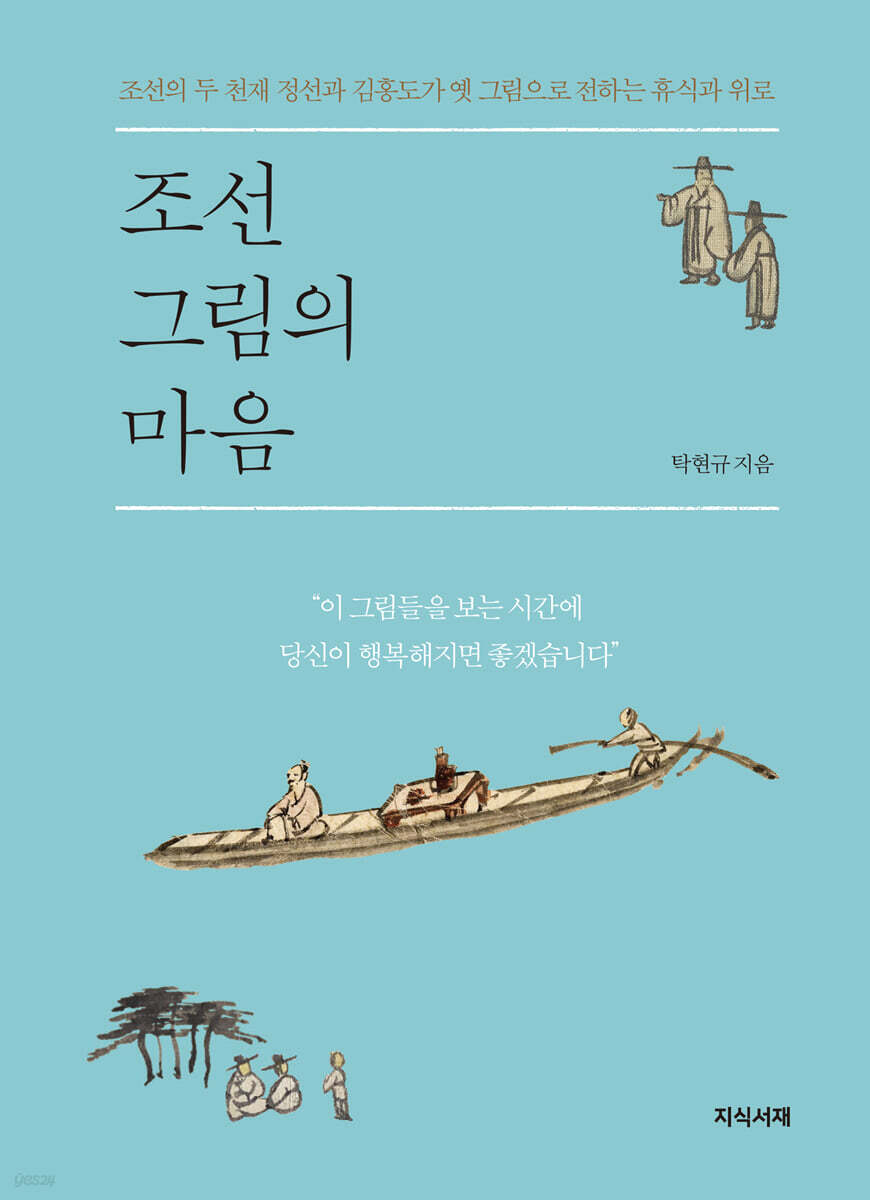
The Heart of Joseon Painting
 |
Description
Book Introduction
The rest and comfort that beautiful old paintings give us
Art gives us a variety of emotions that we need to feel as we live.
Sometimes it allows us to escape from the tiring and difficult daily life and enjoy a moment of rest and comfort.
Here, two genius painters of Joseon, Jeong Seon and Kim Hong-do, speak to us through old paintings.
You must be physically and mentally exhausted from a busy day with a mountain of work, you must miss your loved one who suddenly left, and you must be sad to see yourself getting sick and weak.
It tells us to come here and take a moment to rest amidst the beautiful mountains and rivers, to be comforted by the faces of our beloved family and friends, and to calm our troubled minds with the tranquil scenery of the waterfall on a moonlit night.
Tak Hyun-gyu, the best storyteller who explains Korean art in an easy and fun way, shows the essence of Joseon art in this book.
Jeong Seon and Kim Hong-do were painters who were active during the peak of Joseon culture in the 17th and 18th centuries, when Joseon culture was pursuing its own independent path, free from Chinese influence, with the pride that it was the best in the world.
This is why Jeong Seon's "Inwangjesaek" and "Geumgangjeondo" included in this book are highly regarded as national treasures, and Kim Hong-do's "Samgongbulhwando" and "Chuseongbudo" are highly regarded as treasures.
These paintings are also popular pieces that capture the attention of visitors at exhibitions held at the National Museum of Korea, Gansong Art Museum, and Ho-Am Art Museum, which are recently referred to as meccas of K-culture.
This book uses high-resolution images provided directly by the art collection as illustrations, vividly conveying even the texture of the background fabric.
We also introduce the 'Lee Kun-hee Collection' donated to the nation by the Samsung family in 2021.
The beautiful paintings created by the two painters, Jeong Seon and Kim Hong-do, over a period of 130 years provided great rest and comfort to people of old.
Those paintings have reached us after hundreds of years.
I hope that today's readers will also enjoy the moments of relaxation and comfort that Joseon paintings provide.
Art gives us a variety of emotions that we need to feel as we live.
Sometimes it allows us to escape from the tiring and difficult daily life and enjoy a moment of rest and comfort.
Here, two genius painters of Joseon, Jeong Seon and Kim Hong-do, speak to us through old paintings.
You must be physically and mentally exhausted from a busy day with a mountain of work, you must miss your loved one who suddenly left, and you must be sad to see yourself getting sick and weak.
It tells us to come here and take a moment to rest amidst the beautiful mountains and rivers, to be comforted by the faces of our beloved family and friends, and to calm our troubled minds with the tranquil scenery of the waterfall on a moonlit night.
Tak Hyun-gyu, the best storyteller who explains Korean art in an easy and fun way, shows the essence of Joseon art in this book.
Jeong Seon and Kim Hong-do were painters who were active during the peak of Joseon culture in the 17th and 18th centuries, when Joseon culture was pursuing its own independent path, free from Chinese influence, with the pride that it was the best in the world.
This is why Jeong Seon's "Inwangjesaek" and "Geumgangjeondo" included in this book are highly regarded as national treasures, and Kim Hong-do's "Samgongbulhwando" and "Chuseongbudo" are highly regarded as treasures.
These paintings are also popular pieces that capture the attention of visitors at exhibitions held at the National Museum of Korea, Gansong Art Museum, and Ho-Am Art Museum, which are recently referred to as meccas of K-culture.
This book uses high-resolution images provided directly by the art collection as illustrations, vividly conveying even the texture of the background fabric.
We also introduce the 'Lee Kun-hee Collection' donated to the nation by the Samsung family in 2021.
The beautiful paintings created by the two painters, Jeong Seon and Kim Hong-do, over a period of 130 years provided great rest and comfort to people of old.
Those paintings have reached us after hundreds of years.
I hope that today's readers will also enjoy the moments of relaxation and comfort that Joseon paintings provide.
- You can preview some of the book's contents.
Preview
index
Introduction: The Life and Paintings of Jeong Seon and Kim Hong-do
Chapter 1: Jeong Seon, the Gyeomjae, Provides Rest through Joseon's Landscapes
Living a Leisurely Life in Sansu after Retirement: 10 Paintings of "Returning Home"
The Joy of Living with Wine and the Mountains: "Dongrichaeguk" and "Yuyeon Gyeonnamsan"
The house of a scholar who gave up his official position and lived in the mountains: Yeosan Chodang
The clear-water valley and pavilion where the teacher's family lived: Okryudong and Cheonghuigak
Encounter autumn foliage and streams at Inwangsan Mountain, Hanyang's most famous landmark: "Cheongpunggye" and "Cheongpunggye Jigak."
The finest ink painting of Joseon's 500-year history, depicting Inwangsan Mountain in the rain, longing for a deceased friend: "Inwangjesaek"
The abundance of fishing boats that pleased the magistrate: "Haengho Gwaneo," "Gyeonggyo Myeongseungcheop"
Friendship with a friend who exchanged fish hooks: "Chojaejesi," "Gyeonggyo Myeongseungcheop"
King Yeongjo's view of Dosan, seen with a fan at the Hanyang Palace: "Dosan Seowon" and "Gyesangjeonggeo"
See a spectacular sunrise and temple scenery on your trip to Gangwon-do: Naksan Sunrise and Naksansa Temple
The breathtaking scenery created by the stone pillars and rocky cliffs of the East Sea: Chongseokjeong and Tongcheon Chongseokjeong
The beauty of Mt. Geumgang, so beautiful that even Confucian scholars want to shave their heads and become monks: "Danbalryeongmang Geumgang" and "Haeakjeonsincheop"
Geumgangsan Temples, Hot Places for Hanyang Scholars: Jeongyangsa Temple and Haeakjeonsincheop
Ten thousand waterfalls created by the waters of the Naegumgang Valley: Manbokdong, Haeakjeonsincheop
The red sunrise over the East Sea that captured the eyes of three scholars and two boys: "Sunrise at Munamgwan," "Haeakjeonsincheop"
Enjoying the Geumgangsan Mountain from Manicheonbong while lying in your room: "Geumgangjeondo"
Chapter 2: Kim Hong-do: Providing Comfort through Ordinary Life
A life of contentment and pleasure, enjoying flowers while drunk: "Drunken Flowers" and "Portraits of Ancient Figures"
Drinking and singing on a moonlit night, sailing a boat: "Red Cliff Night", "Portraits of Ancient People"
Climbing a mountain path with two gisaengs: 〈Dongsan Ageum〉, 《Gosa Inmuldo》
Avalokitesvara Bodhisattva and Sudhana, Comforting the Hardships of Life: "The Avalokitesvara Bodhisattva Who Sees the Moon" and "Portraits of Ancient Figures"
The Shame of a Master Calligrapher Who Traded His Calligraphy for a Goose: "Hwang Jeong-hwan-ah," "Portraits of Ancient Figures"
The Happiness of Returning Home to Children: "The Return of the Wrong Person," "The Portrait of a Legendary Figure"
The Pure Life of a Scholar Whose Plum Blossom Wife and Crane Son: "Seohobanghak" and "Gosainmuldo"
The unwavering composure of a great scholar even in critical moments: "Mu-i-gwi-do" and "Gosa-in-mul-do"
Sixteen friends gather to enjoy poetry, painting, and music: "Seowon Ajipdo"
Creating a gathering of all classes in Danwon: "Danwondo"
The sorrow of someone caught in the drizzle in a foreign land: "Giryewon Yudo"
A state of mind free from distraction, like a quiet moonlit valley: "Jeongsim," "The Story of a Housewife and a Poem of the Master"
On Mother's Birthday, the whole family gathers together to eat: "I Am", "The Story of a Housewife"
The task of governing a country is to ensure that no household goes hungry: "Governing the Country", "The Book of Zhu Bu Zashi Yi Do"
The joy of autumn harvest on the faces of farmers, women, and children: "Peaceful World" and "The Story of a Housewife and Her Son"
A time of peace, where both nobles and commoners enjoy a happy life: "The Three Dukes and the Three Nobles"
The loneliness and sadness of old age, depicted in the face of death: "Chuseongbudo"
Jeong Seon Chronology & Kim Hong-do Chronology
Books that helped me
Search
Chapter 1: Jeong Seon, the Gyeomjae, Provides Rest through Joseon's Landscapes
Living a Leisurely Life in Sansu after Retirement: 10 Paintings of "Returning Home"
The Joy of Living with Wine and the Mountains: "Dongrichaeguk" and "Yuyeon Gyeonnamsan"
The house of a scholar who gave up his official position and lived in the mountains: Yeosan Chodang
The clear-water valley and pavilion where the teacher's family lived: Okryudong and Cheonghuigak
Encounter autumn foliage and streams at Inwangsan Mountain, Hanyang's most famous landmark: "Cheongpunggye" and "Cheongpunggye Jigak."
The finest ink painting of Joseon's 500-year history, depicting Inwangsan Mountain in the rain, longing for a deceased friend: "Inwangjesaek"
The abundance of fishing boats that pleased the magistrate: "Haengho Gwaneo," "Gyeonggyo Myeongseungcheop"
Friendship with a friend who exchanged fish hooks: "Chojaejesi," "Gyeonggyo Myeongseungcheop"
King Yeongjo's view of Dosan, seen with a fan at the Hanyang Palace: "Dosan Seowon" and "Gyesangjeonggeo"
See a spectacular sunrise and temple scenery on your trip to Gangwon-do: Naksan Sunrise and Naksansa Temple
The breathtaking scenery created by the stone pillars and rocky cliffs of the East Sea: Chongseokjeong and Tongcheon Chongseokjeong
The beauty of Mt. Geumgang, so beautiful that even Confucian scholars want to shave their heads and become monks: "Danbalryeongmang Geumgang" and "Haeakjeonsincheop"
Geumgangsan Temples, Hot Places for Hanyang Scholars: Jeongyangsa Temple and Haeakjeonsincheop
Ten thousand waterfalls created by the waters of the Naegumgang Valley: Manbokdong, Haeakjeonsincheop
The red sunrise over the East Sea that captured the eyes of three scholars and two boys: "Sunrise at Munamgwan," "Haeakjeonsincheop"
Enjoying the Geumgangsan Mountain from Manicheonbong while lying in your room: "Geumgangjeondo"
Chapter 2: Kim Hong-do: Providing Comfort through Ordinary Life
A life of contentment and pleasure, enjoying flowers while drunk: "Drunken Flowers" and "Portraits of Ancient Figures"
Drinking and singing on a moonlit night, sailing a boat: "Red Cliff Night", "Portraits of Ancient People"
Climbing a mountain path with two gisaengs: 〈Dongsan Ageum〉, 《Gosa Inmuldo》
Avalokitesvara Bodhisattva and Sudhana, Comforting the Hardships of Life: "The Avalokitesvara Bodhisattva Who Sees the Moon" and "Portraits of Ancient Figures"
The Shame of a Master Calligrapher Who Traded His Calligraphy for a Goose: "Hwang Jeong-hwan-ah," "Portraits of Ancient Figures"
The Happiness of Returning Home to Children: "The Return of the Wrong Person," "The Portrait of a Legendary Figure"
The Pure Life of a Scholar Whose Plum Blossom Wife and Crane Son: "Seohobanghak" and "Gosainmuldo"
The unwavering composure of a great scholar even in critical moments: "Mu-i-gwi-do" and "Gosa-in-mul-do"
Sixteen friends gather to enjoy poetry, painting, and music: "Seowon Ajipdo"
Creating a gathering of all classes in Danwon: "Danwondo"
The sorrow of someone caught in the drizzle in a foreign land: "Giryewon Yudo"
A state of mind free from distraction, like a quiet moonlit valley: "Jeongsim," "The Story of a Housewife and a Poem of the Master"
On Mother's Birthday, the whole family gathers together to eat: "I Am", "The Story of a Housewife"
The task of governing a country is to ensure that no household goes hungry: "Governing the Country", "The Book of Zhu Bu Zashi Yi Do"
The joy of autumn harvest on the faces of farmers, women, and children: "Peaceful World" and "The Story of a Housewife and Her Son"
A time of peace, where both nobles and commoners enjoy a happy life: "The Three Dukes and the Three Nobles"
The loneliness and sadness of old age, depicted in the face of death: "Chuseongbudo"
Jeong Seon Chronology & Kim Hong-do Chronology
Books that helped me
Search
Detailed image

Into the book
In front of the scholar, there are two or three bunches of broken chrysanthemums and acorns on the ground, and beside them are blue and red bowls, which are probably wine glasses.
There is no mention of alcohol in the poem, but if you recall the old Chinese custom of climbing a hill and drinking chrysanthemum wine on the Double Ninth Festival, it is a story that follows.
Besides, wasn't the title of the poem 'Drinking'?
Judging by the overturned blue bowl, it seems like he's already had a drink.
--- From "The Joy of Living with Alcohol and the Mountains, 〈Dongrichaeguk〉 and 〈Yuyeon Gyeonnamsan〉"
“Yeosan Chodang,” painted by Jeong Seon around the age of 75, is a work that depicts the most perfect seclusion scene that Joseon scholars envisioned, and is a painting that transforms Chinese landscapes into true landscapes.
All Joseon scholars who viewed this painting would have thought that the scholar on the floor was not Baek Geui but himself, and that the mountain was not Yeosan but Seoraksan or Jirisan.
It was possible to break away from the custom of imitating China and to Joseonize Chinese culture thanks to the pride that Joseon's culture was the best in the world.
This cultural pride was created by the unique ideology of Joseon Seongrihak.
When ideology changes, art changes, so how important is ideology?
Ideology changes everything.
--- From “The House of a Scholar Who Resigned from His Official Post and Remained in the Mountains, 〈Yeosan Chodang〉”
If the Cheongpunggye Valley in the painting had survived to this day, it would have become one of Seoul's most famous landmarks today, just as it was two hundred years ago.
This one small painting will help you understand why the scenery of Cheongpunggye is the best in Hanyang and why Jeong Seon is considered the best among Joseon painters.
--- From "Encountering the autumn foliage and stream waters at Inwangsan, the best tourist attraction in Hanyang, "Cheongpunggye" and "Cheongpunggye Jigak""
If you look at the 『Seungjeongwon Diary』, it says that on May 25th, it rained in the morning and cleared in the evening.
It rained continuously from the 19th to the 24th, so it would have been the rainy season in the fifth month of the lunar calendar.
It rained for 6 days, then cleared up on the 25th and was clear until the 30th.
So, it is highly likely that Jeong Seon painted this picture on the 25th.
What happened to Jeongseon at that time?
My lifelong friend, Sacheon Lee Byeong-yeon, passed away five months ago on January 4th at the age of 81.
Jeong Seon, who was overcome with grief after celebrating Lee Byeong-yeon's 100th day, would have wanted to commemorate his friend through a painting.
Could there be a more suitable subject for a painting commemorating Lee Byeong-yeon than Inwangsan Mountain, where the two always walked hand in hand and shared their friendship?
〈Inwangjesaek〉 is a 'requiem' dedicated to a friend, created by a 76-year-old painter who poured all of his life's knowledge of ink brushwork into a single ink color.
… … I am concerned that the top of the large rock has been cut off. If you look at an old photo of Inwangjesaek, you can see that the top of the large rock is completely exposed and there was a little bit of space on top.
It was cut off while re-framing the painting one day, and this is the only regret we have today when appreciating the Inwangjesaek.
--- From "'The best ink painting of 500 years of Joseon Dynasty, painting Inwangsan Mountain in the rain while missing a dead friend, 〈Inwangjesaek〉"
The most notable feature of the Geumgangjeondo is that, unlike previous Geumgangjeondos, the lower right and left sides are left empty, making the entire Geumgangsan Mountain appear round.
Additionally, the boundary between the rocky mountain on the right and the dirt mountain on the left is curved, giving the appearance of a Taegeuk pattern.
This kind of bold composition is a realm that Jeongseon reached after he turned seventy.
Judging by the fact that the soil is exposed except for the areas on the left side of the dirt hill that are covered by conifers, it seems that spring has not yet fully arrived.
The buds are probably just beginning to sprout.
But spring water is already filling the valley.
--- From "Enjoying the Geumgangsan Mountain from Manicheonbong while lying in the room, 〈Geumgangjeondo〉"
The group of comrades and ambassadors left Hanyang in early November, arrived in Beijing on December 13, and began their return journey on January 26 of the following year, arriving in Hanyang at the end of March.
After a long and arduous five-month journey, Kim Hong-do became ill and fell ill upon returning home.
Fortunately, he was hospitalized for less than a month and recovered sometime in April, and was able to paint this picture.
This reveals why Kim Hong-do copied Yuk Yu's poem into his fan painting.
There is no other piece of writing that better expresses Kim Hong-do's feelings as he spent five months traveling between Joseon and China on horseback, enduring wind, rain, and dust, than Yuk Yu's poem.
--- From "The sorrowful heart of someone caught in the drizzle in a foreign land, "Giryewon Yudo"
Zhu Xi's poetry and Kim Hong-do's paintings vividly portrayed the simple life, so they served as a source of study for the king and the nobles, as well as for painting.
After appreciating the painting, King Jeongjo must have made a pledge to govern well so that the people would not starve.
The poem ends with a story about a runner who lived in poverty but became a great scholar, linking his life of poverty to the virtue of frugality.
King Jeongjo may have wanted to say that while it is not right to live on just soup and barley rice, studying is just as important as not starving.
But did King Jeongjo ever eat only pot soup and barley rice?
--- From “‘Governing a country means ensuring that no household goes hungry, 〈Governing the Country〉”
The joy of the autumn harvest is clearly reflected on the faces of farmers, women, and children.
If there is a good harvest, one house, one village, one country will be at peace. Just by looking at the piles of grain in the three or four houses in the picture, one can infer that the country is at peace.
The noblemen and women in the previous painting were all wearing Chinese clothing, but the farmers and women in this painting were wearing Joseon clothing: a jacket, pants, and a skirt.
The house is not much different from a Joseon thatched-roof house.
So, if you look at only the bamboo grove, it becomes a Joseon genre painting.
--- From "The Joy of Autumn Harvest Filling the Faces of Farmers, Women, and Children, 〈Pyeongcheonha〉"
Kim Hong-do, who had been painting for 40 years, from 1765 at the age of 21 to 1805 at the age of 61, and who had moved the Joseon Dynasty with his paintings, must have sighed as he lay on his sickbed, looking at himself as his mind and body were crumbling, and the sighs he let out were several times stronger than the sighs that Guyangsu uttered in “Chuseongbu.”
Look at how Kim Hong-do copied the original text of the 408-character “Chuseongbu” and wrote the last two characters, “sigh (歎息),” separately on different lines.
This is the end of Kim Hong-do.
But even in the midst of his lament, Kim Hong-do created the greatest masterpiece of his life.
This is the greatness of art.
There is no mention of alcohol in the poem, but if you recall the old Chinese custom of climbing a hill and drinking chrysanthemum wine on the Double Ninth Festival, it is a story that follows.
Besides, wasn't the title of the poem 'Drinking'?
Judging by the overturned blue bowl, it seems like he's already had a drink.
--- From "The Joy of Living with Alcohol and the Mountains, 〈Dongrichaeguk〉 and 〈Yuyeon Gyeonnamsan〉"
“Yeosan Chodang,” painted by Jeong Seon around the age of 75, is a work that depicts the most perfect seclusion scene that Joseon scholars envisioned, and is a painting that transforms Chinese landscapes into true landscapes.
All Joseon scholars who viewed this painting would have thought that the scholar on the floor was not Baek Geui but himself, and that the mountain was not Yeosan but Seoraksan or Jirisan.
It was possible to break away from the custom of imitating China and to Joseonize Chinese culture thanks to the pride that Joseon's culture was the best in the world.
This cultural pride was created by the unique ideology of Joseon Seongrihak.
When ideology changes, art changes, so how important is ideology?
Ideology changes everything.
--- From “The House of a Scholar Who Resigned from His Official Post and Remained in the Mountains, 〈Yeosan Chodang〉”
If the Cheongpunggye Valley in the painting had survived to this day, it would have become one of Seoul's most famous landmarks today, just as it was two hundred years ago.
This one small painting will help you understand why the scenery of Cheongpunggye is the best in Hanyang and why Jeong Seon is considered the best among Joseon painters.
--- From "Encountering the autumn foliage and stream waters at Inwangsan, the best tourist attraction in Hanyang, "Cheongpunggye" and "Cheongpunggye Jigak""
If you look at the 『Seungjeongwon Diary』, it says that on May 25th, it rained in the morning and cleared in the evening.
It rained continuously from the 19th to the 24th, so it would have been the rainy season in the fifth month of the lunar calendar.
It rained for 6 days, then cleared up on the 25th and was clear until the 30th.
So, it is highly likely that Jeong Seon painted this picture on the 25th.
What happened to Jeongseon at that time?
My lifelong friend, Sacheon Lee Byeong-yeon, passed away five months ago on January 4th at the age of 81.
Jeong Seon, who was overcome with grief after celebrating Lee Byeong-yeon's 100th day, would have wanted to commemorate his friend through a painting.
Could there be a more suitable subject for a painting commemorating Lee Byeong-yeon than Inwangsan Mountain, where the two always walked hand in hand and shared their friendship?
〈Inwangjesaek〉 is a 'requiem' dedicated to a friend, created by a 76-year-old painter who poured all of his life's knowledge of ink brushwork into a single ink color.
… … I am concerned that the top of the large rock has been cut off. If you look at an old photo of Inwangjesaek, you can see that the top of the large rock is completely exposed and there was a little bit of space on top.
It was cut off while re-framing the painting one day, and this is the only regret we have today when appreciating the Inwangjesaek.
--- From "'The best ink painting of 500 years of Joseon Dynasty, painting Inwangsan Mountain in the rain while missing a dead friend, 〈Inwangjesaek〉"
The most notable feature of the Geumgangjeondo is that, unlike previous Geumgangjeondos, the lower right and left sides are left empty, making the entire Geumgangsan Mountain appear round.
Additionally, the boundary between the rocky mountain on the right and the dirt mountain on the left is curved, giving the appearance of a Taegeuk pattern.
This kind of bold composition is a realm that Jeongseon reached after he turned seventy.
Judging by the fact that the soil is exposed except for the areas on the left side of the dirt hill that are covered by conifers, it seems that spring has not yet fully arrived.
The buds are probably just beginning to sprout.
But spring water is already filling the valley.
--- From "Enjoying the Geumgangsan Mountain from Manicheonbong while lying in the room, 〈Geumgangjeondo〉"
The group of comrades and ambassadors left Hanyang in early November, arrived in Beijing on December 13, and began their return journey on January 26 of the following year, arriving in Hanyang at the end of March.
After a long and arduous five-month journey, Kim Hong-do became ill and fell ill upon returning home.
Fortunately, he was hospitalized for less than a month and recovered sometime in April, and was able to paint this picture.
This reveals why Kim Hong-do copied Yuk Yu's poem into his fan painting.
There is no other piece of writing that better expresses Kim Hong-do's feelings as he spent five months traveling between Joseon and China on horseback, enduring wind, rain, and dust, than Yuk Yu's poem.
--- From "The sorrowful heart of someone caught in the drizzle in a foreign land, "Giryewon Yudo"
Zhu Xi's poetry and Kim Hong-do's paintings vividly portrayed the simple life, so they served as a source of study for the king and the nobles, as well as for painting.
After appreciating the painting, King Jeongjo must have made a pledge to govern well so that the people would not starve.
The poem ends with a story about a runner who lived in poverty but became a great scholar, linking his life of poverty to the virtue of frugality.
King Jeongjo may have wanted to say that while it is not right to live on just soup and barley rice, studying is just as important as not starving.
But did King Jeongjo ever eat only pot soup and barley rice?
--- From “‘Governing a country means ensuring that no household goes hungry, 〈Governing the Country〉”
The joy of the autumn harvest is clearly reflected on the faces of farmers, women, and children.
If there is a good harvest, one house, one village, one country will be at peace. Just by looking at the piles of grain in the three or four houses in the picture, one can infer that the country is at peace.
The noblemen and women in the previous painting were all wearing Chinese clothing, but the farmers and women in this painting were wearing Joseon clothing: a jacket, pants, and a skirt.
The house is not much different from a Joseon thatched-roof house.
So, if you look at only the bamboo grove, it becomes a Joseon genre painting.
--- From "The Joy of Autumn Harvest Filling the Faces of Farmers, Women, and Children, 〈Pyeongcheonha〉"
Kim Hong-do, who had been painting for 40 years, from 1765 at the age of 21 to 1805 at the age of 61, and who had moved the Joseon Dynasty with his paintings, must have sighed as he lay on his sickbed, looking at himself as his mind and body were crumbling, and the sighs he let out were several times stronger than the sighs that Guyangsu uttered in “Chuseongbu.”
Look at how Kim Hong-do copied the original text of the 408-character “Chuseongbu” and wrote the last two characters, “sigh (歎息),” separately on different lines.
This is the end of Kim Hong-do.
But even in the midst of his lament, Kim Hong-do created the greatest masterpiece of his life.
This is the greatness of art.
--- From "The loneliness and sadness of old age, painted in the face of death, "Chuseongbudo""
Publisher's Review
“When I look at these pictures
I hope you are happy.”
The greatest storyteller of Korean art
Tak Hyun-gyu tells
The Heart of Joseon Painting
Popular works exhibited at the National Museum of Korea, Gansong, and Ho-Am Art Museum
A hot topic from Lee Kun-hee's collection
National Treasures and Treasures of Our Country
Meet these pictures in a book!
Joseon painters ask about our daily lives.
Art gives us a variety of emotions that we need to feel as we live.
Sometimes it allows us to escape from the tiring and difficult daily life and enjoy a moment of rest and comfort.
Here, two genius painters of Joseon, Jeong Seon and Kim Hong-do, speak to us through old paintings.
You must be physically and mentally exhausted from a busy day with a mountain of work, you must miss your loved one who suddenly left, and you must be sad to see yourself getting sick and weak.
It tells us to come here and take a moment to rest amidst the beautiful mountains and rivers, to be comforted by the faces of our beloved family and friends, and to calm our troubled minds with the tranquil scenery of the waterfall on a moonlit night.
Resting with Joseon's landscapes
The greatest scholar-painter of Joseon, Gyeomjae Jeong Seon, was from the Noron faction.
In the early Joseon Dynasty, with Zhu Xi's Neo-Confucianism as the ideology, China was considered the standard for all culture, and Chinese mountains, rivers, and civilization were depicted.
However, later, as he developed Joseon Seongrihak, a unique form of Joseon Confucianism, he began to draw Joseon's mountains, rivers, and civilization with pride in his culture.
The person who took the lead was Jeong Seon, and what he developed was Jin-gyeong landscape painting.
Jeong Seon, a native of Hanyang, climbed Mt. Bukak and Mt. Inwang with his lifelong friend, Lee Byeong-yeon, and rode a boat on the Han River.
In the process, he painted countless landscape paintings depicting Joseon's landscapes.
Examples include “Okryu-dong,” “Cheongpunggye,” and “Inwangjesaek,” which depict Inwangsan Mountain, a hot place in Hanyang and the backyard of his house in Jeongseon.
In particular, “Inwangjesaek” is a masterpiece depicting Inwangsan Mountain after the rain, expressing the artist’s longing for his lifelong friend Lee Byeong-yeon after his death.
The thick rain clouds descending on the valley of Inwangsan Mountain, the solid aura of the granite rocks, and the new waterfalls formed here and there by the rain were expressed using only ink and wash, and today it is designated as a national treasure.
Among the places that Jeong Seon traveled with his friend Lee Byeong-yeon were Geumgangsan Mountain and the Eight Scenic Views of Gwandong.
Many paintings were also produced here, and in particular, the Geumgangsan painting became the core of Jeongseon Jin-gyeong Sansu.
Examples include the national treasure, “Geumgangjeondo” and the treasure, “Haeakjeonsincheop.”
〈Geumgangjeondo〉 is a masterpiece that evokes a sense of mystery by using the shape of a mountain in the shape of a Taegeuk pattern.
Jeong Seon served as a local government official several times, and his last position was as the magistrate of Yangcheon, Gyeonggi Province.
It is said that this was thanks to King Yeongjo's consideration to allow him to paint while riding a boat on the Han River.
King Yeongjo loved Jeong Seon so much that he called him by his pen name rather than his name.
The treasure 《Gyeonggyo Myeongseungcheop》, which includes a painting of the Han River, was created during the time he was the magistrate of Yangcheon.
As we turn the pages, we become scholars enjoying the clear waters and cool breezes of Hanyang, strollers strolling along the Han River, admiring the boats floating on it, and travelers wandering around the red sunrise over the East Sea and the beautiful Mt. Geumgangsan.
Let's take a break from our tiring and difficult daily lives and enjoy Jeong Seon's paintings.
Providing comfort through ordinary, everyday scenes
Kim Hong-do, the greatest painter of Joseon, was a genius who stood out in the Dohwaseo at the age of 21.
He followed in the footsteps of Jeong Seon, who even transformed Chinese painting materials into Joseon-style paintings.
After drawing the famous painting “Xiyuan Ajipdo” where 16 celebrities from various fields of China participated and enjoyed poetry, painting, and music together, he also created “Danwondo” to depict the moment when he and his acquaintances gathered together regardless of social status.
Kim Hong-do enjoyed King Jeongjo's favor throughout his time as a painter at the Dohwaseo.
King Jeongjo said, “I have known Kim Hong-do for a long time because he is a good painter.
He even wrote, “I painted a portrait 30 years ago, and from then on, I let Hongdo take charge of all the painting.”
The last painting that Kim Hong-do presented to King Jeongjo was the eight-panel folding screen “Jubujasiui-do.”
It means a painting that depicts the meaning of the poem by Joo-ja (Ju-bu-ja).
《Jubujasiui-do》 well captures the era of peace that King Jeongjo wanted to achieve and that the people of the time earnestly hoped for.
It was a world where every household lived happily without going hungry.
This thought is captured in a single eight-panel folding screen, like a painting, and is the national treasure, “Samgongbulhwando.”
This is a poem by Daebokgo, a Southern Song Dynasty writer who said he would not trade his secluded life for the position of Samgong (Samjeongseung in Joseon terms).
However, all the characters in the painting are Joseon people, and the houses, trees, and rocks in the painting are all Joseon.
On the left side of the painting, Joseon farmers are weeding rice in the field.
The farmer's wife crosses a wooden bridge carrying a basket of sorghum, with a dog in front and a child following behind.
It is so similar to the lovely scenery of our lives today that it touches my heart.
No matter how peaceful we live, we cannot avoid getting sick, growing old, and dying.
The treasure, “Chuseongbudo,” is a masterpiece that captures the feelings of Kim Hong-do, who was dying of illness in a state of poverty where he could not even pay the tuition of his 14-year-old son.
Kim Hong-do painted an autumn landscape where all things are falling away and copied Guyangsu's poem "Chuseongbu" on top of it, but wrote the last two letters, "sigh," separately on different lines.
The artist's heartbreaking sadness strangely comes to us like words of comfort and touches our lives.
Experience the power of high culture at the K-culture mecca.
Tak Hyun-gyu, the best storyteller who explains Korean art in an easy and fun way, shows the essence of Joseon art in this book.
Jeong Seon and Kim Hong-do were painters who were active during the peak of Joseon culture in the 17th and 18th centuries, when Joseon culture was pursuing its own independent path, free from Chinese influence, with the pride that it was the best in the world.
This is why Jeong Seon's "Inwangjesaek" and "Geumgangjeondo" included in this book are highly regarded as national treasures, and Kim Hong-do's "Samgongbulhwando" and "Chuseongbudo" are highly regarded as treasures.
These paintings are also popular pieces that capture the attention of visitors at exhibitions held at the National Museum of Korea, Gansong Art Museum, and Ho-Am Art Museum, which are recently referred to as meccas of K-culture.
This book uses high-resolution images provided directly by the art collection as illustrations, vividly conveying even the texture of the background fabric.
We also introduce the 'Lee Kun-hee Collection' donated to the nation by the Samsung family in 2021.
The beautiful paintings created by the two painters, Jeong Seon and Kim Hong-do, over a period of 130 years provided great rest and comfort to people of old.
Those paintings have reached us after hundreds of years.
I hope that today's readers will also enjoy the moments of relaxation and comfort that Joseon paintings provide.
I hope you are happy.”
The greatest storyteller of Korean art
Tak Hyun-gyu tells
The Heart of Joseon Painting
Popular works exhibited at the National Museum of Korea, Gansong, and Ho-Am Art Museum
A hot topic from Lee Kun-hee's collection
National Treasures and Treasures of Our Country
Meet these pictures in a book!
Joseon painters ask about our daily lives.
Art gives us a variety of emotions that we need to feel as we live.
Sometimes it allows us to escape from the tiring and difficult daily life and enjoy a moment of rest and comfort.
Here, two genius painters of Joseon, Jeong Seon and Kim Hong-do, speak to us through old paintings.
You must be physically and mentally exhausted from a busy day with a mountain of work, you must miss your loved one who suddenly left, and you must be sad to see yourself getting sick and weak.
It tells us to come here and take a moment to rest amidst the beautiful mountains and rivers, to be comforted by the faces of our beloved family and friends, and to calm our troubled minds with the tranquil scenery of the waterfall on a moonlit night.
Resting with Joseon's landscapes
The greatest scholar-painter of Joseon, Gyeomjae Jeong Seon, was from the Noron faction.
In the early Joseon Dynasty, with Zhu Xi's Neo-Confucianism as the ideology, China was considered the standard for all culture, and Chinese mountains, rivers, and civilization were depicted.
However, later, as he developed Joseon Seongrihak, a unique form of Joseon Confucianism, he began to draw Joseon's mountains, rivers, and civilization with pride in his culture.
The person who took the lead was Jeong Seon, and what he developed was Jin-gyeong landscape painting.
Jeong Seon, a native of Hanyang, climbed Mt. Bukak and Mt. Inwang with his lifelong friend, Lee Byeong-yeon, and rode a boat on the Han River.
In the process, he painted countless landscape paintings depicting Joseon's landscapes.
Examples include “Okryu-dong,” “Cheongpunggye,” and “Inwangjesaek,” which depict Inwangsan Mountain, a hot place in Hanyang and the backyard of his house in Jeongseon.
In particular, “Inwangjesaek” is a masterpiece depicting Inwangsan Mountain after the rain, expressing the artist’s longing for his lifelong friend Lee Byeong-yeon after his death.
The thick rain clouds descending on the valley of Inwangsan Mountain, the solid aura of the granite rocks, and the new waterfalls formed here and there by the rain were expressed using only ink and wash, and today it is designated as a national treasure.
Among the places that Jeong Seon traveled with his friend Lee Byeong-yeon were Geumgangsan Mountain and the Eight Scenic Views of Gwandong.
Many paintings were also produced here, and in particular, the Geumgangsan painting became the core of Jeongseon Jin-gyeong Sansu.
Examples include the national treasure, “Geumgangjeondo” and the treasure, “Haeakjeonsincheop.”
〈Geumgangjeondo〉 is a masterpiece that evokes a sense of mystery by using the shape of a mountain in the shape of a Taegeuk pattern.
Jeong Seon served as a local government official several times, and his last position was as the magistrate of Yangcheon, Gyeonggi Province.
It is said that this was thanks to King Yeongjo's consideration to allow him to paint while riding a boat on the Han River.
King Yeongjo loved Jeong Seon so much that he called him by his pen name rather than his name.
The treasure 《Gyeonggyo Myeongseungcheop》, which includes a painting of the Han River, was created during the time he was the magistrate of Yangcheon.
As we turn the pages, we become scholars enjoying the clear waters and cool breezes of Hanyang, strollers strolling along the Han River, admiring the boats floating on it, and travelers wandering around the red sunrise over the East Sea and the beautiful Mt. Geumgangsan.
Let's take a break from our tiring and difficult daily lives and enjoy Jeong Seon's paintings.
Providing comfort through ordinary, everyday scenes
Kim Hong-do, the greatest painter of Joseon, was a genius who stood out in the Dohwaseo at the age of 21.
He followed in the footsteps of Jeong Seon, who even transformed Chinese painting materials into Joseon-style paintings.
After drawing the famous painting “Xiyuan Ajipdo” where 16 celebrities from various fields of China participated and enjoyed poetry, painting, and music together, he also created “Danwondo” to depict the moment when he and his acquaintances gathered together regardless of social status.
Kim Hong-do enjoyed King Jeongjo's favor throughout his time as a painter at the Dohwaseo.
King Jeongjo said, “I have known Kim Hong-do for a long time because he is a good painter.
He even wrote, “I painted a portrait 30 years ago, and from then on, I let Hongdo take charge of all the painting.”
The last painting that Kim Hong-do presented to King Jeongjo was the eight-panel folding screen “Jubujasiui-do.”
It means a painting that depicts the meaning of the poem by Joo-ja (Ju-bu-ja).
《Jubujasiui-do》 well captures the era of peace that King Jeongjo wanted to achieve and that the people of the time earnestly hoped for.
It was a world where every household lived happily without going hungry.
This thought is captured in a single eight-panel folding screen, like a painting, and is the national treasure, “Samgongbulhwando.”
This is a poem by Daebokgo, a Southern Song Dynasty writer who said he would not trade his secluded life for the position of Samgong (Samjeongseung in Joseon terms).
However, all the characters in the painting are Joseon people, and the houses, trees, and rocks in the painting are all Joseon.
On the left side of the painting, Joseon farmers are weeding rice in the field.
The farmer's wife crosses a wooden bridge carrying a basket of sorghum, with a dog in front and a child following behind.
It is so similar to the lovely scenery of our lives today that it touches my heart.
No matter how peaceful we live, we cannot avoid getting sick, growing old, and dying.
The treasure, “Chuseongbudo,” is a masterpiece that captures the feelings of Kim Hong-do, who was dying of illness in a state of poverty where he could not even pay the tuition of his 14-year-old son.
Kim Hong-do painted an autumn landscape where all things are falling away and copied Guyangsu's poem "Chuseongbu" on top of it, but wrote the last two letters, "sigh," separately on different lines.
The artist's heartbreaking sadness strangely comes to us like words of comfort and touches our lives.
Experience the power of high culture at the K-culture mecca.
Tak Hyun-gyu, the best storyteller who explains Korean art in an easy and fun way, shows the essence of Joseon art in this book.
Jeong Seon and Kim Hong-do were painters who were active during the peak of Joseon culture in the 17th and 18th centuries, when Joseon culture was pursuing its own independent path, free from Chinese influence, with the pride that it was the best in the world.
This is why Jeong Seon's "Inwangjesaek" and "Geumgangjeondo" included in this book are highly regarded as national treasures, and Kim Hong-do's "Samgongbulhwando" and "Chuseongbudo" are highly regarded as treasures.
These paintings are also popular pieces that capture the attention of visitors at exhibitions held at the National Museum of Korea, Gansong Art Museum, and Ho-Am Art Museum, which are recently referred to as meccas of K-culture.
This book uses high-resolution images provided directly by the art collection as illustrations, vividly conveying even the texture of the background fabric.
We also introduce the 'Lee Kun-hee Collection' donated to the nation by the Samsung family in 2021.
The beautiful paintings created by the two painters, Jeong Seon and Kim Hong-do, over a period of 130 years provided great rest and comfort to people of old.
Those paintings have reached us after hundreds of years.
I hope that today's readers will also enjoy the moments of relaxation and comfort that Joseon paintings provide.
GOODS SPECIFICS
- Date of issue: October 24, 2025
- Page count, weight, size: 352 pages | 598g | 152*210*21mm
- ISBN13: 9791190266086
- ISBN10: 1190266083
You may also like
카테고리
korean


korean

![GQ KOREA Mark (Monthly): December [2025]](http://librairie.coreenne.fr/cdn/shop/files/8ef265dbbfbf186523ed75ba7319009d.jpg?v=1765340328&width=3840)


