

A neuroscientist with dementia
 |
Description
Book Introduction
- A word from MD
-
Even if the ending is set, I will do my best until the endThe prevalence of dementia among people aged 65 and older is 10%, and the number of people with dementia is 1 million.
Dementia has become more common, but we still fear a future where we won't even recognize our own family.
This book is an autobiographical account of a doctor who was diagnosed with dementia.
We cannot change the ending called death, but if we are faithful to the moment, we can fill the remaining time to the fullest.
August 19, 2025. Humanities PD Son Min-gyu
“I am a neurologist.
And it's the early stages of Alzheimer's disease."
A neuroscientist who noticed his own dementia 10 years early
Preparation for a 'meaningful life until the end' he preaches
Dr. Daniel Gibbs, a neurologist and neuroscientist with 30 years of experience, has dedicated himself to treating countless dementia patients throughout his career.
Then one day, dementia struck him too.
But what's even more surprising is that he detected the early signs of dementia 10 years ago and took proactive measures to slow the progression of the disease.
How was all this possible? The author's extraordinary journey garnered immediate attention upon its release on Amazon and was even made into an MTV documentary in 2024.
This book is a record of a scientist's meticulous struggle to capture the "critical period for brain health" and a profound optimism about life.
The author shows that even in the face of great loss, happiness, family love, fulfillment, and the desire to live continue.
Because, as he said, “life is always really good.”
And it's the early stages of Alzheimer's disease."
A neuroscientist who noticed his own dementia 10 years early
Preparation for a 'meaningful life until the end' he preaches
Dr. Daniel Gibbs, a neurologist and neuroscientist with 30 years of experience, has dedicated himself to treating countless dementia patients throughout his career.
Then one day, dementia struck him too.
But what's even more surprising is that he detected the early signs of dementia 10 years ago and took proactive measures to slow the progression of the disease.
How was all this possible? The author's extraordinary journey garnered immediate attention upon its release on Amazon and was even made into an MTV documentary in 2024.
This book is a record of a scientist's meticulous struggle to capture the "critical period for brain health" and a profound optimism about life.
The author shows that even in the face of great loss, happiness, family love, fulfillment, and the desire to live continue.
Because, as he said, “life is always really good.”
- You can preview some of the book's contents.
Preview
index
Entering: To preserve the meaning of life until the end
prolog
Beacon Lock
Let's find out in advance and prepare in advance.
The smell of baking bread
I'm Alone premiere
Puzzle that doesn't fit
Locked Chest and Family Tree
Scale of Memory
Anyway, killer whale
My brain, myself
The hidden brain is revealed
Cognitive Reserve and Resilience: Brain Cell Reserves
A life of experimentation
It would be nice if the aria was an opera solo.
Every choice we make changes our lives.
Madeleine, music, African pigeon
It's not scary if you don't look down
Beyond DNA: Rethinking Family History
5 O'Clock News: Retired Neurologist Fights Alzheimer's
The forest, the trees, and the ground I stand on
Rethinking the Reality of the Disease Called Alzheimer's
meaningful results
Epilogue: A Life of Writing
Appendix: The Mind Diet Basics and Clinical Trials
References | Notes | Acknowledgments | Index
prolog
Beacon Lock
Let's find out in advance and prepare in advance.
The smell of baking bread
I'm Alone premiere
Puzzle that doesn't fit
Locked Chest and Family Tree
Scale of Memory
Anyway, killer whale
My brain, myself
The hidden brain is revealed
Cognitive Reserve and Resilience: Brain Cell Reserves
A life of experimentation
It would be nice if the aria was an opera solo.
Every choice we make changes our lives.
Madeleine, music, African pigeon
It's not scary if you don't look down
Beyond DNA: Rethinking Family History
5 O'Clock News: Retired Neurologist Fights Alzheimer's
The forest, the trees, and the ground I stand on
Rethinking the Reality of the Disease Called Alzheimer's
meaningful results
Epilogue: A Life of Writing
Appendix: The Mind Diet Basics and Clinical Trials
References | Notes | Acknowledgments | Index
Detailed image
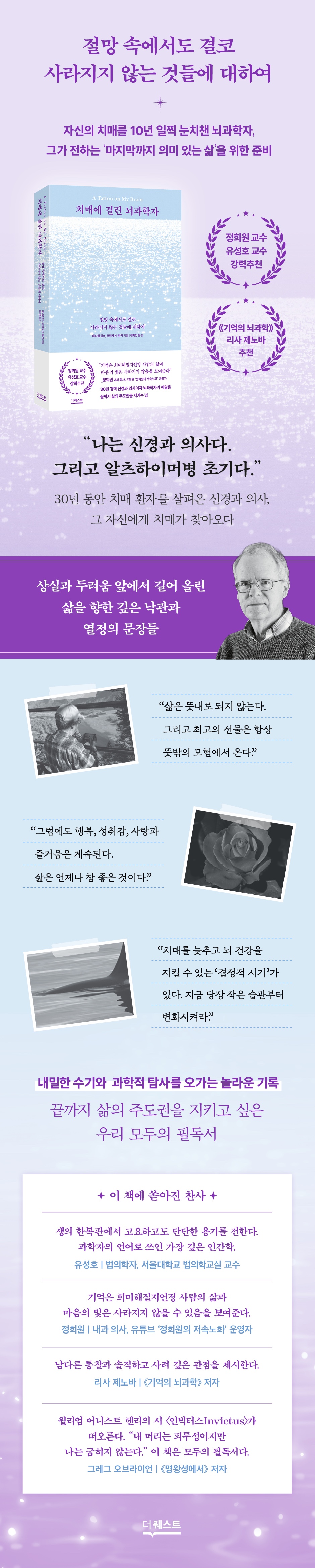
Into the book
A meaningful life.
I believe this is a universally desirable outcome for everyone.
That's the story this book tells.
--- From "Entering"
The question now is: If we could detect the pathological changes that could lead to neurodegenerative disease earlier, could we halt its progression and change its course before damage occurs?
Could we use that latency period to buy time to fight Alzheimer's? I believe we can.
Because I am living in that time.
--- From the "Prologue"
No matter how many times I've witnessed brain surgery, it always leaves me with a sense of awe.
It was truly awe-inspiring to be able to see with my own eyes a living brain, a brain so powerful yet so fragile when exposed to such force.
How fascinating it would be if I, a neuroscientist, could observe my own brain surgery.
But for now, I'm content with being able to see my brain through video scans and data.
--- From "I'm Alone" Preview
After 20 years of doing these trips, I've learned that the best times to see orcas are not when you're looking for them, but when you least expect them.
It's just something we happen to run into by chance.
If the engine had been working properly that year and the voyage had continued as planned, we would not have seen the orca.
When I look back on my first year after retirement, I remember those days when I was aimlessly drifting on the sea, unable to find my way anywhere.
Although the plan was ruined, it was a day filled with ordinary yet memorable events in life.
A gift from the killer whale, a gift of time.
--- From "Anyway, the Killer Whale"
Whatever the case, the next thing we need to do is to examine and understand the specifics of the situation, both clinical and practical.
Because then you can find your center again.
Having choices and the ability to make decisions builds confidence and power.
It's much better than giving in to despair.
--- From "The Hidden Brain Revealed"
Cognitive reserve isn't a medical cure, but it saves lives in other ways.
Because the brain itself preserves mental life even when under siege.
(Omitted) This is not just my wish.
It is a well-established fact in neuroscience that the brain is resilient and can create new connections and pathways to replace brain circuits damaged by disease or trauma.
--- "Cognitive Ability and Resilience"
If there was a drug that slowed the progression of Alzheimer's disease by 50 percent, we would hail it as a miracle, and it would generate billions of dollars for the pharmaceutical industry.
But we already have such a drug.
It's even free.
Yes, that's right.
This medicine is exercise.
--- From "All our choices change our lives"
Even in the context of neurodegeneration, this phenomenon of some abilities declining while others persist resiliently presents a mysterious riddle about the senses.
A fascinating and in some ways encouraging riddle.
--- From "Madeleine, Music, and African Dove"
Looking down isn't always scary.
Because you can also figure out how high the altitude has gone.
I can feel how far I have come.
It takes conscious effort, but you can do it by taking the time to savor the feeling.
--- From "It's not scary if you don't look down"
This transition always happens through the significant others in our lives.
From the people we care about, from each other, we gain insight and patience, courage and compassion, and the ability to laugh about the present.
And maybe we are creating our own legacy.
--- From "Beyond DNA"
But from a purely human perspective, what amnesia threatens is our fundamental sense of self, our sense of who we are, what we know, feel, and believe, how we belong and how we live in the world.
Memories and recollections not only shape our existence, but they define us in the most profound ways, both as individuals and in our relationships.
This is what I mean when I say we need to buy time by diagnosing and treating Alzheimer's disease earlier.
There is no time to waste.
I believe this is a universally desirable outcome for everyone.
That's the story this book tells.
--- From "Entering"
The question now is: If we could detect the pathological changes that could lead to neurodegenerative disease earlier, could we halt its progression and change its course before damage occurs?
Could we use that latency period to buy time to fight Alzheimer's? I believe we can.
Because I am living in that time.
--- From the "Prologue"
No matter how many times I've witnessed brain surgery, it always leaves me with a sense of awe.
It was truly awe-inspiring to be able to see with my own eyes a living brain, a brain so powerful yet so fragile when exposed to such force.
How fascinating it would be if I, a neuroscientist, could observe my own brain surgery.
But for now, I'm content with being able to see my brain through video scans and data.
--- From "I'm Alone" Preview
After 20 years of doing these trips, I've learned that the best times to see orcas are not when you're looking for them, but when you least expect them.
It's just something we happen to run into by chance.
If the engine had been working properly that year and the voyage had continued as planned, we would not have seen the orca.
When I look back on my first year after retirement, I remember those days when I was aimlessly drifting on the sea, unable to find my way anywhere.
Although the plan was ruined, it was a day filled with ordinary yet memorable events in life.
A gift from the killer whale, a gift of time.
--- From "Anyway, the Killer Whale"
Whatever the case, the next thing we need to do is to examine and understand the specifics of the situation, both clinical and practical.
Because then you can find your center again.
Having choices and the ability to make decisions builds confidence and power.
It's much better than giving in to despair.
--- From "The Hidden Brain Revealed"
Cognitive reserve isn't a medical cure, but it saves lives in other ways.
Because the brain itself preserves mental life even when under siege.
(Omitted) This is not just my wish.
It is a well-established fact in neuroscience that the brain is resilient and can create new connections and pathways to replace brain circuits damaged by disease or trauma.
--- "Cognitive Ability and Resilience"
If there was a drug that slowed the progression of Alzheimer's disease by 50 percent, we would hail it as a miracle, and it would generate billions of dollars for the pharmaceutical industry.
But we already have such a drug.
It's even free.
Yes, that's right.
This medicine is exercise.
--- From "All our choices change our lives"
Even in the context of neurodegeneration, this phenomenon of some abilities declining while others persist resiliently presents a mysterious riddle about the senses.
A fascinating and in some ways encouraging riddle.
--- From "Madeleine, Music, and African Dove"
Looking down isn't always scary.
Because you can also figure out how high the altitude has gone.
I can feel how far I have come.
It takes conscious effort, but you can do it by taking the time to savor the feeling.
--- From "It's not scary if you don't look down"
This transition always happens through the significant others in our lives.
From the people we care about, from each other, we gain insight and patience, courage and compassion, and the ability to laugh about the present.
And maybe we are creating our own legacy.
--- From "Beyond DNA"
But from a purely human perspective, what amnesia threatens is our fundamental sense of self, our sense of who we are, what we know, feel, and believe, how we belong and how we live in the world.
Memories and recollections not only shape our existence, but they define us in the most profound ways, both as individuals and in our relationships.
This is what I mean when I say we need to buy time by diagnosing and treating Alzheimer's disease earlier.
There is no time to waste.
--- From "Meaningful Results"
Publisher's Review
The 'critical period for brain health'
Decide on the direction of your life
One summer in 2006, strange symptoms began to appear.
I couldn't smell the roses right in front of me while smelling the bread that wasn't there.
As a neurologist, the author knew about the correlation between some causes of dementia and olfactory disorders, and from then on, he began to track his own health obsessively.
Finally, in 2015, an official diagnosis of Alzheimer's disease was made.
“Now everything is falling into place.
And the brain images themselves were, as always, beautiful.” When we imagine old age, dementia is one of the most feared scenarios.
However, scientific evidence is accumulating that this type of dementia can be detected before symptoms appear and the progression of the disease can be slowed.
The reason the author was so calm when he was diagnosed with dementia was because he had implemented lifestyle changes 10 years earlier.
Healthy lifestyle habits develop 'cognitive resilience'.
Even if they both develop dementia, people with high cognitive reserve have a later onset of cognitive impairment than those with low cognitive reserve.
In particular, regular aerobic exercise reduces the risk of developing dementia by about 50 percent.
In other words, every choice we make during this “critical period for brain health” changes our lives.
★★★
It offers unique insights and honest, thoughtful perspectives.
Lisa Genova, author of "The Neuroscience of Memory"
The author's resolution brings to mind William Ernest Henley's poem "Invictus."
“My head is bloody, but I will not bend.” This book is a must-read for everyone.
Greg O'Brien, author of "On Pluto"
The uncertainty of life, conveyed in the midst of it all
Very ordinary boldness
Our brains and bodies respond to loss by forming new connections in the face of crisis.
Life is the same.
Plans go awry and you encounter unexpected gifts along the way.
For the author, who thought his career as a doctor was over, new doors opened for him, including research, lecturing, and writing.
“Alzheimer’s disease testifies not only to fear and dread, but also to the hope that exists within us.”
The author emphasizes that rather than giving in to despair, we should focus on what we can do in the present moment.
It's not because he's a particularly brave person.
It's because of the realizations I gained from walking down a path filled with fear, shame, and uncertainty.
When we face our mortality, we see clearly what is truly important.
A lot depends on one's life.
We all want to live a dignified life to the end, and the more we do, the more we fear loss and crisis.
But each of our very existences is also a precious legacy “built together with the people we love around us.”
The meaning of life lies beyond genes and data, beyond fear and prediction.
The power of taking one step at a time.
This is the attitude toward life that the author wants to convey.
Decide on the direction of your life
One summer in 2006, strange symptoms began to appear.
I couldn't smell the roses right in front of me while smelling the bread that wasn't there.
As a neurologist, the author knew about the correlation between some causes of dementia and olfactory disorders, and from then on, he began to track his own health obsessively.
Finally, in 2015, an official diagnosis of Alzheimer's disease was made.
“Now everything is falling into place.
And the brain images themselves were, as always, beautiful.” When we imagine old age, dementia is one of the most feared scenarios.
However, scientific evidence is accumulating that this type of dementia can be detected before symptoms appear and the progression of the disease can be slowed.
The reason the author was so calm when he was diagnosed with dementia was because he had implemented lifestyle changes 10 years earlier.
Healthy lifestyle habits develop 'cognitive resilience'.
Even if they both develop dementia, people with high cognitive reserve have a later onset of cognitive impairment than those with low cognitive reserve.
In particular, regular aerobic exercise reduces the risk of developing dementia by about 50 percent.
In other words, every choice we make during this “critical period for brain health” changes our lives.
★★★
It offers unique insights and honest, thoughtful perspectives.
Lisa Genova, author of "The Neuroscience of Memory"
The author's resolution brings to mind William Ernest Henley's poem "Invictus."
“My head is bloody, but I will not bend.” This book is a must-read for everyone.
Greg O'Brien, author of "On Pluto"
The uncertainty of life, conveyed in the midst of it all
Very ordinary boldness
Our brains and bodies respond to loss by forming new connections in the face of crisis.
Life is the same.
Plans go awry and you encounter unexpected gifts along the way.
For the author, who thought his career as a doctor was over, new doors opened for him, including research, lecturing, and writing.
“Alzheimer’s disease testifies not only to fear and dread, but also to the hope that exists within us.”
The author emphasizes that rather than giving in to despair, we should focus on what we can do in the present moment.
It's not because he's a particularly brave person.
It's because of the realizations I gained from walking down a path filled with fear, shame, and uncertainty.
When we face our mortality, we see clearly what is truly important.
A lot depends on one's life.
We all want to live a dignified life to the end, and the more we do, the more we fear loss and crisis.
But each of our very existences is also a precious legacy “built together with the people we love around us.”
The meaning of life lies beyond genes and data, beyond fear and prediction.
The power of taking one step at a time.
This is the attitude toward life that the author wants to convey.
GOODS SPECIFICS
- Date of issue: August 13, 2025
- Page count, weight, size: 320 pages | 386g | 130*200*22mm
- ISBN13: 9791140715114
- ISBN10: 1140715119
You may also like
카테고리
korean


korean

![GQ KOREA Mark (Monthly): December [2025]](http://librairie.coreenne.fr/cdn/shop/files/8ef265dbbfbf186523ed75ba7319009d.jpg?v=1765340328&width=3840)


